Crash of a Piper PA-61P Aerostar (Ted Smith 601P) in Lake of the Woods: 1 killed

Date & Time: Apr 27, 1997 at 1245 LT
Registration:
N30LL
Flight Phase:
Flight Type:
Survivors:
No
Schedule:
Bellingham – Midland
MSN:
61-0379-124
YOM:
1977
Crew on board:
1
Crew fatalities:
Pax on board:
0
Pax fatalities:
Other fatalities:
Total fatalities:
1
Captain / Total flying hours:
6550
Aircraft flight hours:
4000
Circumstances:
About three hours and twenty minutes after departing Bellingham, Washington, for Midland, Texas, the pilot contacted Klamath Falls (Oregon) Tower and told the controller of his intention to land. About 10 minutes later, while about 30 miles north of Klamath Falls, the pilot reported he was low on fuel and was not able to find the city. The tower responded with instructions that would take the pilot south to the airport. But because the pilot seemed not to be following the instructions, but was instead continuing to the west, he was switched to Seattle Center. Center provided the pilot with a southeasterly heading direct to Klamath Falls, but less than a minute later radar and radio contact with the aircraft was lost. Other pilots overheard the pilot transmit that he had lost power in one engine, and later state that he had lost power in both. Soon thereafter the aircraft was seen to descend to about 200 to 300 feet above the surface of Lake of the Woods. The aircraft then began to slow and its nose began to rise. As it was slowing, one of the engines surged back to a high power setting, and the aircraft almost immediately rolled quickly to the side and dove nearly straight down into the lake. During the post-accident inspection of the airframe, the throttle for the right engine was found retarded to idle, but the throttle for the left engine was found in the full-forward (maximum power) position. A review of the Aerostar owner's manual revealed that the Engine Failure/Restart checklist called for the throttle for a failed engine (both engines in this case) to be retarded to the 'Cracked 1/2 inch open' position. Toxicological results indicate the presence in the pilot's blood of chlordiazepoxide and three of its active metabolites, norchlordiazepoxide, nordiazepam, and oxazepam. Chlordiazepoxide (Librium) is a tranquilizer often used to treat anxiety and tension. At sufficient levels it can have significant adverse effects on judgement, alertness, and performance. It is known to cause drowsiness, mental dullness, and euphoria. The results also indicate the presence of diphenhydramine in the pilot's blood. Diphenhydramine is a sedating antihistamine, and in sufficient quantities is known to produce drowsiness, impaired coordination, blurred vision, and reduced mental alertness.
Probable cause:
The pilot's failure to set the throttle of his second failed engine to 'Cracked-1/2-Open' as called for in the Engine Failure/Restart checklist, followed by a high-power engine surge. Factors include the pilot's delay in landing for refueling, the pilot becoming lost/disoriented, drug impairment, and fuel exhaustion.
Final Report:


Crash of a De Havilland DHC-6 Twin Otter 300 in the Pacific Ocean

Date & Time: Apr 12, 1997 at 2204 LT
Operator:
Registration:
N242CA
Flight Phase:
Flight Type:
Survivors:
Yes
Schedule:
Oakland - Honolulu
MSN:
342
YOM:
1972
Country:
Region:
Crew on board:
1
Crew fatalities:
Pax on board:
0
Pax fatalities:
Other fatalities:
Total fatalities:
0
Captain / Total flying hours:
25000
Captain / Total hours on type:
1000.00
Aircraft flight hours:
9873
Circumstances:
On a ferry flight from Oakland, California, to Honolulu, Hawaii, the pilot declared a low fuel emergency and diverted toward Hilo, Hawaii. Approximately 2.5 hours later, the aircraft was ditched in the Pacific ocean. The pilot evacuated the aircraft before it sank and was rescued by the U.S. Coast Guard. He stated that, under flight planned conditions, the aircraft departed Oakland with sufficient fuel onboard to reach the intended destination with a 2-hour fuel reserve. However, the winds at flight altitude, which were reported as light and variable at the preflight weather briefing, developed into a significant headwind during the flight. At a point 7 hours and 10 minutes into the flight, the pilot determined that his fuel remaining was 8 hours and 40 minutes, with 7 hours and 40 minutes remaining to destination. Three hours later, the pilot determined that his 2-hour reserve was gone. He declared an emergency and diverted toward the closest airport, which was Hilo. Prior to fuel system exhaustion, the pilot elected to ditch the aircraft with power.
Probable cause:
The pilot's inadequate en route fuel consumption calculations, which led to his failure to recognize a deteriorating fuel duration versus time-to-go situation in a more timely way.
Final Report:

Crash of a Piper PA-31-350 Navajo Chieftain off Hilo

Date & Time: Apr 10, 1997 at 0706 LT
Registration:
N27659
Flight Phase:
Flight Type:
Survivors:
Yes
Schedule:
Hilo - Hayward
MSN:
31-7852090
YOM:
1978
Location:
Crew on board:
2
Crew fatalities:
Pax on board:
0
Pax fatalities:
Other fatalities:
Total fatalities:
0
Captain / Total flying hours:
5700
Captain / Total hours on type:
15.00
Aircraft flight hours:
5074
Circumstances:
The aircraft was being operated on a trans-Pacific ferry flight. A special flight permit authorized a gross weight increase and ferry fuel tanks had been installed along with long range communication and navigation radios. The pilot reported that when 85 miles from the departure airport, the right engine failed and he was unable to restart it. Power from the remaining engine was insufficient to maintain level flight at the overweight condition and the pilot permitted the aircraft to drift down until it was necessary to ditch in the ocean 28 miles offshore. The pilot had departed and returned to Hawaii twice previously. The first time he returned due to an oil leak on the left engine, and the second time because of a loose window. A mechanic who repaired the window reported that the left engine appeared to still be leaking oil. Both pilots told the FAA inspector that the oil leak had been repaired.
Probable cause:
The loss of engine power in one engine for undetermined reasons. A factor in the accident was the aircraft's diminished single engine performance during the early portion of the overweight ferry flight.
Final Report:

Crash of a Cessna 421A Golden Eagle I off League City: 1 killed

Date & Time: Mar 19, 1997 at 2333 LT
Type of aircraft:
Operator:
Registration:
N4050L
Flight Type:
Survivors:
No
Schedule:
San Diego - Galveston
MSN:
421A-0050
YOM:
1967
Crew on board:
1
Crew fatalities:
Pax on board:
0
Pax fatalities:
Other fatalities:
Total fatalities:
1
Captain / Total flying hours:
536
Circumstances:
The twin engine airplane had been cleared for a night instrument approach to Galveston, Texas, after flying non-stop from San Diego, California, when the pilot reported that he had lost the right engine and did not have much fuel left. The controller vectored the airplane toward the closest airport, and the airplane was approximately 1 mile northeast of that airport when radar contact was lost. A witness observed the airplane enter a spin, descend in a nose down attitude, and impact near the center of a lake. When the pilot filed his flight plan for the cross country flight, he indicated the airplane carried enough fuel to fly for 7 hours and 30 minutes. At the time radar contact was lost, 7 hours and 32 minutes had elapsed since the airplane departed San Diego. Examination of the airplane revealed no evidence of any preimpact mechanical discrepancies. The landing gear was down, the flaps were extended to about 15 degrees, and neither propeller was feathered. The single engine approach procedure in the airplane owner's manual indicated that the landing gear should be extended when within gliding distance of the field and the flaps placed down only after landing is assured.
Probable cause:
The pilot's failure to refuel the airplane which resulted in the loss of power to the right engine due to fuel exhaustion, and the pilot's failure to maintain airspeed during the single engine landing approach which resulted in a stall/spin.
Final Report:

Crash of a Cessna 402A off Caracas: 6 killed

Date & Time: Mar 2, 1997 at 2145 LT
Type of aircraft:
Operator:
Registration:
YV-784C
Flight Phase:
Survivors:
No
Schedule:
Caracas - Los Roques
MSN:
402A-0111
YOM:
1969
Country:
Crew on board:
1
Crew fatalities:
Pax on board:
5
Pax fatalities:
Other fatalities:
Total fatalities:
6
Circumstances:
The twin engine aircraft departed Caracas-Maiquetía-Simon Bolívar Airport at 2145LT on a charter flight to Los Roques. Few minutes later, it went out of control and crashed in the sea bout 85 km north of Caracas. Some debris were found floating on water but no trace of the wreckage nor the six occupants.
Probable cause:
Due to lack of evidences, the exact cause of the accident could not be determined.

Crash of a Cessna 402C II off Charlotte Amalie: 2 killed

Date & Time: Feb 8, 1997 at 1932 LT
Type of aircraft:
Operator:
Registration:
N318AB
Survivors:
Yes
Schedule:
Christiansted – Charlotte Amalie
MSN:
402C-0318
YOM:
1980
Flight number:
YI319
Crew on board:
1
Crew fatalities:
Pax on board:
4
Pax fatalities:
Other fatalities:
Total fatalities:
2
Captain / Total flying hours:
13000
Captain / Total hours on type:
9000.00
Aircraft flight hours:
16085
Circumstances:
As the flight made a visual approach to the airport from the south over the sea, at night, the pilot changed his navigation radio from the VOR to the ILS system for runway 10 and lost DME reading from the VOR located on a hill north of the localizer course. The localizer showed the flight was south of the localizer course, and without DME from the VOR the pilot believed he was much closer to the island and the airport than the aircraft actually was. As the pilot attempted to make visual contact with the airport and maintain clearance from the hills he allowed the aircraft to descend and crash into the sea about 3 miles southwest of the airport. The pilot had not filed a FAA flight plan for the scheduled commuter flight. The pilot had been flying the route for 5 days and had no previous experience in the area. The pilot reported he had no mechanical malfunctions with the aircraft systems, flight controls, or engines. No FAA Operations inspectors had conducted surveillance on the company's flight operations in the Caribbean since service had begun in December 1996.
Probable cause:
The failure of the pilot to maintain altitude while making a visual approach at night over water in black hole conditions resulting in the aircraft descending and crashing into the sea. Contributing to the accident was the failure of the pilot and operator to use all available air traffic control and navigational facilities, and the FAA Principle Operations Inspector's inadequate surveillance of the operation.
Final Report:

Crash of a Harbin Yunsunji Y-12 II off Palaly: 4 killed

Date & Time: Jan 20, 1997 at 0515 LT
Type of aircraft:
Operator:
Registration:
CR-851
Flight Phase:
Survivors:
No
Schedule:
Palaly - Palaly
MSN:
0013
YOM:
1986
Country:
Region:
Crew on board:
4
Crew fatalities:
Pax on board:
0
Pax fatalities:
Other fatalities:
Total fatalities:
4
Circumstances:
While completing a maritime patrol flight over the northwestern coast of Sri Lanka by night, the aircraft crashed in unknown circumstances in the sea. all four crew members were killed.

Crash of a Beechcraft G18S off Roosevelt Roads NAS: 1 killed

Date & Time: Dec 11, 1996 at 1224 LT
Type of aircraft:
Operator:
Registration:
N353T
Flight Type:
Survivors:
No
Schedule:
San Juan - Kingstown
MSN:
BA-485
YOM:
1959
Flight number:
TOL353
Country:
Crew on board:
1
Crew fatalities:
Pax on board:
0
Pax fatalities:
Other fatalities:
Total fatalities:
1
Captain / Total flying hours:
16345
Captain / Total hours on type:
385.00
Aircraft flight hours:
8203
Circumstances:
At 1136 AST, the twin engine airplane departed San Juan, PR, on a flight to St Vincent. About 1208 AST, the pilot contacted ATC and indicated that he would like to divert to St Thomas. He informed the controller that he had 'feathered' the left engine due to loss of the left engine cowling, but he did not declare an emergency. He requested wind information for St Thomas, then at about 1613 AST, he changed his destination to Roosevelt Roads, PR. At 1120 AST, the pilot reported that the airplane was losing about 300'/min, then about 1 minute later, he said he was going to attempt an engine restart, and that the airplane was getting close to the water. A short time later, he informed ATC that he was not going to make it to shore. The pilot acknowledged info that search and rescue personnel were responding, then there was not further contact with the airplane. The airplane was located about 6 miles east of Roosevelt Roads NAS, but the pilot was not found. Review of weight and balance info revealed the pilot did not follow written procedures, and that the airplane exceeded the maximum authorized gross weight for take off. Flight crews had been informed of a communique from the manufacturer that there was no need to shut down an engine and feather the propeller unless engine performance or a major vibration problem confirmed the need.
Probable cause:
The pilot's improper planning/decision concerning separation of the left engine cowling. Factors relating to the accident were: the pilot's failure to perform weight and balance calculations, and/or to ensure the airplane was loaded in accordance with company procedures and the airplane flight manual; loss of the left engine cowling for undetermined reasons; and the pilot's decision not to follow written procedures by intentionally shutting down the left engine and feathering the propeller.
Final Report:

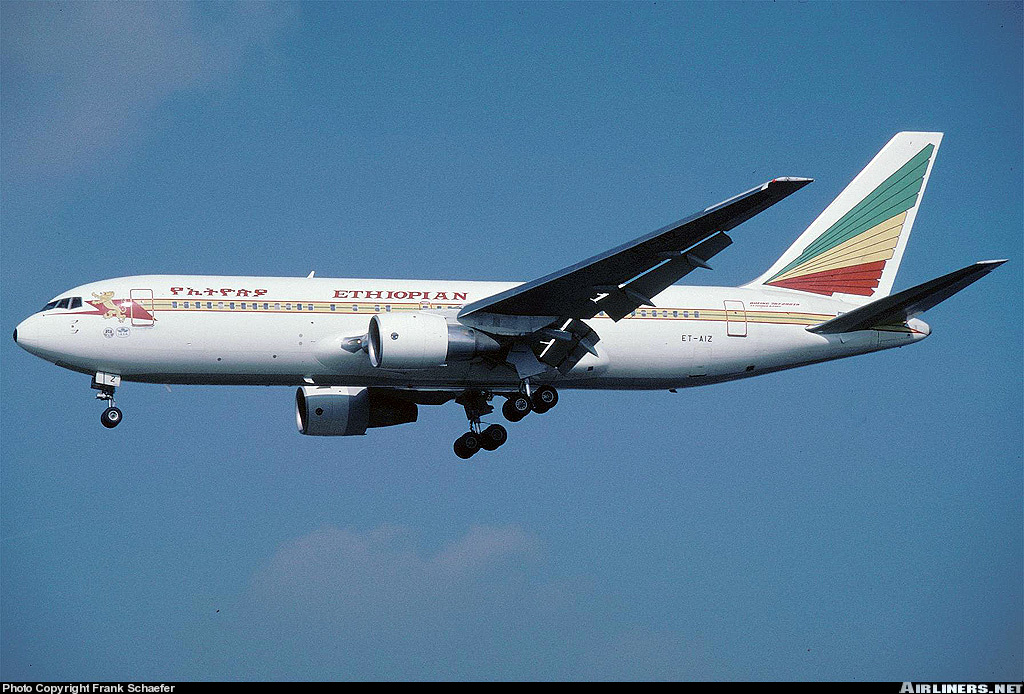
Crash of a Boeing 767 in Moroni: 125 killed

Date & Time: Nov 23, 1996 at 1515 LT
Type of aircraft:
Operator:
Registration:
ET-AIZ
Survivors:
Yes
Schedule:
Addis Ababa – Nairobi – Brazzaville – Lagos – Abidjan
MSN:
23916
YOM:
1987
Flight number:
ET961
Region:
Crew on board:
12
Crew fatalities:
Pax on board:
163
Pax fatalities:
Other fatalities:
Total fatalities:
125
Captain / Total flying hours:
11525
Captain / Total hours on type:
4067.00
Copilot / Total flying hours:
6570
Copilot / Total hours on type:
3042
Aircraft flight hours:
32353
Aircraft flight cycles:
12623
Circumstances:
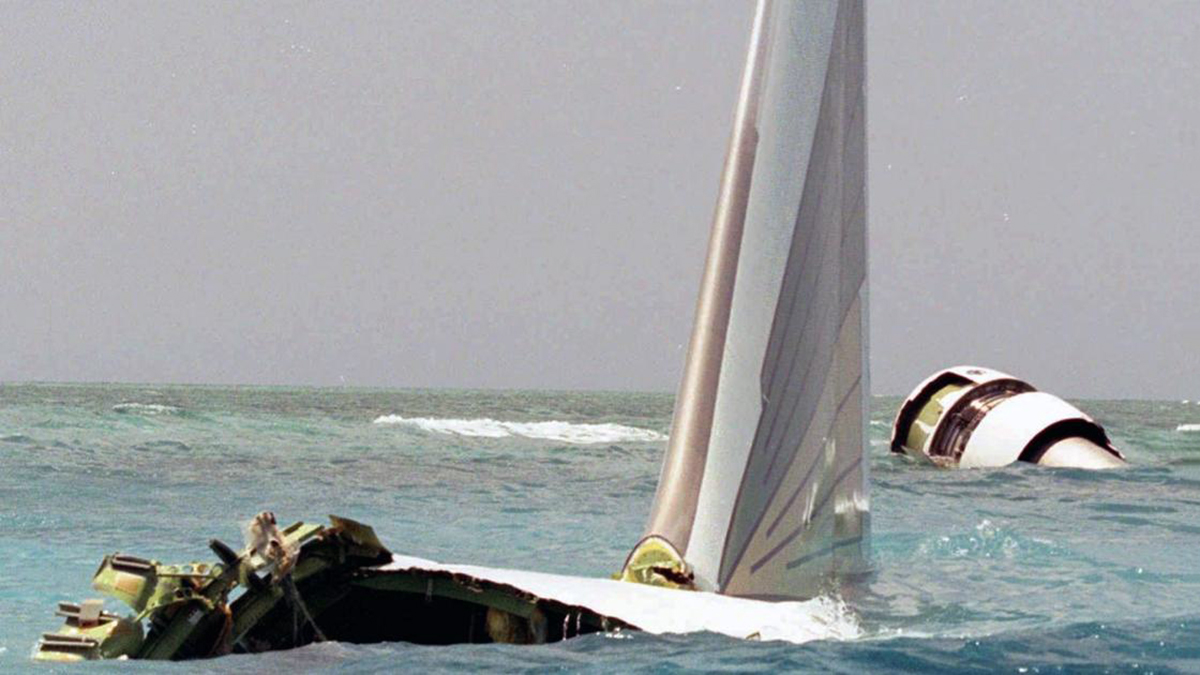
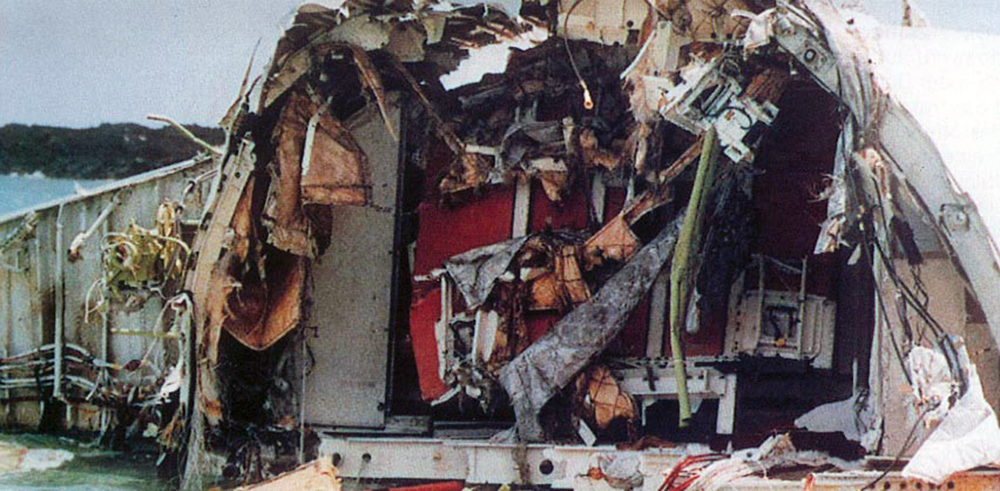
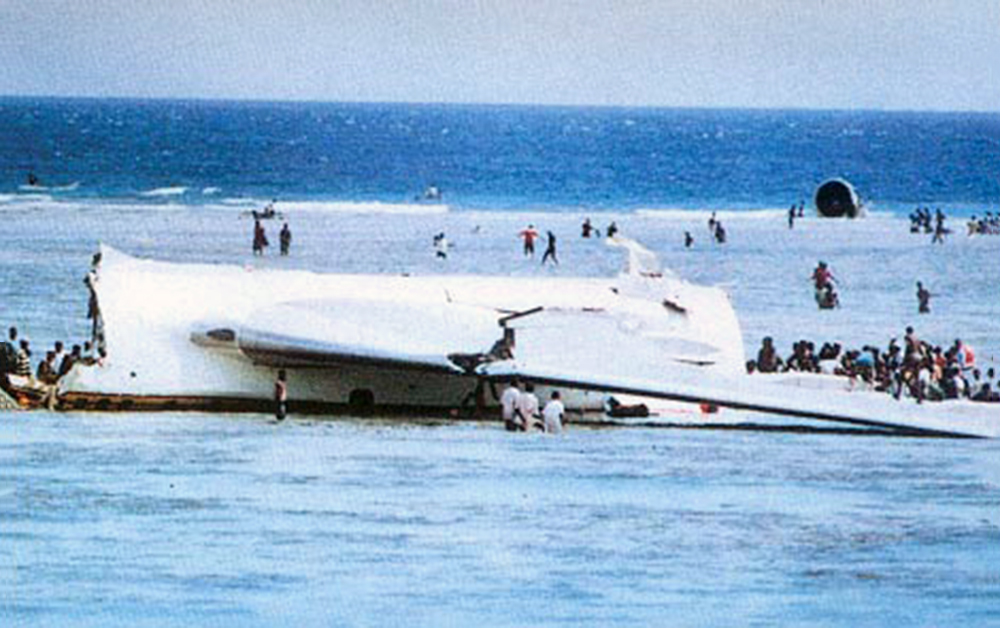
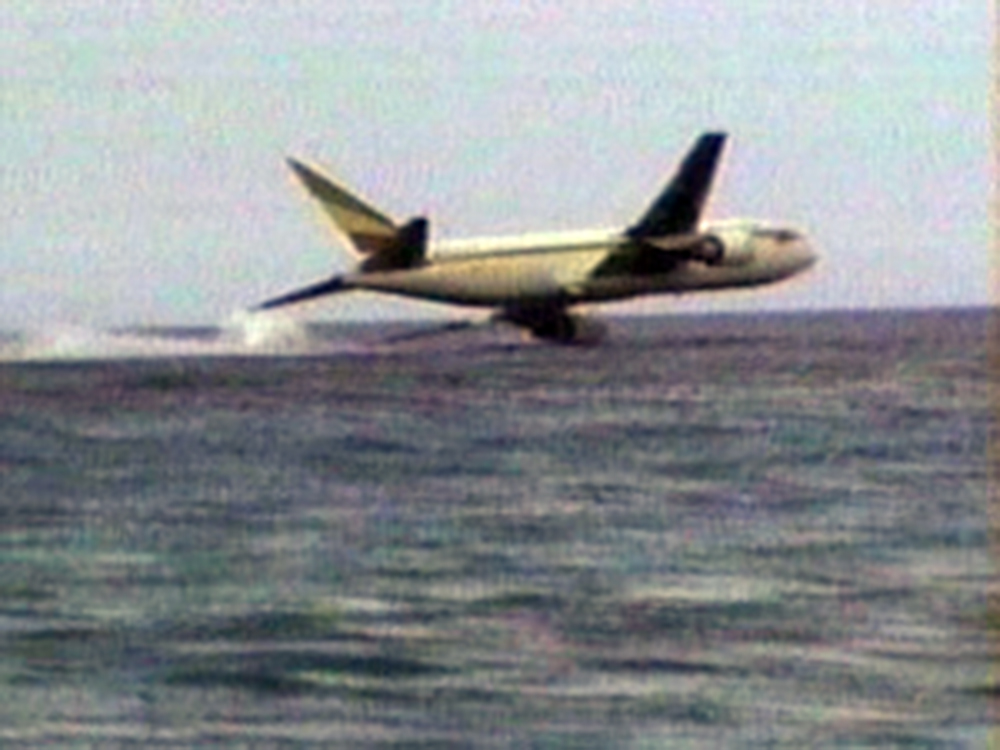
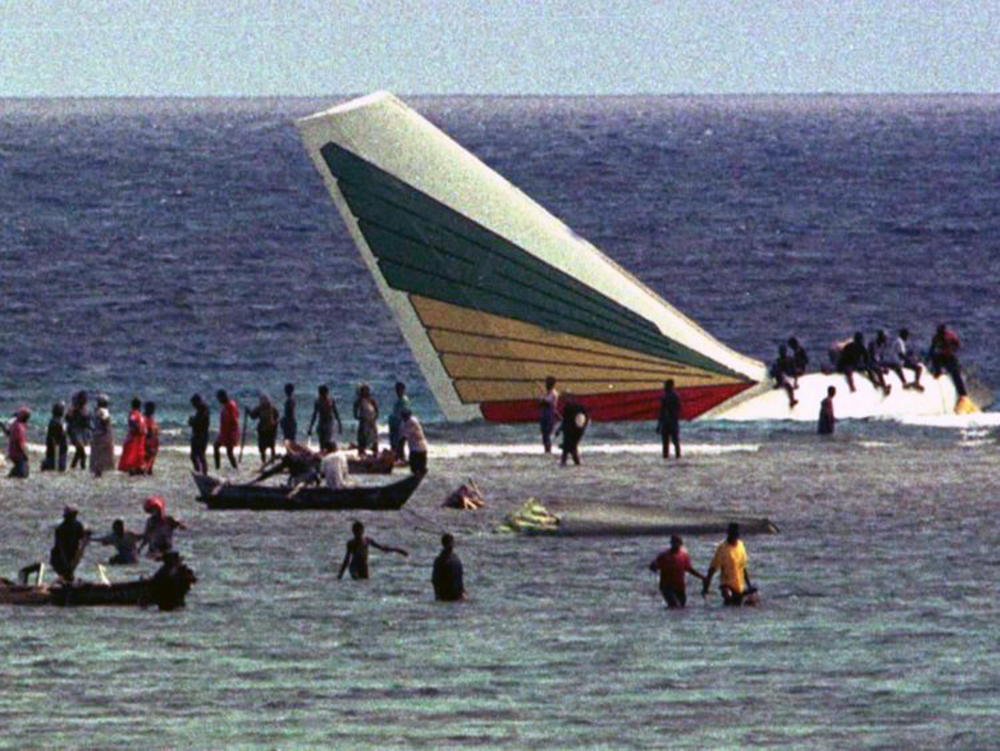
Ethiopian Airlines flight ET961 had taken off from Addis Ababa, Ethiopia, at 08:09 hours UTC for a scheduled flight to Abidjan, Ivory Coast via Nairobi, Kenya; Brazzaville, Congo; and Lagos, Nigeria. Twenty minutes after takeoff, at about 08:29 UTC, one passenger stood up from his seat and ran up the aisle to the cockpit, and two other passengers followed him heading for the cockpit. While rushing to the cockpit one of the men said "Everybody should be seated, I have a bomb!". Then they opened the cockpit door and stormed in. They declared to the pilots that there were eleven hijackers on board and beat the First Officer and forced him out of the cockpit. They then grabbed the fire axe and fire extinguisher bottle from their respective stowages and ordered the pilot-in-command to change direction and fly to Australia. The pilot-in-command explained to the hijackers that he had not enough fuel to reach Australia and demanded to make a refueling stop at Mombasa. The hijackers refused the refueling stop and continued arguing with the pilot-in-command. They insisted that they had learned from the inflight magazine that the B767 could fly 11 hours without refueling. After passing Dar es Salaam one of the hijackers ordered him to fly away from the coast, head to Australia and indicating to the altimeter not to descend below FL390. The pilot-in-command turned left towards the Comoros Island. The lead hijacker was sitting in the first officer's seat and was fiddling with the aircraft's controls, kicking the rudder, whilst also drinking whisky. The pilot-in-command kept on telling them that he was running short of fuel pointing to the fuel quantity indicators, but the hijackers did not listen. The leader continued fiddling with the controls, trying to turn the aileron and pulling the reverse thrust lever at random. As the flight came over the Comoros Islands the pilot-in-command saw the Moroni International Airport runway and circled 15-20 nm south of the field. Then the LOW FUEL CAUTION came on. The pilot-in-command pleaded to land because of low fuel. The hijackers were unconcerned and only insisted that the pilot not descend below FL390. At about 11:41 UTC the right engine ran down to wind milling speed. The pilot-in-command showed the red warning message for the right engine on the EICAS to the hijacker. At this moment, the hijacker left the right seat and went to the cabin door to discuss with the other two hijackers. This gave the captain the opportunity to pick up his microphone and address the passengers: "....ladies and gentlemen this is your pilot, we have run out of fuel and we are losing one engine this time, and we are expecting crash landing and that is all I have to say. we have lost already one engine, and I ask all passengers to react ..... to the hijackers ....". The hijacker then came back to the cockpit and hit the microphone out of the pilot's hand. After the right engine failed, the pilot started to descend the aircraft in order to increase speed, but the hijacker again interfered and violently played with the controls which resulted in improper control inputs. As a result the autopilot was disconnected and the flight became erratic with the airspeed varying between 216 and 336 kts. As the pilot regained control of the aircraft, the left engine went dead. The hijacker kept on instructing the pilot not to descend and again went to the cabin. Upon returning to the cockpit he saw that the altitude was decreasing, and angrily shouted at the pilot not to go any lower. The pilot said that the fuel was already finished and that the engines were without power. This time the hijacker instructed the captain not to touch the controls, and threatened to kill him. The captain said, "I am already dead because I am flying an airplane without engine power." The first officer, who had earlier been forced out to the First Class cabin, got up and, via the right aisle, went to the rear of the aircraft where he saw that a lot of economy class passengers had their life jackets on and that some had already inflated them. The first officer, along with the cabin crew members, helped the passengers to deflate the life jackets and showed them how the jackets should be re-inflated and how to assume the brace position during impact. While returning to the front of the aircraft, they repeated the same instructions as many times as they could. About less than 2 minutes before the ditching, the co-pilot forced his way to the cockpit shouting "let me help the pilot ...". After adjusting his seat and seat belts the pilot asked him for help since the controls were heavy. The hijackers still kept on struggling with the controls. By now, the aircraft was descending into the Indian Ocean over the Comoros Islands. The aircraft now had only standby instruments and RAT (Ram Air Turbine). The altimeter was indicating 150 feet and the airspeed was 200 kts. By this time the flight crew had been left alone to assume control. They turned the aircraft to the left in order to parallel the waves. However, the aircraft brushed the water in a left-wing-low attitude. It was then held straight and level after which it broke into four sections and came to rest in the sheltered waters 500 metres off Le Galawa Beach. Of the 175 occupants, 6 crew members and 119 passengers were fatally injured in the accident. Six crew members and 38 passengers sustained serious injuries, 2 passengers sustained minor injuries and 4 passengers received no injury.
Probable cause:
The Investigation Committee determines that the cause of this accident was unlawful interference by the hijackers which resulted in loss of engines thrust due to fuel exhaustion.
Final Report:
Crash of a Lockheed HC-130P Hercules in the Pacific Ocean: 10 killed

Date & Time: Nov 22, 1996 at 1846 LT
Type of aircraft:
Operator:
Registration:
64-14856
Flight Phase:
Flight Type:
Survivors:
Yes
Schedule:
Portland - North Island
MSN:
4072
YOM:
1965
Flight number:
King 56
Country:
Region:
Crew on board:
11
Crew fatalities:
Pax on board:
0
Pax fatalities:
Other fatalities:
Total fatalities:
10
Circumstances:
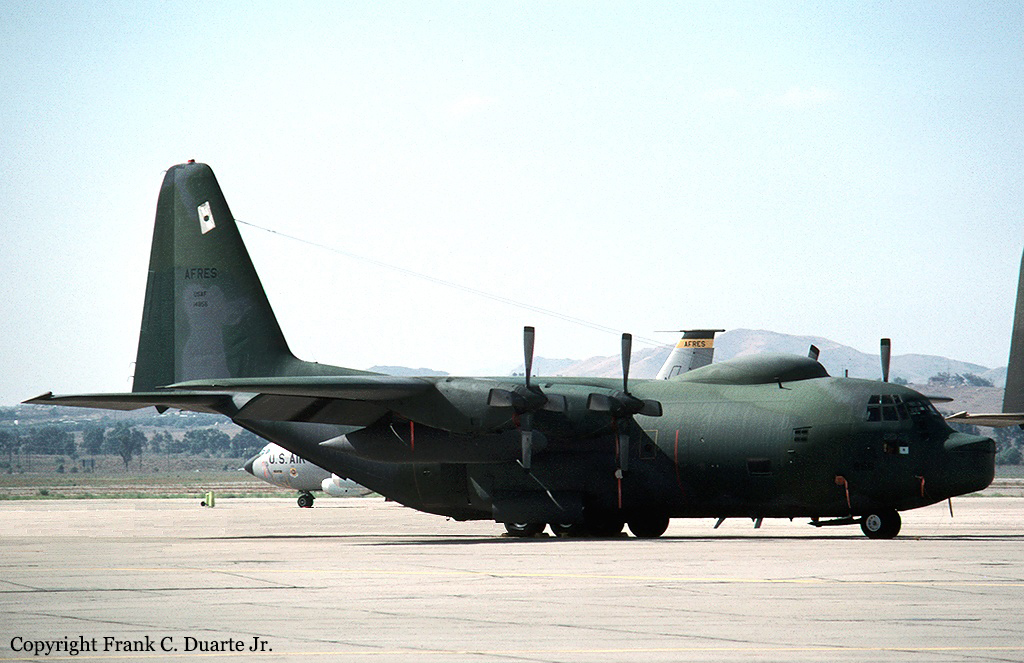
Based upon digital flight data recorded (DFDR) information, the mishap aircraft departed Portland IAP at 1720 PST on 22 Nov 96 on an instrument flight rules (IFR) flight en route to North Island Naval Air Station. The purpose of the sortie was to conduct an overwater navigation evaluation. King 56 began the sortie with a normal takeoff, departure and climbout. One hour and 24 minutes after takeoff in level flight at FL 220 the mishap sequence began with the engineer commenting on a torque flux on the number 1 engine. Nothing on the cockpit voice recorder (CVR), the DFDR, or the survivor’s testimony suggested any unusual events prior to the engineer’s comment. Over the next three minutes, the operations of all four engines became unstable and eventually failed. Crew actions during these critical three minutes are known only by verbal comments on the CVR and the survivor’s testimony. The following discusses what we know of those actions. The engineer called for n°1 propeller to be placed in mechanical governing. This would normally remove electrical inputs to the propeller through the synchrophaser. The pilot then called for all four propellers to be placed in mechanical governing. This action was consistent with treating this emergency as a four-engine rollback. There is no indication on the DFDR or the CVR as to whether or not the crew selected mechanical governing on any of the remaining three propellers. At the same time the crew was analyzing the emergency, they also declared an in-flight emergency with Oakland ARTCC and turned the mission aircraft east to proceed toward Kingsley Field, Klamath Falls, OR, approximately 230 miles away and approximately 80 miles from the coast. The Radio Operator radioed the USCG Humboldt Bay Station and notified them of the in-flight emergency. During the turn toward the shore the number 3 and number 4 engines once briefly recovered most of their torque. These increases are recorded by the flight data recorder. When the RPM on number 3 (the aircraft’s last functioning engine) finally decreased below 94% RPM the last generator producing electrical power dropped off line due to low frequencies. As a result, at 1846 Pacific Standard Time all electrical power was lost. After a brief period, power was restored to the equipment powered by the battery bus. From this point on, the aircraft glided to the attempted ditching. There is no record of that portion of the flight, except the survivor’s testimony.The outboard wing sections and all four engines separated from the center wing section that in turn separated from the fuselage. Subsequently, the engines and fuselage went straight to the ocean floor at a depth of approximately 5500 feet. The outer wing and the center wing sections floated on the surface for several days and sank more than 50 nm from the impact location. The radio navigator was rescued while 10 other crew members were killed.
Probable cause:
Fuel starvation for unknown reasons.