Crash of a Douglas C-47 in Simiátug: 15 killed

Date & Time: May 2, 1950
Operator:
Registration:
HK-120
Flight Phase:
Survivors:
No
Site:
Schedule:
Bogota – Quito – Guayaquil
MSN:
4314
YOM:
1941
Country:
Crew on board:
3
Crew fatalities:
Pax on board:
12
Pax fatalities:
Other fatalities:
Total fatalities:
15
Circumstances:
While cruising southwest of Ambato, the twin engine aircraft crashed in a mountainous area located near Simiátug, about 21 km northwest of the Chimborazo volcano. The wreckage was found two days later and all 15 occupants have been killed.

Crash of a Curtiss C-46-CU Commando in Cochabamba

Date & Time: Apr 24, 1950
Type of aircraft:
Operator:
Registration:
CB-51
Survivors:
Yes
MSN:
26369
YOM:
1942
Country:
Crew on board:
2
Crew fatalities:
Pax on board:
0
Pax fatalities:
Other fatalities:
Total fatalities:
0
Circumstances:
Crashed on approach to Cochabamba Airport. The aircraft was written off and both pilots were injured.

Crash of a Focke-Wulf Fw.200C Condor in Yakutsk

Date & Time: Apr 23, 1950 at 1200 LT
Type of aircraft:
Operator:
Registration:
CCCP-N500
Survivors:
Yes
MSN:
0199
Country:
Region:
Crew on board:
8
Crew fatalities:
Pax on board:
1
Pax fatalities:
Other fatalities:
Total fatalities:
0
Aircraft flight hours:
318
Circumstances:
After touchdown in Yakutsk Airport, the airplane skidded and veered off runway to the right, lost its left main gear and completed a spin before coming to rest. While all nine occupants escaped unhurt, the aircraft was considered as damaged beyond repair due to severe damages on both left engines and the left wing as well. At the time of the accident, a crosswind of 18 km/h was blowing over the airport.

Crash of a Douglas TS-62 near in Vitim: 10 killed

Date & Time: Apr 17, 1950 at 0812 LT
Operator:
Registration:
CCCP-L862
Flight Phase:
Survivors:
Yes
Schedule:
Irkutsk – Kirensk – Olyokminsk – Yakutsk
MSN:
12136
YOM:
1943
Flight number:
SU543
Country:
Region:
Crew on board:
4
Crew fatalities:
Pax on board:
16
Pax fatalities:
Other fatalities:
Total fatalities:
10
Aircraft flight hours:
3686
Circumstances:
En route from Kirensk to Olyokminsk, the left engine caught fire. The captain decided to reduce his altitude but the fire spread to the wing and reached the cabin via the heating system. Descending to an altitude of 2,000 meters, the left engine separated from the aircraft and the aircraft later crash landed in a field located 29 km southwest of Vitim and came to rest in flames. All four crew members and six passengers were able to escape while ten passengers were killed, apparently intoxicated by smoke.
Probable cause:
The cause of the in flight fire on the left engine could not be determined with certainty. However, the assumption that the fire was caused by the failure of a connection on the fuel line was not ruled out. The following factors were considered as contributory:
- the cabin crew failed to us the fire extinguisher, and also failed to close the heating system valve, which contributed to the quick propagation of the fire into the cabin,
- the captain decided to perform a steep descent that also contributed to the fire's propagation,
- the entire crew failed to give appropriate instructions to passengers prior to and after the accident, and failed to assist them for a safe evacuation, causing the death of 10 women and children.

Crash of a Lisunov LI-2T in Poland

Date & Time: Mar 29, 1950
Type of aircraft:
Operator:
Registration:
SP-LBA
MSN:
184 220 09
YOM:
1951
Country:
Region:
Crew on board:
0
Crew fatalities:
Pax on board:
0
Pax fatalities:
Other fatalities:
Total fatalities:
0
Circumstances:
Crash landed on an airport somewhere in Poland.

Crash of a Douglas C-47A-40-DL in Poland

Date & Time: Mar 28, 1950
Operator:
Registration:
SP-LCC
MSN:
9903
YOM:
1943
Country:
Region:
Crew on board:
0
Crew fatalities:
Pax on board:
0
Pax fatalities:
Other fatalities:
Total fatalities:
0
Circumstances:
Crash landed in an airport somewhere in Poland.

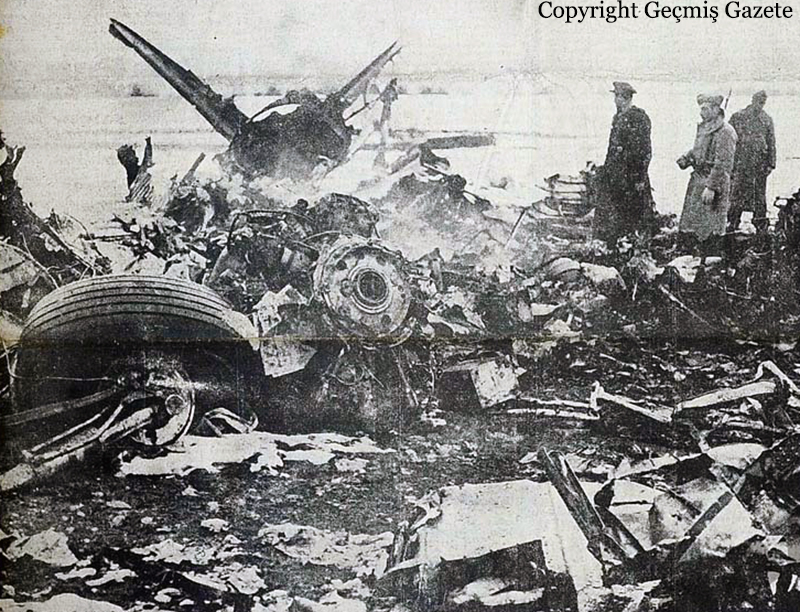
Crash of a Douglas C-47A-75-DL in Ankara: 15 killed

Date & Time: Mar 25, 1950
Operator:
Registration:
TC-BAL
Survivors:
No
Schedule:
Istanbul – Ankara
MSN:
19423
YOM:
1944
Country:
Region:
Crew on board:
4
Crew fatalities:
Pax on board:
11
Pax fatalities:
Other fatalities:
Total fatalities:
15
Circumstances:
On touchdown, the aircraft went out of control, veered off runway and came to rest in flames. The aircraft was destroyed and all 15 occupants were killed.

Crash of a Douglas C-47-DL in Ipiales

Date & Time: Mar 11, 1950
Operator:
Registration:
HK-123
Flight Phase:
Survivors:
Yes
MSN:
6160
YOM:
1942
Country:
Crew on board:
0
Crew fatalities:
Pax on board:
0
Pax fatalities:
Other fatalities:
Total fatalities:
0
Circumstances:
Crashed on takeoff for unknown reason. There were no casualties.

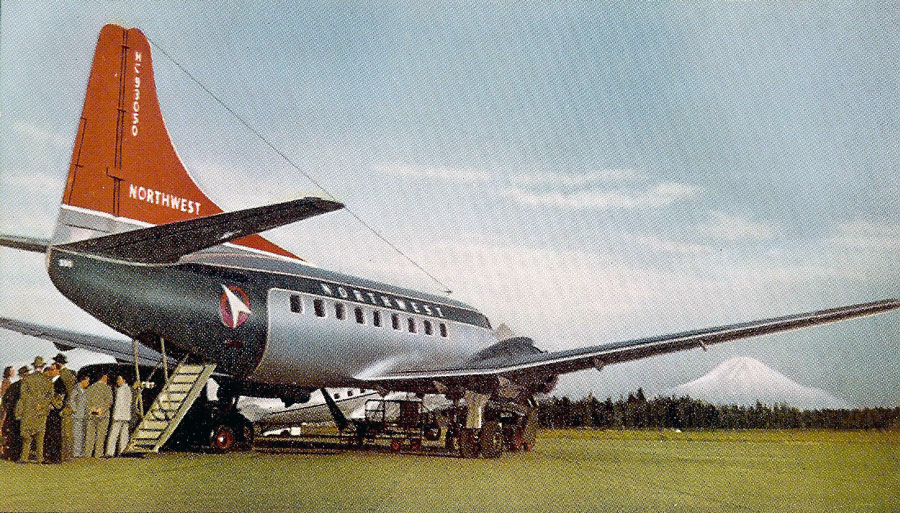
Crash of a Martin 202 in Minneapolis: 15 killed

Date & Time: Mar 7, 1950 at 2059 LT
Type of aircraft:
Operator:
Registration:
NC93050
Survivors:
No
Schedule:
Washington-Detroit-Madison-Rochester-Minneapolis-Winnipeg
MSN:
9134
YOM:
1948
Flight number:
NW307
Crew on board:
3
Crew fatalities:
Pax on board:
10
Pax fatalities:
Other fatalities:
Total fatalities:
15
Captain / Total flying hours:
7619
Captain / Total hours on type:
988.00
Copilot / Total flying hours:
2432
Copilot / Total hours on type:
585
Circumstances:
The aircraft departed Washington DC at 1230LT destined for Winnipeg, Manitoba, Canada, with intermediate stops in Detroit, Rochester, Madison and Minneapolis. With the exception of an hour and 23 minute delay at Detroit, required for the replacement of a ring seal in the hydraulic system, the flight proceeded in air routine manner to Madison, Wisconsin After arrival at Madison the aircraft was serviced with 1,010 gallons of fuel and 38 gallons of oil. Also on board were 10 passengers and 1,799 pounds of cargo which resulted in an aircraft weight of 36,842 pounds. This weight was well within the allowable limit of 39,100 pounds, and so far as is known, the aircraft was properly loaded. Weather information available to the flight prior to its departure from Madison showed that Rochester, 75 miles south southeast of Minneapolis, was reporting a ceiling of 700 feet with visibility of five miles, and that Minneapolis was reporting a ceiling of 900 feet with visibility of 1/2 mile 3. In addition, there was fog and blowing snow at these stations. Turbulence was expected in the clouds, and icing above the freezing level of 8,000 feet. The trip was planned to Minneapolis at an altitude of 4 000 feet, the schedule stop at Rochester being made contingent upon weather conditions at the time of the flight’s arrival. Madison, Wis., and Jamestown, N. Dak where weather conditions were well above landing minimums, were designated as alternate airports. Flight 307 arrived over Rochester at 2023, and because there was light freezing rain, did not land. Twelve minutes later the flight made a routine report to company radio that it was over Stanton which is a radio beacon 30 miles south of the Twin Cities Airport at Minneapolis, and at 2041 contacted Minneapolis Approach Control for landing clearance. The tower advised Flight 307 of existing, weather conditions. There was a precipitation ceiling of 900 feet, visibility was variable 1/2 to 3/4 of a mile, and the wind was from the north 27 miles per hour with gusts up to 40 miles per hour. The tower informed the flight that there had been two electric power failures at the field, and that if no further communication were received from the tower, it would be in all probability the result of another power failure The flight was also told that the ILS was serviceable, but that it had not been flight checked. As Flight 307 approached, another NWA flight, a Boeing 377, was standing at the approach end of the instrument runway, Runway 35, checking engines prior to flight Takeoff clearance was given to the Boeing 377. When it had proceeded half-way down the runway, Flight 307 reported that it was over the outer marker, which was 4.7 miles south of the approach end of the runway. The high intensity runway lights were increased in intensity, their coning device was set to 1/2 mile, the prevailing visibility at the time, and Flight 307 was cleared to land. Flight 307 was not seen from the tower during its approach, but it was heard to pass overhead at which time the controllers received the call, “I have got to get in Clearance was again given to land, following which the flight advised that it would climb to 2,400 feet on the northwest course of the Minneapolis radio range. After a pause, the flight transmitted. “We are going in-we are going in.” After the aircraft had flown over the field, it was observed flying straight and level 3.8 miles northwest of the airport. A wing was seen to fall. Then, the aircraft was observed to dive almost vertically from an altitude of about 300 feet, and crash into a residence in the city of Minneapolis Fire which started immediately after the crash consumed the house and much of the aircraft wreckage. All of the 13 occupants of the aircraft and two of the occupants of the house were killed.
Probable cause:
The Board determines that the probable cause of this accident was the attempt to complete a landing approach by visual means during which time visual reference to the ground was lost.
The following findings were noted:
- Weather conditions were precipitation ceiling, 900 feet, visibility 1/2 mile variable reduced by blowing snow wind from the north at 27 miles an hour with gusts to 40 miles per hour air, cold and dry, and, turbulence over the lending approach flight path,
- During the period preceding and following the accident slant visibility was relatively good, which permitted other flights to complete their landing approaches by visual reference to the runway,
- Flight 307 was flown 128 feet below the ILS glide path and 650 feet to the left of the localizer at a point 4,180 feet south from the approach end of Runway 35 where the aircraft struck a flagpole well marked by red neon obstruction lights.
Final Report:

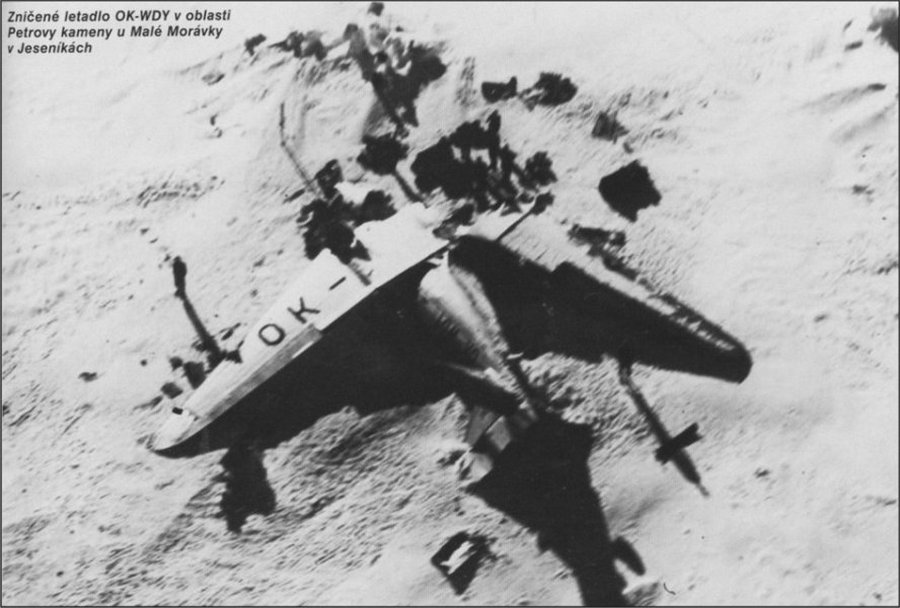
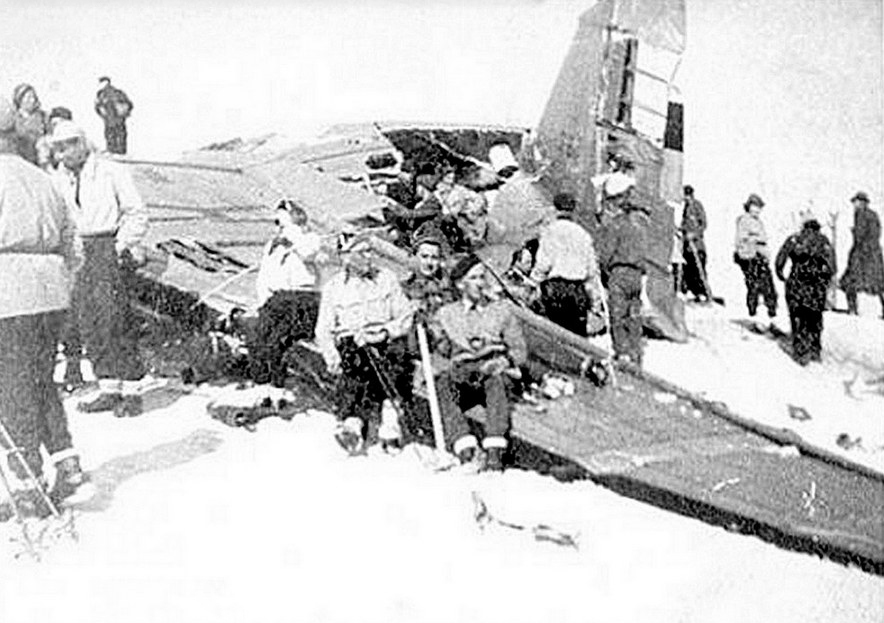
Crash of a Douglas C-47A-15-DK on Mt Praděd: 5 killed

Date & Time: Feb 27, 1950 at 0731 LT
Operator:
Registration:
OK-WDY
Flight Phase:
Survivors:
Yes
Site:
Schedule:
Ostrava – Prague
MSN:
12725
YOM:
1944
Region:
Crew on board:
4
Crew fatalities:
Pax on board:
27
Pax fatalities:
Other fatalities:
Total fatalities:
5
Circumstances:
About thirty minutes after his departure from Ostrava Airport, the crew encountered poor weather conditions with drizzle, low visibility and strong winds gusting to 90 km/h. While cruising at an altitude of 1,440 meters, the aircraft hit the slope of Mt Praděd (1,491 meters high). The aircraft was destroyed and rescuers arrived on site few hours later. Three crew members and two passengers were killed.
Crew killed were:
Vaclav Soukup, pilot,
Augustin Korotvička, radio operator,
Richard Olšovský, flight engineer.
Passengers killed were:
Jan Kloda,
Ladislav Škrabálek.
Probable cause:
The accident was the result of a faulty navigation on part of the crew. Low visibility caused by poor weather conditions was considered as a contributory factor.