Crash of a Vickers Wellington into the Gulf of Aden: 10 killed

Date & Time: Oct 1, 1947 at 1200 LT
Type of aircraft:
Operator:
Registration:
NC565
Flight Phase:
Flight Type:
Survivors:
No
Country:
Region:
Crew on board:
10
Crew fatalities:
Pax on board:
0
Pax fatalities:
Other fatalities:
Total fatalities:
10
Circumstances:
The crew was performing a cargo flight from Aden-Khormaksar Airport. Enroute, the airplane went out of control, went into a dive by an angle of 30° and finally crashed into the Gulf of Aden, about 352 km east of Aden. Few debris were found but no trace of the ten occupants who were considered as deceased. The aircraft sank in relatively deep. It is believed that an engine failed in flight and that the crew mistakenly shot down the wrong engine. It is possible that the engine failure was caused by a lack of electric power due to the failure of a battery. Also, it appears that the cargo loading was completed against the published procedures and that the CofG was affected, which may contribute to the loss of control.

Crash of a Curtiss C-46E-1-CS in Burbank

Date & Time: Sep 17, 1947 at 1112 LT
Type of aircraft:
Operator:
Registration:
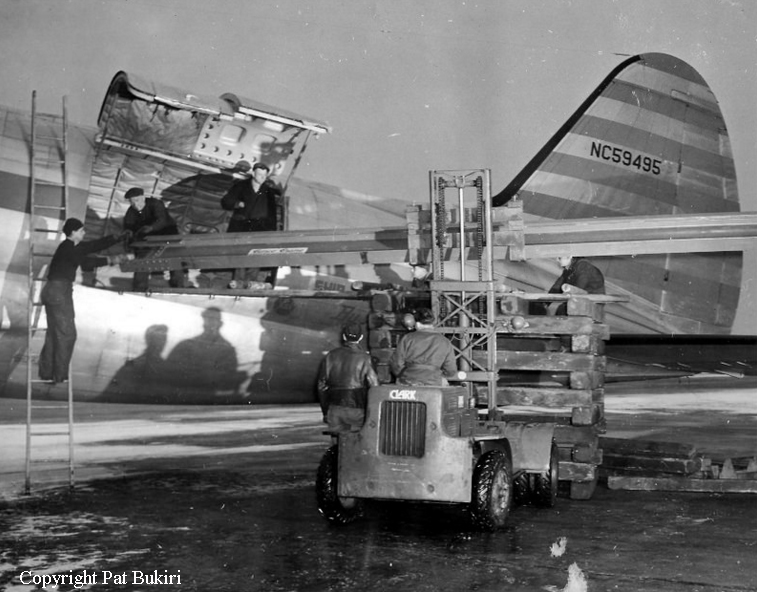
NC59495
Flight Type:
Survivors:
Yes
Schedule:
Denver – Hollywood
MSN:
2937
YOM:
1945
Crew on board:
2
Crew fatalities:
Pax on board:
0
Pax fatalities:
Other fatalities:
Total fatalities:
0
Captain / Total flying hours:
3311
Captain / Total hours on type:
1201.00
Copilot / Total flying hours:
3422
Copilot / Total hours on type:
258
Aircraft flight hours:
3811
Circumstances:
Just before reaching Las Vegas, however, a distance of 268 miles from Burbank, Captain Clark stated that his fuel quantity gauges indicated that he had 360 gallons of fuel remaining. Since he believed this to be sufficient to reach destination, he did not land at Las Vegas which was generally used as a fueling stop for Slick Airways. From Las Vegas to Palmdale, lighter winds were encountered resulting in a ground speed averaging 180 miles per hour. Palmdale was flown over at 1025, at which time the aircraft had been in the air a total of 5 hours and 18 minutes. Three minutes after passing over Palmdale, which was clear, the left engine fuel pressure dropped to 3 pounds, the red fuel warning light came on, and the left engine stopped. Fuel selector valves were changed, and as a result power was restored to the left engine. Captain Clark suspected a fuel leak. He inspected the aircraft for visible loss of fuel or fire, found none, and continued on to Burbank. As the flight approached Newhall California, Burbank reported a ceiling of 1,600 feet with visibility of two and one-half miles. The flight was instructed by the Los Angeles Airways Traffic Control Center to hold on the northwest course of the Burbank range, and advised that the approach clearance Into Burbank could be expected at approximately 1052. Captain Clerk informed the Burbank control tower that he was losing fuel and wanted to land as soon as possible, however, he declined to declare an emergency. Shortly after this, the left engine stopped for the second time, but power was again restored by changing the positions of the fuel selector valves. At 1056, approach clearance into Burbank was given, and at 1058, the flight reported inbound over the Chatsworth fan marker, approximately 14 miles from the Lockheed Air Terminal. The ceiling over Burbank had by this time lowered to 1,000 feet, and rain showers had reduced visibility to about one mile. As the flight descended below 1,600 feet only intermittent bursts of power could be secured from the left engine. The “letdown” was continued, the Burbank radio range station and the Lockheed Air Terminal were passed. Upon completion of a right turn to return to the range station the right engine stopped, and the propeller was immediately feathered. At an altitude of 200 to 400 feet, Captain Clark recognized almost immediately underneath him a hangar on the Lockheed Air Terminal. He executed a sharp right turn of approximately 270 degrees, and landed on the north-south taxi way about 400 feet before crossing Runway 7, a distance of approximately 1,900 feet from the south boundary of the airport. Brakes were applied, but the aircraft could not be brought to a stop within the airport boundaries. It came to rest only after skidding across a highway and railroad line adjacent to the south boundary of the airport.
Probable cause:
The Board determines that the probable cause of this accident was the exhaustion of fuel prior to landing at Burbank, California, due to failure of the pilot to compute properly his fuel consumption, and to provide for a safe fuel reserve.
The following factors were considered as contributory:
- With the exception of “constant pressure charts” no weather data at altitudes of 15,000 to 17,000 feet, the intended altitudes of flight, was available to the flight crew prior to the time of their take-off from Denver, Colorado,
- Head winds of unexpected velocities were encountered en route which resulted in an average ground speed of 148 miles per hour instead of the ground speed of 170 miles per hour used in the flight plan to estimate time en route,
- During the course of the flight the crew made no computation of fuel consumed based on time in the air and on the company's fuel consumption data,
- The flight encountered instrument weather conditions over the Burbank, California area, and was required to wait for an instrument approach clearance to the Lockheed Air Terminal for approximately 10 minutes. No emergency, however, was declared.
Final Report:

Crash of a Douglas C-47A in La Carlota AFB

Date & Time: Sep 17, 1947
Registration:
YV-C-CAJ
Flight Type:
Survivors:
Yes
Country:
Crew on board:
2
Crew fatalities:
Pax on board:
0
Pax fatalities:
Other fatalities:
Total fatalities:
0
Circumstances:
Crashed on landing for unknown reason. Both crew members were slightly injured while the aircraft was written off.

Crash of a Handley Page H.P.70 Halifax VIII in RAF Bovingdon

Date & Time: Sep 5, 1947
Registration:
G-AIWT
Flight Type:
Survivors:
Yes
MSN:
1338
YOM:
1946
Region:
Crew on board:
4
Crew fatalities:
Pax on board:
0
Pax fatalities:
Other fatalities:
Total fatalities:
0
Circumstances:
Crashed on landing for unknown reason. There were no casualties but the aircraft was written off.

Crash of a Curtiss C-46E-1-CS on Mt Blue Bell Knoll: 3 killed

Date & Time: Aug 21, 1947 at 0611 LT
Type of aircraft:
Operator:
Registration:
NC59488
Flight Phase:
Flight Type:
Survivors:
No
Site:
Schedule:
Denver – Los Angeles
MSN:
2935
YOM:
1945
Crew on board:
2
Crew fatalities:
Pax on board:
1
Pax fatalities:
Other fatalities:
Total fatalities:
3
Captain / Total flying hours:
6052
Captain / Total hours on type:
324.00
Copilot / Total flying hours:
3826
Copilot / Total hours on type:
312
Circumstances:
While flying at an altitude of 10,000 feet in marginal weather conditions, the aircraft hit the slope of Mt Blue Bell Knoll located north of Boulder, Utah. The aircraft was destroyed by impact forces and all three occupants were killed.
Probable cause:
Upon the basis of all available evidence, the Board determines that the probable cause of this accident was the continuation of the flight into instrument weather conditions over mountainous terrain at an altitude too low to clear the mountains en route.
Final Report:

Crash of a Vought-Sikorsky VS-44 off Montevideo: 4 killed

Date & Time: Aug 15, 1947 at 2345 LT
Type of aircraft:
Registration:
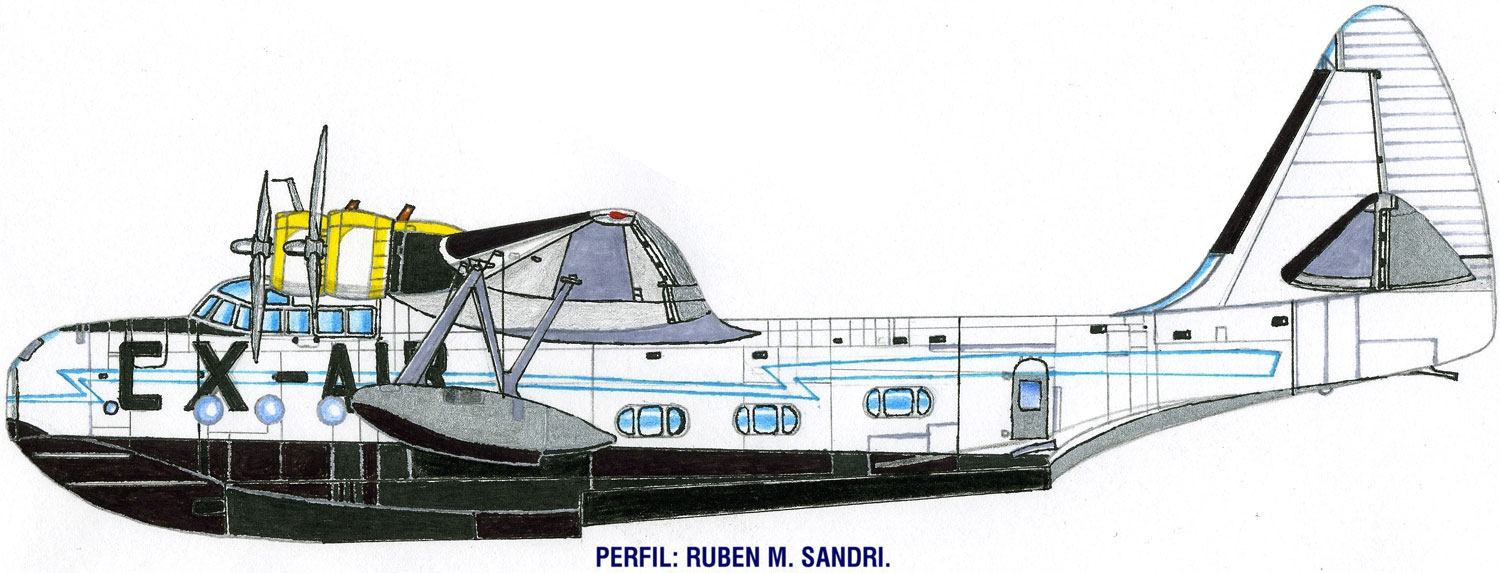
CX-AIR
Flight Type:
Survivors:
Yes
MSN:
4403
YOM:
1942
Country:
Crew on board:
5
Crew fatalities:
Pax on board:
2
Pax fatalities:
Other fatalities:
Total fatalities:
4
Circumstances:
While landing by night off Montevideo, the seaplane crashed, overturned and sank. Four crew members were killed while both passengers and a fifth crewman were injured. The aircraft was lost.
Source:
http://1000aircraftphotos.com/Contributions/HornDavid/9343.htm

Crash of a Douglas DC-3F in Malmö: 1 killed

Date & Time: Aug 9, 1947
Type of aircraft:
Operator:
Registration:
SE-BAY
Flight Type:
Survivors:
Yes
Schedule:
Amsterdam – Malmö
MSN:
19559
YOM:
1944
Location:
Country:
Region:
Crew on board:
5
Crew fatalities:
Pax on board:
0
Pax fatalities:
Other fatalities:
Total fatalities:
1
Circumstances:
On approach to Malmö-Bulltofta Airport, the aircraft was too high on the glide. Instead of making a go around, the captain decided to nose down, increase engine power and landed at high speed. Unable to stop within the remaining distance, the aircraft overran and hit an embankment before coming to rest. The aircraft was destroyed, a crew member was killed while four others were seriously injured.
Probable cause:
Wrong approach configuration.

Crash of a Douglas DC-3C off New York-La Guardia: 3 killed

Date & Time: Aug 8, 1947 at 1849 LT
Type of aircraft:
Operator:
Registration:
NX88787
Flight Type:
Survivors:
Yes
Schedule:
New York – Rochester
MSN:
19639
YOM:
1944
Crew on board:
5
Crew fatalities:
Pax on board:
0
Pax fatalities:
Other fatalities:
Total fatalities:
3
Captain / Total flying hours:
4934
Captain / Total hours on type:
2000.00
Copilot / Total flying hours:
4760
Copilot / Total hours on type:
1500
Aircraft flight hours:
2035
Circumstances:
The aircraft took off on runway 13 of La Guardia Airport at 1843LT, having been cleared on an instrument flight plan to Rochester, New York, with Toronto, Ontario, as an alternate. Approximately 2 minutes after take-off the flight called La Guardia Tower and reported that it was in the vicinity of the south end of Whitestone Bridge, approximately 2 1/2 miles northeast of La Guardia Airport. The flight advised that the oil pressure was low on one engine, and requested clearance to land on runway 22. The request was approved, and the tower informed the crew that the wind was calm. When asked if emergency equipment was desired to stand by, the flight replied in the negative. Shortly thereafter, NX88787 reported that it was on the final approach, and that it was over the sand barges, located approximately one-half mile off the approach end of runway 22. In reply the flight was again given clearance to land. The aircraft was first seen at an altitude of approximately 800 feet, and about 1,300 feet off the approach end of runway 22 with the landing gear extended. The flaps were lowered, and the aircraft started a steep descent to runway 22,but it passed over the approach end of the runway at an altitude of approximately 300 feet. The flight then requested and was granted permission by the tower to make a right turn, however, the aircraft continued straight ahead over the runway, gradually losing altitude. When one-third of the way down the runway, the right propeller was feathered. When over the intersection of runways 22 and 18 and at an altitude of 200 feet the flaps were raised, which resulted in an additional loss of altitude. During or directly after raising the flaps, a right turn was initiated, and the landing gear was observed to retract slowly. Competent witnesses stated that the right turn was made at a very slow speed, at a high angle of attack, and at an altitude appearing never to have exceeded 200 feet. Over Bowery Bay the aircraft on two occasions almost settled into the water. When in a flat right turn toward runway 13 it lost altitude to about 50 feet. Approximately 2,000 feet from the end of the runway, the landing gear started to extend, and became fully extended when the aircraft was aligned with runway 13. At this time the airplane attitude appeared to be that of a steep climb. The wings were seen to wobble slightly, then the left wing and nose dropped, and the airplane struck the water at an angle of approximately 20 degrees. The forward movement of the aircraft continued on the surface of the water for 40 to 50 feet, throwing up a great spray as the tail rose to a vertical position, after which the aircraft continued over on its back and sank in about 5 minutes.
Probable cause:
The Board determines that the probable cause of this accident was that, following an attempted landing, a miss-approach procedure was attempted for a second landing without sufficient air speed for single engine operation.
The following factors were considered as contributory:
- The oil screen cover plate gasket on the right engine was either fractured when installed immediately prior to the flight of August 8, 1947, or failed during the initial part of that flight,
- As a result of the fractured oil screen cover plate gasket, oil pressure for the right engine dropped below normal, and the crew feathered the right propeller,
- Insufficient air speed was maintained in a landing approach to runway 13 at the La Guardia Airport, after an attempted landing and "go around" had been made on runway 22, and as a result the airplane stalled and crashed into Bowery Bay.
Final Report:

Crash of an Avro 652 Anson in Kempsey

Date & Time: Aug 8, 1947
Type of aircraft:
Operator:
Registration:
VH-BCH
Flight Type:
Survivors:
Yes
Schedule:
Sydney – Kempsey
Country:
Region:
Crew on board:
2
Crew fatalities:
Pax on board:
0
Pax fatalities:
Other fatalities:
Total fatalities:
0
Circumstances:
The crew was completing a cargo flight from Sydney-Mascot. On touchdown in Kempsey, the undercarriage collapsed. The aircraft skidded on runway, came to rest and was damaged beyond repair. Both pilots were unarmed.

Crash of a Handley Page HP.70 Halifax VIII in Bergamo

Date & Time: Jul 31, 1947
Operator:
Registration:
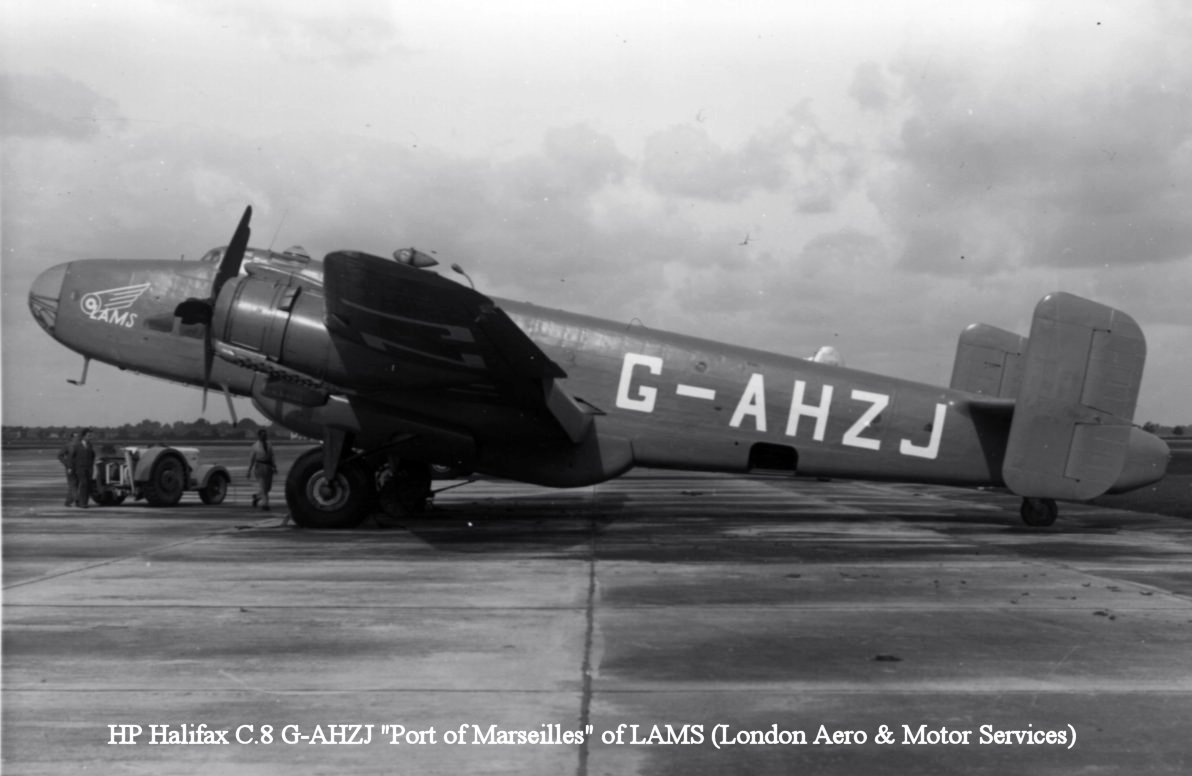
G-AHZJ
Flight Phase:
Flight Type:
Survivors:
Yes
Schedule:
Bergamo – Stansted
MSN:
1331
YOM:
1946
Country:
Region:
Crew on board:
5
Crew fatalities:
Pax on board:
0
Pax fatalities:
Other fatalities:
Total fatalities:
0
Circumstances:
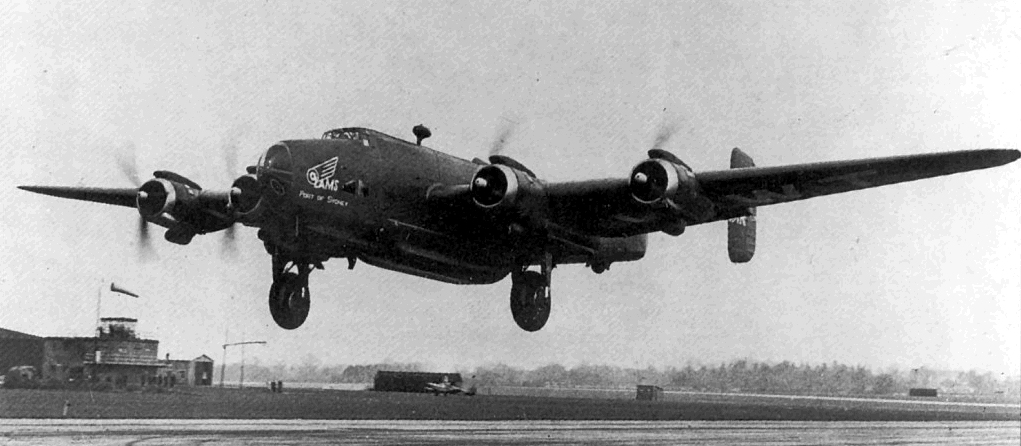
During the takeoff roll, the aircraft went out of control, veered off runway and came to rest. All five crew members were unhurt while the aircraft christened 'Port of Marseilles' was damaged beyond repair.
Probable cause:
A tyre burst during the takeoff roll, causing the aircraft to be uncontrollable.