Crash of a Douglas R4D-1 in Cleveland

Date & Time: Nov 5, 1959
Registration:
N38G
Flight Phase:
Flight Type:
Survivors:
Yes
Schedule:
Cleveland – Dayton
MSN:
4759
YOM:
1942
Crew on board:
1
Crew fatalities:
Pax on board:
4
Pax fatalities:
Other fatalities:
Total fatalities:
0
Circumstances:
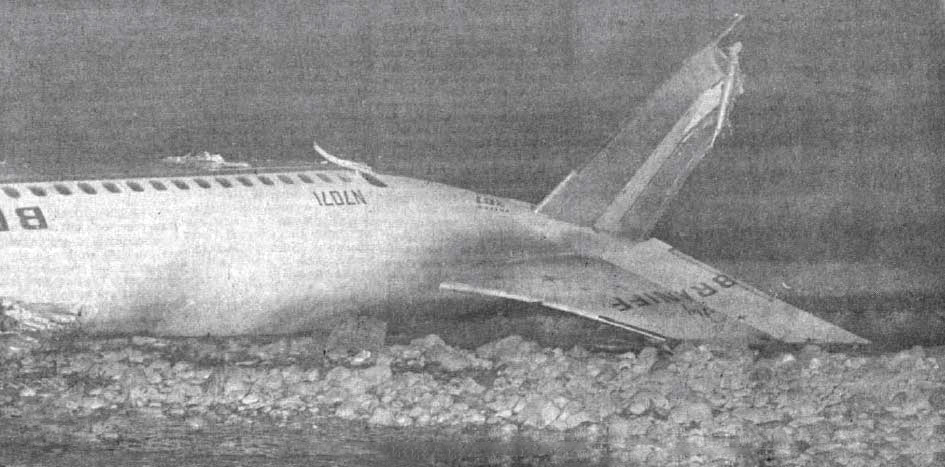
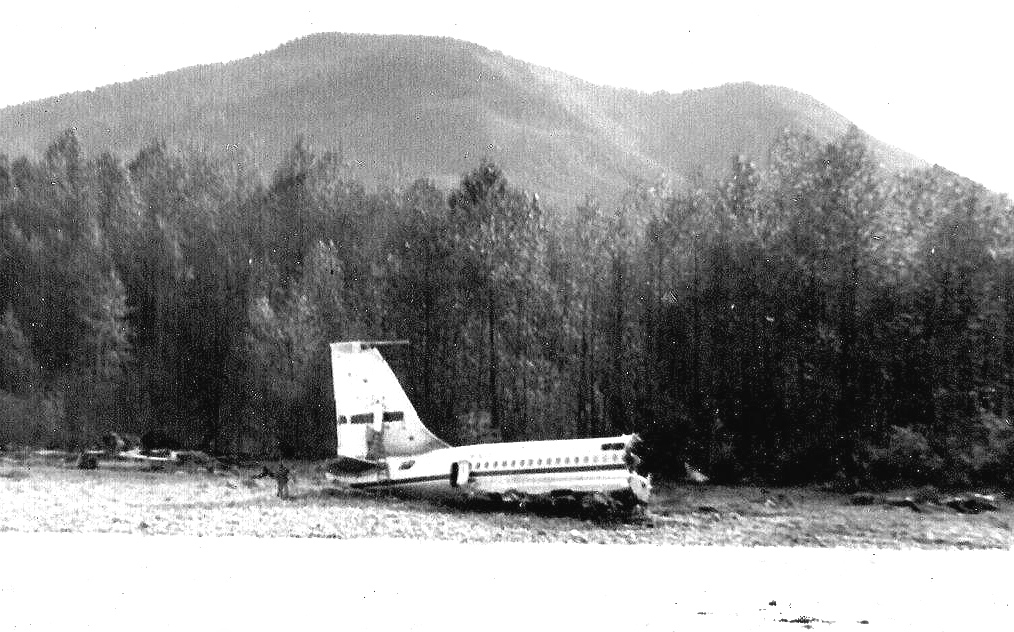
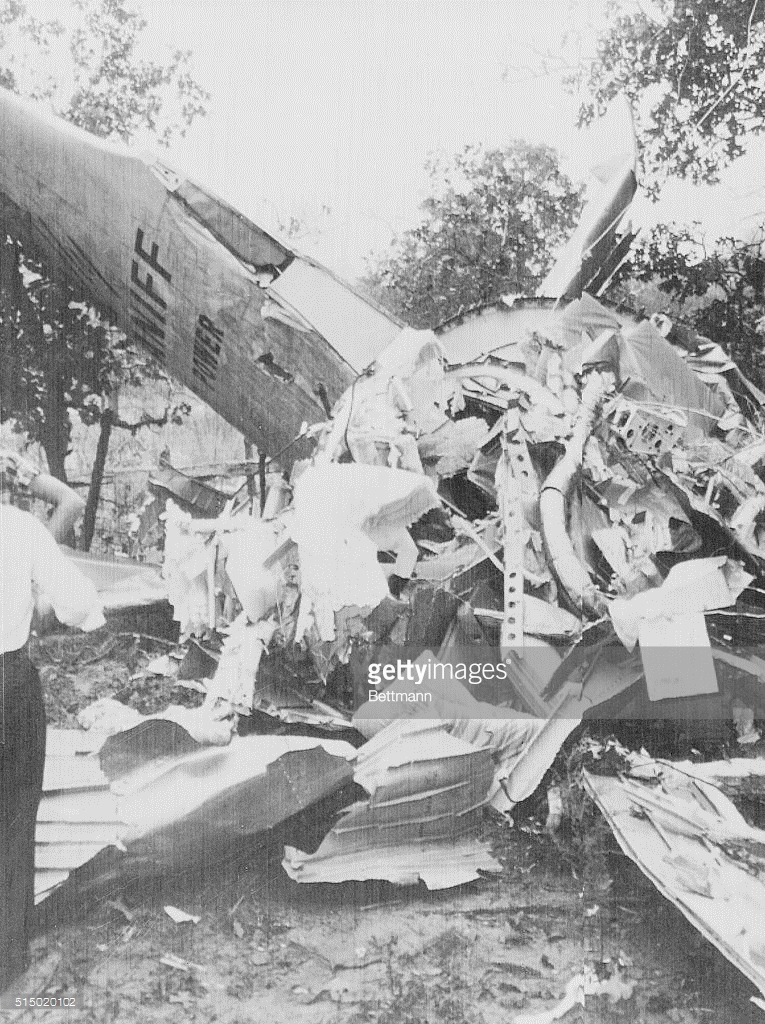
The aircraft was involved in a demo flight from Cleveland to Dayton for a potential client, Columbus Aviation. Takeoff was completed in strong winds and just after liftoff, the pilot realized it was not possible to continue in such conditions. To avoid to crash into Erie Lake, he attempted an emergency landing in a wasteland. The right wing struck the ground and the airplane crashed. All five occupants escaped uninjured while the aircraft was damaged beyond repair.

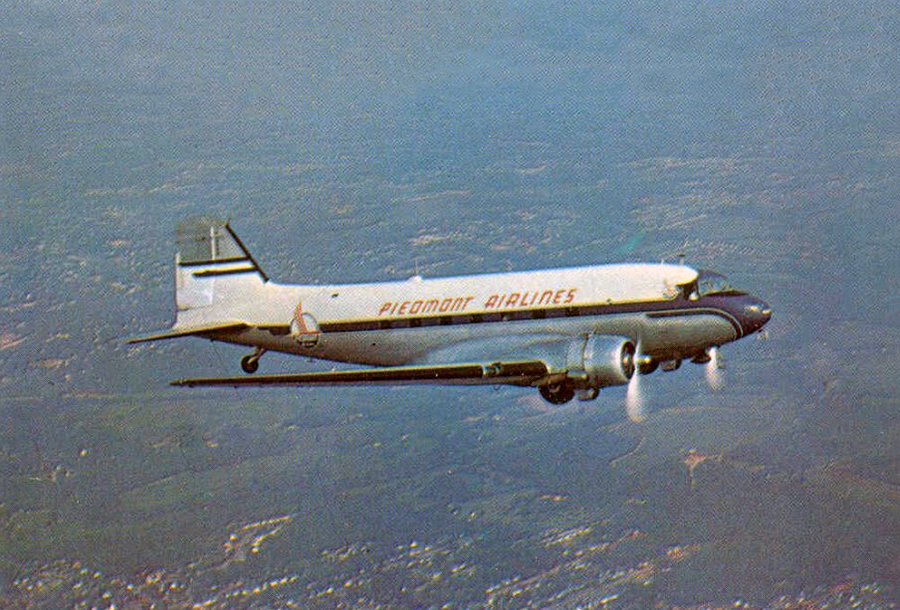
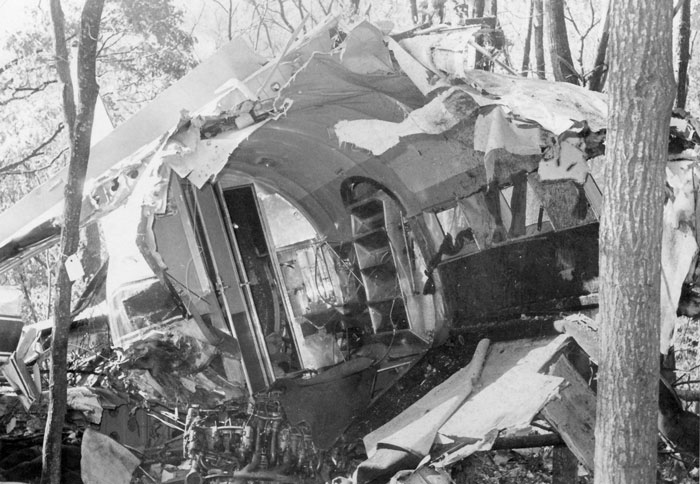
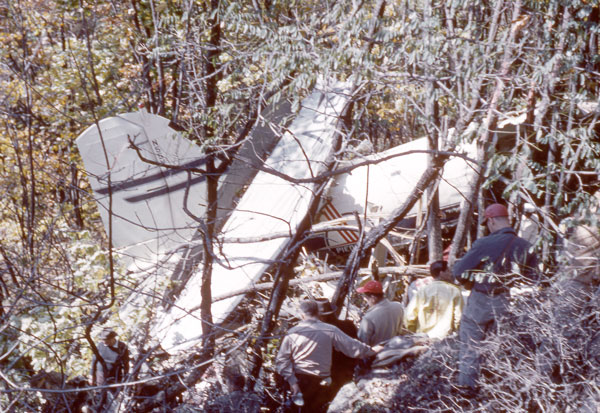
Crash of a Douglas C-47A-90-DL on Mt Bucks Elbow: 26 killed

Date & Time: Oct 30, 1959 at 2040 LT
Operator:
Registration:
N55V
Survivors:
Yes
Schedule:
Richmond – Charlottesville – Lynenburg – Roanoke
MSN:
20447
YOM:
1944
Flight number:
PI349
Crew on board:
3
Crew fatalities:
Pax on board:
24
Pax fatalities:
Other fatalities:
Total fatalities:
26
Captain / Total flying hours:
5101
Captain / Total hours on type:
4771.00
Copilot / Total flying hours:
2858
Copilot / Total hours on type:
1678
Aircraft flight hours:
26339
Circumstances:
About 2040, October 30, 1959, Piedmont Airlines Flight 349 crashed on Bucks Elbow Mountain located about 13 miles west of the Charlottesville-Albemarle County, Virginia, Airport. The crew of 3 and 23 of 24 passengers were killed; the sole survivor was seriously injured. The aircraft, a DC-3, N55V, was demolished by impact. From the available evidence it is the determination of the Board that this accident occurred during an intended instrument approach. More specifically, it occurred during the inbound portion of the procedure turn which was being flown 6 to 11 miles west of the maneuvering area prescribed by the instrument approach procedure. The Board concludes that the lateral error resulted from a navigational omission which took place when the pilot did not turn left about 20 degrees in conformity to V-140 airway at the Casanova omni range station. Consequently, when the pilots believed the flight was over the Rochelle intersection it was in fact 13 files northwest of tract position. As a result of this position, when the pilot turned left and flew the heading normally flown from Rochelle intersection, the path of the aircraft over the ground was displaced 8 to 11 miles west of the prescribed track. The Board further concludes that the error was undetected because tracking and other instrument approach requirements were not followed precisely. From information regarding the personal background of Captain and expert medical analysis of this information, it is the Board's opinion that preoccupation resulting from mental stress may have been a contributing factor in the accident cause.
Probable cause:
The Board determines that the probable cause of this accident was a navigational omission which resulted in a lateral course error that was not detected and corrected through precision instrument flying procedures. A contributing factor to the accident may have been preoccupation of the captain resulting from mental stress.
Final Report:

Crash of a Douglas DC-3 in Santa Maria: 1 killed

Date & Time: Oct 26, 1959 at 2018 LT
Type of aircraft:
Operator:
Registration:
N67589
Flight Phase:
Survivors:
Yes
Schedule:
Los Angeles – Oxnard – Santa Maria – Paso Robles – San Francisco
MSN:
19656
YOM:
1944
Flight number:
PCF308
Crew on board:
3
Crew fatalities:
Pax on board:
17
Pax fatalities:
Other fatalities:
Total fatalities:
1
Captain / Total flying hours:
17467
Captain / Total hours on type:
14467.00
Copilot / Total flying hours:
3951
Copilot / Total hours on type:
3032
Aircraft flight hours:
24805
Circumstances:
Flight 308 was scheduled between Los Angeles, and San Francisco, with intermediate stops at Oxnard, Santa Maria, and Paso Robles, California. The trip to Oxnard. and Santa Maria was routine. Takeoff from, Santa Maria was made from runway 30 with 17 passengers on board and a crew of three. A few seconds after the first power reduction following takeoff, a loud explosion was heard and fire was seen in the left engine. The left propeller was immediately feathered, the engine was shut off, and appropriate power was applied to the right engine. At the time this happened the aircraft was at an approximate altitude of 550 feet m s.l., or 300 feet above the ground. Shortly after this the fire was observed to be out; however, the airplane began to buffet. This buffeting became so severe that the aircraft lost altitude and the captain was forced to make an emergency landing about 1-1/2 miles north of the airport. The copilot was killed, the captain was seriously injured, and the purser and 17 passengers received injuries of varying degrees.
Probable cause:
The Board determines the probable cause of this accident was that following the failure of the left engine, the left engine's ring cowl was deformed causing a buffeting and drag condition which made sustained flight impossible. A contributing factor was the scheduling of the aircraft by the company when there should have been reasonable doubt concerning the airworthiness of an engine.
Final Report:

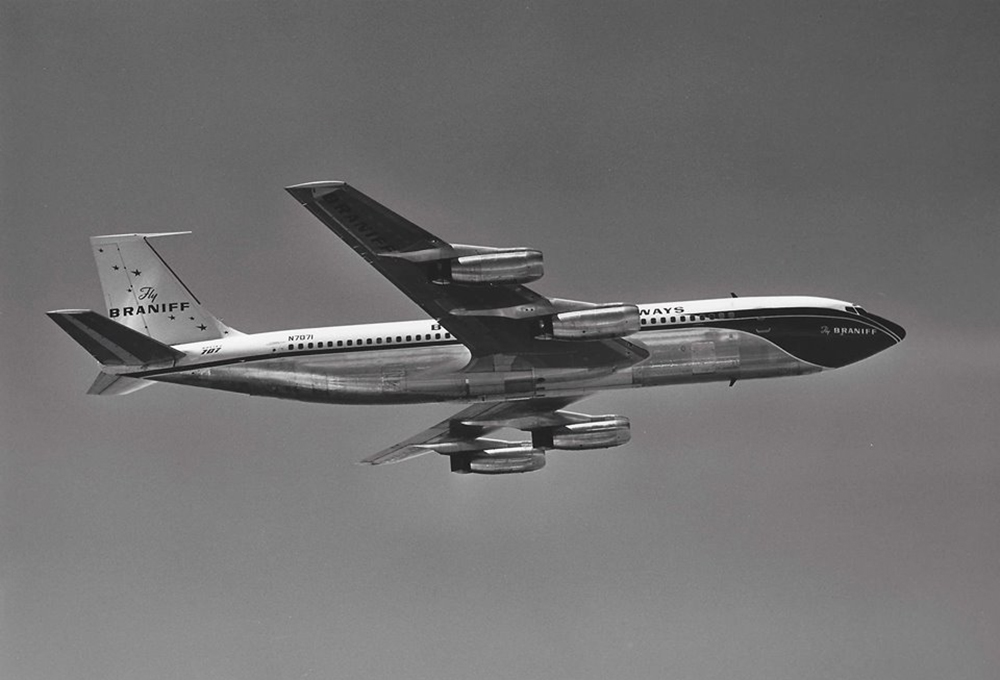
Crash of a Boeing 707-227 near Arlington: 4 killed

Date & Time: Oct 19, 1959 at 1620 LT
Type of aircraft:
Operator:
Registration:
N7071
Flight Phase:
Flight Type:
Survivors:
Yes
Schedule:
Seattle - Seattle
MSN:
17691
YOM:
1959
Crew on board:
8
Crew fatalities:
Pax on board:
0
Pax fatalities:
Other fatalities:
Total fatalities:
4
Captain / Total flying hours:
5015
Captain / Total hours on type:
369.00
Copilot / Total flying hours:
23563
Aircraft flight hours:
173
Circumstances:
A Boeing Airplane Company test pilot was acting as an instructor-pilot on a demonstration and acceptance flight prior to the aircraft being delivered to the customer. The company was also utilizing this flight time for flight instruction purposes in qualifying airline personnel in the aircraft. The instructor-pilot demonstrated several maneuvers, including Dutch Rolls, to a pilot-trainee, an airline captain who was making his first training flight training flight prior to checkout on the Boeing 707. The instructor-pilot initiated a Dutch Roll in which the roll-park angle of the aircraft reached 40 to 60 degrees. This bank angle is in excess of limitation set by the company for demonstration of his maneuver. The pilot-trainee, who was to make the recovery, rolled full right aileron control while the right rank was still increasing. The instructor-pilot immediately rolled in full opposite aileron. The airplane stopped its right roll at a point well past a vertical bank and then rolled to the left even more violently. Several gyrations followed and after control of the aircraft was regained, it was determined that three of the four engines had separated from the aircraft and it was on fire. The fire rapidly reduced controllability of the aircraft and an emergency landing was attempted, however, the aircraft struck trees and crashed short of the intended landing area because power on the engine remaining had to be shut down to keep the aircraft wings level. The aircraft was destroyed and four crew members were killed while four others were injured.
Probable cause:
The Board determines that the probable cause of this accident was the structural failures induced during an improper recovery attempt from a Dutch Roll which exceeded the angle-of-bank limits prescribed by the company.
Final Report:

Crash of a Douglas C-54 Skymaster in Jacksonville

Date & Time: Oct 15, 1959 at 2105 LT
Type of aircraft:
Operator:
Registration:
N4000A
Flight Phase:
Flight Type:
Survivors:
Yes
Schedule:
Jacksonville-Charleston-Cherry Point
MSN:
36063
YOM:
1955
Crew on board:
2
Crew fatalities:
Pax fatalities:
Other fatalities:
Total fatalities:
0
Captain / Total flying hours:
12166
Captain / Total hours on type:
7303.00
Copilot / Total flying hours:
9024
Copilot / Total hours on type:
255
Aircraft flight hours:
19269

Crash of a Boeing B-52F-100-BO Stratofortress near Leitchfield: 4 killed

Date & Time: Oct 15, 1959 at 1945 LT
Type of aircraft:
Operator:
Registration:
57-0036
Flight Phase:
Flight Type:
Survivors:
Yes
MSN:
17430
YOM:
1957
Crew on board:
8
Crew fatalities:
Pax on board:
0
Pax fatalities:
Other fatalities:
Total fatalities:
4
Circumstances:
While on a training mission, the B-52 was supposed to be refueled by the crew of a USAF KC-135 registered 57-1513. At an altitude of 32,000 feet, both aircraft collided in unclear circumstances and dove into the ground before crashing near Leitchfield. All four crew member on board the KC-135 were killed. On board the B-52, four crew members were killed while four others were able to bail out and were found alive. Both aircraft were destroyed upon impact. Both nuclear bombs on board the B-52 were recovered intact.

Crash of a Boeing KC-135A-BN Stratotanker near Leitchfield: 4 killed

Date & Time: Oct 15, 1959 at 1945 LT
Type of aircraft:
Operator:
Registration:
57-1513
Flight Phase:
Flight Type:
Survivors:
No
Schedule:
Columbus - Columbus
MSN:
17584
YOM:
1958
Crew on board:
4
Crew fatalities:
Pax on board:
0
Pax fatalities:
Other fatalities:
Total fatalities:
4
Circumstances:
The crew left Columbus AFB, Mississippi, on a routine refuelling mission of a USAF Boeing B-52 Stratofortress. Registered 57-0036, the B-52 was carrying a crew of eight. At an altitude of 32,000 feet, both aircraft collided in unclear circumstances and dove into the ground before crashing near Leitchfield. All four crew member on board the KC-135 were killed. On board the B-52, four crew members were killed while four others were able to bail out and were found alive. Both aircraft were destroyed upon impact.
Crew:
1st Lt Harold E. Helmick, pilot,
S/Sgt Paul E. Thomasson 2.

Crash of a De Havilland L-20 Beaver in Boerne: 4 killed

Date & Time: Oct 13, 1959
Type of aircraft:
Operator:
Flight Phase:
Flight Type:
Survivors:
No
Schedule:
Dyess - Fort Sam
Location:
Crew on board:
1
Crew fatalities:
Pax on board:
3
Pax fatalities:
Other fatalities:
Total fatalities:
4
Circumstances:
En route from Dyess AFB to Fort Sam AFB in Houston, the pilot encountered poor weather conditions with heavy rain falls and turbulences. Control was lost and the airplane crashed in Boerne, killing all four occupants.

Crash of a Lockheed L-188A Electra near Buffalo: 34 killed

Date & Time: Sep 29, 1959 at 2309 LT
Type of aircraft:
Operator:
Registration:
N9705C
Flight Phase:
Survivors:
No
Schedule:
Houston – Dallas – Washington DC – New York
MSN:
1090
YOM:
1959
Flight number:
BN542
Location:
Crew on board:
6
Crew fatalities:
Pax on board:
28
Pax fatalities:
Other fatalities:
Total fatalities:
34
Captain / Total flying hours:
20726
Captain / Total hours on type:
68.00
Copilot / Total flying hours:
11316
Copilot / Total hours on type:
95
Aircraft flight hours:
132
Circumstances:
Flight 542 departed the ramp at Houston at 2237LT, 22 minutes behind schedule with a total of 34 persons including a crew of six consisting of Captain Wilson Elza Stone, First Officer Dan Hollowell, Second Officer Roland Longhill, and Stewardesses Alvilyn Harrison, Betty Rusch and Leona Winkler, none of whom survived. The delayed departure was due to a mechanical discrepancy involving No. 3 generator. This generator was inoperative on arrival of N9705C at Houston. Prior to departure from Houston the Nos. 3 and 4 voltage regulators were interchanged. Actual gross weight upon departure was calculated at 83,252 pounds, including 17,000 pounds of fuel, and was 16,548 pounds less than the authorized gross weight of 99,800 pounds. The estimated time en route to Dallas was 41 minutes. The flight was given an instrument-flight-rules clearance which was to the Leona omni, via Victor Airway 13 west to the Gulf Coast intersection, direct to Leona, to maintain 2,300 feet altitude to Gulf Coast, then to climb to and maintain 9,000. At approximately 2240 the flight was cleared for takeoff and at 2242 it reported ready for takeoff and was airborne at 2244. After takeoff Houston departure control advised that it had the flight in radar contact and requested it to report when established outbound on the 345-degree radial of the Houston omni. Flight 542 complied and subsequently was cleared to 9,000 feet and advised to contact San Antonio Center on 121.1 mcs. upon passing the Gulf Coast intersection. Flight 542 reported to company radio at 2251 as blocking out of Houston at 37, taking off at 42, to cruise at 15,000 feet when so cleared, estimating Dallas at 2325, and that the Center had this information. At approximately 2252 Flight 542 reported to San Antonio Center as being over Gulf Coast intersection at 9,000 feet. The flight was then issued its destination clearance to the Dallas Airport via direct to Leona, direct to Trinidad, direct to Forney, direct to Dallas, to maintain 15,000 feet. The flight was cleared to climb to its cruising altitude. The next transmission from Flight 542 was to the San Antonio, Center, giving the time over Leona as 05 at 15,000. San Antonio Center acknowledged, and requested Flight 542 to change over and monitor the Fort Worth frequency of 120.8 mcs. at this time. The flight acknowledged. Shortly thereafter Flight 542 contacted company radio with a message for maintenance, advising that the generators were then OK out that there had been insufficient time for maintenance to insulate the terminal strip on No. 3 propeller at Houston and it would like to have it done in Dallas. At this time the flight also said it would give the communication center a Dallas estimate of 25. This was then followed by one other item for maintenance, which was that No. 3 sump pump was inoperative. This was the final transmission from the flight and was logged as completed at 2307. Structural failure of the aircraft occurred at approximately 2309 on course to the next fix, Trinidad intersection. The radial from Leona omni to Trinidad intersection is 344 degrees. The main wreckage was located 19.7 miles 2 north of Leona omni, 3.19 miles east-southeast of Buffalo, Texas. The time, 2309, correlates closely with the information obtained from witnesses to the accident as well as the time indicated on impact-stopped watches recovered at the scene. The aircraft was destroyed upon impact and all 34 occupants were killed.
Probable cause:
The Board determines that the probable cause of this accident was structural failure of the left wing resulting from forces generated by undampened propeller whirl mode.
Final Report:

Crash of a Douglas C-54B-1-DC Skymaster on Great Sitkin Island: 16 killed

Date & Time: Sep 24, 1959 at 1720 LT
Type of aircraft:
Operator:
Registration:
N63396
Survivors:
No
Site:
Schedule:
Anchorage – Cold Bay – Adak – Shemya
MSN:
10486
YOM:
1944
Flight number:
RV003
Crew on board:
5
Crew fatalities:
Pax on board:
11
Pax fatalities:
Other fatalities:
Total fatalities:
16
Captain / Total flying hours:
12853
Captain / Total hours on type:
1278.00
Copilot / Total flying hours:
3949
Copilot / Total hours on type:
883
Aircraft flight hours:
33390
Circumstances:
Flight 3 was a scheduled flight between Anchorage and Shemya, with intermediate stops at Cold Bay and Adak, Alaska. A routine takeoff was made at Cold Bay, and all en route radio reporting points were made to the company within two or three minutes of their estimated times. At 1650LT, the flight reported that it was 100 miles northeast of Adak, at 4,500 feet, on top and in the clear. Flight 3 then estimated it would be over the Adak low frequency range at 1725LT. The flight was cleared to the Adak low frequency range, to maintain VFR on top, and to call Adak approach control when 30 miles out for landing instructions. At 1715LT, the flight advised the company it was canceling its IFR flight plan and was proceeding VFR. Two minutes later Flight 3 attempted to communicate with Adak approach control. Upon hearing this message, approach control called the flight but was unsuccessful. It was later determined that the aircraft had crashed into the northeast side of the Great Sitkin volcano (1,740 meters high) located on the Great Sitkin Island, about 25 miles northeast of Adak Airport. The aircraft was destroyed and all 16 occupants have been killed.
Probable cause:
The Board determines that the probable cause of this accident was the captain's failure to maintain flight in accordance with visual flight rules during a descent over hazardous terrain.
Final Report: