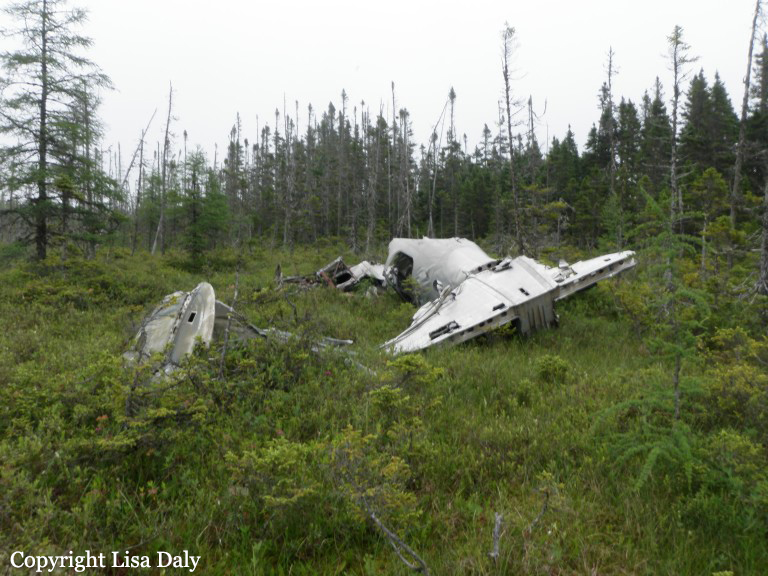
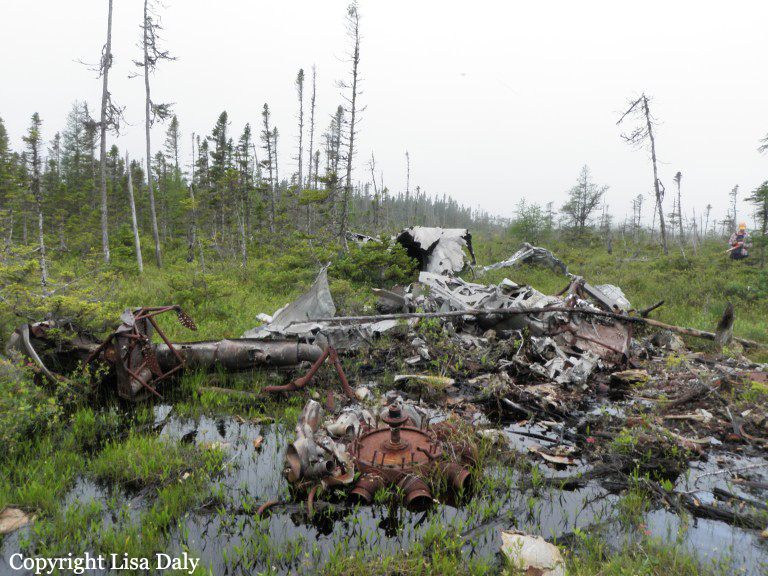
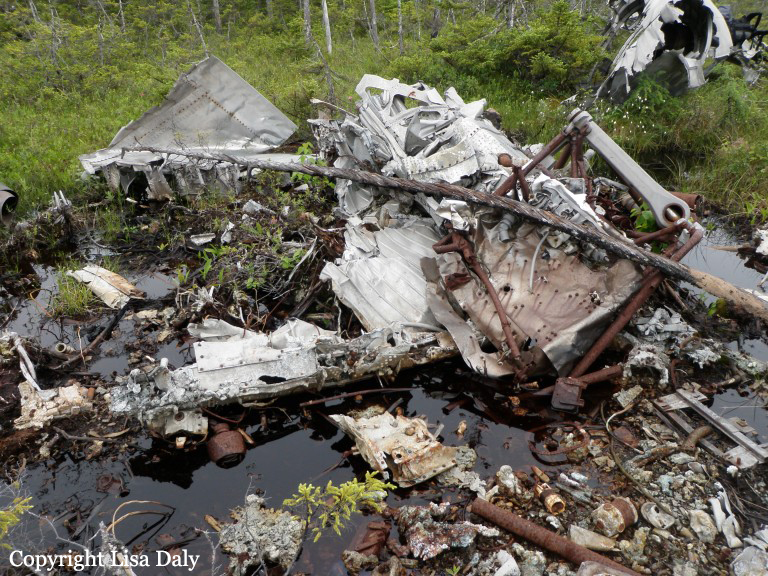
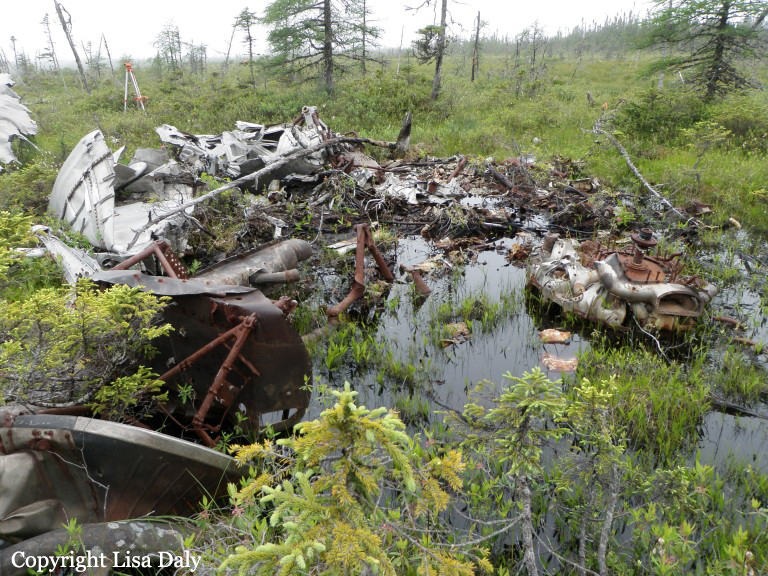
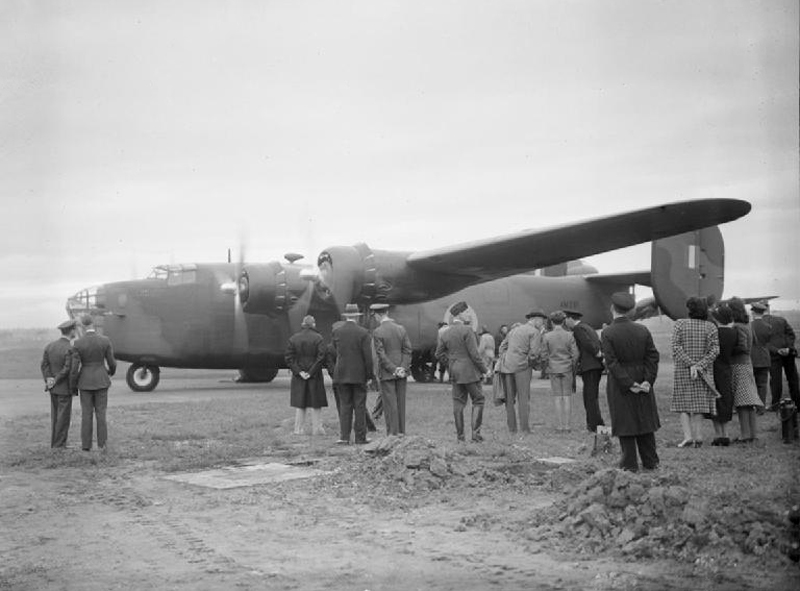
Crash of a Boeing B-17F-10-BO Flying Fortress into the Atlantic Ocean: 10 killed

Date & Time: Sep 5, 1942
Operator:

Registration:
41-24463
Flight Phase:
Flight Type:
Survivors:
No
Schedule:
Gander - Thurleigh
MSN:
3148
YOM:
1942
Country:
Region:
Crew on board:
10
Crew fatalities:
Pax on board:
0
Pax fatalities:
Other fatalities:
Total fatalities:
10
Circumstances:
The airplane departed Gander Airport on a transatlantic flight to RAF Thurleigh, carrying a crew of 10. About an hour into the flight, while en route between Canada and Greenland, the airplane exploded in midair and crashed into the Atlantic Ocean. All 10 occupants were killed.
Crew:
T/Sgt William Blakesley,
S/Sgt Charles H. Carlton,
2nd Lt Andrew J. Hoyt,
2nd Lt Robert R. Landry,
1st Lt John Thomas Leahy,
S/Sgt Roland L. Oikle,
S/Sgt Leslie R. Pettyjohn,
Cpt Rush Poulan,
2nd Lt Frank L. Shannon Jr.,
Pvt James A. Wiley.
Probable cause:
The exact cause of the accident could not be determined but the explosion coincided with the time that the bomb bay overload fuel tank was due to be switched on and may have been caused by an electrical fault.


Crash of a Lockheed L-414 Hudson I in Dartmouth

Date & Time: Jul 30, 1942 at 1930 LT
Type of aircraft:
Operator:
Registration:
785
Flight Type:
Survivors:
Yes
Schedule:
Gander - Dartmouth
MSN:
414-1789
YOM:
1940
Country:
Crew on board:
3
Crew fatalities:
Pax on board:
5
Pax fatalities:
Other fatalities:
Total fatalities:
0
Circumstances:
The aircraft was coming in high and fast so the aerodrome control officer told the pilot to go around again, but the pilot never received this message because after getting clearance he took off his headphones. The visibility was poor due to rain as he came in to land. After touching down he did not apply brakes full but when he was first able to see the end of the runway, he applied full brakes but it was too late. The airplane rolled straight down the runway but slowed down when it rolled over the end of the runway across rocks, crashing into a gully at the end of the runway. Flames broke out and the aircraft was destroyed. All eight occupants were injured, five seriously.
Crew:
F/Sgt C. E. Ross, pilot,
Sgt G. R. C. Harron, navigator,
Sgt J. G. M. La Jambe, wireless operator and air gunner.
Passengers:
F/Sgt E. G. Todd,
F/O N. D. Lindsay,
Lac A. E. Tudor,
Sgt M. L. Dickle,
Lac E. E. Pritchard.
Probable cause:
Error of judgment on the part of the pilot who overshot due to an obscured front windshield which deprived him of forward vision.
Final Report:

Crash of a Boeing B-17B Flying Fortress in North Reading: 10 killed

Date & Time: Jul 18, 1942 at 1520 LT
Operator:
Registration:
39-008
Flight Type:
Survivors:
No
Schedule:
Gander - Warminster
MSN:
2040
YOM:
1939
Crew on board:
8
Crew fatalities:
Pax on board:
2
Pax fatalities:
Other fatalities:
Total fatalities:
10
Circumstances:
The airplane departed Gander Airport to be transferred to the Johnsonville Naval Air Development Center located in Warminster, about 30 km north of Philadelphia, to be retrofitted with the latest armament. Flying over North Reading, the crew encountered an unexpected situation and apparently attempted an emergency landing when the airplane collided with the chimney of a house and crashed in a dense wooded area. The airplane was totally destroyed and all 10 occupants were killed. At the time of the accident, the visibility was poor due to foggy conditions.
Crew:
1st Lt Marion R. Klyce, pilot,
1st Lt Don H. Johnson Jr., pilot,
2nd Lt Orville D. Andrews, navigator,
1st Lt James Phillips Jr., bombardier,
S/Sgt William E. Perkins, flight engineer,
Pfc Sidney S. Koltun, assistant flight engineer,
Cpl Stephen Bilocur, radio operator,
Cpl Charles H. Torrence, assistant radio operator.
Passengers:
S/Sgt Robert J. Aulsbury,
T/Sgt Archie R. Jester Jr.
Probable cause:
The accident was the consequence of a phenomenon called ‘flutter’ that may have caused one of the airplane’s wings to fall off on its descent. Further supporting this theory was the fact that an undamaged wing was found a significant distance away from the wreckage.

Crash of a Lockheed C-60A-5-LO LodeStar in Gander: 3 killed

Date & Time: May 8, 1942 at 0010 LT
Type of aircraft:
Operator:
Registration:
557
Flight Type:
Survivors:
No
Schedule:
Moncton – Gander
MSN:
18-2377
YOM:
1943
Country:
Crew on board:
3
Crew fatalities:
Pax on board:
0
Pax fatalities:
Other fatalities:
Total fatalities:
3
Circumstances:
The airplane departed Moncton, New Brunswick, at 2345 GMT on 7 May 1943 on a cargo transport flight to Gander. At 0313 GMT the following day, the aircraft contacted the Aerodrome Control Officer at Gander Station to request landing clearance. The aircraft was given landing clearance by P/O Thomas Howard Murray, aerodrome control officer, and was told to check their wheels down. The messages were acknowledged by 557. At this time the ceiling was practically unlimited. The aircraft was heard to pass over Gander airfield shortly thereafter, but the ceiling had unexpectedly fallen to 700 feet. This lowering of the ceiling possibly meant that ice may have formed on the aerials. It is unlikely that icing would have occurred on the wings or engines. This fly over was apparently done on instruments. The Lodestar contacted the Control Officer to indicate they had missed the field and were to try again. The aircraft then acknowledged being given the ceiling height and barometric pressure by the station. At this point, the landing of the aircraft on the control tower side was taken over by the station manager of Trans Canada Airlines (TCA), Mr. Harry Beardsell. The aircraft was carrying cargo and under the operational control of TCA and therefore should be under TVA radio coverage. Instructions were passed to the aircraft by TCA as to the proper landing procedures for Gander, and these were acknowledged. The aircraft broke through the now 600 ft. ceiling, and was advised to circle and approach runway 27 (note, runway 27 is no longer in use at YQX; ourairports.com). At this point, TCA spoke directly to the pilot. According to Beardsell, he advised Svendsen to make one more attempt before proceeding to Sydney where the ceiling was at 1000 ft. and visibility was 3 miles. P/O Murray, who was listening to the communications between the control tower and Lodestar 557 denied that the aircraft was advised of a secondary landing location. According to the radio log, it was actually Lodestar 557 who suggested that it would try for one more landing and if not successful would return to Sydney and TCA seconded the decision. The aircraft approached, but seemed to be lined up with the wrong runway and was advised to circle again and attempt runway 27. P/O Murray believed that the boundary lights were confusing 557, causing it to line up with the wrong runway, so he switched off the lights and informed the aircraft through Beardsell. One the second attempt, the aircraft did not turn enough and was again told that it would probably not make it to the runway and to attempt again. The aircraft was told to make a right turn over the field near the airport, but it could be seen that the aircraft would not make the turn successfully. The pilot was advised to pull up two or three times by TCA, but at this point 557 was in a steep bank and went into a stall, losing altitude until it crashed. One witness saw the aircraft moments before the crash and stated it was flying very low at 200 ft. with engines functioning properly. The crash was indicated by a flash followed by a second, brighter flash, indicating it had crashed and was burning. Fire trucks and ambulances were dispatched to the scene. It crashed at 0340 GMT on 8 May 1943 approximately two miles east of the RCAF Station in Gander. All crew were killed.
Crew (164th Squadron):
P/O Humphrey Svendsen, pilot,
W/O Charles Needham Allan, pilot,
Lac Allan Gerald Sewell, wireless operator.
Source & photo:
http://www.planecrashgirl.ca/2016/03/17/lodestar-557/
Probable cause:
The aircraft had been certified as airworthy and in serviceable condition; the pilot, WO2 Svendsen, was fully qualified to fly a Lodestar in all conditions, and had twice flown the same route to Gander on transportation flights. The cause of the crash was determined to be “pilot error, while attempting to get into position to make approach under low ceiling” (Mulvihill 1943). The aircraft slipped or stalled after changing from a left turn to a right turn in an attempt to realign with the runway. Because it was already in low altitude, the slip or stall caused it to strike the trees while trying to recover from the turn. The report recommends safety changes to the airbase. As Lodestar 557 had to make a final attempt because it had aligned with the wrong runway, the report determined that the runway lighting system of the RCAF station in Gander was confusing and should be studied and improved.
Final Report:

Crash of a Douglas Digby I in Gander

Date & Time: Mar 26, 1942 at 1035 LT
Type of aircraft:
Operator:
Registration:
753
Flight Type:
Survivors:
Yes
Schedule:
Gander - Gander
MSN:
1645
YOM:
1936
Country:
Crew on board:
4
Crew fatalities:
Pax on board:
0
Pax fatalities:
Other fatalities:
Total fatalities:
0
Captain / Total flying hours:
974
Captain / Total hours on type:
735.00
Circumstances:
The crew was completing practice instrument approaches at Gander Airport. On short final, at a height of 20 feet, the airplane stalled and the wing dropped. Full power was added but the airplane bounced lightly on its undercarriage. The wing caught on runway boundary snowbank 30 yards from point wheels touched the runway and the airplane crashed. All four crew members escaped uninjured.
Crew:
F/Lt E. M. William, pilot,
P/O D. F. Raymes, copilot,
P/O Johnson, wireless operator,
Sgt Corbitt, wireless operator.
Probable cause:
Error in judgment on part of the pilot, in that he commenced to level out for landing at too great a height and allowed the airplane to stall while at 20 feet.
Final Report:

Crash of a Boeing B-17E Flying Fortress in Gander

Date & Time: Jan 9, 1942
Operator:
Registration:
41-2393
Flight Type:
Survivors:
Yes
MSN:
2204
YOM:
1941
Country:
Crew on board:
0
Crew fatalities:
Pax on board:
0
Pax fatalities:
Other fatalities:
Total fatalities:
0
Circumstances:
After touchdown at Gander Airport, the airplane veered off runway and crashed into a snow bank. There were no injuries but the airplane was damaged beyond repair.

Crash of a Douglas Digby I in Freshwater Bay

Date & Time: Jan 2, 1942 at 1020 LT
Type of aircraft:
Operator:
Registration:
738
Flight Phase:
Survivors:
Yes
Schedule:
Gander - Gander
MSN:
1630
YOM:
1936
Country:
Crew on board:
6
Crew fatalities:
Pax on board:
0
Pax fatalities:
Other fatalities:
Total fatalities:
0
Captain / Total flying hours:
866
Captain / Total hours on type:
436.00
Circumstances:
The aircraft took off from base at 0940LT on a patrol duty on convoy. About 40 minutes into the flight, the starboard engine became very rough and the propeller was feathered. The Aircraft was losing altitude, bombs were dropped but height could not be maintained. As the aircraft was below the altitude of some hills, the captain landed on the water in Locker Bay. The the captain instructed the radio operator to try to contact base, but upon turning on the master switch, fire broke out in the cabin, forcing all personnel to leave the aircraft. The crew paddle ashore in the dinghy where they were found by some fishermen from Wellington who took them to town. The airplane was later towed to shore but was damaged beyond repair.
Crew:
F/O D. G. J. Maltby, pilot,
P/O P. Hutchinson, copilot,
P/O D. W. Morrisson, navigator,
P/O F. S. Johnston, radio operator,
Sgt G. F. Davidson, air gunner,
Sgt A. C. Collville, air gunner.
Probable cause:
Failure of the starboard engine in flight.
Final Report:

Crash of a Douglas Digby I in the Atlantic Ocean: 6 killed

Date & Time: Dec 29, 1941
Type of aircraft:
Operator:
Registration:
744
Flight Phase:
Survivors:
No
Schedule:
Gander - Gander
MSN:
1636
YOM:
1936
Country:
Region:
Crew on board:
6
Crew fatalities:
Pax on board:
0
Pax fatalities:
Other fatalities:
Total fatalities:
6
Captain / Total flying hours:
635
Copilot / Total flying hours:
253
Circumstances:
The twin engine airplane departed Gander Airport at 0840LT on an authorized operational flight (anti-submarine patrol flight) east of Newfoundland. The airplane failed to return to base and no visual or radio contact was made with it from time of takeoff. An extensive search was made for the missing airplane and crew but no trace of either was found.
Crew:
F/O James William Paul Skidmore, pilot,
P/O Kenneth George Schaefer, copilot,
P/O Albert William Runte, navigator,
Cpl Cecil George Heeney, wireless operator,
LAC John Sydney Legon, air gunner,
F/Sgt Arthur Chapman, air gunner.
Probable cause:
Due to the lack of evidence, it could not be possible to determine the cause of the accident.
Final Report:

Crash of a Consolidated LB-30A Liberator at RAF Heathfield: 22 killed

Date & Time: Aug 14, 1941 at 2040 LT
Operator:
Registration:
AM260
Flight Phase:
Flight Type:
Survivors:
No
Schedule:
Heathfield – Gander – Montreal
MSN:
169
YOM:
1941
Region:
Crew on board:
4
Crew fatalities:
Pax on board:
18
Pax fatalities:
Other fatalities:
Total fatalities:
22
Circumstances:
The pilot started the take off procedure from runway 06. The aircraft failed to rotate, overran and impacted an embankment, bounced then crashed in a huge explosion on a second embankment. All 22 occupants were killed.
Crew (BOAC & ATA):
Cpt Richard Charles Stafford, pilot,
F/O Earl Wellington Watson,
Richard Coates, radio officer,
Roland Folford Davis, flight engineer.
Passengers:
F/O Elbert Beard Anding,
Joseph Culbert, radio officer,
Cpt Murray Benjamin Dilley Jr., pilot,
Robert Arnold Duncan, radio officer,
Cpt Alton Chester Earle, pilot,
Wesley Francis J. Goddard, radio officer,
Cpt Edward Hamel, pilot,
Donald Norman Hannant, radio officer,
Cpt Gerald Hull, pilot,
Cpt John Joseph Kerwin, pilot,
Philip Francis Lee, first officer,
Glenwood McKay, radio officer,
John Joseph MacDonald, radio officer,
Cpt James John Moffat, pilot,
Mr. Arthur Blakie Purvis (civilian),
Albert Tamblin, radio officer,
Walter Lee Trimble, first officer,
Martin Joseph Wetzel, first officer.
Source and photos:
http://www.aircrashsites-scotland.co.uk/liberator_lb-30a_heathfield.htm
Probable cause:
The pilot-in-command started the takeoff procedure from runway 06 which was too short for such type of airplane.

Crash of a Consolidated LB-30A Liberator on Mt Mullach Buidhe: 22 killed

Date & Time: Aug 10, 1941 at 2035 LT
Operator:
Registration:
AM261
Flight Phase:
Flight Type:
Survivors:
No
Site:
Schedule:
Heathfield – Gander – Montreal
MSN:
170
YOM:
1941
Region:
Crew on board:
3
Crew fatalities:
Pax on board:
19
Pax fatalities:
Other fatalities:
Total fatalities:
22
Circumstances:
The airplane departed RAF Heathfield in Prestwick, in the evening, on a schedule service to Montreal-Saint Hubert Airport with an intermediate stop in Gander, carrying 19 passengers and a crew of three. After departure, the crew encountered marginal weather conditions and followed a wrong heading. In limited visibility due to low clouds, the airplane impacted the slope of Mt Mullach Buidhe (2,366 feet) located on the Isle of Arran, some 41 km northwest of the departure point. The airplane disintegrated on impact and all 22 occupants were killed, among them RAF personnel and civilians.
Crew (BOAC):
Cpt Ernest Robert Bristow White, pilot,
Cpt Francis Delaforce Bradbrooke, copilot,
Henry Samuel Green, radio officer.
Passengers:
Albert Alexander Oliver, radio officer,
George Herbert Powell, radio officer,
Herbert David Rees. radio officer,
Cpt James Josiah Anderson,
Ralph Bruce Brammer, radio officer,
John Beatty Drake, radio officer,
Cpt Daniel Joseph Duggan,
Cpt George Thomas Harris,
Cpt Hoyt Ralph Judy,
Wilfrid Groves Kennedy, radio officer,
Cpt Watt Miller,
George Laing, radio officer,
William Kenneth Marks, radio officer,
Hugh Cameron McIntosh, radio officer,
Cpt John Evan Price,
Ernest George Reeves, flight engineer,
F/O John James Rouleston,
Cpt Harold Clifford Wesley Smith,
Cpt Jack Wixen.
More info and photos on:
http://www.aircrashsites-scotland.co.uk/liberator_lb-30a_buidhe.htm
Probable cause:
The accident occurred in poor weather conditions with low visibility and the mountain was shrouded in clouds. According to the RAF investigation team, the accident was caused by a navigation error on part of the crew who followed a heading of 295° shortly after takeoff instead of 012°. It resulted in a deviation of the airplane which was flying 15 km north of the initial track. The crew was unable to know his real position due to low visibility and the absence of ground visual references. Therefore, the accident is the result of a controlled flight into terrain.