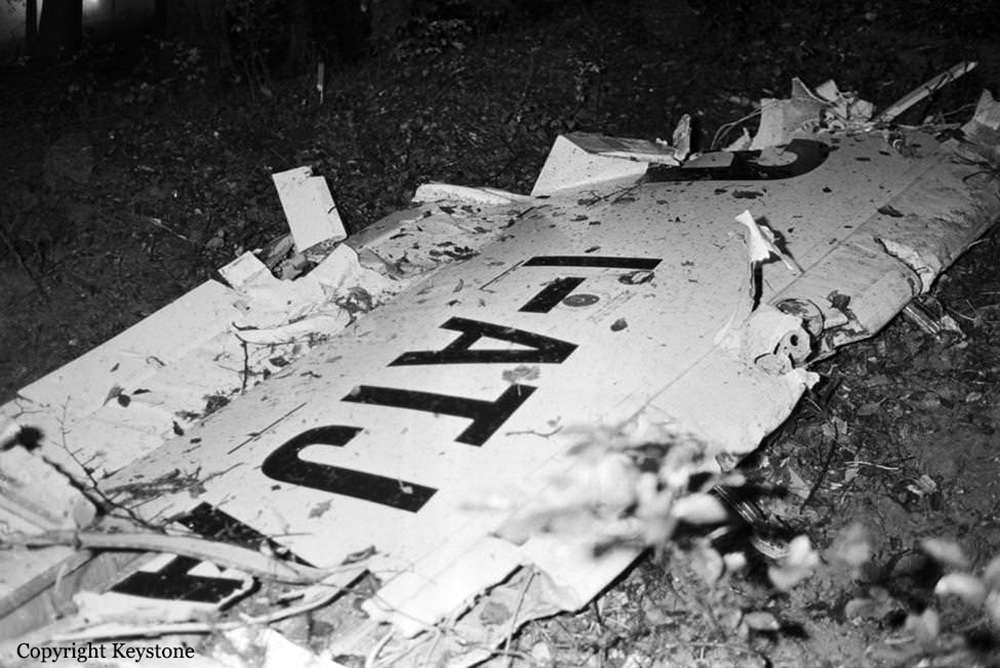
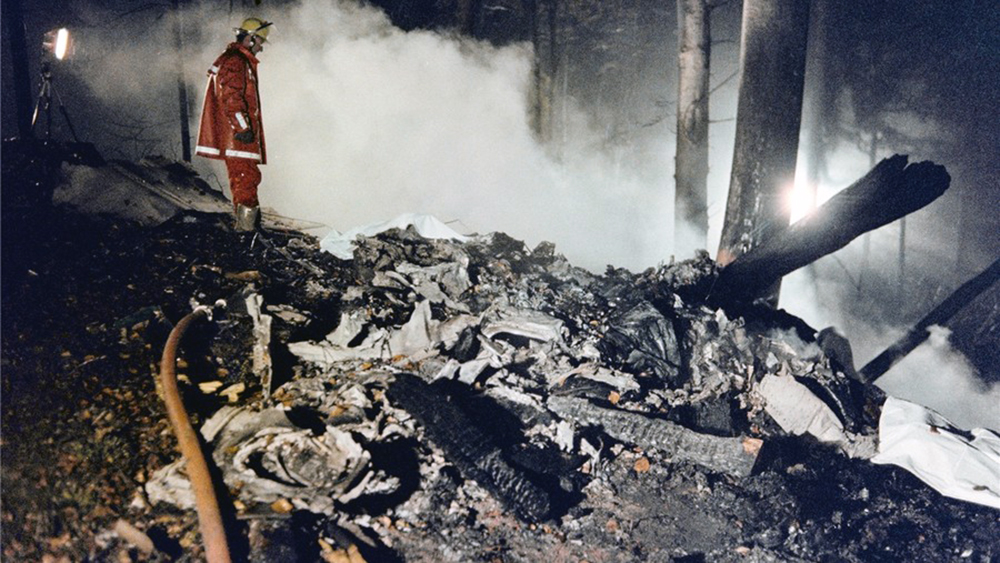
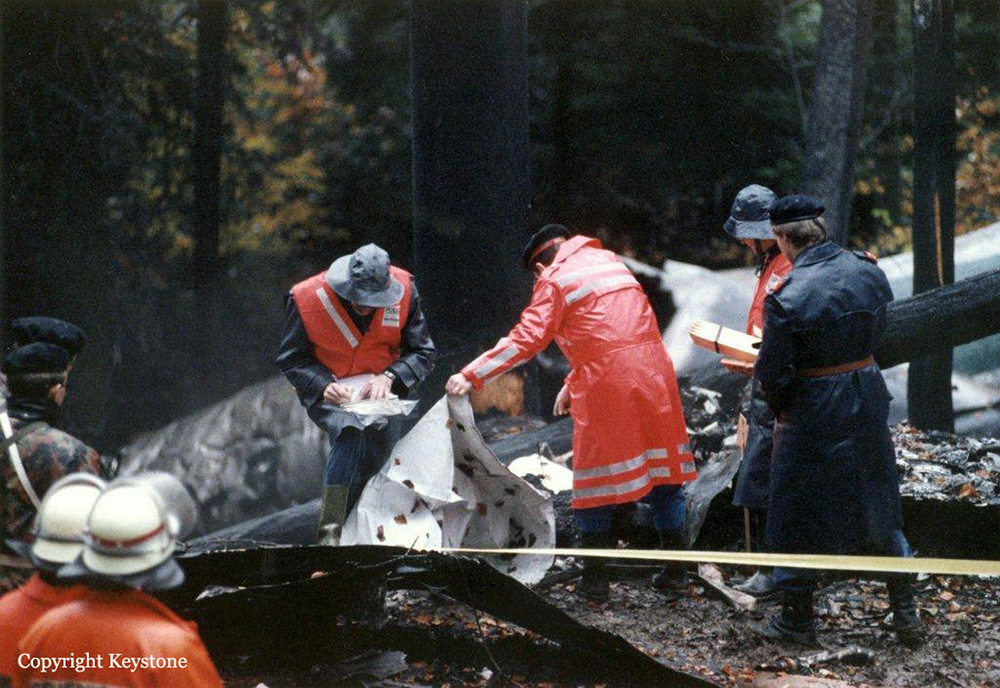
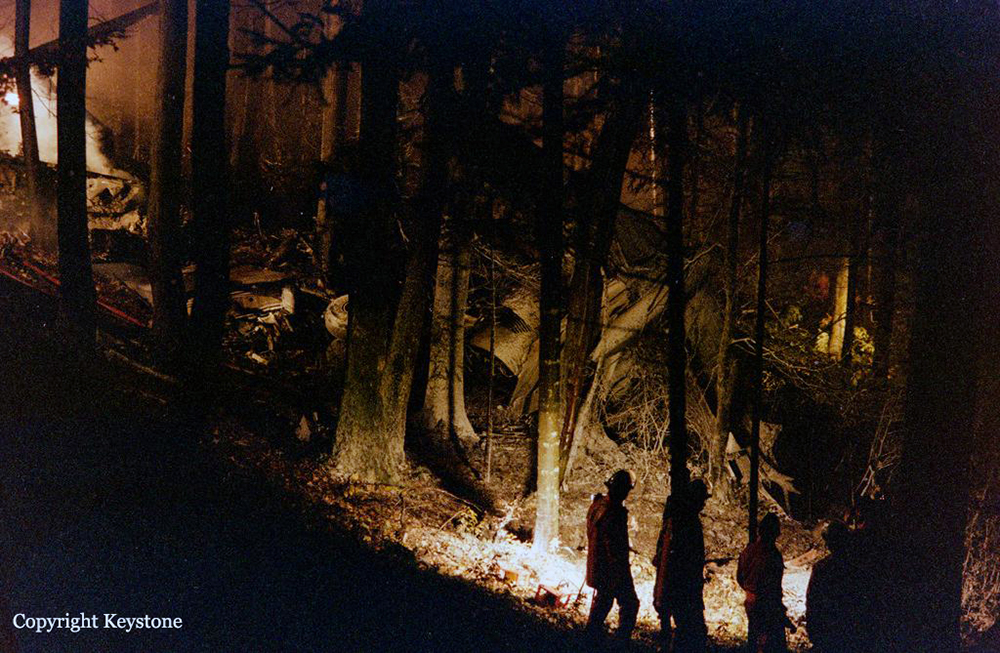
Crash of a Douglas DC-9-32 in Zurich: 46 killed

Date & Time: Nov 14, 1990 at 2011 LT
Type of aircraft:
Operator:
Registration:
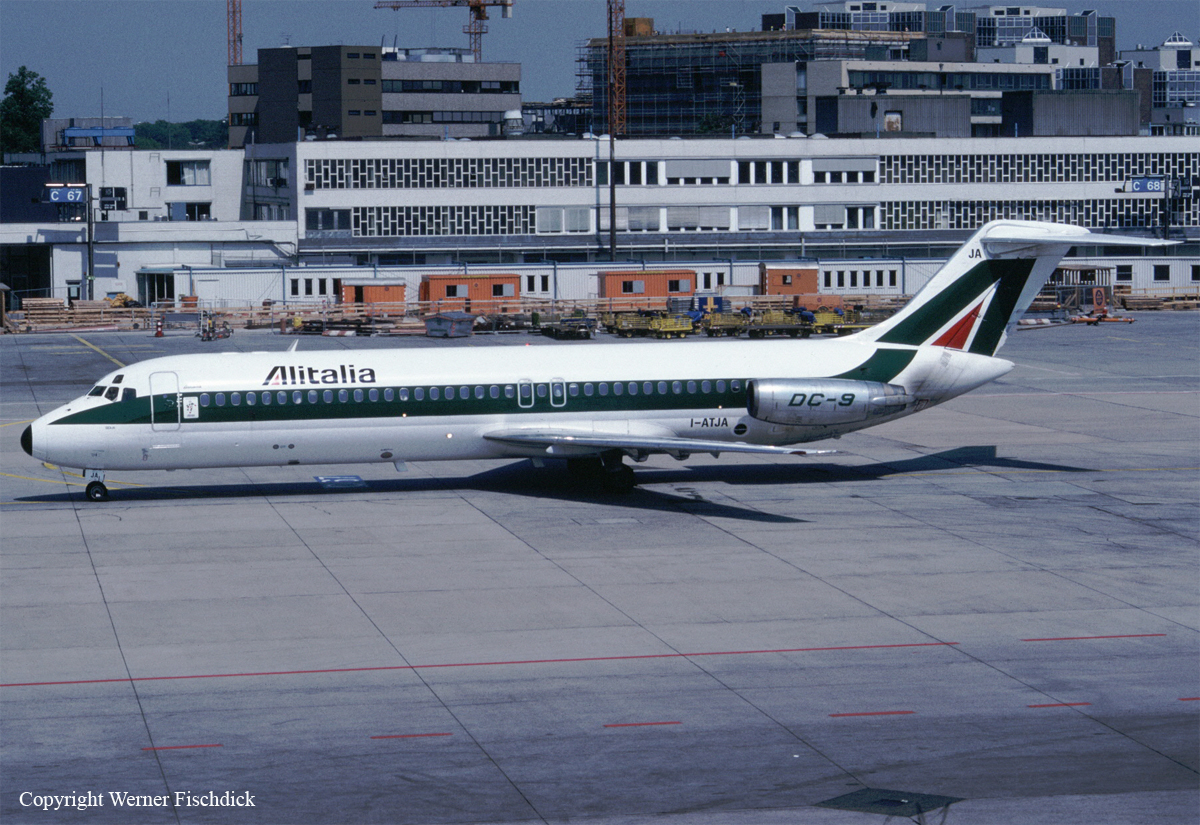
I-ATJA
Survivors:
No
Schedule:
Milan - Zurich
MSN:
47641
YOM:
1974
Flight number:
AZ404
Country:
Region:
Crew on board:
6
Crew fatalities:
Pax on board:
40
Pax fatalities:
Other fatalities:
Total fatalities:
46
Captain / Total flying hours:
10193
Captain / Total hours on type:
3194.00
Copilot / Total flying hours:
831
Copilot / Total hours on type:
621
Aircraft flight hours:
43894
Aircraft flight cycles:
43452
Circumstances:
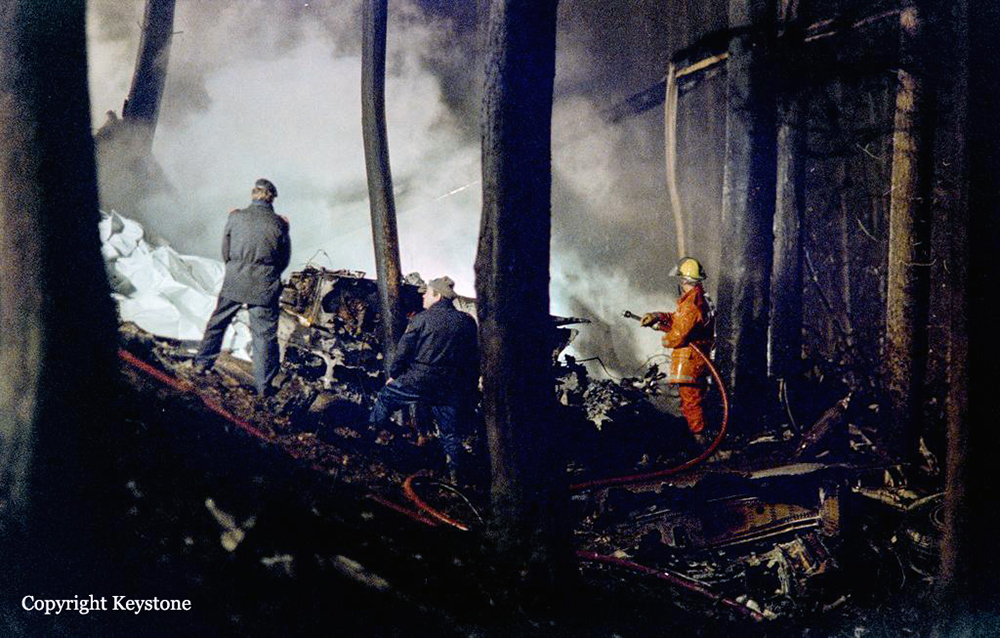
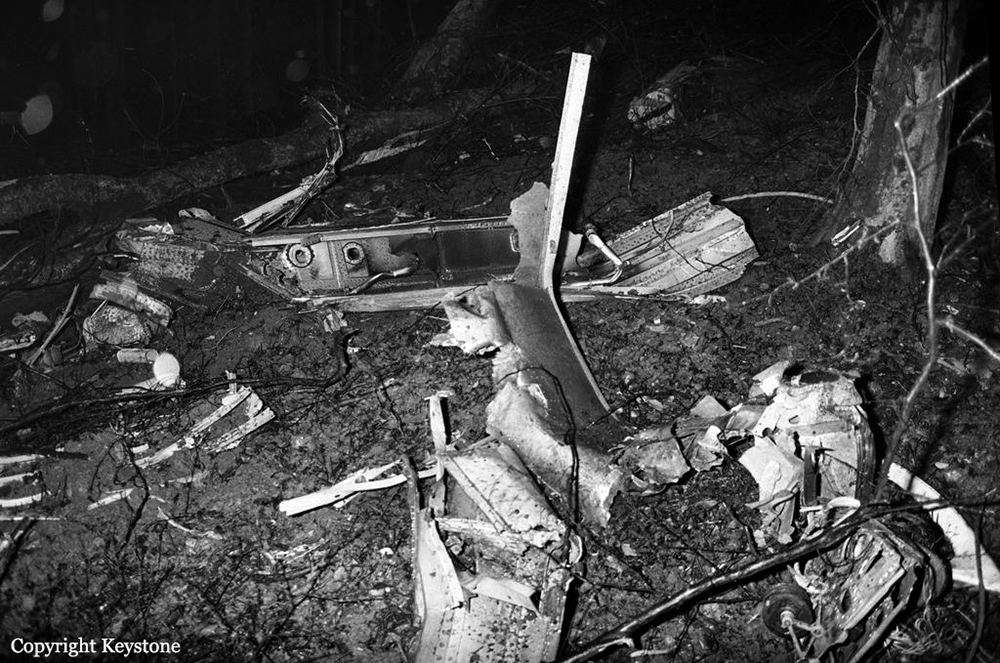
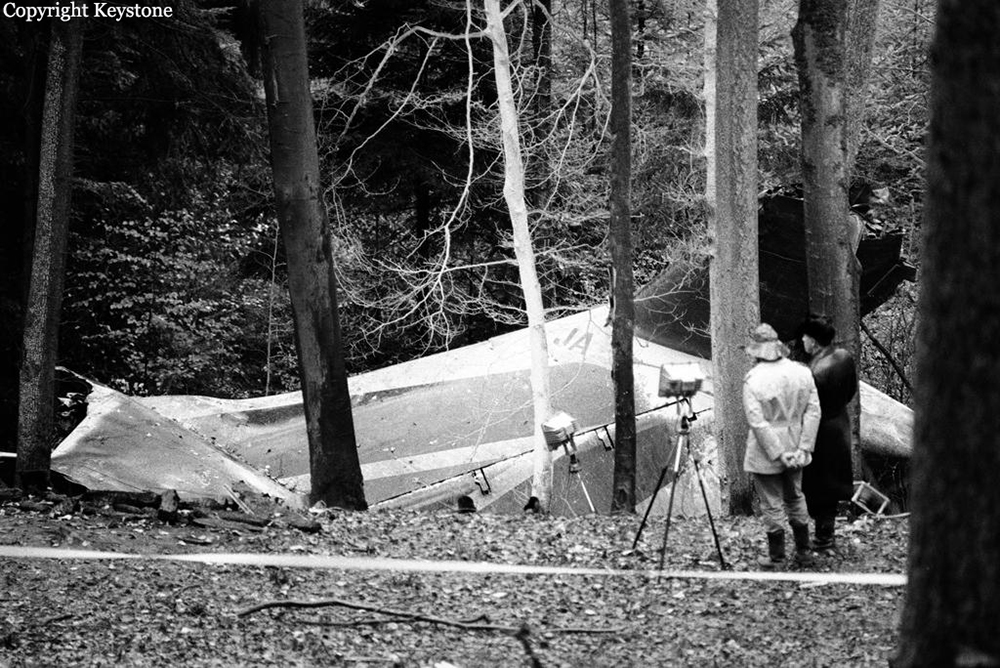
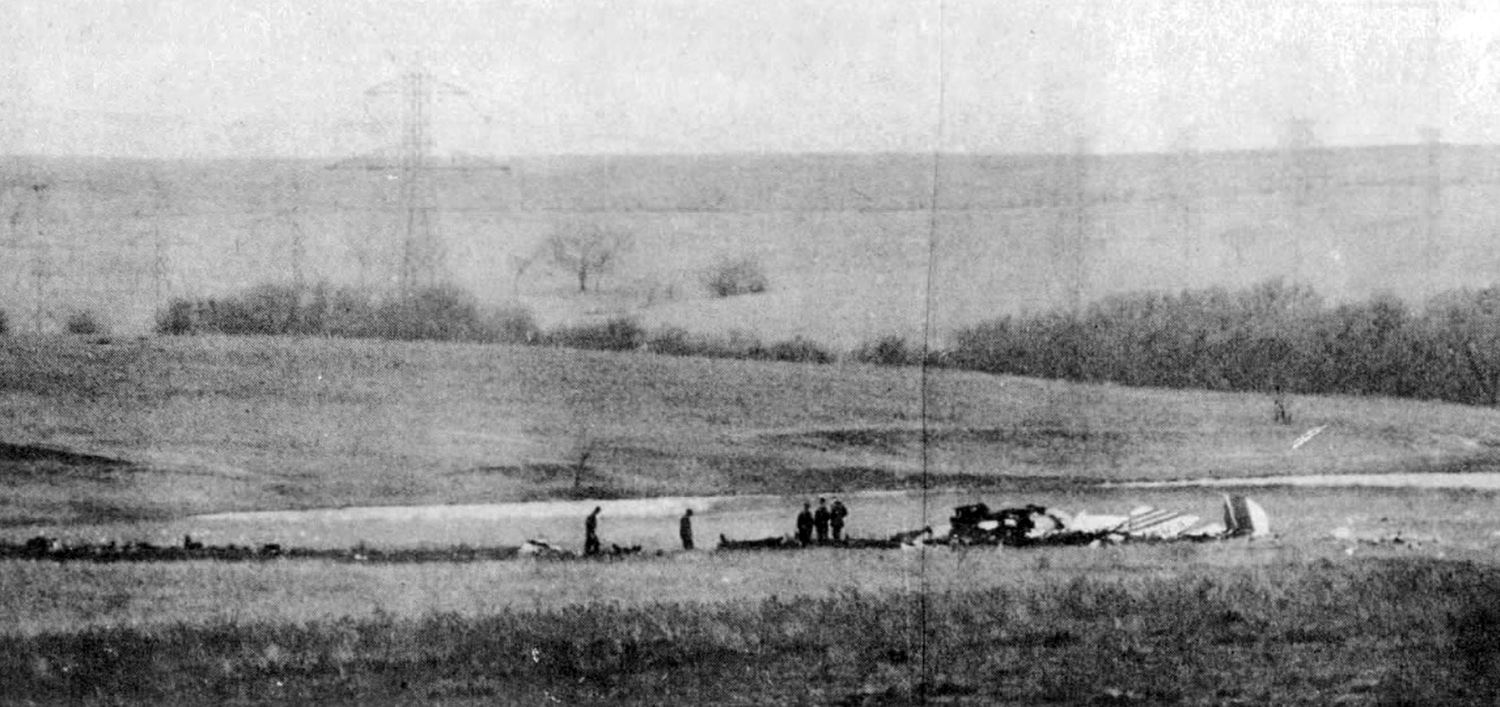
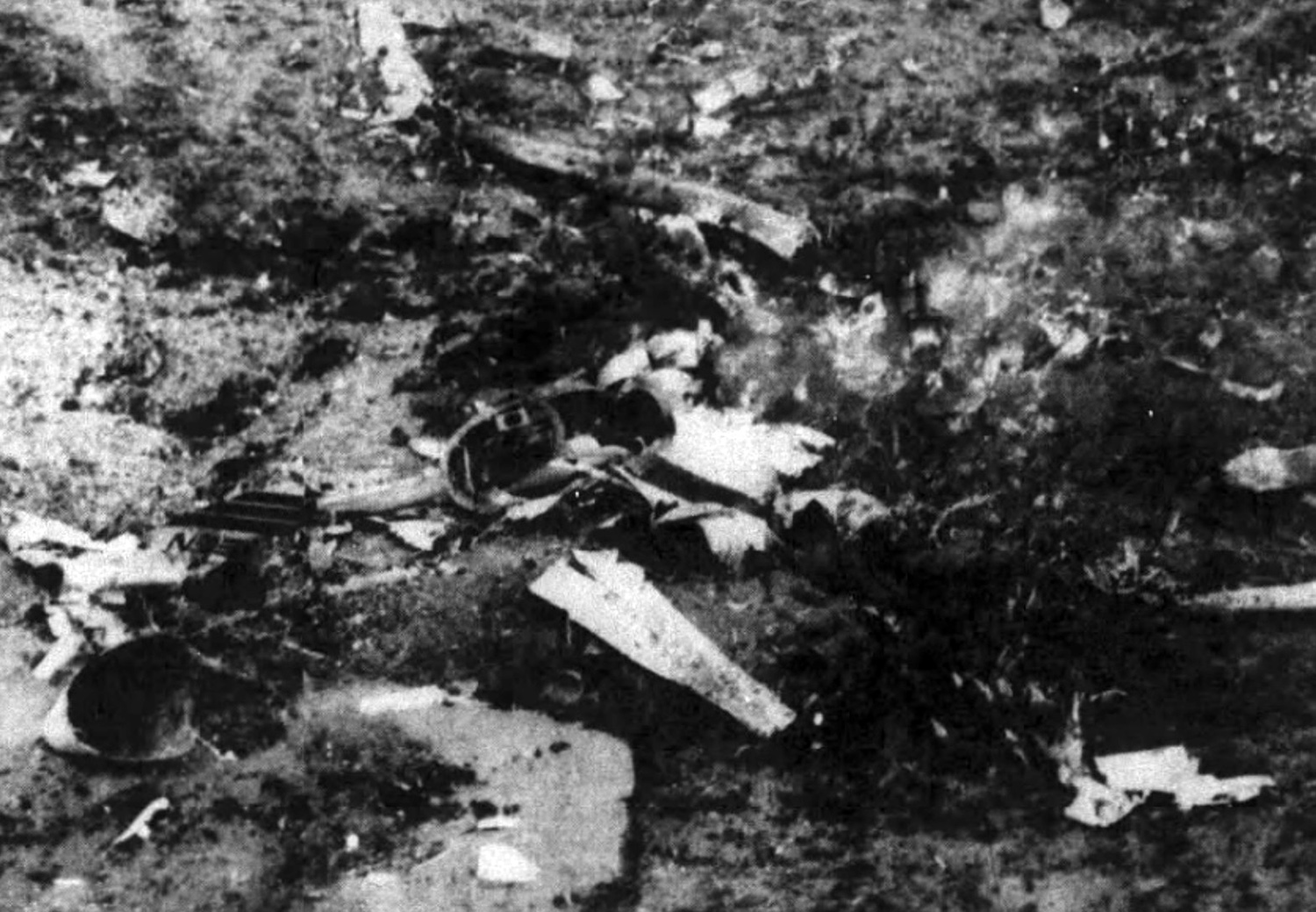
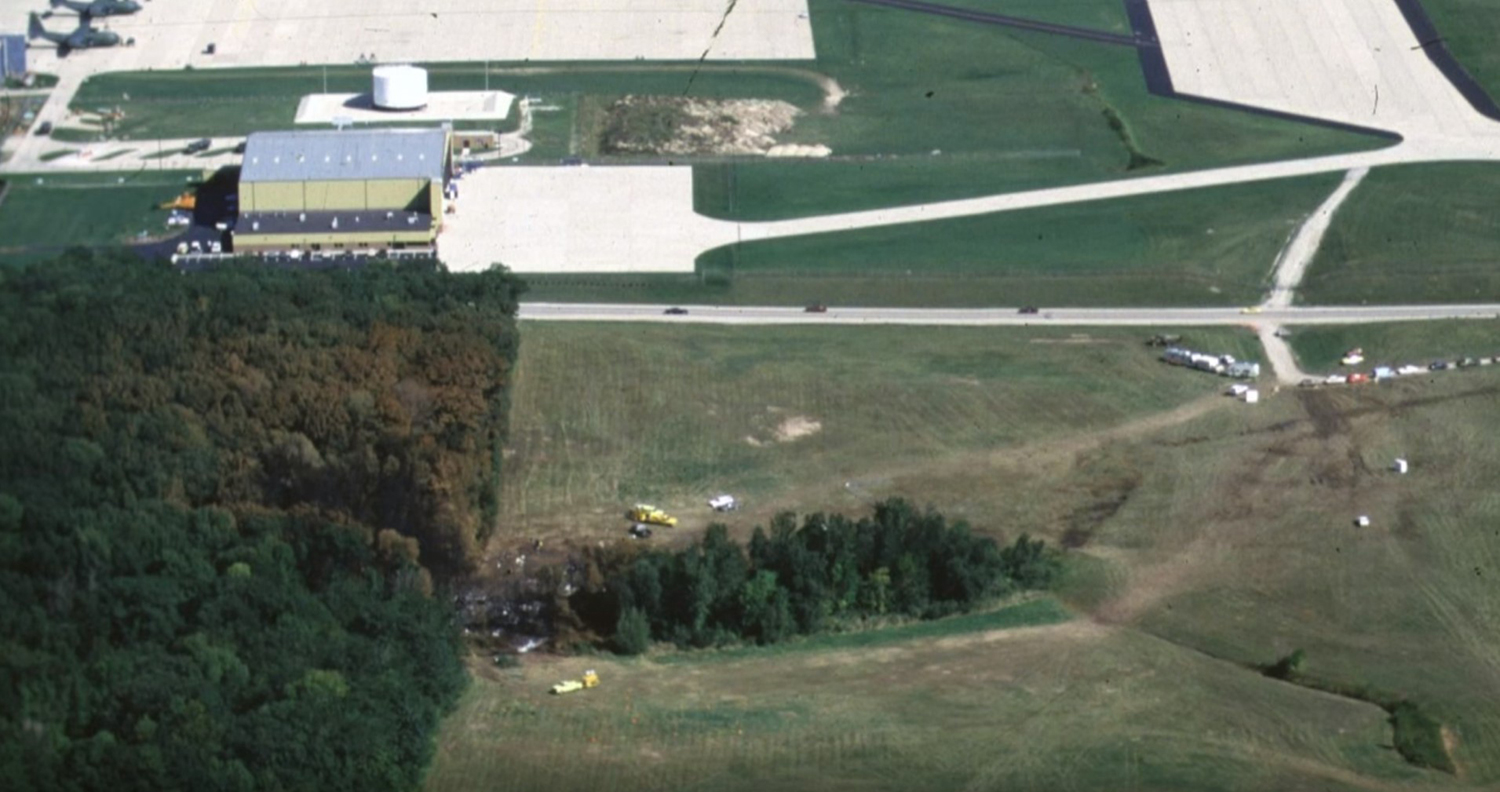
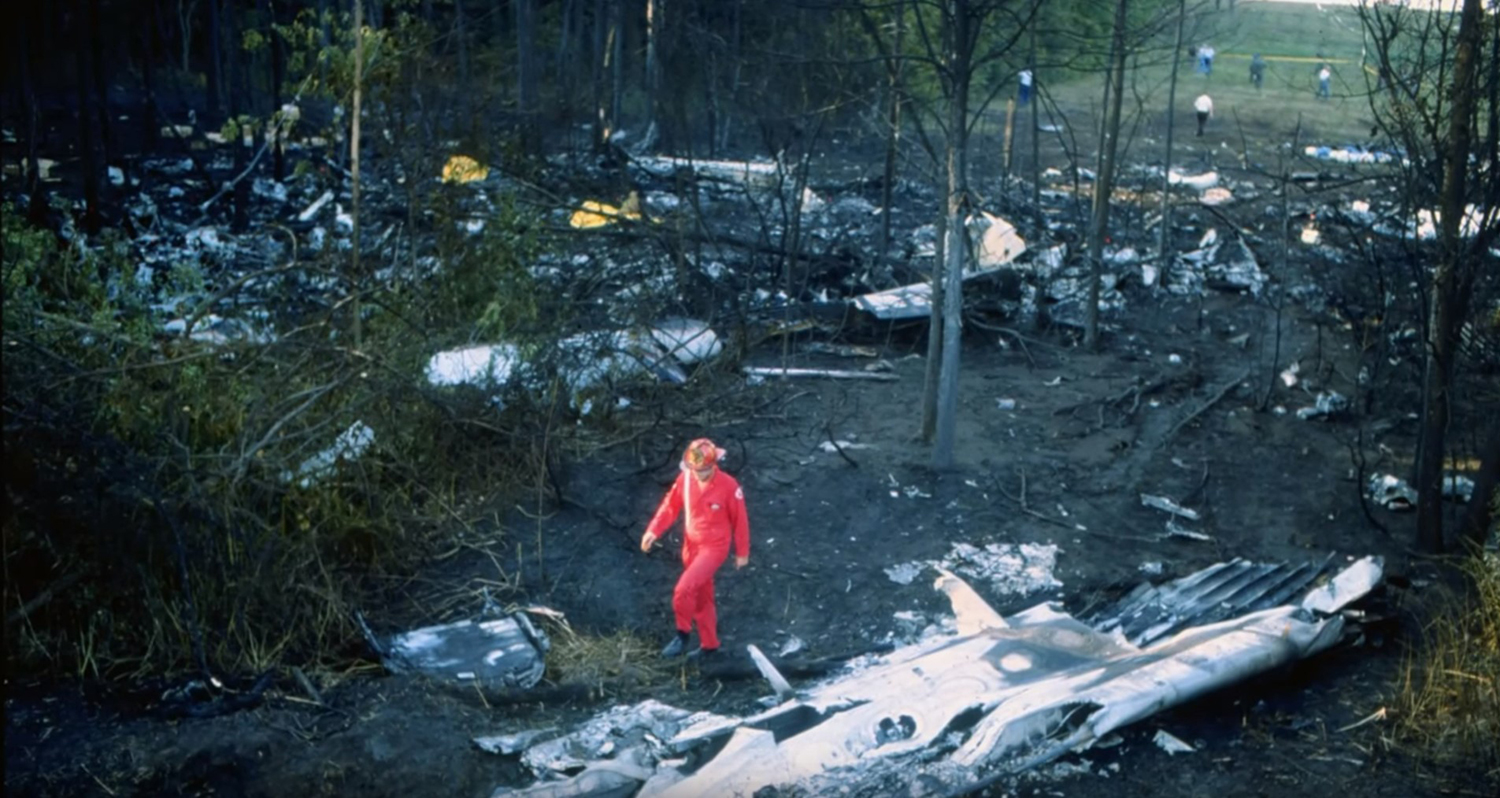
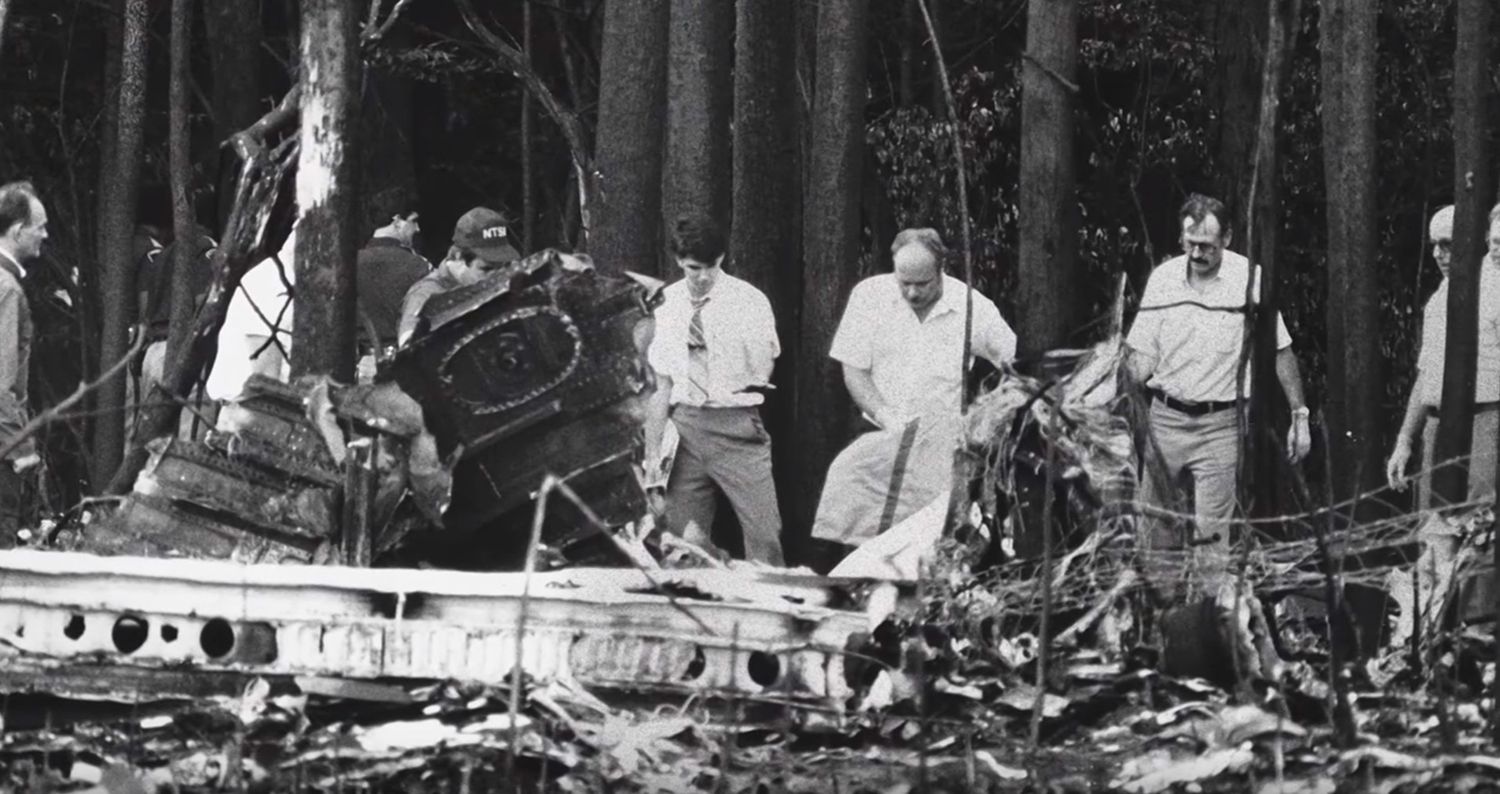
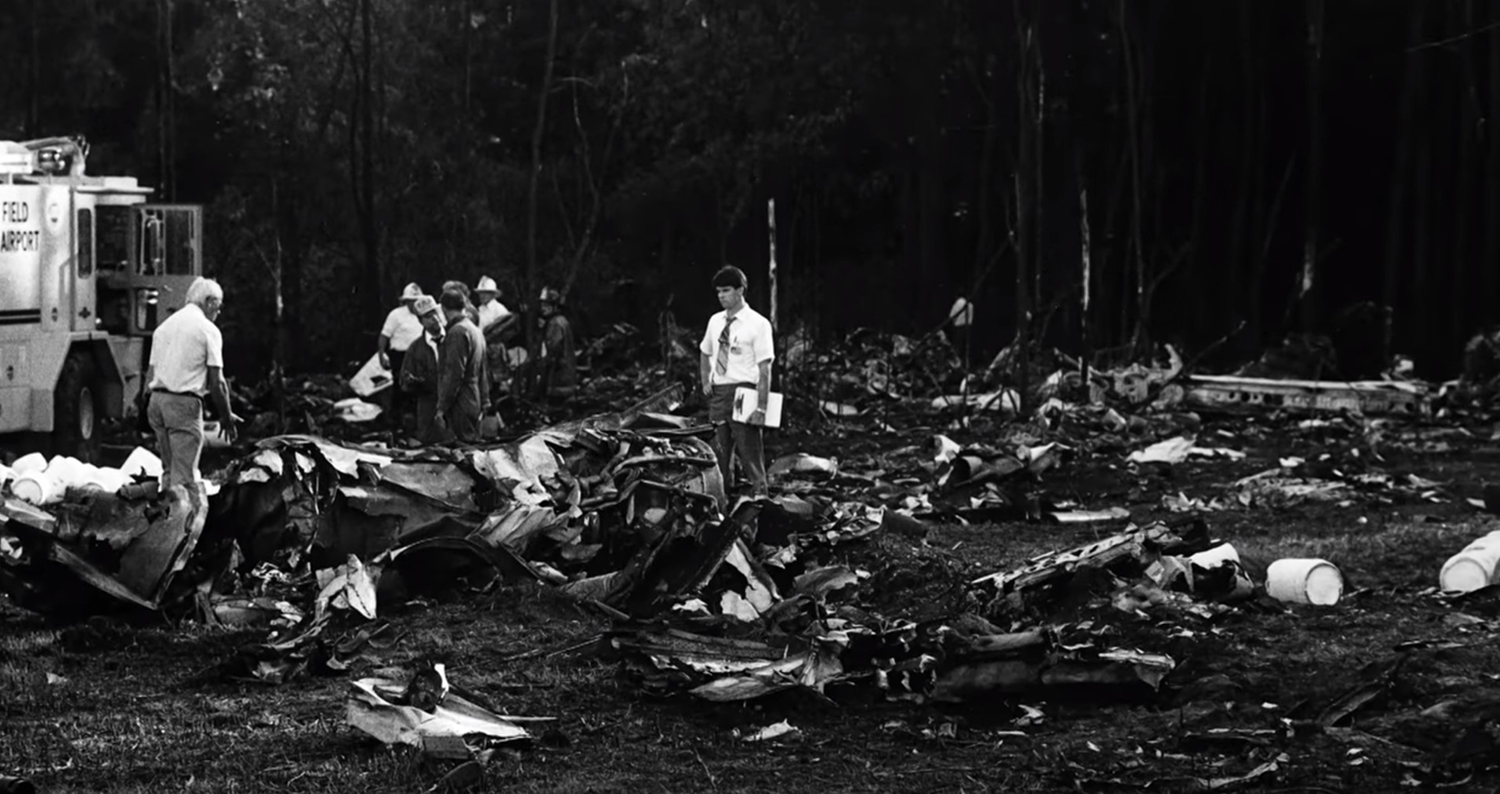
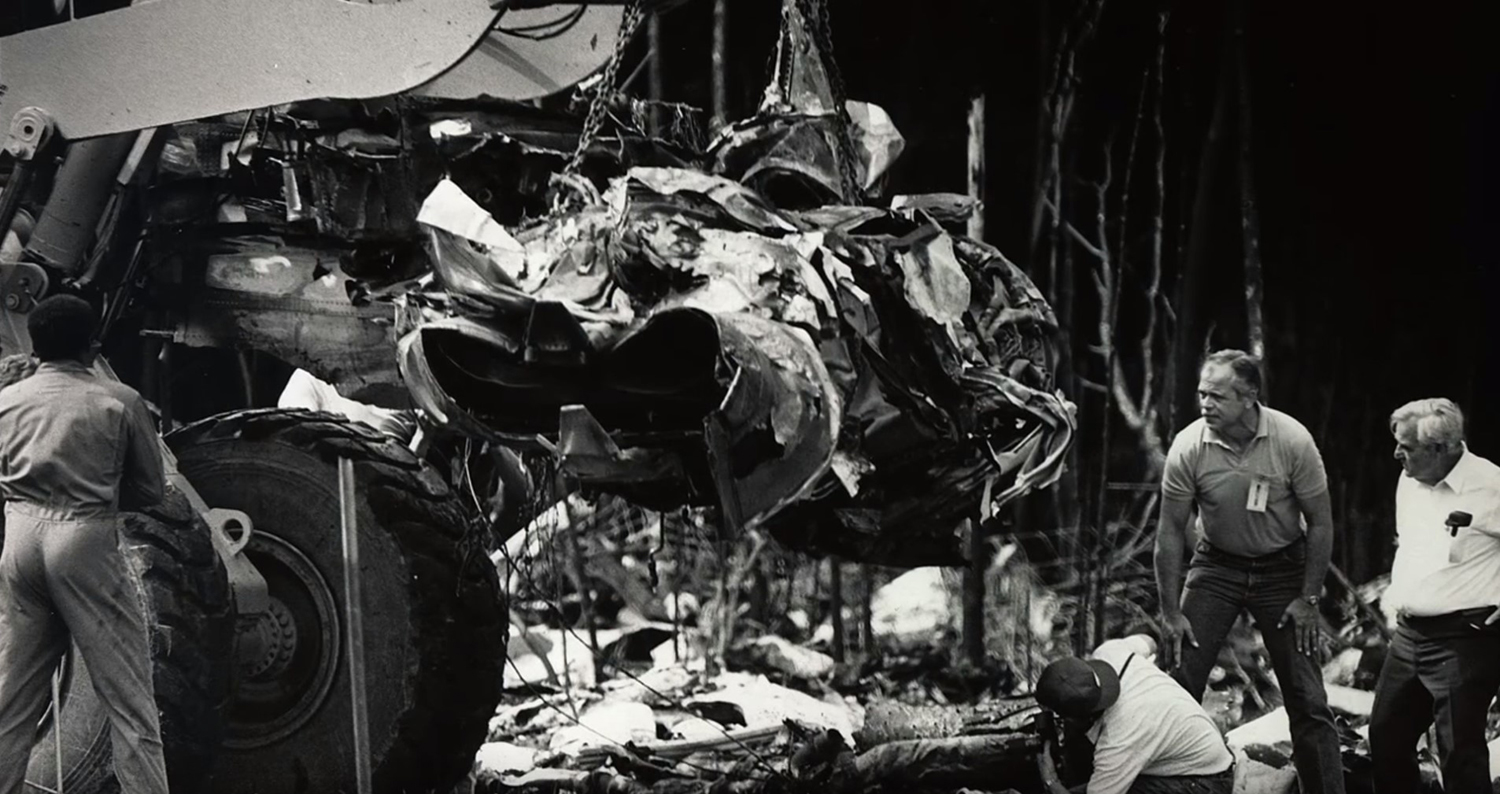
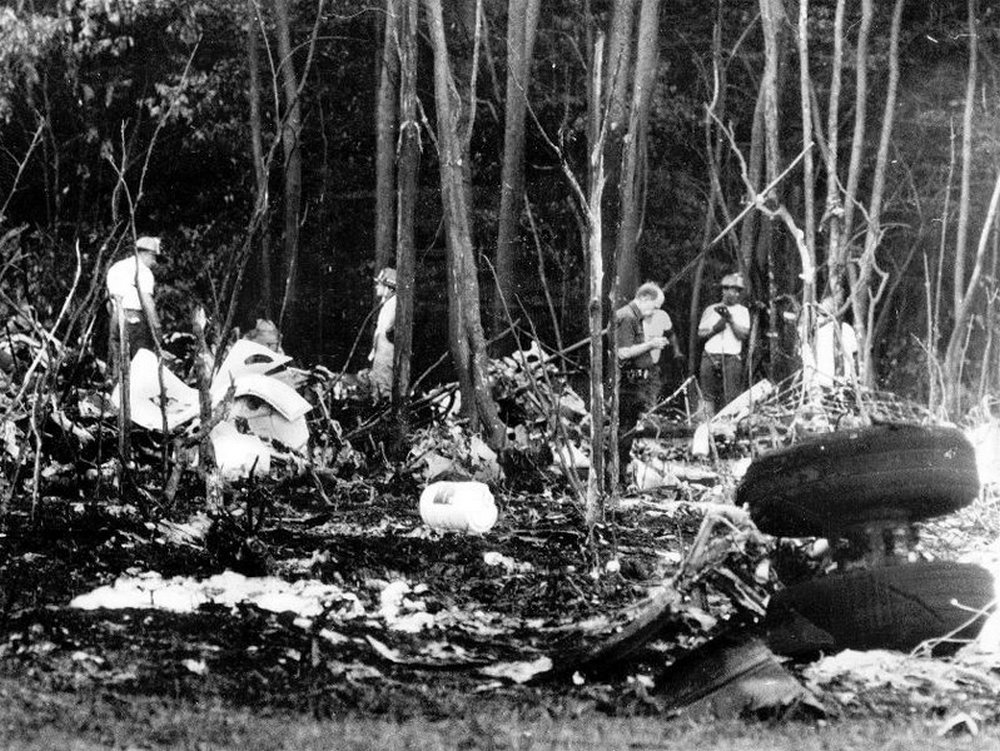
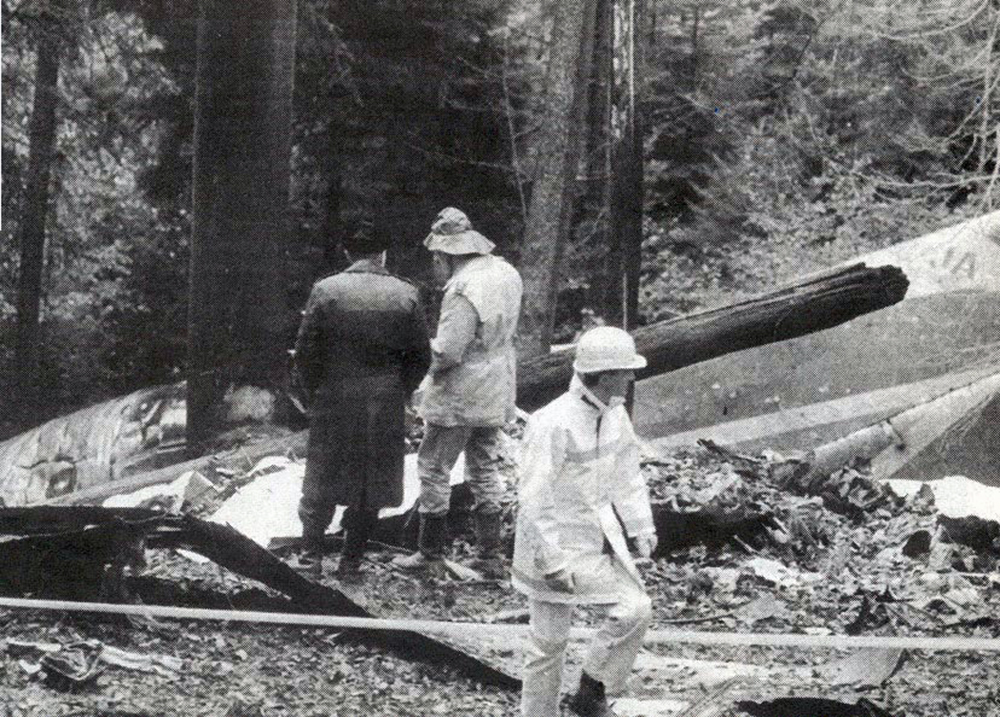
On the 14th November 1990 ALITALIA flight 404, aircraft type DC-9-32 registration I-ATJA, took off from runway 36R at LIN bound for ZRH. The flight was a scheduled commercial flight. The clearance was to the destination airport Zürich, via a CANNE IC departure to Flight Level 120, the transponder code 0302. The PIC assumed the duties of assisting pilot and dealt with the radio-telephony. The First Officer was the handling pilot. The take-off was at 1836 hrs. The standard climb via CANNE towards Airway A9 to the cruising flight level of 200 was trouble free. About 2 minutes after reaching Flight Level 200 the crew listened to Zürich VOLMET. From this they gathered that the surface wind at Zürich was 240/08 kt. This led the PIC forsee a landing on runway 28. Having heard from the ATIS that the landing runway was 14, the crew still discussed a right hand circling approach for a landing on runway 28. The discussion continued considering a left hand circling to runway 28. At 1852.53 hrs, from a QNH of 1019 hPa the crew worked out a QFE of 970 hPa. During the descent, the crew discussed the approach procédure for runway 14, where the Copilot mentioned the Outer Marker height for runway 16. After the discussion about the setting of the navigation aids, they also discussed the procédure to be followed in the event of a communications failure. The crew were instructed that following radar vectors they should fly an ILS approach to runway 14. At 1900.01 hrs the Copilot said "We perform a CAT JJ (approach)". The PIC was in agreement because the navigation equipment had to be checked. Whilst verifying the décision height, it transpired that the Copilot was still Consulting the approach chart for runway 16. Further lengthy discussions about the setting of the required navigation aids followed. As the aircraft passed abeam Zürich descending to Flight Level 90, the PIC noted: "We are by KLOTEN, FL 90. He is bringing us in high". Clearance to descend to Flight Level 60 followed at 1902.28 hrs. At 1902.50 hrs ALITALIA 404 was instructed to fly heading 325. VHF NAV 1 was tuned to Trasadingen VOR (TRA), VHF NAV 2 to Kloten VOR (KLO). To define the fix at EKRON, the course 068 was also set. At 1904.32 hrs the PIC repeated "The outer marker is at 1200 ft (QFE), it can be verified by 3.8 [NM] from Kloten. Rhein (RHI NDB) 5.6 [NM]...". At 1905.15 hrs a new heading was required which the PIC confirmed. The identification of the ILS - 14 was registered on the CVR at 1905.32 hrs. At 1906.20 hrs, together with the approach clearance to runway 14, a new heading of 110, descent to 4000 ft and the QNH of 1019 hPa was given. The PIC confirmed this clearance, however the heading was read back as 120. The incorrect readback of the clearance by the PIC caused the Copilot some uncertainty of the required heading to be flown. The PIC confirmed the approach clearance and the cleared altitude 4000 ft to the COPI, whereby the COPI ordered "RADIO APPROACH...". At this point an altitude of about 5000 ft (QNH) was passed. One of the pilots asked the other whether he had a Glide Path indication. The aircraft position was just before interception of the Localiser passing an altitude of about 4700 ft (QNH) (according to radar and DFDR). It was already about 1300 ft below the Glide Path. Answering the question about the Glide Path, the other pilot replied (hardly understandable) "On 1...I don't have...." Consequently the PIC said: "Good, so let's do it on 1". The COPI then ordered "RADIO 1". The flaps were probably set to 15°. In the meantime, the aircraft had passed through the localiser and was now slightly east of it. About the same time as the PIC said "Capture LOC capture glide path capture - so we are on the localiser, a little off track but..." (translated from Italian) the aircraft descended through 4000 ft (QNH) (about 11.5 NM from the threshold runway 14). It was thus about 1200 ft below the glide path. The QFE 970 hPa was also set by the COPI. About 5 seconds later the Altitude Exit Alert was heard (Descent through 3700 ft [QNH]). The PIC cancelled the warning by setting 5000 ft (Go Around Altitude) on the Altitude Preselect. The PIC said to the COPI: "There is another one (Finnair 863) in front quite close. You can reduce even further to 150 (kt) otherwise we'll end up with a "go around". A discussion followed about possible icing. After this the flaps were set to 25 during which no Landing Gear horn was heard. At this point the aircraft was established on the localiser. The altitude was about 3000 ft QNH - ca. 1200 feet below the glide path. The PIC: "Outer Marker check is at 1250 ft [QFE]". The height was now about 1600 ft QFE. 10 seconds after Flaps 25, the flaps were set to 50. The Outer Marker height of 1250 ft QFE was now passed. The PIC said "Bravo" followed by sounds of switching. At 8 NM final the PIC mentioned "3.8 almost 4 miles". At about 7 NM final, (15 seconds after the PIC's words "Almost 4 miles") the COPI asked "... haven't we passed it?". After a further 12 seconds the COPI asked once again "Didn't we pass the outer marker?" The height was now 670 ft QFE. The PIC's answer was "No no it hasn't changed yet. At 6.6 NM final the PIC said "Oh it shows 7 The crew was now ordered by Zürich ARR to change frequency to Zürich TWR. At 6.25 NM final the pilots conversed as follows: "... That doesn't make sense to me "Nor to me ...". 2 seconds after this conversation the PIC called out "Pull, pull, pull, pull! ". Simultaneously autopilot disconnection could be heard. The position was now about 500 ft AGL overhead Weiach - about 350 ft QFE. 2 seconds later the COPI called out "GO AROUND" the PIC responded with "No no no no ... catch the glide". At this point the DFDR shows a pitch change from -2° [AND] to +5.4° [ANU]. At the same time the thrust was increased from 1.3 to 1.7 EPR. The sink rate decreased from 1100 ft/min. to 190 ft/min. After 11 seconds (the pitch oscillated at +1° [ANU]) the PIC asked "Can you hold it?" to which the COPI replied "Yes". One second after the COPI's answer the Radio Altimeter warning (pip pip pip) indicating 200 ft/AGL could be heard. During this, the PIC said "Hold on let's try to At 1911.18 hrs the aircraft Struck the north em slope of the Stadlerberg at a altitude of 1660 ft QNH. All 46 occupants were killed.
Probable cause:
The accident was the consequence of the combination of the following factors:
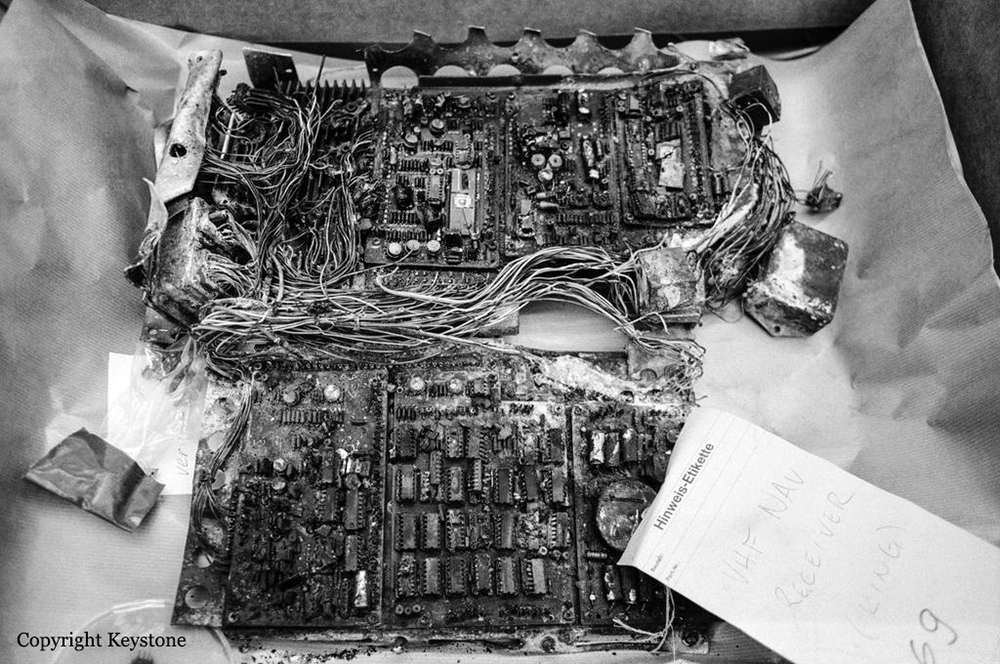
- False indication of VHF NAV unit n°1 in the cockpit,
- Probable altimeter misreading by the PIC,
- No GPWS warning in the cockpit,
- Pilots not aware of the possibility of incorrect indications in the NAV equipment in use (without flag-alarm),
- Inadequate failure analysis by the pilots,
- Non-compliance by the pilots with basic procedural instructions during the approach,
- Unsuitable cooperation between the pilots during the approach,
- COPI's initiated go around procedure aborted by the PIC,
- The Approach Controller not observing the leaving of the cleared altitude of 4000 ft QNH before the FAP.
Final Report:
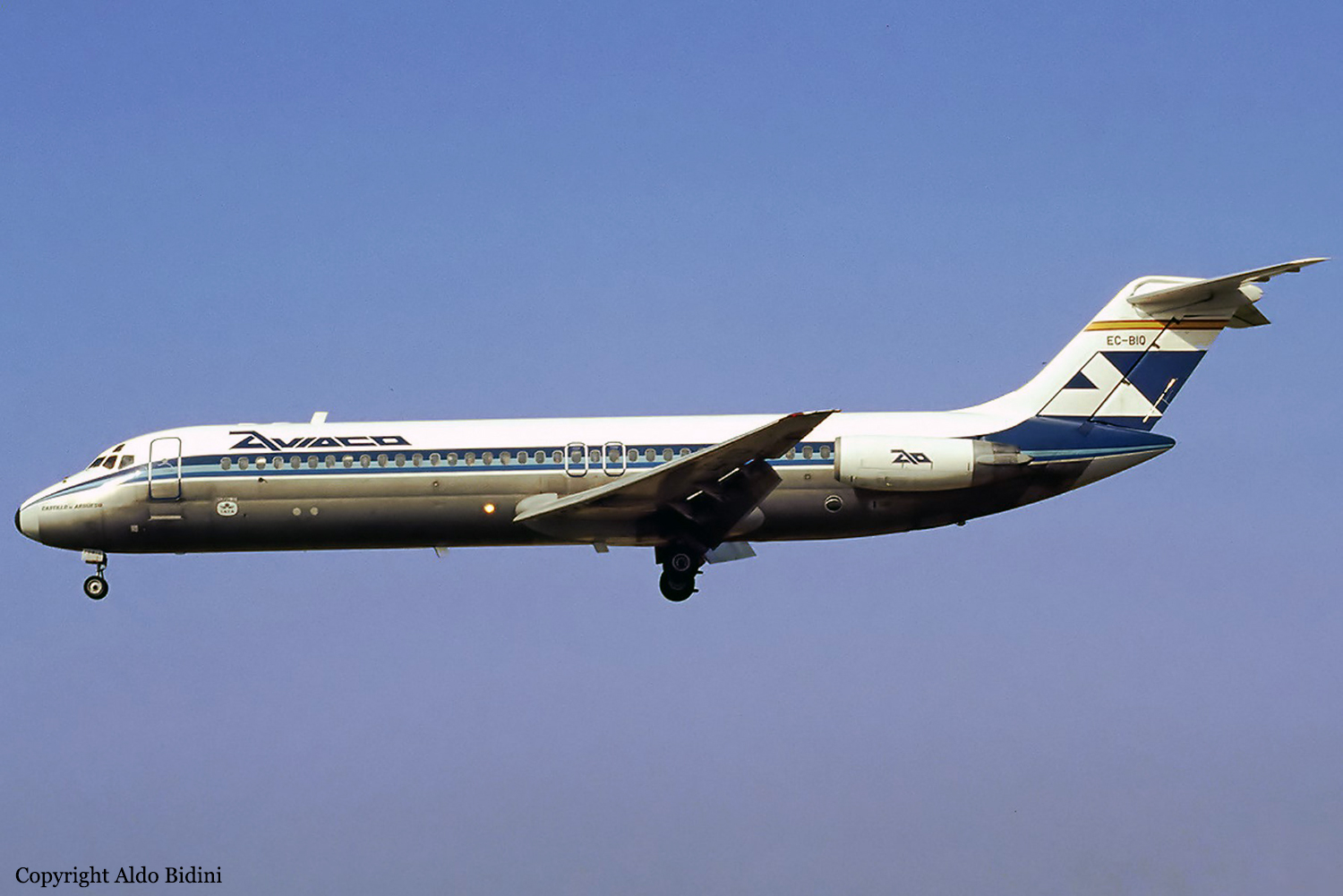
Crash of a Douglas DC-9-32 in Mahón

Date & Time: Feb 17, 1990 at 2030 LT
Type of aircraft:
Operator:
Registration:
EC-BIQ
Survivors:
Yes
Schedule:
Palma de Mallorca - Mahón
MSN:
47092
YOM:
1967
Country:
Region:
Crew on board:
7
Crew fatalities:
Pax on board:
82
Pax fatalities:
Other fatalities:
Total fatalities:
0
Circumstances:
The approach to Mahón Airport was completed by night and poor weather conditions. On final, the crew lost visual contact with the runway and the captain instructed the pilot to initiate a go-around. In a certain confusion, the aircraft continued its approach until it struck the runway surface with a positive acceleration of 3,56 G. The captain took over control, initiated a go-around and decided to return to Palma de Mallorca where a safe landing wa completed. All 89 occupants evacuated safely while the aircraft was considered as damaged beyond repair due to severe structural damages.
Probable cause:
It was determined that the copilot (pilot-in-command) did not understand the captain's instructions to initiate a go-around procedure due to non standard phraseology used by the captain. Poor crew coordination and lack of visibility were considered as contributing factors.

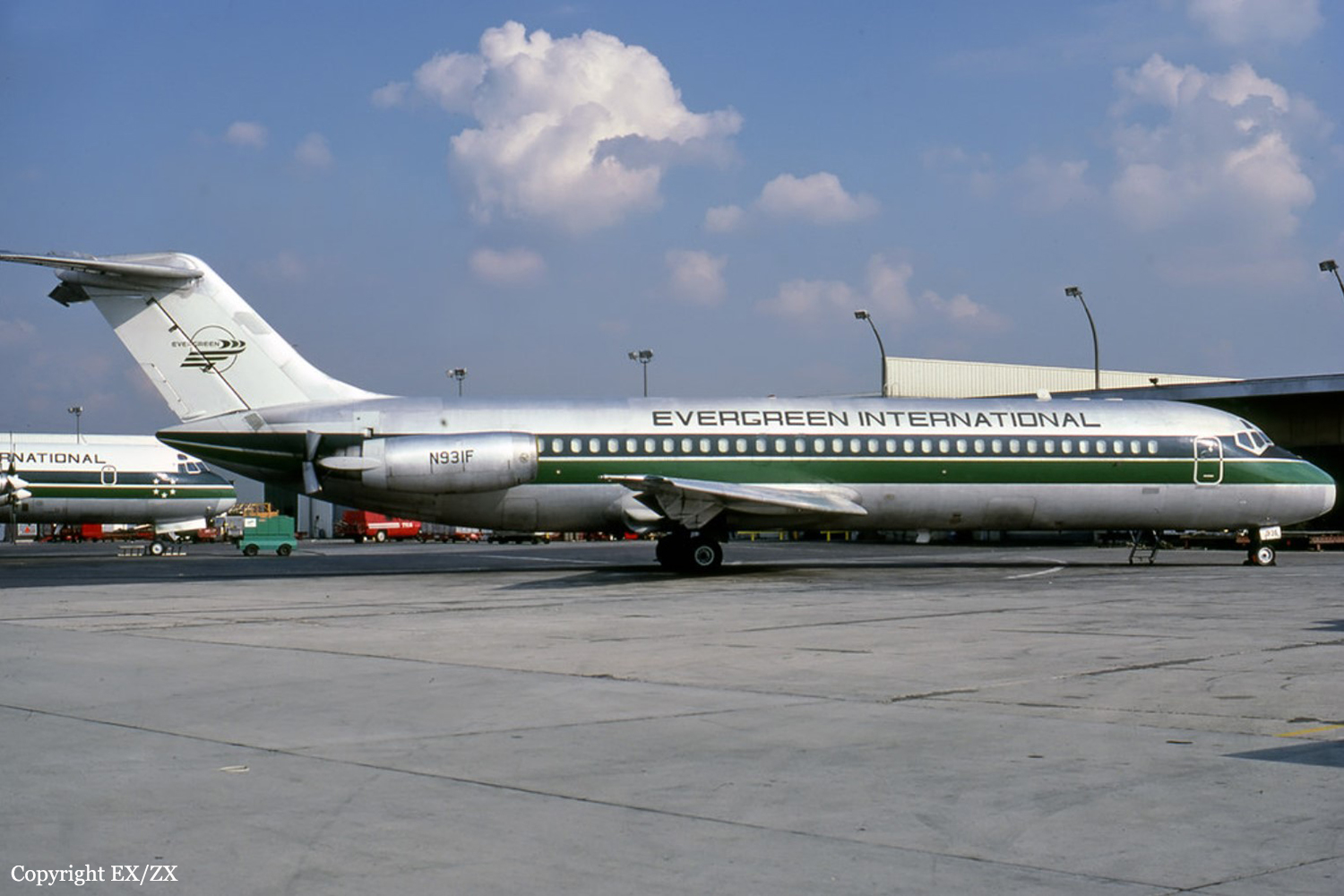
Crash of a Douglas DC-9-33RC at Carswell AFB: 2 killed

Date & Time: Mar 18, 1989 at 0216 LT
Type of aircraft:
Operator:
Registration:
N931F
Flight Phase:
Flight Type:
Survivors:
No
Schedule:
Carswell - Tinker
MSN:
47192
YOM:
1968
Flight number:
EV417
Crew on board:
2
Crew fatalities:
Pax on board:
0
Pax fatalities:
Other fatalities:
Total fatalities:
2
Captain / Total flying hours:
7238
Captain / Total hours on type:
1938.00
Copilot / Total flying hours:
10863
Copilot / Total hours on type:
1213
Aircraft flight hours:
41931
Aircraft flight cycles:
40808
Circumstances:
The DC-9 arrived at Carswell AFB at 01:12 CST after a flight from Kelly AFB. The aircraft was off-loaded and re-loaded with cargo by USAF personnel. The engines were then started at 02:04. The crew received taxi instructions for runway 17 and took off from this runway at 02:09. At (or immediately after) rotation, the main cargo door opened. An emergency was declared and the crew climbed to 2500 feet msl before entering a right turn. When about 5nm north of the airport the captain began a shallow turn to the right (for base leg). The aircraft crossed the extended centreline and the captain tightened the turn to establish their position relative to the runway threshold. In doing so, the air load on the door probably caused it to rapidly move to its full open over the top position. A sudden opening of the door would also have produced an unexpected change in the yawing and rolling moments. The captain, possibly partially disoriented, may not have sensed the increasing roll and nose tuck and thus failed to correct a changing attitude until a critical bank angle and loss of altitude had occurred. The DC-9 struck the ground in an inverted, nose down, left wing low attitude and disintegrated. It appeared that the first officer, when closing the main cargo door, didn't hold the door control valve 'T' handle in the closed position long enough for the latching hooks to move into place over the door sill spools. External latched and locked indicators were applied incorrectly, so the first officer thought the door was latched properly when the handle was pointed more toward the 'locked' than the 'unlocked' chevron. It also appeared that one of the two open door warning light switches was malfunctioning. Because of their wiring, this malfunction made the entire door warning system ineffective.
Probable cause:
The loss of control of the airplane for undetermined reasons following the in-flight opening of the improperly latched cargo door. Contributing to the accident were inadequate procedures used by Evergreen Airlines and approved by the FAA for pre-flight verification of external cargo door lock pin manual control handle, and the failure of McDonnell Douglas to provide flight crew guidance and emergency procedures for an in-flight opening of the cargo door. Also contributing to the accident was the failure of the FAA to mandate modification to the door-open warning system for DC-9 cargo-configured airplanes, given the previously known occurrences of in-flight door openings.
Final Report:
Crash of a Douglas DC-9-31 in Pensacola

Date & Time: Dec 28, 1987 at 2339 LT
Type of aircraft:
Operator:
Registration:
N8948E
Survivors:
Yes
Schedule:
Richmond – Atlanta – Pensacola
MSN:
47184/274
YOM:
1968
Flight number:
EA573
Crew on board:
4
Crew fatalities:
Pax on board:
103
Pax fatalities:
Other fatalities:
Total fatalities:
0
Captain / Total flying hours:
13246
Captain / Total hours on type:
4397.00
Aircraft flight hours:
55645
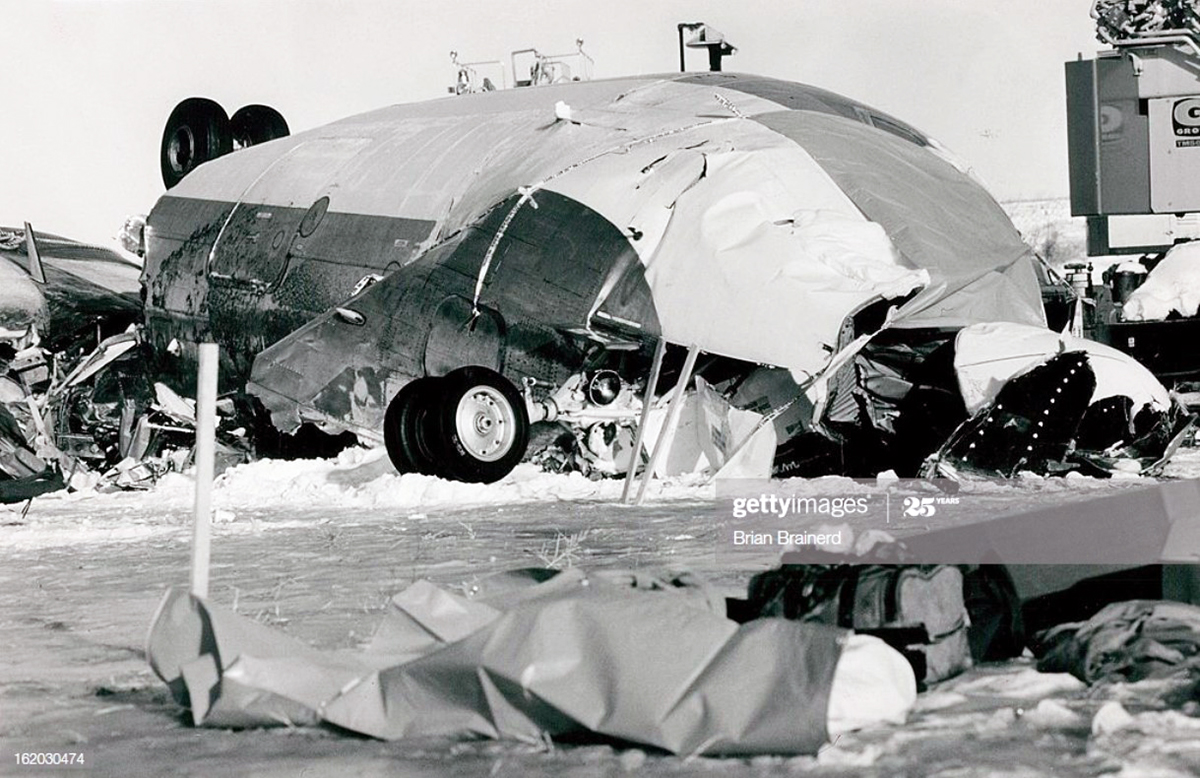
Circumstances:
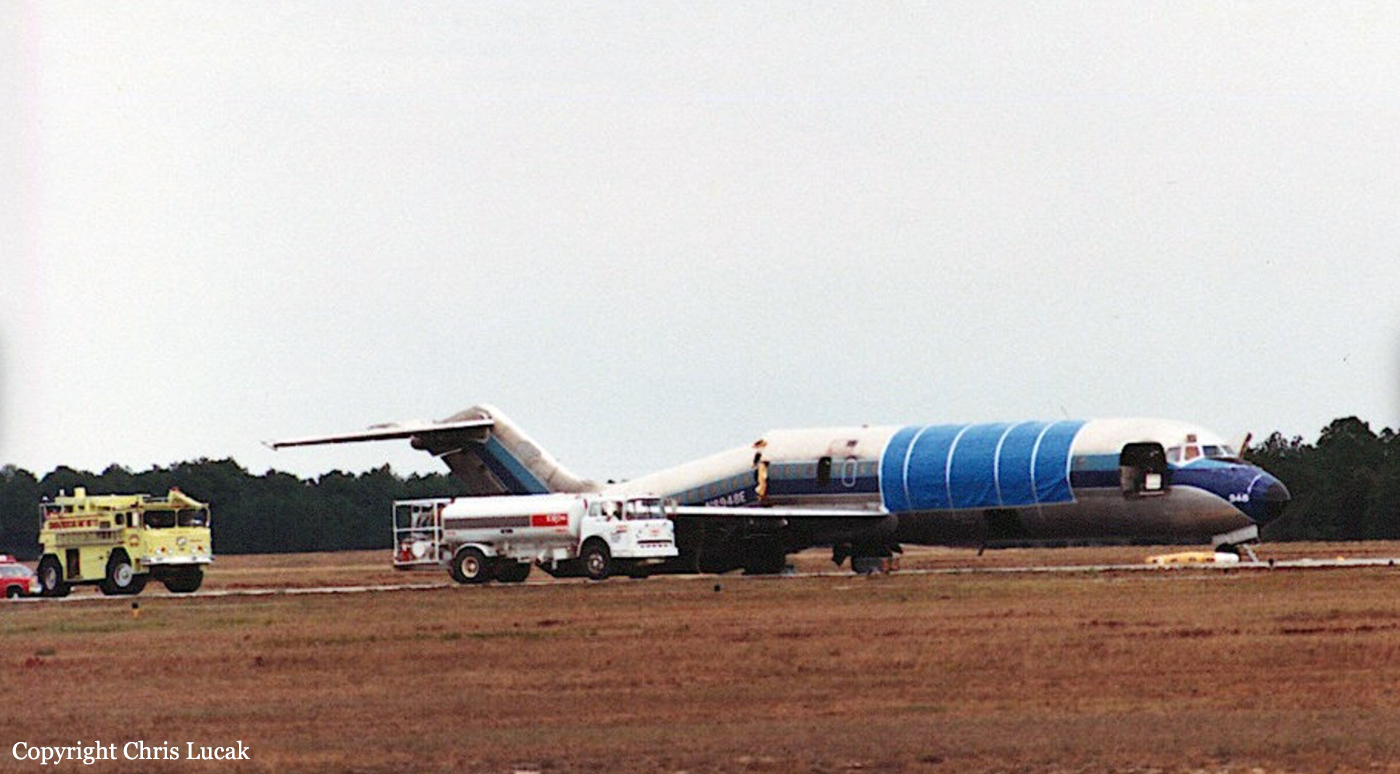
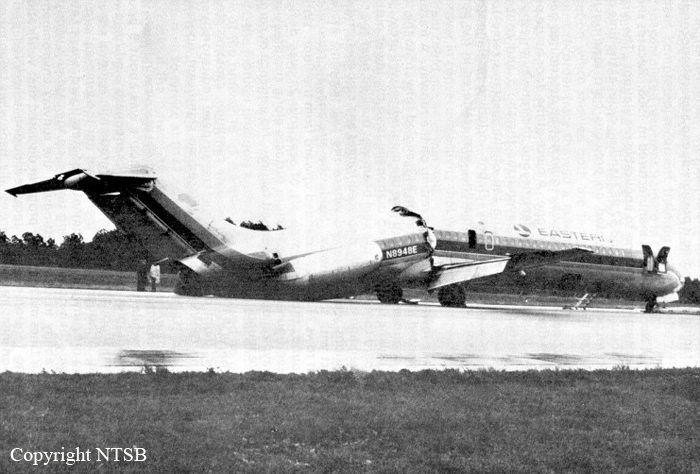
Eastern flight 573 contacted approach control at 2323 cst, was advised to expect an ILS runway 16 approach and was vectored around weather. At 2330, the controller advised the ILS glide slope (g/s) had gone into 'alarm' but the loc appeared normal. At 2333, the wind shifted to 310° at 7 knots. Since the bc approach to runway 34 was notamed as inop, the crew continued to runway 16, using 50° of flaps. At 2334, they told the controller, 'if you don't get the g/s up, we'll do a... loc approach.' They reported receiving the g/s, but were advised the g/s was still in alarm. The aircraft broke out of clouds in rain at 900 feet; light turbulence was encountered on final approach. At about 1 mile out, the f/o noted the aircraft was high and advised the captain. The captain pushed the nose over and reduced power, increasing speed and rate of descent. Requested altitude callouts were not made. F/O advised captain to flare, but flare was inadequate. The aircraft touched down hard and the fuselage failed between stations 813 and 756. Aircraft was stopped with the tail resting on the runway. Four passengers received minor injuries during evacuation. Weather study showed a moderate to strong (vip level 2 to 3) weather echo over the approach end of runway 16.
Probable cause:
The captain's failure to maintain a proper descent rate on final approach or to execute a missed approach, which caused the airplane to contact the runway with a sink rate exceeding the airplane's design limitations. Contributing to the cause of the accident was the failure of the captain and first officer to make required altitude callouts and to properly monitor the flight instruments during the approach.
Final Report:
Crash of a Douglas DC-9-14 in Denver: 28 killed

Date & Time: Nov 15, 1987 at 1415 LT
Type of aircraft:
Operator:
Registration:
N626TX
Flight Phase:
Survivors:
No
Schedule:
Denver - Boisé
MSN:
45726
YOM:
1966
Flight number:
CO1713
Crew on board:
5
Crew fatalities:
Pax on board:
77
Pax fatalities:
Other fatalities:
Total fatalities:
28
Captain / Total flying hours:
12125
Captain / Total hours on type:
133.00
Copilot / Total flying hours:
3186
Copilot / Total hours on type:
36
Aircraft flight hours:
42184
Aircraft flight cycles:
54759
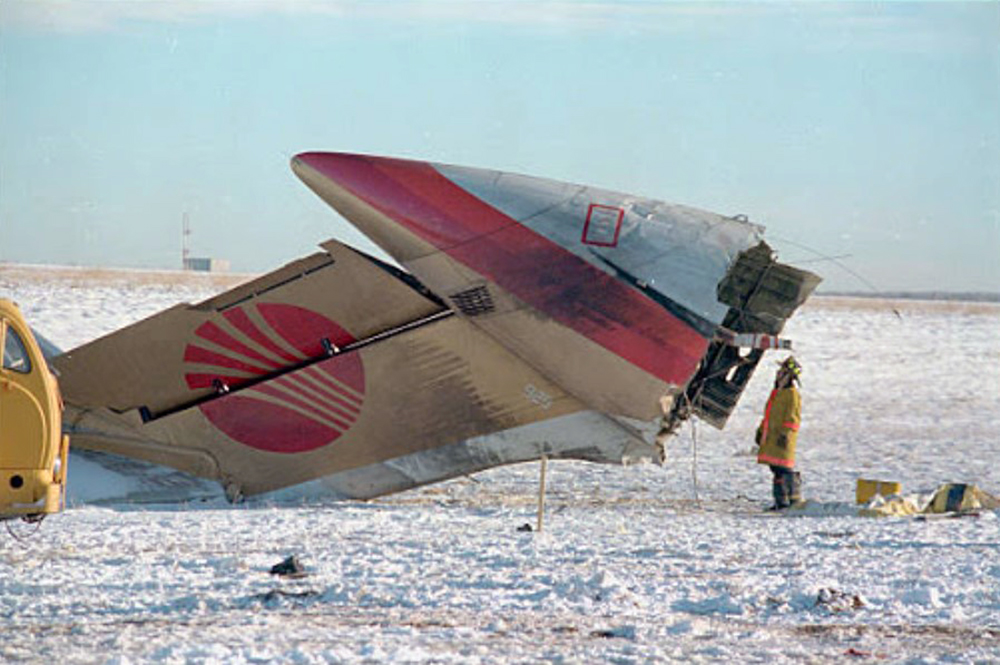
Circumstances:
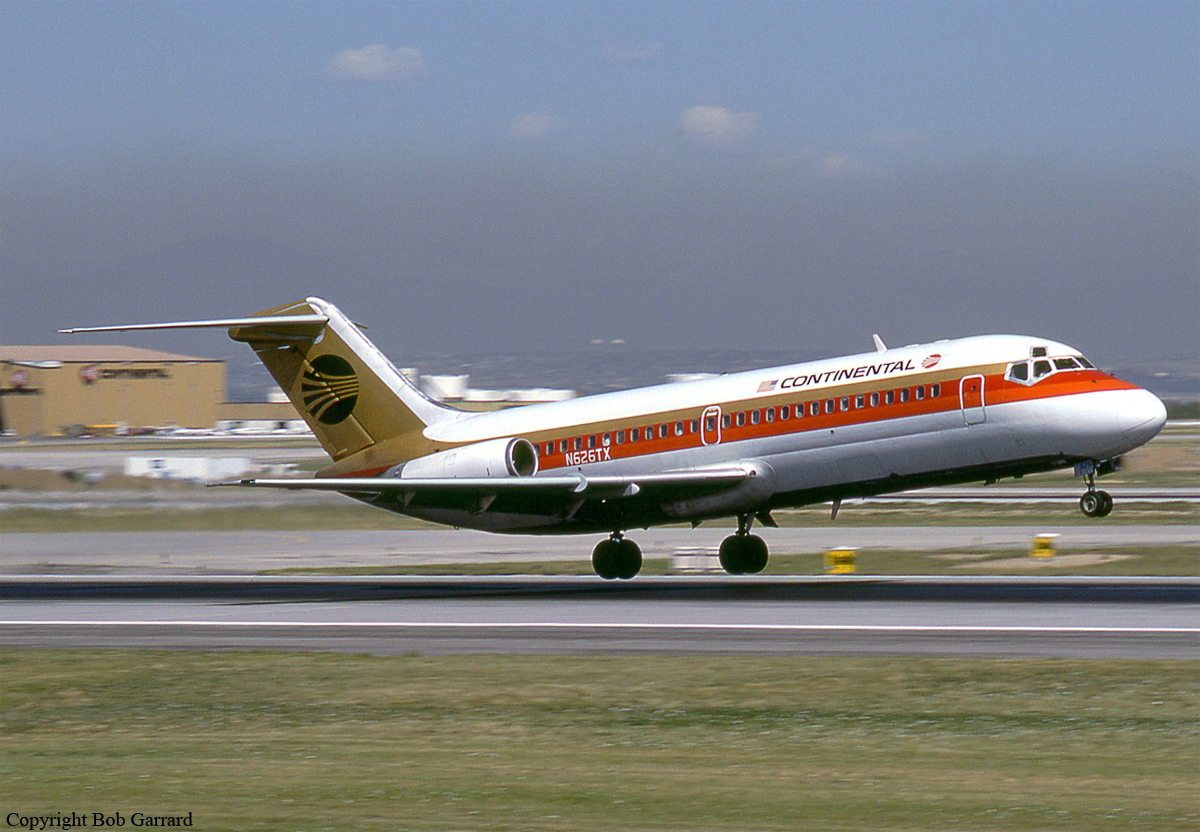
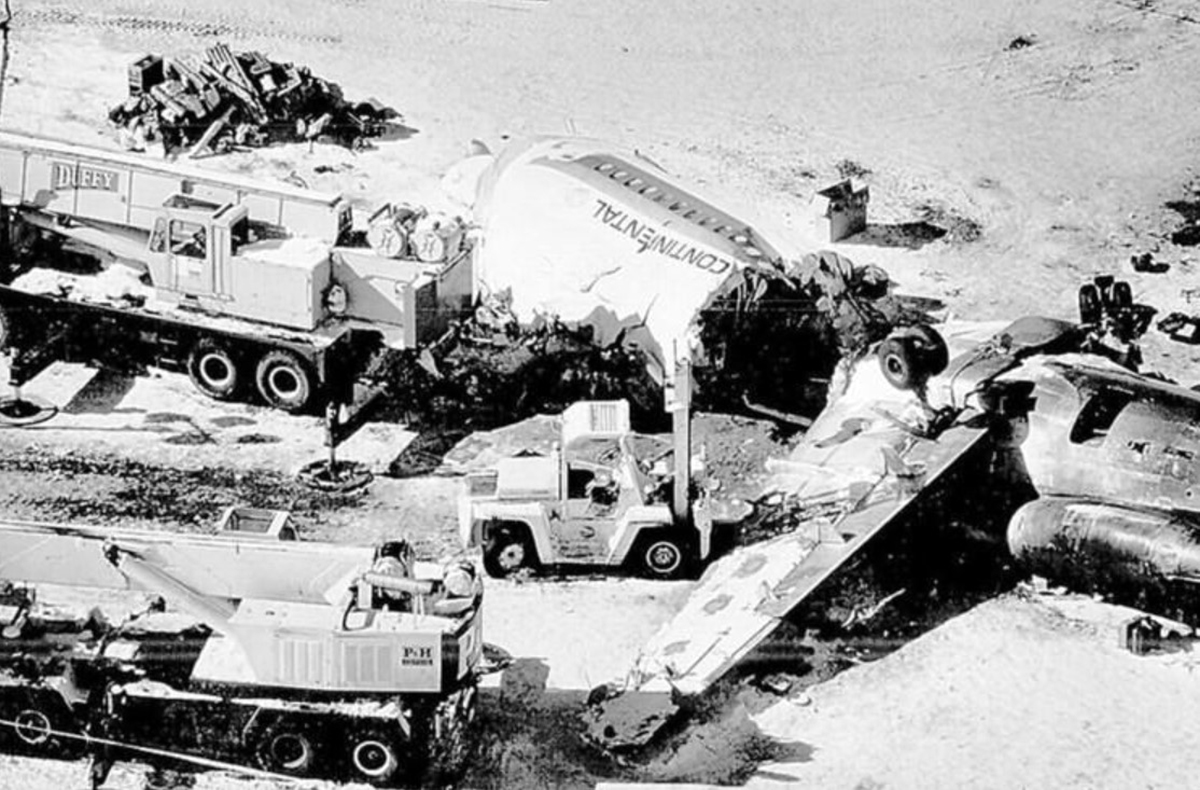
Weather conditions were moderate snow and freezing temperatures. Following a 27 minute delay between deicing and departure, on takeoff the aircraft was over-rotated by the first officer. Aircraft control was lost, the aircraft stalled and impacted off the right side of the runway. Company procedures called for repeat deicing when in icing conditions if a delay exceeds 20 minutes. Confusion between the tower and the flight crew due to procedural errors resulted in the delayed takeoff clearance. Both pilots were inexperienced in their respective crew positions. The captain had 33 hours experience as a DC-9 captain. The first officer had 36 hours jet experience, all in the DC-9. First officer demonstrated weak scan in training and had pilot performance problems with previous employers. First officer was on reserve, and had not flown for 24 days. The trip was assigned to the first officer for proficiency. Flight was first officer's 2nd trip as DC-9 first officer. Wing vortices from a landing aircraft on a parallel runway were not a factor in the accident.
Probable cause:
The captain's failure to have the airplane de-iced a second time after delay before take-off that led to upper wing surface contamination and a loss of control during rapid take-off rotation by the first officer.
Contributing was the absence of regulatory or management controls governing operations by newly qualified flight crew members and the confusion that existed between the flight crew and air traffic controllers that led to the delay in departure.
Final Report:
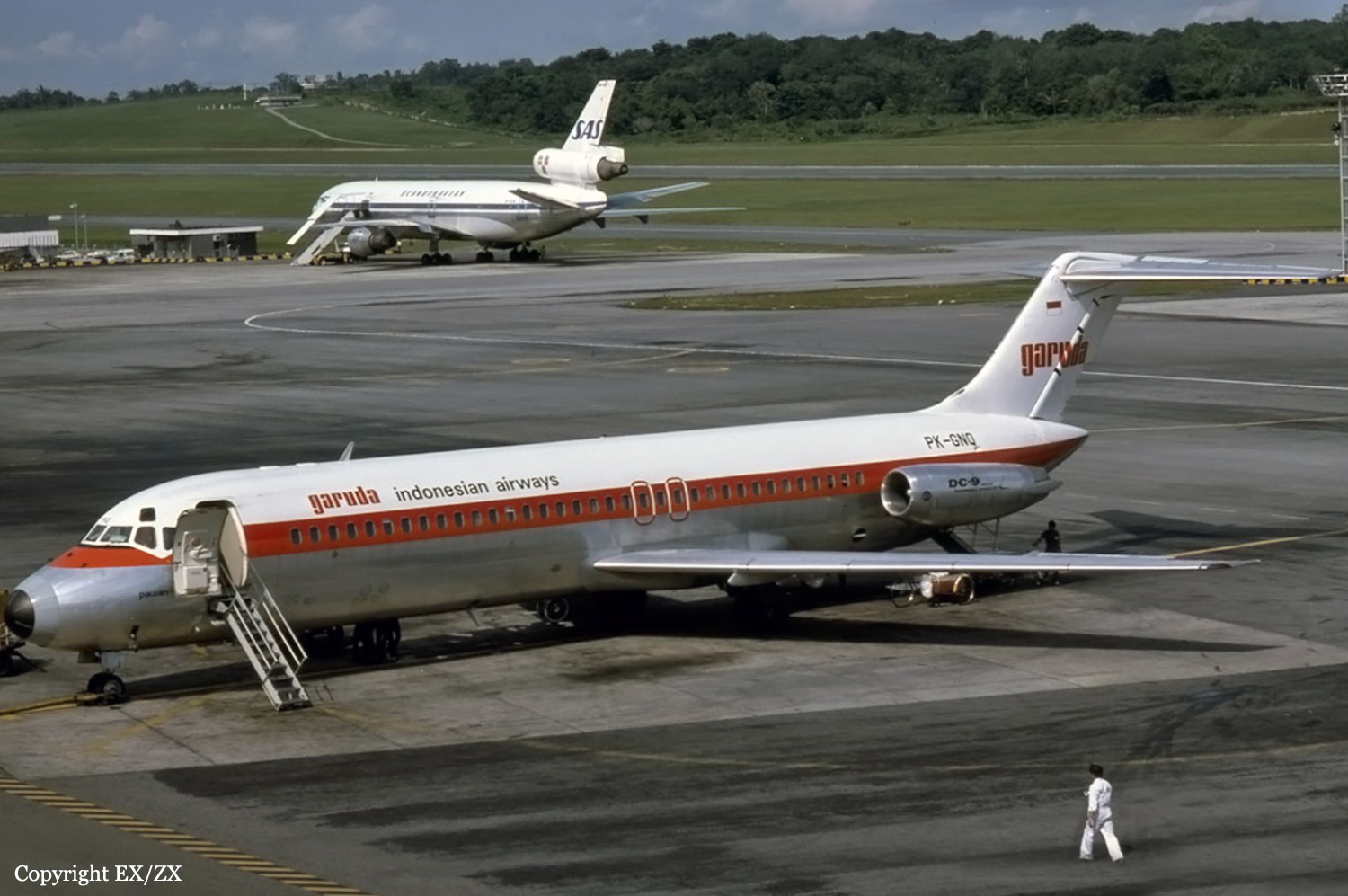
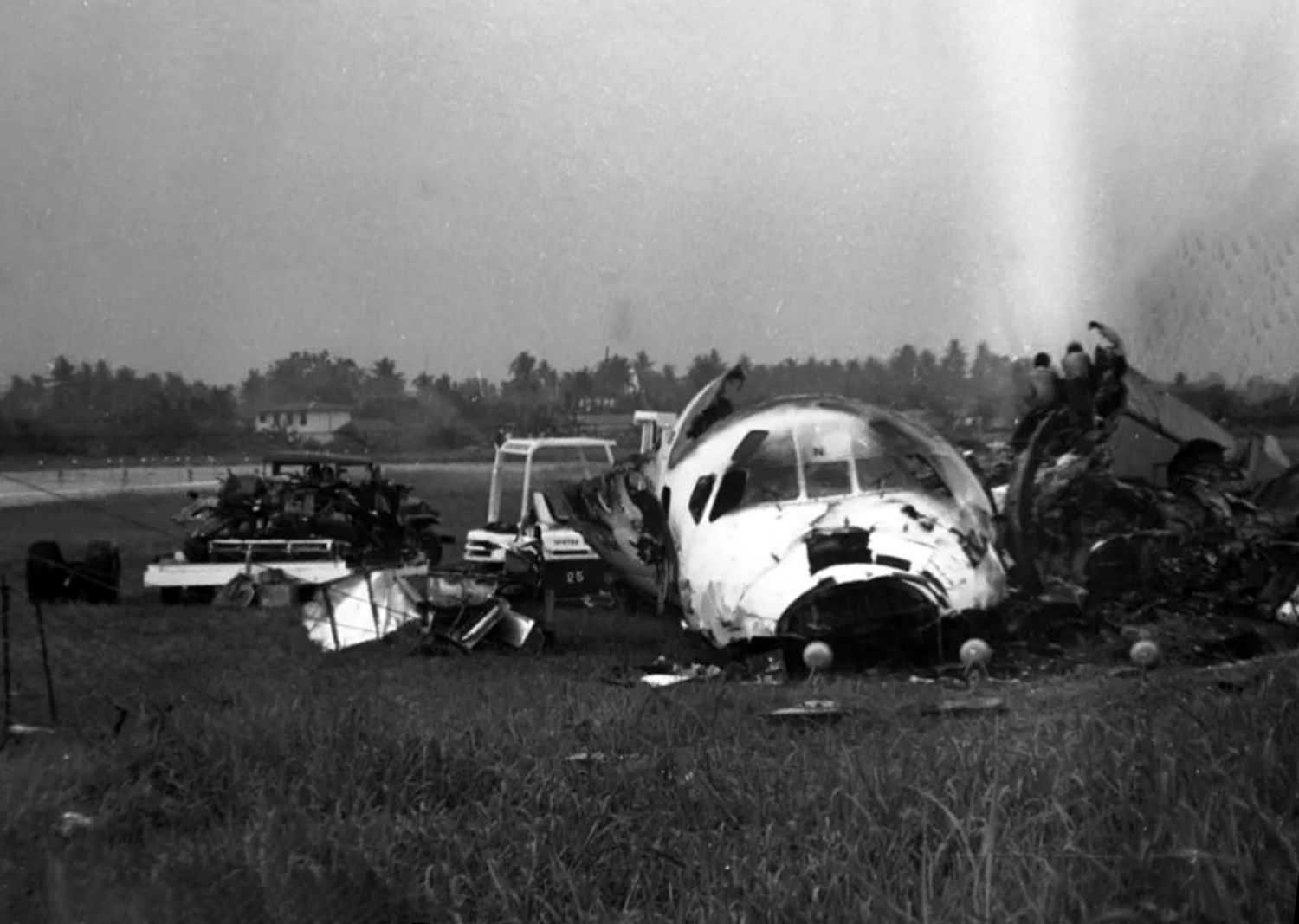
Crash of a Douglas DC-9-32 in Medan: 23 killed

Date & Time: Apr 4, 1987 at 1440 LT
Type of aircraft:
Operator:
Registration:
PK-GNQ
Survivors:
Yes
Schedule:
Banda Aceh - Medan
MSN:
47741
YOM:
1976
Flight number:
GA035
Country:
Region:
Crew on board:
8
Crew fatalities:
Pax on board:
37
Pax fatalities:
Other fatalities:
Total fatalities:
23
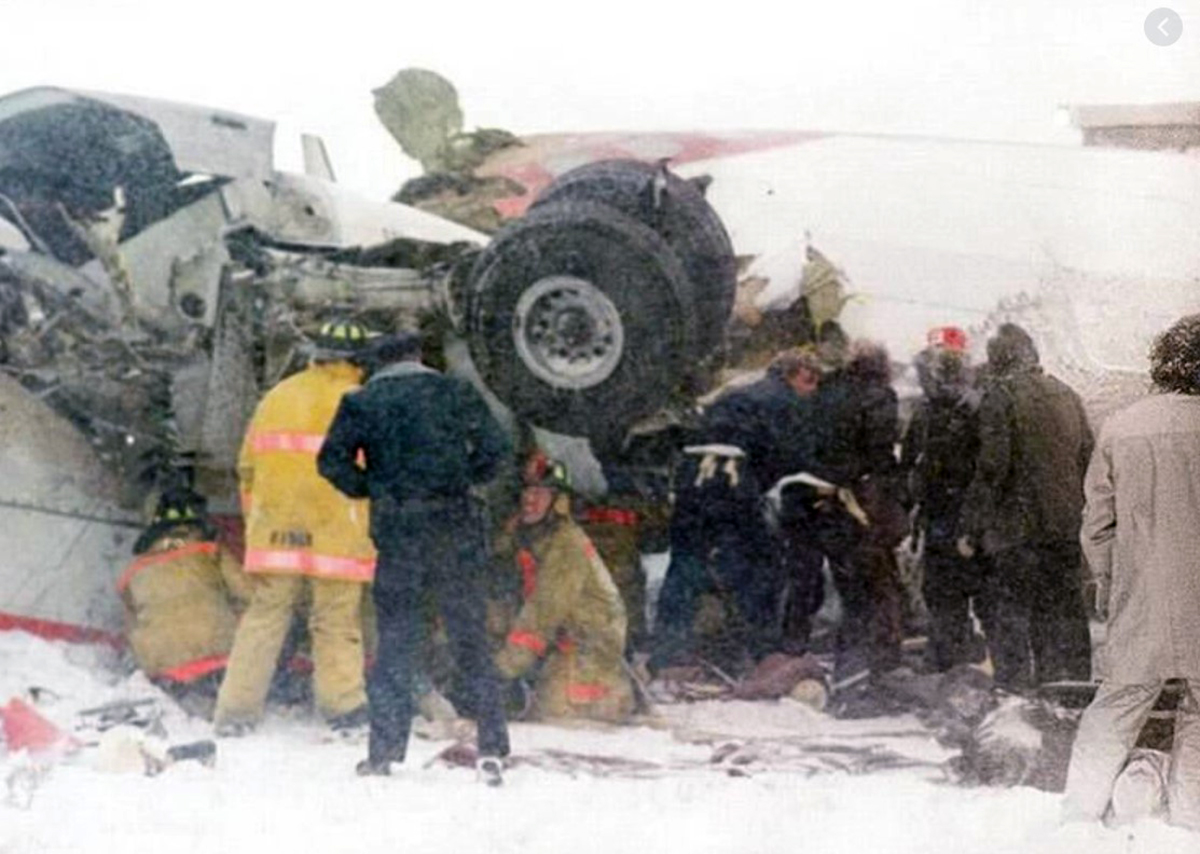
Circumstances:
On final approach to Medan-Polonia Airport, pilots encountered poor weather conditions with thunderstorm activity, turbulences and heavy rain falls. On final, the aircraft became unstable and lost height. The pilot increased engine power when the aircraft struck a television antenna, stalled and crashed in a field, bursting into flames. 23 occupants were killed while 22 others were injured.
Probable cause:
Loss of control on final approach probably caused by windshear and microburst.

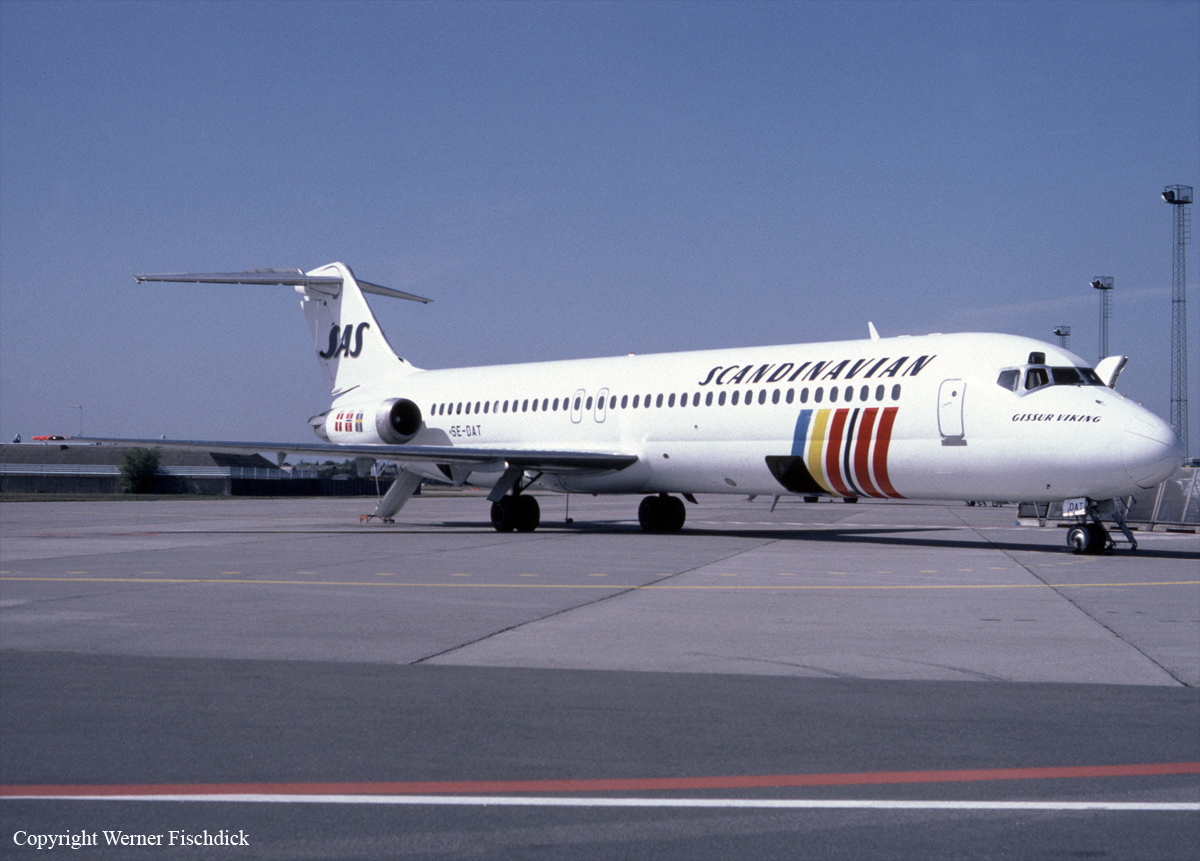
Crash of a Douglas DC-9-41 in Trondheim

Date & Time: Feb 23, 1987
Type of aircraft:
Operator:
Registration:
SE-DAT
Survivors:
Yes
Schedule:
Bodø - Trondheim
MSN:
47625
YOM:
1974
Flight number:
SK355
Country:
Region:
Crew on board:
4
Crew fatalities:
Pax on board:
103
Pax fatalities:
Other fatalities:
Total fatalities:
0
Circumstances:
The airplane named 'Gissur Viking' was approaching Trondheim runway 27 with the copilot at the controls. Descending through 2500 feet the ATC controller asked the crew to contact SAS Station in Trondheim over company frequency. The captain was working through the checklist but contacted SAS, contrary to company regulations (it's not allowed use company frequency while on final approach). The captain then forgot to arm the spoilers because he had not completed the checklist. He co-pilot noticed that the spoilers had not been armed and, while descending through 100 feet, called "Spoilers". The pilot instinctively extended the spoilers and, realizing his mistake, immediately retracted them. The aircraft entered a high sink rate and touched down heavily. A go-around was executed and after landing severe structural damage was found to the undercarriage, engines (30° respectively 15° tilted down), and tail cone (the APU was pushed halfway up the tail). All 107 occupants escaped uninjured while the aircraft was damaged beyond repair.
Probable cause:
Wrong approach configuration on part of the flying crew. Lack of crew coordination and approach checklist not completed were considered as contributing factors.

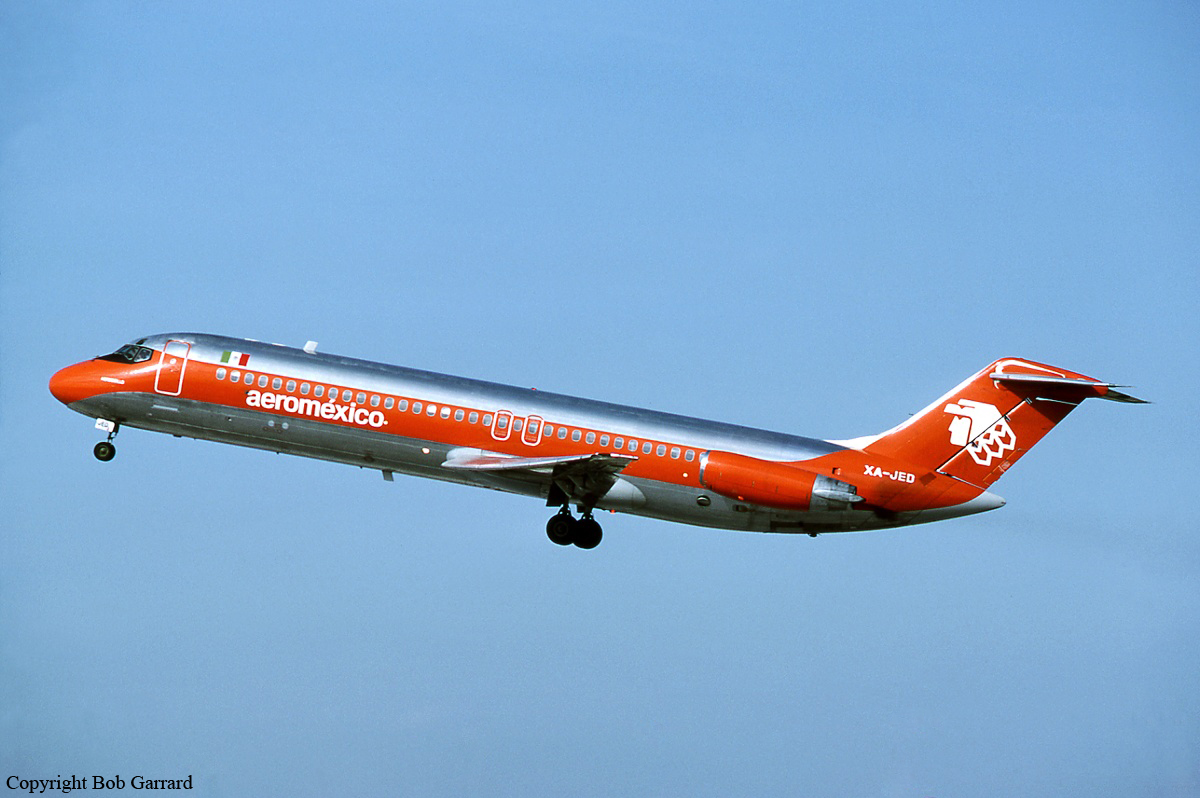
Crash of a Douglas DC-9-32 in Cerritos: 79 killed

Date & Time: Aug 31, 1986 at 1152 LT
Type of aircraft:
Operator:
Registration:
XA-JED
Survivors:
No
Site:
Schedule:
Mexico City – Guadalajara – Loreto – Tijuana – Los Angeles
MSN:
47356
YOM:
1969
Flight number:
AM498
Crew on board:
6
Crew fatalities:
Pax on board:
58
Pax fatalities:
Other fatalities:
Total fatalities:
79
Captain / Total flying hours:
10641
Captain / Total hours on type:
4632.00
Copilot / Total flying hours:
1463
Copilot / Total hours on type:
1245
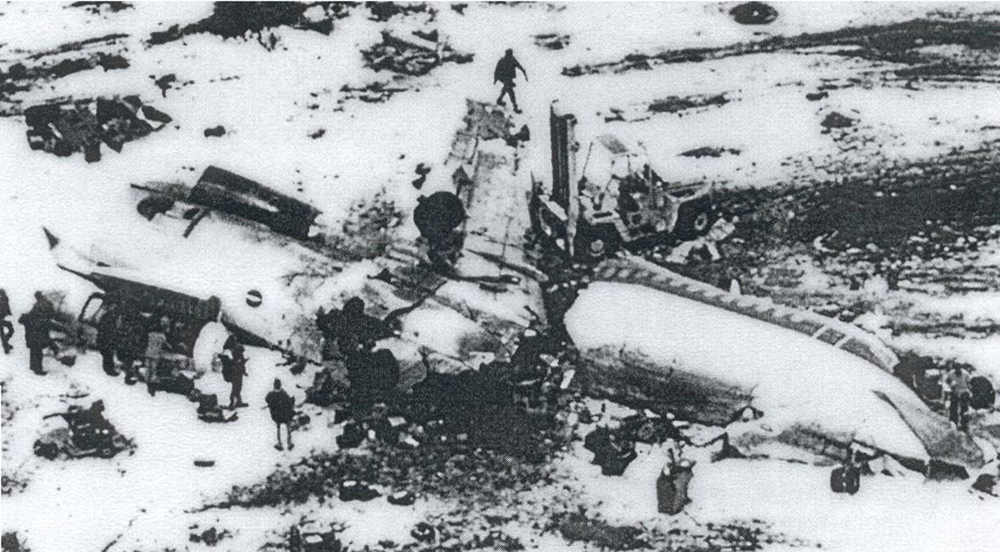
Circumstances:
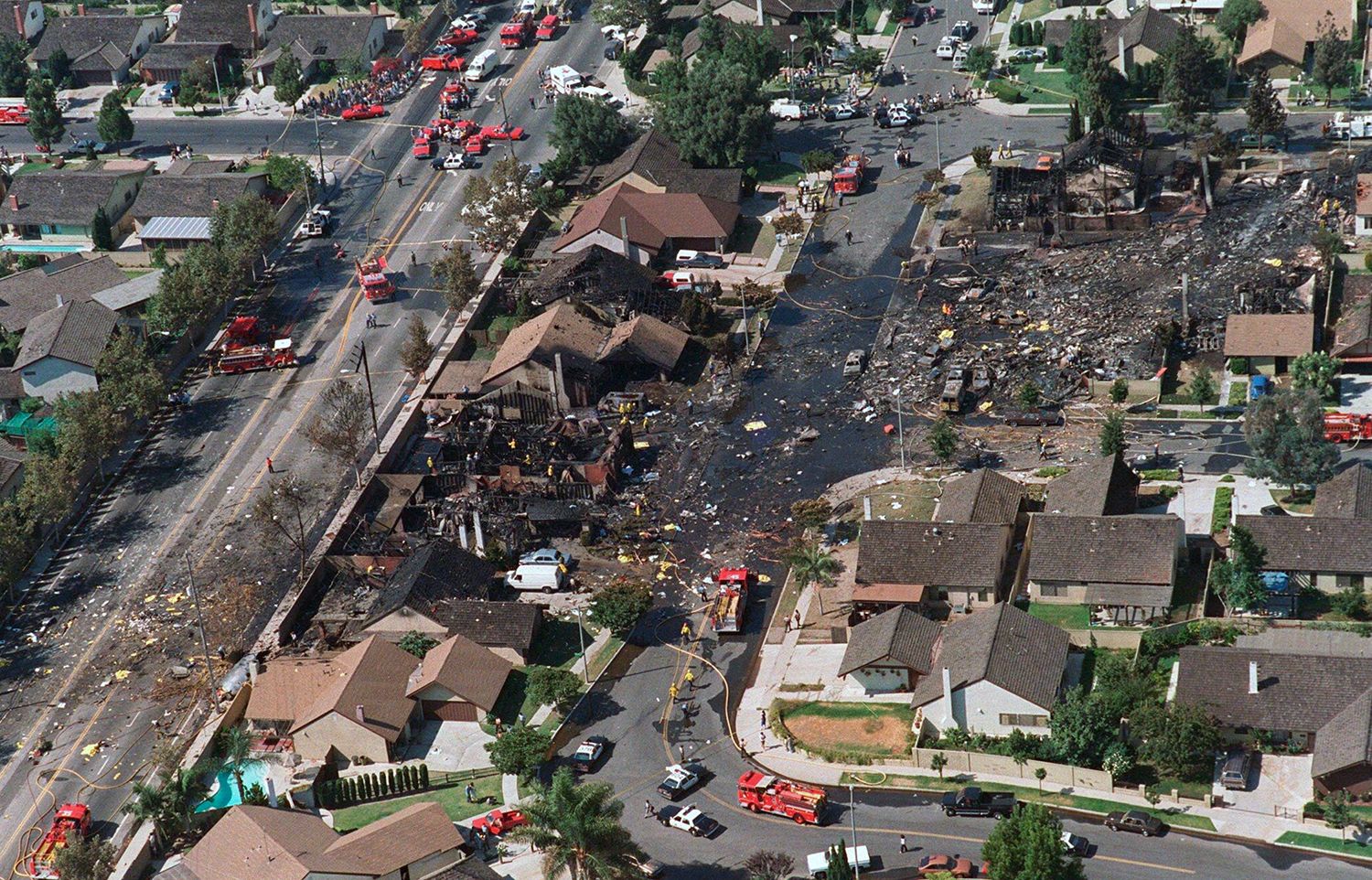
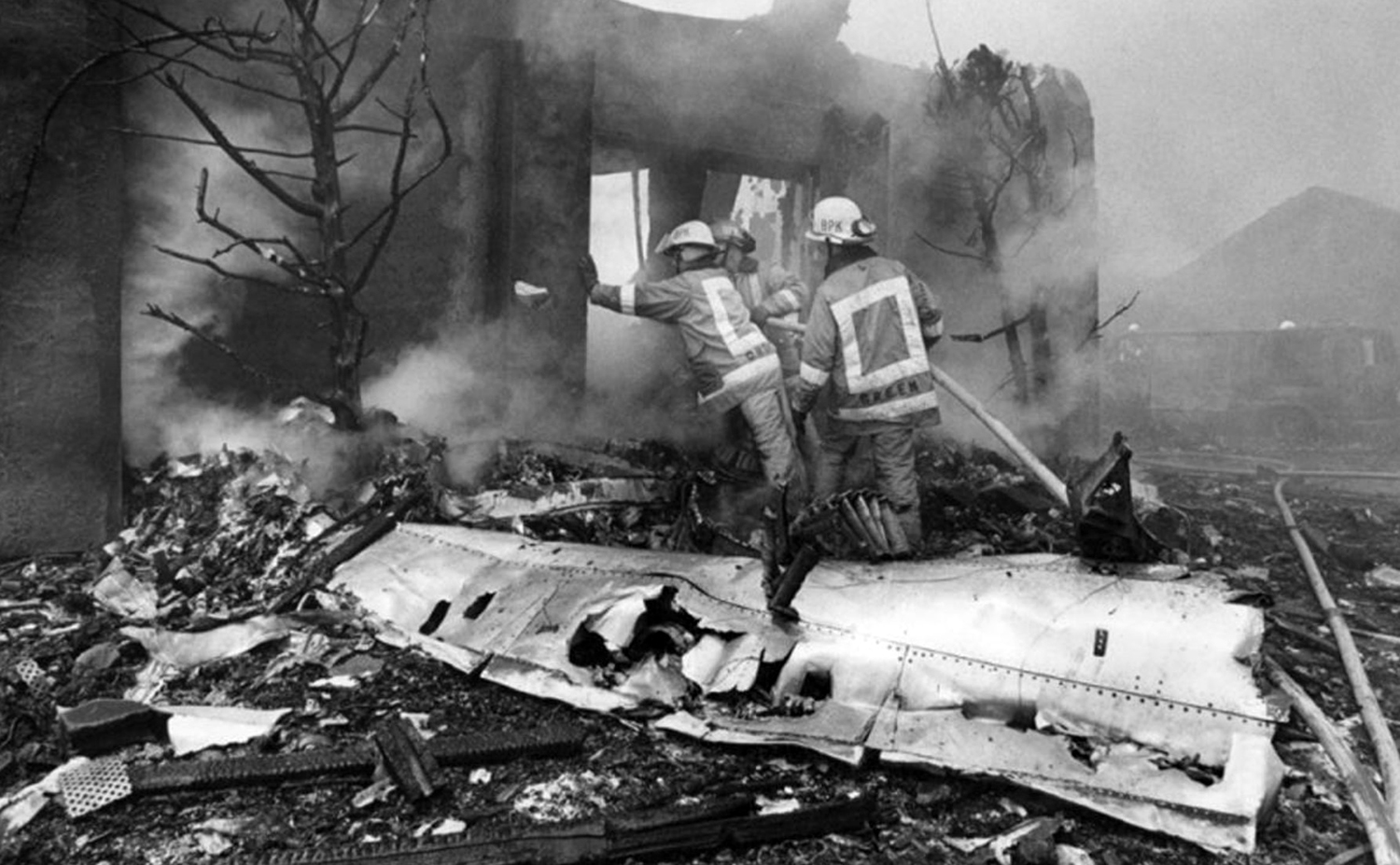
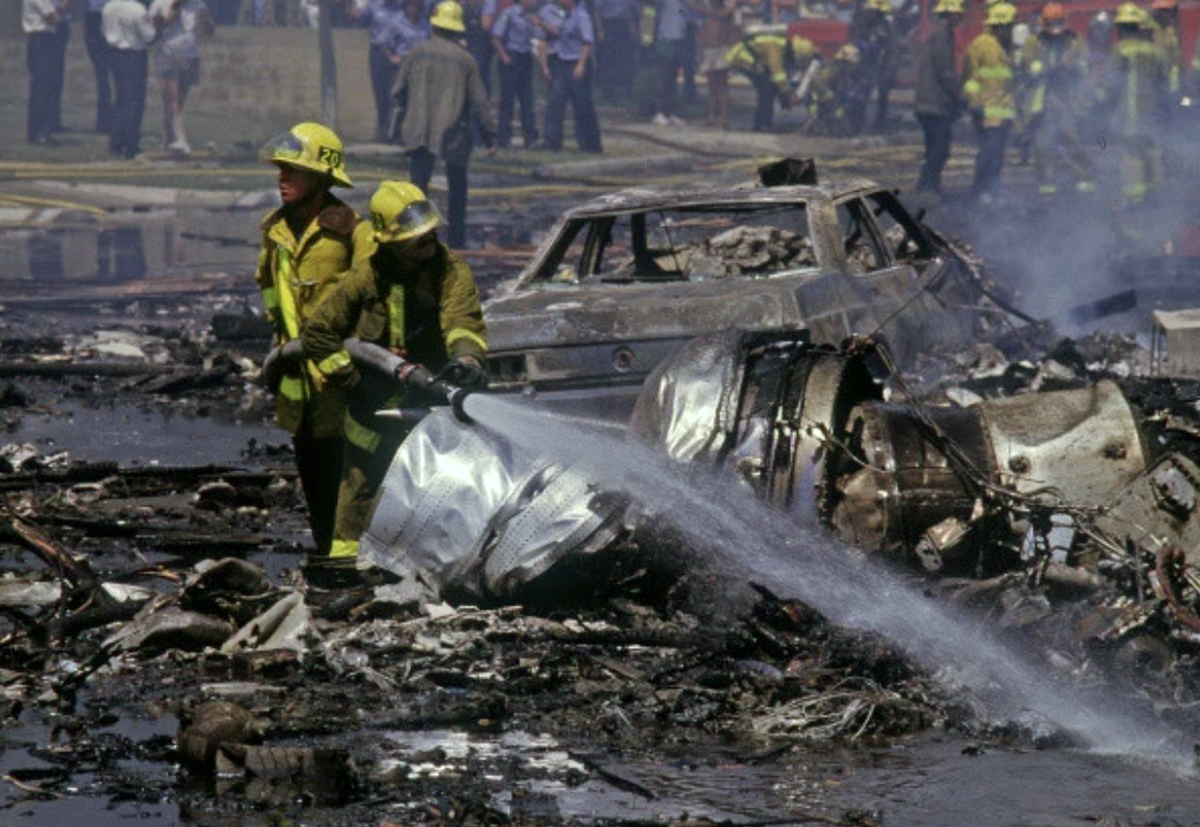
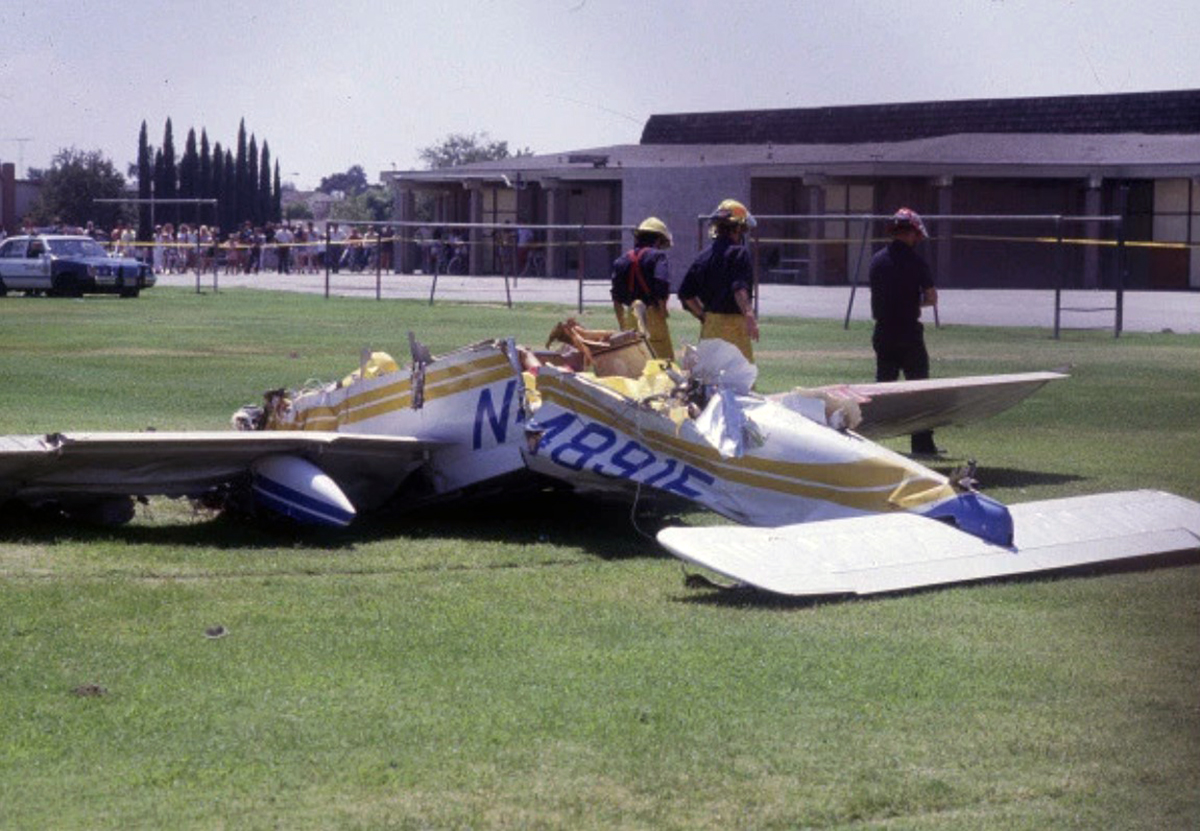
AeroMéxico flight AM498 was a scheduled passenger flight from Mexico City to Los Angeles with intermediate stops at Guadalajara, Loreto and Tijuana. The DC-9, named 'Hermosillo', departed Tijuana Airport at 11:20 and proceeded toward Los Angeles at FL100. At 11:44 Coast Approach Control cleared the flight to 7,000 feet. Just three minutes earlier Piper PA-28-181 Cherokee N4891F departed Torrance Airport, CA for a VFR flight to Big Bear, CA. On board were a pilot and two passengers. The Piper pilot turned to an easterly heading toward the Paradise VORTAC and entered the Terminal Control Area (TCA) without receiving clearance from ATC as required by FAR Part 91.90. At 11:47 the AeroMéxico pilot contacted LA Approach Control and reported level at 7,000 feet. The approach controller cleared flight 498 to depart Seal Beach on a heading of 320 degrees for the ILS runway "two five left final approach course...". At 11:51:04, the approach controller asked the flight to reduce its airspeed to 190 KIAS and cleared it to descend to 6,000 feet. At about 11:52:09, flight 498 and the Piper collided over Cerritos at an altitude of about 6,560 feet. The Piper struck the left hand side of the DC-9's horizontal and vertical stabilizer. The horizontal stabilizer sliced through the Piper's cabin following which it separated from the tailplane. Both planes tumbled down out of control. The wreckage and post impact fires destroyed five houses and damaged seven others. Fifteen persons on the ground were killed. The sky was clear, the reported visibility was 14 miles.
Probable cause:
The limitations of the ATC system to provide collision protection, through both ATC procedures and automated redundancy. Factors contributing to the accident were:
- The inadvertent and unauthorized entry of the PA-28 into the Los Angeles Terminal Control Area and
- The limitations of the 'see and avoid' concept to ensure traffic separation under the conditions of the conflict.
Final Report:
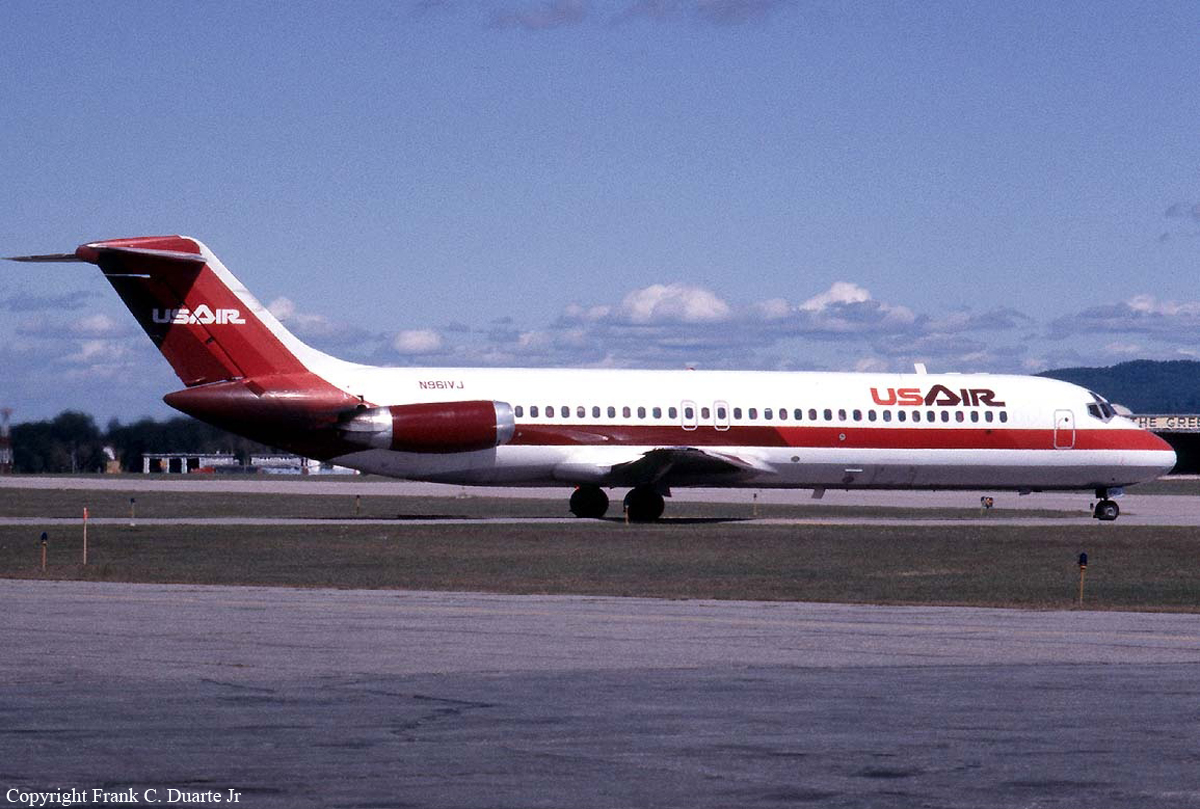
Crash of a Douglas DC-9-31 in Erie

Date & Time: Feb 21, 1986 at 0859 LT
Type of aircraft:
Operator:
Registration:
N961VJ
Survivors:
Yes
Schedule:
Toronto - Erie
MSN:
47506
YOM:
1970
Flight number:
US499
Crew on board:
5
Crew fatalities:
Pax on board:
18
Pax fatalities:
Other fatalities:
Total fatalities:
0
Captain / Total flying hours:
8900
Captain / Total hours on type:
5900.00
Aircraft flight hours:
42104
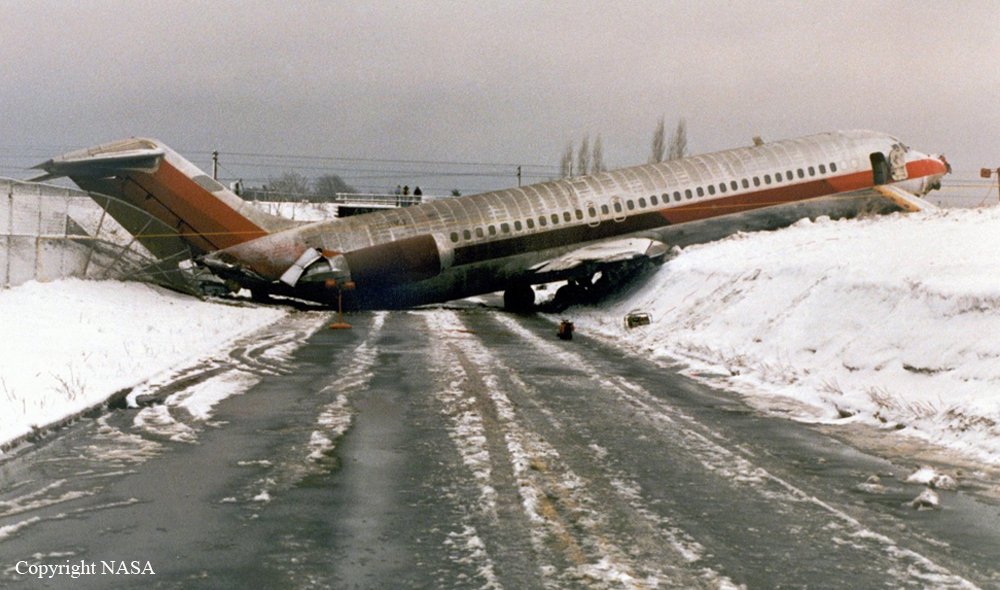
Circumstances:
During arrival, the crew of USAir flight 499 landed on runway 24, which was covered with snow. Reportedly, while landing, the aircraft touched down approximately 1,800 to 2,000 feet beyond the displaced threshold. Altho armed, the spoilers did not autodeploy, so the captain operated them manually. He lowered the aircraft's nose, actuated reverse thrust and applied brakes. The brakes were not effective. Subsequently, the aircraft continued off the end of the runway, ran over a runway end id light, struck a fence and came to rest straddling a road. The crew had planned on making an ILS approach to runway 06, but the RVR was only 2,800 feet and a minimum RVR of 4 000 feet was requested for that runway. The crew elected to land on runway 24, since 1/2 mile visibility was sufficient for that runway. However, the approach was made with a qtrg tailwind and approximately 10 knots above Vref. Tailwind landings were not authorized on runway 24 in wet/slippery conditions. The runway braking action was reported as fair-to-poor. The pilot's handbook cautioned the crew to monitor the spoilers when landing on slippery runways, since the spoilers auto-deploy only with wheel spin-up or when the nose wheel is on the ground. A passenger was slightly injured while 22 other occupants were uninjured.
Probable cause:
Occurrence #1: overrun
Phase of operation: landing - roll
Findings
1. (f) weather condition - low ceiling
2. (f) weather condition - snow
3. (f) weather condition - fog
4. (f) weather condition - tailwind
5. (c) planning/decision - improper - pilot in command
6. (f) airspeed(vref) - exceeded - pilot in command
7. (f) airport facilities, runway/landing area condition - displaced threshold
8. (f) proper touchdown point - not attained - pilot in command
9. (f) airport facilities, runway/landing area condition - snow covered
10. (c) go-around - not performed - pilot in command
----------
Occurrence #2: on ground/water collision with object
Phase of operation: landing - roll
Findings
11. (f) object - runway light
12. (f) object - fence
----------
Occurrence #3: on ground/water encounter with terrain/water
Phase of operation: landing - roll
Findings
13. (f) terrain condition - rough/uneven
Final Report:

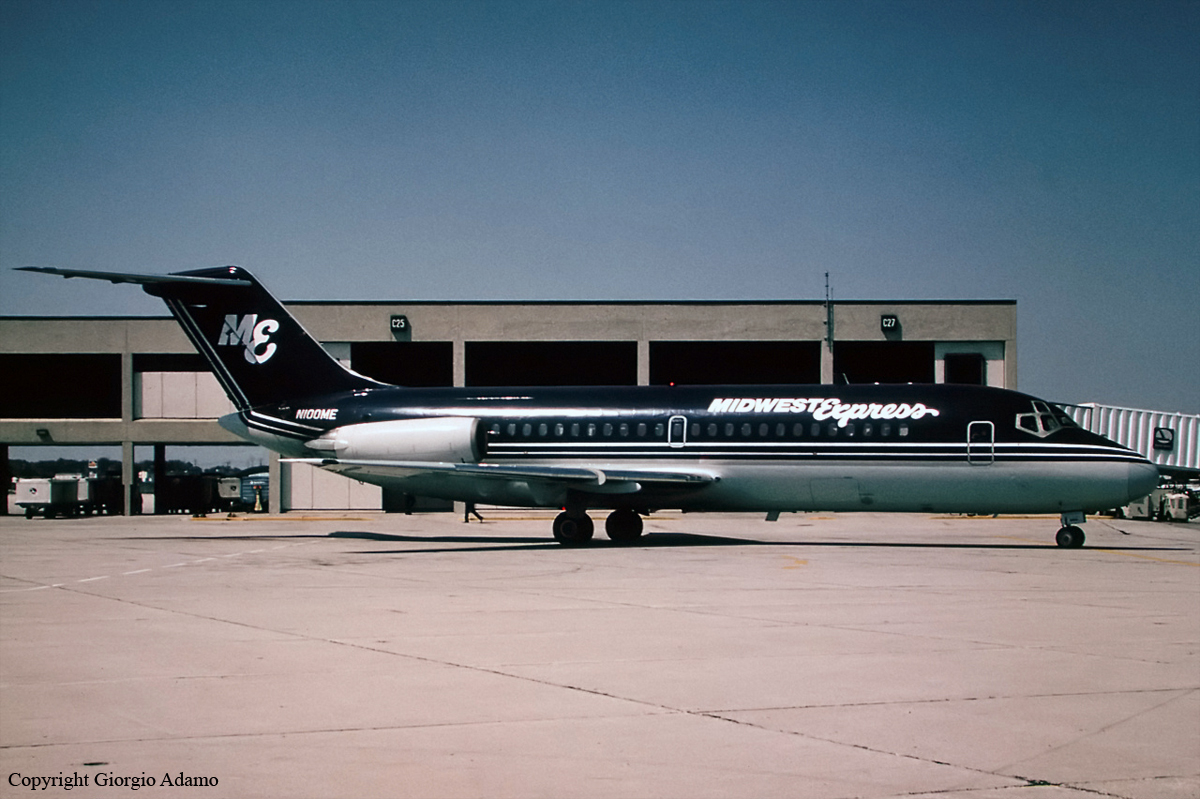
Crash of a Douglas DC-9-14 in Milwaukee: 31 killed

Date & Time: Sep 6, 1985 at 1521 LT
Type of aircraft:
Operator:
Registration:
N100ME
Flight Phase:
Survivors:
No
Schedule:
Milwaukee - Atlanta
MSN:
47309
YOM:
1968
Flight number:
YX105
Crew on board:
4
Crew fatalities:
Pax on board:
27
Pax fatalities:
Other fatalities:
Total fatalities:
31
Captain / Total flying hours:
5100
Captain / Total hours on type:
1100.00
Copilot / Total flying hours:
5197
Copilot / Total hours on type:
1640
Aircraft flight hours:
31892
Aircraft flight cycles:
48903
Circumstances:
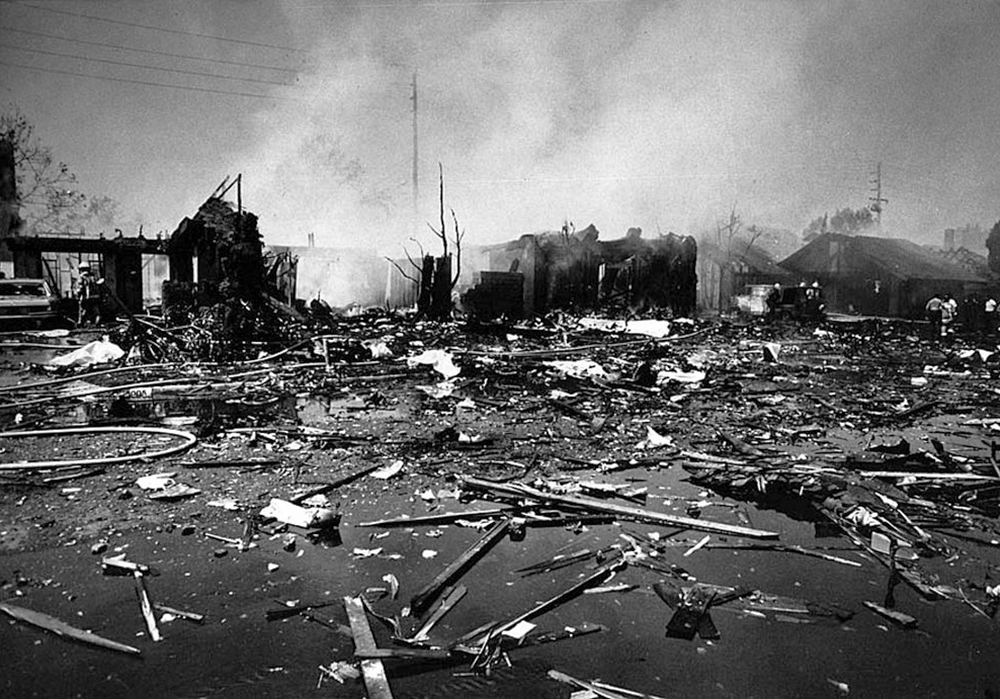
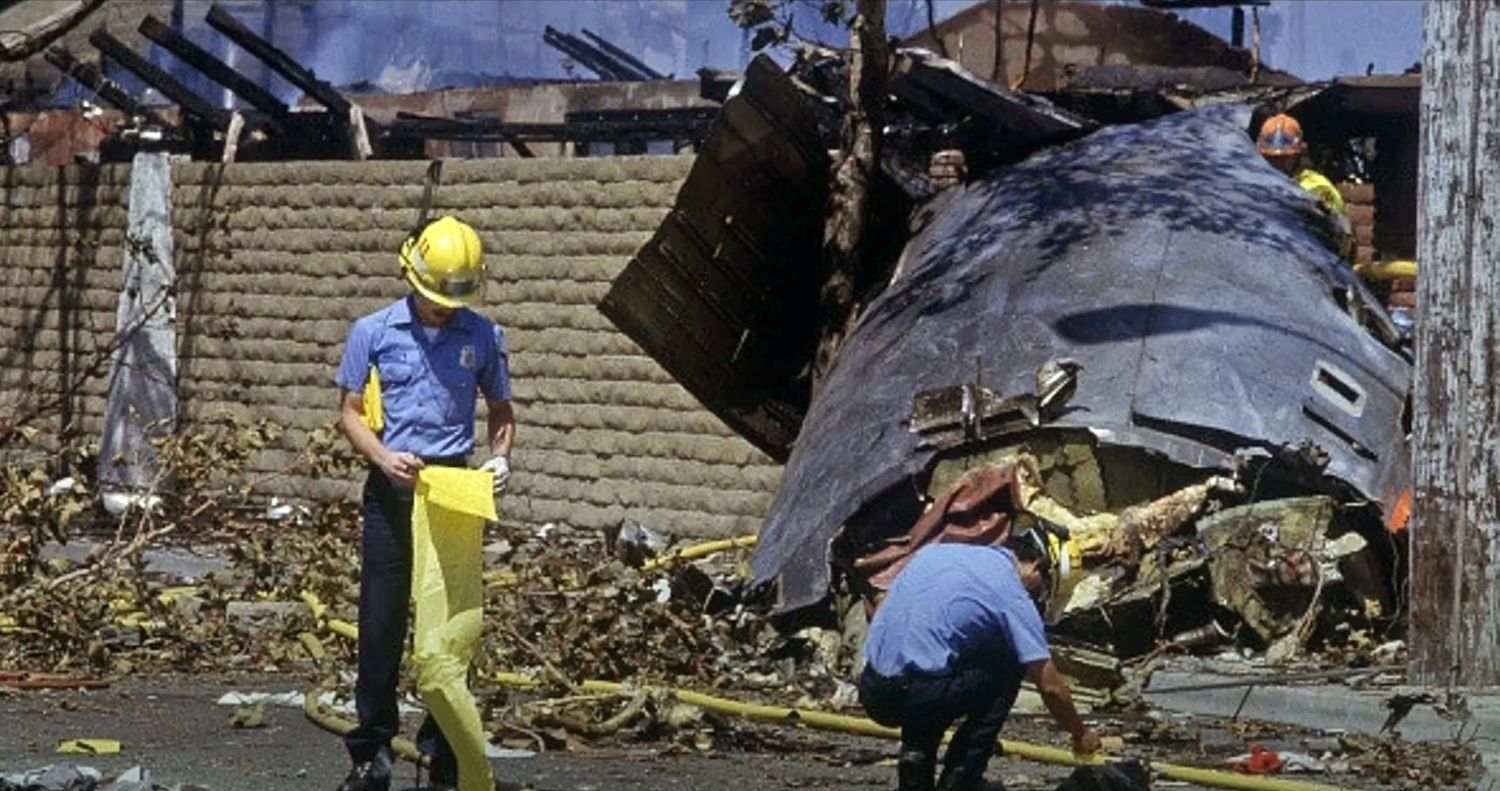
Midwest Express Airlines Flight 206, DC-9 N100ME arrived at Milwaukee (MKE) at 13:15 on September 6, 1985. It departed Milwaukee at 13:36 and arrived in Madison at 13:55 after an uneventful flight. At Madison, N100ME was designated as flight 105 to Atlanta (ATL), with an intermediate stop in Milwaukee. Flight 105 departed Madison at 14:25 and arrived at Milwaukee, on time and without incident, at 14:41. About 14:49, the first officer of flight 105 contacted Milwaukee Tower to request an instrument flight rule (IFR) clearance to Atlanta. The clearance was received. The Atlanta forecast included a 1,000-foot ceiling, visibility 2 miles, thunderstorms and rain showers. At 15:12, the Before Engine Start Checklist was read and accomplished in accordance with Midwest Express operating procedures. Engine start was commenced at 15:14 and the After Start Checklist was accomplished. The first officer requested clearance to taxi to runway 19R for departure. About 15:17:50, the Taxi Checklist was completed, and the engine pressure ratio (EPR) and airspeed reference bugs were set to 1.91 and 133 knots, respectively. Both indications were correct for the departure conditions applicable to flight 105. At the conclusion of the Taxi Checklist, the captain advised the first officer "Standard briefing ..." At 15:19:15, the first officer reported to the tower local controller, "Milwaukee, Midex 105, ready on 19R." Flight 105 was cleared to "position and hold" on runway 19R. The captain called for the Before Takeoff Checklist, which was completed in accordance with the COM. Flight 105 was cleared for takeoff at 15:20:28; the first officer acknowledged the clearance. The captain operated the flight controls, and the first officer handled radio communications and other copilot responsibilities during the takeoff. The Midwest Express DC-9 Flight Operations Manual required the use of standard noise abatement takeoff procedures during all line operations, unless precluded by safety considerations or special noise abatement procedures. At the time flight 105 departed, noise abatement procedures were in effect. Midwest Express also utilized "reduced thrust" takeoff procedures (at the captain's discretion) to extend engine life. The flightcrew was complying with the reduced thrust and standard noise abatement takeoff procedures. The takeoff roll and liftoff were normal, with liftoff occurring near the intersection of the midfield taxiway and runway 19R, about 4,200 feet from the start of the takeoff roll. Rotation to the takeoff attitude occurred at 140 knots. The DC-9 accelerated to 168 knots with a rate of climb of about 3,000 feet/minute, indicating a normal two-engine initial takeoff flightpath. At 15:21:26 N100ME was about 7,600 feet down the runway, reaching a height of 450 feet above the ground. At that moment there was a loud noise and a noticeable decrease in engine sound. The captain then remarked "What the # was that?" The first officer did not respond. At 15:21:29, the local controller transmitted, "Midex 105, turn left heading 175." At the time of his transmission he observed smoke and flame emanating from the right airplane engine. The captain asked the first officer, "What do we got here, Bill?" The first officer did not respond to the captain but advised the local controller, "Midex 105, roger, we've got an emergency here." Two seconds later, the captain said, "Here"; again there was no response. Neither pilot made the call outs for "Max Power" or "Ignition Override-Check Fuel System," which were part of the Midwest Express "Engine Failure after V1" emergency procedure. Meanwhile the airplane began to deviate substantially to the right and the heading changed from 194 degrees to 260 degrees in eight seconds. The vertical acceleration dropped sharply to about 0.3 G and increased to a value of 1.8 G. At that point the airplane stalled. This accelerated stall occurred at a KIAS of about 156 kts.
Probable cause:
The flight crew's improper use of flight controls in response to the catastrophic failure of the right engine during a critical phase of flight, which led to an accelerated stall and loss of control of the airplane. Contributing to the loss of control was a lack of crew coordination in response to the emergency. The right engine failed from the rupture of the 9th to 10th stage removable sleeve spacer in the high pressure compressor because of the spacer's vulnerability to cracks.
Final Report: