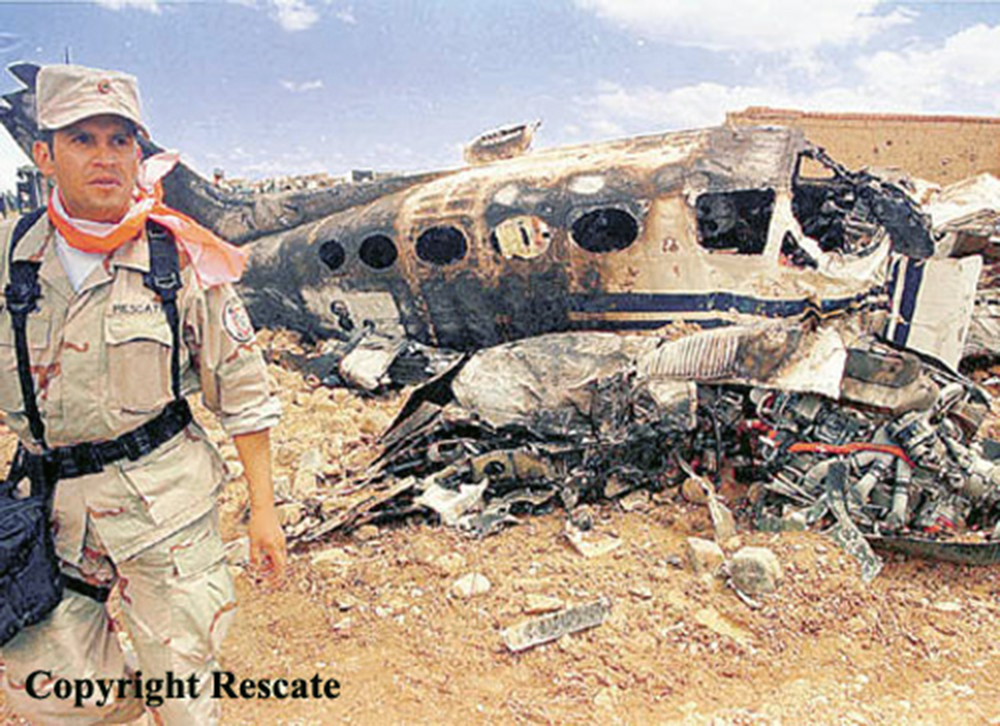
Crash of a Cessna 421C Golden Eagle III in Eagle Pass

Date & Time: Oct 18, 1998 at 0600 LT
Operator:
Registration:
N19MH
Flight Phase:
Flight Type:
Survivors:
Yes
Schedule:
Eagle Pass - San Antonio
MSN:
421C-1008
YOM:
1980
Crew on board:
1
Crew fatalities:
Pax on board:
4
Pax fatalities:
Other fatalities:
Total fatalities:
0
Captain / Total flying hours:
2095
Captain / Total hours on type:
120.00
Aircraft flight hours:
4071
Circumstances:
During takeoff climb, the twin-engine airplane encountered a strong downdraft and impacted trees and terrain. The pilot reported that while taxiing to the runway, he scanned the sky with the monochrome weather radar, which was set at the 40-mile range. 'No weather was shown behind the runway and a cell was shown 15 miles from the runway.' The takeoff roll was 'uneventful,' and the airplane was rotated at 95 knots. Climb out was accomplished at 110 knots, the engines were at maximum power, the propellers at maximum RPM, and the manifold pressure was indicating maximum. A 10-degree turn towards the Cotulla VOR was being made when at 1,500 feet msl, a sharp descent was felt with the VSI indicating an 800 ft/min rate of descent. The wings were leveled and the airspeed was slowed to 85 knots. 'The rate of descent slowed to 400 ft/min and then finally to 300 ft/min until impact...' The airplane was destroyed by fire that erupted on impact. A review of doppler weather radar images showed thunderstorms in the vicinity of the airport.
Probable cause:
A downdraft, which exceeded the aircraft's climb performance. A factor was the thunderstorms in the vicinity of the airport.
Final Report:

Crash of a Cessna 421C Golden Eagle III in Lanseria

Date & Time: May 4, 1998
Operator:
Registration:
ZS-JRR
Flight Phase:
Survivors:
Yes
MSN:
421C-0141
YOM:
1976
Country:
Region:
Crew on board:
0
Crew fatalities:
Pax on board:
0
Pax fatalities:
Other fatalities:
Total fatalities:
0
Circumstances:
During the takeoff roll at Lanseria Airport, the crew encountered technical problems and elected to abort. Unable to stop within the remaining distance, the aircraft overran and came to rest, bursting into flames. There were no casualties.

Crash of a Cessna 421C Golden Eagle III off Monaco: 4 killed

Date & Time: Apr 10, 1998 at 1320 LT
Operator:
Registration:
D-IALE
Flight Type:
Survivors:
Yes
Schedule:
Bad Vöslau - Nice
MSN:
421C-0635
YOM:
1974
Country:
Region:
Crew on board:
1
Crew fatalities:
Pax on board:
7
Pax fatalities:
Other fatalities:
Total fatalities:
4
Circumstances:
The twin engine aircraft departed Bad Vöslau Airport at 0900LT on a private flight to Nice. While approaching Nice-Côte d'Azur Airport in poor weather conditions, the aircraft suffered a double engine failure. The pilot attempted to ditch the aircraft that crashed one nautical mile off Monaco. Four passengers were killed while four other occupants were rescued, among them the pilot, his wife and daughter. The aircraft sank and its wreckage was found four days later at a depth of 165 metres. At the time of the accident, weather conditions were poor with heavy rain falls and hail.
Probable cause:
Double engine failure due to fuel exhaustion.

Crash of a Cessna 421C Golden Eagle III in Hamburg: 1 killed

Date & Time: Apr 6, 1998 at 1320 LT
Operator:
Registration:
D-ICBK
Flight Phase:
Flight Type:
Survivors:
No
Schedule:
Hamburg - Hanover
MSN:
421C-0292
YOM:
1977
Country:
Region:
Crew on board:
1
Crew fatalities:
Pax on board:
0
Pax fatalities:
Other fatalities:
Total fatalities:
1
Circumstances:
Shortly after takeoff from Hamburg-Fuhlsbüttel Airport, while climbing, the pilot reported engine problems and was cleared to return for an emergency landing. While completing a turn, he lost control of the airplane that crashed in Niendorf, near the airport. The pilot, sole on board, was killed.

Crash of a Cessna 421C Golden Eagle III in Bursa: 3 killed

Date & Time: Feb 16, 1998
Operator:
Registration:
TC-BAS
Survivors:
No
Site:
Schedule:
Istanbul - Bursa
MSN:
421C-0331
YOM:
1977
Country:
Region:
Crew on board:
2
Crew fatalities:
Pax on board:
1
Pax fatalities:
Other fatalities:
Total fatalities:
3
Circumstances:
While descending to Bursa Airport by night, the twin engine aircraft struck the slope of a mountain and was destroyed upon impact. All three occupants were killed.

Crash of a Cessna 421C Golden Eagle III in Elkins

Date & Time: Dec 28, 1997 at 1340 LT
Registration:
N1348T
Flight Phase:
Survivors:
Yes
Schedule:
Elkins - Orlando
MSN:
421C-1059
YOM:
1981
Crew on board:
2
Crew fatalities:
Pax on board:
5
Pax fatalities:
Other fatalities:
Total fatalities:
0
Captain / Total flying hours:
3100
Captain / Total hours on type:
60.00
Aircraft flight hours:
3593
Circumstances:
The pilot/owner and a flight instructor had flown in to pick-up passengers. The owner was not multiengine rated and was receiving instruction from the instructor. The airplane was fueled and two adults and three children were boarded about 1 hour later. The owner was the flying pilot in the left seat. The owner stated that the 4,500 foot long runway was covered with 2 1/2 to 3 inches of snow and slush. He further stated that during the takeoff roll, 'The snow was so bad we could not get off the ground...' The pilot estimated that he aborted the takeoff at 100 mph, the braking action was zero, and the airplane went off the end of the runway. According to a witness, the five passengers arrived with 'lots of heavy bags.' After the accident, the baggage was removed before it could be weighed. An estimated airplane takeoff weight of 7,856 pounds was computed without baggage, based upon weights from the airplane weight and balance form, the police report, and FAA records. According to the Pilot's Operating Handbook, the maximum takeoff weight was published at 7,560 pounds.
Probable cause:
The flight instructor's failure to identify an unsafe runway condition and his delay in aborting the takeoff. Contributing was the aircraft's maximum takeoff weight exceeded, and a snow covered runway.
Final Report:

Crash of a Cessna 421C Golden Eagle III in Donzeil: 8 killed

Date & Time: Nov 7, 1996 at 1029 LT
Operator:
Registration:
HB-LRX
Flight Phase:
Survivors:
No
Schedule:
Geneva - Bordeaux
MSN:
421C-0217
YOM:
1976
Location:
Country:
Region:
Crew on board:
1
Crew fatalities:
Pax on board:
7
Pax fatalities:
Other fatalities:
Total fatalities:
8
Captain / Total flying hours:
7047
Captain / Total hours on type:
113.00
Aircraft flight hours:
2488
Circumstances:
The twin engine aircraft departed Geneva-Cointrin Airport at 0842LT on a charter flight to Bordeaux-Mérignac, carrying one pilot and seven passengers. At 0903LT, while cruising at an altitude of 20,000 feet, the pilot informed ATC about the failure of the right engine and was cleared to reduce his altitude and to divert to Limoges Airport. The pilot elected to restart the engine below FL100 but was unable to do so. Due to high drag, the aircraft continued to lose height and was unable to reach Limoges Airport. At 1029LT, the aircraft went out of control and crashed in an open field, bursting into flames. The wreckage was found near Donzeil, between Guéret and Aubusson, about 60 km northeast of Limoges. The aircraft was totally destroyed by impact forces and a post crash fire and all eight occupants were killed.
Pilot:
Jean-Claude Kaufmann.
Passengers:
Jacques Faini,
Serge Frochot,
Didier Hostettler,
Étienne Moinat,
Jean-Claude Paccaud,
Michel Rothen,
Jean-François Troger.
Probable cause:
It was determined that the accident was the consequence of an inappropriate management of the flight following jamming of the propeller in an intermediate position after the RH crankshaft rupture. The inappropriate management was due to:
- The pilot's relative lack of experience on this aircraft type,
- His false notions about the aircraft's performance and about the existence of a flight level to maintain level flight with an unfeathered propeller and an heavy aircraft,
- A series of misjudged strategies to attempt to continue the flight then to land at Limoges when the aircraft's altitude no longer made this possible.
The lack of instructions relative to inspections by a reliable method for detection of cracks on crankshafts installed on GTSIO-520 engines was a contributory factor.
Final Report:

Crash of a Cessna 421C Golden Eagle III near Cleveland: 6 killed

Date & Time: Dec 21, 1995 at 1442 LT
Registration:
N421EP
Flight Phase:
Flight Type:
Survivors:
No
Schedule:
Tulsa - Aspen
MSN:
421C-1236
YOM:
1982
Crew on board:
1
Crew fatalities:
Pax on board:
5
Pax fatalities:
Other fatalities:
Total fatalities:
6
Captain / Total flying hours:
1320
Circumstances:
At 1350 cst, a McAlester FSS specialist gave a preflight briefing to a Cessna 421 pilot concerning IMC (instrument meteorological conditions) along the route & advised that VFR flight was not recommended. Cloud tops were at 12,000', & freezing level was at 1,600'. A PIREP at 1416 cst reported light mixed icing from 6,400' to 9,000' at Oklahoma City. At 1424 cst, the pilot departed Tulsa (VFR), then radar service was terminated. No further communication was received from the airplane. Radar data showed that it climbed westerly, reaching 9,800' at 1440 cst; during the next 88 seconds, its heading & altitude deviated until it descended through 3,200'. Ground witnesses saw the airplane descend out of low clouds in a 'flat spin' & crash. No preimpact mechanical failure was found. The airplane's gross weight was about 150 lbs over its maximum limit. In November 1995, the pilot received 10 hrs of Cessna 421 simulator training; his instructor noted in training records that he met minimum standards for VFR, but 'under IMC conditions,' he 'could not maintain altitude within 1,300 feet or heading within 40 degrees.' Postmortem toxicology tests showed 0.079 mcg/ml Nordiazepam (metabolite of Valium) in kidney fluid, 0.044 mcg/ml Desipramine (metabolite of Imipramine, an antidepressant) in spleen fluid, 0.733 mcg/ml Diphenhydramine (Benadryl) in spleen fluid, & 0.353 mcg/ml Diphenhydramine in lung fluid. These medications are not approved by the FAA for use while flying. The airplane was equipped for flight in icing & IFR
conditions.
Probable cause:
The pilot's continued VFR flight into instrument meteorological conditions (IMC), and his failure to maintain control of the airplane after encountering adverse weather conditions, which resulted in a stall/spin. Factors relating to the accident were: pilot impairment due to a medication that was not approved by the FAA for use while flying, the adverse weather conditions, and the pilot's lack of instrument proficiency in the Cessna 421 airplane.
Final Report: