Crash of a Boeing B-52B-30-BO Stratofortress in Tracy: 4 killed

Date & Time: Feb 16, 1956
Type of aircraft:
Operator:
Registration:
53-0384
Flight Phase:
Flight Type:
Survivors:
Yes
Schedule:
Castle - Castle
MSN:
16863
YOM:
1953
Crew on board:
8
Crew fatalities:
Pax on board:
0
Pax fatalities:
Other fatalities:
Total fatalities:
4
Circumstances:
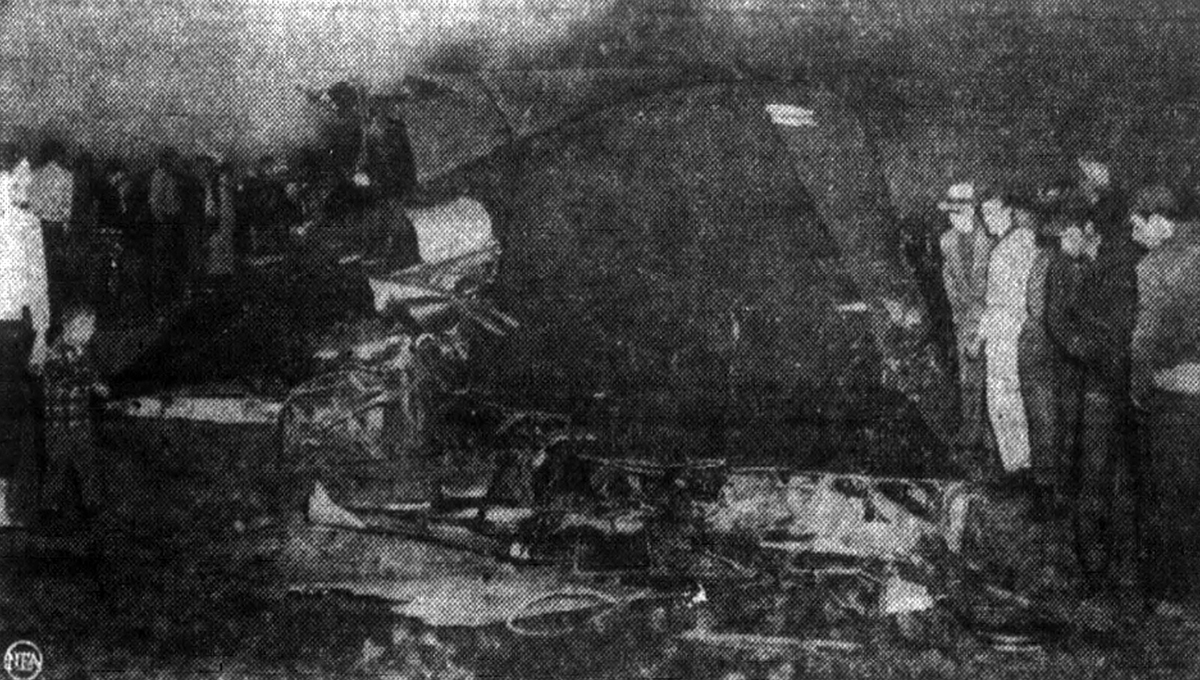
The crew was performing a training mission out from Castle AFB when a fire broke out apparently on the leading edge of the right wing. It appears that four crew members were able to bail out and were found alive while four others were killed when the aircraft crashed in Tracy.
Crew:
Maj Edward L. Stefanski, pilot, †
Maj Michael Shay, copilot,
Maj Albert K. Brown, pilot, †
Col Patrick D. Fleming, instructor pilot, †
Cpt James Fredrickson, navigator, †
Maj Harold F. Korger, radar observer,
Maj Billie M. Beardsley, radio operator,
M/Sgt Williard Milo Lucy, tail gunner.
Probable cause:
It is believed that a fire broke out following an explosion that occurred in an electrical power panel located on the alternator deck blowing off the cover. This caused the cover to jam the regulator valve of the left hand forward alternator disabling the over speed protection and resulting in an over speed failure.
Crash of a Douglas DC-3C in Burbank: 3 killed

Date & Time: Sep 8, 1955 at 0757 LT
Type of aircraft:
Registration:
N74663
Survivors:
Yes
Schedule:
Burbank – Oakland
MSN:
6257
YOM:
1943
Flight number:
CRR024
Crew on board:
3
Crew fatalities:
Pax on board:
30
Pax fatalities:
Other fatalities:
Total fatalities:
3
Captain / Total flying hours:
4500
Captain / Total hours on type:
1200.00
Copilot / Total flying hours:
2880
Copilot / Total hours on type:
120
Aircraft flight hours:
9849
Circumstances:
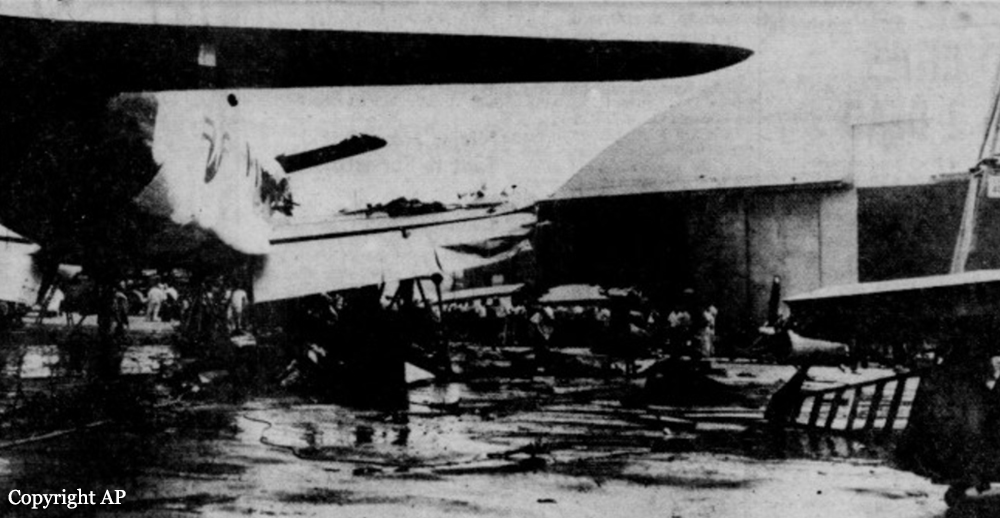
This was a nonscheduled flight originating at Burbank, California, for Oakland, California. There were 30 passengers and a crew consisting of Captain Joseph A. Bradsher, Copilot Keith C. Dutson, and Stewardess Utta Jorgensen. Company records indicated that takeoff gross weight was 26,089 pounds (authorized maximum was 26,200 pounds), and the center of gravity of the aircraft was located within prescribed limits. A Defense Visual Flight Rules flight plan was filed; the plane was loaded, taxied to the end of the runway, and its engines were run up. At 0751 the flight was cleared for takeoff from runway 15, to climb westward on top of haze and smoke. It executed a takeoff and climbed in a normal manner into smoke haze, which was more dense toward the south., and in which it was lost to view of observers at the airport. Approximately one minute 2 after takeoff (0752) Flight 24 called the tower and requested an emergency landing clearance. This was granted; runway 7 was suggested by the tower and accepted by the pilot. The airport was cleared of traffic and emergency equipment alerted. At 0755 the tower called repeatedly as the flight had not been sighted. At 0756 the flight called the tower and stated its intent to land on runway "31." Lockheed Air Terminal has no runway 31 but has a runway 33. About this time Flight 24 was sighted by the control tower operator an estimated one mile to the southwest proceeding in a nose-high attitude toward the airport but not aligned with any runway. Across the approach track being used was a powerline about 500 feet short of the airport boundary. As this line approached the nose-high attitude increased and immediately after passing this powerline the aircraft executed a slight left turn, banked 10 to 12 degrees. The left wing then struck a service powerline at the airport boundary. The aircraft stalled, its left wing collided with two parked Air Force C-54's, it cartwheeled, slid across the apron and struck Lockheed Service hangar No. 24, coming to rest in the open doorway of that hangar. The fuselage broke open at a point behind the wing and most of the survivors escaped or were rescued through this opening. Small fires started by the crash were quickly extinguished by personnel of Lockheed's plant protection organization, who also rescued survivors and rendered first aid most efficiently. This organization also guarded the scene and wreckage.
Probable cause:
On the basis of all available evidence the Board determines that the probable cause of this accident was the captain's irrevocable commitment to a landing without radio or visual confirmation of his runway alignment following engine failure immediately after takeoff. A contributing factor was engine malfunction immediately after takeoff in near minimum visibility. The following findings were reported:
- Overheating of the right engine's rear master rod and loss of much of its bearing metal constituted a failure which foretold imminent internal destruction of that engine,
- Feathering of the right propeller was not accomplished and that propeller continued to rotate (windmill),
- The aircraft when observed approaching the airport had its gear extended, its attitude was excessively nose-high, and it was not aligned with any runway,
- The left wing of the aircraft struck a powerline,
- Forward motion continued; the aircraft stalled and collided successively with two parked Air Force aircraft, the apron, and Lockheed Service Hangar No. 24.
Final Report:

Crash of a Boeing KC-97G -25-BO Stratotanker near Cressey: 10 killed

Date & Time: Jul 13, 1955
Type of aircraft:
Operator:
Registration:
52-2637
Flight Phase:
Flight Type:
Survivors:
No
Schedule:
Castle - Castle
MSN:
16668
YOM:
1952
Crew on board:
10
Crew fatalities:
Pax on board:
0
Pax fatalities:
Other fatalities:
Total fatalities:
10
Circumstances:
Shortly after takeoff from Castle AFB, while climbing, the aircraft suffered serious technical issues and crashed in a huge explosion about seven miles northwest of the airbase, near the city of Cressey. All ten crew members were killed.

Crash of a Beechcraft SNB-2 Navigator on Mt Cajon: 3 killed

Date & Time: Jan 9, 1955
Type of aircraft:
Operator:
Registration:
67260
Flight Phase:
Flight Type:
Survivors:
No
Site:
Schedule:
Monterey - Norton
MSN:
5091
YOM:
1942
Crew on board:
2
Crew fatalities:
Pax on board:
1
Pax fatalities:
Other fatalities:
Total fatalities:
3
Circumstances:
The aircraft was completing a flight from Monterey to Norton AFB in San Bernardino, carrying a crew of two and a sailor passenger, fireman of the USS Badoeng Strait. While cruising by night at an altitude of 5,000 feet, the airplane hit the slope of Mt Cajon located south of Cajon Pass. The wreckage was found four days later, on January 13. The aircraft was destroyed and all three occupants have been killed.
Crew:
Lt Marshall Hand, pilot,
Lt Lasley K. Lacewell Jr., copilot.
Passenger:
Haskel Lewis Reichbach.

Crash of a Boeing RB-50G ELINT near Willows: 13 killed

Date & Time: Oct 6, 1954
Type of aircraft:
Operator:
Registration:
47-154
Flight Phase:
Flight Type:
Survivors:
Yes
Schedule:
Biggs - Biggs
MSN:
15838
YOM:
1947
Crew on board:
17
Crew fatalities:
Pax on board:
0
Pax fatalities:
Other fatalities:
Total fatalities:
13
Circumstances:
The heavy bomber was engaged in a training mission out from Biggs AAF in El Paso, Texas. While cruising by night in light rain conditions, the airplane went out of control and entered a dive. Three crew members were able to bail out before the aircraft crashed in a field located about three miles southeast of Willows. They were found alive as well as a fourth crew member who was found seriously wounded in the wreckage. All 13 other occupants were killed.
Crew:
Maj John M. Wirt, †
Cpt Keith B. Wright, †
Maj Park B. Herrick, †
M/Sgt Charles M. Ford, †
A2c Daniel A. Baca, †
M/Sgt Clarence Foster, †
A2c Eddie L. Wynne, †
M/Sgt Junior Townsend, †
Cpt Otto Robinson, †
1st Lt John T. Vaughn, †
M/Sgt Howard J. Hansen, †
A2c Williams S. Myers, †
1st Lt John Swisher, †
T/Sgt Natividad Vasquez,
S/Sgt Joseph E. Wittens,
A1c John B. Patton,
Sgt Frank M. Imely.

Crash of a Fairchild C-82A Packet near Fawnskin: 1 killed

Date & Time: Sep 21, 1954
Type of aircraft:
Operator:
Registration:
45-57744
Flight Phase:
Flight Type:
Survivors:
Yes
Site:
Schedule:
Norton - Ogden-Hill
MSN:
10114
YOM:
1945
Crew on board:
9
Crew fatalities:
Pax on board:
0
Pax fatalities:
Other fatalities:
Total fatalities:
1
Circumstances:
The crew departed Norton AFB in San Bernardino on a flight to Ogden-Hill AFB, Utah. Few minutes after takeoff, while cruising above the mountains, an engine failed. As the pilot was unable to maintain a safe altitude, he ordered his crew to bail out. Few minutes later, he crashed with the airplane in a wooded and mountainous area located in Fawnskin, near Big Bear Lake. Unfortunately, Captain Charles M. Eckstein was unable to escape in a timely manner and was killed in the crash. All other crew members were found alive.
Probable cause:
Engine failure in flight.

Crash of a Curtiss C-46D-15-CU Commando in Santa Clarita

Date & Time: Sep 20, 1954
Type of aircraft:
Operator:
Registration:
44-78035
Flight Phase:
Flight Type:
Survivors:
Yes
Schedule:
Burbank - Mather
MSN:
33431
YOM:
1945
Crew on board:
3
Crew fatalities:
Pax on board:
17
Pax fatalities:
Other fatalities:
Total fatalities:
0
Circumstances:
An engine caught fire in flight. All 20 occupants decided to bail out and abandoned the aircraft that dove into the ground and crashed in Santa Clarita. All 20 occupants were found uninjured while the aircraft was destroyed.
Probable cause:
Engine fire in flight.

Crash of a North American B-25J-30-NC Mitchell near San Jose: 7 killed

Date & Time: Aug 25, 1954
Operator:
Registration:
44-86783
Flight Phase:
Flight Type:
Survivors:
Yes
Site:
MSN:
108-47537
YOM:
1944
Crew on board:
8
Crew fatalities:
Pax on board:
0
Pax fatalities:
Other fatalities:
Total fatalities:
7
Circumstances:
While cruising in bad weather conditions, the aircraft hit the slope of a mountain located southeast of San Jose. A crew member survived while seven other occupants were killed.

Crash of a Boeing KC-97G-25-BO Stratotanker near Norton AFB: 14 killed

Date & Time: Jun 27, 1954 at 0308 LT
Type of aircraft:
Operator:
Registration:
52-2654
Flight Phase:
Flight Type:
Survivors:
No
Site:
Schedule:
Altus – March
MSN:
16685
YOM:
1952
Crew on board:
7
Crew fatalities:
Pax on board:
7
Pax fatalities:
Other fatalities:
Total fatalities:
14
Circumstances:
The crew was completing a flight from Altus, Oklahoma, to the March AFB located southeast of Riverside, California. While approaching March AFB, the crew was informed by ATC about poor weather at destination and was then vectored to Norton AFB in San Bernardino. While cruising by night at an altitude of 3,000 feet, the airplane hit the slope of Mt Box Springs located between the cities of Riverside and San Bernardino. The airplane disintegrated on impact and all 14 occupants were killed.

Crash of a Kaiser-Frazer C-119J Flying Boxcar near Santa Clarita: 7 killed

Date & Time: Apr 20, 1954
Operator:
Registration:
51-8153
Flight Type:
Survivors:
No
Site:
Schedule:
Williams - Burbank
MSN:
156
YOM:
1952
Crew on board:
7
Crew fatalities:
Pax on board:
0
Pax fatalities:
Other fatalities:
Total fatalities:
7
Circumstances:
Following an uneventful flight from Williams AFB, Arizona, the crew started the approach to Burbank Airport from the north when he encountered foggy conditions. The aircraft hit the slope of the Mt Mission Point (2,771 feet high) located about five miles south of Santa Clarita. All seven crew members were killed.