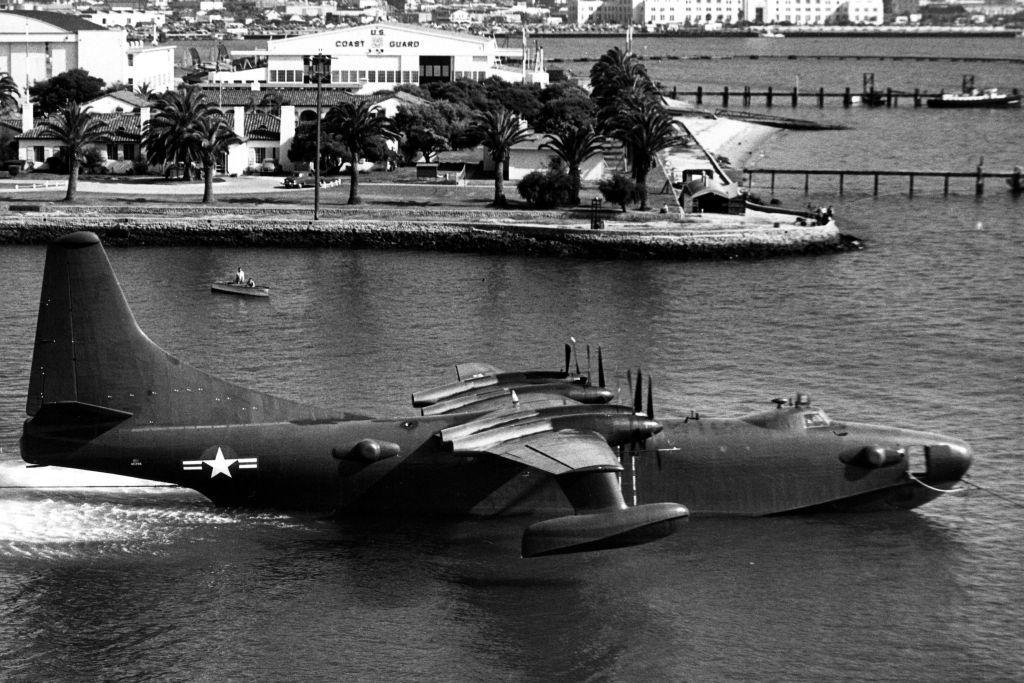
Crash of a Convair R3Y-2 Tradewind off Alameda NAS

Date & Time: Jan 24, 1958
Type of aircraft:
Operator:
Registration:
128446
Flight Type:
Survivors:
Yes
Schedule:
Honolulu - Alameda
Crew on board:
5
Crew fatalities:
Pax on board:
16
Pax fatalities:
Other fatalities:
Total fatalities:
0
Circumstances:
On a flight from Honolulu (Keehi lagoon) to Alameda NAS, the propeller detached from the engine number one and struck the fuselage, causing vibrations. The crew continued the flight to Alameda NAS and while landing on breakwater, the airplane crash landed and sank. All 21 occupants were rescued but the aircraft was lost.
Probable cause:
Loss of a propeller blade in flight.

Crash of a Boeing B-52B-30-BO Stratofortress at Castle AFB

Date & Time: Nov 6, 1957
Type of aircraft:
Operator:
Registration:
53-0382
Flight Type:
Survivors:
Yes
Schedule:
Castle - Castle
MSN:
16861
YOM:
1953
Crew on board:
0
Crew fatalities:
Pax on board:
0
Pax fatalities:
Other fatalities:
Total fatalities:
0
Circumstances:
The crew was completing a local training sortie at Castle AFB, consisting of touch and go manoeuvre. After touchdown, the undercarriage failed and the airplane slid on the runway before coming to rest. There were no injuries but the aircraft was damaged beyond repair.
Probable cause:
Failure of the landing gear lever latch after landing, causing the aircraft to sink on runway.

Crash of a Lockheed P2V-7 Neptune at Alameda NAS

Date & Time: Sep 23, 1957
Type of aircraft:
Operator:
Registration:
135619
Flight Type:
MSN:
726-7051
Crew on board:
0
Crew fatalities:
Pax on board:
0
Pax fatalities:
Other fatalities:
Total fatalities:
0
Circumstances:
Crashed in unknown circumstances at or near Alameda NAS. Crew fate remains unknown.

Crash of a Convair R3Y-2 Tradewind off San Francisco

Date & Time: May 10, 1957
Type of aircraft:
Operator:
Registration:
128448
Flight Phase:
Flight Type:
Survivors:
Yes
Crew on board:
0
Crew fatalities:
Pax on board:
0
Pax fatalities:
Other fatalities:
Total fatalities:
0
Circumstances:
The crew was forced to ditch the airplane in the San Francisco bay following an engine failure in flight. There were no casualties but the aircraft sank and was lost. §
Probable cause:
Engine failure in flight.

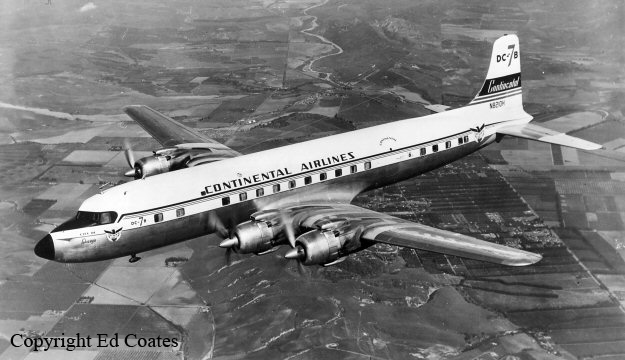
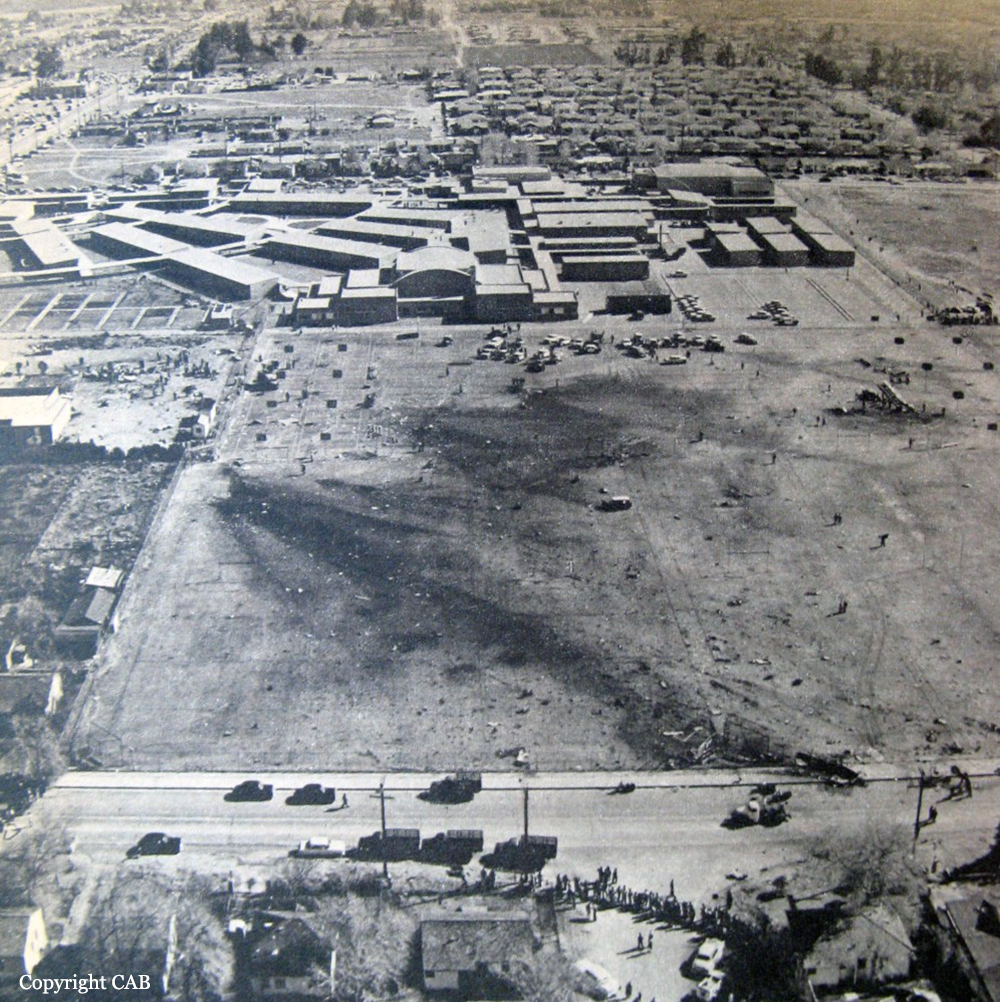
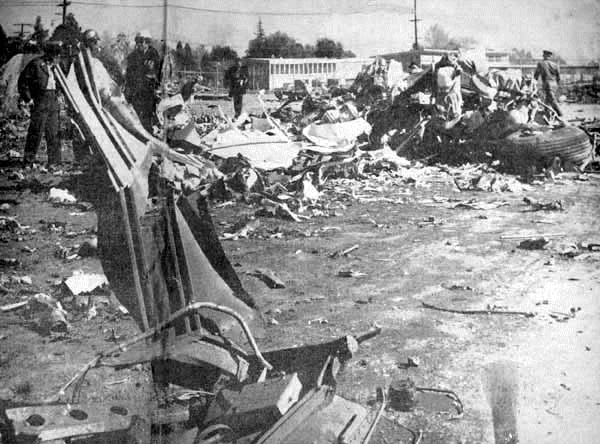
Crash of a Douglas DC-7B in Sunland: 7 killed

Date & Time: Jan 31, 1957 at 1118 LT
Type of aircraft:
Operator:
Registration:
N8210H
Flight Phase:
Flight Type:
Survivors:
No
Site:
Schedule:
Santa Monica - Santa Monica
MSN:
45192
YOM:
1957
Crew on board:
4
Crew fatalities:
Pax on board:
0
Pax fatalities:
Other fatalities:
Total fatalities:
7
Captain / Total flying hours:
11757
Captain / Total hours on type:
598.00
Copilot / Total flying hours:
7115
Copilot / Total hours on type:
287
Aircraft flight hours:
1
Circumstances:
On January 31, at 1015, N8210H took off tram runway 03 of the Santa Monica, California, Airport. The aircraft was a new DC-7B being flown for the first time for the purpose of functionally checking the aircraft and its components in flight following production. The flight crew were Douglas Aircraft employees consisting of Pilot William G. Carr; Copilot Archie R. Twitchell; Flight Engineer Waldo B. Adams; and Radio Operator Roy Nakazawa. The aircraft had been subject to many regular inspections during its manufacture and numerous inspections which were required after production preceding the first flight. Accordingly, it was presumed the DC-7B was in airworthy condition. Preparations for the flight by its crew were routine, Departure was on a local VFR flight plan filed with the operations office of the company. The plan showed six hours of fuel aboard end that the flight duration wee estimated as 2 hours 15 minutes. It also showed the gross takeoff night of N8210H was 88,000, pounds, well under the maximum allowable. The load was properly distributed with respect to center of gravity limitations. According to routine procedure the flight switched to the Douglas company radio frequency after takeoff and made periodic progress reports. At 1030 the crew reported over the Catalina intersection, 9,000 feet, routine, and thereafter, at 1106, over Ontario, 25,000 feet, routine. At 1050 that morning, the Northrop operated F-89J, 52-1870, took off from runway 25 of the Palmdale, California, Airport, accompanied by another F-89J, 53-25 6A. The flight of 52-1870 was one of a series of functional flight checks following the completion of IRAN (inspection and repair as necessary), an overhaul project performed under contract by Northrop Aircraft for the United States Air Force. The specific flight was in accordance with provisions of the contract and its purpose was to check the radar fire control systems of both of the all-weather interceptors. The two-member flight crew of 52-1870 consisted of Pilot Roland E. Owen and Radar Operator Curtiss A. Adams, both employees of Northrop. Preparations for the operation were routine and departure was in accordance with a local VFR flight plan filed with the flight department of the company. The plan indicated the estimated duration of the operation as one hour with sufficient fuel aboard for approximately 1 hour and 45 minutes, considering afterburner time, altitude, and power settings for the mission. The F-89's took off individually, using afterburners, with a separation interval, of 20 seconds. In a wide starboard orbit the pilots utilized radar in a “snake climb” to 25,000 feet. At that altitude, a predetermined scissoring flight pattern was utilized which positioned the F-89's, without ground radar control, for simulated all-weather interceptor attacks on each other, during which the operation of airborne radar equipment could be checked. Radio transmissions, on company frequency, were recorded by ground facilities. These were routine commands between the pilots as they executed the radar check pattern and intercepts. At 1118 activity in the Douglas radio roan was interrupted by an emergency transmission from N 8210H. The voices were recognized by radio personnel familiar with the crew members. Pilot Cart first transmitted, “Uncontrollable," Copilot Twitchell then said, “We‘re a midair collision - midair collision, 10 How (aircraft identification using phonetic How for H) we are going in-uncontrollable - uncontrollable - we are . . . we've had it boy - poor jet too - told you we should take chutes - say goodbye to everybody.” Radio Operator Nakazawa’s voice was recognized and he concluded the tragic message with, "We are spinning In the valley.” This final transmission from the flight is presented because it contained important information relative to the accident investigation. It not only establishes the midair collision but also indicates the DC-7 was rendered uncontrollable. It further indicates that Mr. Twitchell at least recognized the aircraft with which they collided as a jet. Further, the DC-7 spun during its descent to the ground. All four crew members on board the DC-7 were killed plus three people on the ground. Seventy others have been injured. Weather conditions in the area at the time of the accident were reported by the Weather Bureau as clear, visibility 50 miles. Winds aloft at 25,000 were approximately 30 knots from 320 degrees.
Probable cause:
The Board determines that the probable cause of this midair collision was the high rate of near head-on closure at high altitude which, together with physiological limitations, resulted in a minimum avoidance opportunity during which the pilots did not see the other’s aircraft. The following findings were reported:
- The flights were operated in clear weather conditions and in accordance with the provisions of local VFR flight plans,
- Under VFR weather conditions and VFR flight plans collision avoidance rested in visual separation, a pilot responsibility,
- The DC-7 and F-89 collided in flight on approximately west and east headings, respectively. They were at 25,000 feet over a non-congested area between one and two miles northeast of the Hansen Dam Spillway,
- At impact the F-89 was rolled about 30 degrees left, both aircraft were about level in the pitch plane, and the convergence angle was about five degrees from head-on,
- Both aircraft tell out of control and the DC-7 crashed in a populated area,
- From visual range, estimated at 3.5 miles, the closure speed between the two aircraft was 700 knots and over the probable flight paths the tine to collision from visual range was about 15 seconds,
- The nature and purpose of the flights did not prevent all pilots from maintaining a lookout for other aircraft,
- There was no evidence found to indicate that any malfunction or failure of the aircraft or their components was a factor in the accident.
Final Report:

Crash of a Curtiss C-46A-45-CU Commando in Long Beach

Date & Time: Dec 16, 1956
Type of aircraft:
Operator:
Registration:
N2028A
Flight Type:
Survivors:
Yes
MSN:
30380
YOM:
1944
Crew on board:
4
Crew fatalities:
Pax on board:
0
Pax fatalities:
Other fatalities:
Total fatalities:
0
Circumstances:
Following an uneventful cargo flight, the crew started the approach to Long Beach under VFR. On final, the airplane went through a patch of fog. In zero visibility, the airplane descended until it struck the ground and crashed few dozen yards short of runway threshold. All four crew members were slightly injured and the aircraft was damaged beyond repair.

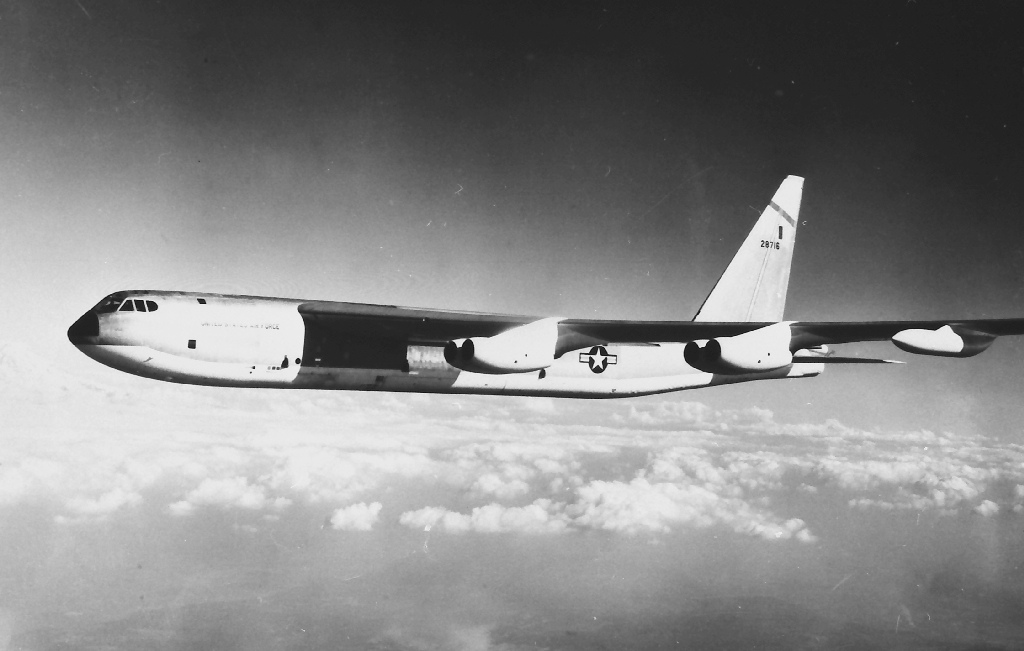
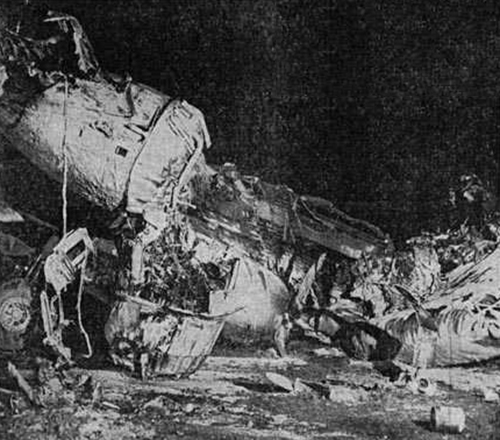
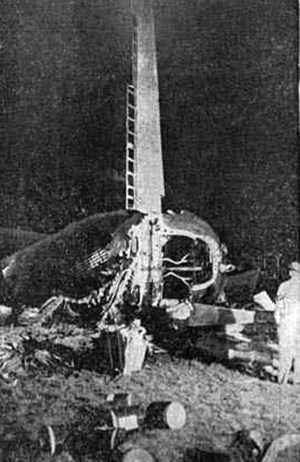
Crash of a Boeing RB-52B-20-BO Stratofortress at Castle AFB: 10 killed

Date & Time: Nov 30, 1956 at 2200 LT
Type of aircraft:
Operator:
Registration:
52-8716
Flight Phase:
Flight Type:
Survivors:
No
Schedule:
Castle - Castle
MSN:
16844
YOM:
1952
Crew on board:
10
Crew fatalities:
Pax on board:
0
Pax fatalities:
Other fatalities:
Total fatalities:
10
Circumstances:
Soon after a night takeoff from Castle AFB, while climbing to a height of 500 feet, the aircraft adopted a 5° nose down attitude. The crew elected to correct this but the aircraft went into a descent and struck the ground 4 miles north of the airbase and exploded on impact, killing all 10 crew members.
Crew:
Cpt John A. Goddard, aircraft commander,
Cpt Richard M. Wikstrom, pilot,
Cpt Leland Fulton Burch, navigator,
Maj Robert Louis Sherman, ECM operator
Cpt Jack Eugene Welch, radar-bombardier,
Maj Bryant Guernsey Gay, electronic counter measure operator,
T/Sgt William J. Maguire, radio operator,
Cpt Nick Sam Koss, radar-bombardier instructor,
Cpt Charles Warren Schweer, ECM instructor,
T/Sgt Gerald Everett Riley, tail gunner.
Probable cause:
No technical issues and no structural failure was found during investigations. It is believed the accident was the consequence of an uncontrolled descent caused either by a wrong maneuver on part of the pilot or due to the fact that they were distracted. Following this accident, it will be recommended that flaps could not be raised below a minimum altitude of 1,000 feet.

Crash of a Boeing B-52B-35-BO Stratofortress near Madera: 5 killed

Date & Time: Sep 17, 1956
Type of aircraft:
Operator:
Registration:
53-0393
Flight Phase:
Flight Type:
Survivors:
Yes
MSN:
16873
YOM:
1953
Crew on board:
7
Crew fatalities:
Pax on board:
0
Pax fatalities:
Other fatalities:
Total fatalities:
5
Circumstances:
En route, the aircraft caught fire, apparently on a wing. The crew elected to return to his base but control was lost. Two crew members were able to bail out and were later recovered while all five other occupants were killed when the airplane crashed along Highway 99, about 9 miles southeast of Madera.

Crash of a Douglas C-124C Globemaster II at Travis AFB: 3 killed

Date & Time: Apr 7, 1956
Operator:
Registration:
52-1078
Flight Phase:
Flight Type:
Survivors:
Yes
Schedule:
Travis - Travis
MSN:
43987
YOM:
1952
Crew on board:
7
Crew fatalities:
Pax on board:
0
Pax fatalities:
Other fatalities:
Total fatalities:
3
Circumstances:
The crew was conducting a post-maintenance test flight. Shortly after takeoff from Travis AFB, while climbing to a height of 100 feet, the aircraft banked left, stalled and crashed in flames. Three crew members were killed while four others were injured. The aircraft was destroyed.
Crew:
1st Lt James Lyman Hayter,
2nd Lt Richard C. Nelson,
2nd Lt Garth L. Tingey,
M/Sgt Russell M. Hobart,
M/Sgt Harold E. Roache, †
M/Sgt Arthur G. Bird, †
S/Sgt Amos H. Kolb. †
Probable cause:
Ailerons and elevators control cables have been changed by mechanics based at Travis AFB and the crew was engaged in a post-maintenance check flight. It is believed that control was lost during initial climb because these cables were incorrectly installed, not adhering to the manufacturer procedures.

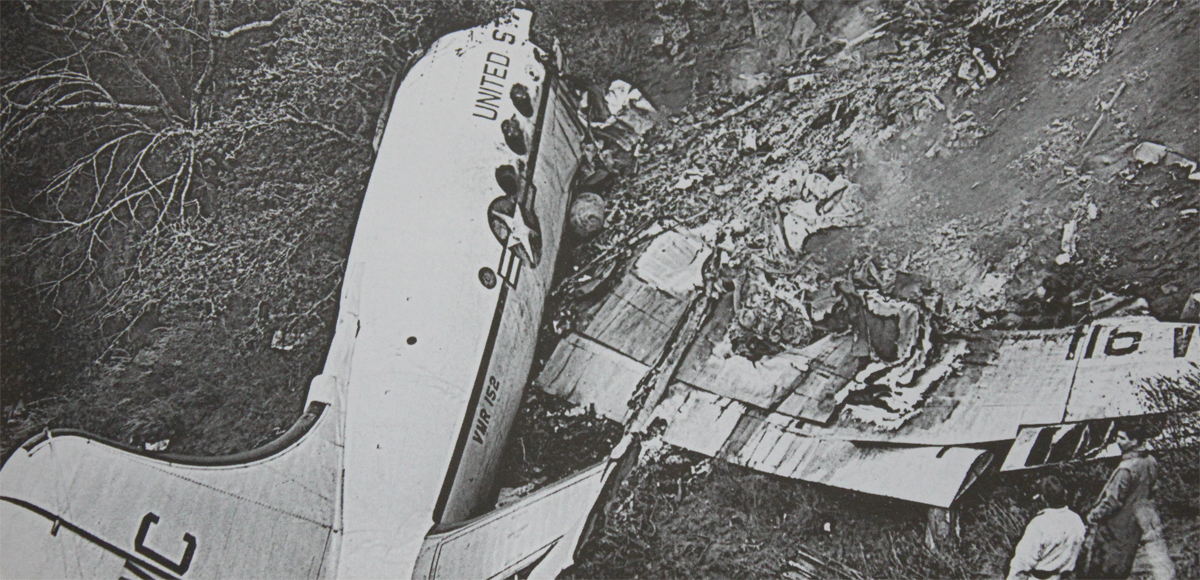
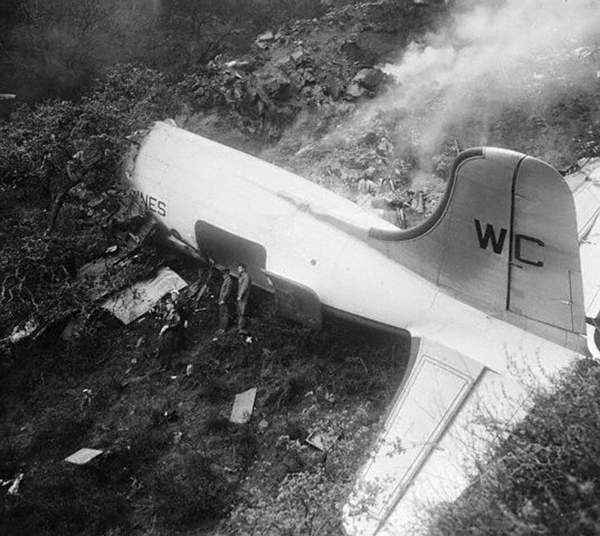
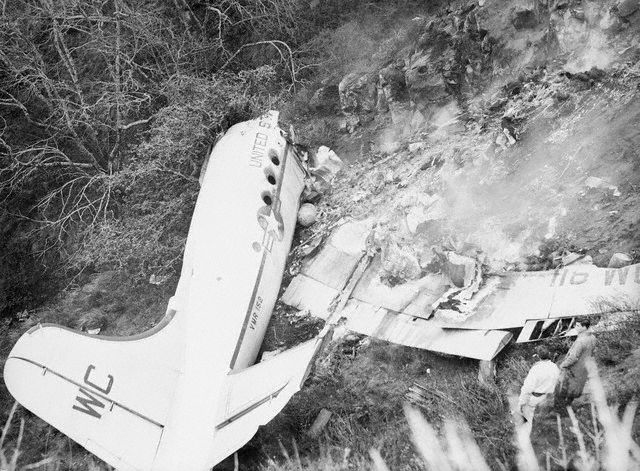
Crash of a Douglas R5D-2 on Mt Sunol Ridge: 40 killed

Date & Time: Feb 17, 1956 at 1342 LT
Type of aircraft:
Operator:
Registration:
39116
Flight Type:
Survivors:
No
Site:
Schedule:
Camp Pendleton – El Toro – Alameda – Hickam
MSN:
18331
YOM:
1944
Crew on board:
5
Crew fatalities:
Pax on board:
35
Pax fatalities:
Other fatalities:
Total fatalities:
40
Circumstances:
The aircraft departed El Toro Airbase at 1030LT Bound for Alameda NAS on behalf of the Marine Transport Squadron 152. On board were United States Marines from Camp Pendleton en route to Hickam Field, and five crew members. While approaching his destination, the captain was instructed to follow a 30 minutes holding circuit. At 1342LT, while descending at an altitude of 3,500 feet in marginal weather conditions, the pilot started the approach when the aircraft hit the slope of Mt Sunol Ridge located about 21 miles southeast of Alameda Airbase. The aircraft was destroyed upon impact and all 40 occupants have been killed. It was reported that the airplane hit the mountain about 200 feet below the summit.
Crew:
Maj Alexander Watson, pilot,
1st Lt Thomas E. Straughan, copilot,
M/Sgt Donald J. Down, navigator,
S/Sgt Terrell M. Young, flight engineer,
S/Sgt Harry E. Knight, radio operator.
Probable cause:
It was determined that the collision with the mountain was the consequence of several errors and omissions on part of the flying crew who neglected approach procedures and wrongly interpreted some signals transmitted by local beacons. This caused the crew to start the descent prematurely and the aircraft to drift off course by six miles to the northeast at the time of the accident. Low visibility due to clouds was considered as a contributing factor.