Crash of a Cessna 207A Stationair 8 II near Kotzebue: 1 killed

Date & Time: Apr 14, 1999 at 0930 LT
Registration:
N73188
Flight Phase:
Flight Type:
Survivors:
No
Schedule:
Noorvik - Kotzebue
MSN:
207-0568
YOM:
1981
Crew on board:
1
Crew fatalities:
Pax on board:
0
Pax fatalities:
Other fatalities:
Total fatalities:
1
Captain / Total flying hours:
10000
Captain / Total hours on type:
7800.00
Aircraft flight hours:
16790
Circumstances:
The certificated airline transport pilot departed on a flight to a remote village about 37 miles away. The trip was the first since an annual inspection had been completed the day before. The pilot departed with fuel only in the left wing tank. The right wing tank was empty. About 35 minutes later, the pilot was on a return flight to his original departure airport that was within Class E airspace. During the pilot's absence, the airport visibility had decreased to 1 1/2 mile. Instrument meteorological conditions, and special VFR procedures were in use. A 'MAYDAY' was heard over the common traffic advisory frequency, and was monitored by the local flight service station. The voice of the pilot was recognized as the accident pilot. Search personnel found the airplane on a flat area of a frozen, snow-covered lagoon. The weather at the accident site was described as fog, with flat lighting conditions. The wreckage path was oriented away from higher terrain around the destination airport which is located on a peninsula. The airplane had crashed in a nose down attitude, and came to rest inverted. The engine separated completely from the airframe. An examination of the engine revealed fuel throughout, and mechanical continuity. The vacuum pump's internal support post, on which the internal block rotated, was found fractured through 70 percent of its diameter from fatigue, the remaining portion of fracture was overstress. The airplane was equipped with a standby vacuum system. An examination of the airframe located a combination screwdriver in the left wing. The handle was shattered. No flight control cable impingement was observed.
Probable cause:
The pilot's continued VFR flight into instrument meteorological conditions, spatial disorientation, and an inadvertent stall. Factors in the accident were weather conditions consisting of snow and mist, and flat lighting conditions.
Final Report:


Crash of a Beechcraft 1900C-1 in Saint Mary's

Date & Time: Feb 11, 1999 at 2345 LT
Type of aircraft:
Operator:
Registration:
N31240
Flight Type:
Survivors:
Yes
Schedule:
Anchorage – Saint Mary’s
MSN:
UC-28
YOM:
1988
Flight number:
AER91
Crew on board:
1
Crew fatalities:
Pax on board:
0
Pax fatalities:
Other fatalities:
Total fatalities:
0
Captain / Total flying hours:
12326
Captain / Total hours on type:
1587.00
Aircraft flight hours:
19588
Circumstances:
The airline transport pilot was cleared for the localizer approach. The airplane impacted the ground 3.2 nautical miles from the runway threshold. The minimum descent altitude (MDA) for the approach was 560 feet msl, which is 263 feet above touchdown. Night, instrument meteorological conditions prevailed at the time of the accident. The surrounding terrain was flat, snow-covered, and featureless. The reported weather was 200 feet overcast, 1 1/2 miles visibility in snow, and winds of 12 knots, gusting to 32 knots. The pilot reported he was established on the final approach course, descending to the MDA, and then woke up in the snow. He said he did not remember any problems with the airplane. No pre accident mechanical anomalies were discovered with the airplane during the investigation. The airport has high intensity runway lights, sequenced flashing lead-in lights, and visual approach slope indicator lights. All airport lights and navigation aids were functioning. The airplane was not equipped with an autopilot. Captains have the option of requesting a copilot, but, the captain's pay is reduced by a portion equal to one-half the copilot's pay. The pilot had returned from the previous nights trip at 0725. He had three rest periods, four hours, two hours, and five hours 15 minutes, since his previous nights flight. Each rest period was interrupted by contact with the company. The company indicated that it is the pilot's responsibility to tell the company if duty times are being exceeded. 14 CFR 135.267 states, in part: '(d) Each assignment ... must provide for at least 10 consecutive hours of rest during the 24 hours that precedes the planned completion of the assignment.'
Probable cause:
The pilot's descent below the minimum descent altitude on the instrument approach. Factors were pilot fatigue resulting from the pilot's rest period being interrupted by scheduling discussions and the night weather conditions of low ceilings and whiteout.
Final Report:

Crash of a Cessna 207A Skywagon in Manokotak

Date & Time: Dec 17, 1998 at 1740 LT
Operator:
Registration:
N1764U
Flight Phase:
Survivors:
Yes
Site:
Schedule:
Dillingham – Togiak – Manokotak – Togiak – Dillingham
MSN:
207-0364
YOM:
1976
Flight number:
UYA611
Crew on board:
1
Crew fatalities:
Pax on board:
1
Pax fatalities:
Other fatalities:
Total fatalities:
0
Captain / Total flying hours:
1600
Captain / Total hours on type:
700.00
Aircraft flight hours:
7283
Circumstances:
The certificated commercial pilot and the pilot-rated, nonrevenue passenger, departed at night from a remote village airport on the last leg of a VFR scheduled air taxi flight. The destination airport was 17 nautical miles northeast of the departure point. After departure, the pilot said he encountered severe turbulence and entered a snow squall where the visibility dropped below 1 mile. The pilot said he was in instrument meteorological conditions, and a strong surface wind was blowing the airplane toward the southwest. He began correcting his course toward the southeast, and then collided with a snow-covered hill. The passenger said that light snow showers were falling in the area, along with turbulence and strong winds from the northeast. After departing on the accident flight, snow showers intensified, and the pilot turned toward the south, away from the intended destination. About 10 minutes after takeoff, the passenger inquired about the direction of flight, and the pilot said he was going to head to the coast and follow it to the destination. The visibility was about 1 mile. No ground features were visible until the passenger saw snow-covered terrain about 3 feet below the airplane. The airplane then collided with terrain. The pilot indicated he obtained a weather briefing from an FAA Flight Service Station.
Probable cause:
The pilot's continued VFR flight into instrument meteorological conditions. Factors in the accident were dark night conditions, snow covered terrain, and low ceilings.
Final Report:

Crash of a Piper PA-31-350 Navajo Chieftain in Point Lay

Date & Time: Dec 3, 1998 at 1038 LT
Operator:
Registration:
N3542H
Flight Type:
Survivors:
Yes
Schedule:
Kotzebue - Point Lay
MSN:
31-7952233
YOM:
1979
Crew on board:
1
Crew fatalities:
Pax on board:
0
Pax fatalities:
Other fatalities:
Total fatalities:
0
Captain / Total flying hours:
3069
Captain / Total hours on type:
311.00
Aircraft flight hours:
15638
Circumstances:
A witness observed the airplane circle to land at the completion of an NDB approach. The nighttime meteorological conditions were an 800 feet ceiling, 1 mile visibility in blowing snow, and 26 knot winds. The surrounding terrain was essentially flat, snow covered, and featureless. The witness saw the airplane on final approach misaligned for the runway, and then disappear below an 18 feet msl bluff. He transmitted on the radio to 'get out of there,' and heard no response. About 10 minutes later the accident pilot walked up to the witness' airplane. The pilot told the investigator-in-charge that he was 'beat around by the winds, ...it was snowing pretty hard, I always had the lights, and I was concentrating on the runway. The next thing I knew I was on the ground short of the runway.' The pilot's previous experience to this airport was during daytime, and during visual conditions. The airport, which was being transferred from the Air Force to the North Slope Borough, has medium intensity runway lights (MIRL), and runway end identifier lights (REILS). It does not have visual approach slope indicator (VASI) lights.
Probable cause:
Failure of the pilot to maintain a proper glidepath. Factors associated with this accident were the airport not having a VASI system installed, and the lack of visual perception for the pilot.
Final Report:

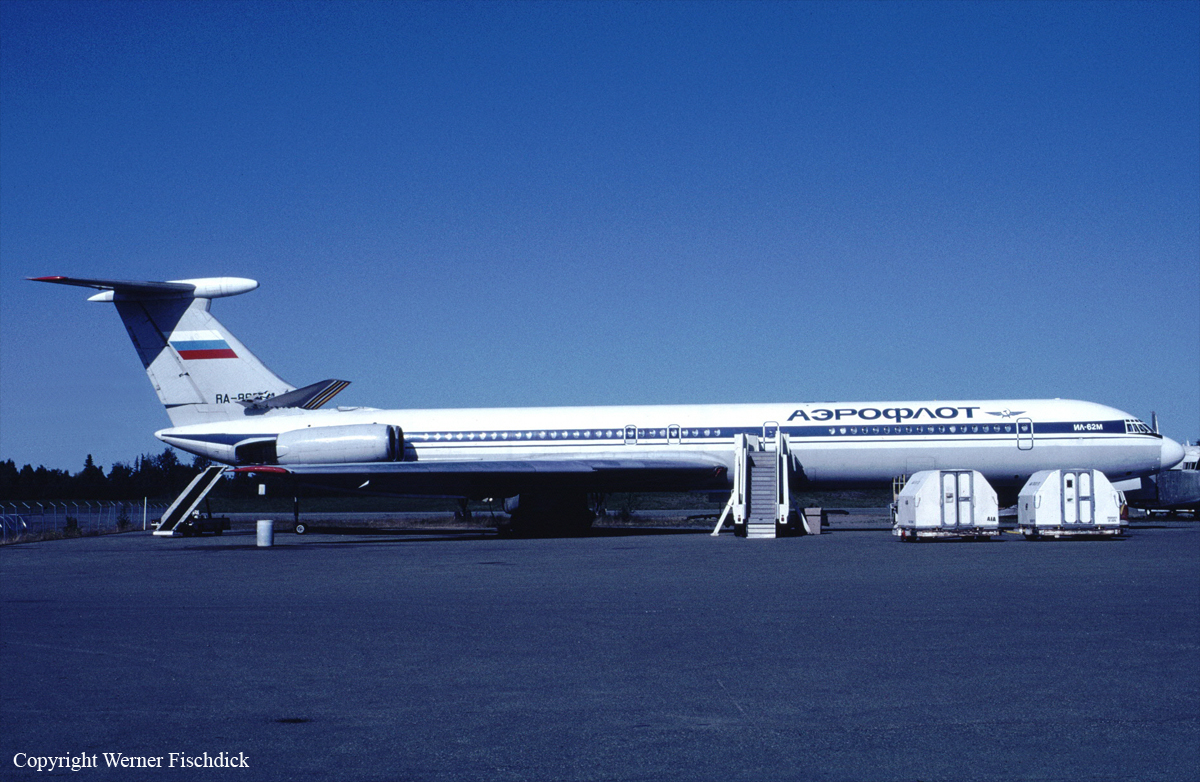
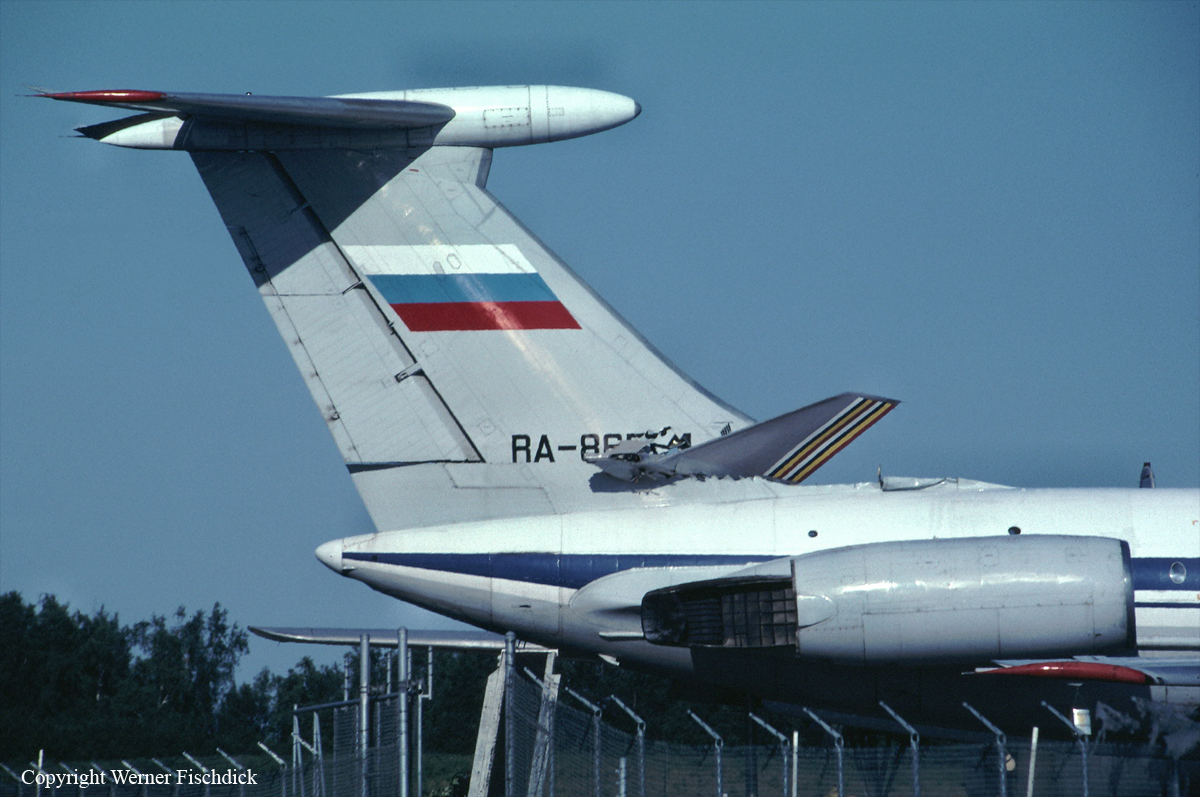
Ground collision of an Ilyushin II-62M in Anchorage

Date & Time: Nov 11, 1998 at 0133 LT
Type of aircraft:
Operator:
Registration:
RA-86564
Flight Phase:
Survivors:
Yes
Schedule:
Anchorage - San Francisco
MSN:
4934734
YOM:
1979
Crew on board:
12
Crew fatalities:
Pax on board:
0
Pax fatalities:
Other fatalities:
Total fatalities:
0
Circumstances:
The Ilyushin II-62M was parked at gate with its 12 crew members on board, awaiting the passengers for the next leg to San Francisco. An Asiana Boeing 747-400 (HL7414) was taxiing to gate N6 for a refueling stop on the flight Seoul - New York (flight 211). While trying to make a U-turn, the Boeing's n°1 engine struck the wing of the Ilyushin. Then the left winglet struck the base of the Ilyushin's tail. The Asiana crew added more power causing the wing to cut through nearly half of the tail of the Russian aircraft. The maximum ground speed recorded by the on-board recorders was 16 knots, while according to the company flight manual it should have been "10 knots or below (5 knots if wet or slippery)".
Probable cause:
The excessive taxi speed by the pilot of the other aircraft. A factor associated with the accident was the other pilot's inadequate maneuver to avoid the parked airplane.

Crash of a Cessna 207 Skywagon on Mt Noak: 1 killed

Date & Time: Sep 17, 1998 at 1430 LT
Registration:
N1809Q
Flight Phase:
Flight Type:
Survivors:
No
Site:
Schedule:
Kotzebue - Point Hope
MSN:
207-0787
YOM:
1984
Location:
Crew on board:
1
Crew fatalities:
Pax on board:
0
Pax fatalities:
Other fatalities:
Total fatalities:
1
Captain / Total flying hours:
8891
Captain / Total hours on type:
446.00
Aircraft flight hours:
12268
Circumstances:
The airline transport pilot departed on a CFR Part 135 cargo/mail flight for a remote coastal village. When the flight did not reach the destination, an aerial search was initiated. The wreckage was located the following day in mountainous terrain, 21 miles from the departure airport. The airplane had collided with rising terrain. An AIRMET for mountain obscuration in clouds and precipitation was issued for the pilot's planned route of flight. A pilot that departed about 20 minutes after the accident airplane's departure, had a similar route of flight. He characterized the weather conditions along the accident airplane's route as 'very low visibility with rain, fog and varied layers of cloud cover.' This pilot stated that he changed his route in order to avoid the worsening weather conditions. He added that with satisfactory weather conditions, and given the intended destination of the accident airplane, the standard route of flight would be directly over the mountain that the accident airplane collided with.
Probable cause:
The pilot's continued VFR flight into instrument meteorological conditions. Factors associated with the accident were low ceilings, mountainous/hilly terrain features, rain, and fog.
Final Report:

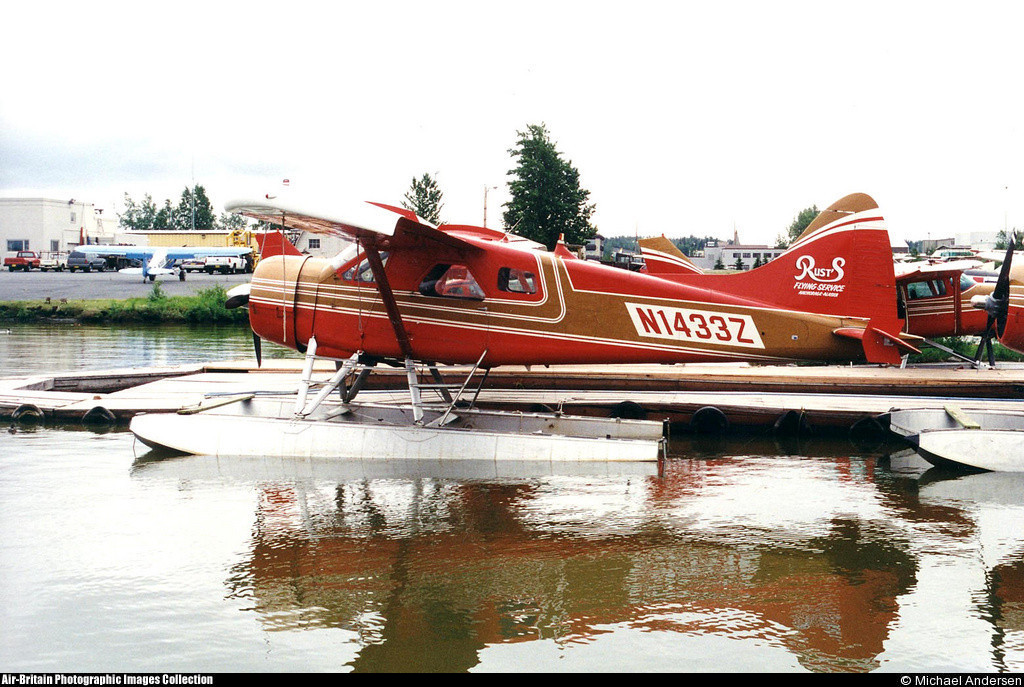
Crash of a De Havilland DHC-2 Beaver near Telequana Pass: 5 killed

Date & Time: Sep 9, 1998 at 1045 LT
Type of aircraft:
Operator:
Registration:
N1433Z
Flight Phase:
Survivors:
No
Site:
Schedule:
Anchorage - Hoholitna River
MSN:
0595
YOM:
1953
Crew on board:
1
Crew fatalities:
Pax on board:
4
Pax fatalities:
Other fatalities:
Total fatalities:
5
Captain / Total flying hours:
1720
Captain / Total hours on type:
150.00
Aircraft flight hours:
12948
Circumstances:
The float equipped airplane was attempting to cross a mountain pass, following two other company airplanes. The first two pilots, and passengers, described five to seven miles visibility, 700 feet ceilings, clouds hanging on the mountainsides, and misty rain. The route of flight required several turns in the pass. The pilot had not flown through the pass in marginal Visual Flight Rules (VFR) weather before this flight. After the first two airplanes went through the pass, they lost radio contact with the accident pilot, and did not see or hear from him again. The wreckage was later located at the head of an intersecting canyon, two miles before the correct pass. The airplane had been modified with a Short Take Off and Landing (STOL) kit. Canadian certification flight tests had determined that this modification eliminated aerodynamic warning of impending stalls, and therefore required an audible stall warning. Company pilots indicated it was common for the stall warning system to activate at an airspeed 10-15 miles per hour above the actual stall. At the time of the accident, the airplane did not have the ventral fin installed, and a takeoff flaps setting was selected. The audible stall warning circuit breaker was found in the pulled (disabled) position.
Probable cause:
The pilot's failure to maintain adequate airspeed which resulted in an inadvertent stall. Factors associated with this accident were the pilot's unfamiliarity with the geographic area, the low clouds, his becoming disoriented, and the blind canyon into which he flew. An additional factor was the intentionally disabled stall warning system.
Final Report:

Crash of a Piper PA-31-350 Navajo Chieftain off Homer

Date & Time: Sep 7, 1998 at 1513 LT
Registration:
N4072A
Flight Phase:
Survivors:
Yes
Schedule:
Homer - Anchorage
MSN:
31-8152016
YOM:
1981
Location:
Crew on board:
1
Crew fatalities:
Pax on board:
0
Pax fatalities:
Other fatalities:
Total fatalities:
0
Captain / Total flying hours:
9070
Captain / Total hours on type:
2000.00
Aircraft flight hours:
4133
Circumstances:
The pilot departed from an intersection 2,100 feet from the approach end of the 6,700 feet long runway. Immediately after takeoff the right engine failed. The pilot told the NTSB investigator-in-charge that he feathered the right propeller, and began a wide right turn away from terrain in an attempt to return to the airport. He stated the airspeed did not reach 90 knots, the airspeed and altitude slowly decayed, and the airplane was ditched into smooth water. After recovery, the cowl flaps were found in the 50% open position. No anomalies were found with the fuel system. The airplane departed with full fuel tanks, at a takeoff weight estimated at 6,606 pounds. The right engine was disassembled and no mechanical anomalies were noted. The best single engine rate of climb airspeed is 106 knots, based on cowl flaps closed, and a five degree bank into the operating engine.
Probable cause:
A total loss of power in the right engine for undetermined reasons.
Final Report:

Crash of a Grumman G-44 Widgeon near New Stuyahok

Date & Time: Sep 2, 1998 at 1002 LT
Type of aircraft:
Registration:
N139F
Flight Phase:
Survivors:
Yes
Site:
Schedule:
Dillingham - Lake Chikuminuk
MSN:
1375
YOM:
1944
Crew on board:
2
Crew fatalities:
Pax on board:
1
Pax fatalities:
Other fatalities:
Total fatalities:
0
Captain / Total flying hours:
7800
Captain / Total hours on type:
750.00
Circumstances:
The commercial pilot departed under special VFR conditions on a CFR part 135 flight for a remote lake. During the flight, low clouds, rain, and fog were present in an area of mountainous terrain along the route of flight. The pilot stated that he intended to utilize a narrow mountain pass to transit the area, and as he entered the mountain pass, discovered that the ceiling and visibility would not allow safe passage. He said that he made an emergency 180 degree turn in an attempt to exit the pass, and subsequently collided with terrain. After initial impact, the airplane slid downhill about 100 feet, and came to rest on a 35 degree slope. The pilot stated that weather conditions at the time of the accident consisted of: Ceiling, 500 foot overcast; visibility, 2 miles with rain and fog; wind 360 degrees, at 8 knots. The pilot noted that there were no pre accident anomalies with the airplane.
Probable cause:
The pilot's failure to maintain clearance with terrain. Contributing factors were the pilot's delayed remedial action (course reversal), low ceilings, rain, fog, and mountainous terrain.
Final Report:

Crash of a Swearingen SA26T Merlin IIB in Saint George: 2 killed

Date & Time: Jul 7, 1998 at 1547 LT
Type of aircraft:
Operator:
Registration:
N501FS
Flight Type:
Survivors:
No
Site:
Schedule:
Anchorage - Saint George
MSN:
T26-146
YOM:
1969
Crew on board:
2
Crew fatalities:
Pax on board:
0
Pax fatalities:
Other fatalities:
Total fatalities:
2
Captain / Total flying hours:
13000
Captain / Total hours on type:
250.00
Aircraft flight hours:
7799
Circumstances:
The flight departed Anchorage, Alaska, and was en route to Saint George, Alaska, to pick up passengers for a return flight to Anchorage. The pilot-in-command (PIC) was seated in the right seat, and the copilot was seated in the left seat. This was the copilot's third flight in this make and model airplane, and he was not qualified as a crewman in it under 14 CFR Part 135. There was no record of when the copilot last performed a non directional beacon (NDB) approach. The NDB indicator in the cockpit was on the left side of the left control column, partially blocked from the view of the PIC. The minimum altitude for the segment of the approach prior to the final approach fix (FAF) was 1,700 feet. The Minimum Descent Altitude (MDA) for the final segment of the approach was 880 feet. The reported ceiling was 100 feet overcast. The Air Route Traffic Control Center radar altitude readout for the airplane revealed that the airplane descended below 600 feet prior to reaching the FAF. The radar ground track revealed the airplane on course prior to the course reversal procedure turn on the published approach. The radar ground track showed that after the course reversal, the airplane continued through the published final approach course, and turned to parallel the inbound track three miles north of course. The radar plot terminates about the location of the 550 feet high cliffs where the airplane was located. Weather at the time of the accident was reported as 100 foot overcast. This location was 5.5 miles (DME) from the airport. A review of radar tapes from the day prior to the accident, show the same airplane and PIC tracking the published course outbound and inbound, and descending below the published approach minima to below 500 feet. This flight successfully landed at the airport. An interview with the copilot from the successful flight revealed that the PIC intentionally descended to 300 feet on the approach until he acquired visual contact with the ocean, then flew to the airport to land. An aircraft flying on the published inbound final approach course at 5.5 DME is over water, approximately three miles from the nearest terrain.
Probable cause:
The pilot-in-command's failure to adequately monitor the instrument approach and the copilot's failure to intercept and maintain the proper NDB bearing on the approach. Contributing factors were the pilot-in-command's obstructed view of the NDB indicator and his overconfidence in his personal ability, the terrain (cliffs), low ceiling, and the flight crew's disregard of the minimum descent altitude.
Final Report: