Crash of a Curtiss C-46D-10-CU Commando into the Caribbean Sea: 4 killed

Date & Time: Apr 10, 1970
Type of aircraft:
Operator:
Registration:
HK-1281
Flight Phase:
Flight Type:
Survivors:
No
Schedule:
Santa Marta – Pointe-à-Pitre
MSN:
33275
YOM:
1945
Country:
Region:
Crew on board:
4
Crew fatalities:
Pax on board:
0
Pax fatalities:
Other fatalities:
Total fatalities:
4
Circumstances:
The C-46 departed Santa Marta Airport at 1211LT on a cargo flight to Pointe-à-Pitre, Guadeloupe, carrying a load of 5 tons of meat. While cruising at an altitude of 7,000 feet, the crew informed ATC about his ETA in Guadeloupe at 1755LT when contact was lost. The airplane crashed in unknown circumstances into the sea. No trace of the aircraft nor the four crew members was found.

Crash of a Lockheed C-130A Hercules off Okinawa: 11 killed

Date & Time: Apr 10, 1970
Type of aircraft:
Operator:
Registration:
56-0516
Flight Phase:
Flight Type:
Survivors:
No
MSN:
3124
YOM:
1957
Country:
Region:
Crew on board:
8
Crew fatalities:
Pax on board:
3
Pax fatalities:
Other fatalities:
Total fatalities:
11
Circumstances:
Shortly after takeoff from Kadena AFB, while en route to Vietnam, the crew informed ground that two engines failed and was initiating a return. Shortly later, the airplane went out of control and crashed into the ocean some 24 km southeast of Kadena AFB. All 11 occupants were killed.
Probable cause:
Double engine failure during climb-out for undetermined reason.

Crash of a Grumman E-2A Hawkeye into the Gulf of Tonkin: 5 killed

Date & Time: Apr 8, 1970
Type of aircraft:
Operator:
Registration:
151711
Flight Phase:
Survivors:
No
MSN:
A031
Country:
Region:
Crew on board:
5
Crew fatalities:
Pax on board:
0
Pax fatalities:
Other fatalities:
Total fatalities:
5
Circumstances:
While completing a maritime patrol flight and while cruising 112 km off Đồng Hới, the crew informed ground about fire in the cockpit and elected to return to USS Coral Sea. Shortly later, the airplane crashed into the Gulf of Tonkin. All five crew members were killed.
Crew:
Lt(jg) Charles Brooks Pfaffmann,
Lt Larry Coleman Knight,
SN Brian Lee Bushnell,
SN Andrew Anthony Horchar,
AMEC Jack Lee Wright.

Crash of a De Havilland DHC-4A Caribou into the Cowie Bay: 10 killed

Date & Time: Mar 30, 1970 at 0850 LT
Type of aircraft:
Operator:
Registration:
M21-10
Flight Phase:
Flight Type:
Survivors:
Yes
MSN:
278
YOM:
1969
Location:
Country:
Region:
Crew on board:
3
Crew fatalities:
Pax on board:
16
Pax fatalities:
Other fatalities:
Total fatalities:
10
Circumstances:
Crashed in unknown circumstances into the Cowie Bay. Ten passengers were killed while nine other occupants were rescued.

Crash of a Fairchild-Hiller FH-227B off Belém: 38 killed

Date & Time: Mar 14, 1970 at 1730 LT
Type of aircraft:
Operator:
Registration:
PP-BUF
Survivors:
Yes
Schedule:
Recife - Belém
MSN:
556
YOM:
1967
Flight number:
QR903
Country:
Crew on board:
5
Crew fatalities:
Pax on board:
35
Pax fatalities:
Other fatalities:
Total fatalities:
38
Circumstances:
The approach to Belém-Val-de-Cans-Júlio Cezar Ribeiro Airport was initiated in poor weather conditions with thunderstorm activity and heavy rain falls. While completing a last turn to join the approach path of runway 06, the pilot-in-command failed to realize his altitude was insufficient when one of the wing struck the water surface. The airplane crashed into the Guajará Bay, about 800 meters short of runway 06 threshold. A crew member and a passenger were rescued while 38 other occupants were killed.
Probable cause:
Probable misjudgement of the distance separating the aircraft and the water surface on part of the flying crew while conducting an approach in marginal weather conditions.

Crash of a Douglas DC-9-32 off Santo Domingo: 102 killed

Date & Time: Feb 15, 1970 at 1830 LT
Type of aircraft:
Operator:
Registration:
HI-177
Flight Phase:
Survivors:
No
Schedule:
Santo Domingo - San Juan
MSN:
47500/546
YOM:
1969
Flight number:
DO603
Crew on board:
5
Crew fatalities:
Pax on board:
97
Pax fatalities:
Other fatalities:
Total fatalities:
102
Circumstances:
Two minutes after takeoff from runway 16 at Santo Domingo-Las Américas Airport, while in initial climb, the pilot informed ATC that the right engine failed and was cleared to return for an emergency landing. Shortly later, the left engine failed as well. Out of control, the airplane entered a dive and crashed into the Caribbean Sea about three km offshore. Few debris were floating on water and others sank by a depth of 300 meters. All 102 occupants were killed among them the Dominican boxer Carlos Teo Cruz, world lightweight champion as well as a large part of the Puerto Rico's National Women's Volleyball Team.
Probable cause:
Brand new, the aircraft was delivered by Douglas Corp to Dominicana de Aviación last 16 of December 1969. Only few debris were recovered and unfortunately, both CVR & FDR were not found. Due to lack of evidences, the exact cause of the accident could not be determined with certainty. However, it is believed that the double engine failure may have been caused by the contamination of fuel by an important quantity of water.

Crash of a Douglas C-47B-5-DK off Puerto Montt

Date & Time: Feb 12, 1970
Operator:
Registration:
CC-CBT
Flight Phase:
Flight Type:
Survivors:
Yes
MSN:
14727/26172
YOM:
1944
Country:
Crew on board:
2
Crew fatalities:
Pax on board:
0
Pax fatalities:
Other fatalities:
Total fatalities:
0
Circumstances:
About 35 minutes into the flight, while cruising at an altitude of 5,500 feet, the left engine started to malfunction. It was decided to shut it down and to feather the propeller. Full power was added on the right engine that exploded shortly later. In such situation, the crew decided to ditch the aircraft off Llaque Island located in the region of Puerto Montt. The aircraft sank and was lost and the crew was rescued.
Probable cause:
Engine malfunction in flight.

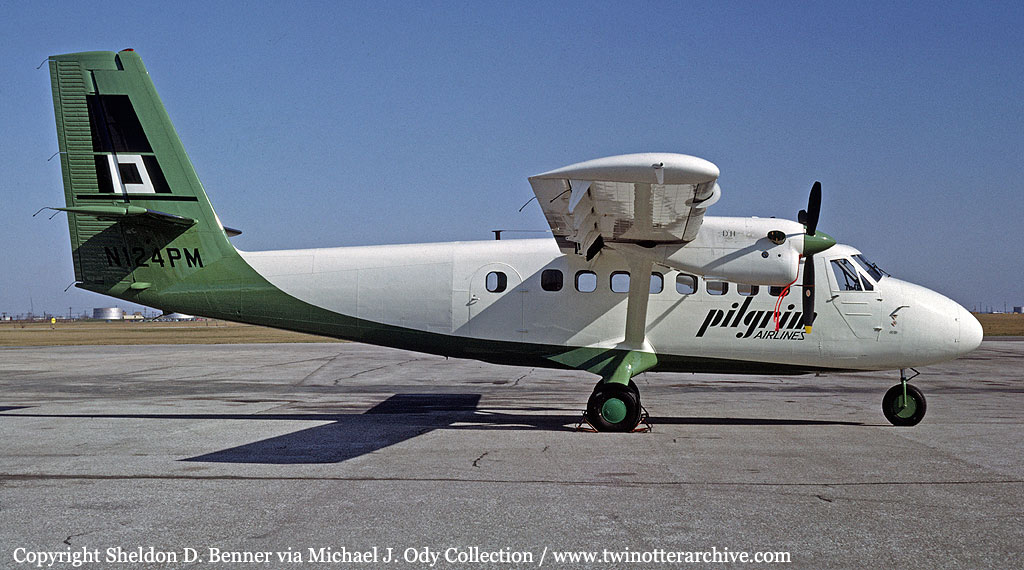
Crash of a De Havilland DHC-6 Twin Otter 100 off Groton: 5 killed

Date & Time: Feb 10, 1970 at 1837 LT
Operator:
Registration:
N124PM
Survivors:
No
Schedule:
Groton - New York
MSN:
41
YOM:
1967
Flight number:
PM203
Crew on board:
2
Crew fatalities:
Pax on board:
3
Pax fatalities:
Other fatalities:
Total fatalities:
5
Captain / Total flying hours:
6335
Captain / Total hours on type:
2180.00
Copilot / Total flying hours:
991
Copilot / Total hours on type:
669
Aircraft flight hours:
5817
Circumstances:
Pilgrim Flight 203 departed from Groton about 16:21, approximately 15 minutes behind schedule primarily because of ground delays encountered on previous flights which used the aircraft. Shortly after takeoff, Flight 203 reported on course and was instructed to contact the New York Center. Communications were established at 16:27 and the Center cleared the flight to Deer Park via its flight plan route to cross Saybrook at 4,000 feet, and then to climb and maintain 6,000 feet. At 16:33, the New York Center controller recleared the flight to Deer Park, to climb to 9,000 feet, and issued it holding instructions at Deer Park. About 2 minutes later, the controller advised that 7,000 feet was open for the flight, with the possibility of no holding, and he cleared it back to 7,000 feet. The flight reported at 7,000 immediately thereafter. About 16:36, the controller told Pilgrim 203 that if holding were necessary, its expected approach clearance time was 17.06. At 16:47 the crew contacted Kennedy Approach Control and they reported holding at Deer Park at 7,000 feet. About this time, the weather conditions at the Kennedy Airport deteriorated, and some flights which were then making instrument approaches to runway 13L began missing their approaches. Because of this, instrument approaches were changed to runway 22R, which had a better RVR. At 16:55, in connection with the runway change, Pilgrim 203 was recleared to hold in the Medford holding pattern. At 1709, Pilgrim 203 was given an expected approach clearance time of 17:46, which the flight acknowledged. At 17:39, the Kennedy approach controller cleared Pilgrim Flight 203 to descend to 6,000 feet. At 17:42, the crew of Pilgrim 203 radioed: "Pilgrim 203 request New Haven if we can get there, expedite." At 17:48, the flight was cleared to descend to 4,000 feet, and at 1750, it was cleared to Pond Point, which is the final approach fix from which VOR instrument approaches are made to New Haven-Tweed Airport. During the next minute, Pilgrim Flight 203 contacted Westchester Approach Control and asked for the latest Tweed weather. It was advised that the weather was: Scattered clouds 200 feet, estimated ceiling 500 feet broken, 700 feet overcast; visibility 2 miles, rain and fog; altimeter 29.46: wind variable 120° to 040° at 15 knots with gusts to 25 knots. At 17:53, the Westchester approach controller instructed Flight 203, "Upon reaching Pond Point hold southwest on the 205 radial, right turns, EAC 1815." Two minutes later the controller checked the position of the flight and, finding it was suitable for descent, cleared the flight to descend to 3,000 feet. At 17:57, the flight reported at Pond Point and asked if holding were still necessary. The controller advised that it was and repeated the holding instruction. At 18:12, the Westchester approach controller called Flight 203 and advised that, based on a report from the Cessna pilot who just landed, the airport was below minimums. He advised the weather was: Aircraft ceiling 200 feet broken, 500 feet, overcast: visibility 2 miles. He then asked the pilot his intentions. About 18:13, after asking for and being given the Bridgeport weather, which was lower than New Haven, the flight advised it would make the approach. The flight was cleared for the approach and instructed to contact New Haven Tower. This was done, and, at 1814, the flight advised New Haven it was inbound from Pond Point. The controller acknowledged, cleared the flight to land, and repeated the surface wind as variable 120° to 060°, 15 knots with gusts to 25 knots. Shortly before 18:17, Flight 203 reported to New Haven it had missed its approach. The tower controller immediately cleared the flight to the Madison VOR at 2,000 feet and instructed it to contact Westchester Approach Control. At 18:17, the flight asked for the Groton weather. The controller then gave the flight the Groton weather as: Measured ceiling 300 feet overcast; visibility 1-1/2 miles, moderate rain and fog; wind 100° at 15 knots, with gusts to 25 knots; altimeter 29.50. At 18:19, the crew told the controller, "Westchester, we’d like to ah get direct Groton right now." Within the same minute, the controller advised he was getting the clearance. The flight repeated that it had to get direct to Groton and the controller replied he had to coordinate (with New York Center). At 18:20, Flight 203 advised the Westchester controller, "Ah Westchester, 203 ah we got minimum fuel now, we gotta get to Groton." About 18:21, the controller cleared the flight to the Groton VOR via Victor Airway 126 and climb and maintain 3,000 feet. The flight reported it was level at 3,000 feet and asked to be cleared for an approach to Groton direct from Saybrook. The controller advised the flight to contact Quonset Approach Control. At 18:22, Flight 203 called Bradley FSS and advised it could not contact Quonset Approach Control, it was low on fuel, and wanted clearance for an instrument approach direct to Groton from Saybrook. On request, Quonset Approach Control gave this clearance to Bradley FSS and, at 18:23, the latter delivered it to the flight. About 18:24, the captain of Flight 203 called his company radio and said, "We’re coming home with this... pile of junk. We ain’t got any equipment working." He then asked to talk to the chief pilot. The captain asked initially for the Groton weather which was ceiling 300 feet, overcast; visibility 1-1/2 miles, rain and fog Later, he was advised that the ceiling had lowered to 200 feet. The captain said that Kennedy would not accept him because the aircraft transponder was not working. He said he was inbound to Groton on the 270 degree radial of the Groton VOR, flying about 100 feet above the water, and he could see the shoreline. Asked how much fuel he had remaining, the captain answered "none," and added, in essence, that fuel exhaustion could occur at anytime. Shortly thereafter, he radioed that he had lost one engine and was going to try to reach the shore. He then said he had just lost the other engine, could not make the shore, and was going into the water off Harkness Point. This was the last transmission from the aircraft.
Probable cause:
Fuel exhaustion resulting from inadequate flight preparation and erroneous in-flight decisions by the pilot-in-command.
Final Report:

Crash of a De Havilland DH.104 Dove 6A off Cleveland: 9 killed

Date & Time: Jan 28, 1970 at 0749 LT
Type of aircraft:
Operator:
Registration:
N2300H
Flight Phase:
Survivors:
No
Schedule:
Cleveland - Detroit
MSN:
04444
YOM:
1953
Crew on board:
2
Crew fatalities:
Pax on board:
7
Pax fatalities:
Other fatalities:
Total fatalities:
9
Captain / Total flying hours:
10200
Captain / Total hours on type:
2000.00
Circumstances:
Shortly after takeoff from Cleveland-Burke Lakefront Airport, while climbing, the airplane went out of control and crashed into the Lake Erie. The aircraft was destroyed upon impact and all nine occupants were killed.
Probable cause:
Loss of control after the right wing partially failed during climb. The following factors were considered as contributing:
- Wing attachment fitting, bolts,
- Fatigue fracture,
- FAA replacement time requirement inadequate on part of the company personnel,
- Lower right main wing/fuselage root JT attach fitting.
Final Report:

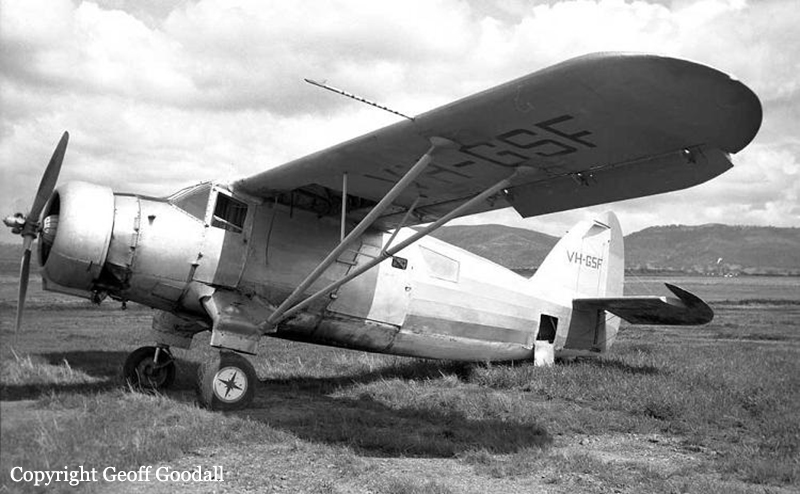
Crash of a Noorduyn Norseman off Sydney

Date & Time: Jan 18, 1970
Type of aircraft:
Registration:
VH-GSF
Flight Phase:
Survivors:
Yes
MSN:
270
YOM:
1943
Country:
Region:
Crew on board:
1
Crew fatalities:
Pax on board:
8
Pax fatalities:
Other fatalities:
Total fatalities:
0
Circumstances:
The engine failed and burst into flames during a skydiving display off Manly Beach, northeast of Sydney. Eight parachutists baled out, followed by pilot Ken Andrews (owner of Skyservice Aviation) at 5,000 feet who was wearing a parachute. As he floated down under his parachute the circling Norseman came very close to hitting him. All were rescued by boats. The Norseman struck the sea 6 miles off the beach, 5 miles southeast off Sydney Heads.
Souce: Geoff Goodall
Probable cause:
Engine failure in flight.