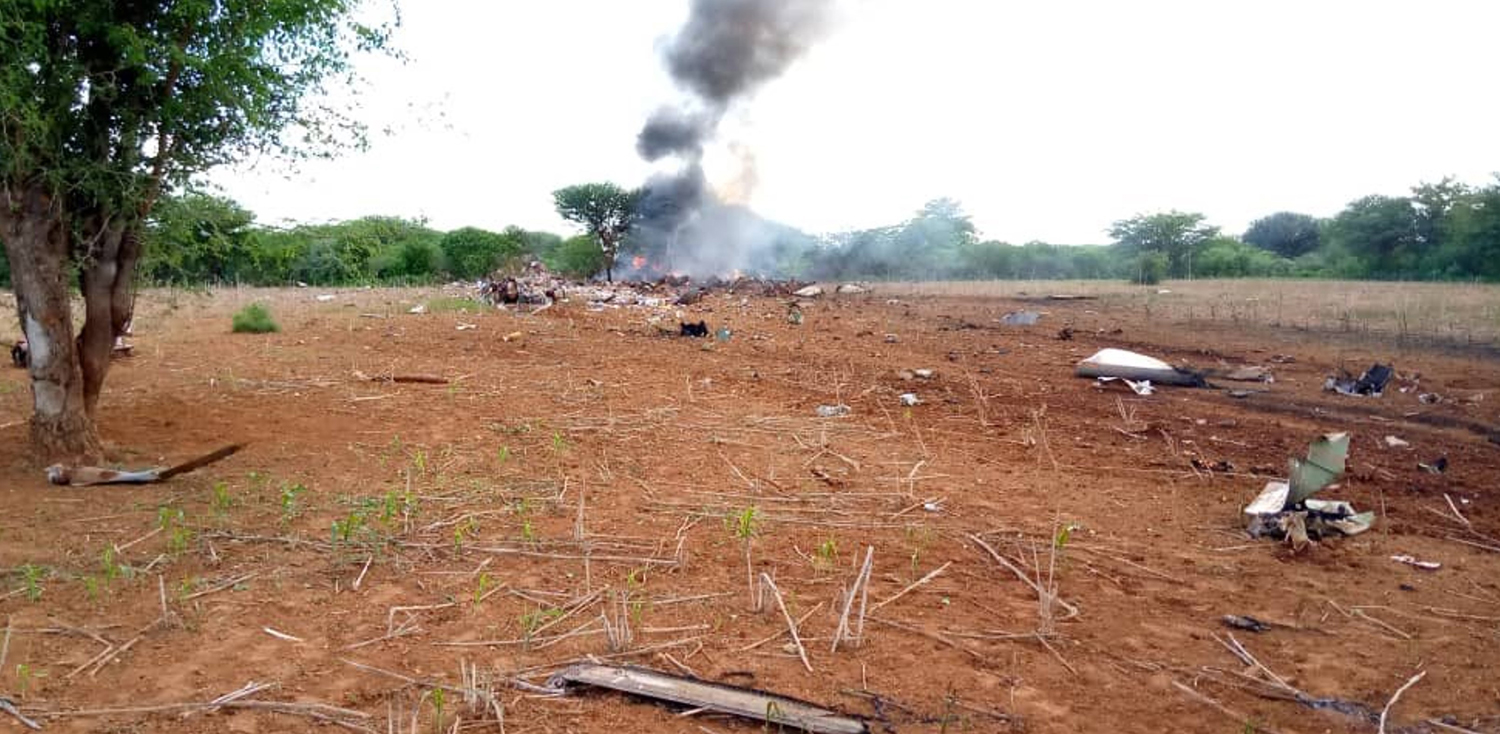
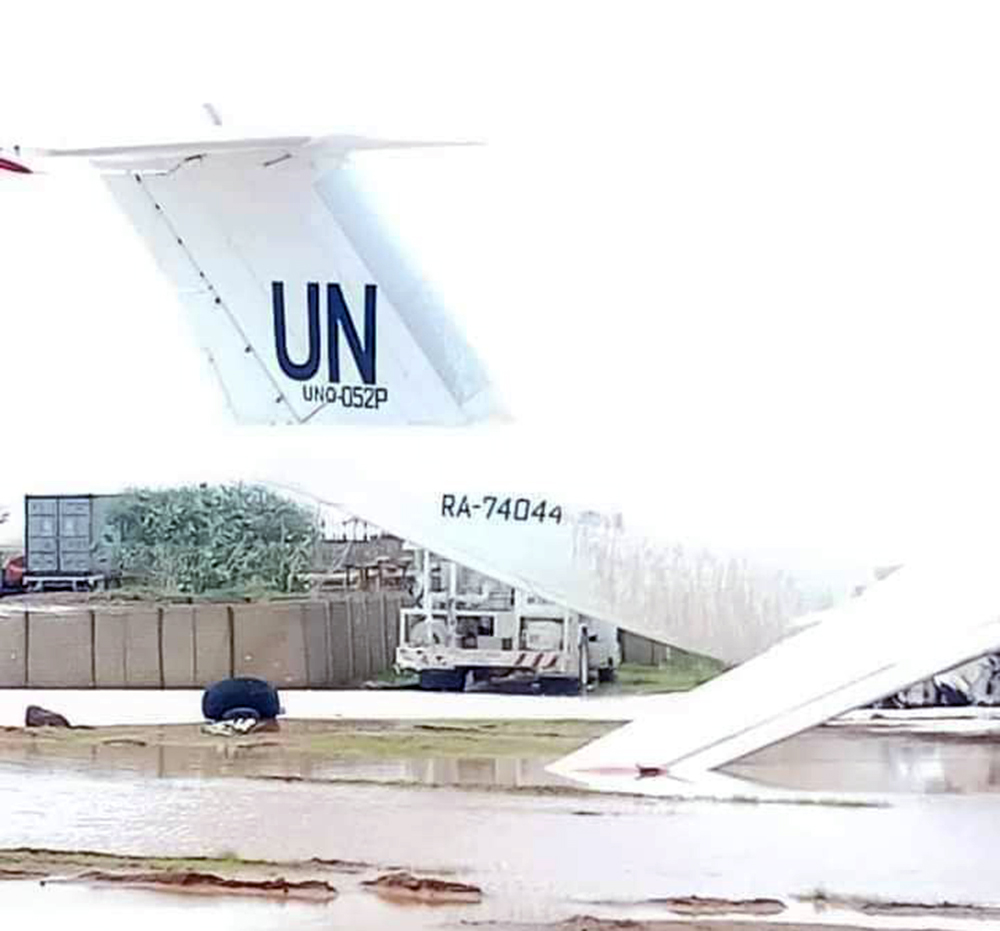
Crash of an Antonov AN-74TK-100 in Gao

Date & Time: Aug 3, 2020 at 1000 LT
Type of aircraft:
Operator:
Registration:
RA-74044
Flight Type:
Survivors:
Yes
Schedule:
Bamako - Gao
MSN:
470 97 936
YOM:
1994
Flight number:
UNO052P
Location:
Country:
Region:
Crew on board:
7
Crew fatalities:
Pax on board:
4
Pax fatalities:
Other fatalities:
Total fatalities:
0
Captain / Total flying hours:
13299
Captain / Total hours on type:
2246.00
Copilot / Total flying hours:
3051
Copilot / Total hours on type:
1580
Aircraft flight hours:
13302
Aircraft flight cycles:
6496
Circumstances:
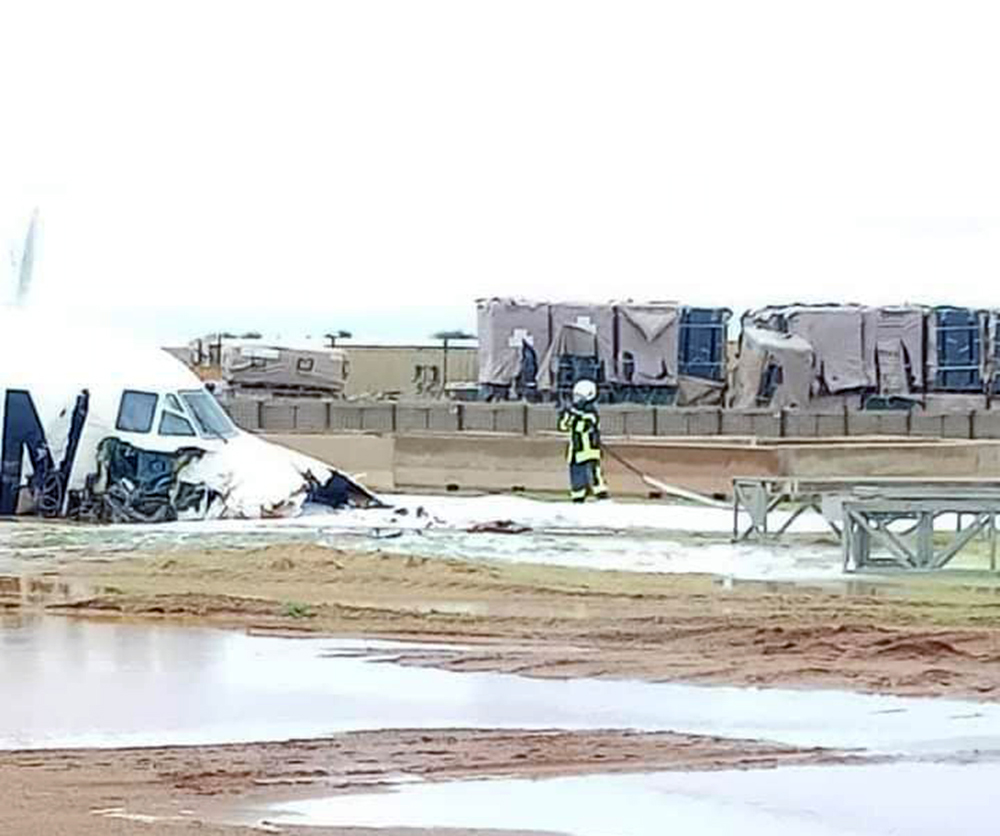
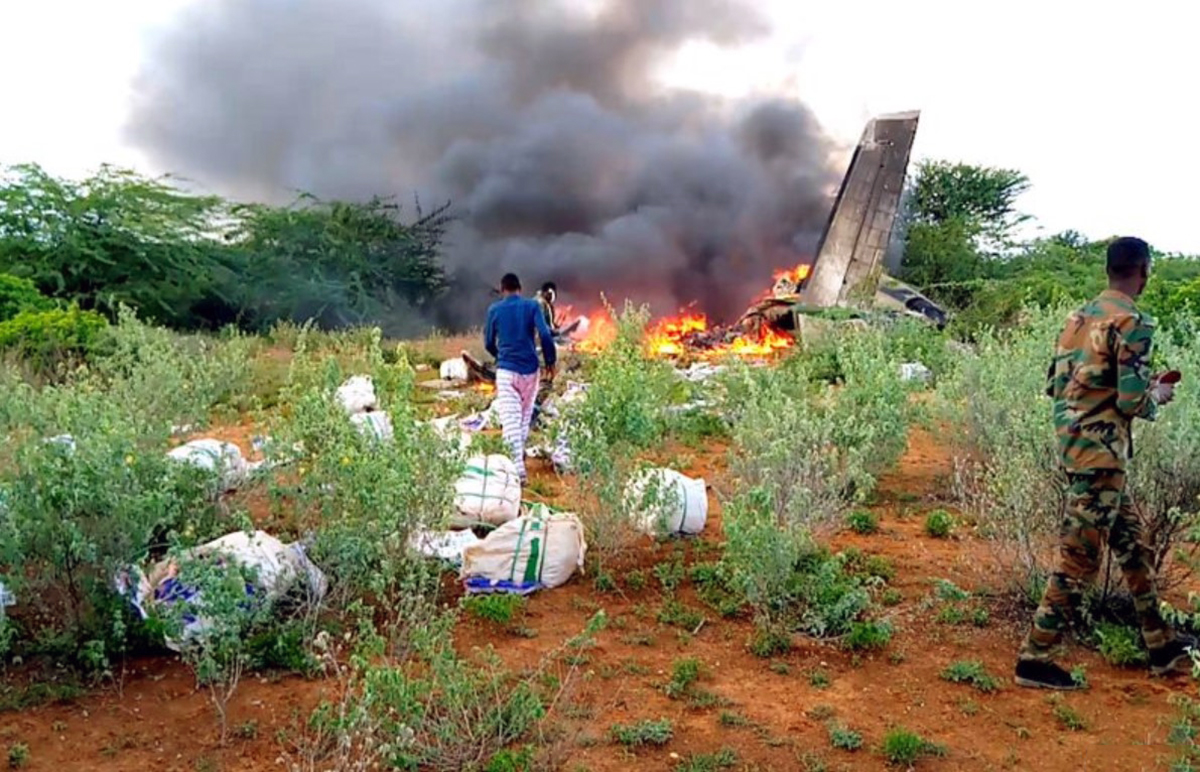
The aircraft was completing flight UNO-052P from Bamako to Gao on behalf of the United Nations Multidimensional Integrated Stabilization Mission in Mali (MINUSMA). En route, the crew encountered technical problems with the electrical system when the right generator failed. The crew attempted to start the APU several times but without success when the left generator also failed. The undercarriage were lowered manually and the landing was completed on a wet runway in rainy conditions. After touchdown, 500 metres past the runway threshold, the crew started the braking procedure but was unable to deploy the thrust reversers. At a speed of 140-160 km/h, the aircraft overran, lost its undercarriage and came to rest in a waterlogged land. All 11 occupants were rescued, among them six were injured. The aircraft was destroyed.
Probable cause:
The aviation incident occurred during rollout after landing, resulting in the longitudinal excursion of the aircraft beyond the runway and collision with a sewage collector during ground movement. The landing was performed on a fully unpowered aircraft with wing flaps retracted, without the possibility of using spoilers and engine reversers for braking. Immediately after landing, the wheel brake system failed due to its usage by the crew at speeds significantly exceeding the established FCOM maximum values for the An-74TK-100 aircraft. The landing under these conditions exceeded the expected operating conditions, as there is no data in the FCOM for its calculation and execution.
The most probable contributing factors were:
- The absence of information in the FCOM regarding landing calculation and crew actions during unpowered flight (landing with retracted flaps without the possibility of using spoilers and engine reversers) due to the aircraft developer's assessment of such a situation as practically improbable.
- Poor execution of pre-flight refueling of generator oil systems and a lack of proper control over their execution, leading to exceeding the permissible maximum oil level, its overheating in flight, melting of thermal sensors, and sequential automatic disconnection of two GP21 generators.
- Failure of the crew to adhere to standard operational procedures for the APU in-flight (failure to activate the APU compartment heater), as well as the preparation and start-up methods outlined in the FCOM, leading to the inability to start the APU and complete loss of power in the aircraft after the battery voltage dropped below the permissible value.
Final Report:

Ground fire of a Boeing 777-F60 in Shanghai

Date & Time: Jul 22, 2020 at 1520 LT
Type of aircraft:
Operator:
Registration:
ET-ARH
Flight Phase:
Flight Type:
Survivors:
Yes
Schedule:
Shanghai – Addis Ababa – São Paulo – Santiago de Chile
MSN:
42031/1242
YOM:
2014
Flight number:
ET3739
Country:
Region:
Crew on board:
2
Crew fatalities:
Pax on board:
0
Pax fatalities:
Other fatalities:
Total fatalities:
0
Captain / Total flying hours:
15000
Captain / Total hours on type:
3000.00
Copilot / Total flying hours:
2500
Copilot / Total hours on type:
1000
Aircraft flight hours:
26740
Aircraft flight cycles:
4286
Circumstances:
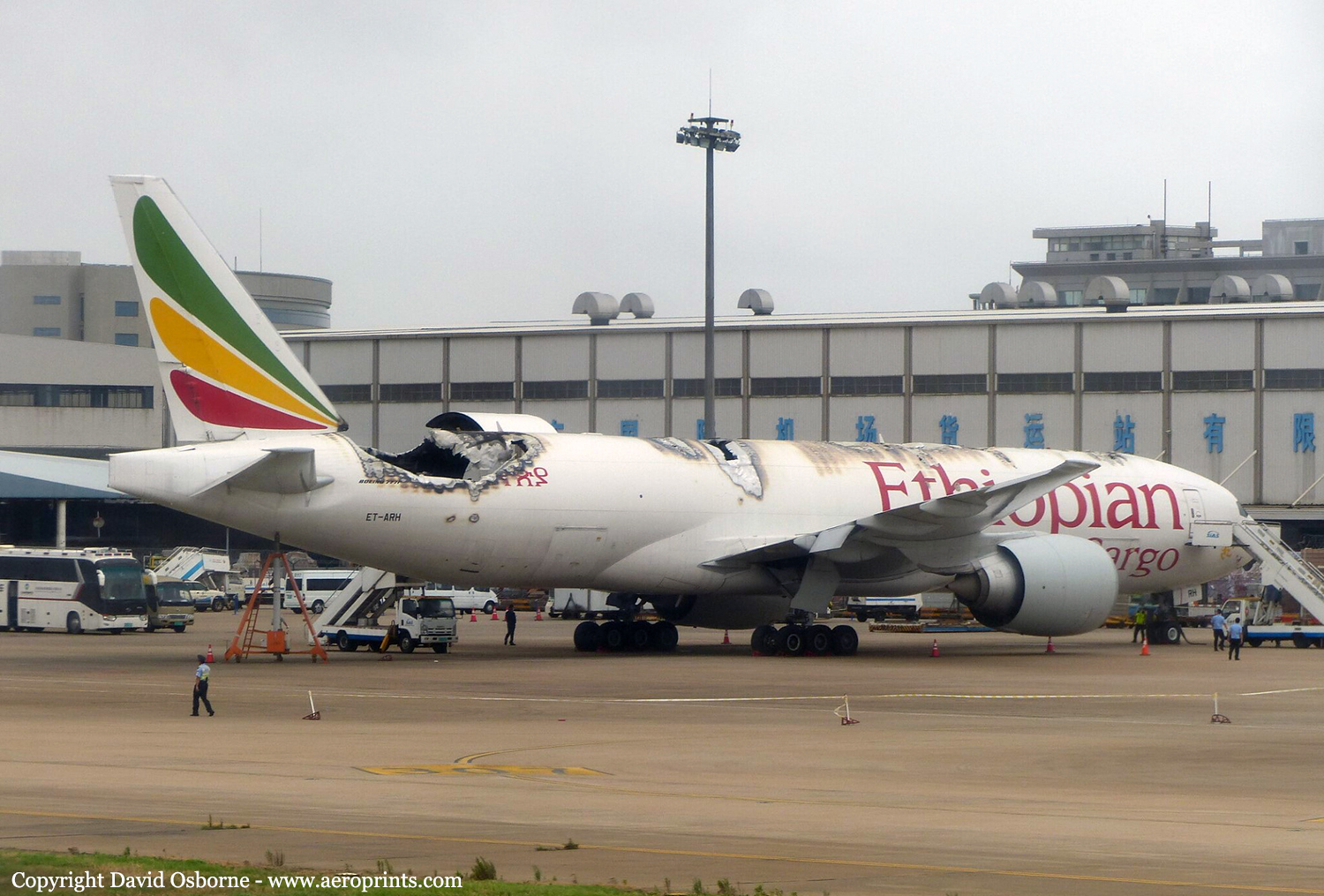
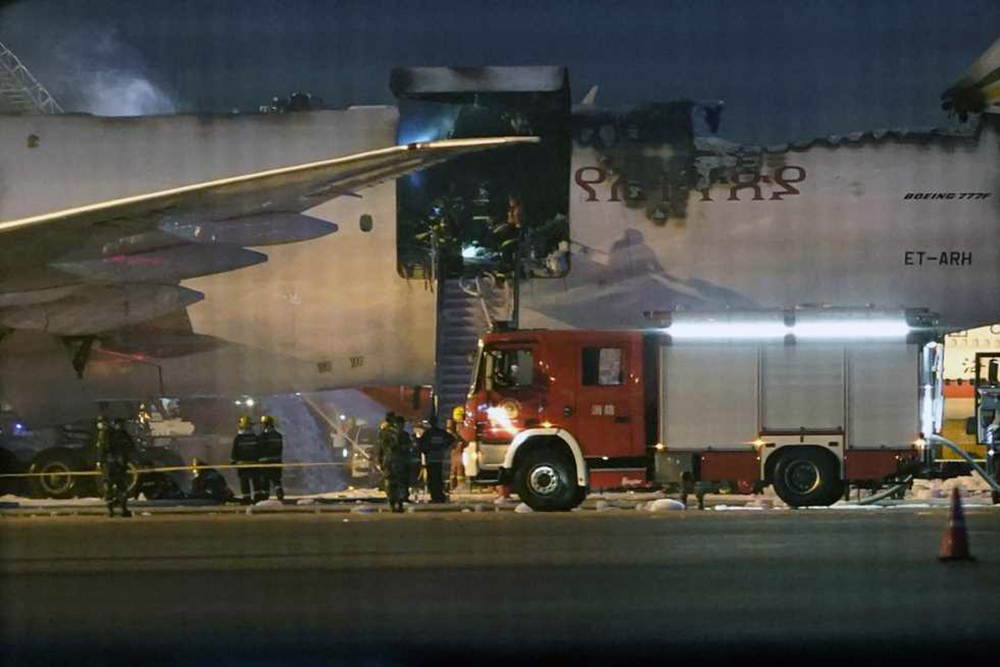
Parked at position 306 at Shanghai-Pudong Airport, the aircraft was prepared for a cargo service (flight ET3739) to Santiago de Chile with intermediate stops in Addis Ababa and São Paulo. At 1520LT, while being loaded, the crew contacted ground on the frequency and sent a mayday message, saying that a fire erupted in the cargo compartment. Fire brigade arrived quickly on the scene but the airplane was partially destroyed by fire and damaged beyond repair. Both pilots evacuated safely.
Probable cause:
The investigation team determined that the fire originated in the area of the aircraft's main cargo hold station STA1790-STA2129; the fire origin was at the right side of the main cargo hold at stations STA1916-STA2048 (main cargo hold PR position), with the most likely cause of the fire being the spontaneous combustion of chlorine dioxide disinfection tablets loaded in the main cargo hold under high-temperature and humid conditions, leading to the fire.
Final Report:
Crash of a De Havilland DHC-8-Q402 Dash-8 in Beledweyne

Date & Time: Jul 14, 2020
Operator:
Registration:
5Y-VVU
Flight Type:
Survivors:
Yes
Schedule:
Djibouti City – Beledweyne
MSN:
4008
YOM:
2000
Country:
Region:
Crew on board:
3
Crew fatalities:
Pax on board:
0
Pax fatalities:
Other fatalities:
Total fatalities:
0
Circumstances:
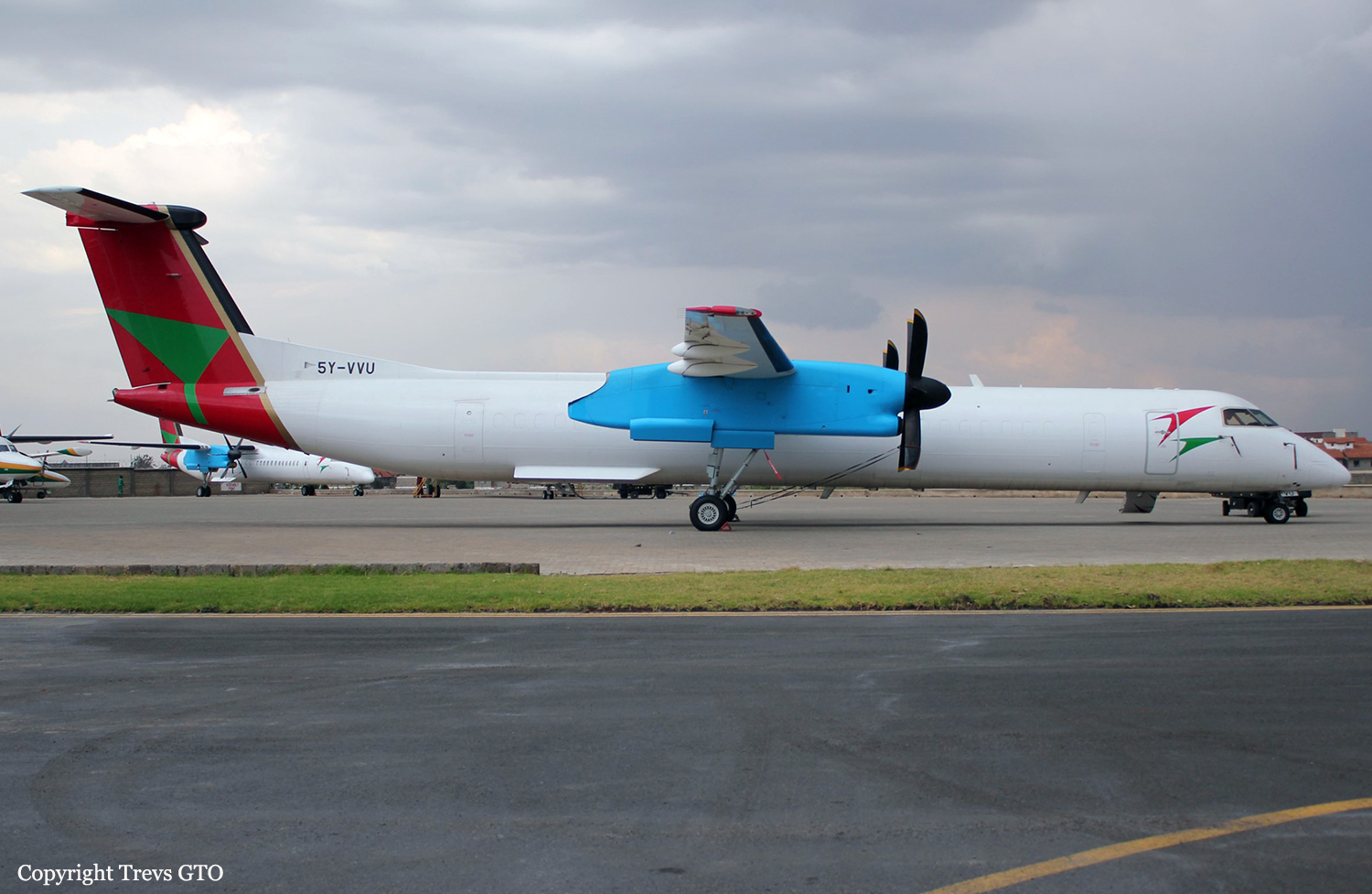
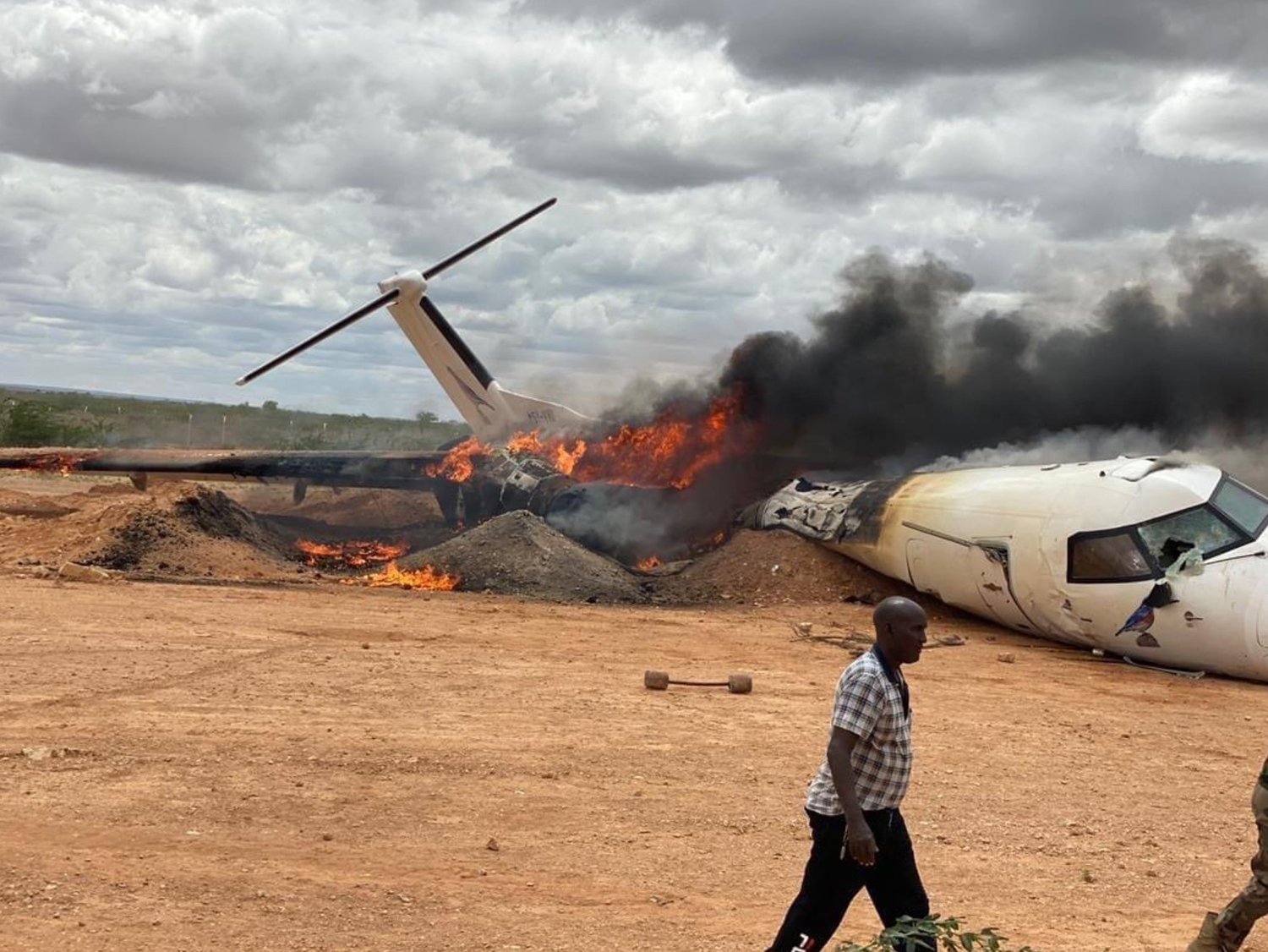
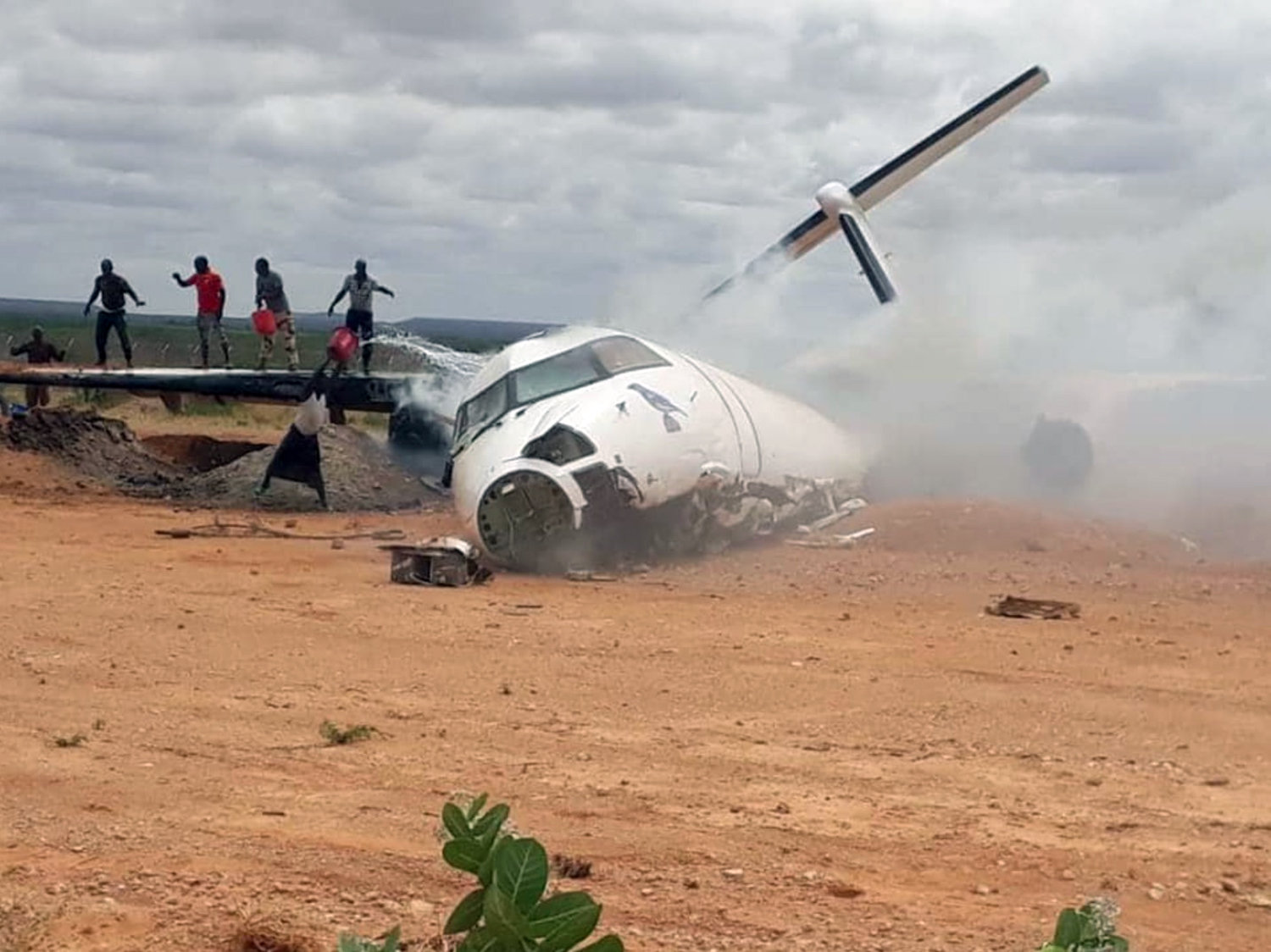
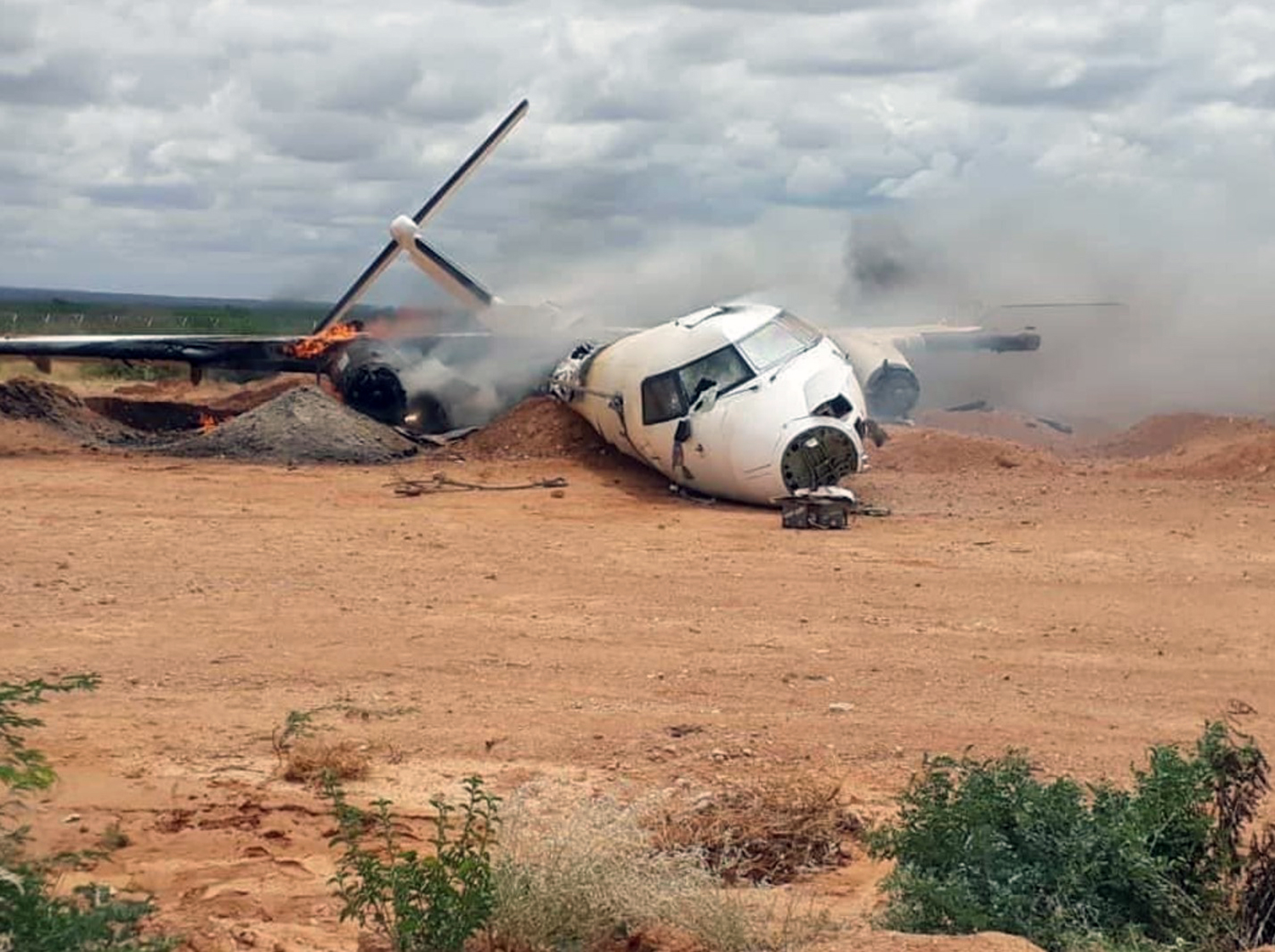
After landing at Beledweyne-Haji-Sheikh Mahmud Hasan (Ugas Khalif) Airport, the aircraft went out of control and came to rest against several earth mounds, bursting into flames. All three crew members managed to escape while the aircraft was destroyed by fire. The crew was completing a cargo flight from Djibouti City on behalf of the African Union Mission to Somalia (AMISOM) and it is believed that the aircraft was carrying food supplies.

Crash of an Embraer EMB-121A Xingu in Tegará da Serra: 2 killed

Date & Time: Jun 14, 2020 at 0840 LT
Type of aircraft:
Registration:
PT-MBV
Flight Phase:
Flight Type:
Survivors:
No
Schedule:
Tangará da Serra – Goiânia
MSN:
121-053
YOM:
1982
Country:
Crew on board:
2
Crew fatalities:
Pax on board:
0
Pax fatalities:
Other fatalities:
Total fatalities:
2
Captain / Total flying hours:
607
Captain / Total hours on type:
41.00
Copilot / Total flying hours:
425
Aircraft flight hours:
4453
Circumstances:
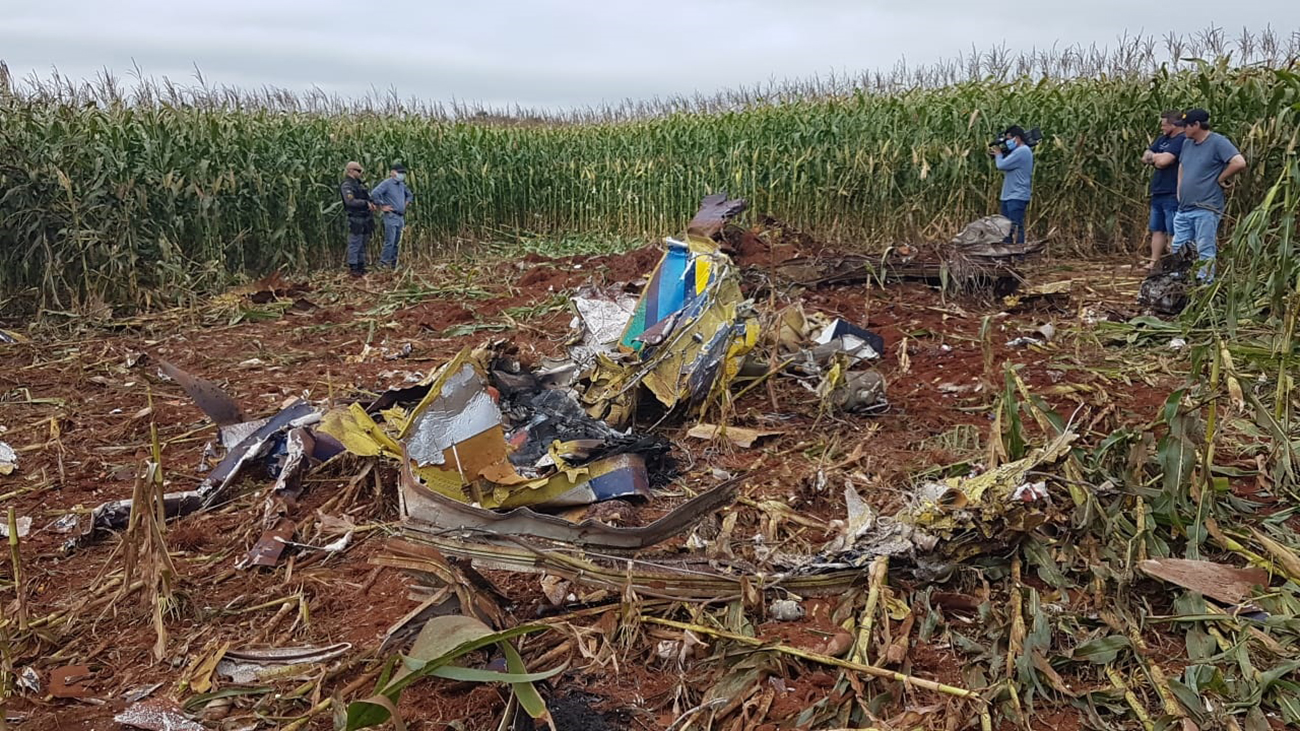
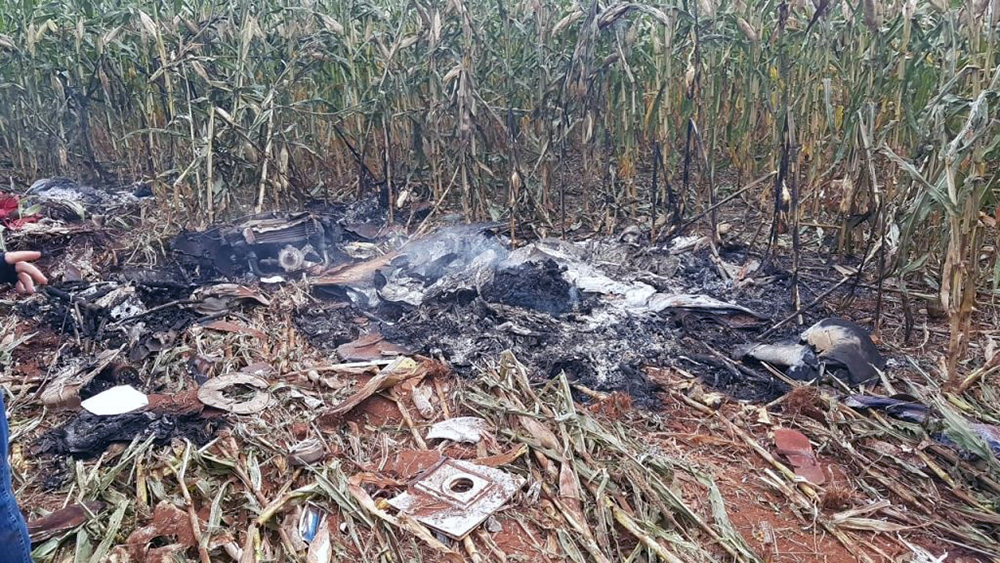
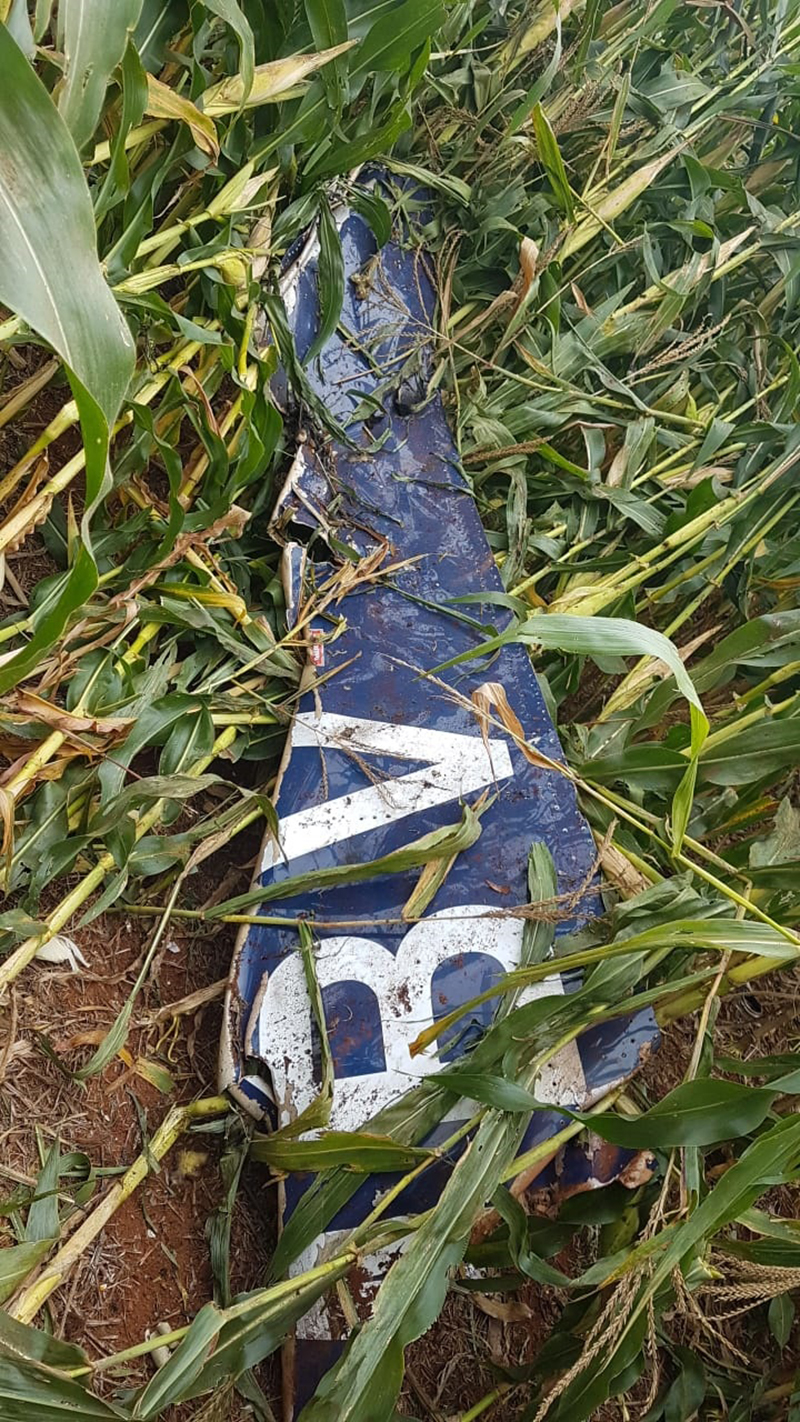
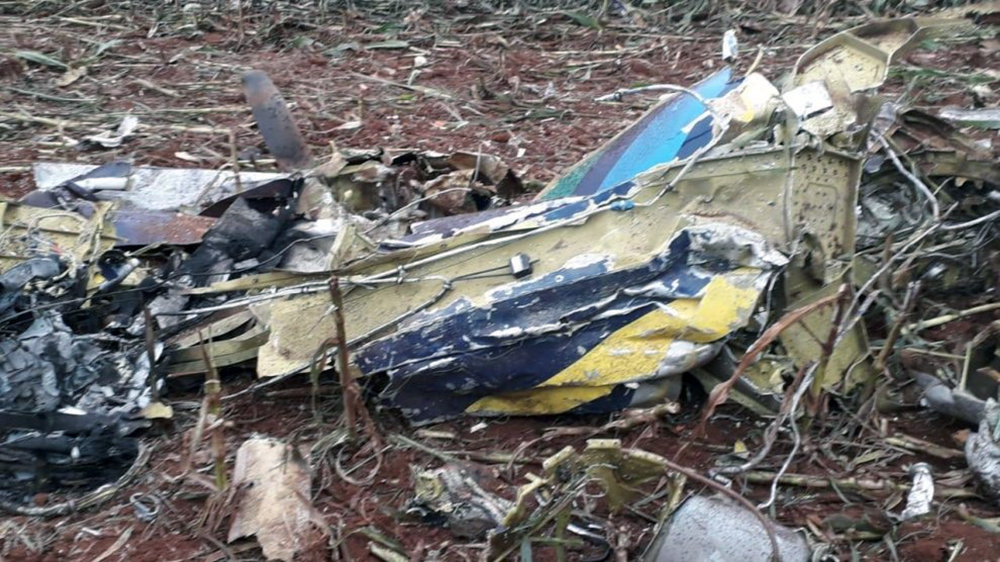
Four minutes after takeoff from Tengará da Serra Airport Runway 20, while climbing, the twin engine airplane entered an uncontrolled descent. One minute later, it crashed with a high angle of attack in a cornfield, bursting into flames. The airplane disintegrated on impact and both occupants were killed.
Probable cause:
One should not rule out the hypothesis of a possible malfunction of the aircraft's angle-of-attack control system, considering that the records related to the provision of the calibration service (a necessary condition for the proper functioning of the referred system, and prescribed in the aircraft's maintenance manual) were not identified in the pertinent
control documents.
Final Report:

Crash of a Lockheed C-130H3 Hercules at Al Taji AFB

Date & Time: Jun 8, 2020 at 2205 LT
Type of aircraft:
Operator:
Registration:
94-6706
Flight Type:
Survivors:
Yes
Schedule:
Ali Al Salem AFB - Al Taji AAF
MSN:
5398
YOM:
1995
Country:
Region:
Crew on board:
7
Crew fatalities:
Pax on board:
19
Pax fatalities:
Other fatalities:
Total fatalities:
0
Captain / Total hours on type:
1700.00
Copilot / Total hours on type:
506
Circumstances:
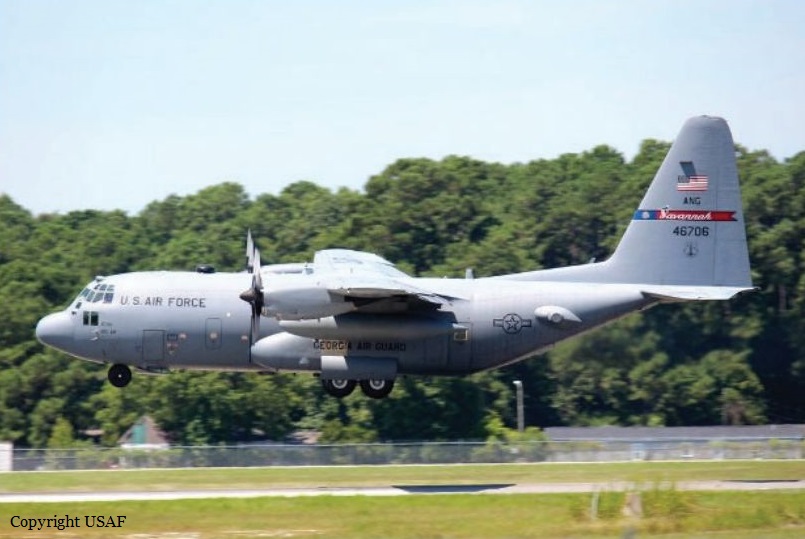
On 8 June 2020, at approximately 2205 hours local time (L), the mishap aircraft (MA), a C-130H (tail number (T/N) 94-6706), was involved in a mishap during a routine mobility airlift mission from Ali Al Salem Air Base, Kuwait, into Al Taji (Camp Taji), Iraq, when it failed to come to a stop during landing, overran the runway, and impacted a concrete barrier. All 26 mishap crew (MC) members and passengers survived the mishap, with relatively minor injuries to two of the individuals. The MA was damaged beyond repair, and was valued at $35,900,000. The MA was from the 165th Airlift Wing (165 AW), Georgia Air National Guard (ANG), was manned with Wyoming ANG crew members deployed from the 153d Airlift Wing (153 AW), in Cheyenne, Wyoming, and assigned to the 386th Air Expeditionary Wing (386 AEW) at Ali Al Salem Air Base, Kuwait. The mishap occurred at the end of the first planned leg of the MC’s mission on 8 June 2020. The MC departed Ali Al Salem Air Base, Kuwait, at approximately 2053L, with an uneventful start, taxi, takeoff, and cruise to Camp Taji. During descent into Camp Taji, the MC prepared the MA for a nighttime landing, using night vision devices. During this time, the MC turned the MA earlier than their planned turn point, did not descend to lower altitudes in accordance with their planned descent, and allowed the airspeed to exceed recommended maximum speeds for the configuration the plane was in. During the landing, the MA continued to be above the planned glideslope and maintained excessive airspeed, with a nose-down attitude until touchdown. The MA proceeded to “porpoise” or oscillate down the runway from the point of touchdown until the MA was slowed sufficiently by use of reverse thrust from the engines to allow the MA to settle onto the wheels, which in turn allowed for the brakes to engage. The MA, despite slowing somewhat, had less than 1,000 feet of runway remaining by that point, and thus overran the runway and did not come to a complete stop until it impacted a 12-foot-high concrete barrier, approximately 600 feet past the runway.
Probable cause:
The Accident Investigation Board (AIB) President found by a preponderance of the evidence that the causes of the mishap were the MA’s excess airspeed above recommended landing velocity, which caused the MA to maintain lift (flight) and did not provide sufficient weight on wheels (WOW) to allow braking action to occur. Additionally, the AIB President found, by a preponderance of the evidence, the MC’s failure to adequately assess risk, failure to follow proper procedures, and their poor communication were all substantially contributing factors to the mishap.
Final Report:
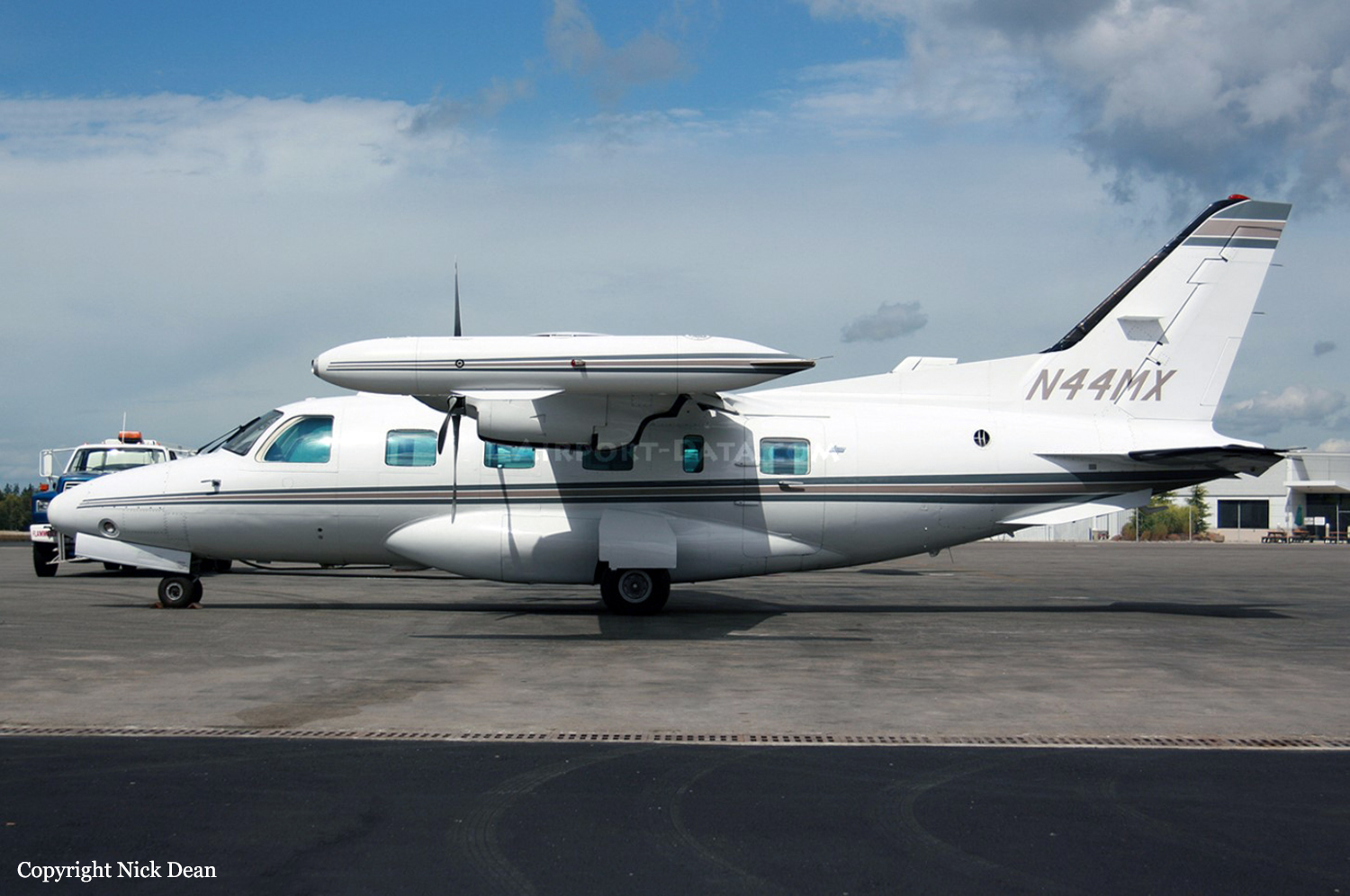
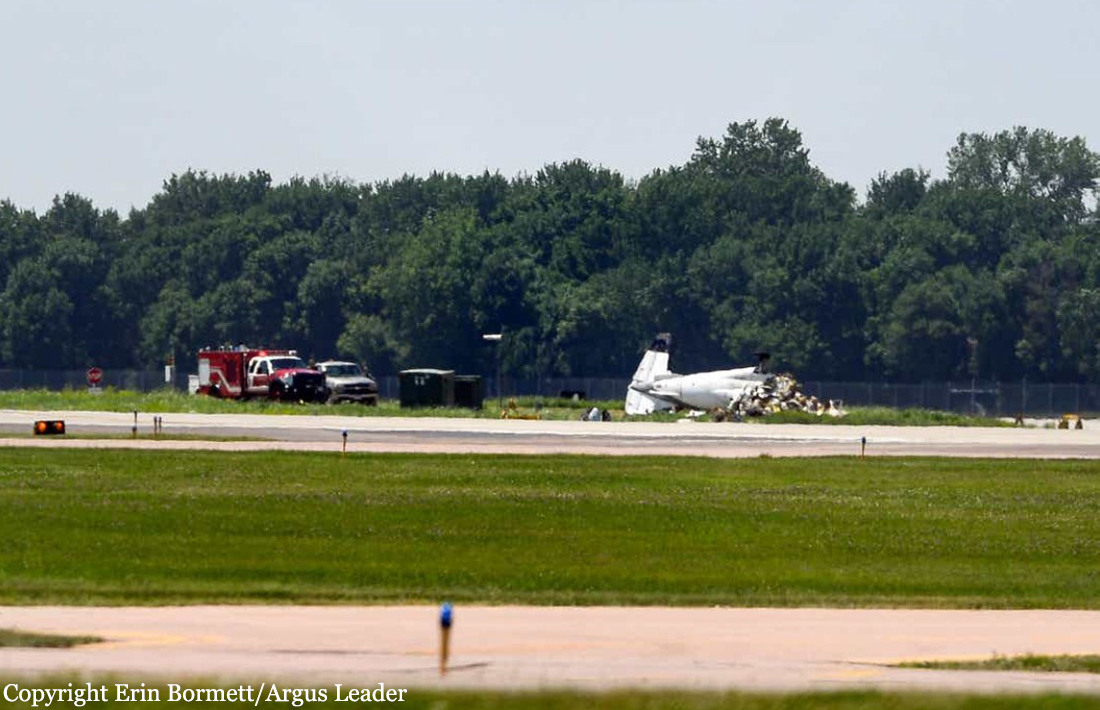
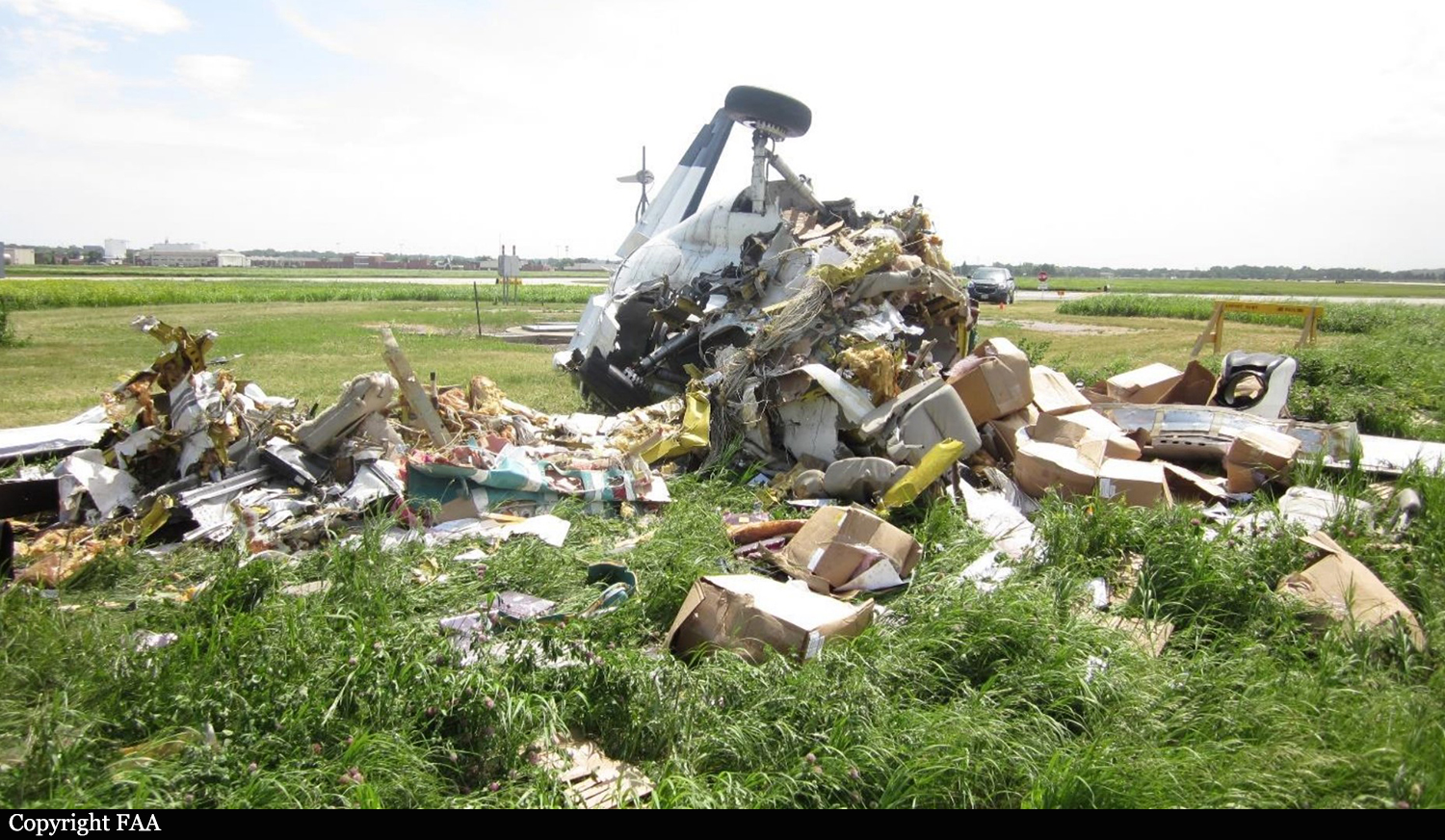
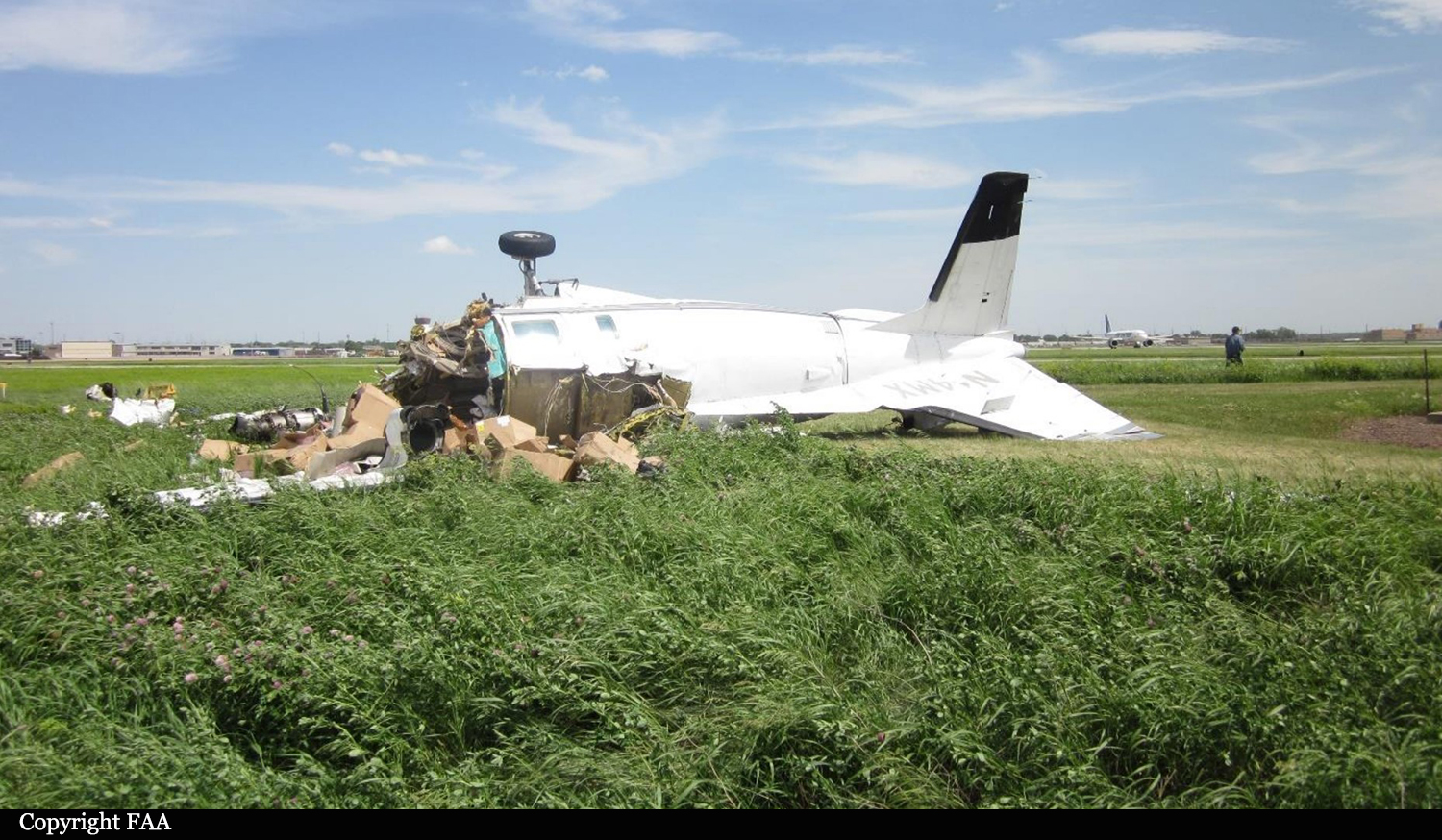
Crash of a Mitsubishi MU-2B-60 Marquise in Sioux Falls: 1 killed

Date & Time: Jun 7, 2020 at 0415 LT
Type of aircraft:
Operator:
Registration:
N44MX
Flight Phase:
Flight Type:
Survivors:
No
Schedule:
Everett – Huron - Kokomo
MSN:
1526
YOM:
1981
Flight number:
MDS44
Crew on board:
1
Crew fatalities:
Pax on board:
0
Pax fatalities:
Other fatalities:
Total fatalities:
1
Captain / Total flying hours:
22000
Captain / Total hours on type:
10900.00
Aircraft flight hours:
12104
Circumstances:
The pilot departed on a cross country flight in a turbine-powered, multiengine airplane at night and in visual meteorological conditions. Recovered GPS data revealed that as the airplane accelerated down the runway, it drifted to the right of the runway centerline. A video recording showed that shortly after takeoff, the airplane rolled right, the nose dropped, and the airplane impacted the ground. It came to rest on its left side with both wings separated and the fuselage was highly fragmented forward of the main landing gear. A post-accident examination of the airframe and engines found no mechanical malfunctions or anomalies that would have precluded normal operation. A witness that spoke to the pilot shortly before the accident flight stated that the pilot exhibited difficulty in completing some paperwork; however, no medical reasoning for this difficulty could be determined based upon the available evidence. The investigation determined that at the time of the accident the pilot had been on duty for about 19 hours and 20 minutes, which was contrary to duty and rest regulations. At his estimated arrival time into the destination, the pilot would have accumulated about 20 hours and 54 minutes of duty time. The investigation was unable to determine if the pilot took advantage of the opportunity for rest that existed during the day, and therefore could not determine if fatigue contributed to the accident. Investigators were unable to determine the reason for the loss of control on takeoff with the available information.
Probable cause:
The pilot’s failure to maintain control of the airplane during takeoff for reasons that could not be determined.
Final Report:
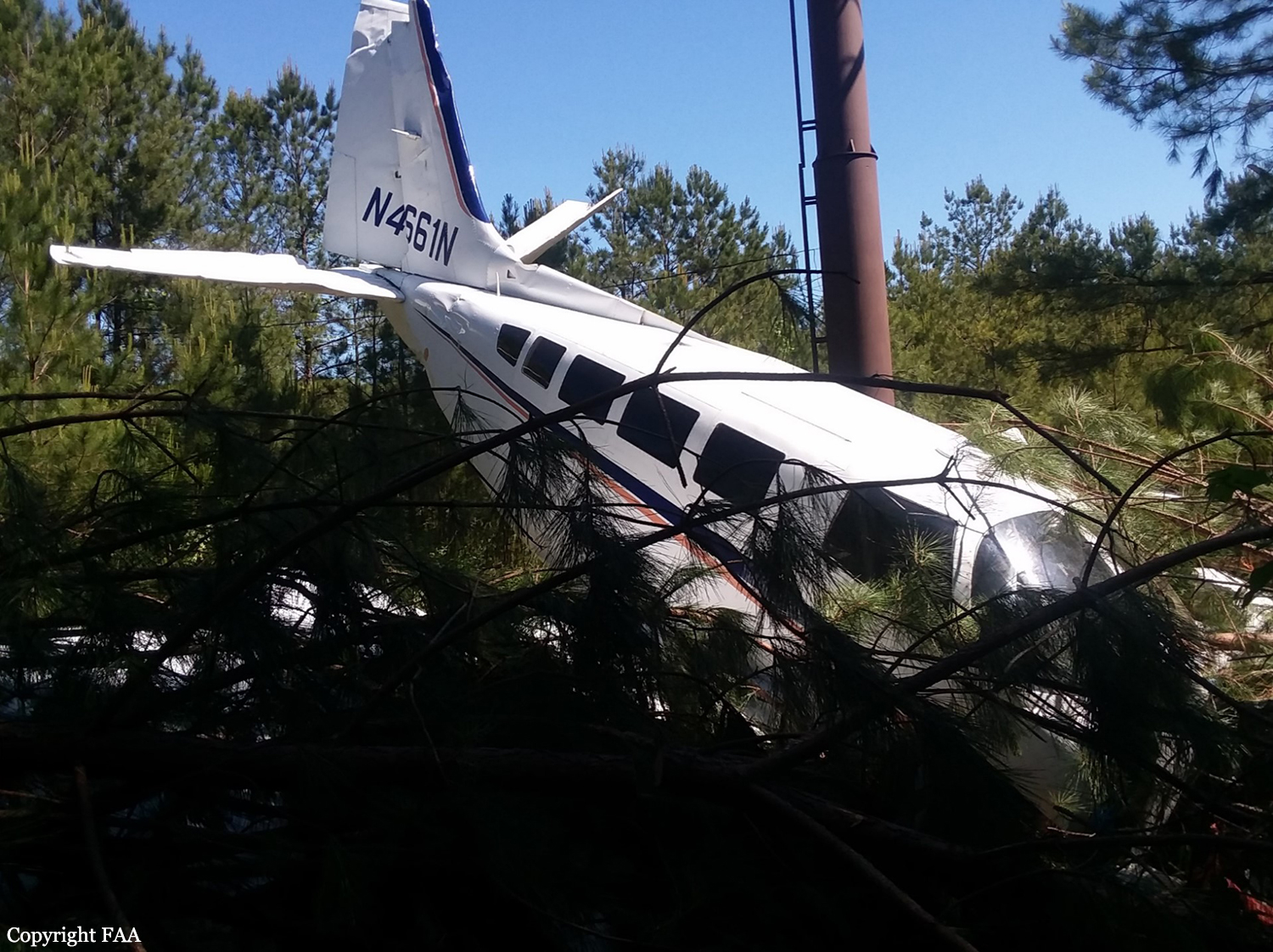
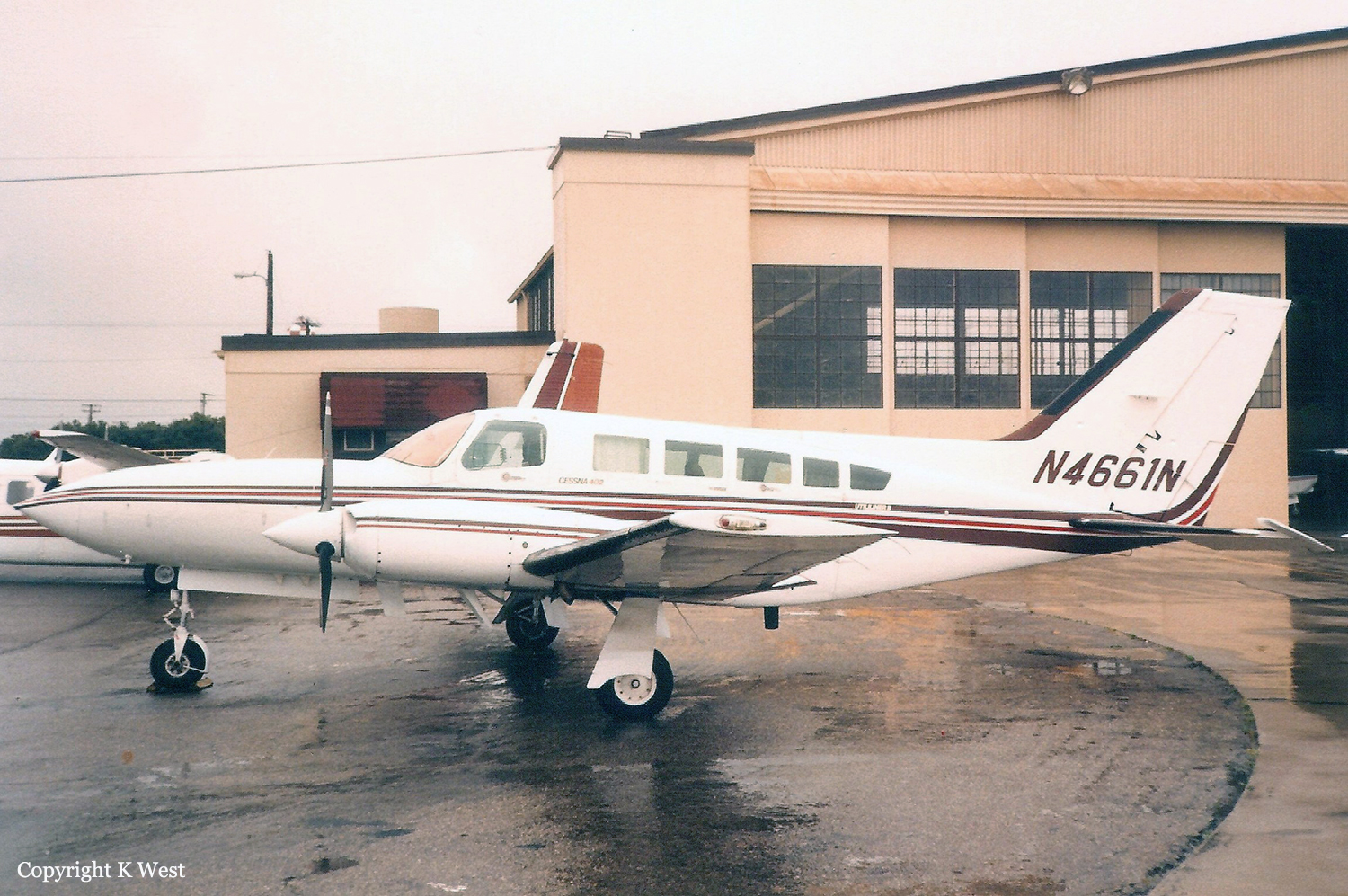
Crash of a Cessna 402C in Hampton

Date & Time: May 9, 2020 at 1513 LT
Type of aircraft:
Operator:
Registration:
N4661N
Survivors:
Yes
Schedule:
Peachtree City - Peachtree City
MSN:
402C-0019
YOM:
1979
Crew on board:
2
Crew fatalities:
Pax on board:
0
Pax fatalities:
Other fatalities:
Total fatalities:
0
Captain / Total flying hours:
7330
Captain / Total hours on type:
11.00
Copilot / Total flying hours:
1096
Copilot / Total hours on type:
5
Aircraft flight hours:
17081
Circumstances:
According the commercial pilot and a flight instructor rated check pilot, they were conducting their first long-duration, aerial observation flight in the multiengine airplane, which was recently acquired by the operator. They departed with full fuel tanks, competed the 5-hour aerial observation portion of the flight, and began to return to the destination airport. About 15 miles from the airport, the left engine fuel warning light illuminated. Within a few seconds, the right engine stopped producing power. They attempted to restart the engine and turned the airplane toward an alternate airport that was closer. The pilots then turned on the electric fuel pump, the right engine began surging, and soon after the left engine stopped producing power. They turned both electric fuel pumps to the low setting, both engines continued to surge, and the pilots continued toward the alternate airport. When they were about 3 miles from the airport, both engines lost total power, and they elected to land on a highway. When they were a few feet above the ground, power returned briefly to the left engine, which resulted in the airplane climbing and beginning to roll. The commercial pilot pulled the yoke aft to avoid a highway sign, which resulted in an aerodynamic stall, and subsequent impact with trees and terrain. The airplane sustained substantial damage to the wings and fuselage. Although both pilots reported the fuel gauges indicated 20 gallons of fuel remaining on each side when the engines stopped producing power, the flight instructor noted that there was no fuel in the airplane at the time of the accident. In addition, according to a Federal Aviation Administration inspector who responded to the accident site, both fuel tanks were breached and there was no evidence of fuel spillage.
Probable cause:
A dual total loss of engine power as a result of fuel exhaustion.
Final Report:
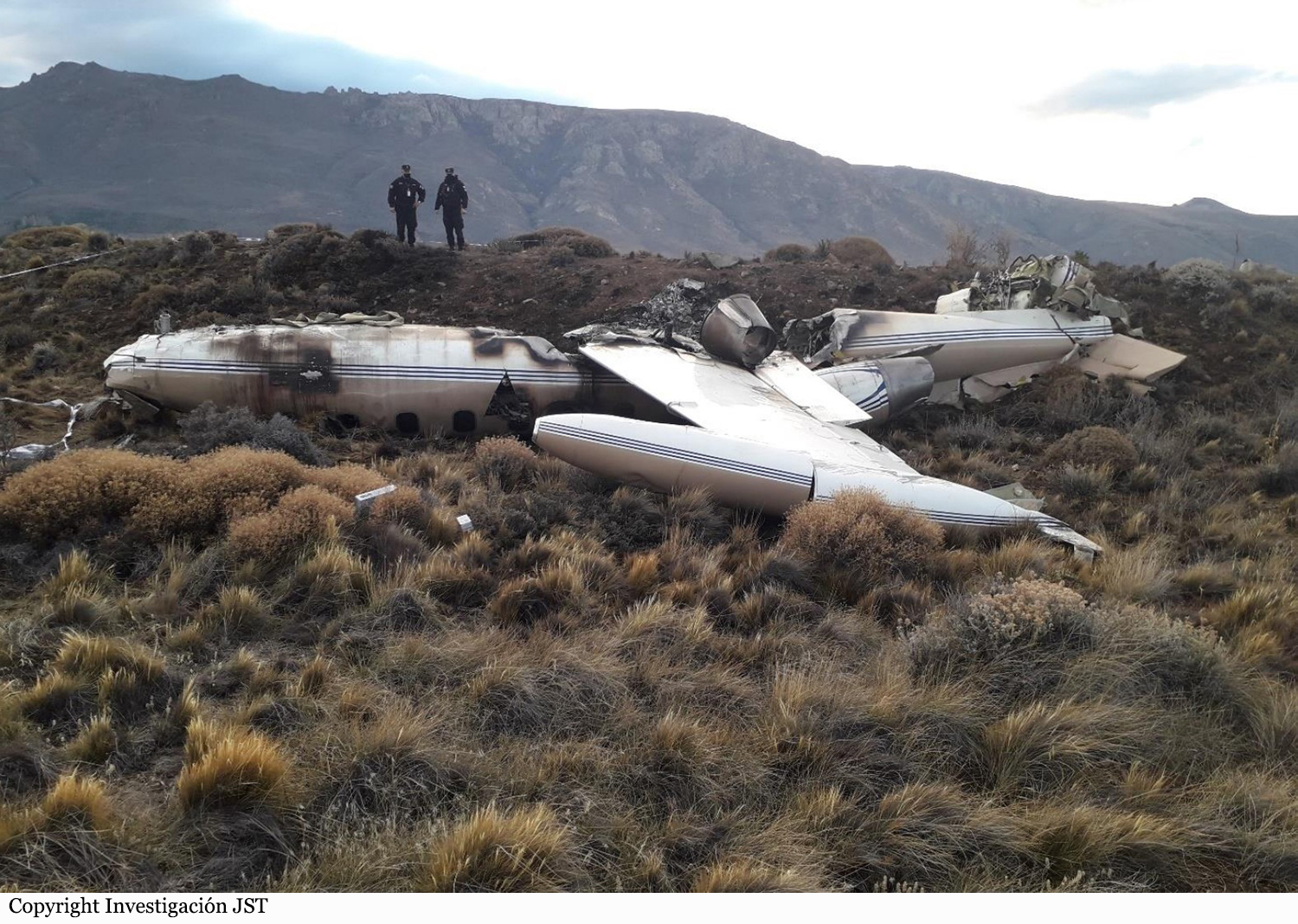
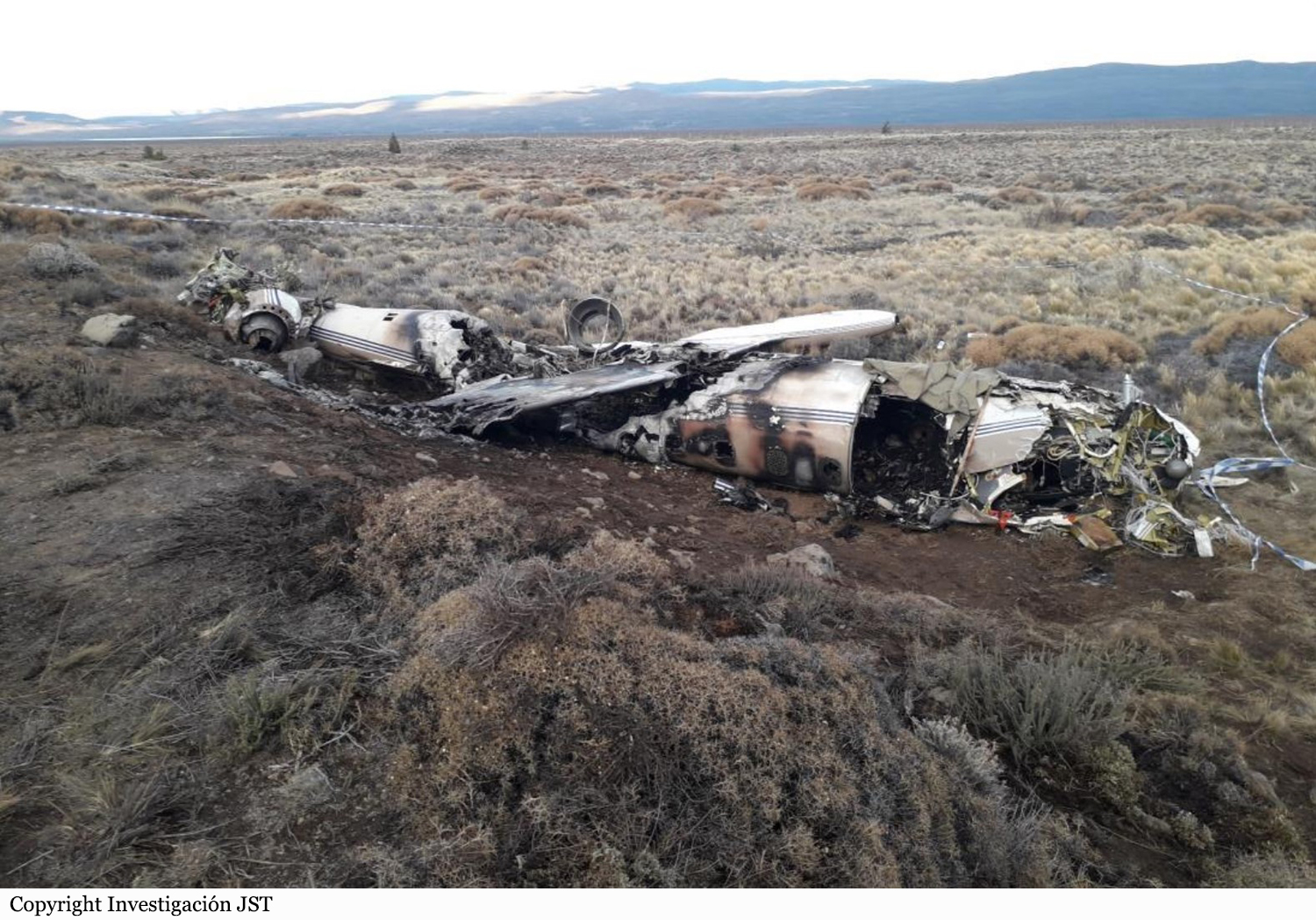
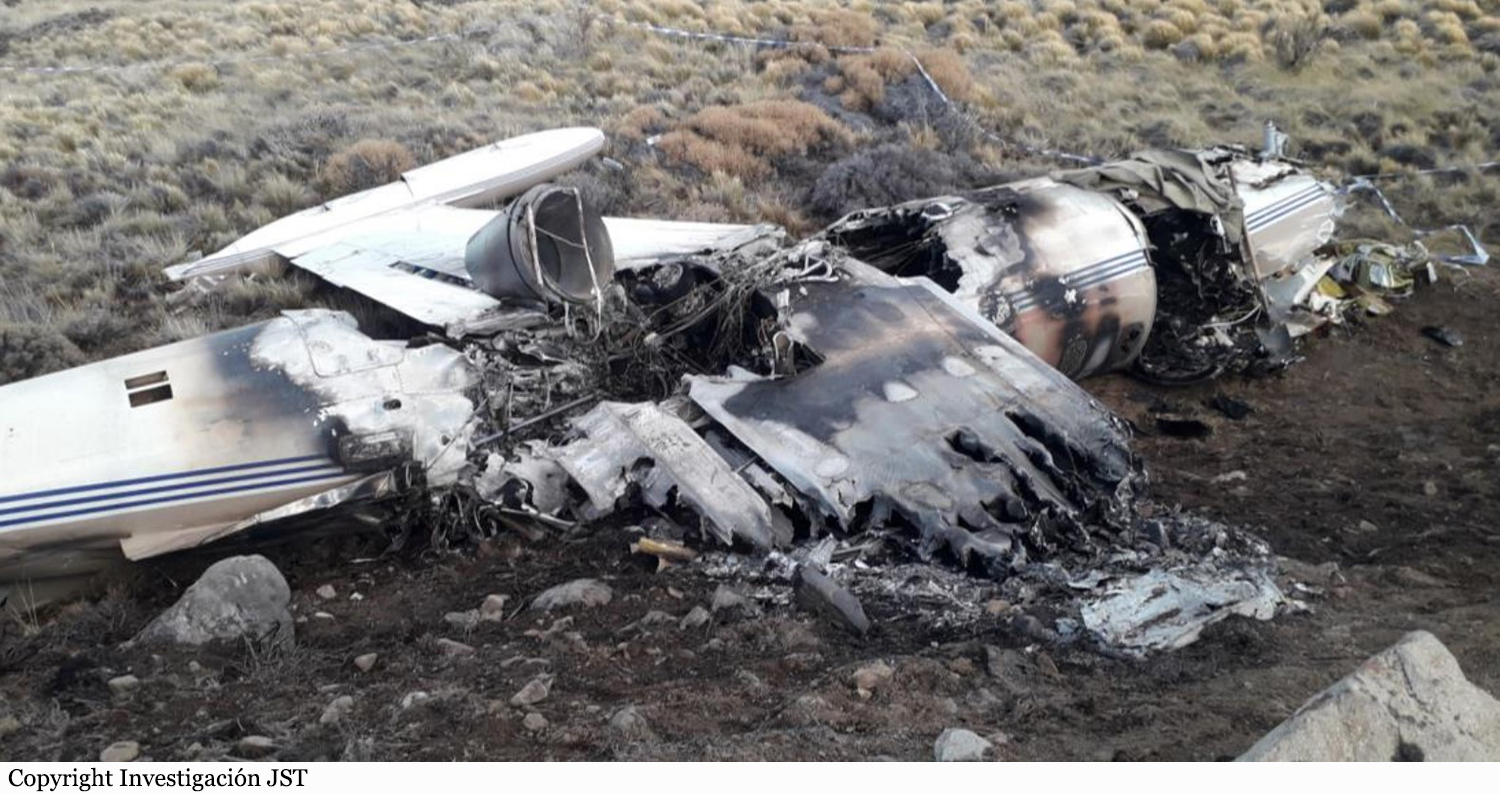
Crash of a Learjet 35A in Esquel: 3 killed

Date & Time: May 5, 2020 at 2238 LT
Type of aircraft:
Operator:
Registration:
LV-BXU
Flight Type:
Survivors:
Yes
Schedule:
San Fernando – Esquel
MSN:
35-462
YOM:
1982
Location:
Country:
Crew on board:
2
Crew fatalities:
Pax on board:
2
Pax fatalities:
Other fatalities:
Total fatalities:
3
Captain / Total flying hours:
1498
Copilot / Total flying hours:
2612
Aircraft flight hours:
11711
Aircraft flight cycles:
10473
Circumstances:
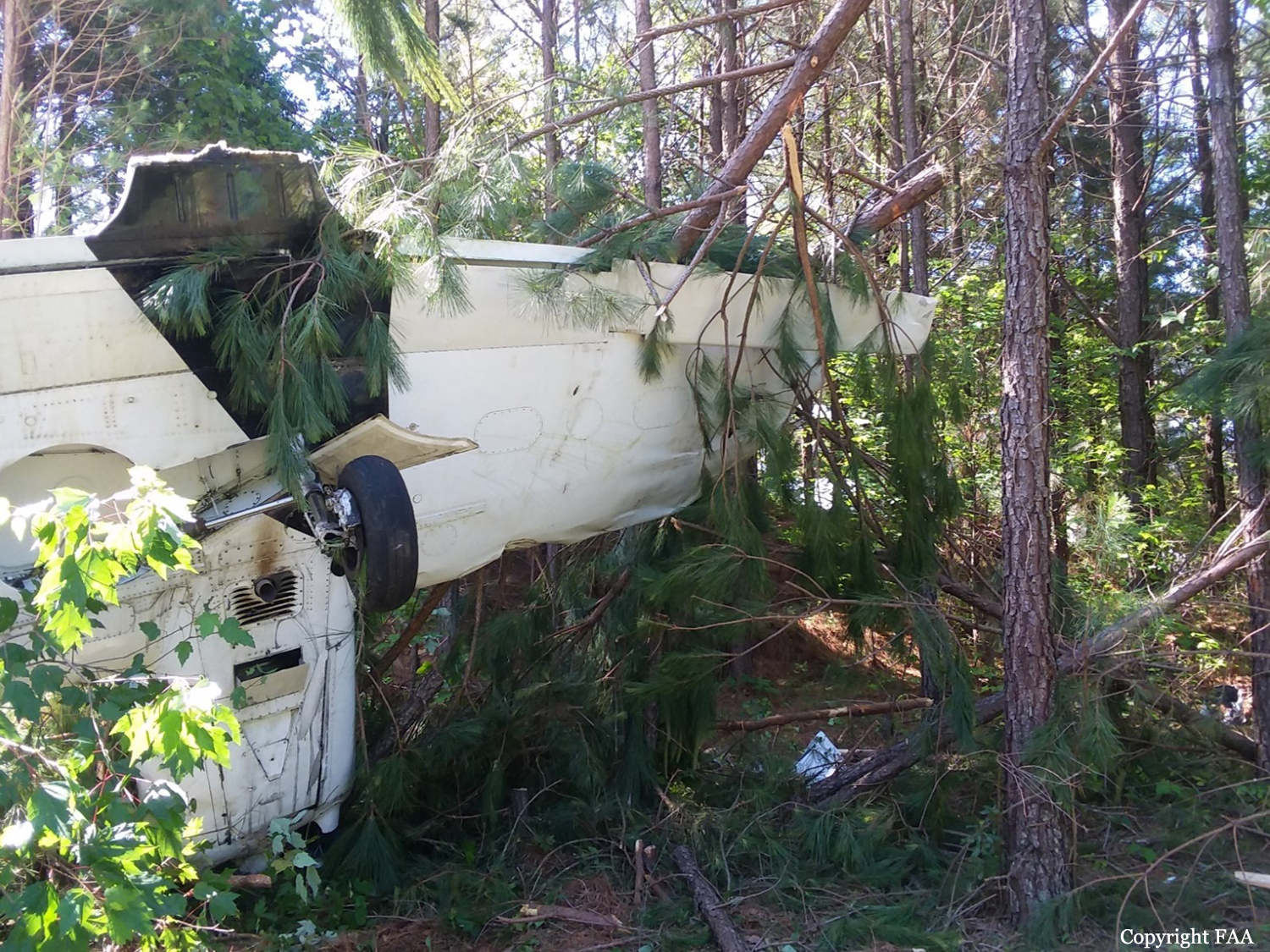
The airplane departed San Fernando Airport on an ambulance flight to Esquel, carrying a doctor, a nurse and two pilots. On approach to Esquel-Brigadier General Antonio Parodi Airport at night, the crew encountered poor visibility (200 metres) and the visual contact with the runway was lost intermittently. Nevertheless, the crew continued the approach and at decision height, the captain decided to continue the descent. After crossing Runway 23 threshold at a height of 78 feet, the pilot-in-command initiated a go-around procedure and turned to the left. The airplane continued in a left hand turn, causing the left wing tip fuel tank to struck the ground. Out of control, the airplane crashed on a small embankment located about 400 metres to the left of the runway centerline, coming to rest upside down and bursting into flames. Both passengers were killed and both pilots were seriously injured. Two days later, the copilot died from injuries sustained.
Probable cause:
It was determined that the accident was the consequence of a controlled flight into terrain (CFIT) and the airplane did not suffer any technical anomalies.
The following contributing factors were identified:
- The crew failed to check the approach charts according to SOP's,
- The approach was initiated and continued in conditions that were below weather minimums,
- Visibility data transmitted by Tower to the crew were inaccurate, leading to confusion on the part of the pilots and their decision-making,
- Both engines were at full power upon impact as the crew was initiating a go-around procedure.
Final Report:

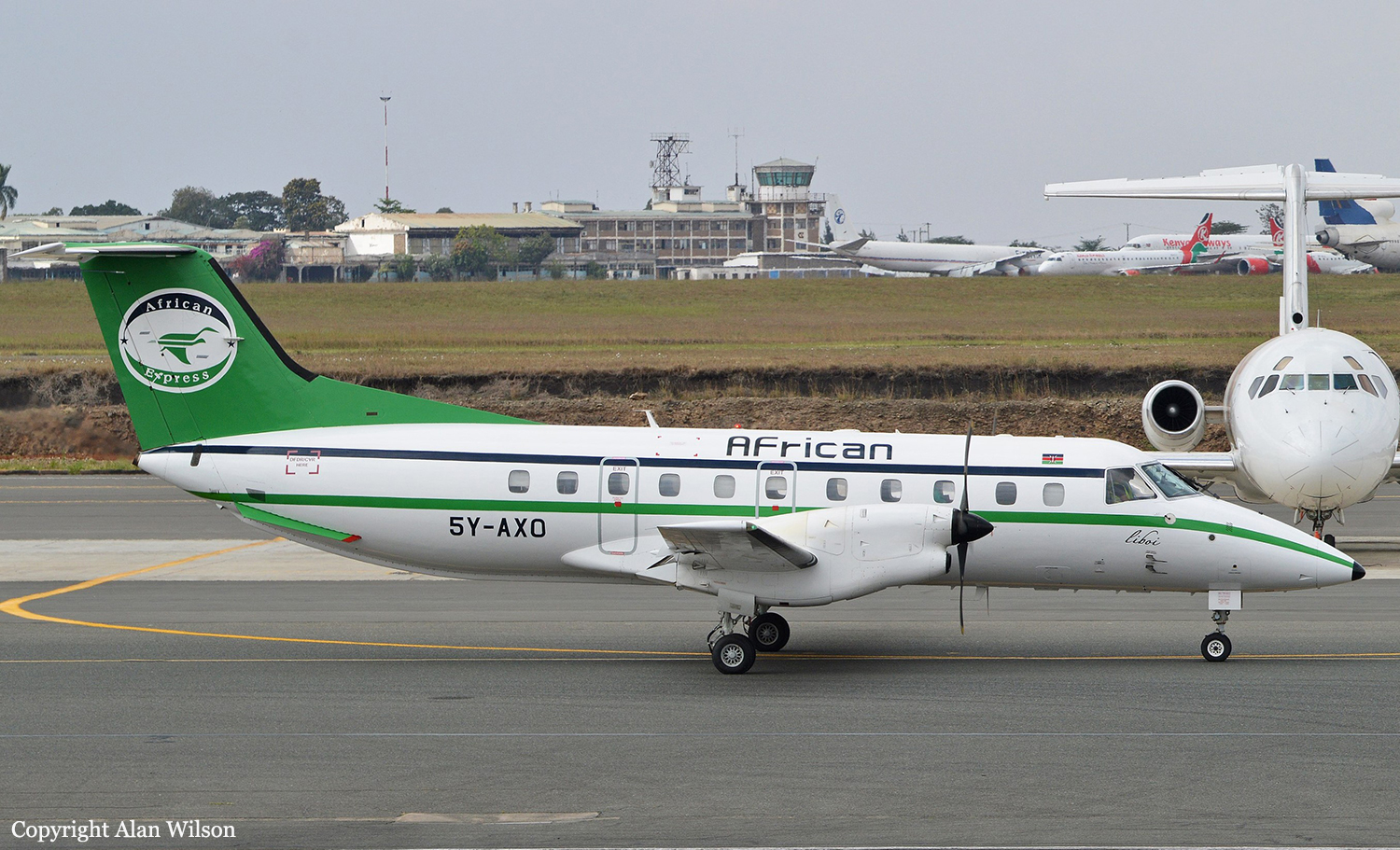
Crash of an Embraer EMB-120RT Brasília in Bardale: 5 killed

Date & Time: May 4, 2020 at 1545 LT
Type of aircraft:
Operator:
Registration:
5Y-AXO
Flight Type:
Survivors:
No
Schedule:
Mogadiscio – Baidoa – Bardale
MSN:
120-259
YOM:
1992
Country:
Region:
Crew on board:
2
Crew fatalities:
Pax on board:
3
Pax fatalities:
Other fatalities:
Total fatalities:
5
Circumstances:
On approach to Bardale Airstrip, the twin engine aircraft struck the ground and crashed 5 km from the airport, bursting into flames. The aircraft was totally destroyed and all five occupants were killed. The crew was enroute from Mogadiscio to Bardale with an en route stop in Baidao, carrying medical supplies and mosquito nets.
Probable cause:
When the aircraft was arriving at Bardale FOB, the usual direction is east-west, but the aircraft was flying from west-east to land over the base camp. Even though the troops did not shoot it down, the aircraft crashed on the ground and was apparently not ready not land. The troops concluded that the aircraft was suspected to be a suicide and trying to find the target to make suicide in the base camp because of the movement of the aircraft. Due to lack of communication and awareness, the aircraft was shot down and all five occupants (3 Kenyan and 2 Somali citizens) died. The incident was performed by a non-AMISOM troops of Ethiopia, which will require mutual collaborative investigation team from Somalia, Ethiopia and Kenya for determine the truth.
Final Report:

Crash of a Pilatus PC-12/47 in Mesquite

Date & Time: Apr 23, 2020 at 1600 LT
Type of aircraft:

Operator:
Registration:
N477SS
Flight Type:
Survivors:
Yes
Schedule:
Dallas – Muscle Shoals
MSN:
813
YOM:
2007
Crew on board:
1
Crew fatalities:
Pax on board:
0
Pax fatalities:
Other fatalities:
Total fatalities:
0
Captain / Total flying hours:
2283
Captain / Total hours on type:
1137.00
Aircraft flight hours:
7018
Circumstances:
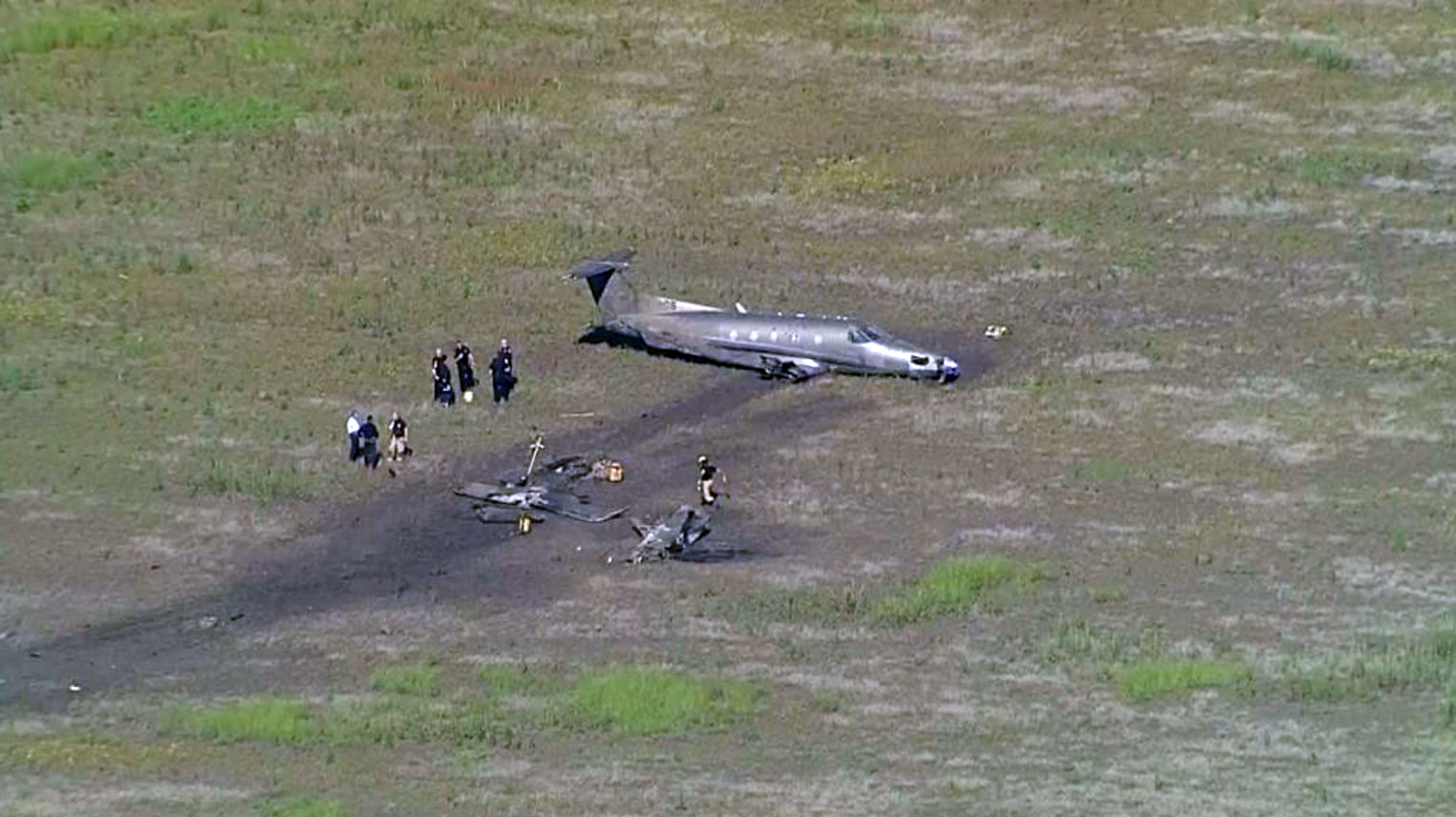
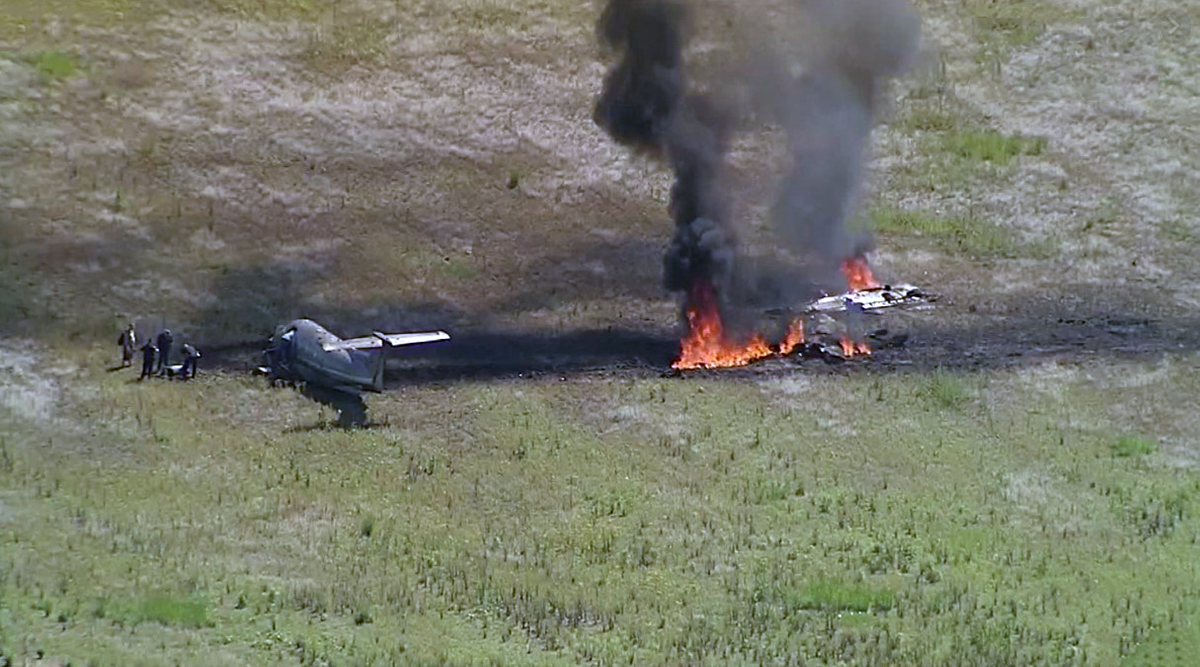
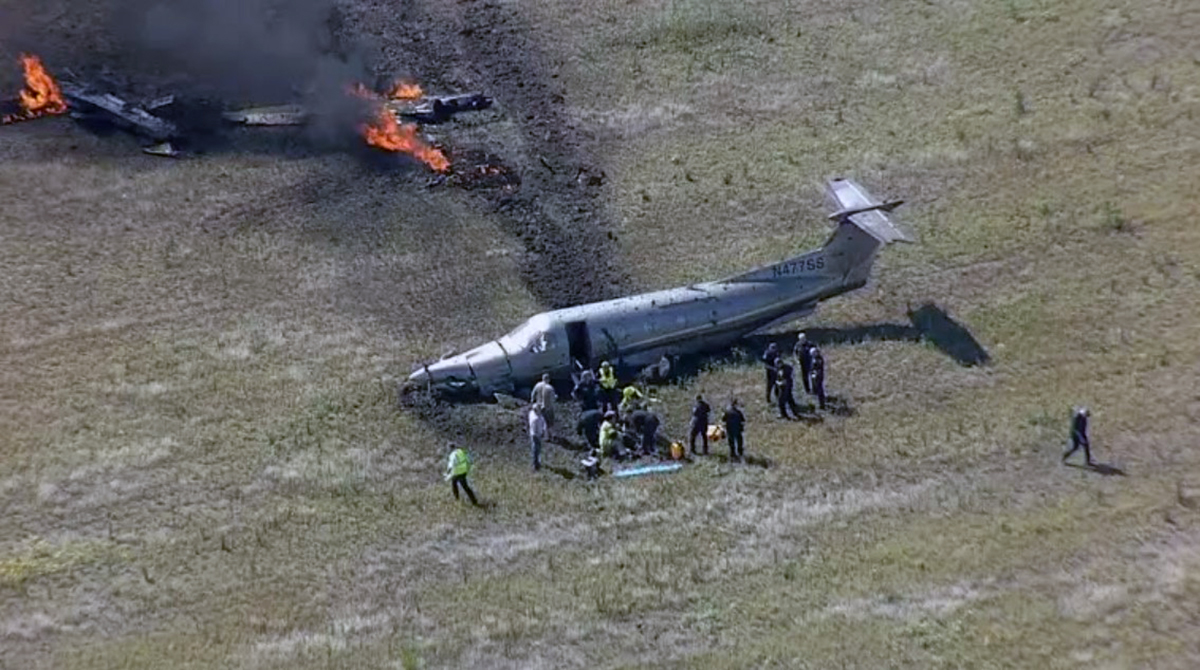
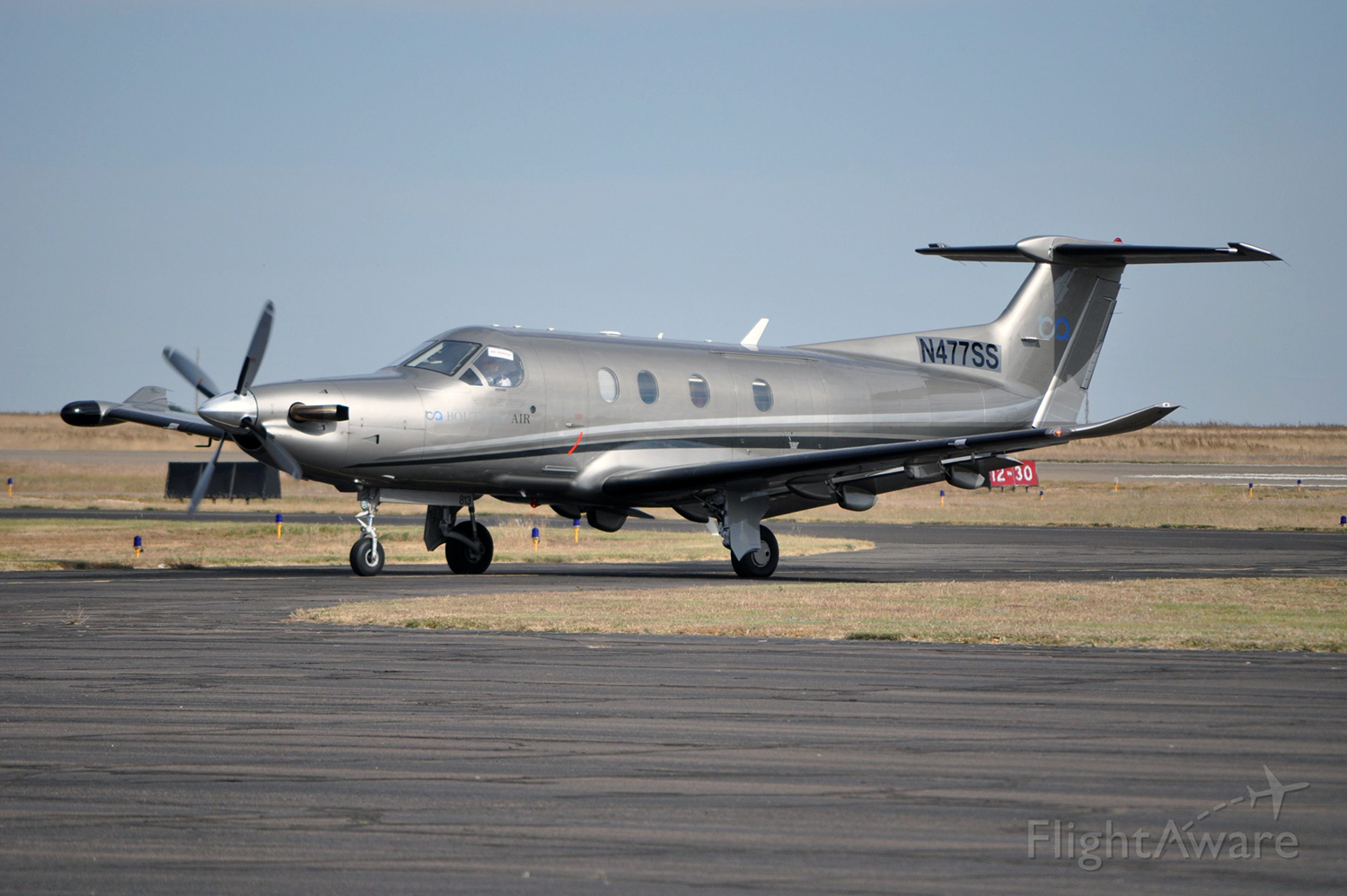
Shortly after takeoff the pilot reported to the air traffic controller that he was losing engine power. The pilot then said he was going to divert to a nearby airport and accepted headings to the airport. The pilot then reported the loss of engine power had stabilized, so he wanted to return to his departure airfield. A few moments later the pilot reported that he was losing engine power again and he needed to go back to his diversion airport. The controller reported that another airport was at the pilot’s 11 o’clock position and about 3 miles. The pilot elected to divert to that airport. The airplane was at 4,500 ft and too close to the airport, so the pilot flew a 360° turn to set up for a left base. During the turn outbound, the engine lost all power, and the pilot was not able to reach the runway. The airplane impacted a field, short of the airport. The airplane’s wings separated in the accident and a small postcrash fire developed. A review of the airplane’s maintenance records revealed maintenance was performed on the day of the accident flight to correct reported difficulty moving the Power Control Lever (PCL) into reverse position. The control cables were inspected from the pilot’s control quadrant to the engine, engine controls, and propeller governor. A static rigging check of the PCL was performed with no anomalies noted. Severe binding was observed on the beta control cable (propeller reversing cable). The cable assembly was removed from the engine, cleaned, reinstalled, and rigged in accordance with manufacturer guidance. During a post-accident examination of the engine and propeller assembly, the beta control cable was found mis-rigged and the propeller blades were found in the feathered position. The beta valve plunger was extended beyond the chamfer face of the propeller governor, consistent with a position that would shut off oil flow from the governor oil pump to the constant speed unit (CSU). A wire could be inserted through both the forward and aft beta control cable clevis inspection holes that function as check points for proper thread engagement. The forward beta control cable clevis adjustment nut was rotated full aft. The swaging ball end on the forward end of the beta control cable was not properly secured between the clevis rod end and the push-pull control terminal and was free to rotate within the assembly. Before takeoff, the beta valve was in an operational position that allowed oil flow to the CSU, resulting in normal propeller control. Vibration due to engine operation and beta valve return spring force most likely caused the improperly secured swaging ball to rotate (i.e. “unthread”) forward on the beta control cable. The resulting lengthening of the reversing cable assembly allowed the beta valve to stroke forward and shut off oil flow to the propeller CSU. Without propeller servo oil flow to maintain propeller control, the propeller faded to the high pitch/feather position due to normal leakage in the transfer bearing. The reported loss of power is consistent with a loss of thrust due to the beta control cable being mis-rigged during the most recent maintenance work.
Probable cause:
The loss of engine power due to a mis-rigged beta control cable (propeller reversing cable), which resulted in a loss of thrust inflight.
Final Report: