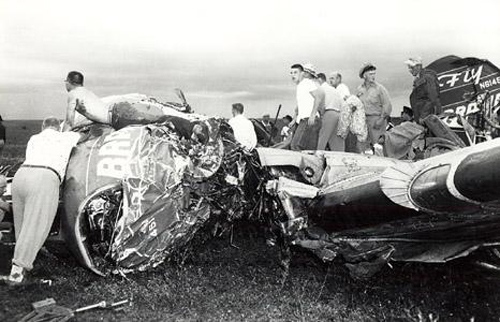
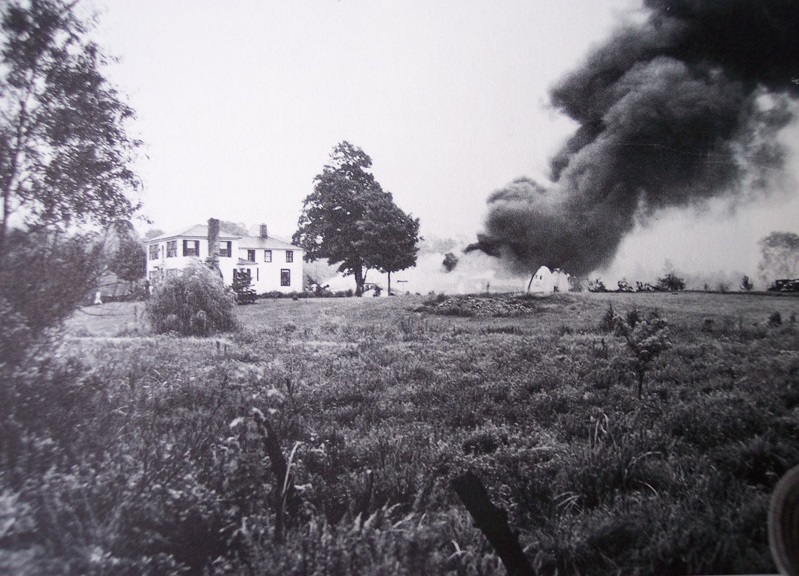
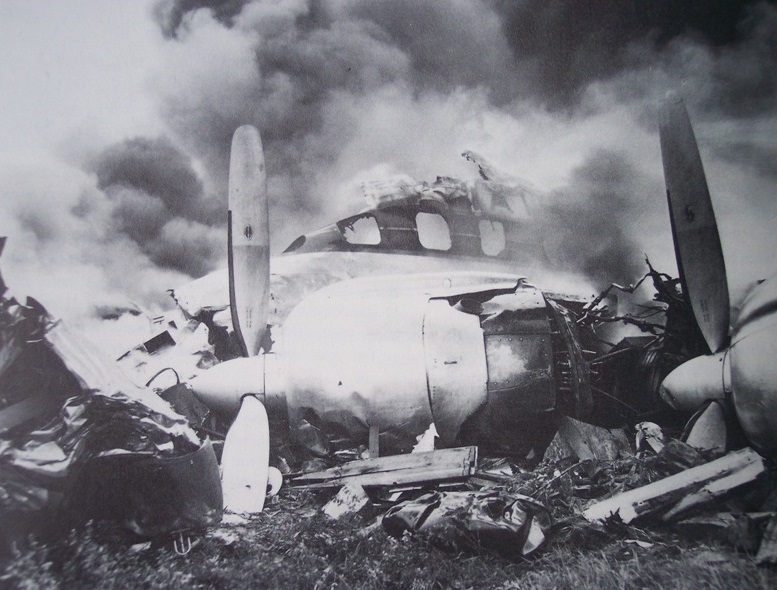
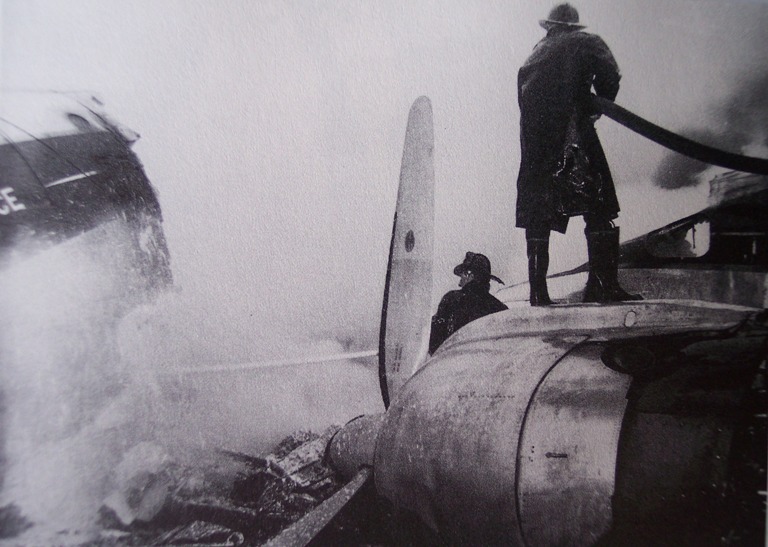
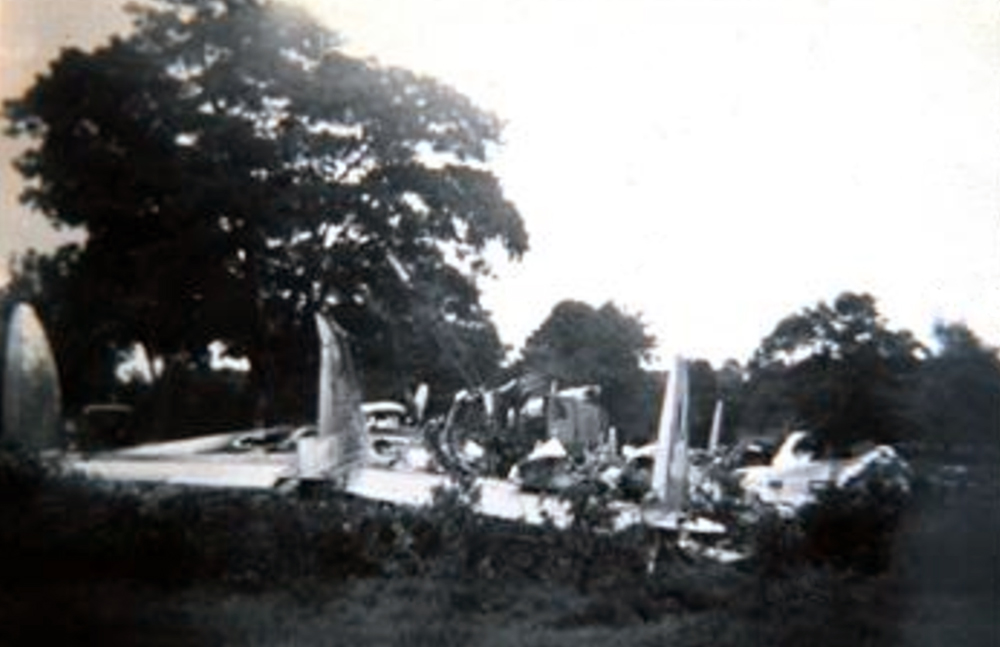
Crash of a Douglas C-47-DL near Mason City: 12 killed

Date & Time: Aug 22, 1954 at 1703 LT
Operator:
Registration:
N61451
Survivors:
Yes
Schedule:
Memphis – Little Rock – Fort Smith – Muskogee – Tulsa – Kansas City – Des Moines – Waterloo – Mason City – Austin – Rochester – Minneapolis
MSN:
4630
YOM:
1942
Flight number:
BN152
Location:
Crew on board:
3
Crew fatalities:
Pax on board:
16
Pax fatalities:
Other fatalities:
Total fatalities:
12
Captain / Total flying hours:
11077
Captain / Total hours on type:
8000.00
Copilot / Total flying hours:
5682
Copilot / Total hours on type:
2700
Aircraft flight hours:
23062
Probable cause:
The Board determines that the probable cause of this accident was that the flight while endeavouring to traverse a thunderstorm area encountered very heavy rain, divergent winds, and strong downdrafts that forced the aircraft to the ground. The following findings were reported:
- The flight was observed to enter and disappear in a thunderstorm,
- The aircraft crashed in an area where severe storm ground damage occurred,
- The US Weather Bureau Kansas City received the USAF severe weather advisories but considered their forecast in effect at the time to be adequate,
- The weather forecast issued by the Weather Bureau and Braniff did not indicate the severity of the storm that was encountered.
Final Report:

Crash of a Grumman J4F-2 Widgeon in Bauru: 1 killed

Date & Time: Aug 17, 1954 at 1300 LT
Type of aircraft:
Operator:
Registration:
2668
Flight Type:
Survivors:
Yes
Schedule:
Bauru - Bauru
MSN:
1272
YOM:
1943
Country:
Crew on board:
2
Crew fatalities:
Pax on board:
0
Pax fatalities:
Other fatalities:
Total fatalities:
1
Circumstances:
The crew left Bauru Airport at 1100LT for local training purposes. After completing several maneuvers, the crew started a new approach when the pilot-in-command decided to make a go around. The aircraft stalled and crashed short of runway. Both pilots were seriously injured but one of them died from his injuries few hours later.

Crash of a Bristol 170 Freighter 21E in Pakse: 47 killed

Date & Time: Aug 16, 1954
Type of aircraft:
Operator:
Registration:
F-VNAI
Flight Type:
Survivors:
Yes
Schedule:
Hanoi – Saigon
MSN:
12809
YOM:
1946
Country:
Region:
Crew on board:
4
Crew fatalities:
Pax on board:
51
Pax fatalities:
Other fatalities:
Total fatalities:
47
Circumstances:
The aircraft was performing a special flight from Hanoi to Saigon, carrying refugees leaving the Red River. In-flight, the crew informed ATC about an engine failure and received the permission to divert to Pakse for an emergency landing. The airplane lost height and eventually crashed on the bank of the Sedone River, a tributary of the Mekong River. Three crew members and five passengers were seriously injured while 47 other occupants were killed. The aircraft was totally destroyed upon impact.
Probable cause:
Engine failure in flight.

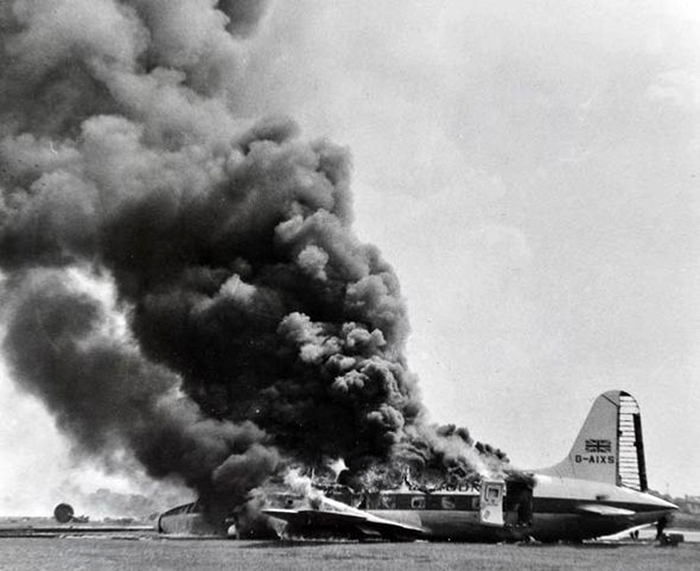
Crash of a Vickers 627 Viking 1B in Blackbushe

Date & Time: Aug 15, 1954 at 1000 LT
Type of aircraft:
Operator:
Registration:
G-AIXS
Survivors:
Yes
Schedule:
Blackbushe – Nice
MSN:
234
YOM:
1946
Region:
Crew on board:
5
Crew fatalities:
Pax on board:
32
Pax fatalities:
Other fatalities:
Total fatalities:
0
Circumstances:
Ten minutes after takeoff from Blackbushe, at an altitude of 6,000 feet, an oil leak occurred on the right engine that was shot down and its propeller feathered. The crew received the permission to return to Blackbushe. On final approach, at a speed of 100 knots, the aircraft stalled and crashed in flames in a field located 135 yards short of runway 26 threshold. All 37 occupants evacuated the cabin and four of them were injured, two seriously. The aircraft was destroyed by fire.
Probable cause:
The accident was the result of the captain allowing the aircraft to stall when making a single engine approach to land. A contributory factor was distraction of the captain's attention by the flickering of the undercarriage red indicator lights during a critical stage of the approach. The starboard engine was also damaged by fire and was removed for detailed examination by the Engine Division of the Bristol Aeroplane Company Ltd. Their report stated that the rear of the crankcase had been almost consumed by fire and that a number of cylinder barrels were severely burned. A detailed strip examination did not disclose any mechanical defect and no reason for the failure was established.
Final Report:

Crash of a Vickers 607 Valetta C.1 in Bahrain

Date & Time: Aug 4, 1954
Type of aircraft:
Operator:
Registration:
VX557
Flight Type:
Survivors:
Yes
YOM:
1950
Country:
Region:
Crew on board:
0
Crew fatalities:
Pax on board:
0
Pax fatalities:
Other fatalities:
Total fatalities:
0
Circumstances:
After takeoff from Bahrain Airport, the crew encountered technical problems with the undercarriage that remained down. The pilot obtained the permission to return for an emergency landing when all undercarriage collapsed upon touchdown. The aircraft slid for several yards and came to rest, damaged beyond repair. There were no injuries.

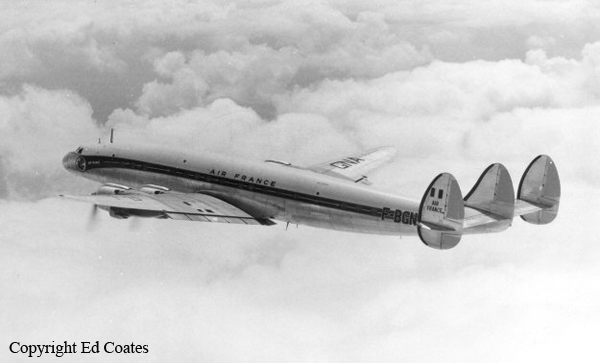
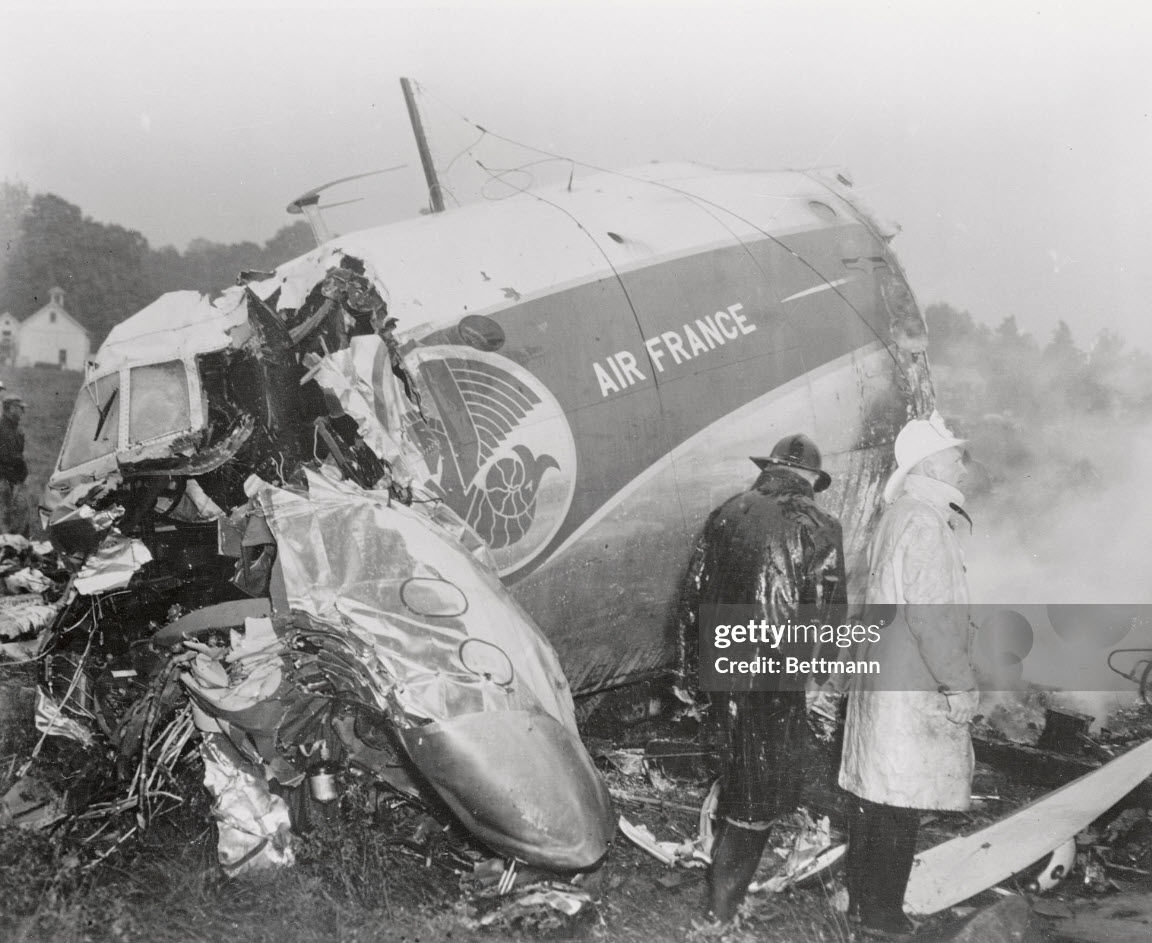
Crash of a Lockheed L-1049C Super Constellation in Preston City

Date & Time: Aug 3, 1954 at 0840 LT
Operator:
Registration:
F-BGNA
Survivors:
Yes
Schedule:
Paris – Shannon – New York
MSN:
4510
YOM:
1953
Flight number:
AF075
Crew on board:
8
Crew fatalities:
Pax on board:
29
Pax fatalities:
Other fatalities:
Total fatalities:
0
Captain / Total flying hours:
11959
Captain / Total hours on type:
453.00
Copilot / Total flying hours:
10679
Copilot / Total hours on type:
453
Aircraft flight hours:
2479
Circumstances:
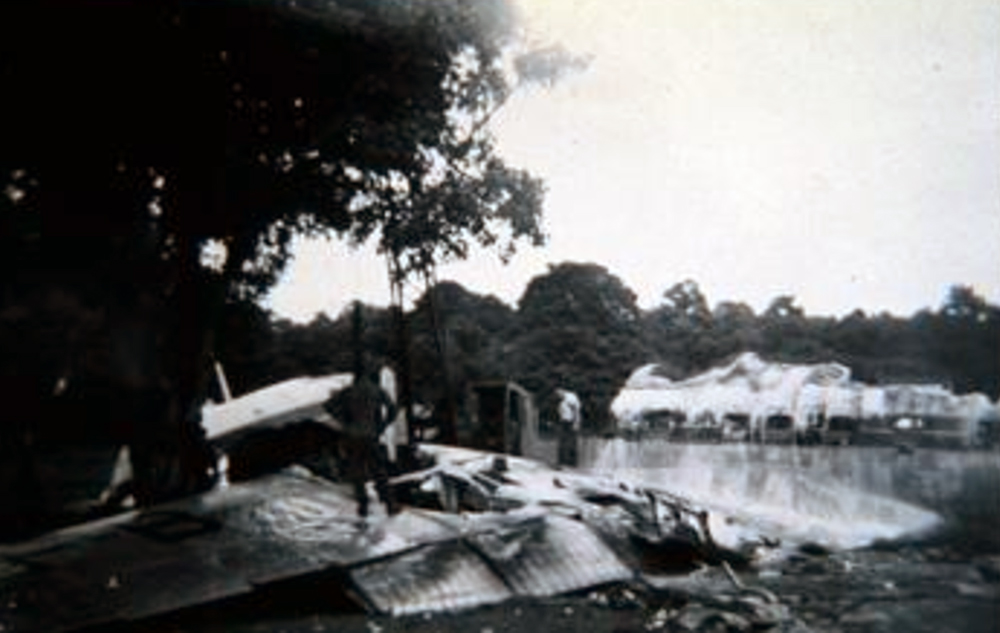
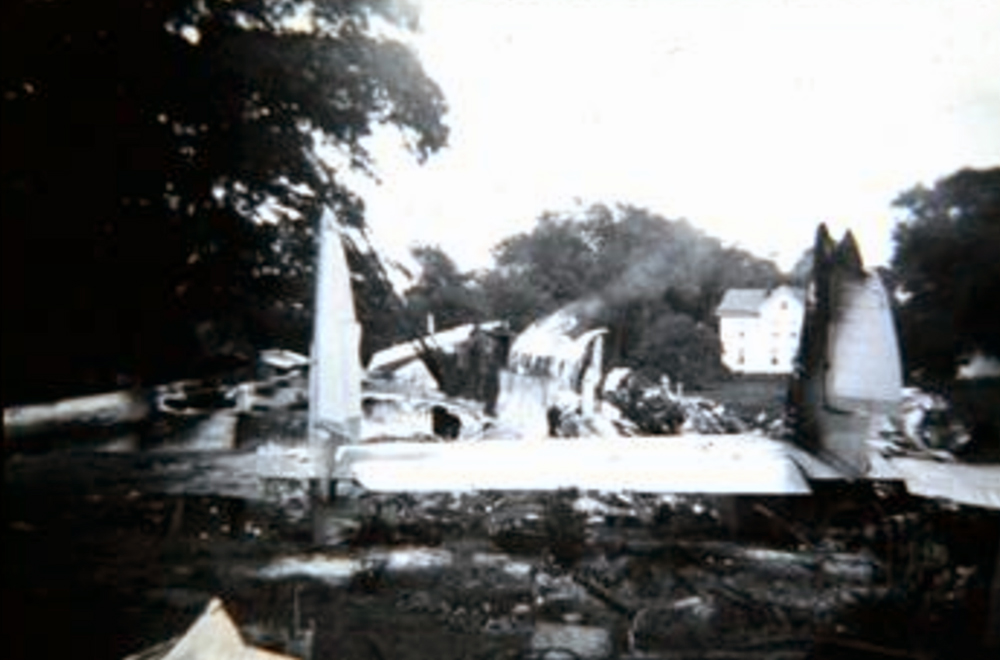
Air France Flight 075 originated at Orly Field, Paris, August 2, 1954, with a crew consisting of Captain Jean Caboche, Copilot Jean Roussean, Navigator Jacques Geffard., First Flight Engineer Albert Grandvaux, Second Flight Engineer Jean-Baptiste *** Stewardess Francine Dono, First Steward Michael Gallet, and Second Steward Jean Capron. The dispatch office had prepared two flight plans - one for a stop at Gander, Newfoundland, the other with a stop at Shannon, Ireland. Owing to marginal weather at Gander with the forecast indicating no improvement, the captain chose the latter plan. The flight departed Paris at 2024 and arrived Shannon at 2247. Fuel tanks were filled and the pilots ware briefed on weather for the nonstop flight to New York. Flight 075 departed Shannon at 0003 the next morning (August 3), estimating 11 hours 49 minutes an route, with fuel for nearly 14 hours. The gross weight at takeoff, 126,100 pounds, was less than the maximum allowable 133,000, and the load was correctly distributed relative to the canter of gravity of the aircraft. The Atlantic crossing was uneventful. Routine position reports were made en route and the flight periodically received weather reports for points along the route and at the destination. Stronger headwinds than had been anticipated were encountered near the North American continent, resulting in lower ground speed and somewhat higher fuel consumption per mile. The flight had approximately 600 gallons of fuel left at 1230 when it reported over Scotland Intersection (15 statute miles southwest of New York International Airport) and received clearance for an ILS approach. It was then 38 minutes behind its original flight plan estimate made at Shannon and had approximately 100 gallons less fuel than anticipated. During the approach, which was being monitored by New York International Airport radar, the flight encountered unexpected heavy turbulence, heavy rain, and a low ceiling, and the captain discontinued the approach at 1237 (0737 e. s. t.) when near his minimum prescribed altitude of 200 feet. The heavy turbulence made control of the aircraft difficult and when the missed approach was made, the captain found himself left of the localizer and below of glide path. The tower, which was immediately advised of the missed approach, told the flight to turn right to 130 degrees (the missed approach course), proceed to Scotland Intersection, and climb to 2,500 feet. Approximately three minutes after the missed approach and while on the 130-degrees course, the flight requested clearance to Boston. Such clearance was issued nine minutes later, as soon as possible consistent with other traffic. Meanwhile, the flight had reported being low on fuel but when asked if an emergency as being declared replied, "Negative, negative, not yet." At the approximate time clearance to Boston was received the flight engineer advised the captain that they had fuel of one more hour of flight. Thirty-three minutes after being cleared to Boston, the flight, at that time in the vicinity of Providence, Rhode Island, called Providence Tower, declared an emergency, and requested weather information. Providence weather, which was marginal, was furnished and the flight was cleared for an approach. However, the pilots found that their navigation kit did not contain an approach plate for Providence Airport and they advised they were not landing there. The captain then descended through a break in the overcast, circled two or three times, and landed with the gear retracted in a field at Preston City, Connecticut. It came to rest in flames in a garden and was destroyed by a post crash fire. All 37 occupants were evacuated safely. Nevertheless, 12 occupants were injured, among them both pilots.
Probable cause:
The Board determines that the probable cause of this accident was inadequate in-flight planning, in that the captain did not make a firm selection of a suitable airport within range of the fuel remaining at the time of the missed approach, necessitating an off-airport landing. The following findings were reported:
- All fuel tanks were filled to capacity during the scheduled stop at Shannon,
- Owing to headwinds the flight had approximately 100 gallons less fuel than anticipated when it arrived over Scotland Intersection, southwest of New York International Airport,
- In the ILS approach to New York International Airport during instrument weather conditions, the flight encountered an unexpected severe local storm with greater turbulence, heavier rain, and a lower ceiling than weather reports had led them to anticipate, and the captain discontinued the approach at 1237,
- The captain decided not to attempt another approach to New York International Airport and instead requested clearance to Boston at 1240 while climbing on the missed approach course,
- The flight was asked by New York International Airport Approach Control if an emergency was being declared, but the copilot replied in the negative,
- An IFR clearance to Boston was issued by New York ARTC at approximately 1249, the flight in the interim having been routed toward Boston via Mitchel range station,
- When the flight reported over Mitchel range station at 1250, the flight engineer advised the captain, upon the latter's request, that there was fuel for one more hour of flight,
- Difficulties with communications after being cleared from ARTC frequency prevented the flight from receiving the dispatcher's suggestion to proceed to Bridgeport or Hartford,
- Testimony of the pilots indicated that the captain intended to land at an intermediate airport between New York and Boston if he could find one with sufficiently good weather conditions,
- There were no language difficulties in conversations with the flight,
- There was sufficient fuel available to fly to Boston or any intermediate airport, but the fuel remaining over Boston, had the flight continued to that point, would have allowed only about 17 minutes of flight thereafter,
- Flight 075 declared an emergency at 1322 (0822 e. a. t.) in its first contact with Providence Tower/INSAC, indicated intention to land at Providence, was cleared for an approach, and then at 1329, advised that they were not landing there,
- The flight descended through a break in the overcast and made an emergency landing at about 1340 (0840 e. s. t. ) in a field and without loss of life.
Final Report:

Crash of a De Havilland DH.89A Dragon Rapide in Frankfurt

Date & Time: Aug 2, 1954
Operator:
Registration:
G-AGUR
Survivors:
Yes
Schedule:
Luton – Frankfurt
MSN:
6910
YOM:
1945
Country:
Region:
Crew on board:
2
Crew fatalities:
Pax on board:
5
Pax fatalities:
Other fatalities:
Total fatalities:
0
Circumstances:
A tire burst on landing. For unknown reason, the captain decided to go around when the twin engine aircraft went out of control and crashed near the runway end. The airplane was destroyed and all seven occupants were injured.

Crash of a Fiat G.212 in Kuwait City

Date & Time: Jul 29, 1954 at 0448 LT
Type of aircraft:
Registration:
G-ANOE
Flight Type:
Survivors:
Yes
Schedule:
Beirut - Kuwait City
MSN:
10
YOM:
1948
Country:
Region:
Crew on board:
3
Crew fatalities:
Pax on board:
0
Pax fatalities:
Other fatalities:
Total fatalities:
0
Circumstances:
During the final approach completed by night, the pilot did not realize his altitude was insufficient when the three engine airplane hit a sand dune located few dozen yards short of runway. On impact, the undercarriage were torn off and the aircraft crash landed on its belly and came to rest. While all three crew members were unhurt, the aircraft was damaged beyond repair.

Crash of an Airspeed AS.10 Oxford II in Liège

Date & Time: Jul 12, 1954
Type of aircraft:
Operator:
Registration:
O-36
Flight Type:
Survivors:
Yes
Schedule:
Liège - Liège
Location:
Country:
Region:
Crew on board:
3
Crew fatalities:
Pax on board:
0
Pax fatalities:
Other fatalities:
Total fatalities:
0
Circumstances:
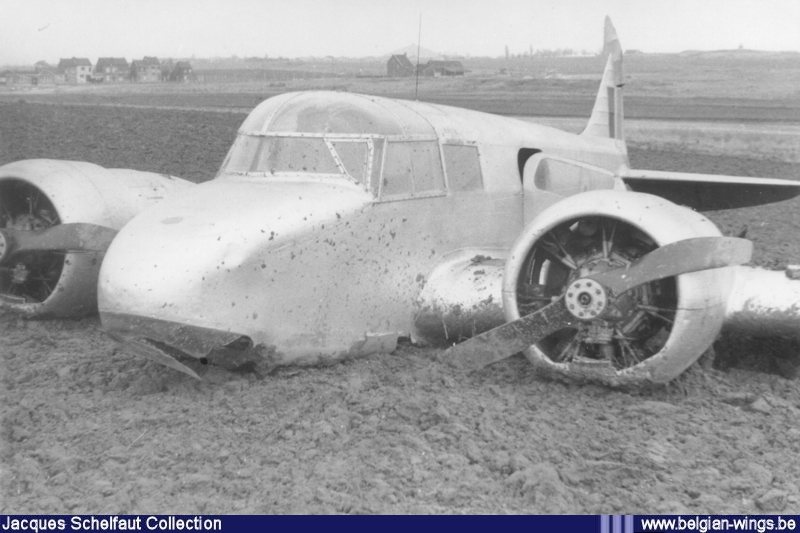
The crew was performing a local training at Liège-Bierset Airport when on final approach, he was unable to lower the landing gear. The twin engine aircraft belly landed and after a roll of few dozen yards, veered off runway and came to rest. All three crew members were uninjured while the aircraft was considered as damaged beyond repair.
Probable cause:
Failure of the undercarriage to extend on final approach.

Crash of a Douglas C-124C Globemaster II at Fort Campbell AFB

Date & Time: Jul 2, 1954
Operator:
Registration:
51-5210
Flight Type:
Survivors:
Yes
MSN:
43620
YOM:
1951
Crew on board:
0
Crew fatalities:
Pax on board:
0
Pax fatalities:
Other fatalities:
Total fatalities:
0
Circumstances:
Crashed on landing. No casualties.