Crash of a Cessna 208 Caravan I off Port Blair: 1 killed

Date & Time: Sep 6, 1993 at 1132 LT
Type of aircraft:
Operator:
Registration:
VT-AAN
Survivors:
Yes
Schedule:
Port Blair - Dugong Creek - Hut Bay - Port Blair
MSN:
208-0221
YOM:
1992
Country:
Region:
Crew on board:
1
Crew fatalities:
Pax on board:
3
Pax fatalities:
Other fatalities:
Total fatalities:
1
Captain / Total flying hours:
6300
Circumstances:
Cessna 208 Caravan aircraft VT-AAN operated by Andaman and Nicobar Administration was engaged in a flight from Port Blair - Dugong Creek - Hut Bay - Port Blair. There were four persons on board the aircraft including pilot-in-command. The flight from Dugong Creek to Hut Bay was uneventful. The aircraft took-off from Hut Bay for Port Blair where it was intended to land on sea
adjacent to Viper Island. Soon after touchdown on seawater, the aircraft flipped over its nose and sank thereafter. Three persons including the pilot evacuated the aircraft. However, one person died due to drowning, as he remained strapped in his seat. The aircraft sustained substantial damage. There was no fire.
Probable cause:
The pilot failed to ensure that the landing gears are fully retracted before landing on water thereby causing the aircraft to flip on to its back as a result of abnormally high hydrodynamic drag generated on landing with landing gears remaining extended. Non-availability of the revised pilot's checklist, appropriate to the aircraft configuration and the practice adopted during conversion training of the pilot were the contributory factors.
Final Report:


Crash of a Piper PA-46-350P Malibu Mirage in Block Island

Date & Time: Sep 5, 1993 at 1108 LT
Operator:
Registration:
N46DK
Flight Type:
Survivors:
Yes
Schedule:
Manchester - Block Island
MSN:
46-22010
YOM:
1989
Crew on board:
1
Crew fatalities:
Pax on board:
3
Pax fatalities:
Other fatalities:
Total fatalities:
0
Captain / Total flying hours:
4100
Captain / Total hours on type:
700.00
Aircraft flight hours:
998
Circumstances:
During an approach to land, the pilot made S-turns to allow for proper spacing from a preceding airplane. On short final, he decided to go around because the runway was still not clear. However, he reported there was a lack of response concerning the power, so he decided to land as originally planned. The pilot tried to align the airplane with the runway centerline, but its right wing and landing gear struck the ground, and the right landing gear collapsed. The airplane skidded off the right side of the runway. During the accident sequence, the outward portion of the right wing was torn away from the airplane and a fuel line was ruptured. A ground fire erupted and burned through the right side of the airplane's structure and right wing. No preimpact part failure or malfunction was reported.
Probable cause:
Improper in-flight planning/decision by the pilot, and his failure to attain proper runway alignment.
Final Report:

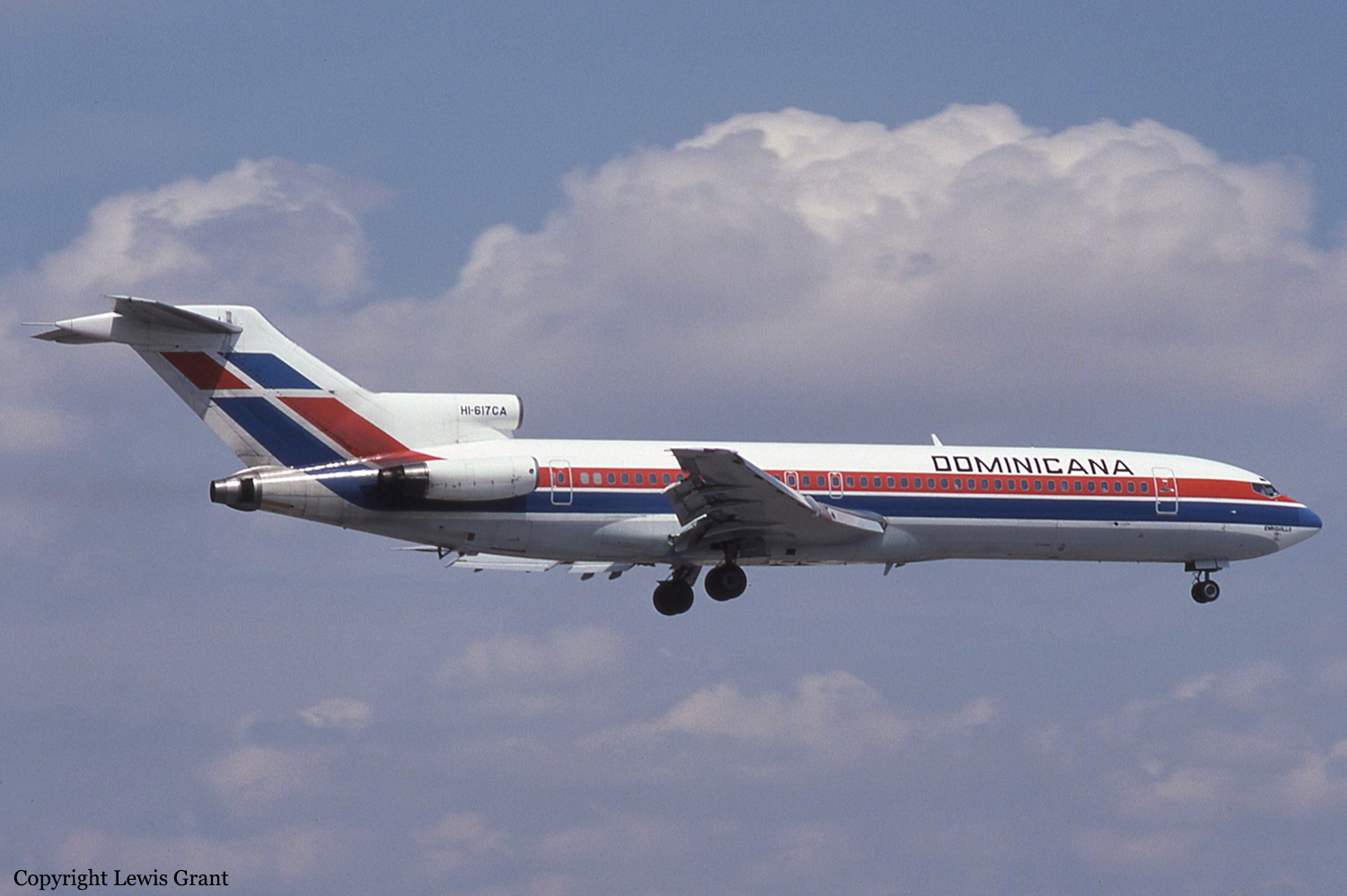
Ground fire of a Boeing 727-281 in Santo Domingo

Date & Time: Sep 5, 1993
Type of aircraft:
Operator:
Registration:
HI-617CA
Survivors:
Yes
Schedule:
San Juan - Santo Domingo
MSN:
20726
YOM:
1973
Crew on board:
7
Crew fatalities:
Pax on board:
98
Pax fatalities:
Other fatalities:
Total fatalities:
0
Circumstances:
Twenty minutes after takeoff from San Juan-Luis Muñoz Marin Airport, while in cruising altitude, a steward noticed smoke in the lavatory and informed the crew accordingly. In the meantime, the crew noticed a fire alarm in the cockpit, declared an emergency and became number one for landing at Santo Domingo-Las Américas Airport. Following a normal approach and landing, the crew vacated the runway and parked the aircraft at gate A6. While the passengers was disemmarking, smoke spread in the cabin and fire erupted, destroying the airplane.
Probable cause:
It was determined that a fire broke out in the rear lavatory after an engine used to drain the toilet overheated.

Crash of a Rockwell Sabreliner 40A in Buenos Aires

Date & Time: Sep 3, 1993 at 2155 LT
Type of aircraft:
Operator:
Registration:
OB-1319
Survivors:
Yes
Schedule:
Neuquén – Buenos Aires
MSN:
282-127
YOM:
1973
Country:
Crew on board:
2
Crew fatalities:
Pax on board:
2
Pax fatalities:
Other fatalities:
Total fatalities:
0
Circumstances:
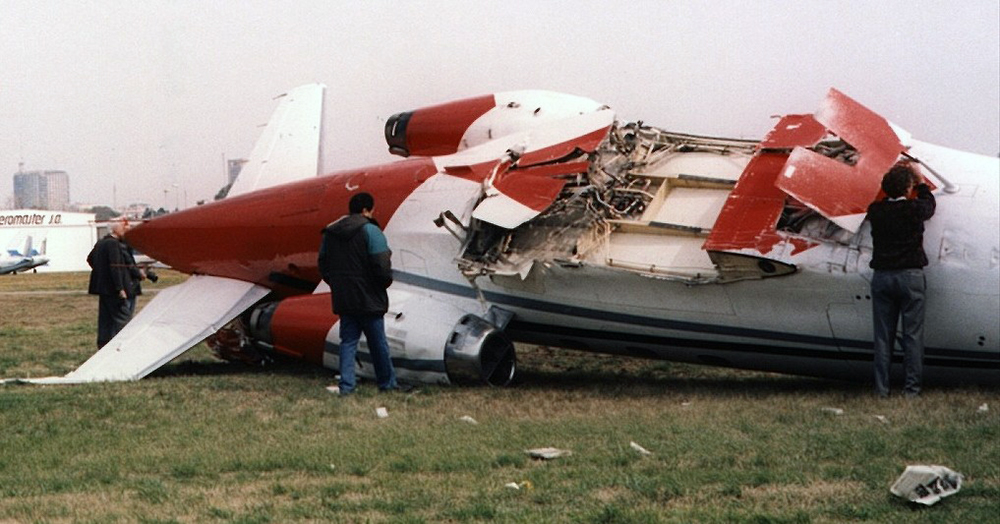
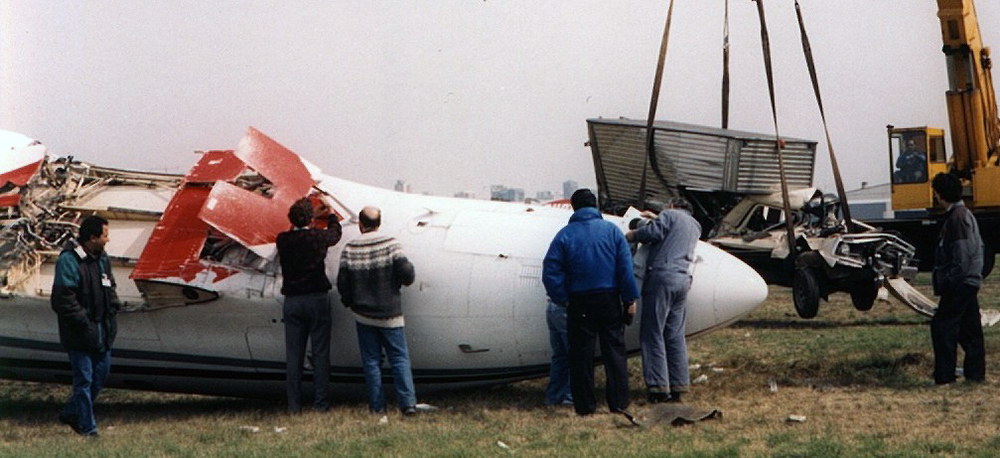
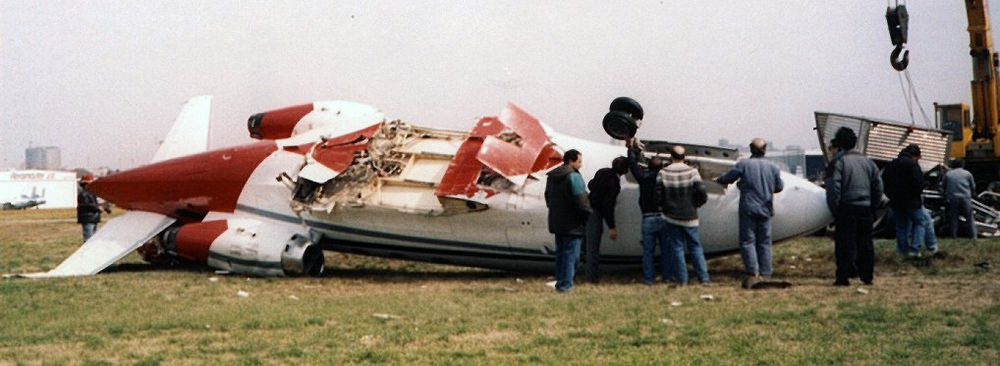
After landing at Buenos Aires-Aeroparque-Jorge Newbury Airport, the crew started the braking procedure and activated the reverse thrust that failed to deploy. The crew used the emergency brakes but the aircraft failed to stop within the remaining distance, overran and collided with a support vehicle (pick up) that was parked outside the safety zone. The aircraft lost its undercarriage and both wings and all four occupants were injured.
Probable cause:
The brakes and reverse thrust systems were unserviceable following a failure of the primary hydraulic system. The auxiliary braking system was also unserviceable. For unknown reasons, the problem has not been identified by the flying crew neither the maintenance personnel.

Crash of a Learjet 25D in Tijuana

Date & Time: Sep 2, 1993
Type of aircraft:
Operator:
Registration:
XA-NOG
Survivors:
Yes
Schedule:
Mexico City – Tijuana
MSN:
25-349
YOM:
1981
Country:
Crew on board:
2
Crew fatalities:
Pax on board:
4
Pax fatalities:
Other fatalities:
Total fatalities:
0
Circumstances:
The approach to Tijuana-General Abelardo L. Rodríguez Airport was completed in poor weather conditions with clouds down to 180 metres. On short final, the captain realized his position was not correct and made several correction but inefficiently. The aircraft landed hard, right main gear first. On impact, both tires on the right main gear burst. The aircraft went out of control, veered to right and came to rest. All six occupants escaped uninjured while the aircraft was damaged beyond repair.
Probable cause:
The crew completed a landing procedure following an unstabilized approach and failed to initiate a go-around.

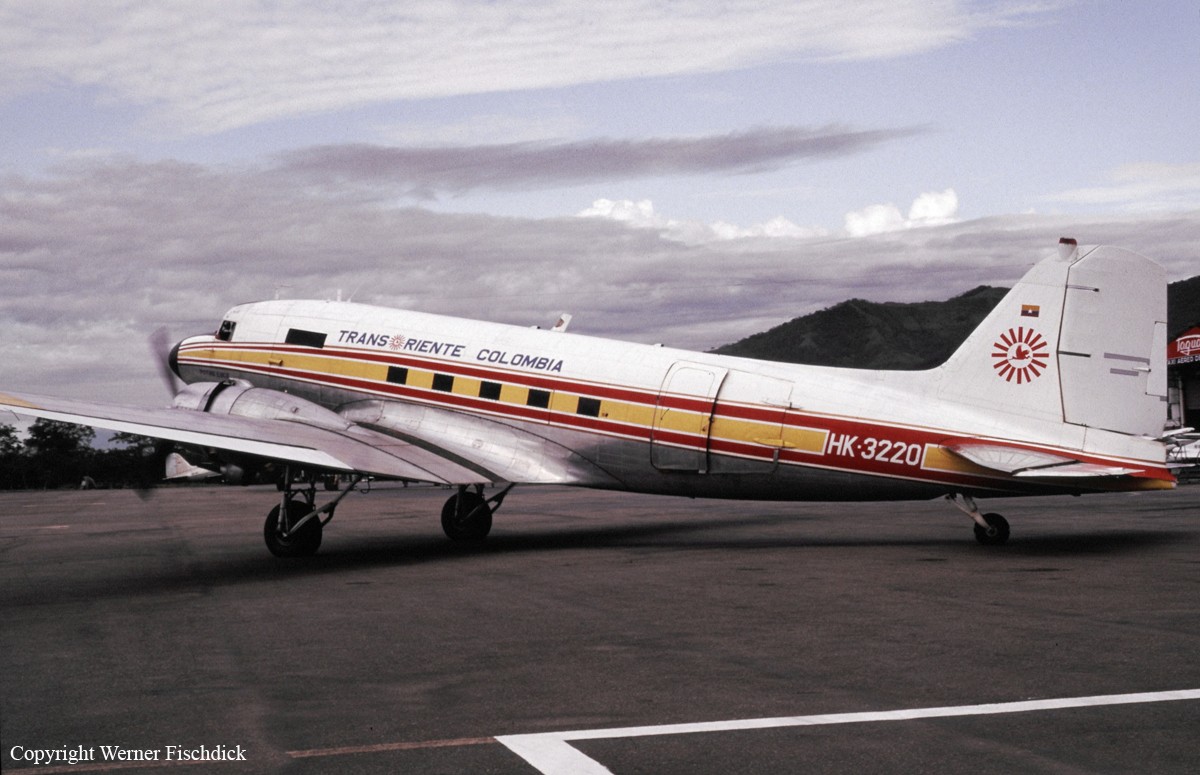
Crash of a Douglas DC-3 in Barranco Minas: 2 killed

Date & Time: Aug 31, 1993
Type of aircraft:
Operator:
Registration:
HK-3220
Flight Type:
Survivors:
Yes
Schedule:
San Felipe - Villavicencio
MSN:
11808
YOM:
1943
Country:
Crew on board:
3
Crew fatalities:
Pax on board:
3
Pax fatalities:
Other fatalities:
Total fatalities:
2
Circumstances:
The aircraft was completing a cargo flight from San Felipe, Guainía, to Villavicencio, carrying three passengers, three crew members and a load of straw. En route, one of the engine failed and the crew decided to divert to Barranco Minas Airport. After touchdown on runway 27, the aircraft was unable to stop within the remaining distance, overran and plunged in the Río Guaviare. Four people were rescued while the bodies of the copilot and the flight engineer disappeared in the river.
Probable cause:
Engine failure in flight for unknown reasons.

Crash of a Mitsubishi MU-2B-40 Marquise in South Charleston

Date & Time: Aug 29, 1993 at 1550 LT
Type of aircraft:
Operator:
Registration:
N965MA
Survivors:
Yes
Schedule:
Rochester - Roanoke
MSN:
404
YOM:
1979
Crew on board:
1
Crew fatalities:
Pax on board:
2
Pax fatalities:
Other fatalities:
Total fatalities:
0
Captain / Total flying hours:
6370
Captain / Total hours on type:
2500.00
Aircraft flight hours:
2739
Circumstances:
The pilot reported the right engine failed, followed by the left engine approximately one minute later while he was in cruise at 25,000 feet. He said he initiated a steep descent to get below 18,000 feet, and attempts at restarting the left engine were unsuccessful. The pilot landed 500 feet down a 1,900 feet long runway and ran off the departure end, 300 feet, into a wooded area. Post accident investigation found 130 gallons of fuel onboard in the main tanks. The fuel was tested and found to be free of water. The fuel lines were free of obstructions and the fuel pumps worked. A failed torque sensor was found on the left engine which would disconnect the left engine driven fuel pump. The right engine was test run satisfactorily.
Probable cause:
Improper emergency procedures by the pilot which resulted in the shutdown of an operative engine, following a power loss due to a failed torque sensor in the other engine, which resulted in a total power loss approach, landing, and overrun.

Crash of an Antonov AN-26 in Donetsk

Date & Time: Aug 29, 1993 at 0131 LT
Type of aircraft:
Registration:
RA-26549
Flight Type:
Survivors:
Yes
Schedule:
Khmelnytskyi – Donetsk – Samara
MSN:
57302907
YOM:
1975
Flight number:
MP9437
Country:
Region:
Crew on board:
5
Crew fatalities:
Pax on board:
0
Pax fatalities:
Other fatalities:
Total fatalities:
0
Circumstances:
The crew was completing a cargo service from Khmelnytskyi to Samara with an intermediate stop in Donetsk. The approach was completed by night and limited visibility due to thunderstorm activity and heavy rain falls. On final, the crew failed to realize the aircraft was not properly aligned and continued the approach when the aircraft landed hard 80 metres to the left of the runway. Out of control, it rolled for few dozen metres and eventually collided with a building. The aircraft was destroyed and all five occupants were seriously injured.
Probable cause:
Poor approach planning and landing configuration on part of the crew. The aircraft was not properly aligned and its rate of descent was excessive during the last segment. This led the aircraft to land with a positive acceleration of 5,8 g.

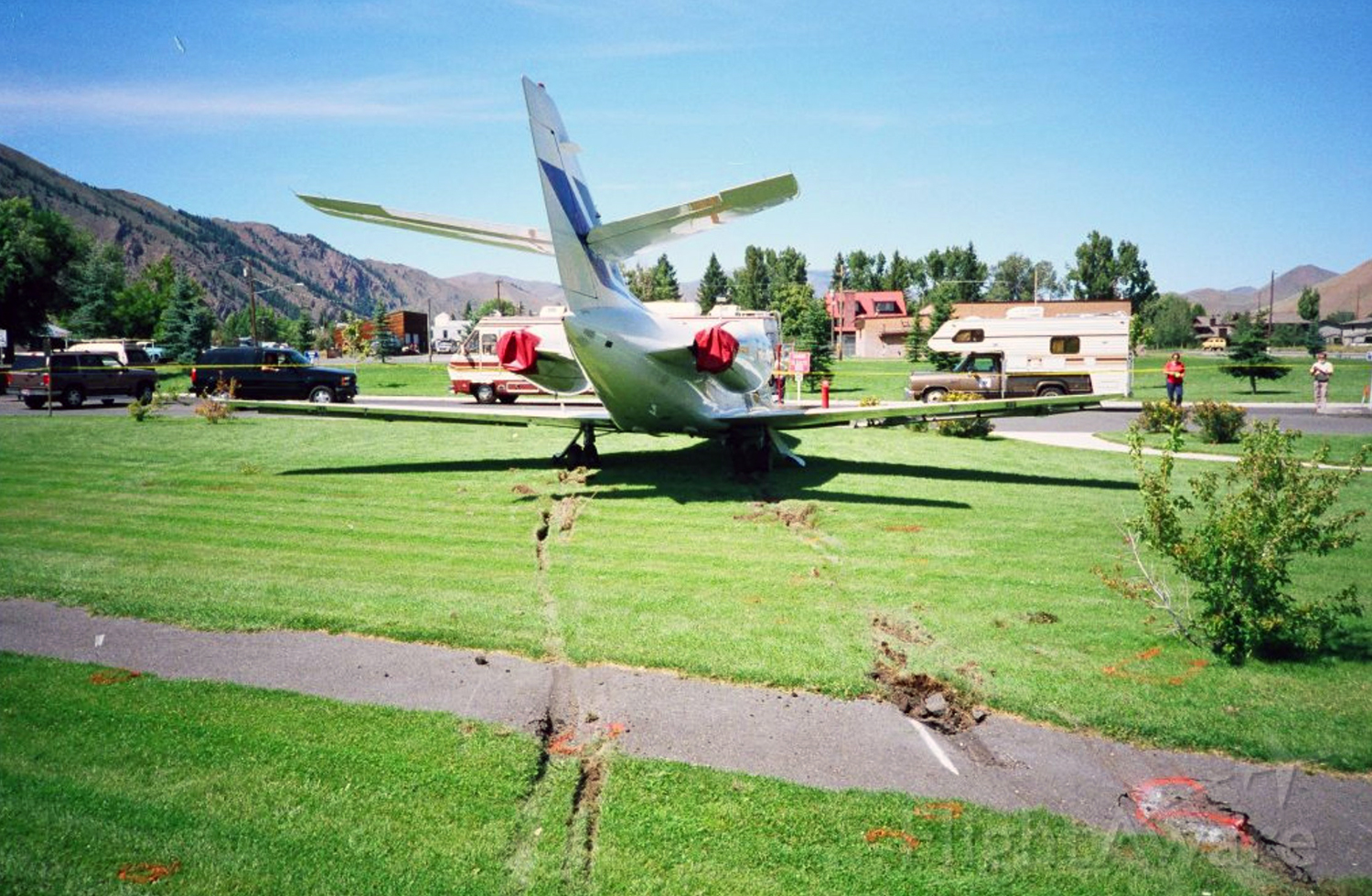
Crash of a Dassault Falcon 10 in Hailey

Date & Time: Aug 26, 1993 at 1430 LT
Type of aircraft:
Operator:
Registration:
F-BYCV
Flight Type:
Survivors:
Yes
Schedule:
Saskatoon – Great Falls – Hailey
MSN:
93
YOM:
1976
Crew on board:
2
Crew fatalities:
Pax on board:
0
Pax fatalities:
Other fatalities:
Total fatalities:
0
Captain / Total flying hours:
3440
Captain / Total hours on type:
40.00
Aircraft flight hours:
8607
Circumstances:
Because of the failure of the thrust reverser relay circuit board, the thrust reversers failed to deploy when selected by the pilot. Because the reversers failed to deploy, the 'reversers in transition' lights, and the 'reversers deployed' lights did not illuminate. Even though the aircraft flight manual warns against moving the reverser throttle levers into the power range without the illumination of these lights, the pilot did so anyway. The pilot continued to select reverse power even after the activation of the throttle mismatch warning horn, resulting in an increase in forward thrust while attempting to stop. During this sequence of events the second-in-command moved the parking brake lever to full override, locking the main wheel brakes and overriding the antiskid system.
Probable cause:
The pilot-in-command's improper procedures. Factors include failure of an electrical relay, inoperative thrust reverser, poor crew coordination, and the second-in-command's improper procedures.
Final Report:

Crash of a Let L-410UVP-E in Aldan: 24 killed

Date & Time: Aug 26, 1993
Type of aircraft:
Operator:
Registration:
RA-67656
Survivors:
No
Schedule:
Yakutsk - Aldan
MSN:
90 25 09
YOM:
1990
Flight number:
SVT301
Country:
Region:
Crew on board:
2
Crew fatalities:
Pax on board:
22
Pax fatalities:
Other fatalities:
Total fatalities:
24
Circumstances:
On final approach to Aldan Airport, at a speed of 196 km/h, the crew extended the flaps to 42° when the aircraft adopted a 42,5° nose-up attitude. The crew elected to go-around but, as the speed dropped to 52 km/h, the aircraft stalled and crashed 273 metres short of runway and 160 metres to the left of its extended centreline. The aircraft was destroyed by impact forces and all 24 occupants were killed.
Probable cause:
It was determined that the total weight of the aircraft was 623 kilos above MTOW while departing Yakutsk Airport and 550 kilos above the max landing weight upon arrival at Aldan Airport. More than 400 kilos of bagages were placed in the rear compartment, causing the CofG to be out of permissible limits.