Country
Crash of a Cessna 421B Golden Eagle II near Conchas
Date & Time:
Aug 30, 1996 at 1830 LT
Registration:
N55HU
Survivors:
Yes
Schedule:
Albuquerque - Alva
MSN:
421B-0014
YOM:
1970
Crew on board:
1
Crew fatalities:
Pax on board:
2
Pax fatalities:
Other fatalities:
Total fatalities:
0
Captain / Total hours on type:
67.00
Aircraft flight hours:
2700
Circumstances:
At 1615, the pilot called FSS for a weather briefing and to file an IFR flight plan. He was told that there was thunderstorm activity, which was building in intensity, extending from Raton, New Mexico, to Garden City, Kansas, with some scattered activity in the Oklahoma panhandle. The briefer further reported that the thunderstorm activity was moving east, southeast. The pilot checked in with Albuquerque Center at 1750 during his departure climb to 21,000 feet. At 1755, convective SIGMET 70C was issued for isolated severe thunderstorms located 10 miles north, northeast, of Las Vegas, New Mexico. FAA Order 7110.65J, Air Traffic Control, section 2-6-2, states that 'controllers shall advise pilots of hazardous weather that may impact operations within 150 NM of their sector or area of jurisdiction.' SIGMET 70C was not given to the pilot by the center controller. Radio contact was lost at 1823. The pilot reported that the airplane was in VMC, approaching precipitation, when they encountered hail and the pilot's windshield was broken out which resulted in the airplane's depressurization.
Probable cause:
The pilot's inadvertent flight into hail which shattered the pilot's windshield and resulted in his incapacitation due to hypoxia.
Final Report:
Crash of a Cessna 421B Golden Eagle II off Vigan: 1 killed
Date & Time:
Mar 3, 1996
Registration:
N69905
Survivors:
No
Schedule:
Manila - Vigan
MSN:
421B-0537
YOM:
1973
Crew on board:
1
Crew fatalities:
Pax on board:
0
Pax fatalities:
Other fatalities:
Total fatalities:
1
Circumstances:
On March 3,1996, at a time not reported, a Cessna 421B, N69905, registered to Hi Tech Aviation in Scottsdale, Arizona, reportedly crashed into the sea while attempting to land at the airport at Vigan in the Philippine Islands. The weather at the time and the circumstances of the accident were not reported. It was reported that the pilot was the only occupant onboard. According to the Philippine Air Transportation Office, the aircraft arrived in Manila on March 2, 1996. It departed the next day for a flight to Vigan to pick up a passenger with a return to Manila. It was last seen flying over the airport in the traffic pattern for landing. It is presumed to have crashed into the sea. The FAA aircraft records section in Oklahoma City, Oklahoma, indicated that they received a bill of sale from Hi Tech Aviation indicating the aircraft was sold to a company in Manila on 01/19/96.
Crash of a Cessna 421B Golden Eagle II in Coldwater: 1 killed
Date & Time:
Sep 21, 1995 at 1145 LT
Registration:
N14A
Survivors:
No
Schedule:
Coldwater - Elkhart
MSN:
421B-0373
YOM:
1973
Crew on board:
1
Crew fatalities:
Pax on board:
0
Pax fatalities:
Other fatalities:
Total fatalities:
1
Captain / Total hours on type:
203.00
Aircraft flight hours:
5044
Circumstances:
The pilot obtained a preflight briefing and indicated that he would obtain an IFR clearance after becoming airborne; however, he took off and did not activate a flight plan. Witnesses observed the airplane flying north (away from the destination) about 200 to 300 feet above the ground below a low overcast sky condition. One witness said the airplane was flying very slow; he said he was almost able to keep up with it in his vehicle. The witnesses said they saw the airplane roll rapidly to the right and descend toward the ground. It collided with the ground in an approximate 50 degree pitch down attitude. An on-scene examination did not reveal any airframe or control anomaly that would have resulted in the accident. The engines and propellers were disassembled for inspection. Examination of the engines revealed they were capable of producing power. Examination of the propellers revealed both were operating at low pitch settings. About 25 miles north-northwest at Battle Creek, MI, the 1145 edt weather was, in part: 500 feet overcast, visibility 2 miles with fog, wind from 050 degrees at 10 knots.
Probable cause:
Failure of the pilot to maintain adequate airspeed, while maneuvering (turning) at low altitude, which resulted in an inadvertent stall and collision with the terrain. Factors relating to the accident were: the adverse weather conditions, and the lack of altitude for recovery from the stall.
Final Report:
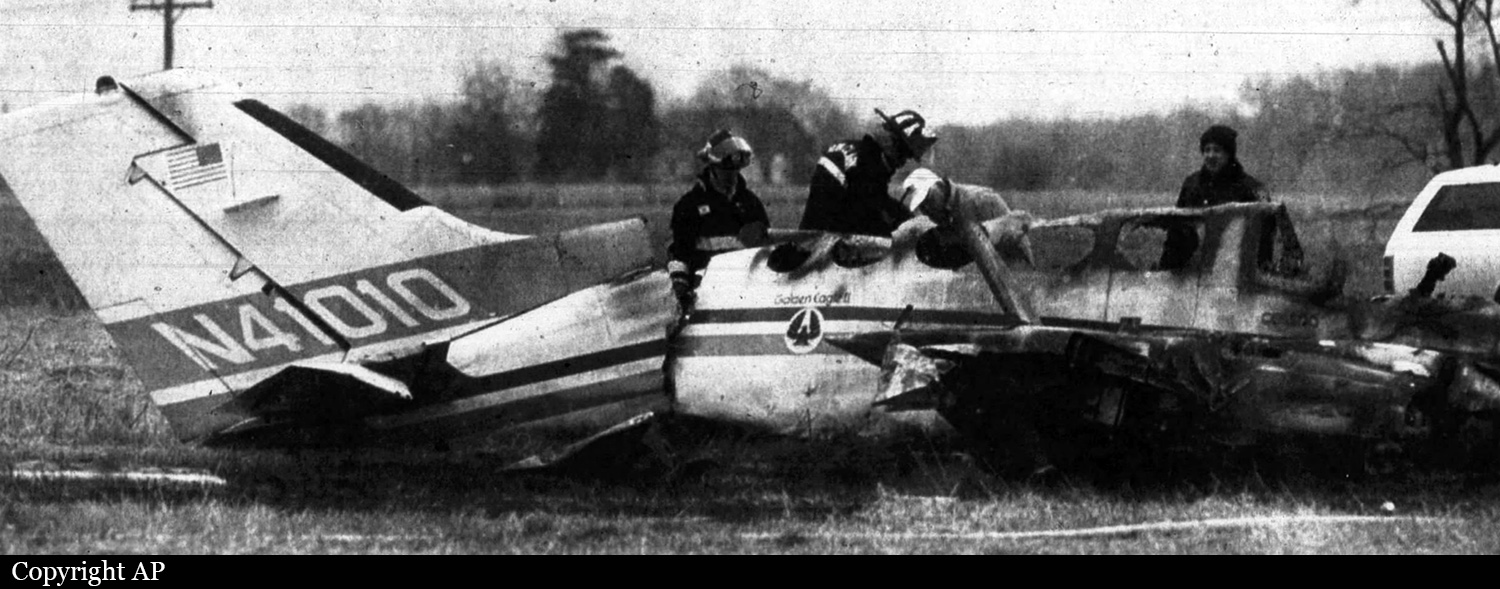
Crash of a Cessna 421B Golden Eagle II in Greensburg: 5 killed
Date & Time:
Nov 6, 1993 at 0851 LT
Registration:
N41010
Survivors:
No
Schedule:
Pontiac - Greensburg
MSN:
421B-0569
YOM:
1974
Crew on board:
1
Crew fatalities:
Pax on board:
4
Pax fatalities:
Other fatalities:
Total fatalities:
5
Captain / Total hours on type:
225.00
Aircraft flight hours:
2600
Circumstances:
The pilot reported ice accretion en route to his destination and subsequently requested, and received a lower altitude from ATC. The flight was issued a clearance for a VOR-A approach to the Greensburg Airport, and was observed by a witness north of the airport to fly for a short period down runway 18 about seven feet above the runway. The witness then observed the airplane began to climb and fly off in a southerly direction. Other witnesses saw the airplane flying in the vicinity of the airport beneath an overcast ceiling estimated between 300 feet and 1,000 feet AGL. One witness, located about two miles south of the airport, saw the airplane turn sharply left, drop nose low, recover, drop nose low, and then descend from sight behind trees. Investigators and rescue personnel discovered a large amount of ice debris along the flight path and outside the fire ring at the crash site.
Probable cause:
An inadvertent stall by the pilot in command. Factors associated with the accident are the icing conditions and low ceilings.
Final Report:
Crash of a Cessna 421B Golden Eagle II in Genoa: 5 killed
Date & Time:
Sep 30, 1993 at 1903 LT
Registration:
I-STMO
Survivors:
No
Schedule:
Olbia - Torino
MSN:
421B-0410
YOM:
1973
Crew on board:
1
Crew fatalities:
Pax on board:
4
Pax fatalities:
Other fatalities:
Total fatalities:
5
Circumstances:
En route from Olbia to Torino-Caselle Airport, the pilot was informed about the deterioration of the weather conditions and decided to divert to Genoa-Sestri-Cristoforo Colombo Airport. On approach, he was unable to establish on the localizer despite several attempts and finally initiated a go-around procedure. While circling in limited visibility, the aircraft struck the slope of a mountain. All five occupants were killed.
Probable cause:
It was reported that the pilot was not certified to fly in IMC conditions and his experience was limited.
Crash of a Cessna 421B Golden Eagle II in Gadsden
Date & Time:
Jun 10, 1993 at 1727 LT
Registration:
N699DT
Survivors:
Yes
Schedule:
Gadsden - Huntsville
MSN:
421B-0540
YOM:
1973
Crew on board:
1
Crew fatalities:
Pax on board:
0
Pax fatalities:
Other fatalities:
Total fatalities:
0
Captain / Total hours on type:
300.00
Aircraft flight hours:
4430
Circumstances:
The airline transport pilot reported that shortly after takeoff from runway 36, he heard a loud noise from the left engine area, and observed smoke trailing the left engine nacelle. He confirmed that the left engine was losing power, and he feathered the left propeller. He was unable to maintain altitude, and the aircraft was force landed on wooded terrain. The aircraft caught fire on the ground after colliding with trees and was destroyed. An inspection of the left engine turbocharger revealed that the rotor shaft was seized, with evidence of metal transfer to the bearing journals.
Probable cause:
The failure of the left engine turbocharger due to rotor shaft seizure, which resulted in a loss of engine power.
Crash of a Cessna 421B Golden Eagle II in Chesterfield: 2 killed
Date & Time:
Apr 29, 1993 at 1400 LT
Registration:
N4939M
Survivors:
No
Schedule:
Chesterfield - Chesterfield
MSN:
421B-0632
YOM:
1974
Crew on board:
2
Crew fatalities:
Pax on board:
0
Pax fatalities:
Other fatalities:
Total fatalities:
2
Aircraft flight hours:
3726
Circumstances:
Two foreign pilots took off VFR to remain in the vicinity of an airport on the outskirts of a metropolitan area. No record was found to show the airplane had been fueled either before or after the preceding flight. The flight crew contacted an area approach control and requested an ILS approach to test their ILS equipment without specifying an airport. Approach control issued and the flight crew accepted vectors to another airport for which the pilots had no approach plate or airport information. Vectors took the airplane about 25 miles from the departure airport. The flight crew requested to proceed back to the departure airport. A short time later, the flight crew declared an emergency due to low fuel, then radar contact was lost. Witnesses at a landfill heard an intermittent sound from the engine(s). The airplane came into their view with one engine running, then the engine sound ceased. They indicated the airplane went out of control and crashed, but one engine accelerated just before impact. A small fire was confined to the left wing. Both occupants were killed.
Probable cause:
Improper planning/decision by the pilot, which resulted in fuel exhaustion, due to an inadequate supply of fuel, and the pilot's failure to maintain control of the airplane during approach to an emergency landing. A related factor was: failure of the pilot to refuel the airplane before flight.
Final Report:
Crash of a Cessna 421B Golden Eagle II in Shelter Cove
Date & Time:
Jul 4, 1992 at 1709 LT
Registration:
N929DB
Survivors:
Yes
Schedule:
Shelter Cove - Oakland
MSN:
421B-0864
YOM:
1974
Crew on board:
1
Crew fatalities:
Pax on board:
3
Pax fatalities:
Other fatalities:
Total fatalities:
0
Captain / Total hours on type:
218.00
Aircraft flight hours:
2198
Circumstances:
The pilot said he was on the takeoff ground roll at about 100 knots when he discovered that the control lock was still in place. The pilot said he attempted to remove the control lock but could not prior to the aircraft over running the departure end of the 3,400 foot long runway. The aircraft collided with a county sewage treatment building, separating the wings from the fuselage. The aircraft fuselage continued through the building and came to rest on rocks near the beach. All four occupants were seriously injured.
Probable cause:
The pilot's inadequate preflight inspection of the aircraft and his failure to ensure that the control surface locks were removed prior to flight.
Final Report:
Crash of a Cessna 421B Golden Eagle II in Monterey: 3 killed
Date & Time:
Jun 24, 1992 at 1030 LT
Registration:
N628RJ
Survivors:
No
Schedule:
Monterey - Tucson
MSN:
421B-0028
YOM:
1970
Crew on board:
1
Crew fatalities:
Pax on board:
2
Pax fatalities:
Other fatalities:
Total fatalities:
3
Captain / Total hours on type:
10.00
Circumstances:
The 3 occupants aboard were: the owner in the left front seat, his wife in the right front seat, and a man hired by the owner to fly the airplane (seat location could not be determined). Prior to takeoff a man telephoned FSS for a weather briefing and to file an IFR flight plan. He told FSS the pilot's name was J. Hamlett; a J. Hamlett was not aboard (it was found later that Hamlett was the maiden name of the wife of the man hired to fly the airplane). Two minutes after takeoff the pilot was told to contact departure; the pilot acknowledged. This was the last recorded radio contact. The airplane collided with a hill obscured by ground fog about 3 miles east of the airport. The man hired to fly the airplane did not possess an airman certificate; his certificate was revoked 2 years prior to the accident. The owner had obtained his private certificate for airplane single-engine land about 1 month prior to the accident, and had not received any multi-engine instruction. All three occupants were killed.
Probable cause:
The owner/pilot's poor judgement in attempting an operation beyond his experience and ability, which resulted in his failure to attain an adequate climb profile necessary for terrain clearance. Also, the owner/pilot lacked instrument experience, and was overconfident in his ability. Factors in the accident were: the hilly terrain and weather conditions.
Final Report: