Crash of a Cessna 421B Golden Eagle II in Norman: 2 killed

Date & Time: Dec 10, 2000 at 0448 LT
Registration:
N52KL
Flight Type:
Survivors:
No
Schedule:
Altus - Norman
MSN:
421B-0254
YOM:
1972
Crew on board:
1
Crew fatalities:
Pax on board:
1
Pax fatalities:
Other fatalities:
Total fatalities:
2
Captain / Total flying hours:
10000
Aircraft flight hours:
5315
Circumstances:
According to air traffic control communication and radar data, the flight was VFR over the top, approximately 7,900 feet, and requested an IFR clearance to the destination airport. The flight was issued an IFR clearance and, subsequently, was cleared for the localizer runway 03 approach. Radar data indicates that the airplane intercepted the localizer and began tracking inbound. Once the airplane reached the final approach fix, the airplane entered a shallow descent, but did not reach the MDA until after passing the missed approach point (MAP). The airplane flew past the MAP, continued to descend and over flew the runway. The final radar return was captured at 1,200 feet and one mile northeast of the airport, where the airplane was later located. The weather observation facility located at the airport reported that, 11 minutes before the accident, the winds were from 140 degrees at 6 knots, ceiling 200 feet overcast, visibility 1/4 miles in fog, temperature 45 degrees Fahrenheit and dew point 45 degrees Fahrenheit. A person who was at the airport at the time of the accident reported that the "clouds were low and visibility was poor." Toxicological testing performed on the pilot by the FAA's Civil Aeromedical Institute, Oklahoma City, Oklahoma, revealed the following: 0.121 (ug/ml, ug/g) amphetamine detected in blood, 0.419 (ug/ml, ug/g) amphetamine detected in liver, amphetamine detected in kidney, 4.595 (ug/ml, ug/g) methamphetamine detected in blood, 5.34 (ug/ml, ug/g) methamphetamine detected in liver, 3.715 (ug/ml, ug/g) methamphetamine detected in kidney, pseudoephedrine present in blood, and pseudoephedrine present in liver. The airframe and engines were examined and no anomalies were discovered that would have affected operation of the flight.
Probable cause:
The pilot's failure to follow the instrument approach procedure and his continued descent below the prescribed minimum descent altitude (MDA). Contributory factors were the pilot's physical impairment from drugs, the low ceiling, fog, and dark night light conditions.
Final Report:


Crash of a Cessna 421B Golden Eagle II near Telluride: 1 killed

Date & Time: Jan 2, 2000 at 0950 LT
Operator:
Registration:
N421CF
Flight Phase:
Flight Type:
Survivors:
No
Site:
Schedule:
Montrose - Las Cruces
MSN:
421B-0513
YOM:
1973
Crew on board:
1
Crew fatalities:
Pax on board:
0
Pax fatalities:
Other fatalities:
Total fatalities:
1
Captain / Total flying hours:
3700
Captain / Total hours on type:
200.00
Aircraft flight hours:
3154
Circumstances:
The non-instrument rated private pilot departed Montrose, Colorado, southbound in a Cessna 421B. According to radar data, the airplane climbed from 14,300 to 16,600 feet msl at a rate of 1,792 fpm. The data shows that 19 seconds later, the airplane lost 4,000 feet of altitude, or descended at a rate of 12,631 fpm. The airplane then climbed back to 13,300 feet msl at a rate of 1,448 fpm, and then disappeared from radar. The airplane crashed in snow covered mountainous terrain. Snowmobilers, who were in the vicinity of the impact site at the time of the accident, said that snow showers made visibility less than 1/2 sm. A pilot departing Telluride Regional Airport (located 33 nm at 045 degrees from the crash site), on a heading of 300 degrees, at approximately 1015 said that it was clear right over Telluride. He said that as he climbed out, he got into weather at 12,000 feet msl, and didn't break out until 22,000 feet msl. He also said that he experienced no icing or turbulence during his climb out.
Probable cause:
The non-instrument rated pilot's intentional flight into IMC, and his subsequent spatial disorientation that resulted in an inadvertent stall. A factor was the snow showers weather condition.
Final Report:

Crash of a Cessna 421B Golden Eagle II in Jefferson City: 4 killed

Date & Time: May 27, 1999 at 1826 LT
Registration:
N34TM
Survivors:
No
Schedule:
Poplar Bluff – Jefferson City
MSN:
421B-0965
YOM:
1975
Crew on board:
1
Crew fatalities:
Pax on board:
3
Pax fatalities:
Other fatalities:
Total fatalities:
4
Captain / Total flying hours:
1850
Captain / Total hours on type:
850.00
Aircraft flight hours:
5530
Circumstances:
The airplane impacted the ground in a nose low, inverted attitude. The pilot reported, 'Jeff Tower, N34TM, I've just lost power on the right engine, eh, left engine.' The airplane's altitude was approximately 200 to 400 feet when the airplane's wings wobbled back and forth. The airplane's wings banked approximately 90 degrees to the left, and then the airplane nosed over and impacted the ground. White smoke was seen coming from the belly of the airplane for 1 to 2 seconds about 20 seconds prior to it impacting the ground. The terrain was a flat, hard packed field used for growing grass sod. Both the left and right propellers were found 12 to 18 inches under the hard packed soil. Rotational paint transfer patterns from the propeller blades onto the hard packed soil were evident. The left and right propeller blades exhibited chordwise scratching and leading edge polishing. The #2 cylinder piston was broken and the piston pin was still attached to the piston rod. The NTSB Materials Laboratory examination revealed the fracture face of the #2 exhaust valve stem was consistent with a bending fatigue separation. Both #2 and #6 exhaust valve guides showed heavy wear that ovalized the bores. The annual inspection conducted on March 15, 1999, indicated the compression on the left engine was 80/64, 50, 67, 70, 69, and 62.
Probable cause:
The pilot failed to maintain control of the airplane. A factor was the partial loss of power due to the exhaust valve fatigue failure.
Final Report:

Crash of a Cessna 421B Golden Eagle II off Stauning

Date & Time: May 21, 1999 at 0002 LT
Operator:
Registration:
OY-BIM
Flight Phase:
Flight Type:
Survivors:
Yes
Schedule:
Stauning - Manchester
MSN:
421B-0878
YOM:
1974
Country:
Region:
Crew on board:
2
Crew fatalities:
Pax on board:
0
Pax fatalities:
Other fatalities:
Total fatalities:
0
Captain / Total flying hours:
3706
Captain / Total hours on type:
361.00
Copilot / Total flying hours:
650
Copilot / Total hours on type:
54
Aircraft flight hours:
5518
Circumstances:
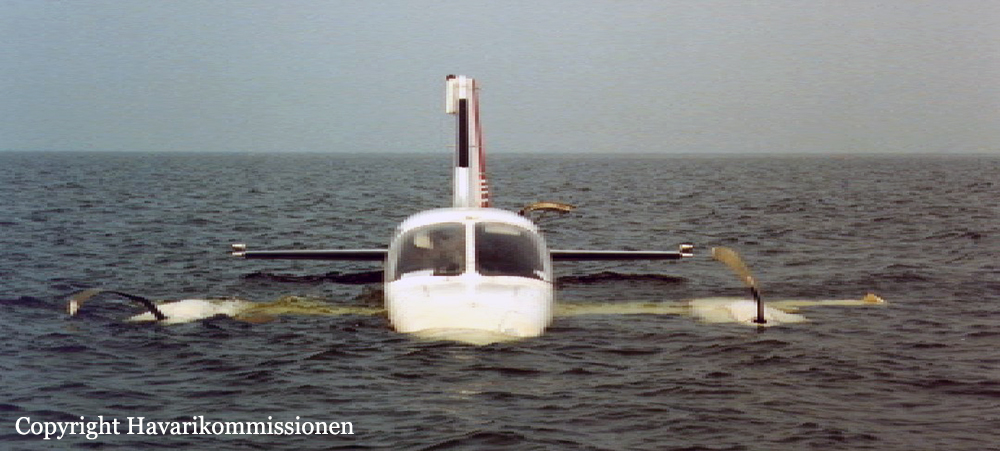
The twin engine aircraft departed Stauning Airport at 0000LT on a cargo flight to Manchester with two pilots on board. Shortly after takeoff from runway 27, while in initial climb by night, the crew declared an emergency after the main cabin door opened. The captain reduced both engines power and the aircraft crash landed on the Klægbanke, less than 4 km from the airport. Both pilots were rescued an hour later (they were uninjured) and the aircraft was damaged beyond repair.
Probable cause:
The main cabin door opened during initial climb because the crew failed to ensure it was properly closed. Investigations reported that the door locking mechanism was not properly adjusted and that the crew did not identify the abnormal situation. The following factors were identified:
- The captain immediately reduced power on both engines when the door opened,
- The captain was not properly trained,
- The operator did not ensure that the crew was qualified and trained to perform this type of flight,
- The crew failed to follow the pre departure checklist,
- The crew's attention was focused on the door that opened at a critical moment of the flight and failed to continue the flight and monitor the various instruments.
Final Report:

Crash of a Cessna 421B Golden Eagle II in North Bend: 2 killed

Date & Time: Mar 8, 1999 at 2145 LT
Operator:
Registration:
N41096
Flight Phase:
Flight Type:
Survivors:
No
Schedule:
North Bend - Aurora
MSN:
421B-0446
YOM:
1973
Crew on board:
1
Crew fatalities:
Pax on board:
1
Pax fatalities:
Other fatalities:
Total fatalities:
2
Captain / Total flying hours:
1200
Captain / Total hours on type:
135.00
Aircraft flight hours:
2342
Circumstances:
Witnesses reported hearing the engines start and shortly thereafter, the airplane taxied to the runway. The pilot then contacted ATC for an IFR clearance. The clearance was given with a short void time. The pilot acknowledged the clearance and began the takeoff ground roll. Witnesses reported that the night-time takeoff roll and engine sound appeared normal. Witnesses near the end of the runway reported that the airplane was observed at about 50 feet above the runway with about 1,000 feet of runway remaining when engine power was reduced on both engines. The airplane was heard to touch down, then engine power was reapplied. Shortly thereafter, the sound of the impact was heard. The airplane collided with the terrain about 600 feet from the end of the runway. During the post-accident inspection of the airplane and engines, no evidence was found to indicate a mechanical failure or malfunction. Documentation of the events indicated that from the time the aircraft began its taxi to the runway, to the time the takeoff roll began, was approximately six minutes in duration. Before the takeoff roll began, the pilot had accepted a clearance with a void time of four minutes. By the time the pilot correctly read back the clearance, less than two minutes remained before the void time. Post accident documentation of the accident site revealed that neither the pilot nor the passenger were wearing their lap belts or shoulder harnesses. It was also noted that the pilot had not yet selected the discrete transponder code as indicated by the clearance.
Probable cause:
A delayed aborted takeoff for an undetermined reason.
Final Report:

Crash of a Cessna 421B Golden Eagle II in Columbus

Date & Time: Aug 6, 1998 at 0450 LT
Registration:
N5MJ
Flight Phase:
Survivors:
Yes
Schedule:
Columbus - Detroit
MSN:
421B-0925
YOM:
1975
Crew on board:
2
Crew fatalities:
Pax on board:
4
Pax fatalities:
Other fatalities:
Total fatalities:
0
Captain / Total flying hours:
2145
Captain / Total hours on type:
594.00
Aircraft flight hours:
6925
Circumstances:
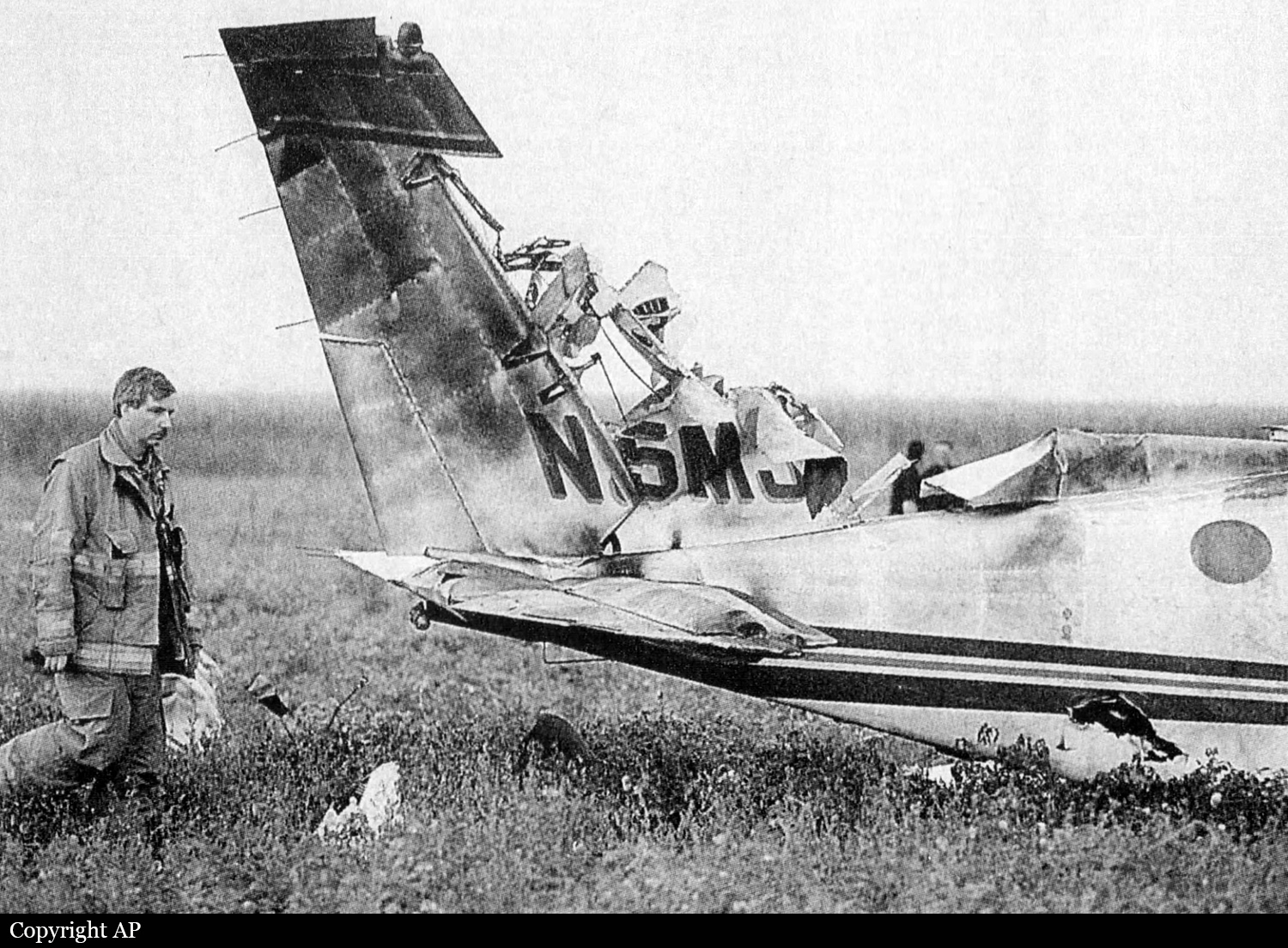
Upon reaching an altitude of 400 agl after takeoff, the left side door on the nose baggage door opened. The pilot-in- command initiated a left turn to return to the airport. During the turn the stall horn sounded. The airplane then descended and impacted the terrain. Investigation revealed that both pilots did a portion of the aircraft preflight inspection. Both pilots were qualified to act as PIC for the flight and this flight would typically have been a single pilot operation. However, the company who hired the operator to transport their employees requested two pilots. The operator did not have any written procedures regarding the division of duties for a two pilot operation on this type of aircraft.
Probable cause:
The pilot-in-commands failure to maintain airspeed and the subsequent stall/mush. Factors associated with the accident were the open baggage door and the inadequate aircraft preflight.
Final Report:

Crash of a Cessna 421B Golden Eagle II in Nassau

Date & Time: May 11, 1998 at 1349 LT
Registration:
N17BN
Survivors:
Yes
Schedule:
Charlotte Amalie – Nassau
MSN:
421B-0396
YOM:
1973
Country:
Crew on board:
1
Crew fatalities:
Pax on board:
2
Pax fatalities:
Other fatalities:
Total fatalities:
0
Circumstances:
On May 11, 1998, about 1349 eastern daylight time, a Cessna 421B, N17BN, registered to Quinn Industries, Inc., operating as a 14 CFR 91 personal flight, crashed into Lake Killarney, New Providence Island, Bahamas, while on approach for landing to Nassau International Airport. Visual meteorological conditions prevailed and no flight plan was filed. The airplane received unknown damage, the pilot suffered serious injuries, and two passengers suffered minor injuries. The flight originated about 26 minutes before the accident. According to initial reports, the flight originated earlier that day from St. Thomas, Virgin Islands, with a stop at Governor's Harbour, Eleuthera, for refueling. Upon landing at Governor's Harbour, the pilot was advised no fuel was available and elected to proceed to Nassau for refueling. Some time during the straight-in approach the pilot transmitted he was "low on fuel", and N17BN crashed about 400 yards short of the runway into a swamp.