Crash of a Learjet 24B in Orlando

Date & Time: May 23, 1998 at 0330 LT
Type of aircraft:
Registration:
N100DL
Flight Type:
Survivors:
Yes
Schedule:
Miami - Orlando
MSN:
24-201
YOM:
1969
Crew on board:
2
Crew fatalities:
Pax on board:
4
Pax fatalities:
Other fatalities:
Total fatalities:
0
Captain / Total flying hours:
18395
Captain / Total hours on type:
318.00
Aircraft flight hours:
8138
Circumstances:
During landing roll, the airplanes normal braking system failed as a result of hydraulic fluid leak(s). At the pilot's request, deployment of the drag chute and application of the emergency braking system was performed by the first officer. According to the first officer, application of the emergency brakes caused the airplane to yaw. The first officer then pulled up on the emergency brakes handle followed by re-application of braking pressure. This action took place several times during the landing roll. Gates' Learjet Flight Training Manual (Page 105) states, 'In using the emergency brake lever, slow steady downward pressure is required. Each time the lever is allowed to return upward to the normal position, nitrogen is evacuated overboard. Brace your hand so you will not allow the lever to move up and down inadvertently on a bumpy runway.' The airplane overran the end of the runway and collided with the Instrument Landing System back course antennae.
Probable cause:
The first officer's failure to perform proper emergency braking procedures.
Final Report:

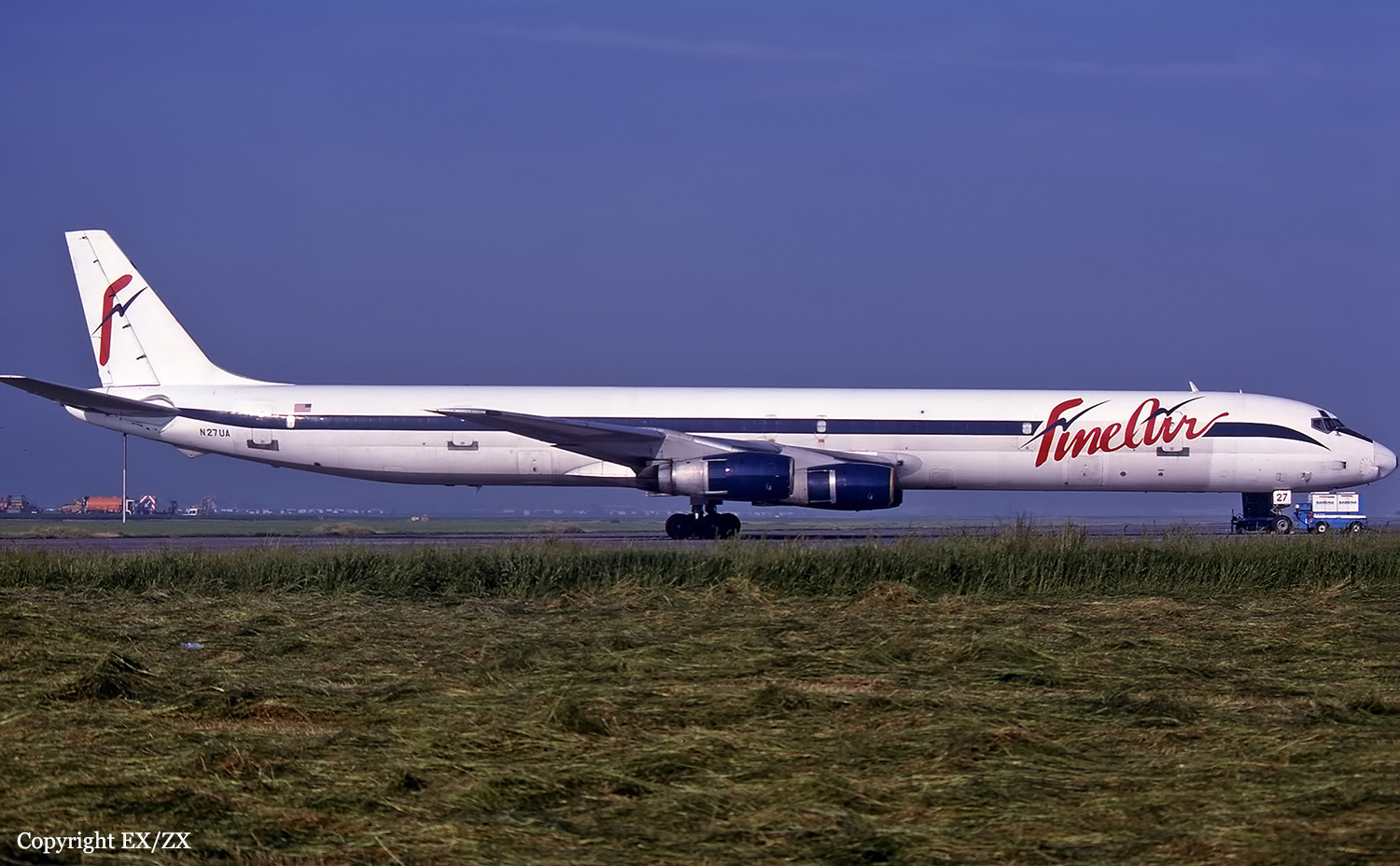
Crash of a Douglas DC-8-61F in Miami: 5 killed

Date & Time: Aug 7, 1997 at 1236 LT
Type of aircraft:
Operator:
Registration:
N27UA
Flight Phase:
Flight Type:
Survivors:
No
Site:
Schedule:
Miami - Santo Domingo
MSN:
45942
YOM:
1968
Flight number:
FB101A
Crew on board:
3
Crew fatalities:
Pax on board:
1
Pax fatalities:
Other fatalities:
Total fatalities:
5
Captain / Total flying hours:
12154
Captain / Total hours on type:
2522.00
Copilot / Total flying hours:
2641
Copilot / Total hours on type:
1592
Aircraft flight hours:
46825
Aircraft flight cycles:
41688
Circumstances:
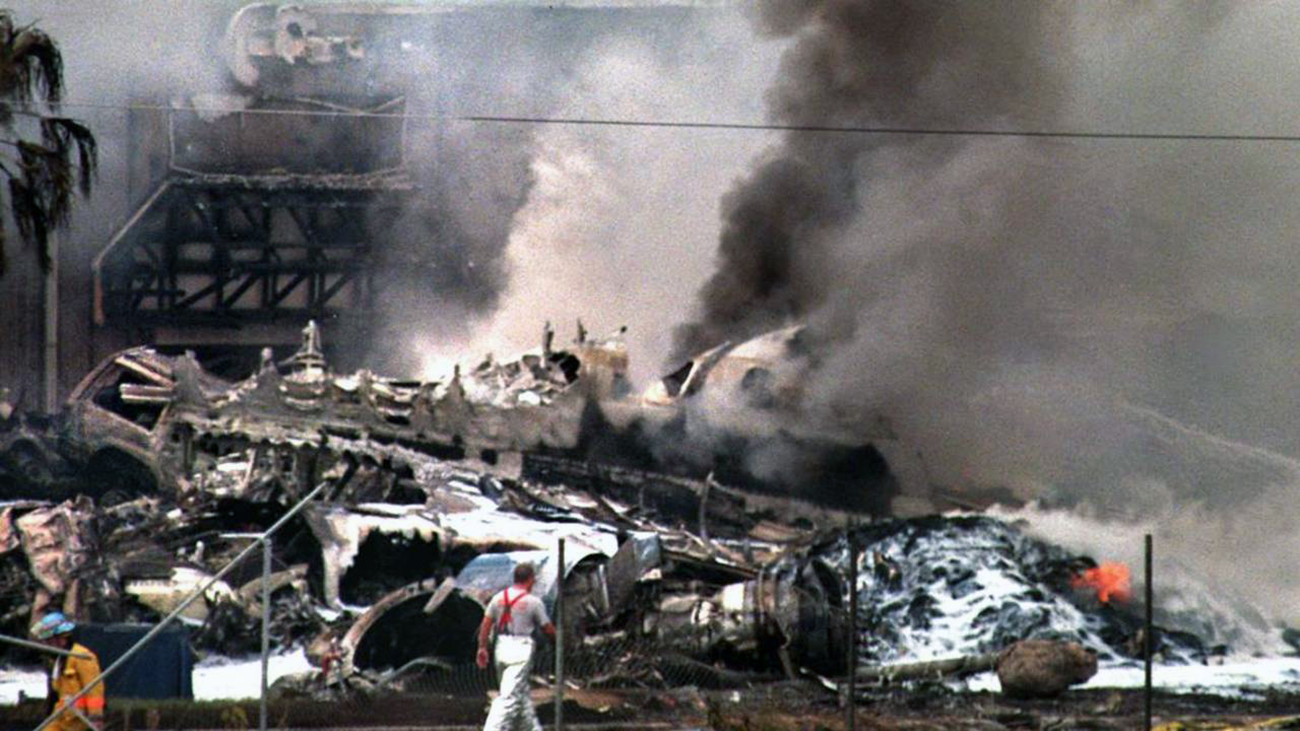
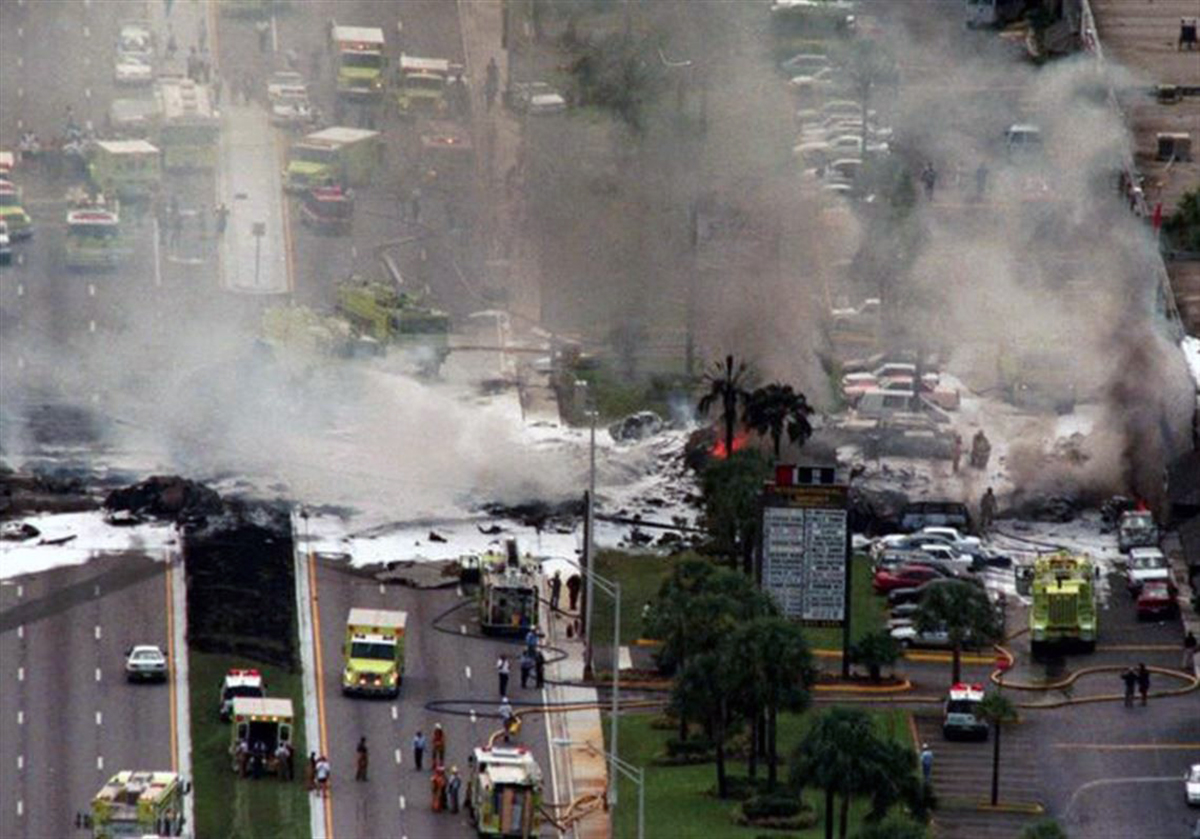
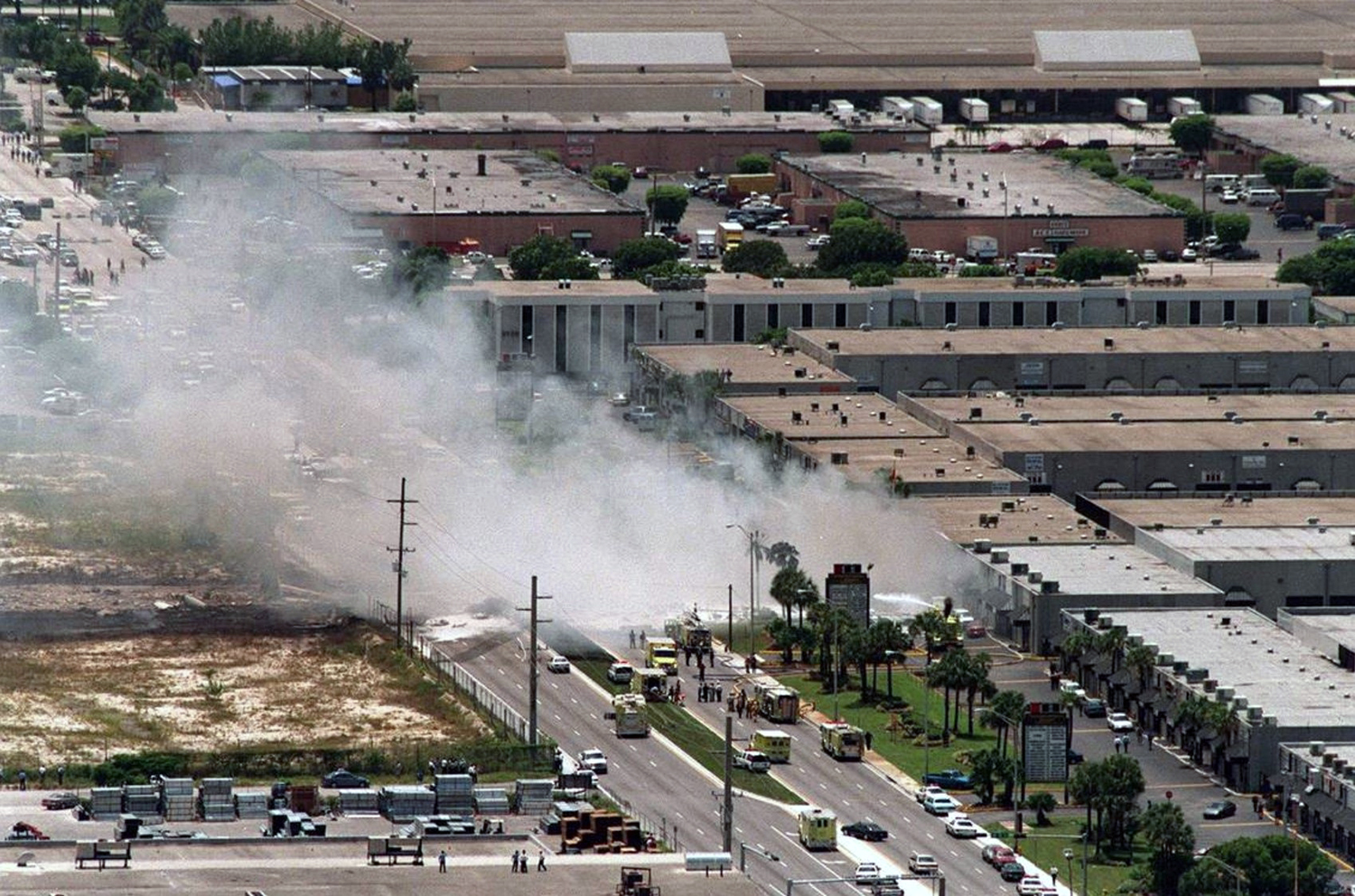
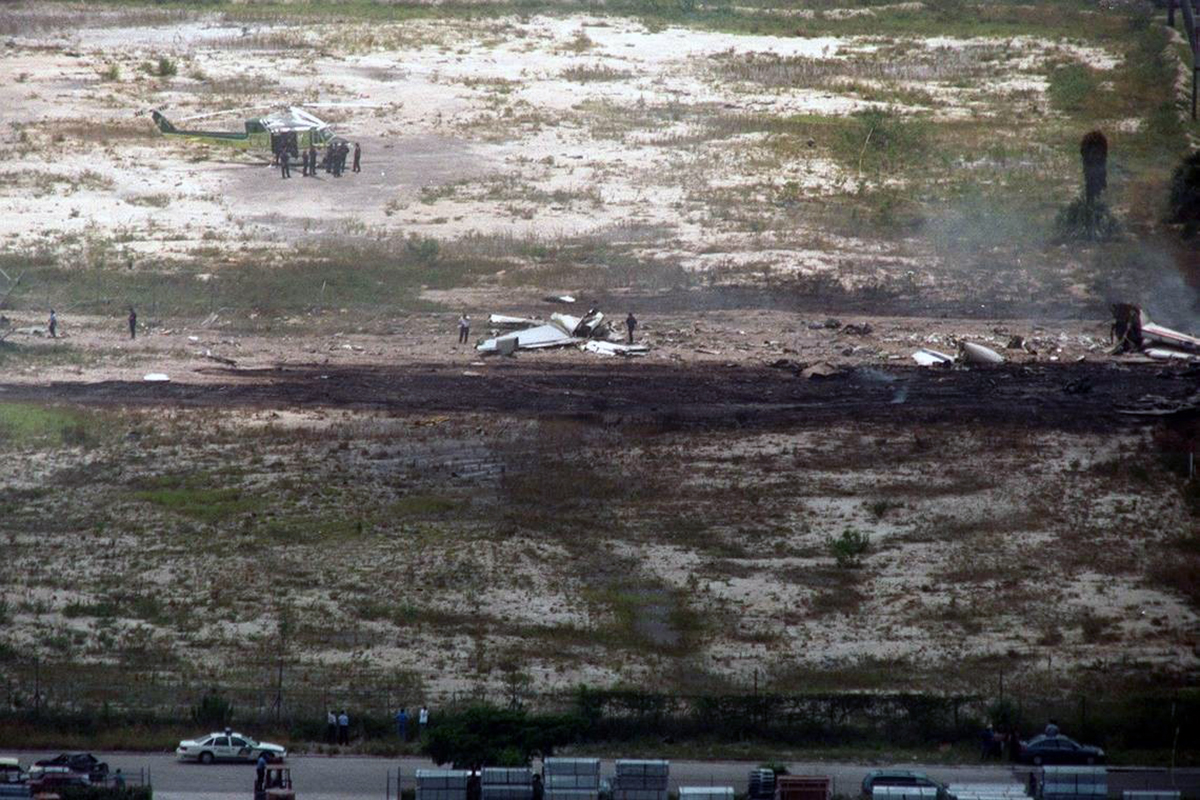
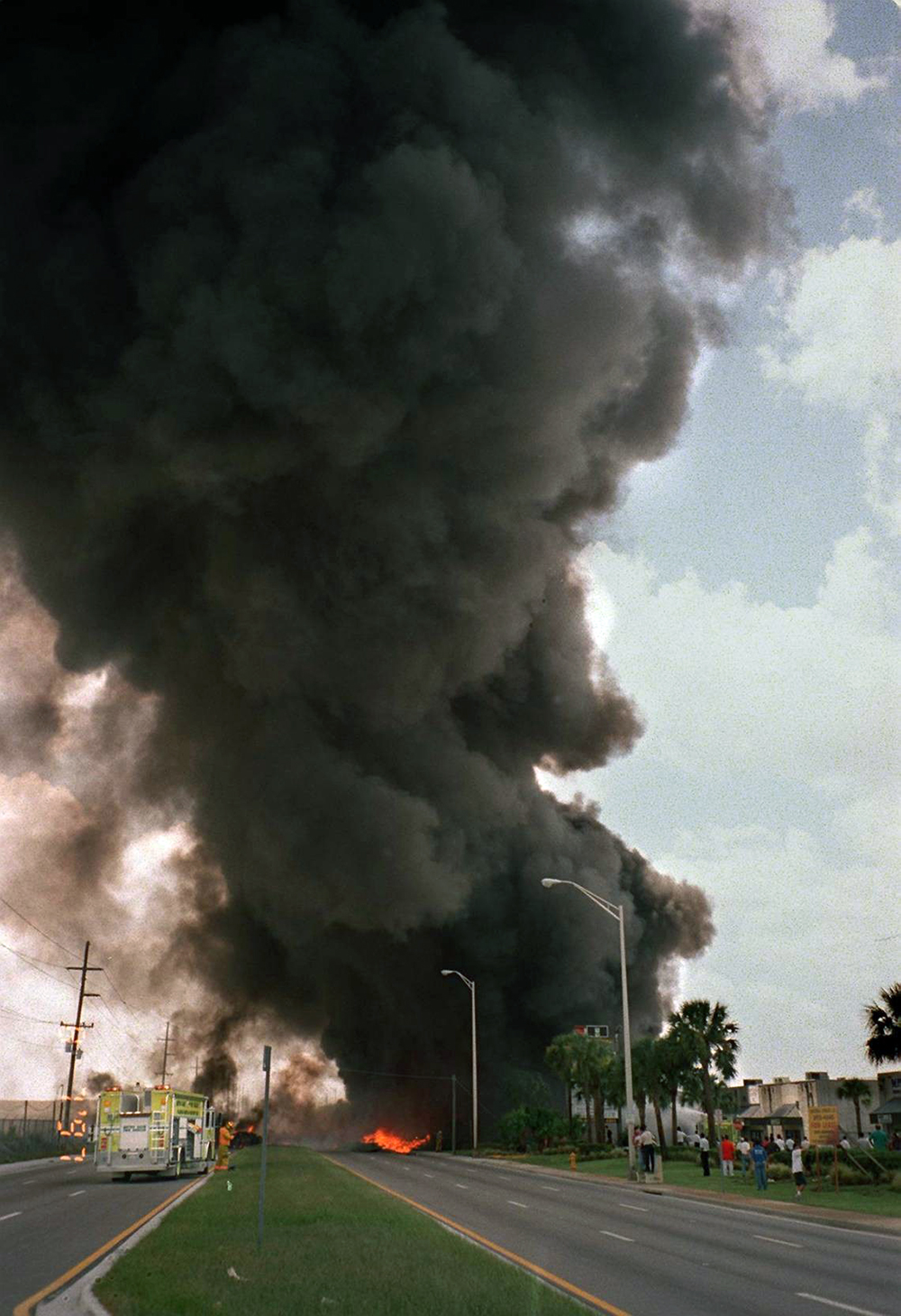
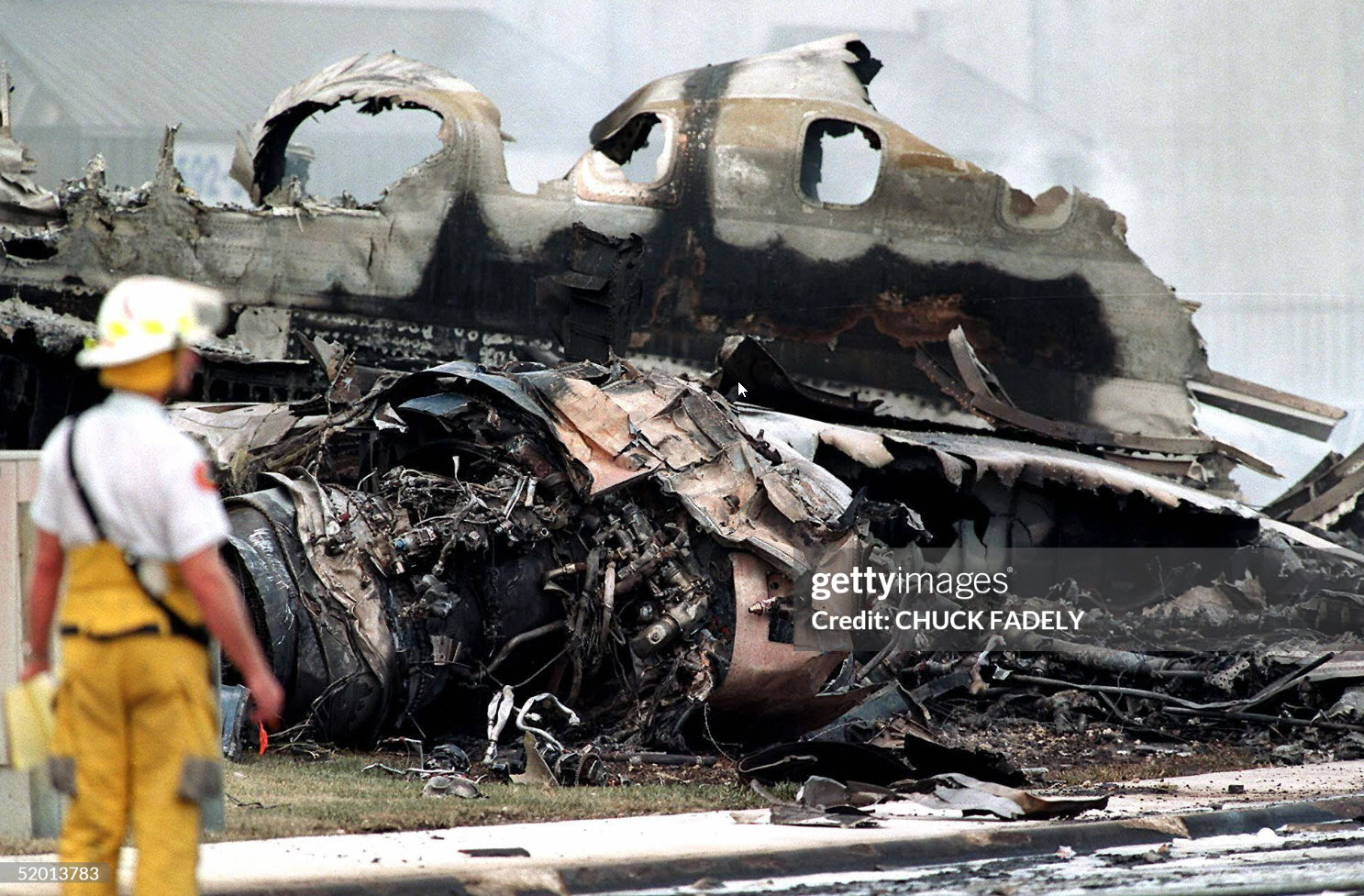
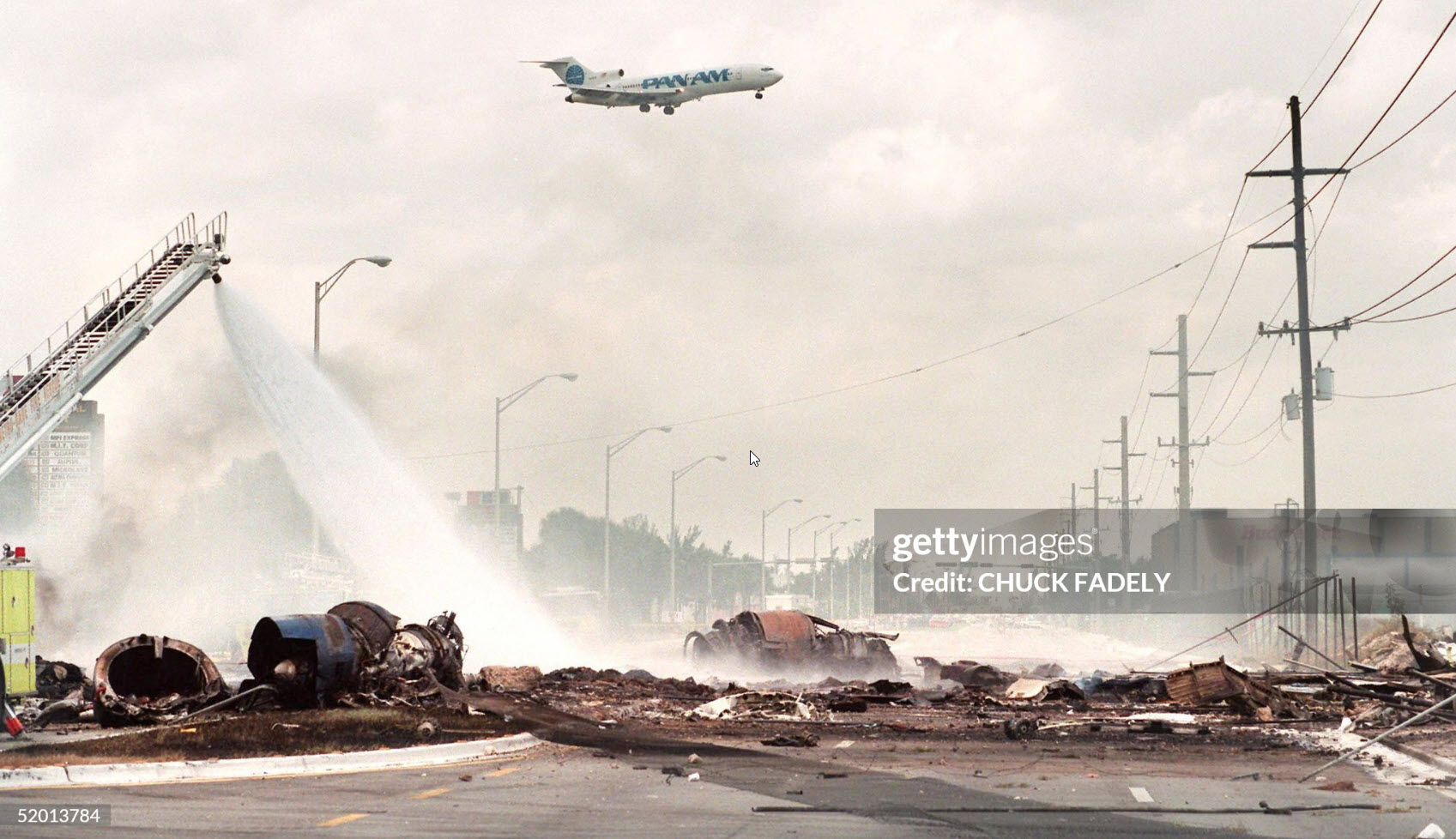
Fine Air Flight 101 was originally scheduled to depart Miami for Santo Domingo at 09:15 using another DC-8 airplane, N30UA, to carry cargo for Aeromar. Due to a delay of the inbound aircraft, Fine Air substituted N27UA for N30UA and rescheduled the departure for 12:00. N27UA arrived at Miami at 09:31 from San Juan, Puerto Rico, and was parked at the Fine Air hangar ramp. The security guard was not aware of the airplane change, and he instructed Aeromar loaders to load the airplane in accordance with the weight distribution form he possessed for N30UA. The first cargo pallet for flight 101 was loaded onto N27UA at 10:30 and the last pallet was loaded at 12:06. The resulting center of gravity (CG) of the accident airplane was near or even aft of the airplane’s aft CG limit. After the three crew members and the security guard had boarded the plane, the cabin door `was closed at 12:22. Eleven minutes later the flight obtained taxi clearance for runway 27R. The Miami tower controller cleared flight 101 for takeoff at 12:34. Takeoff power was selected and the DC-8 moved down the runway. The flightcrew performed an elevator check at 80 knots. Fourteen seconds later the sound of a thump was heard. Just after calling V1 a second thump was heard. Two seconds later the airplane rotated. Immediately after takeoff the airplane pitched nose-up and entered a stall. The DC-8 recovered briefly from the stall, and stalled again. The airplane impacted terrain in a tail first, right wing down attitude. it slid west across a road (72nd Avenue) and into the International Airport Center at 28th Street and burst into flames. Investigation showed that the center of gravity resulted in the airplane’s trim being mis-set by at least 1.5 units airplane nose up, which presented the flightcrew with a pitch control problem on takeoff.
Probable cause:
The probable cause of the accident, which resulted from the airplane being misloaded to produce a more aft center of gravity and a correspondingly incorrect stabilizer trim setting that precipitated an extreme pitch-up at rotation, was
1) The failure of Fine Air to exercise operational control over the cargo loading process; and
2) The failure of Aeromar to load the airplane as specified by Fine Air.
Contributing to the accident was the failure of the FAA to adequately monitor Fine Airs operational control responsibilities for cargo loading and the failure of the FAA to ensure that known cargo-related deficiencies were corrected at Fine Air.
Final Report:

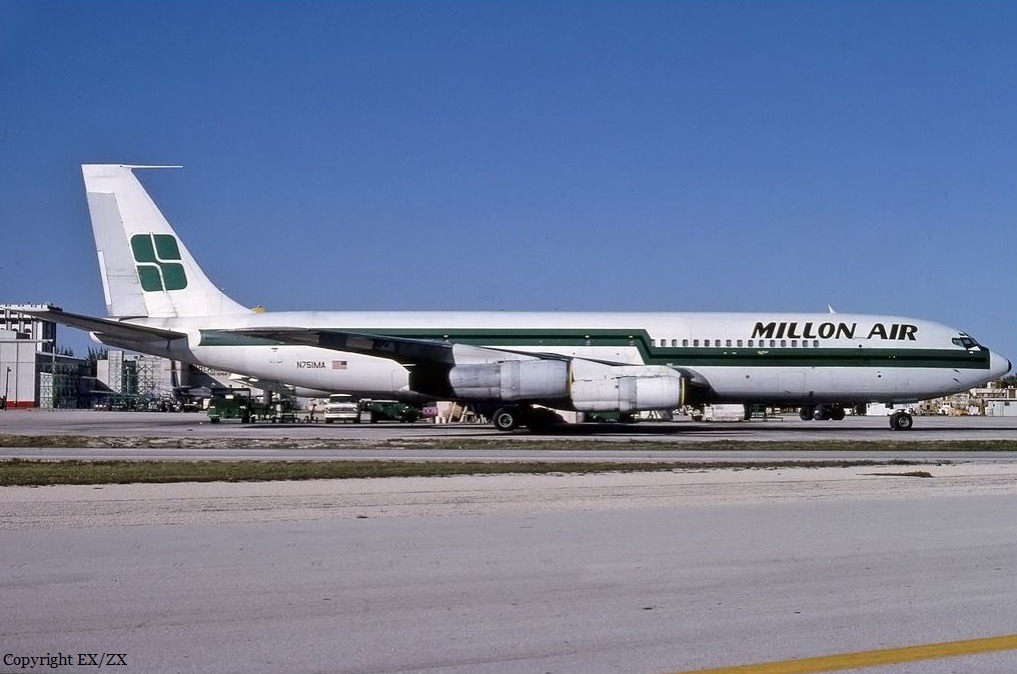
Crash of a Boeing 707-323C in Manta: 34 killed

Date & Time: Oct 22, 1996 at 2244 LT
Type of aircraft:
Operator:
Registration:
N751MA
Flight Phase:
Flight Type:
Survivors:
No
Site:
Schedule:
Manta - Miami
MSN:
19582
YOM:
1967
Flight number:
OX406
Country:
Crew on board:
4
Crew fatalities:
Pax on board:
0
Pax fatalities:
Other fatalities:
Total fatalities:
34
Circumstances:
The aircraft departed Manta-Eloy Alfaro Airport on a cargo flight to Miami, carrying one passenger, three crew members and a load of frozen fish and flowers. Seven seconds after liftoff, while in initial climb, the crew informed ATC that the engine n°3 caught fire. The captain elected to maintain control but the aircraft lost altitude, struck the bell tower of the church La Dolorosa and crashed in a populated area located about 4 km west of the airport. The aircraft disintegrated on impact and several houses and building were destroyed. All four occupants as well as 30 people on the ground were killed. Fifty other people on the ground were seriously injured.
Probable cause:
It was reported that the engine n°3 suffered an uncontained failure during the takeoff roll as debris were found on runway 23.

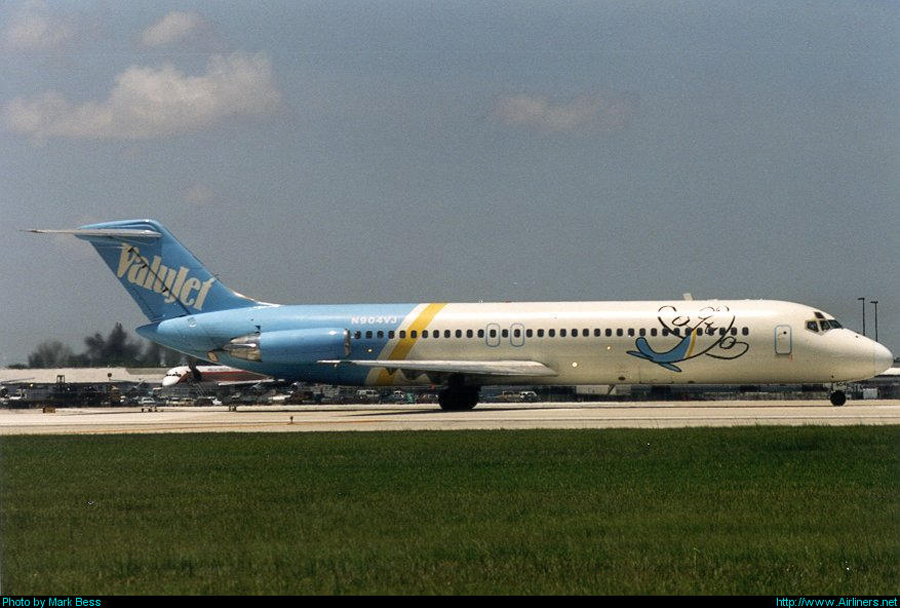
Crash of a Douglas DC-9-32 in the Everglades National Park: 110 killed

Date & Time: May 11, 1996 at 1413 LT
Type of aircraft:
Operator:
Registration:
N904VJ
Flight Phase:
Survivors:
No
Schedule:
Miami - Atlanta
MSN:
47377
YOM:
1969
Flight number:
VJA592
Crew on board:
5
Crew fatalities:
Pax on board:
105
Pax fatalities:
Other fatalities:
Total fatalities:
110
Captain / Total flying hours:
8928
Captain / Total hours on type:
2116.00
Copilot / Total flying hours:
6448
Copilot / Total hours on type:
2148
Aircraft flight hours:
68395
Aircraft flight cycles:
80663
Circumstances:
ValuJet Flight 592 was a scheduled flight from Miami (MIA) to Atlanta (ATL). The inbound flight had been delayed and arrived at Miami at 13:10. Flight 592 had been scheduled to depart at 13:00. The cruising altitude was to be flight level 350 with an estimated time en route of 1 hour 32 minutes. The DC-9 was loaded with 4,109 pounds of cargo (baggage, mail, and company-owned material (COMAT)). The COMAT consisted of two main tires and wheels, a nose tire and wheel, and five boxes that were described as "Oxy Cannisters -‘Empty.’" This cargo was loaded in the forward cargo compartment. Flight 592 was pushed back from the gate shortly before 13:40. The DC-9 then taxied to runway 09L. At 14:03:24, ATC cleared the flight for takeoff and the flightcrew acknowledged the clearance. At 14:04:24, the flightcrew was instructed by ATC to contact the north departure controller. At 1404:32, the first officer made initial radio contact with the departure controller, advising that the airplane was climbing to 5,000 feet. Four seconds later, the departure controller advised flight 592 to climb and maintain 7,000 feet. The first officer acknowledged the transmission. At 14:07:22, the departure controller instructed flight 592 to "turn left heading three zero zero join the WINCO transition climb and maintain one six thousand," which was acknowledged. At 14:10:03, the flight crew heard a sound, after which the captain remarked, "What was that?" At that moment, the airplane was at 10,634 feet msl, 260 knots indicated airspeed (KIAS), and both engine pressure ratios (EPRs) were 1.84. At 14:10:15, the captain stated, "We got some electrical problem," followed 5 seconds later with, "We’re losing everything." At 14:10:21, the departure controller advised flight 592 to contact Miami on frequency 132.45 mHz. At 14:10:22, the captain stated, "We need, we need to go back to Miami," followed 3 seconds later by shouts in the background of "fire, fire, fire, fire." At 14:10:27, the CVR recorded a male voice saying, "We’re on fire, we’re on fire." At 14:10:28, the controller again instructed flight 592 to contact Miami Center. At 14:10:31, the first officer radioed that the flight needed an immediate return to Miami. The controller replied, "Critter five ninety two uh roger turn left heading two seven zero descend and maintain seven thousand." The first officer acknowledged the heading and altitude. The peak altitude reached was 10,879 feet msl at 14:10:31, and about 10 seconds a wings-level descent started. Shouting in the cabin subsided. The controller then queried flight 592 about the nature of the problem. The captain stated "fire" and the first officer replied, "uh smoke in the cockp... smoke in the cabin." The controller responded, "roger" and instructed flight 592, when able, to turn left to a heading of two five zero and to descend and maintain 5,000 feet. At 14:11:12, a flight attendant was heard shouting, "completely on fire." The DC-9 began to change heading to a southerly direction and at 14:11:26, the north departure controller advised the controller at Miami Center that flight 592 was returning to Miami with an emergency. At 14:11:37, the first officer transmitted that they needed the closest available airport. At 1411:41, the controller replied, "Critter five ninety two they’re gonna be standing (unintelligible) standing by for you, you can plan runway one two when able direct to Dolphin [a navaid] now." At 14:11:46, the first officer responded that the flight needed radar vectors. At 14:11:49, the controller instructed flight 592 to turn left heading one four zero. The first officer acknowledged the transmission. At 14:12:45, the controller transmitted, "Critter five ninety two keep the turn around heading uh one two zero." There was no response from the flightcrew. The last recorded FDR data showed the airplane at 7,200 feet msl, at a speed of 260 KIAS, and on a heading of 218 degrees. At 14:12:48, the FDR stopped recording data. The airplane’s radar transponder continued to function; thus, airplane position and altitude data were recorded by ATC after the FDR stopped. At 14:13:18, the departure controller instructed, "Critter five ninety two you can uh turn left heading one zero zero and join the runway one two localizer at Miami." Again there was no response. At 14:13:27, the controller instructed flight 592 to descend and maintain 3,000 feet. At 1413:37, an unintelligible transmission was intermingled with a transmission from another airplane. No further radio transmissions were received from flight 592. At 14:13:43, the departure controller advised flight 592, "Opa Locka airport’s about 12 o’clock at 15 miles." The accident occurred at 14:13:42. Ground scars and wreckage scatter indicated that the airplane crashed into the Everglades in a right wing down, nose down attitude.
Probable cause:
The National Transportation Safety Board determines that the probable causes of the accident, resulting in a fire in the Class D cargo compartment from the actuation of one or more oxygen generators improperly carried as cargo, were: (1) the failure of SabreTech to properly prepare, package, identify, and track unexpended chemical oxygen generators before presenting them to ValuJet for carriage; (2) the failure of ValuJet to properly oversee its contract maintenance program to ensure compliance with maintenance, maintenance training, and hazardous materials requirements and practices; and (3) the failure of Federal Aviation Administration (FAA) to require smoke detection and fire suppression systems in Class D cargo compartments. Contributing to the accident was the failure of the FAA to adequately monitor ValuJet's heavy maintenance program and responsibilities, including ValuJet's oversight of its contractors, and Sabre Tech's repair station certificate; the failure of the FAA to adequately respond to prior chemical oxygen generator fires with programs to address the potential hazards; and the failure of ValuJet to ensure that both ValuJet and contract maintenance employees were aware of the carrier's no-carry hazardous materials policy and had received appropriate hazardous materials training." (NTSB/AAR-97/06)
Final Report:

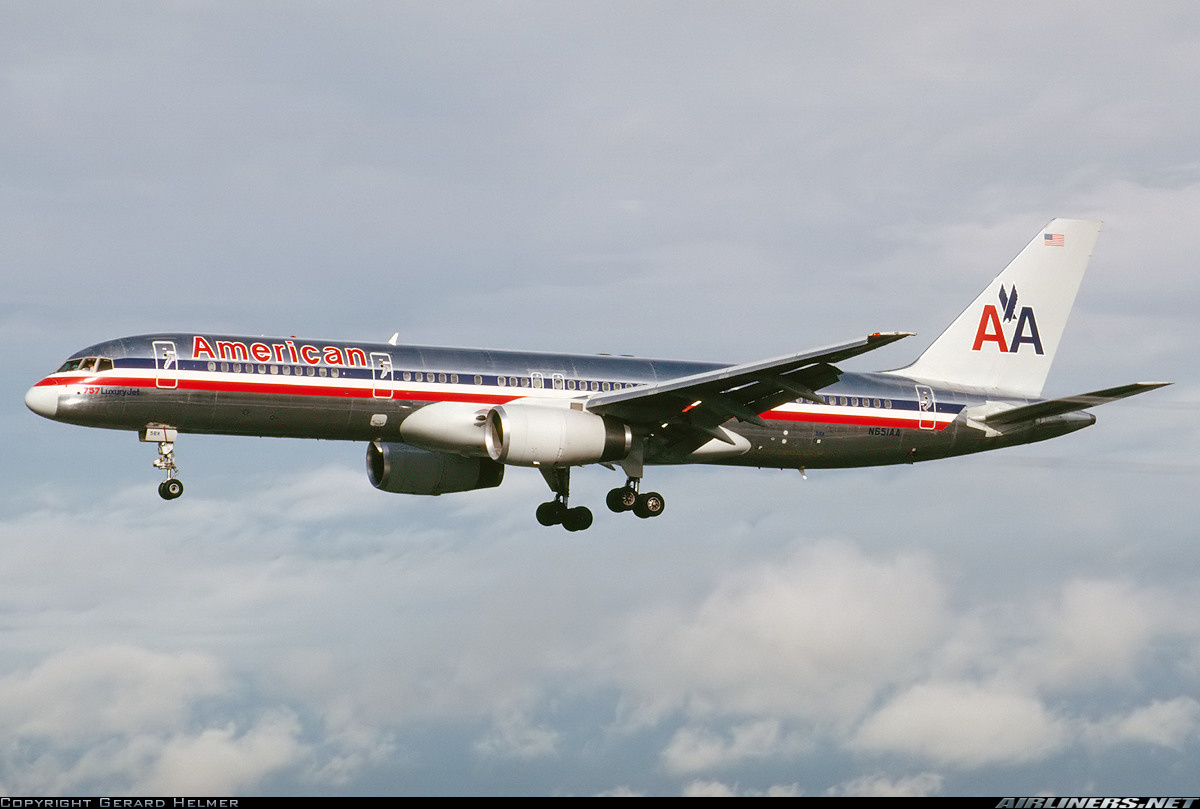
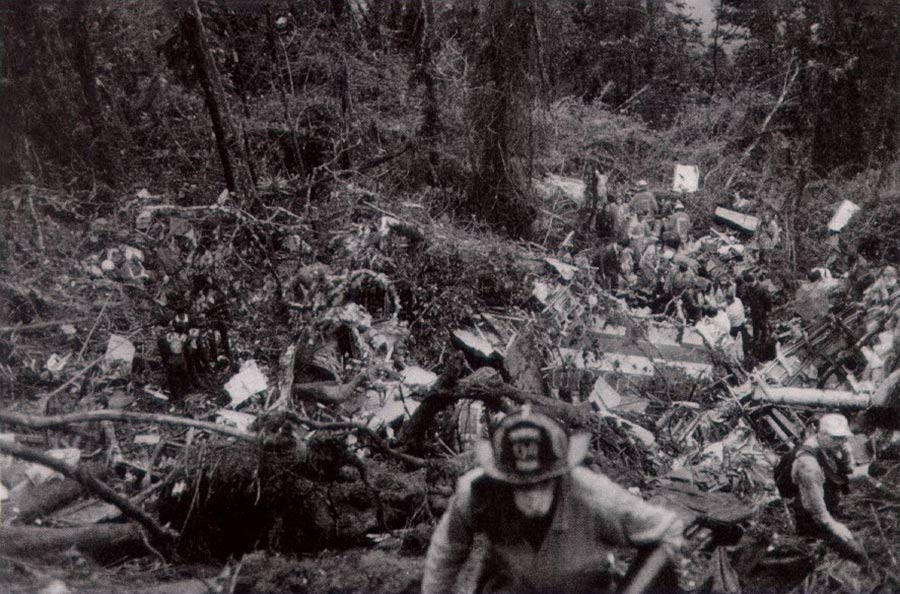
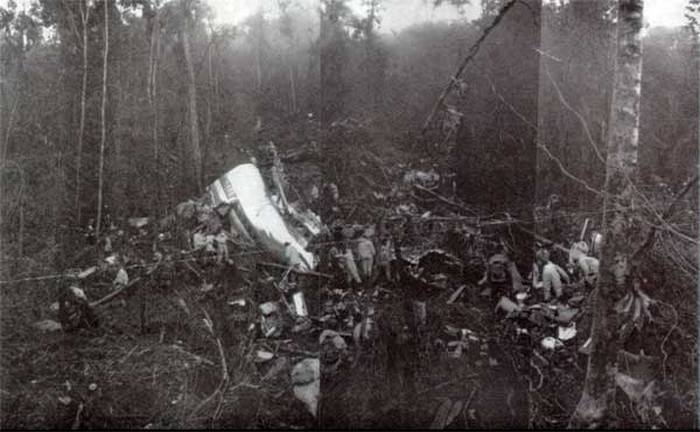
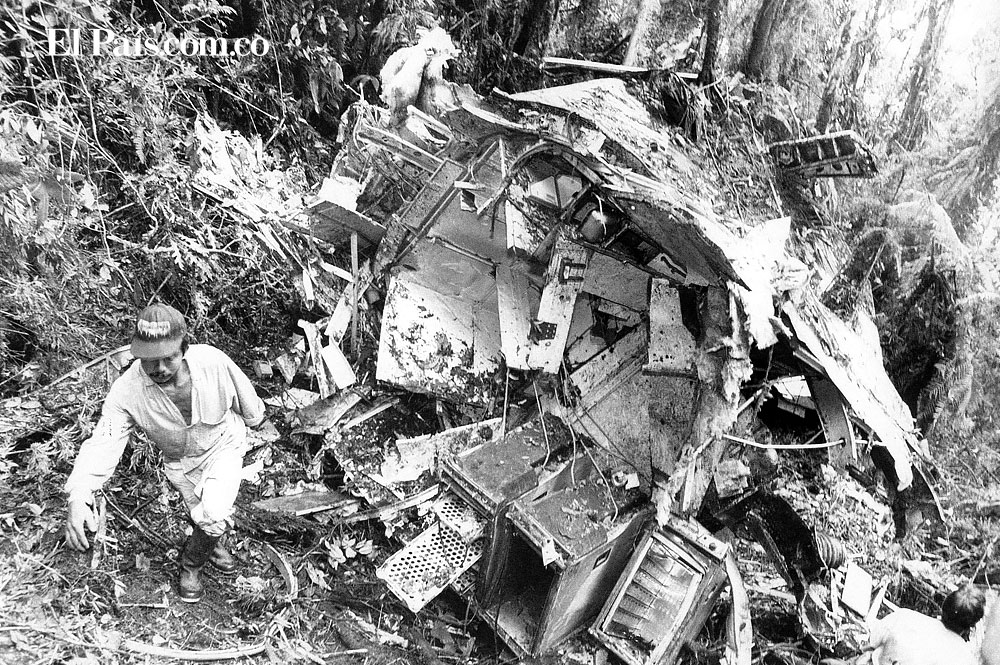
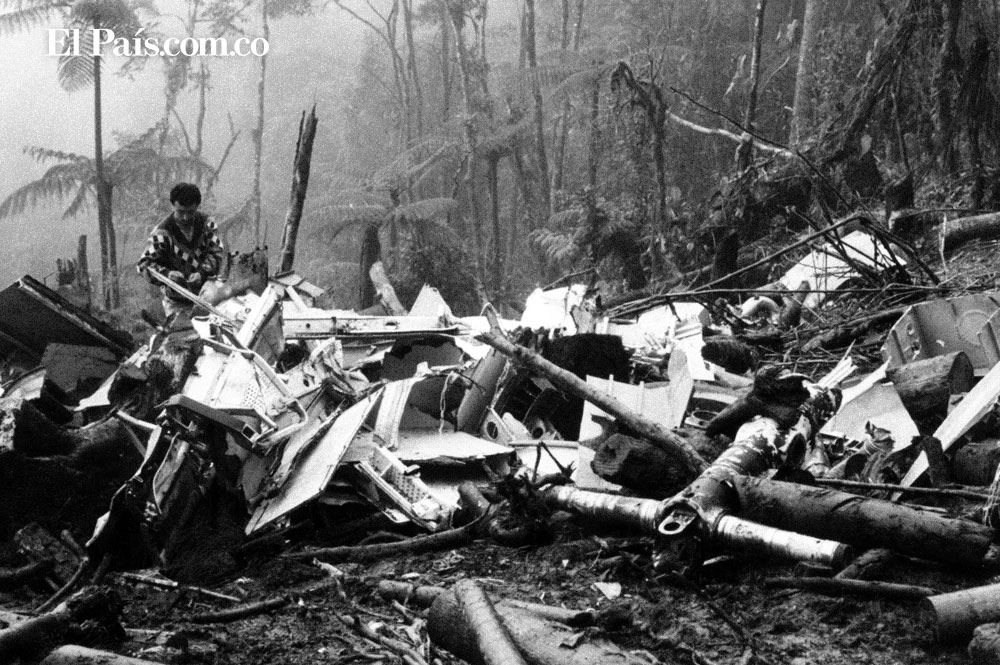
Crash of a Boeing 757-223 near Buga: 159 killed

Date & Time: Dec 20, 1995 at 2138 LT
Type of aircraft:
Operator:
Registration:
N651AA
Flight Phase:
Survivors:
Yes
Site:
Schedule:
Miami - Cali
MSN:
24609
YOM:
1991
Flight number:
AA965
Country:
Crew on board:
8
Crew fatalities:
Pax on board:
155
Pax fatalities:
Other fatalities:
Total fatalities:
159
Captain / Total flying hours:
13000
Captain / Total hours on type:
2260.00
Copilot / Total flying hours:
5800
Copilot / Total hours on type:
2286
Aircraft flight hours:
13782
Aircraft flight cycles:
4922
Circumstances:
At about 18:34 EST, American Airlines Flight 965 took off from Miami for a flight to Cali. At 21:34, while descending to FL200, the crew contacted Cali Approach. The aircraft was 63 nm out of Cali VOR (which is 8nm South of the airport) at the time. Cali cleared the flight for a direct Cali VOR approach and report at Tulua VOR. Followed one minute later by a clearance for a straight in VOR DME approach to runway 19 (the Rozo 1 arrival). The crew then tried to select the Rozo NDB (Non Directional Beacon) on the Flight Management Computer (FMC). Because their Jeppesen approach plates showed 'R' as the code for Rozo, the crew selected this option. But 'R' in the FMC database meant Romeo. Romeo is a navaid 150nm from Rozo, but has the same frequency. The aircraft had just passed Tulua VOR when it started a turn to the left (towards Romeo). This turn caused some confusion in the cockpit since Rozo 1 was to be a straight in approach. 87 Seconds after commencing the turn, the crew activated Heading Select (HDG SEL), which disengaged LNAV and started a right turn. The left turn brought the B757 over mountainous terrain, so a Ground Proximity (GPWS) warning sounded. With increased engine power and nose-up the crew tried to climb. The spoilers were still activated however. The stick shaker then activated and the aircraft crashed into a mountain at about 8900 feet (Cali field elevation being 3153 feet).
Probable cause:
The accident was the consequence of the combination of the following factors:
1. The flightcrew's failure to adequately plan and execute the approach to runway 19 at SKCL and their inadequate use of automation.
2. Failure of the flightcrew to discontinue the approach into Cali, despite numerous cues alerting them of the inadvisability of continuing the approach.
3. The lack of situational awareness of the flightcrew regarding vertical navigation, proximity to terrain, and the relative location of critical radio aids.
4. Failure of the flightcrew to revert to basic radio navigation at the time when the FMS-assisted navigation became confusing and demanded an excessive workload in a critical phase of the flight.
Final Report:

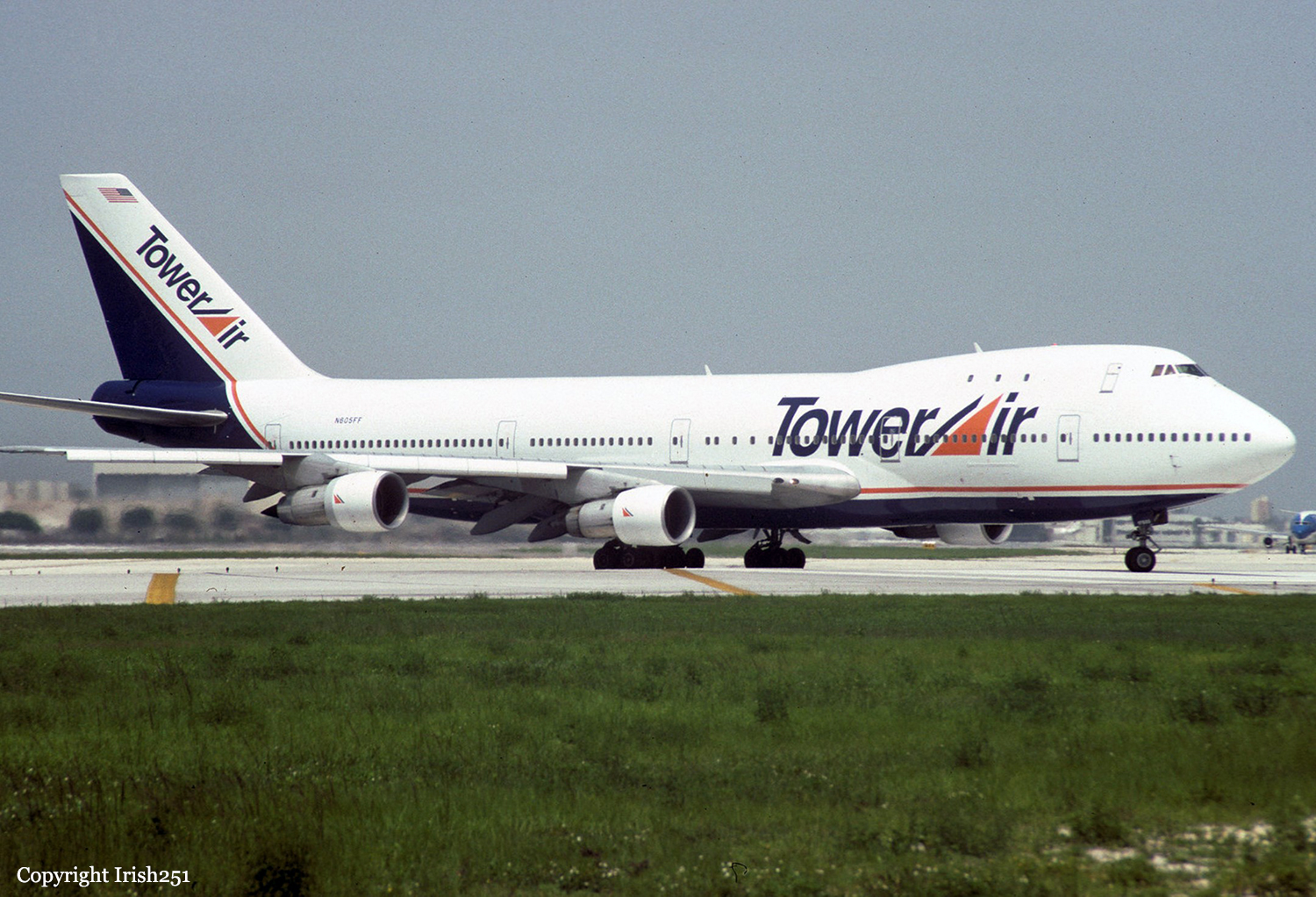
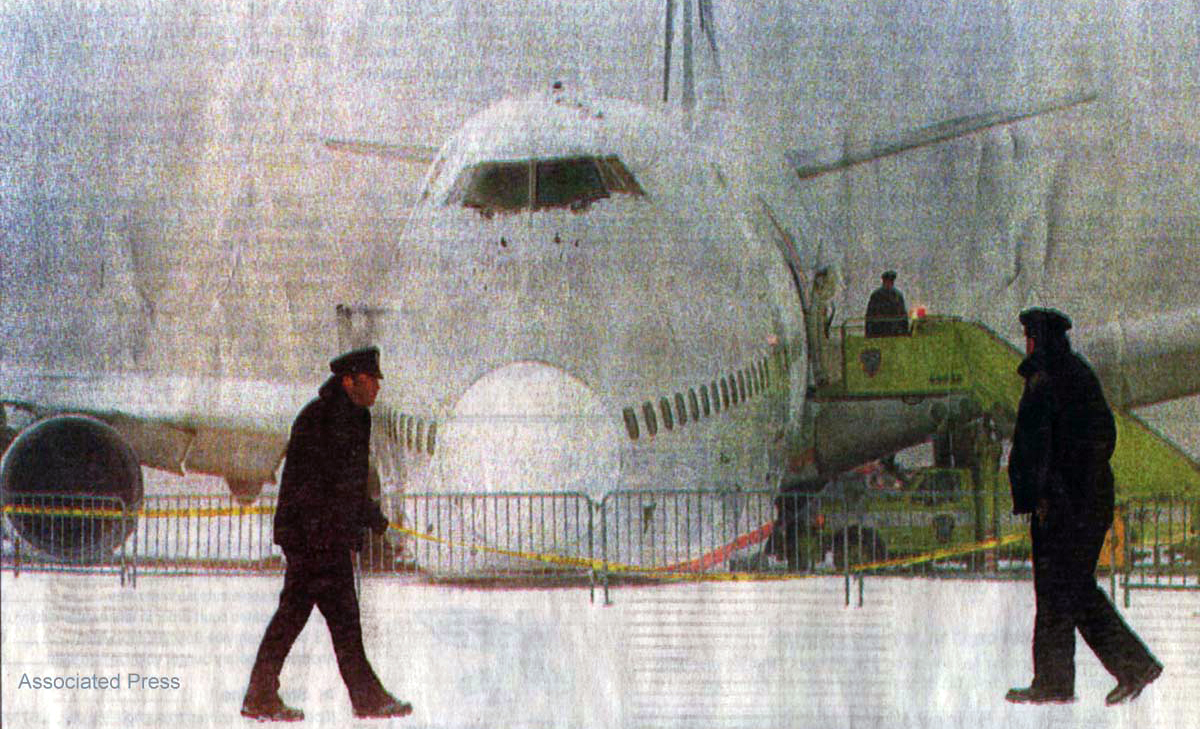
Crash of a Boeing 747-136 in New York

Date & Time: Dec 20, 1995 at 1136 LT
Type of aircraft:
Operator:
Registration:
N605FF
Flight Phase:
Survivors:
Yes
Schedule:
New York - Miami
MSN:
20271
YOM:
1971
Flight number:
FF041
Crew on board:
17
Crew fatalities:
Pax on board:
451
Pax fatalities:
Other fatalities:
Total fatalities:
0
Captain / Total flying hours:
16455
Captain / Total hours on type:
2905.00
Copilot / Total flying hours:
17734
Copilot / Total hours on type:
4804
Aircraft flight hours:
90456
Aircraft flight cycles:
17726
Circumstances:
The captain initiated a takeoff on runway 04L, which was covered with patches of ice and snow. The wind was from 330 degrees at 11 knots. Before receiving an 80-knot call from the 1st officer, the airplane began to veer to the left. Subsequently, it went off the left side of the runway and collided with signs and an electric transformer. Investigation revealed evidence that the captain had overcontrolled the nosewheel steering through the tiller, then applied insufficient or untimely right rudder inputs to effect a recovery. The captain abandoned an attempt to reject the takeoff, at least temporarily, by restoring forward thrust before the airplane departed the runway. The current Boeing 747 operating procedures provide inadequate guidance to flightcrews regarding the potential for loss of directional control at low speeds on slippery runways with the use of the tiller. Current Boeing 747 flight manual guidance was inadequate about when a pilot should reject a takeoff following some indication of a lack of directional control response. Improvements in the slippery runway handling fidelity of flight simulators used for Boeing 747 pilot training were considered to be both needed and feasible.
Probable cause:
The captain's failure to reject the takeoff in a timely manner when excessive nosewheel steering tiller inputs resulted in a loss of directional control on a slippery runway. Inadequate Boeing 747 slippery runway operating procedures developed by Tower Air, Inc., and the Boeing Commercial Airplane Group and the inadequate fidelity of B-747 flight training simulators for slippery runway operations contributed to the cause of this accident. The captain's reapplication of forward thrust before the airplane departed the left side of the runway contributed to the severity of the runway excursion and damage to the airplane.
Final Report:

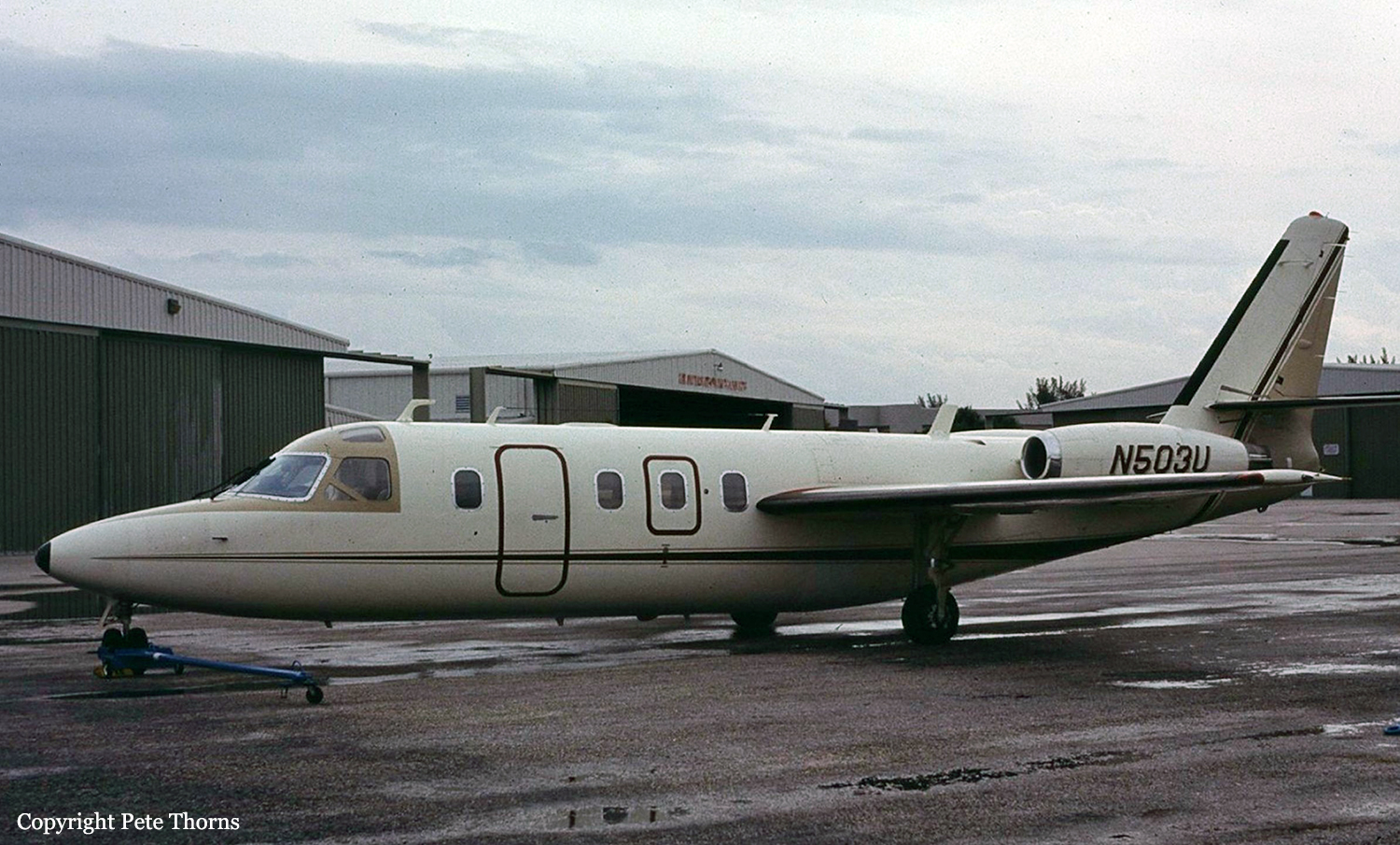
Crash of a Rockwell 1121 Jet Commander near Guatemala City: 2 killed

Date & Time: Dec 14, 1995 at 0014 LT
Registration:
N503U
Flight Type:
Survivors:
No
Site:
Schedule:
Miami - Guatemala City
MSN:
1121-083
YOM:
1966
Country:
Crew on board:
2
Crew fatalities:
Pax on board:
0
Pax fatalities:
Other fatalities:
Total fatalities:
2
Circumstances:
On December 14, 1995, about 0014 central standard time N503U, an Aero Commander 1121, operated by American Air Network crashed about 10 miles North of Guatemala City, Guatemala, while on a 14 CFR Part 135 on-demand, international, cargo flight. Instrument meteorological conditions prevailed at the time and an IFR flight plan was filed. The airplane was destroyed and the pilot and co-pilot received fatal injuries. The flight had originated from Miami, Florida about 2200 the previous day. The crew executed three instrument approaches to the Guatemala City Airport, and reported to controllers on duty that they were low on fuel and could not proceed to their alternate airport.