Crash of an Avro 652 Anson T.21 at RAF Leeming

Date & Time: Sep 23, 1959
Type of aircraft:
Operator:
Registration:
WJ514
Flight Type:
Survivors:
Yes
Schedule:
Binbrook - Leeming
Region:
Crew on board:
2
Crew fatalities:
Pax on board:
0
Pax fatalities:
Other fatalities:
Total fatalities:
0
Circumstances:
The crew was performing a training flight from RAF Binbrook to RAF Leeming. On touchdown, the tail wheel detached. The airplane swung on runway and went out of control before coming to rest. While both crew members were uninjured, the airplane was considered as damaged beyond repair. Strong cross winds were blowing at the time of the accident.

Crash of a Vickers 607 Valetta T.4 at RAF Leeming

Date & Time: Aug 6, 1958
Type of aircraft:
Operator:
Registration:
WJ467
Flight Phase:
Flight Type:
Survivors:
Yes
Schedule:
Leeming - Leeming
MSN:
592
YOM:
1952
Region:
Crew on board:
3
Crew fatalities:
Pax on board:
0
Pax fatalities:
Other fatalities:
Total fatalities:
0
Circumstances:
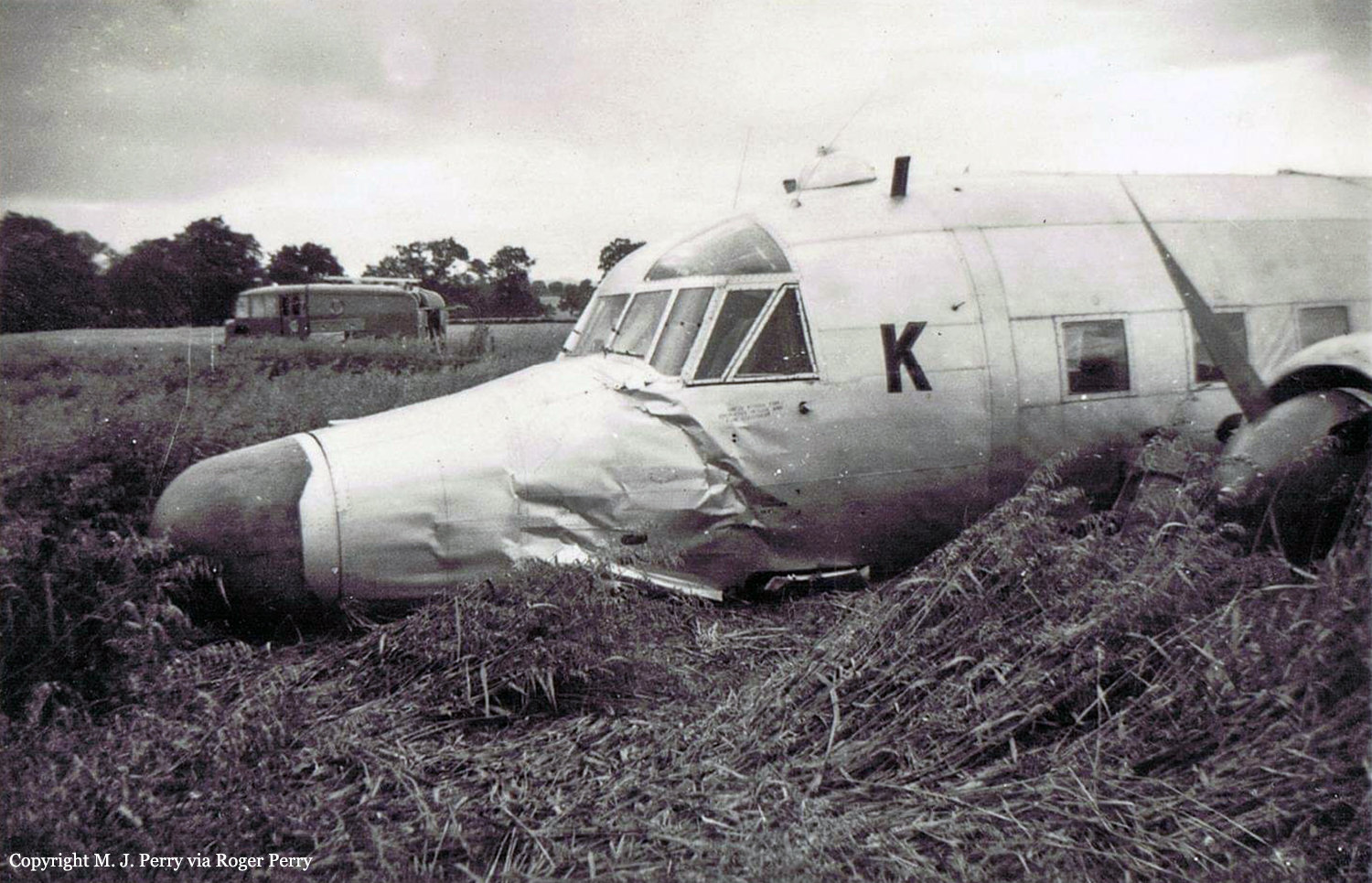
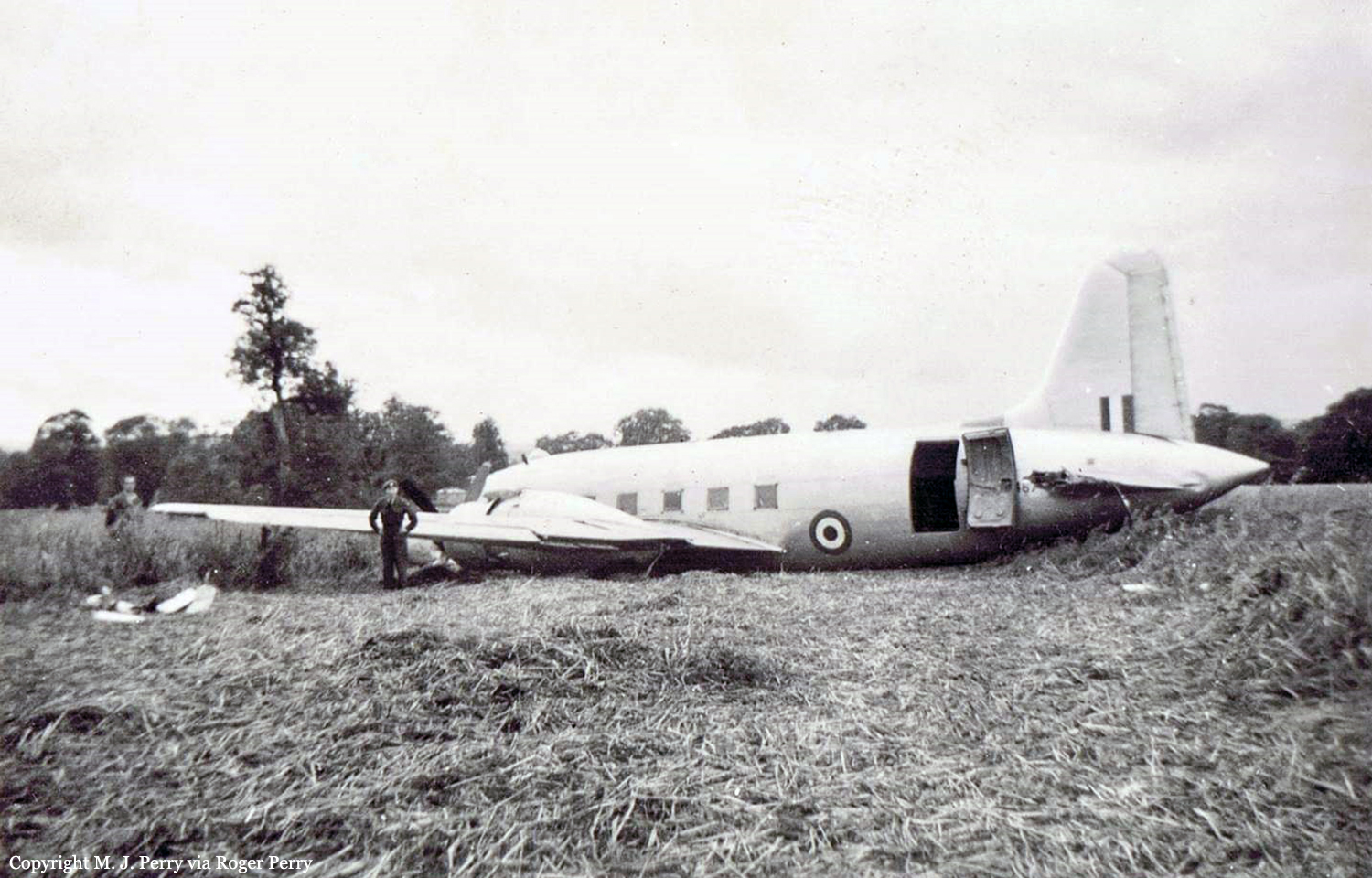
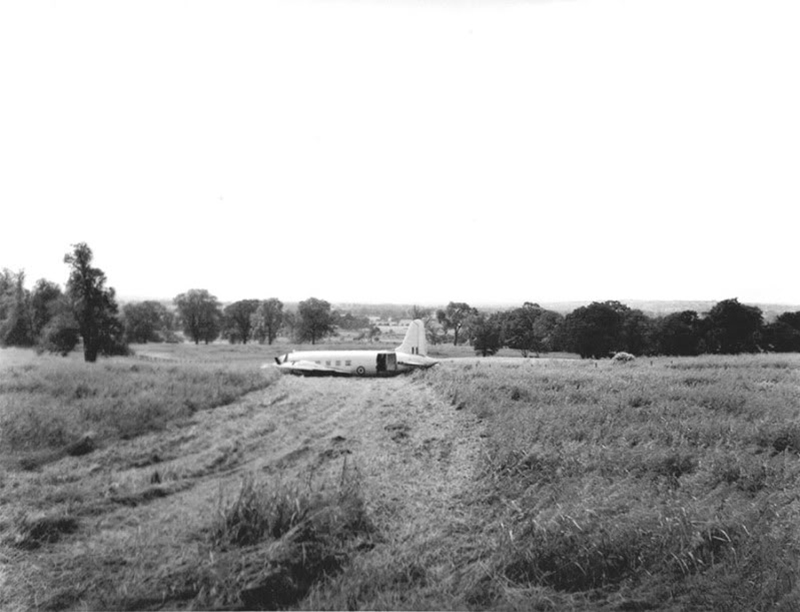
The crew was engaged in a local training flight at RAF Leeming and was completing local single engine circuits and bumps. After takeoff, the operating engine failed. The airplane lost speed and height and belly landed in a cornfield located at Holtby Hall next to the A1, about 3 miles north of the airbase. All three crew members were unhurt while the aircraft was damaged beyond repair. Pilot was Sgt M. J. Perry. Thanks to his son Roger Perry for the photos.
Probable cause:
Engine failure after takeoff while the aircraft was operated on single engine configuration. The cause of the engine failure remains unknown.

Crash of a Vickers 490 Wellington XVIII in Hudswell: 6 killed

Date & Time: Aug 13, 1951
Operator:
Registration:
PG367
Flight Phase:
Flight Type:
Survivors:
Yes
Schedule:
Leeming - Leeming
Region:
Crew on board:
7
Crew fatalities:
Pax on board:
0
Pax fatalities:
Other fatalities:
Total fatalities:
6
Circumstances:
At the time of the accident RAF Leeming was using the Martinet aircraft as a target aircraft for crews training in the use of the interception radar flying in larger bomber-aircraft. In the Wellington on this day were Cadets from 1869 (Middlesbrough) Squadron ATC who were visiting Leeming in August 1951 during their summer camp and the boys were being given flights in both aircraft to demonstrate such techniques done in the RAF's training role. In the mid-afternoon of 13th August 1951 such a training flight was being carried out. Each aircraft was carrying one ATC Cadet and any other day such a flight would have been a fantastic experience for these young boys. There were three trainee navigators on the Wellington, all taking turns in doing the interceptions. Some would appear to have flying experience though and many were commissioned officers and it is probable that all has seen Wartime service. One of men these was certainly no novice, F/Lt Quinton had been a night-fighter navigator who was awarded the DFC in 1946 but was retraining at Leeming at the time of this accident. He had been de-mobbed after the War but had found civilian life hard and after five years had re-applied for a short-service commission. For him this training flight would have been very much run of the mill and really only a refresher course. As the two flights begun the Martinet took off and flew away in one direction, a short time later the Wellington took off with seven on board and flew off in the opposite direction. The radar operators would then guide their pilot to the Martinet to practice their skills. Both aircraft were flying at between 8-10,000 feet and the area of the sky was free of cloud, without warning cloud closed in and soon after the Martinet appeared out of the cloud and was too close to the Wellington, it's wing struck the Wellington. The Martinet then went into a dive and crashed killing the two in the aircraft which included the ATC Cadet. Both probably stood no chance of being able to get out of the aircraft. The Wellington went into an uncontrollable spin and began to break up in midair. By the time of the collision the Cadet and F/Lt Quinton in the Wellington had taken up a position in the astrodome, Quinton had carried out his part of the exercise and had moved to one side to let one of the others have their turn. The tail section of the Wellington began to break away from the aircraft and there would have been very little the pilot would have been able to do to land the aircraft. In the Wellington at the time the parachutes of the aircrew were stowed awaiting use, seeing a parachute pack nearby F/Lt Quinton picked up this and clipped it on ATC Cadet Derek Coates' harness. He jestured to the Cadet how to deploy his parachute and then pushed him through a hole where the tail section of the aircraft was once attached and thus clear of the crashing aircraft. Such an action then prevented F/Lt Quinton's own survival as further parachutes were stowed in the rear of the aircraft and were by now impossible to get to. F/Lt Quinton would have known this and by these actions his own chances were limited. The aircraft crashed in fields around Hudswell, near Catterick, North Yorkshire and sadly the six remaining aircrew were killed in the crash. In all eight were killed in the collision.
Crew (228th OCU):
F/O Peter Frederick Keeling, pilot, †
F/O Dawyck George McLeod Veitch, pilot, †
F/O George Michael Trotman, navigator, †
F/Lt John Alan Quinton, navigator, †
P/O Frank Leslie Farrell, navigator, †
P/O Edwin George Percival Garratt, navigator, †
Cad Derek Coates.
Source:
http://www.yorkshire-aircraft.co.uk/aircraft/planes/dales/pg367.html


Crash of an Airspeed AS.10 Oxford I near Dent: 4 killed

Date & Time: Aug 29, 1943 at 1500 LT
Type of aircraft:
Operator:
Registration:
DF471
Flight Phase:
Flight Type:
Survivors:
No
Site:
Schedule:
Leeming – Ford
Location:
Region:
Crew on board:
4
Crew fatalities:
Pax on board:
0
Pax fatalities:
Other fatalities:
Total fatalities:
4
Circumstances:
The crew was returning to his base in RAF Ford after the three mechanics performed some repairs on an aircraft that previously diverted to RAF Leeming. En route, the pilot encountered poor weather conditions and low visibility when the twin engine aircraft hit the slope of Mt Great Coum located 3 miles south of Dent. All four crew members were killed. Crew from the 427th Squadron.

Crash of a Handley Page H.P.63 Halifax V in Den Hoorn: 4 killed

Date & Time: Jun 13, 1943 at 0213 LT
Operator:
Registration:
DK183
Flight Phase:
Flight Type:
Survivors:
Yes
Schedule:
Leeming - Leeming
Country:
Region:
Crew on board:
7
Crew fatalities:
Pax on board:
0
Pax fatalities:
Other fatalities:
Total fatalities:
4
Circumstances:
The aircraft left RAF Leeming in the evening of June 12 on a bombing mission to Bochum, Germany. While overflying The Netherlands by night, the aircraft was shot down by the pilot of a German fighter and crashed in flames in a field. Four crew were killed while three others were injured.
Crew (427th Squadron):
P/O Al M. Fellner, pilot,
Sgt J. Imms, †
P/O G. Dalton, †
P/O W. Thurston,
P/O B. Tedford, †
Sgt A. Dixon, †
P/O G. Huston.
Source & photos: http://www.626-squadron.co.uk/willem23.htm
Probable cause:
Shot down by a German fighter.

Crash of a Handley Page H.P.57 Halifax II in Stapelmoor: 7 killed

Date & Time: Mar 30, 1943 at 0439 LT
Operator:
Registration:
DT679
Flight Phase:
Flight Type:
Survivors:
No
Schedule:
Leeming - Leeming
Country:
Region:
Crew on board:
7
Crew fatalities:
Pax on board:
0
Pax fatalities:
Other fatalities:
Total fatalities:
7
Circumstances:
The airplane departed RAF Leeming at 2142LT on March 29 on an operation to Berlin. While returning to base the following morning, it was shot down by the German Flak and crashed in Stapelmoor, 10 km northwest of Papenburg. All seven crew members were killed.
Crew:
F/O Frank Napoleon Smith Cavanaugh, pilot,
Sgt Raymond Henry Holtham, flight engineer,
Sgt Thomas William Harris, navigator,
F/O Harold Edward Tanner, navigator,
Sgt Edwin Arthur Biggs, wireless operator,
F/Sgt Granite William Herrington, air gunner,
F/Sgt Walter Anthony Kopacz, air gunner.
Probable cause:
Shot down by the German Flak.

Crash of a Handley Page H.P.57 Halifax II in Süderschmedeby: 6 killed

Date & Time: Mar 30, 1943 at 0036 LT
Operator:
Registration:
HR654
Flight Phase:
Flight Type:
Survivors:
Yes
Schedule:
Leeming - Leeming
Country:
Region:
Crew on board:
7
Crew fatalities:
Pax on board:
0
Pax fatalities:
Other fatalities:
Total fatalities:
6
Circumstances:
The airplane departed RAF Leeming at 2127LT on March 29 on an operation to Berlin. Shortly after midnight, it was shot down by a German fighter and crashed in Süderschmedeby, 15 km south of Flensburg. Six crew members were killed and a navigator became PoW.
Crew:
Sgt Gordon Jennings, pilot, †
Sgt Harold Davenport, flight engineer, †
P/O John Sidney Acheson, navigator,
Sgt Ronald Stanley Victor Lewis-Staniford, navigator, †
Sgt Frederick John Cherry, wireless operator, †
F/Sgt Norman William Roberts, air gunner, †
F/Sgt John Francis Barnes, air gunner. †
Probable cause:
Shot down by a German fighter.

Crash of a Handley Page H.P.57 Halifax II in Lindberg

Date & Time: Mar 28, 1943
Operator:
Registration:
BB332
Flight Phase:
Flight Type:
Survivors:
Yes
Schedule:
Leeming - Leeming
Country:
Region:
Crew on board:
7
Crew fatalities:
Pax on board:
0
Pax fatalities:
Other fatalities:
Total fatalities:
0
Circumstances:
The airplane departed RAF Leeming at 2000LT on March 27 on an operation to Berlin. While cruising near Hanover, it was hit by the German Flak which damaged both port engines and holed fuel tanks. Course was set for neutral Sweden and the Halifax later crash landed in Lindberg, some 64 km south southeast of Göteborg. The airplane was damaged beyond repair and all seven crew members were interned.
Crew:
Sgt R. H. Batchelor, pilot,
Sgt H. L. Grayson,
Sgt H. Wein,
P/O R. V. Fisher,
Sgt R. E. Hall,
Sgt F. W. Grant,
Sgt A. G. Sieben, air gunner.
Probable cause:
Badly shot about by the German Flak.

Crash of a Handley Page H.P.57 Halifax II at RAF Leeming

Date & Time: Mar 13, 1943 at 0047 LT
Operator:
Registration:
DT790
Flight Type:
Survivors:
Yes
Schedule:
Leeming - Leeming
Region:
Crew on board:
7
Crew fatalities:
Pax on board:
0
Pax fatalities:
Other fatalities:
Total fatalities:
0
Circumstances:
The airplane departed RAF Leeming at 1916LT on March 12 on an operation to Essen. After being hit by the German Flak, the crew was able to return to base and while on finals both port engines failed, causing the Halifax to yaw violently and crash near the airfield. All seven crew members escaped uninjured.
Crew:
F/O C. O. Hatle, pilot,
Sgt W. G. Kapuscinski,
F/O A. M. Stockdale,
Sgt S. F. Osmond,
P/O W. E. Rowland,
Sgt H. Richmond,
Sgt A. A. Tschantre, air gunner.
Probable cause:
Failure of both left engines on final approach.

Crash of a Handley Page H.P.57 Halifax II in Rozières

Date & Time: Mar 11, 1943 at 2343 LT
Operator:
Registration:
HR656
Flight Phase:
Flight Type:
Survivors:
Yes
Schedule:
Leeming - Leeming
Country:
Region:
Crew on board:
7
Crew fatalities:
Pax on board:
0
Pax fatalities:
Other fatalities:
Total fatalities:
0
Circumstances:
The airplane departed RAF Leeming at 1910LT on an operation to Stuttgart. Outbound at 20,000 feet, an engine on the port side cut. The bombs were jettisoned circa 2305LT near the target, but height could not be maintained and while on course for base at 8,500 feet, the Halifax was shot down by a German fighter and crashed in Rozières. All seven crew members survived, three became PoW and four evaded.
Crew:
F/O Arnot Andrew Stewart, pilot,
Sgt J. A. Hammond, flight engineer,
F/Sgt David Duncan Patrick Leitch, navigator,
F/O George Herbert Lamus, bomb aimer,
Sgt Laurence Stanley Marsden, wireless operator,
Sgt R. D. Davidson, air gunner,
Sgt C. T. Hamilton, air gunner.
Probable cause:
Shot down by a German fighter.