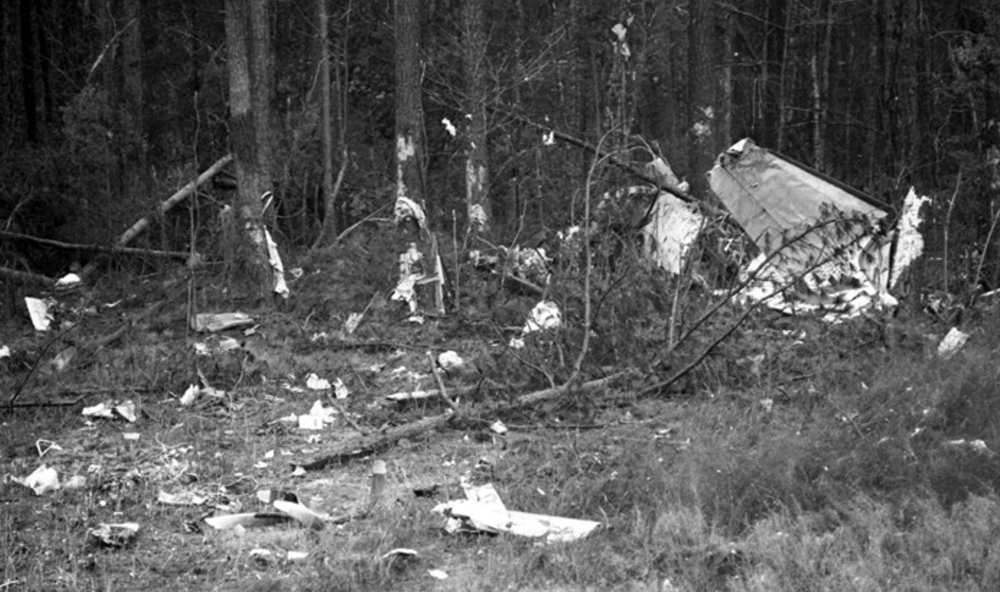
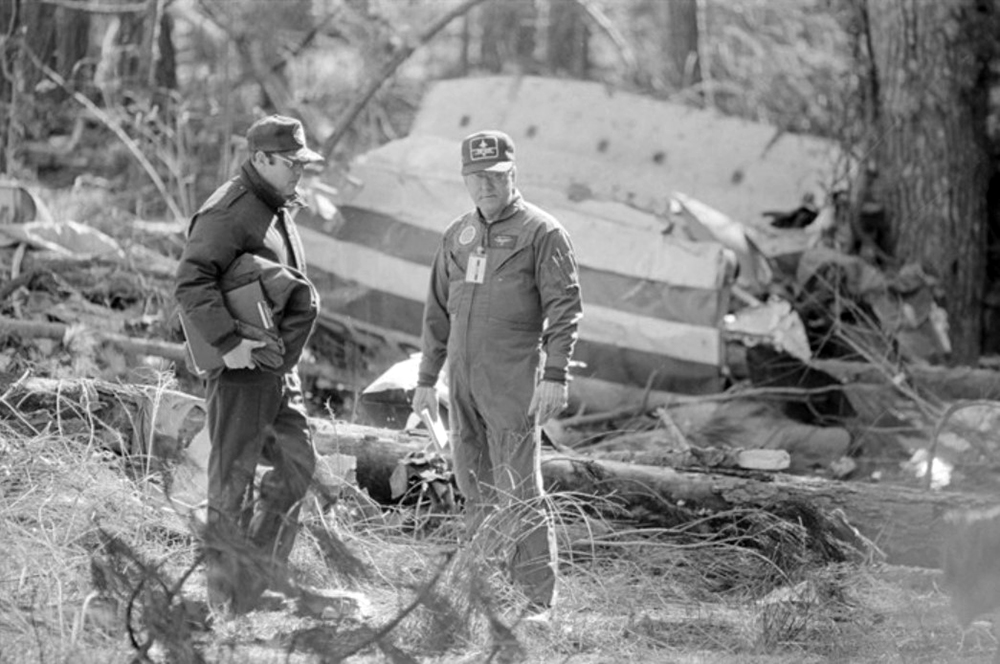
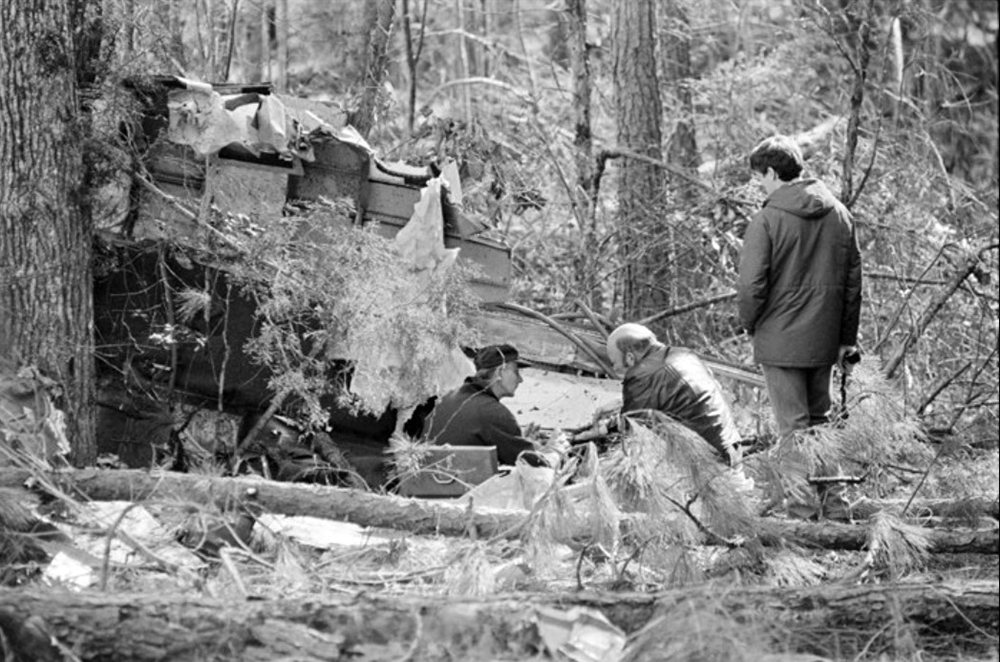
Crash of a Swearingen SA227CC Metro 23 in Sioux Lookout: 3 killed

Date & Time: May 1, 1995 at 1330 LT
Type of aircraft:
Operator:
Registration:
C-GYYB
Survivors:
No
Schedule:
Red Lake - Sioux Lookout
MSN:
CC-827B
YOM:
1993
Flight number:
BLS362
Country:
Crew on board:
2
Crew fatalities:
Pax on board:
1
Pax fatalities:
Other fatalities:
Total fatalities:
3
Captain / Total flying hours:
7330
Captain / Total hours on type:
580.00
Copilot / Total flying hours:
2810
Copilot / Total hours on type:
355
Aircraft flight hours:
3200
Circumstances:
Bearskin flight 362, a Fairchild Swearingen Metro 23, departed Red Lake, Ontario, at 1300 central daylight saving time (CDT), with two pilots and one passenger on board, en route to Sioux Lookout on an instrument flight rules (IFR) flight plan. At approximately 30 nautical miles (nm) north of Sioux Lookout, the flight was cleared by the Winnipeg area control centre (ACC) for an approach to the Sioux Lookout airport. Air Sandy flight 3101, a Piper Navajo PA-31, departed Sioux Lookout at 1323 with one pilot and four passengers on board en route to Red Lake on a visual flight rules (VFR) flight. The pilot of Air Sandy 3101 reported clear of the Sioux Lookout control zone at 1326. No other communication was heard from the Air Sandy flight. At 1315 the Winnipeg ACC controller advised the Sioux Lookout Flight Service specialist that Bearskin 362 was inbound from Red Lake, estimating Sioux Lookout at 1332. At 1327, Bearskin 362 called Sioux Lookout Flight Service Station (FSS) and advised them they had been cleared for an approach and that they were cancelling IFR at 14 nm from the airport. At 1328, as Sioux Lookout FSS was giving an airport advisory to Bearskin 362, the specialist heard an emergency locator transmitter (ELT) emit a signal on the emergency frequencies. Moments later, the pilot of Bearskin 305, a Beechcraft B-99 in the vicinity of Sioux Lookout, advised the specialist that he had just seen a bright flare in the sky and that he was going to investigate. The pilot of Bearskin 305 stated that the flare had fallen to the ground and a fire was burning in a wooded area. A communications search was initiated to locate Bearskin 362, but the aircraft did not respond. A Search and Rescue aircraft from Trenton, Ontario, and an Ontario Ministry of Natural Resources (MNR) helicopter were dispatched to the site. The source of the fire was confirmed to be the Air Sandy aircraft. The MNR helicopter noticed debris and a fuel slick on a nearby lake, Lac Seul. It was later confirmed that Bearskin 362 had crashed into the lake. (See Appendix A.) The two aircraft collided in mid-air at 1328 during the hours of daylight at latitude 50º14'N and longitude 92º07'W, in visual meteorological conditions (VMC). All three persons on board the Bearskin aircraft and all five persons on board the Air Sandy aircraft were fatally injured.
Probable cause:
Neither flight crew saw the other aircraft in time to avoid the collision. Contributing to the occurrence were the inherent limitations of the see-and-avoid concept which preclude the effective separation of aircraft with high closure rates, the fact that neither crew was directly alerted to the presence of the other aircraft by the Flight Service specialist or by onboard electronic equipment, and an apparent lack of pilot understanding of how to optimize avoidance manoeuvring.
Final Report:
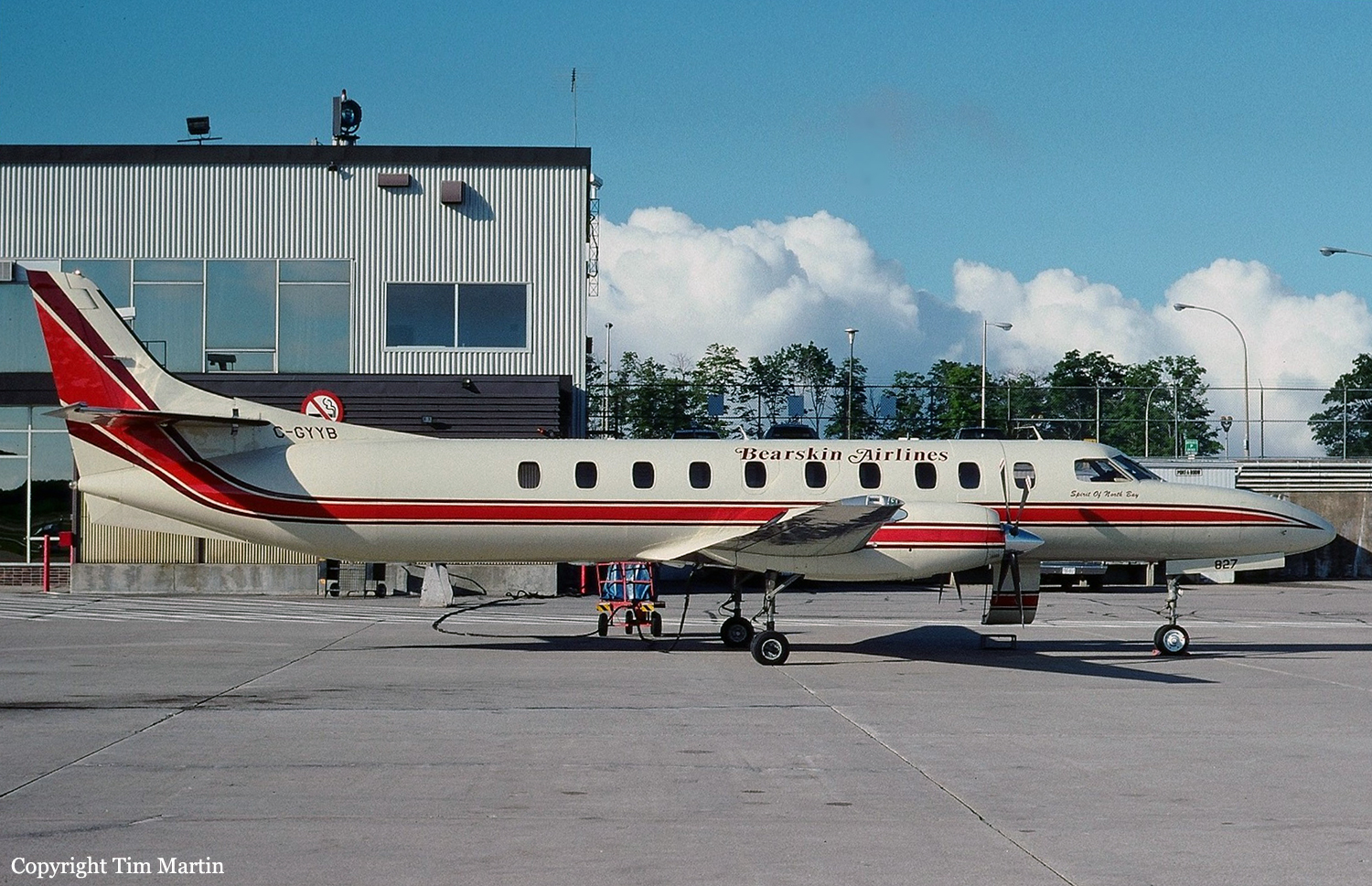

Crash of a Swearingen SA227AC Metro III in Troyes

Date & Time: Sep 19, 1993 at 1240 LT
Type of aircraft:
Operator:
Registration:
F-GILN
Flight Phase:
Survivors:
Yes
Schedule:
Troyes - Biggin Hill
MSN:
AC-458
YOM:
1981
Location:
Country:
Region:
Crew on board:
2
Crew fatalities:
Pax on board:
17
Pax fatalities:
Other fatalities:
Total fatalities:
0
Captain / Total flying hours:
2400
Captain / Total hours on type:
200.00
Copilot / Total flying hours:
640
Copilot / Total hours on type:
220
Aircraft flight hours:
13436
Circumstances:
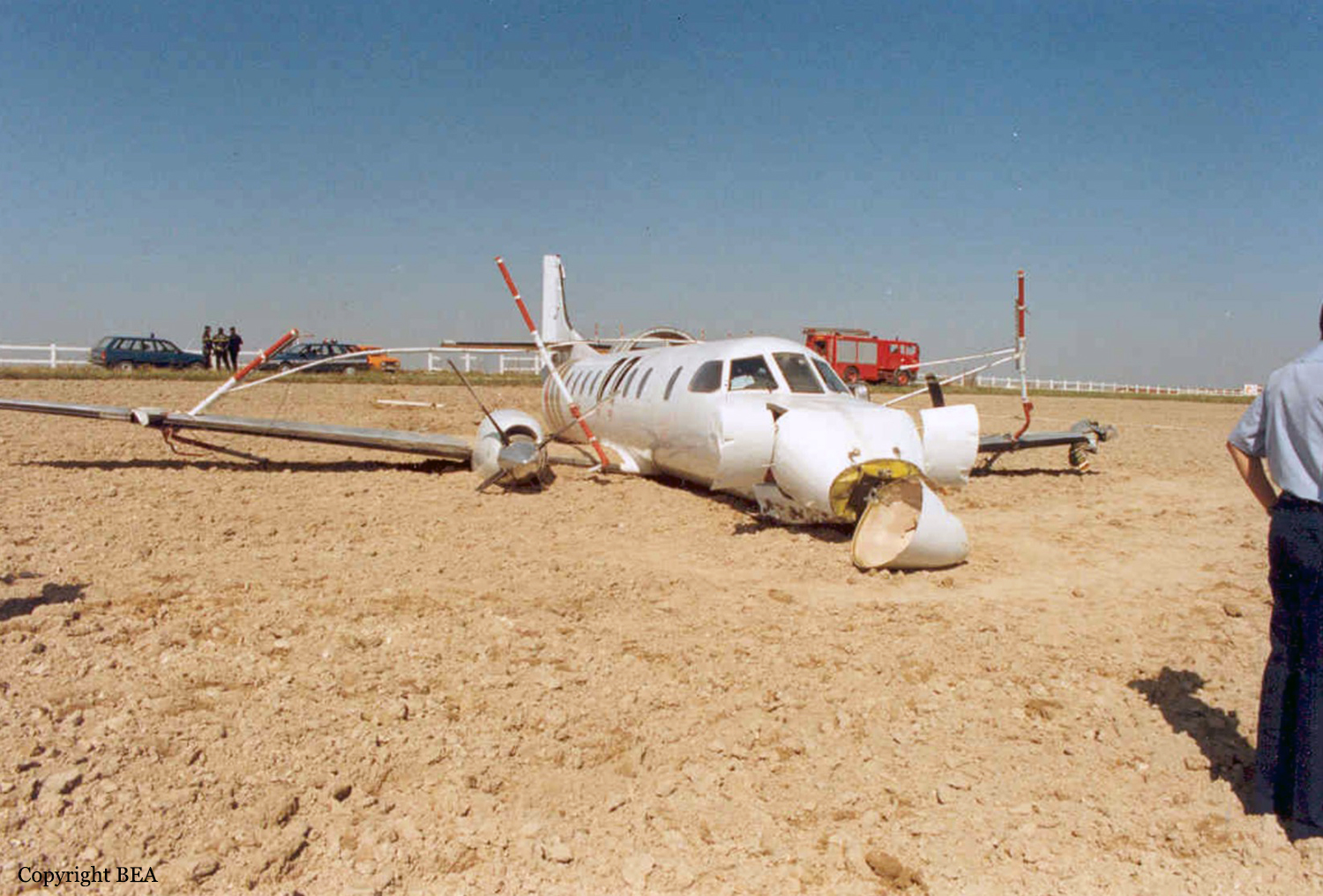
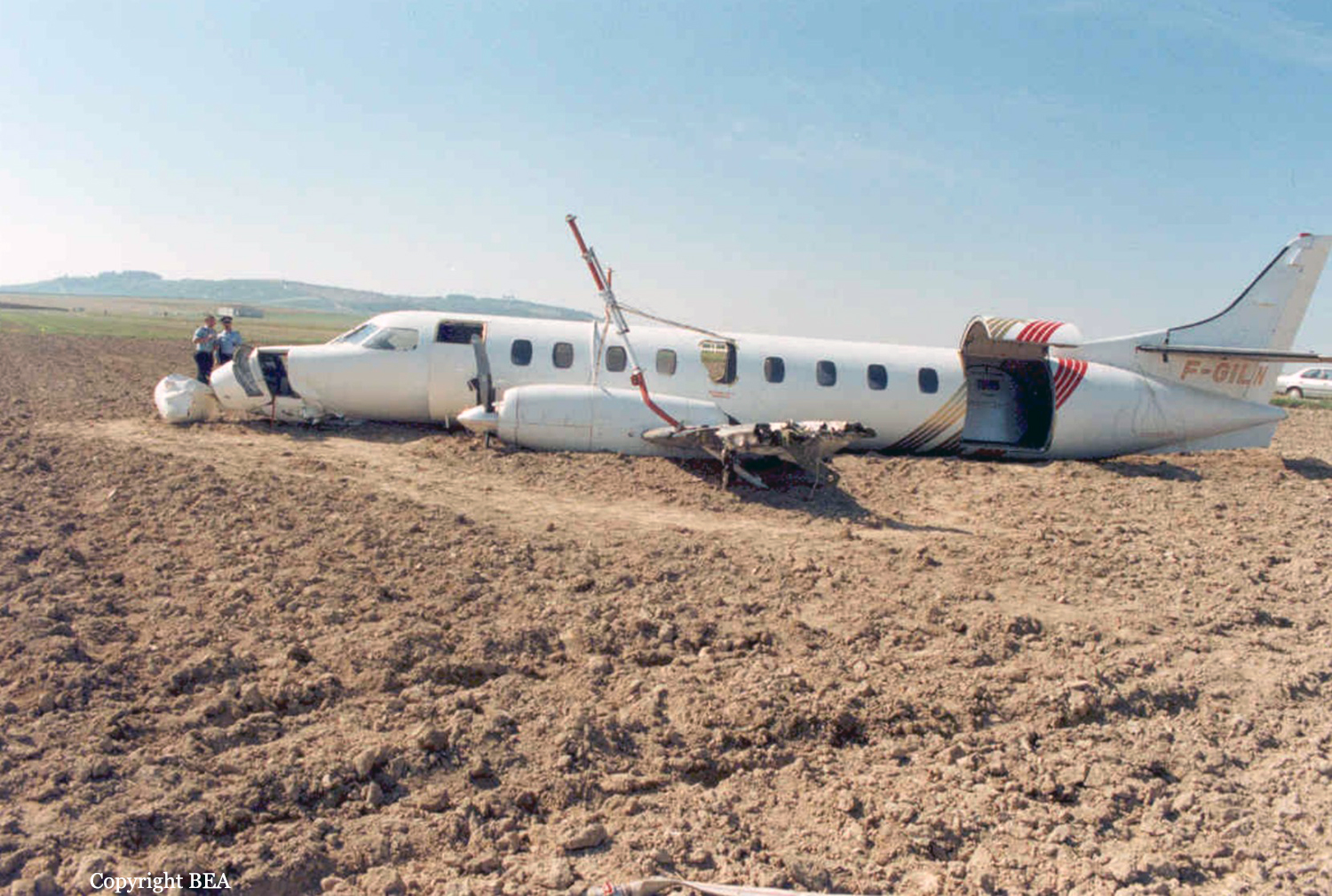
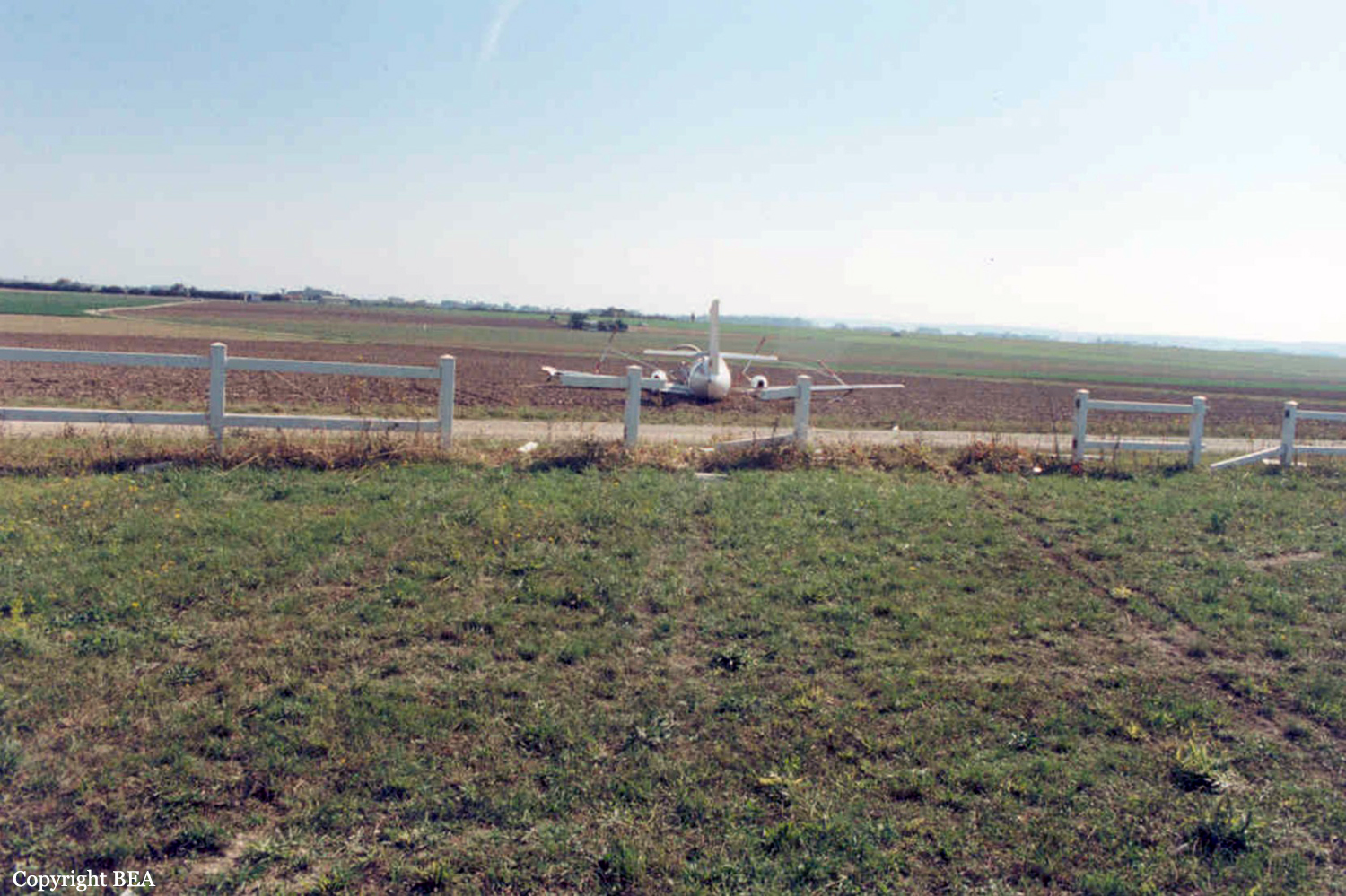
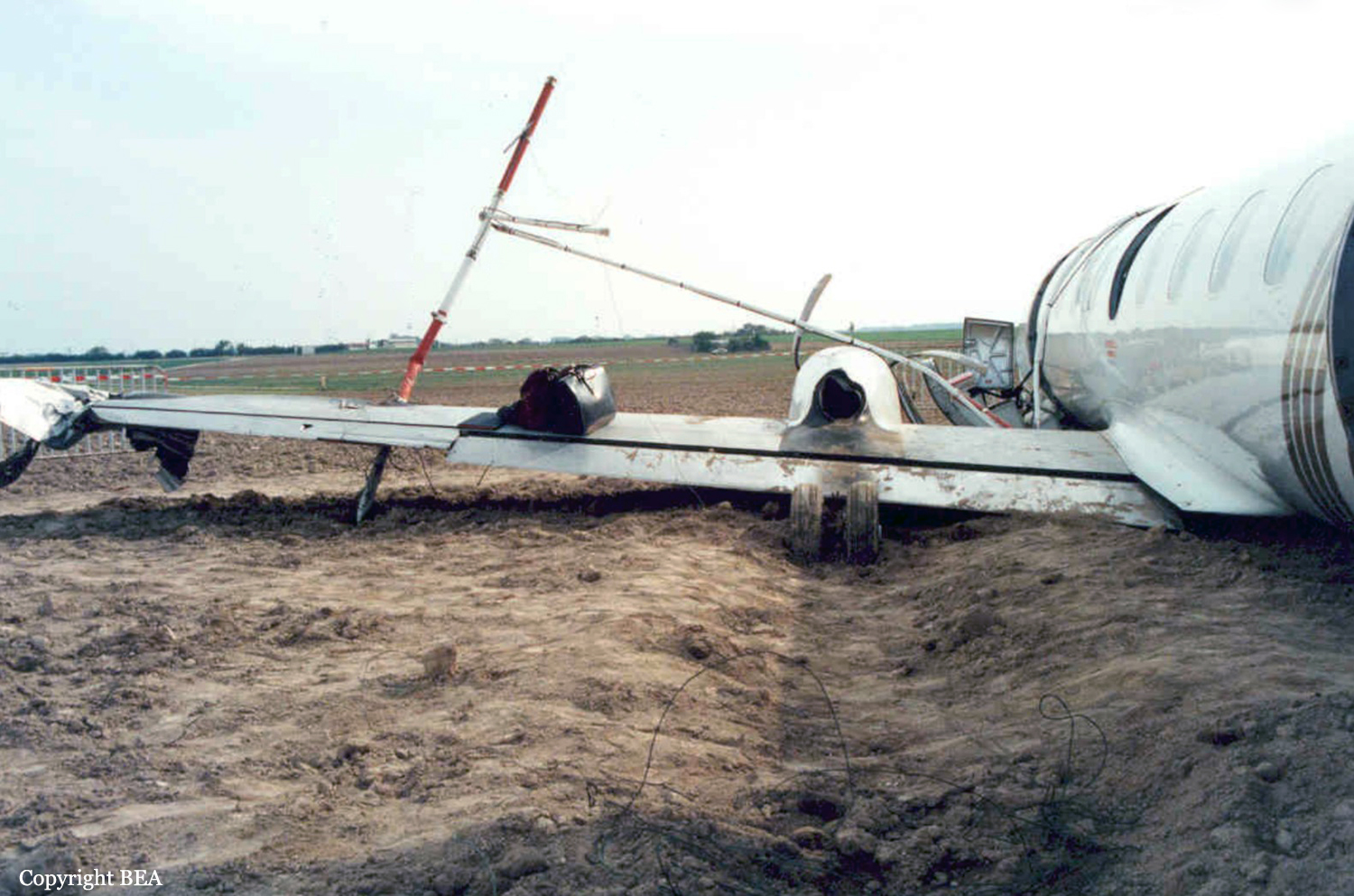
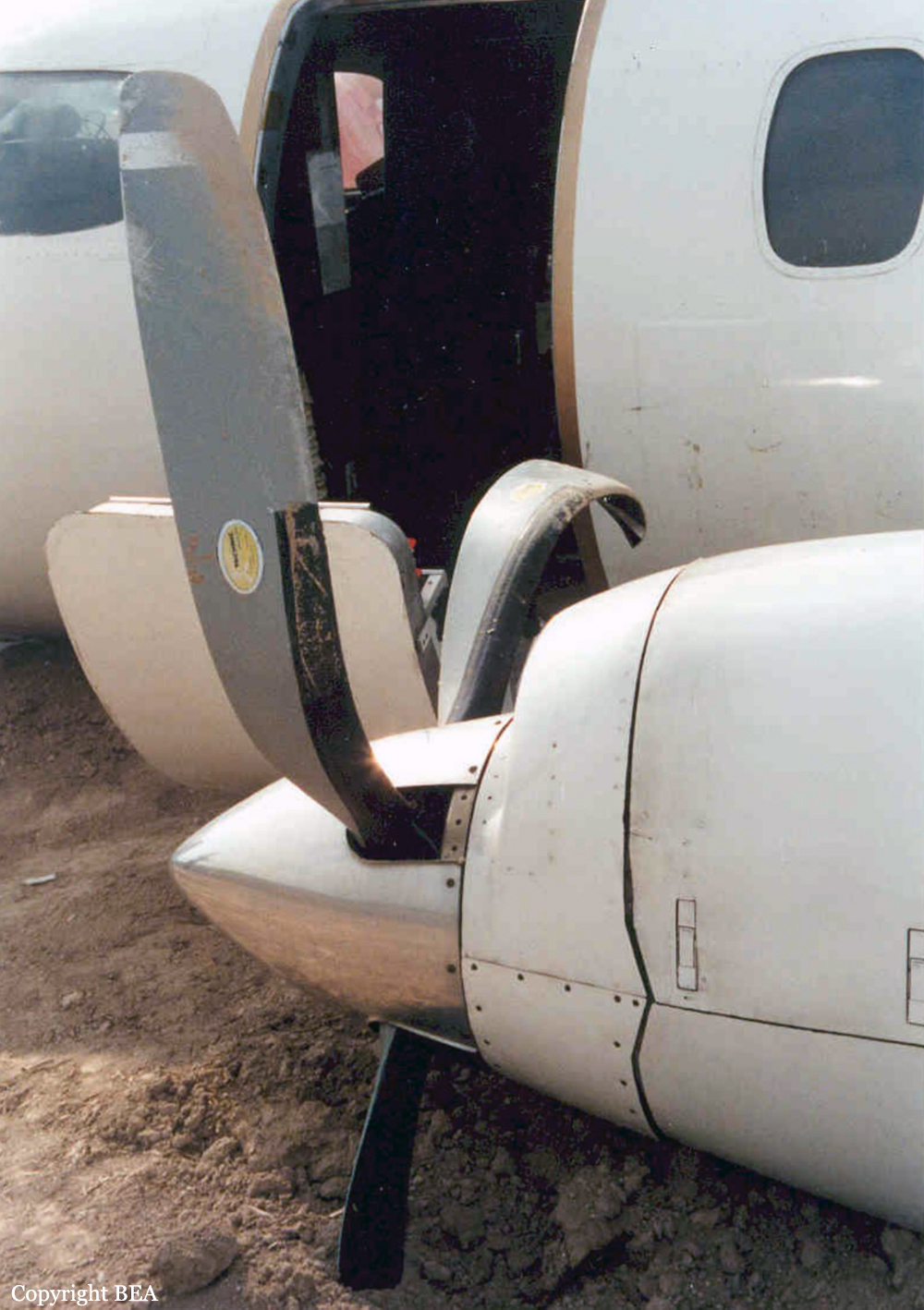
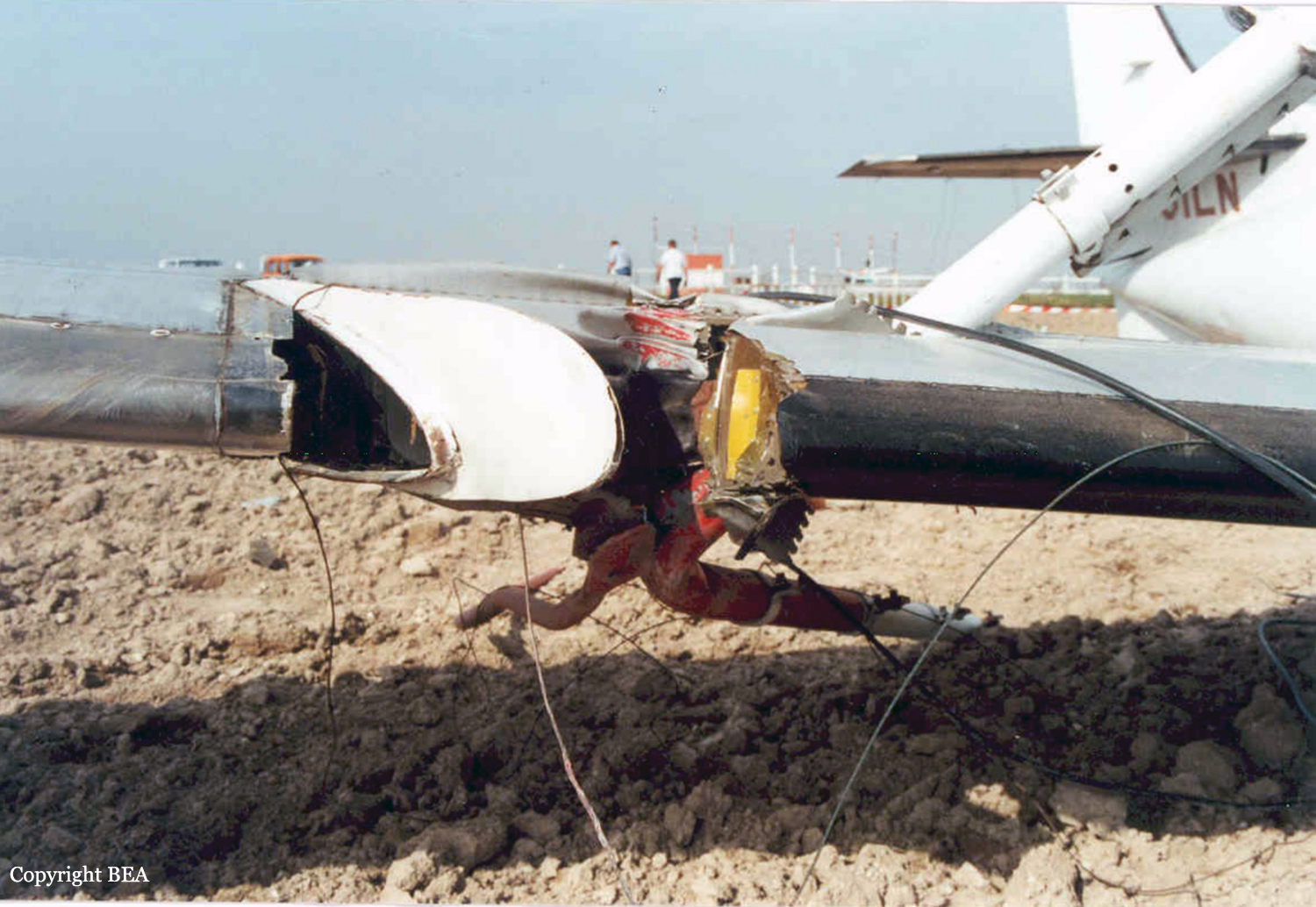
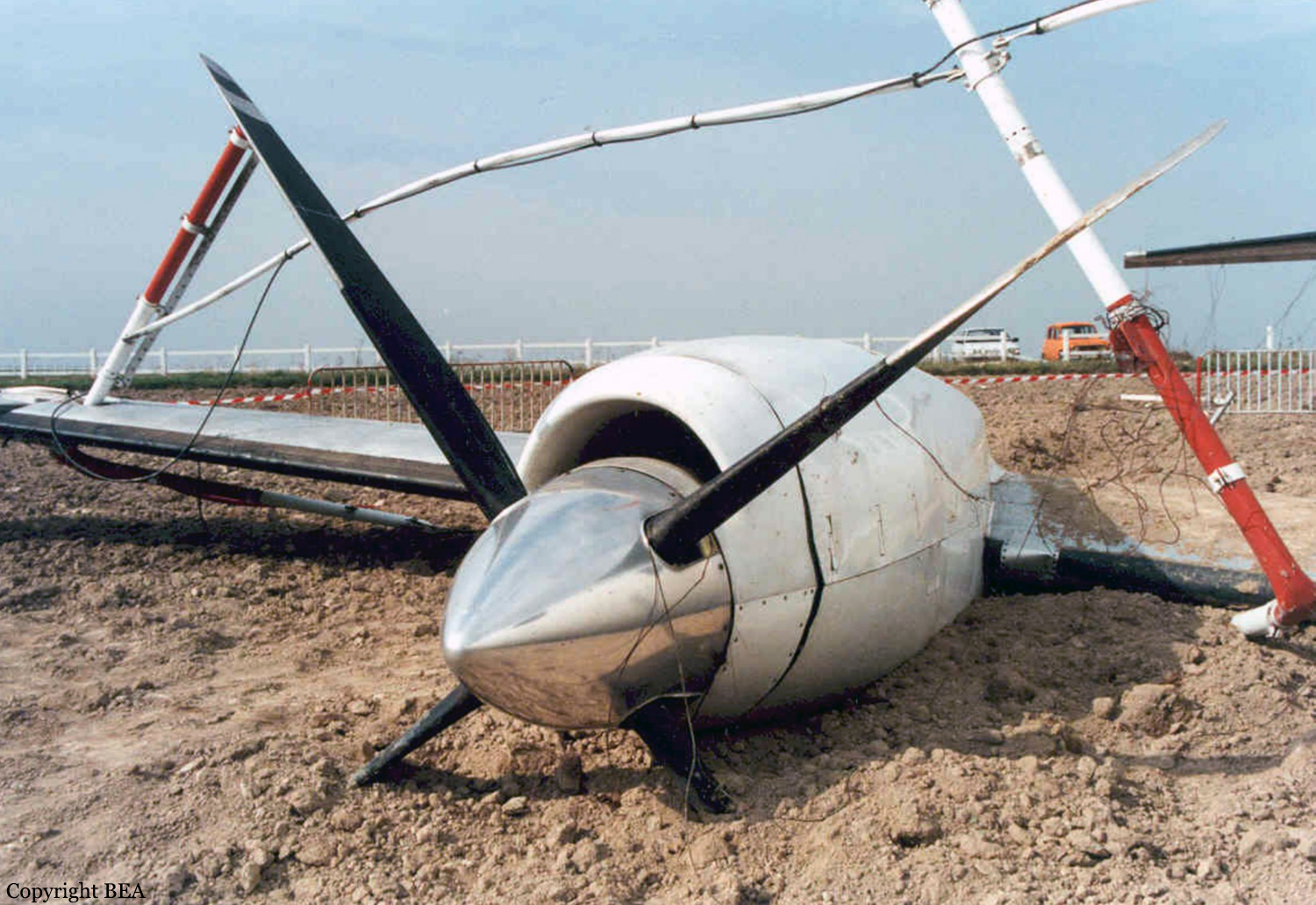
The aircraft has been chartered to transfer to Biggin Hill, UK, 17 people who suffered a bus accident two days ago. During the takeoff roll from Troyes-Barberey Airport, after a course of 1,100 metres, at a speed of about 100 knots, the right engine power dropped from 93% to 40%. In the meantime, the temperature of the right engine increased. As the aircraft was veered to the right, the captain decided to abort and started an emergency braking procedure. Unable to stop within the remaining distance, the aircraft overran, rolled for about 150 metres, went through a fence and eventually collided with the localizer antenna. All 19 occupants escaped uninjured while the aircraft was written off.
Probable cause:
The accident appears to be due to a combination of a positioning error of the Speed Levers at the time of take-off, leading to the overheating of both engines, which forced the take-off to stop, and to the preparation and insufficient management of the take-off, leading to an underestimation of the acceleration-stop distance and a late decision to reject the take-off.
The following contributing factors were reported:
- The fouling of the brakes, which reduced their performance,
- The failure to update the aircraft's base weight in the operations manual,
- The crew's very limited experience on type of aircraft,
- The aircraft total weight was 300 kg above MTOW.
Final Report:
Crash of a Swearingen SA227AC Metro III in Trinidad

Date & Time: Nov 12, 1992
Type of aircraft:
Operator:
Registration:
N3044J
Flight Phase:
Survivors:
Yes
Schedule:
Trinidad - Cochabamba
MSN:
AC-466
YOM:
1981
Location:
Country:
Crew on board:
2
Crew fatalities:
Pax on board:
14
Pax fatalities:
Other fatalities:
Total fatalities:
0
Circumstances:
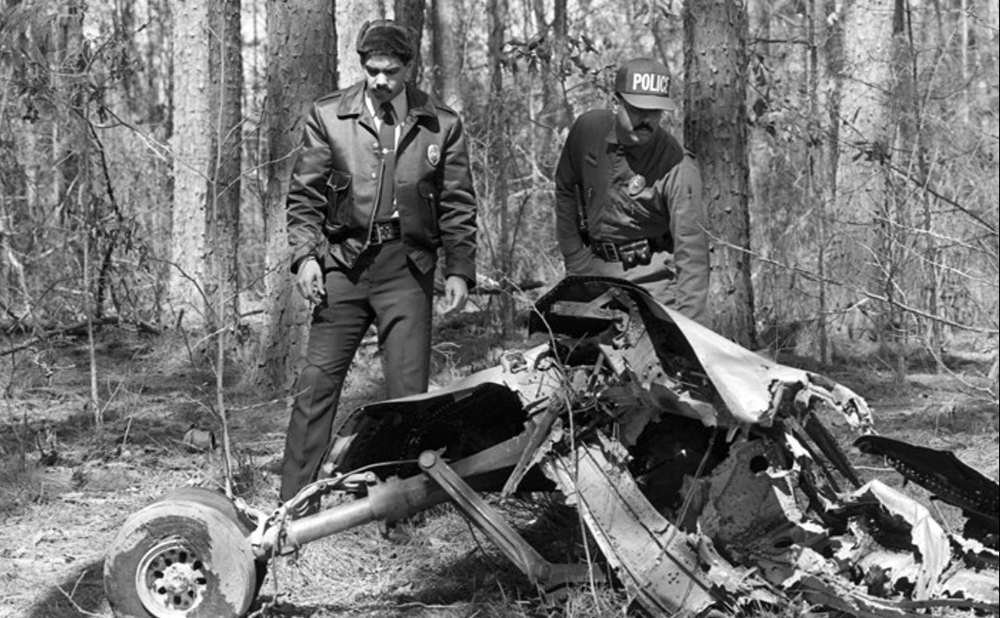
During the takeoff roll, the aircraft deviated to the right and eventually veered off runway. While contacting soft ground, the nose gear collapsed and the aircraft came to rest. All 16 occupants evacuated safely while the aircraft was damaged beyond repair.

Crash of a Swearingen SA227AC Metro III in San Antonio

Date & Time: Sep 18, 1992 at 1310 LT
Type of aircraft:
Operator:
Registration:
N2183A
Flight Type:
Survivors:
Yes
Schedule:
San Antonio - San Antonio
MSN:
AC-422
YOM:
1981
Crew on board:
2
Crew fatalities:
Pax on board:
0
Pax fatalities:
Other fatalities:
Total fatalities:
0
Captain / Total flying hours:
6000
Captain / Total hours on type:
650.00
Aircraft flight hours:
17936
Circumstances:
The pilot was conducting a functional test flight and qualitative engineering evaluation of the airplane's longitudinal control during landing. During final approach to runway 12L, he reduced the engines to the flight idle positions and established 95 kias. He was unable to raise the nose of the airplane during the flare to arrest the descent rate and landed hard onto the runway. The airplane was taxied to the ramp and secured. No mechanical failure was found or reported.
Probable cause:
The landing capability of the airplane was exceeded. The lack of performance data was a factor in the accident.
Final Report:
Crash of a Swearingen SA227AC Metro III in Hot Springs: 3 killed

Date & Time: Aug 25, 1992 at 0515 LT
Type of aircraft:
Operator:
Registration:
N342AE
Flight Phase:
Flight Type:
Survivors:
No
Schedule:
Hot Springs - Hot Springs
MSN:
AC-545
YOM:
1983
Crew on board:
2
Crew fatalities:
Pax on board:
1
Pax fatalities:
Other fatalities:
Total fatalities:
3
Captain / Total flying hours:
2828
Captain / Total hours on type:
667.00
Aircraft flight hours:
19889
Circumstances:
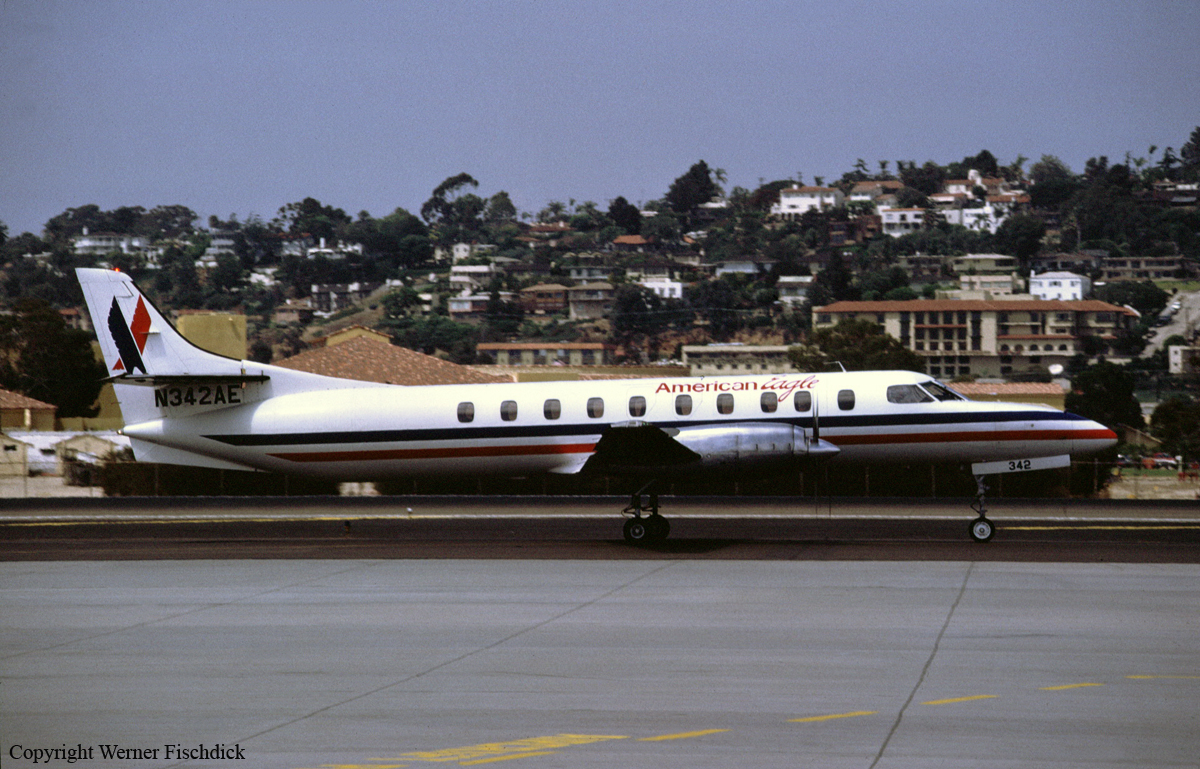
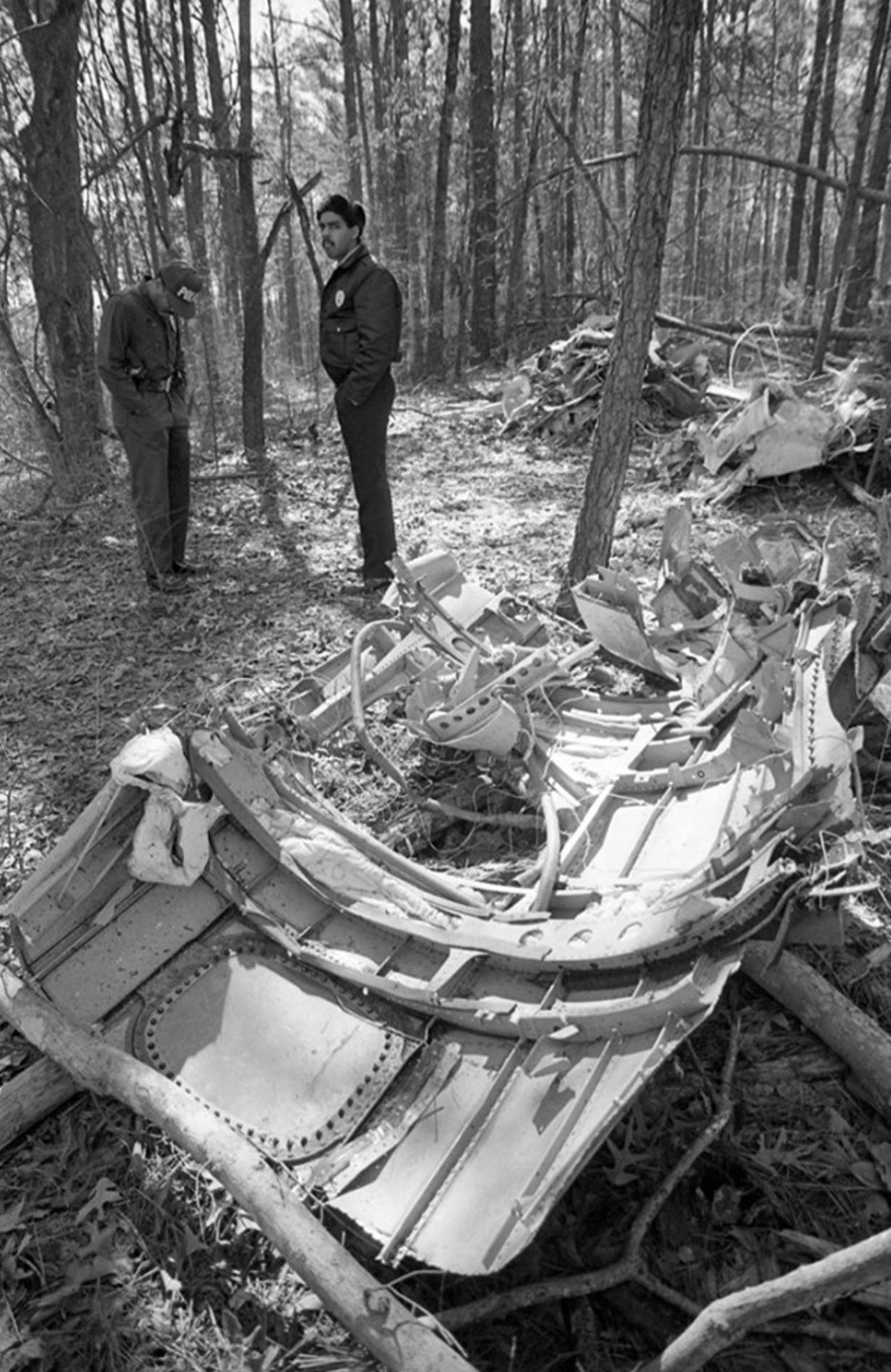
The maintenance test flight was being flown following completion of airworthiness directive 87-02-02 requiring the mandatory replacement of all primary flight control cables. Following lift-off, witnesses observed the airplane start a rapid roll to the right until initial impact was made with the ground by the right wing tip. Examination of the wreckage revealed the a half turn in the routing of the replaced flight control cable was inadvertently omitted on both control columns which would result in the ailerons operating in reverse of the commanded input. The passenger was the quality control inspector who had inspected and signed off the maintenance performed. According to other company personnel, he had briefed the crew prior to the flight on the purpose of the test flight and the extent of the maintenance that the airplane had undergone. All three occupants were killed.
Probable cause:
Inadequate maintenance and inspection by the operator's maintenance personnel, and the failure of the pilot-in-command to assure proper travel direction of the airplane's primary flight controls after being made aware of the nature of the maintenance performed.
Final Report:

Crash of a Swearingen SA227AC Metro III in Los Angeles: 12 killed

Date & Time: Feb 1, 1991 at 1807 LT
Type of aircraft:
Operator:
Registration:
N683AV
Flight Phase:
Survivors:
No
Schedule:
Los Angeles - Palmdale
MSN:
AC-683
YOM:
1987
Flight number:
OO5569
Crew on board:
2
Crew fatalities:
Pax on board:
10
Pax fatalities:
Other fatalities:
Total fatalities:
12
Captain / Total flying hours:
8808
Captain / Total hours on type:
2107.00
Copilot / Total flying hours:
8000
Copilot / Total hours on type:
1363
Circumstances:
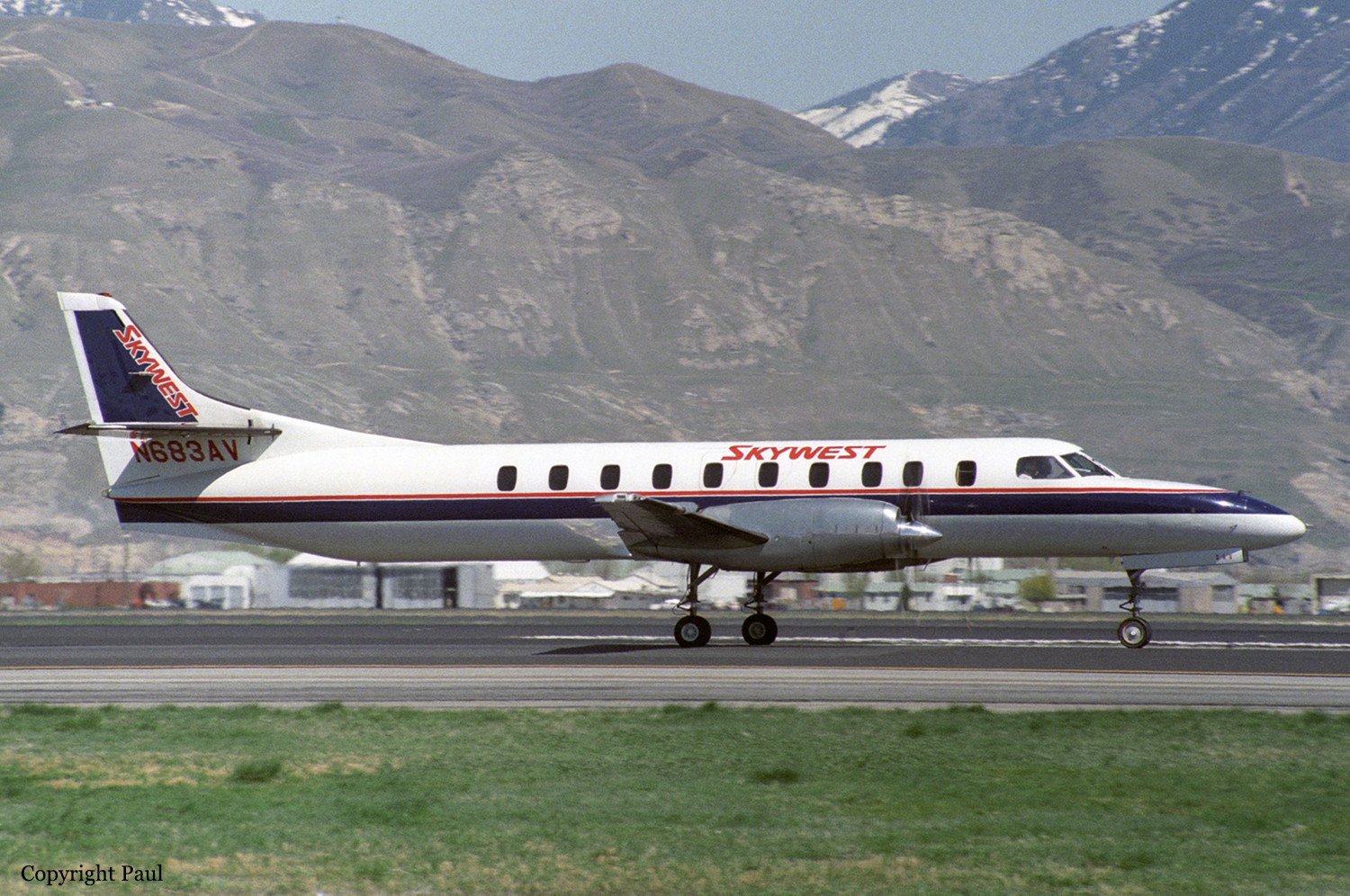
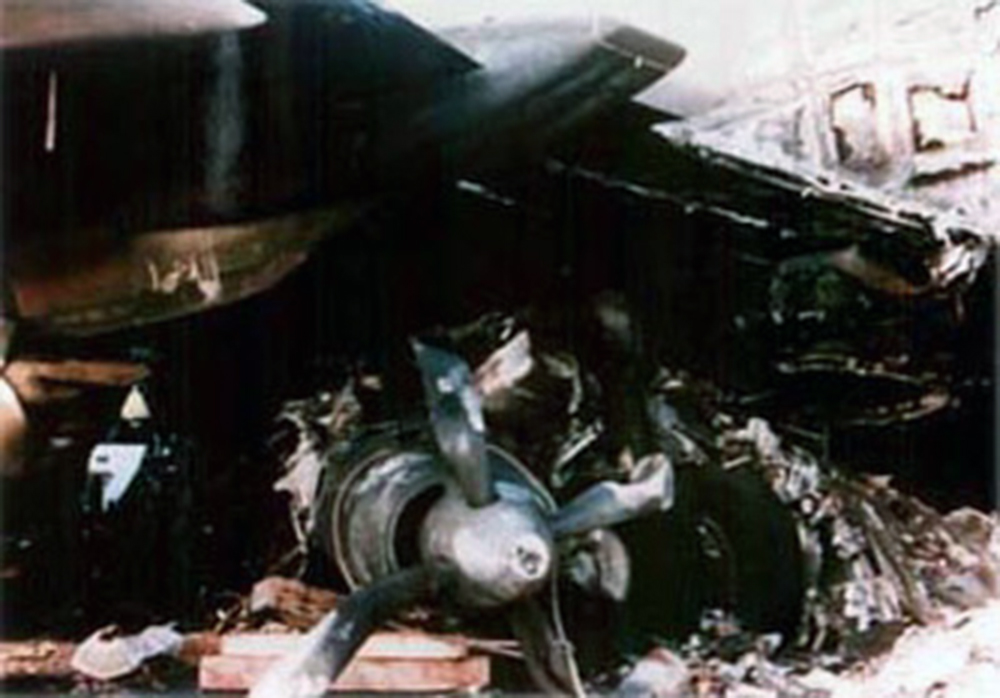
SKW5569, N683AV, had been cleared to runway 24L, at intersection 45, to position and hold. The local controller, because of her preoccupation with another airplane, forgot she had placed SKW5569 on the runway and subsequently cleared US1493, N388US, for landing. After the collision, the two airplanes slid off the runway into an unoccupied fire station. The tower operating procedures did not require flight progress strips to be processed through the local ground control position. Because this strip was not present, the local controller misidentified an airplane and issued a landing clearance. The technical appraisal program for air traffic controllers is not being fully utilized because of a lack of understanding by supervisors and the unavailability of appraisal histories.
Probable cause:
The failure of the los angeles air traffic facility management to implement procedures that provided redundancy comparable to the requirements contained in the national operational position standards and the failure of the faa air traffic service to provide adequate policy direction and oversight to its air traffic control facility managers. These failures created an environment in the Los Angeles air traffic control tower that ultimately led to the failure of the local controller 2 (lc2) to maintain an awareness of the traffic situation, culminating in the inappropriate clearances and the subsequent collision of the usair and skywest aircraft. Contributing to the cause of the accident was the failure of the faa to provide effective quality assurance of the atc system.
Final Report:

Crash of a Swearingen SA227AC Metro III in Cincinnati

Date & Time: Nov 8, 1990 at 2223 LT
Type of aircraft:
Operator:
Registration:
N445AC
Flight Type:
Survivors:
Yes
Schedule:
Cincinnati - Cincinnati
MSN:
AC-445
YOM:
1981
Crew on board:
2
Crew fatalities:
Pax on board:
1
Pax fatalities:
Other fatalities:
Total fatalities:
0
Captain / Total flying hours:
3918
Captain / Total hours on type:
1019.00
Aircraft flight hours:
15616
Circumstances:
The pilot, a company check airman, and an FAA inspector were on board the aircraft for a checkride which was intended to reassess the pilot's competency. A maintenance test (aileron rigging) was to be performed in conjunction with the check ride. The first maneuver to be performed was a no-flap landing. All three pilots stated that the pilot had difficulty managing the aircraft while in the traffic pattern; airspeeds were too slow, and the pilot was constantly manipulating power. The pilot never called for the before landing checklist, and the aircraft touched down on the runway with the landing gear up. The check pilot stated that the landing gear warning horn came on briefly, but the pilot added power and silenced the horn. The FAA inspector was seated in a passenger seat for takeoff and landing, and was not aware that the landing gear was not extended.
Probable cause:
The pilot-in-command's failure to extend the landing gear prior to touchdown. Checkride-induced pressure was a contributing factor, and inadequate supervision by the check pilot was a factor.
Final Report:

Crash of a Swearingen SA227AC Metro III in Elko

Date & Time: Jan 15, 1990 at 1028 LT
Type of aircraft:
Operator:
Registration:
N2721M
Survivors:
Yes
Schedule:
Salt Lake City - Elko
MSN:
AC-716
YOM:
1988
Flight number:
OO5855
Location:
Crew on board:
2
Crew fatalities:
Pax on board:
14
Pax fatalities:
Other fatalities:
Total fatalities:
0
Captain / Total flying hours:
14314
Captain / Total hours on type:
5337.00
Aircraft flight hours:
2928
Circumstances:
During arrival, the flight crew of SkyWest Airlines flight 5855 requested a VOR/DME-B approach to the Elko Airport, which was approved. As the approach continued, the flight crew reported over the Bullion VOR. Approximately 30 seconds later, the aircraft crashed. Impact occurred at the top of a mountain, about 100 feet before reaching the VOR station. Elevation of the crash site was about 6,460 feet; minimum published crossing altitude at the VOR was 7,000 feet. The airport was 4.1 miles from the VOR at an elevation of 5,135 feet.
Probable cause:
Improper ifr procedure by the captain, and inadequate monitoring of the approach by the first officer, which resulted in a failure to maintain proper altitude during the approach. Factors related to the accident were: the terrain and weather conditions at the accident site.
Final Report:

Crash of a Swearingen SA227AC Metro III in Terrace: 7 killed

Date & Time: Sep 26, 1989 at 0828 LT
Type of aircraft:
Registration:
C-GSLB
Survivors:
No
Schedule:
Prince Rupert - Terrace
MSN:
AC-481
YOM:
1981
Flight number:
SLK070
Country:
Crew on board:
2
Crew fatalities:
Pax on board:
5
Pax fatalities:
Other fatalities:
Total fatalities:
7
Aircraft flight hours:
11177
Circumstances:
A Swearingen SA227-AC Metro III passenger plane, operating as Skylink Flight 070 was destroyed in accident at Terrace Airport, BC (YXT), Canada. All five passengers and two crew members were killed. Flight 070 took off from Vancouver, BC (YVR) at 06:51 on a scheduled domestic flight to Terrace, BC. At 08:20 Flight 070 was cleared for an approach at Terrace. At 08:27, at an altitude of 1,200 feet asl and just prior to reaching the published missed approach point (MAP), the captain stated "OK, I got the button here." Fourteen seconds after this, the captain saw the button of runway 27. At approximately this same time, the aircraft was observed on what corresponded to a downwind leg for runway 15 at about 500 feet above ground level (agl), flying straight and level over the threshold of runway 27, with the landing gear down. The aircraft crossed the localizer transmitter at an altitude of 1,100 feet asl and at an airspeed of 140 knots. Approximately 30 seconds after crossing the localizer transmitter, the aircraft commenced a descent out of 1,100 feet, and the flaps were lowered to the full position. The aircraft then levelled at an altitude of approximately 900 feet. At or about this same time, the aircraft was observed on base leg for runway 15 at a low altitude, close to the east/west ridge located about 1.5 miles north of the airport. Twenty-six seconds after full flap was selected, a missed approach was initiated, and the landing gear and flaps were selected up. Within five seconds of the initiation of the missed approach, the aircraft began to accelerate and a rate of climb of approximately 1,200 feet per minute was established. This rate of climb quickly diminished to zero, followed by the start of a descent which quickly increased to 3,000 feet per minute. As the aircraft descended, the co-pilot called "descending" twice. A few seconds later, the aircraft struck trees on the west side of runway 15 just inside the airport perimeter. A second and final impact with the ground occurred just outside the airport perimeter approximately 800 feet from the initial tree strike. A fire erupted following the ground impact.
Probable cause:
The crew continued with the approach beyond the missed approach point without establishing the required visual references. The evidence indicates that, while subsequently carrying out a missed approach in IFR conditions, the aircraft was flown into the ground in a manner consistent with disorientation. Contributing to the occurrence were the inadequacy of the company's operating procedures, the reduced operating standards, and the inadequate definition of the visual references required for a circling approach.

Crash of a Swearingen SA227AC Metro III in Raleigh: 12 killed

Date & Time: Feb 19, 1988 at 2127 LT
Type of aircraft:
Operator:
Registration:
N622AV
Flight Phase:
Survivors:
No
Schedule:
Raleigh - Richmond
MSN:
AC-622
YOM:
1985
Flight number:
CE3378
Crew on board:
2
Crew fatalities:
Pax on board:
10
Pax fatalities:
Other fatalities:
Total fatalities:
12
Captain / Total flying hours:
3426
Captain / Total hours on type:
1836.00
Copilot / Total flying hours:
2080
Copilot / Total hours on type:
450
Aircraft flight hours:
4222
Circumstances:
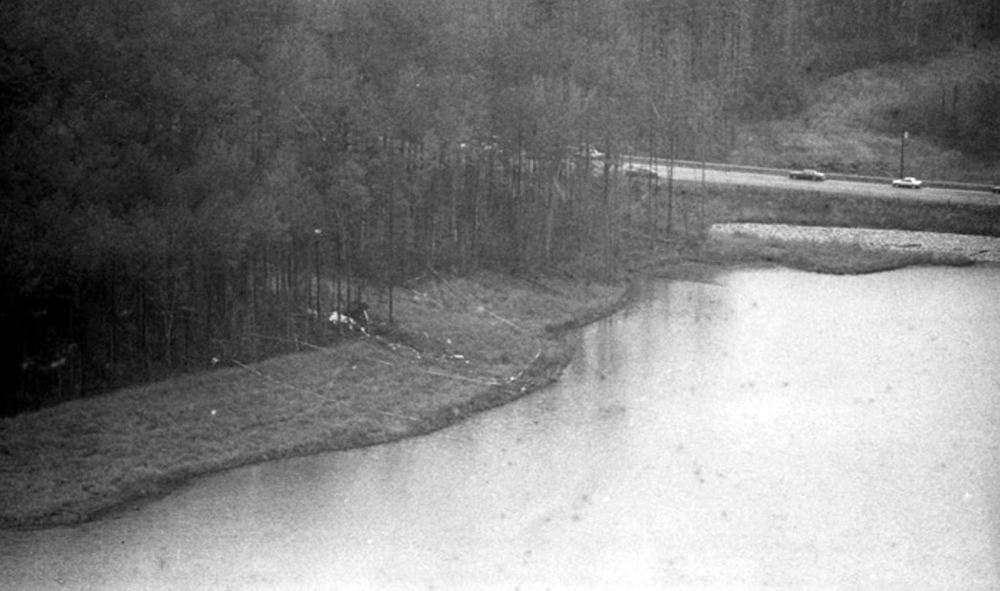
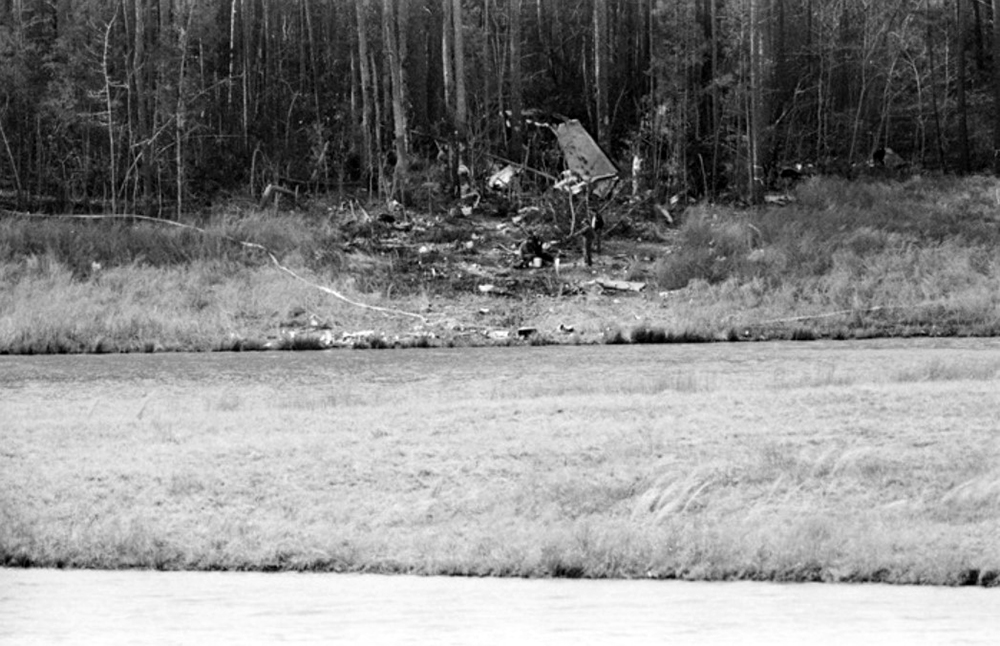
The aircraft departed during low ceiling, low visibility, and night conditions. Shortly after takeoff the aircraft impacted a reservoir. Analysis of radar data indicated the aircraft was in a 45° descending turn. Examination of the aircraft trim system showed that the aircraft was trimmed for level flight. There was no voice or flight data recorder on board. A review of ATC communications indicated that the captain was communicating with ATC allowing the first officer to accomplish the flying duties. Examination of the wreckage revealed no indications of powerplant or system failures. However, there was evidence that the sas warning light was illuminated, the sas switch was in the off position, and no sas system malfunction could be found. Witnesses stated that before the flight the captain had complained of illness but he decided to report for duty. Company records showed instances of substandard performance by the first officer. The investigation found company oversight of training, operations, and inadequate faa supervision. All 12 occupants were killed.
Probable cause:
The National Transportation Safety Board determines that the probable cause of this accident was a failure of the flight crew to maintain a proper flightpath. Contributing to the accident were the ineffective management and supervision of flight crew training and flight operations, and ineffective FAA surveillance of AVAir.
Final Report: