Crash of a Lockheed P-3C-125-LO Orion at Moffett AFB: 5 killed

Date & Time: Apr 12, 1973 at 1450 LT
Type of aircraft:
Operator:
Registration:
157332
Flight Type:
Survivors:
Yes
Schedule:
Moffett - Moffett
MSN:
185-5547
YOM:
1970
Crew on board:
6
Crew fatalities:
Pax on board:
0
Pax fatalities:
Other fatalities:
Total fatalities:
5
Circumstances:
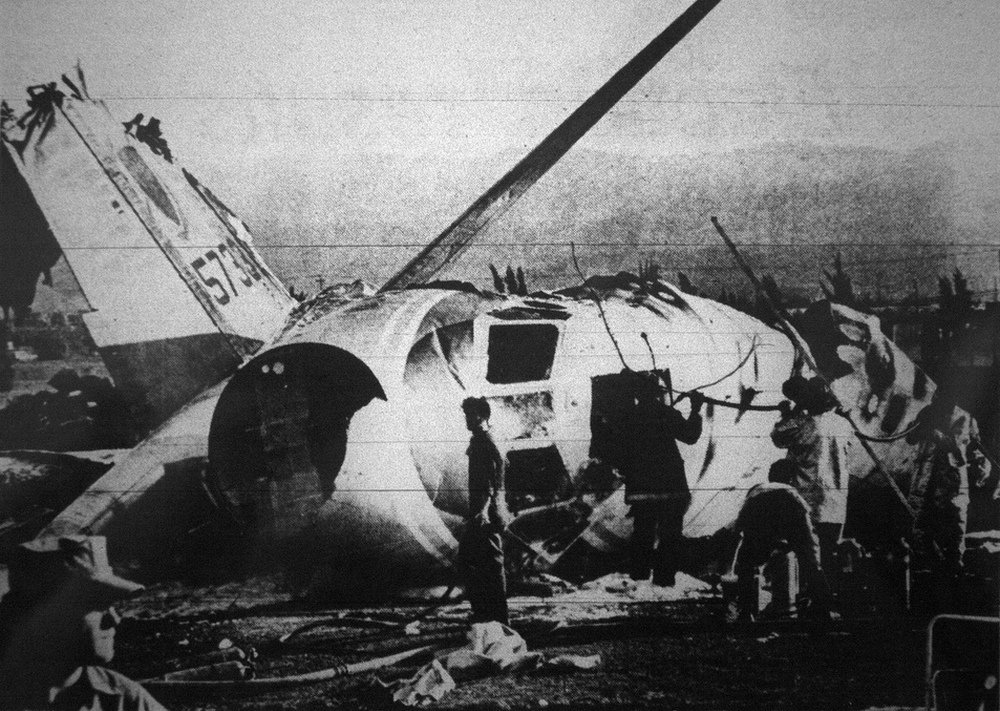
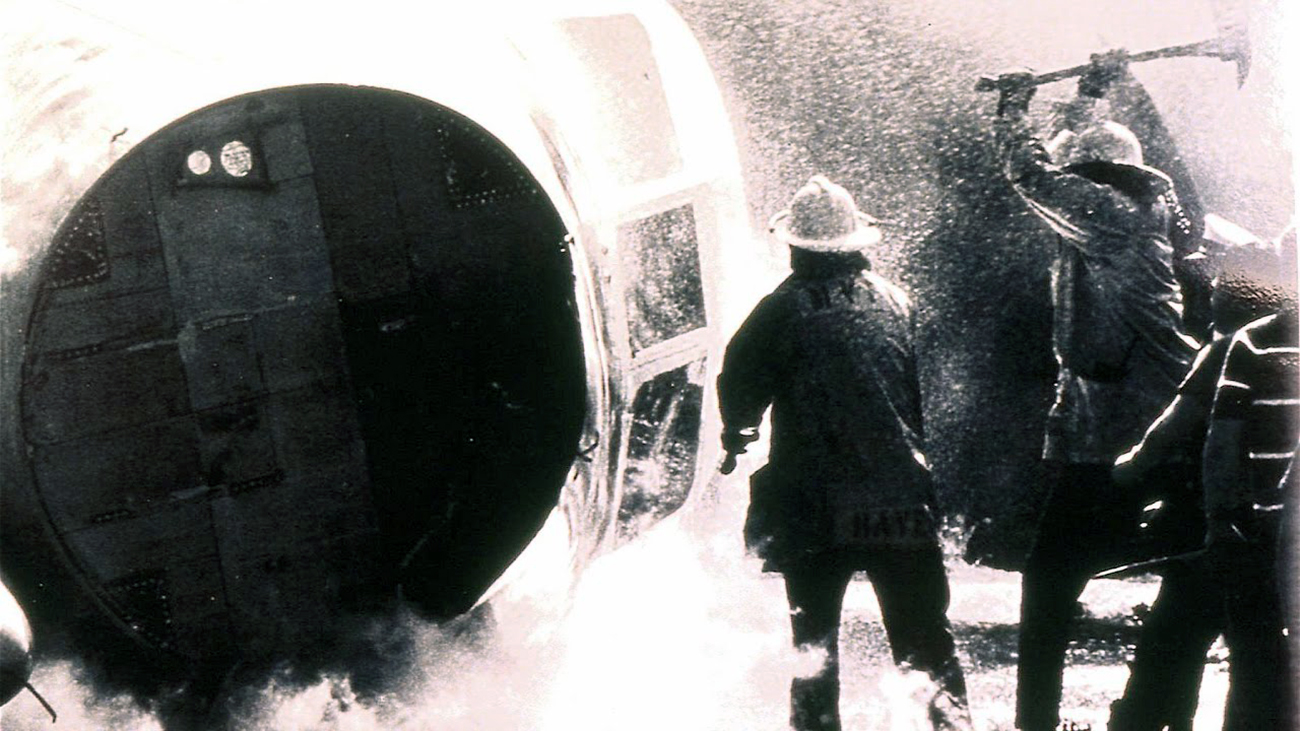
The aircraft was engaged in a local training flight with a crew of six on board. At a same time was approaching to Moffett AFB a NASA Convair CV-990-30A-5 registered N711NA that was returning to Moffett following a test flight over the Monterey Bay with eight scientists and a crew of three on board. Following an uneventful mission, the crew of the Convair started the approach and was cleared to land on runway 32R while seven miles out. After been cleared, the Orion's crew informed ATC he was joining the runway 32L approach path when the controller cleared the crew of the Convair to land at runway 32L. Shortly later, at an altitude of about 300 feet, the nose gear of the Convair struck the top of the Orion's tail. Both airplanes went out of control and crashed in flames on the Sunnyvale golf course located about 0,3 mile short of runway threshold. A crew member from the Orion was seriously injured while all 16 other occupants on both aircraft were killed.
Probable cause:
It was determined that the collision was the consequence of several errors on part of the approach controller. He firstly cleared the Convair's crew to land on runway 32R and the Orion's crew to land on runway 32L. But during the approach, after the Orion's crew confirmed he was joining the runway 32L approach path, the controller cleared the crew of the Convair to land on the same runway 32L. For reasons undetermined, the Convair's crew did not ask any question about this runway change. Also, none of the crew was able to see and avoid each other.
Crash of a Lockheed P-3B-70-LO Orion off Brunswick: 5 killed

Date & Time: Mar 15, 1973 at 1400 LT
Type of aircraft:
Operator:
Registration:
152749
Flight Phase:
Flight Type:
Survivors:
No
Schedule:
Brunswick - Brunswick
MSN:
185-5189
YOM:
1966
Location:
Crew on board:
5
Crew fatalities:
Pax on board:
0
Pax fatalities:
Other fatalities:
Total fatalities:
5
Circumstances:
The aircraft was completing a training flight out of Brunswick NAS when it crash in unknown circumstances into the Atlantic Ocean about 40 miles offshore. The wreckage sank by a depth of 300-600 feet. All five crew members were killed.
Probable cause:
The cause of the accident could not be determined.

Crash of a Lockheed P-3A-60-LO Orion on Jebel Musa: 14 killed

Date & Time: Jun 3, 1972
Type of aircraft:
Operator:
Registration:
152182
Flight Phase:
Flight Type:
Survivors:
No
Site:
Schedule:
Rota - Souda Bay
MSN:
185-5152
YOM:
1965
Country:
Region:
Crew on board:
4
Crew fatalities:
Pax on board:
10
Pax fatalities:
Other fatalities:
Total fatalities:
14
Circumstances:
About an hour after its departure from Rota NAS, Spain, while cruising at an altitude of 800 meters in marginal weather conditions, the four engine aircraft struck the slope of Jebel Musa (851 meters high) located near the Spanish enclave of Ceuta. The aircraft was destroyed and all 14 occupants have been killed. Attached to Brunswick Air Base, Maine, the airplane was completing a routine flight from Rota NAS to Souday BAY AFB, Chania, Greece.

Crash of a Lockheed P-3A-50-LO Orion into the Pacific Ocean: 8 killed

Date & Time: May 26, 1972
Type of aircraft:
Operator:
Registration:
152155
Flight Phase:
Survivors:
No
Schedule:
Moffett - Moffett
MSN:
185-5125
YOM:
1965
Country:
Region:
Crew on board:
4
Crew fatalities:
Pax on board:
4
Pax fatalities:
Other fatalities:
Total fatalities:
8
Circumstances:
While engaged in a maritime patrol flight over the Pacific Ocean, the airplane crashed in unknown circumstances. No trace of the aircraft nor the eight occupants was found.

Crash of a Lockheed P-3A-50-LO Orion off Cubi Point NAS: 1 killed

Date & Time: Dec 5, 1971 at 0710 LT
Type of aircraft:
Operator:
Registration:
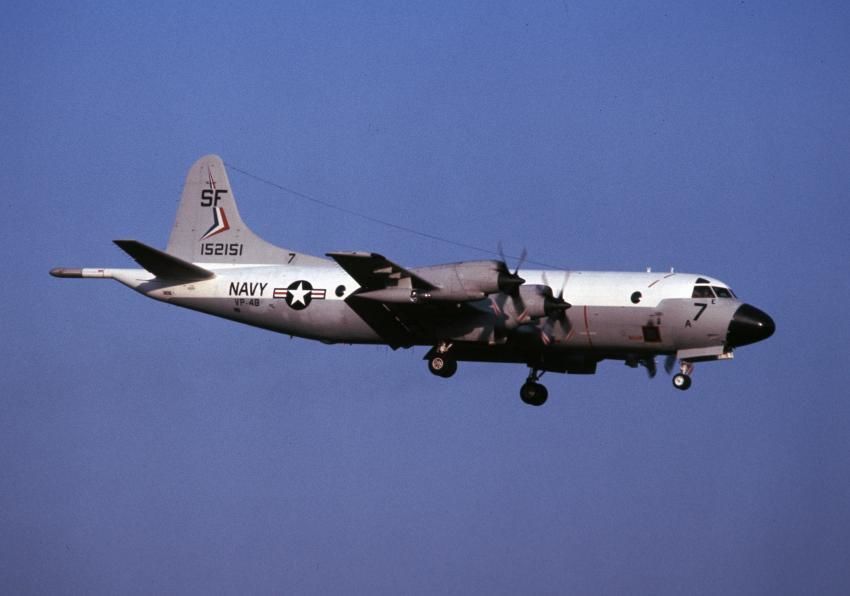
152151
Flight Phase:
Survivors:
Yes
Schedule:
Cubi Point - Cubi Point
MSN:
185-5121
YOM:
1965
Country:
Region:
Crew on board:
4
Crew fatalities:
Pax on board:
12
Pax fatalities:
Other fatalities:
Total fatalities:
1
Circumstances:
Shortly after takeoff from Cubi Point NAS, while in initial climb, both engines n°2 & 3 exploded. Both electric and hydraulic systems failed and the captain elected to ditch the airplane that crashed into the sea few dozen yards offshore. Fifteen occupants were rescued while Ensign Ed Cooper was killed.
Probable cause:
The airplane's water-alcohol injection system was accidentally serviced with water and cleaning solvent by the ground crew. This caused the turbine inlet temperature to increase immediately after liftoff.

Crash of a Lockheed P-3A-55-LO Orion near Searchlight: 10 killed

Date & Time: Aug 3, 1970
Type of aircraft:
Operator:
Registration:
152159
Flight Phase:
Flight Type:
Survivors:
No
Site:
Schedule:
Nellis – North Island – Barbers Point
MSN:
185-5129
YOM:
1965
Crew on board:
10
Crew fatalities:
Pax on board:
0
Pax fatalities:
Other fatalities:
Total fatalities:
10
Circumstances:
The crew departed Nellis AFB in Las Vegas on a flight to Barbers Point NAS, Hawaii, with an intermediate stop at North Island-Halsey Field NAS in San Diego. Few minutes after takeoff, the airplane went through a thunderstorm area and encountered heavy turbulences. The pilot lost control of the airplane that entered a dive, partially disintegrated in the air and eventually crashed in a desert area located 10 miles northwest of Searchlight, Nevada. The airplane was totally destroyed and debris scattered on more that half a mile. All ten crew members were killed.
Crew (VP-17):
Lt Timothy D. Bailing,
Lt Norman L. Johnson,
Ltjg Henry J. McGreevey,
Adj1 Ambrose Ordonia,
Adj1 Johnny D. Shelton,
Atn3 Cletus L. Morrison,
Aw3 John D. Maas,
Aw3 John W. Schmitz,
Aw3 Michael A. Silvers,
Aw3 Bruce E. Weaver.
Probable cause:
The Navy concluded that the aircraft was struck by lightning, but Lockheed determined that the breakup of the aircraft in flight was caused by structural overloading of the right wing from a positive high angle of attack condition. Lockheed concluded that it was the uncontrollable flight and the resultant stresses that caused the aircraft to disintegrate in flight.

Crash of a Lockheed P-3A-40-LO Orion in Adak

Date & Time: Jun 3, 1969
Type of aircraft:
Operator:
Registration:
151363
Flight Phase:
Flight Type:
Survivors:
Yes
Schedule:
Adak - Jacksonville
MSN:
185-5076
YOM:
1964
Location:
Crew on board:
8
Crew fatalities:
Pax on board:
0
Pax fatalities:
Other fatalities:
Total fatalities:
0
Circumstances:
During the takeoff roll at Adak Airport, the pilot-in-command pull the control column and started to rotate when the copilot reported a technical problem (smoke hatch blew open). The crew decided to abort the takeoff procedure and started an emergency braking manoeuvre. Few seconds later, the airplane veered off runway to the left and struck an obstacle, causing the right wing to be torn off. The airplane came to rest in flames down an embankment. All eight crew members escaped with minor injuries while the aircraft was destroyed.

Crash of a Lockheed P-3B-75-LO Orion at Lemoore-Reeves Field AFB: 6 killed

Date & Time: Mar 6, 1969
Type of aircraft:
Operator:
Registration:
152765
Flight Type:
Survivors:
No
Schedule:
Lemoore - Lemoore
MSN:
185-5210
YOM:
1966
Crew on board:
6
Crew fatalities:
Pax on board:
0
Pax fatalities:
Other fatalities:
Total fatalities:
6
Circumstances:
The P-3 Orion aircraft was on a practice GCA approach to Lemoore-NAS/Reeves Field, CA (NLC). The aircraft nosed down at the approach end of the runway then flared nose high with an excessive sink rate. It touched down on the port main landing gear, then the starboard main landing gear, followed by the fuselage section just forward of the mad boom striking the runway. The port wing broke inboard of the #2 engine on or shortly after touchdown and separated from the fuselage. The fuselage slid down the runway and came to rest off the left side of the runway approximately 1100 feet from the approach end. The port wing continued approximately 300 feet beyond the fuselage. Both parts were engulfed in flame. All six occupants were killed.
Source: ASN
Probable cause:
The power levers were at the flight idle position at impact. Investigation concluded that an attempt was made to decrease the sink rate by establishing a nose high attitude prior to impact and the aircraft was in a stalled or near stalled condition with minimum power set.

Crash of a Lockheed P-3B-95-LO Orion at Moffett AFB

Date & Time: Apr 11, 1968
Type of aircraft:
Operator:
Registration:
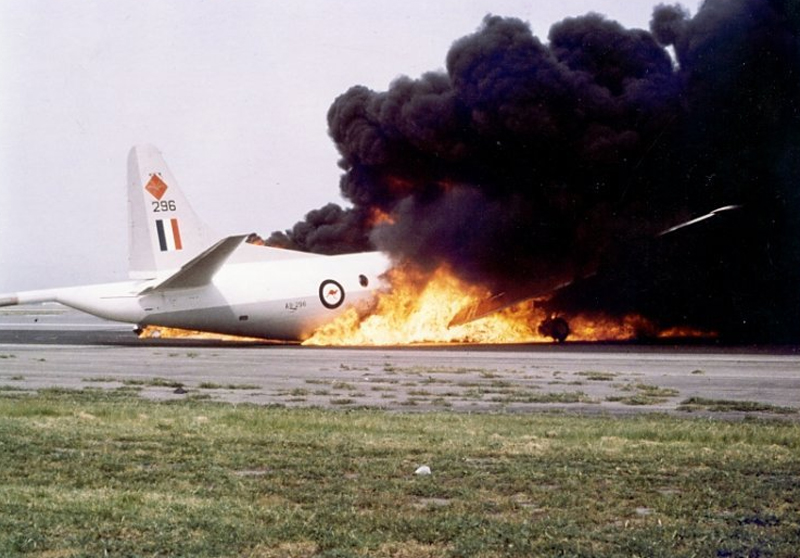
A9-296
Flight Type:
Survivors:
Yes
Schedule:
Moffett - Moffett
MSN:
5406
YOM:
1968
Crew on board:
4
Crew fatalities:
Pax on board:
0
Pax fatalities:
Other fatalities:
Total fatalities:
0
Circumstances:
The crew was completing a local test flight on this new aircraft which should be delivered to the Royal Australian Air Force. Upon landing, one of the main landing gear collapsed and the airplane came to rest in flames. While all four crew members escaped uninjured, the aircraft was destroyed by fire.
Probable cause:
Undercarriage collapsed upon landing.

Crash of a Lockheed P-3A-35-LO Orion into the Pacific Ocean: 8 killed

Date & Time: Apr 5, 1968 at 0310 LT
Type of aircraft:
Operator:
Registration:
151350
Flight Phase:
Survivors:
Yes
Schedule:
Kadena - Kadena
MSN:
185-5063
YOM:
1963
Country:
Region:
Crew on board:
12
Crew fatalities:
Pax on board:
0
Pax fatalities:
Other fatalities:
Total fatalities:
8
Circumstances:
The airplane departed Kadena AFB on a night patrol flight over the Pacific Ocean. While cruising at low height in a flat attitude some 320 km east of Okinawa, the aircraft struck the water surface, crashed and broke in three pieces that sank by a depth of 1,600 meters. Four crew members were found alive while eight others were killed.
Probable cause:
The exact cause of the accident could not be determined with certainty. However, it is believed the accident may have been caused by an accidental disconnection of the automatic pilot system.