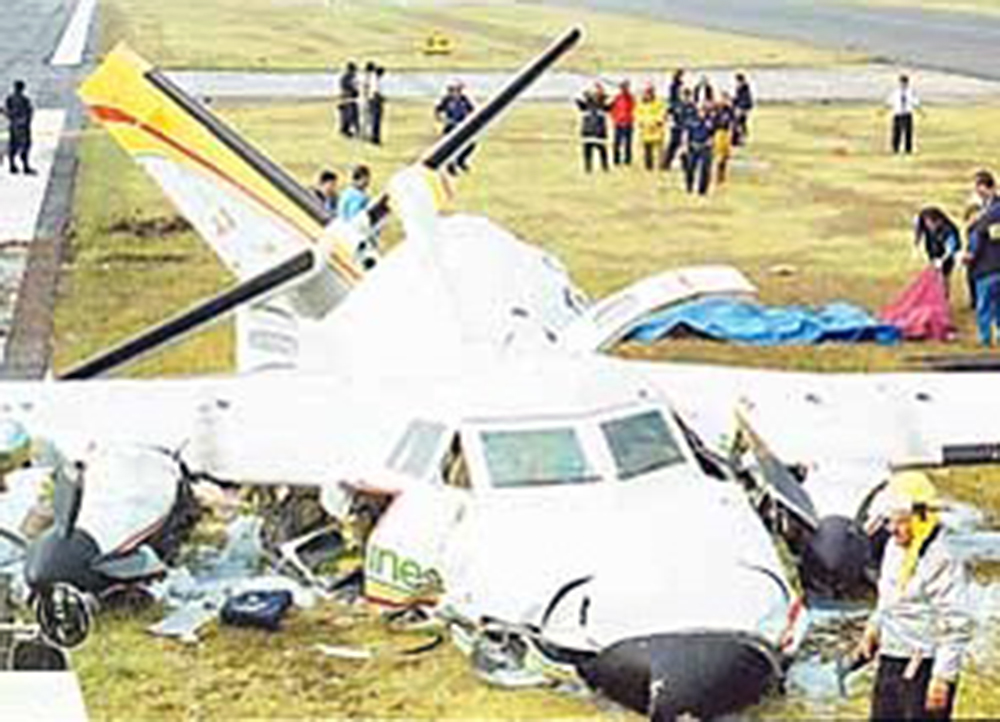
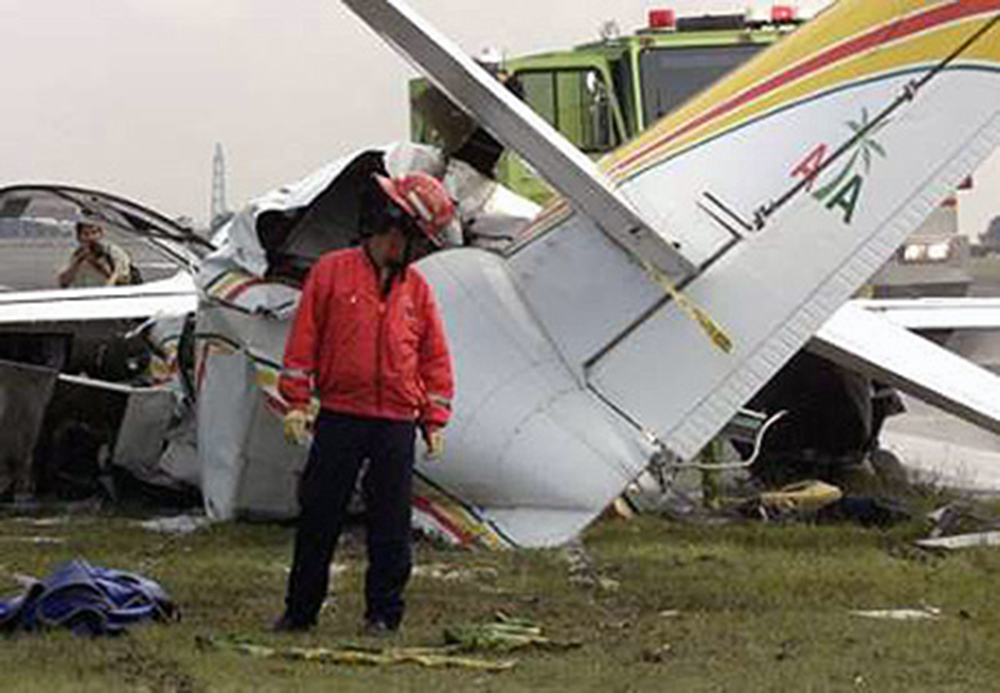
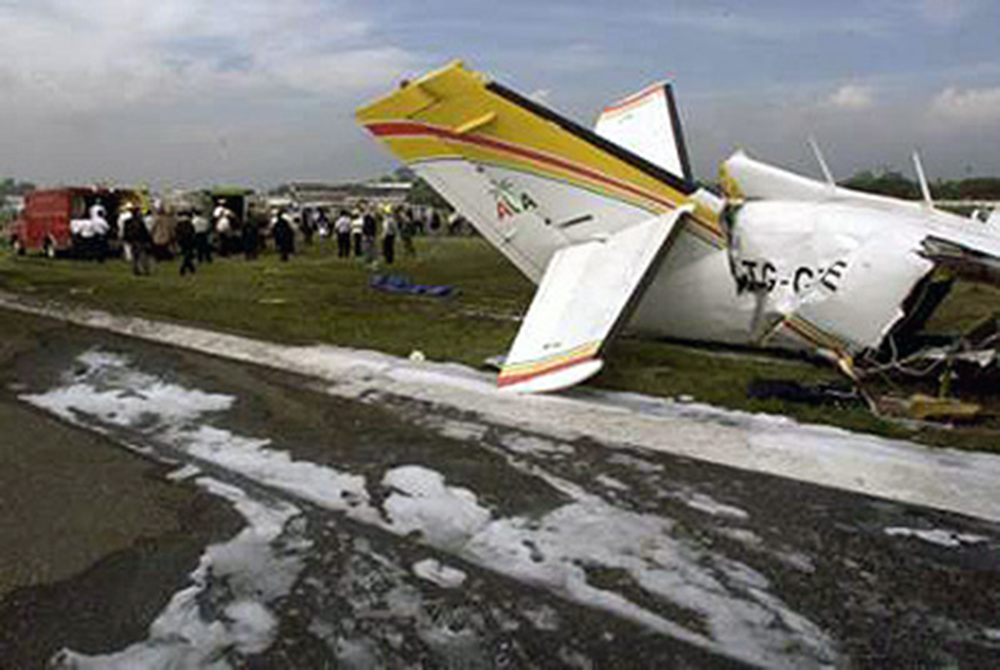
Crash of a Let L-410UVP-E in Guatemala City: 8 killed

Date & Time: Sep 18, 2001 at 0642 LT
Type of aircraft:
Operator:
Registration:
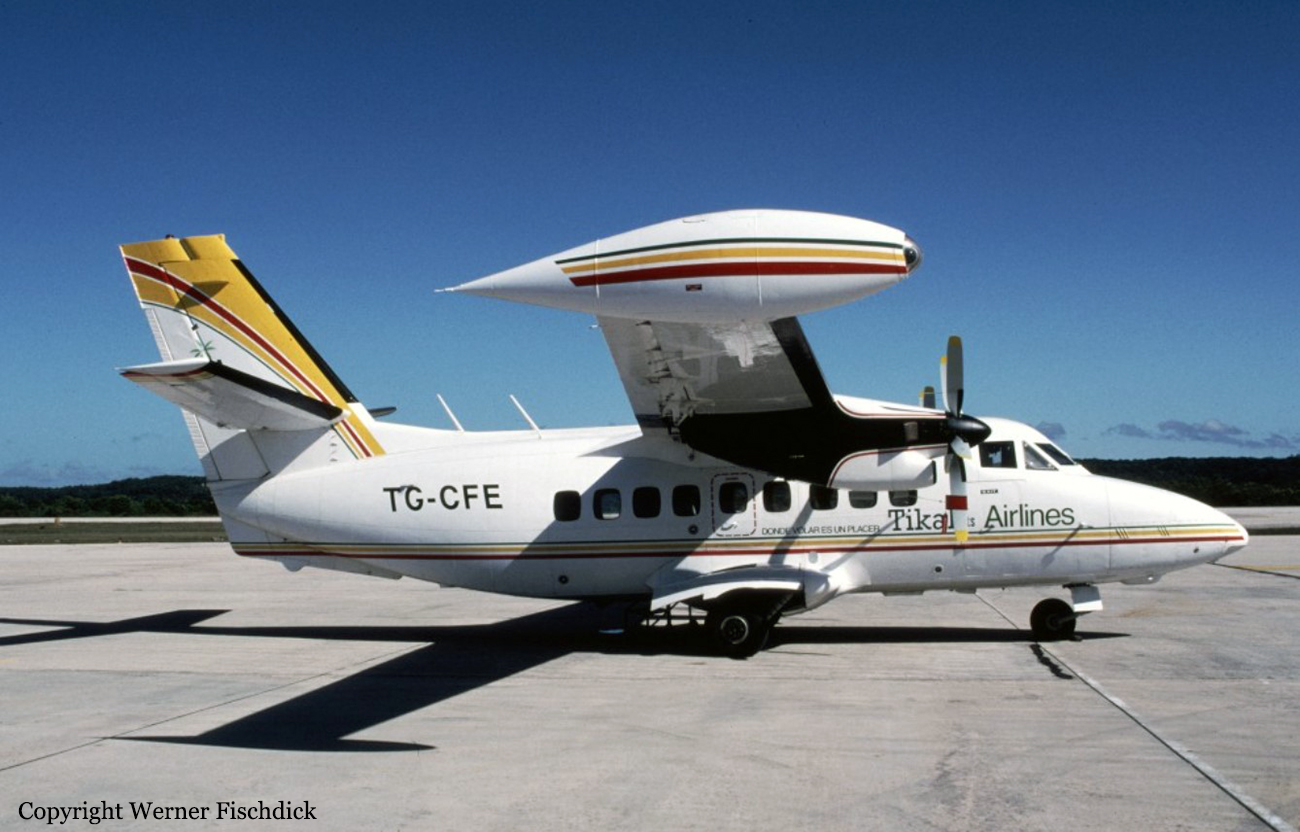
TG-CFE
Flight Phase:
Survivors:
Yes
Schedule:
Guatemala City – San Pedro Sula
MSN:
86 17 05
YOM:
1986
Flight number:
ATL870
Country:
Crew on board:
2
Crew fatalities:
Pax on board:
11
Pax fatalities:
Other fatalities:
Total fatalities:
8
Aircraft flight hours:
2467
Aircraft flight cycles:
4001
Circumstances:
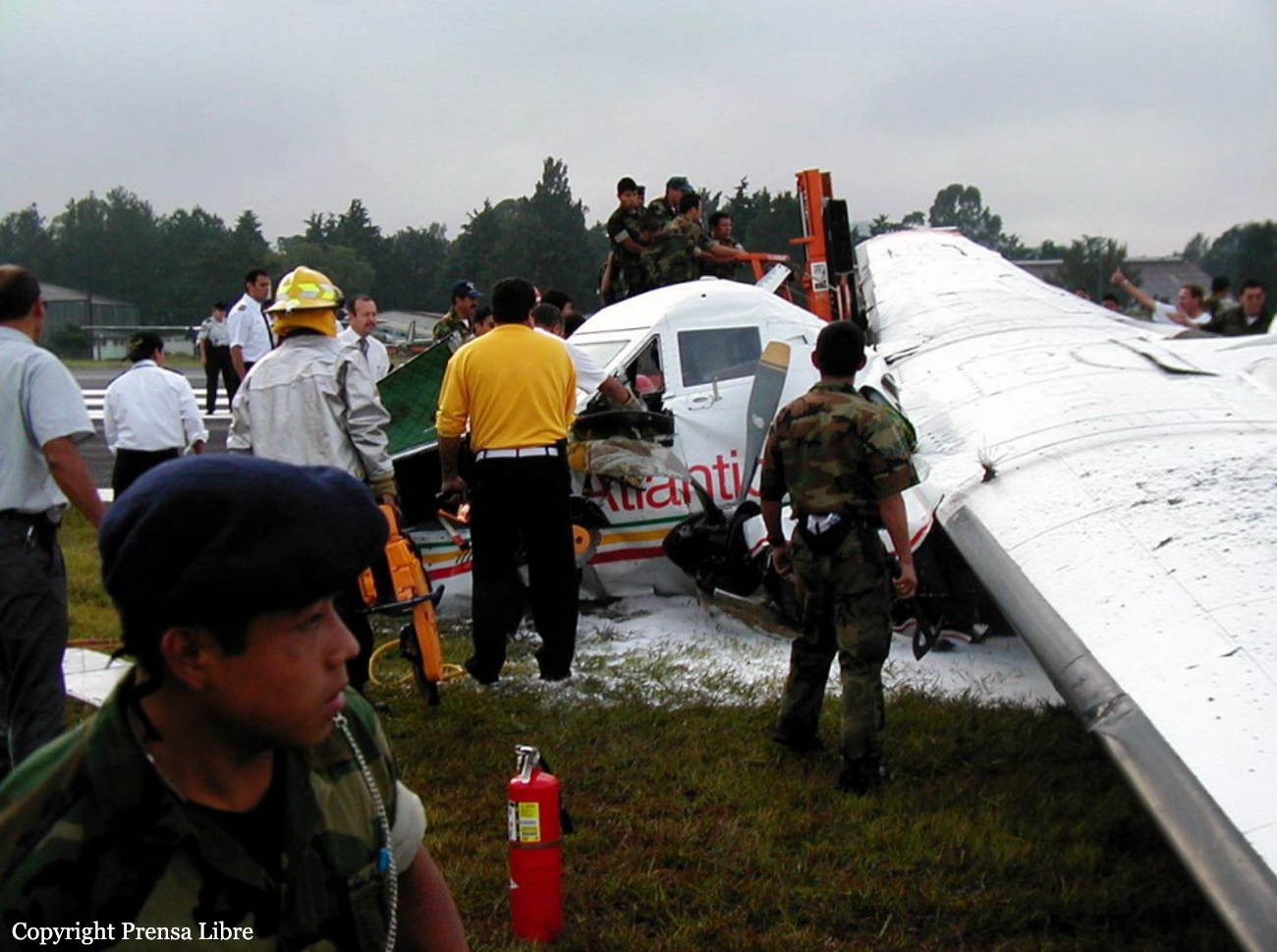
After takeoff from runway 01 at Guatemala City-La Aurora Airport, while climbing to a height of 200 feet, the twin engine aircraft rolled left and right then stalled and crashed beside the runway, about 550 metres from its end. The copilot and four passengers were injured while eight other occupants including the captain were killed. The aircraft was totally destroyed.
Probable cause:
It was determined that the aircraft stalled during initial climb because the passengers seats were not properly allocated, causing the center of gravity to be outside the permissible limit. The following contributing factors were identified:
- The Atlantic Airlines company, at the date of the accident, did not have sufficiently trained administrative and operational personnel for a safe operation.
- The poor allocation of the passengers inside the cabin affected lift, causing the aircraft to stall. Due to its low height, it was impossible to expect a stall recovery. This shows that the aircraft collapsed completely without move on the ground and being destroyed by the weight of the engines and their wings that were full of fuel.
- Lack of crew training, especially the copilot who was not rated on this type of aircraft. Thus, he was not able to assist the captain in an emergency situation but only reading the checklist.
- The engines were operating normal at the time of impact and they were running in normal takeoff conditions.
- No evidence of mechanical failure was found.
- The accident shows that the aircraft was operating normally, but that due to aerodynamic circumstances, it entered a stall and crashed on the ground abruptly and uncontrollably.
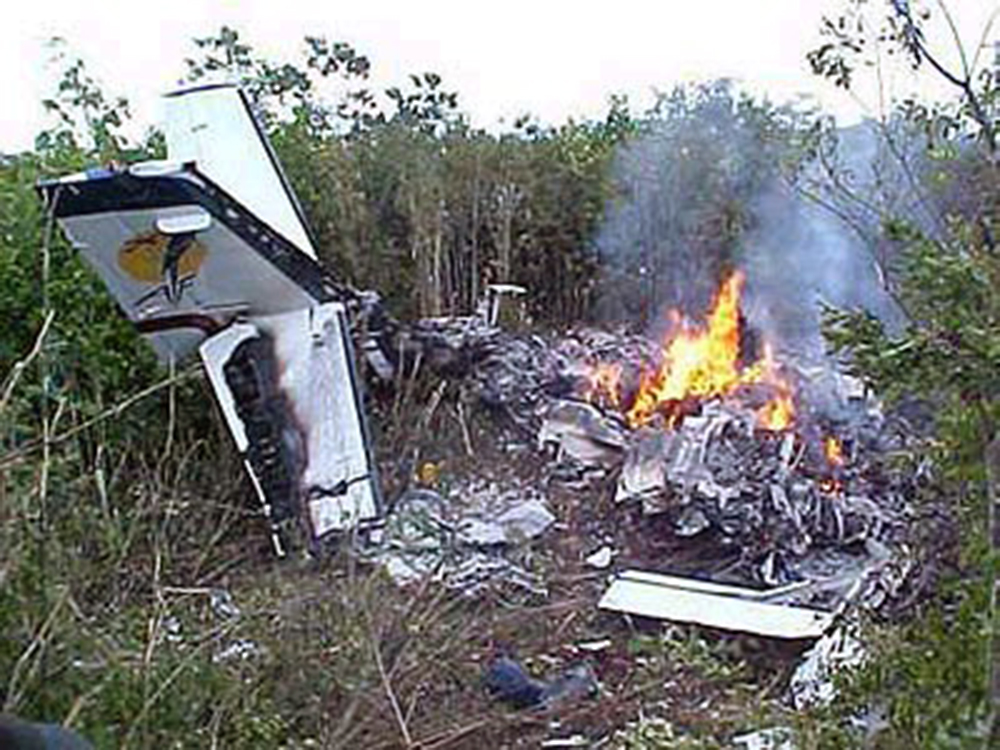
Crash of a Let L-410UVP-E in Chichén Itzá: 19 killed

Date & Time: Sep 12, 2001 at 1620 LT
Type of aircraft:
Operator:
Registration:
XA-ACM
Flight Phase:
Survivors:
No
Schedule:
Chichén Itzá – Cozumel
MSN:
89 24 01
YOM:
1989
Country:
Crew on board:
3
Crew fatalities:
Pax on board:
16
Pax fatalities:
Other fatalities:
Total fatalities:
19
Captain / Total flying hours:
7100
Copilot / Total flying hours:
1000
Aircraft flight hours:
1903
Aircraft flight cycles:
3654
Circumstances:
Shortly after takeoff from Chichén Itzá Airport runway 28, while climbing to a height of about 500 feet, the aircraft rolled to the right, stalled and crashed in a wooded area located about one km past the runway end, bursting into flames. The aircraft was totally destroyed by a post crash fire and all 19 occupants were killed, among them US and Canadian citizens and three Mexican, both pilots and a local tourist guide.
Probable cause:
It was determined that the aircraft rolled through 2,100 of the 2,800 metres of runway 28 and that the right engine failed while its propeller autofeathered. Investigations were unable to determine the exact cause of the right engine failure. Nevertheless, appropriate flight techniques were not applied by the crew.

Crash of a Let L-410UVP in Maiduguri

Date & Time: Jan 23, 2001 at 2130 LT
Type of aircraft:
Operator:
Registration:
9L-LCG
Survivors:
Yes
Schedule:
Jos – Maiduguri
MSN:
85 15 31
YOM:
1985
Location:
Country:
Region:
Crew on board:
4
Crew fatalities:
Pax on board:
14
Pax fatalities:
Other fatalities:
Total fatalities:
0
Circumstances:
The twin engine aircraft departed Jos on a charter flight to Maiduguri, carrying 14 passengers and four crew members for the Nigerian daily newspaper 'This Day'. After takeoff from Jos Airport, the crew was informed about good weather conditions at destination with a 9 km visibility that dropped few minutes later to 5 km. While approaching Maiduguri, the crew encountered poor weather conditions and ATC advised the crew to divert to another airport. The crew followed a holding pattern for few minutes for weather improvement but informed ATC that he was unable to divert due to insufficient fuel reserve. Eventually, the captain attempted an emergency landing 12 km from the airport. The aircraft crash landed in an open field and came to rest. All 18 occupants escaped with minor injuries and the aircraft was damaged beyond repair.
Probable cause:
Forced landing due to the deterioration of the weather conditions with tropical storm. Poor flight preparation from the crew who miscalculated the fuel reserve for a possible alternate airport. It was also determined that the crew was unable to locate the runway because the intensity of the runway light system was too low.

Crash of a Let L-410UVP in Freetown

Date & Time: Aug 24, 2000 at 1406 LT
Type of aircraft:
Registration:
9L-LBN
Flight Phase:
Flight Type:
Survivors:
Yes
Schedule:
Freetown - Freetown
MSN:
851334
YOM:
1985
Country:
Region:
Crew on board:
2
Crew fatalities:
Pax on board:
0
Pax fatalities:
Other fatalities:
Total fatalities:
0
Circumstances:
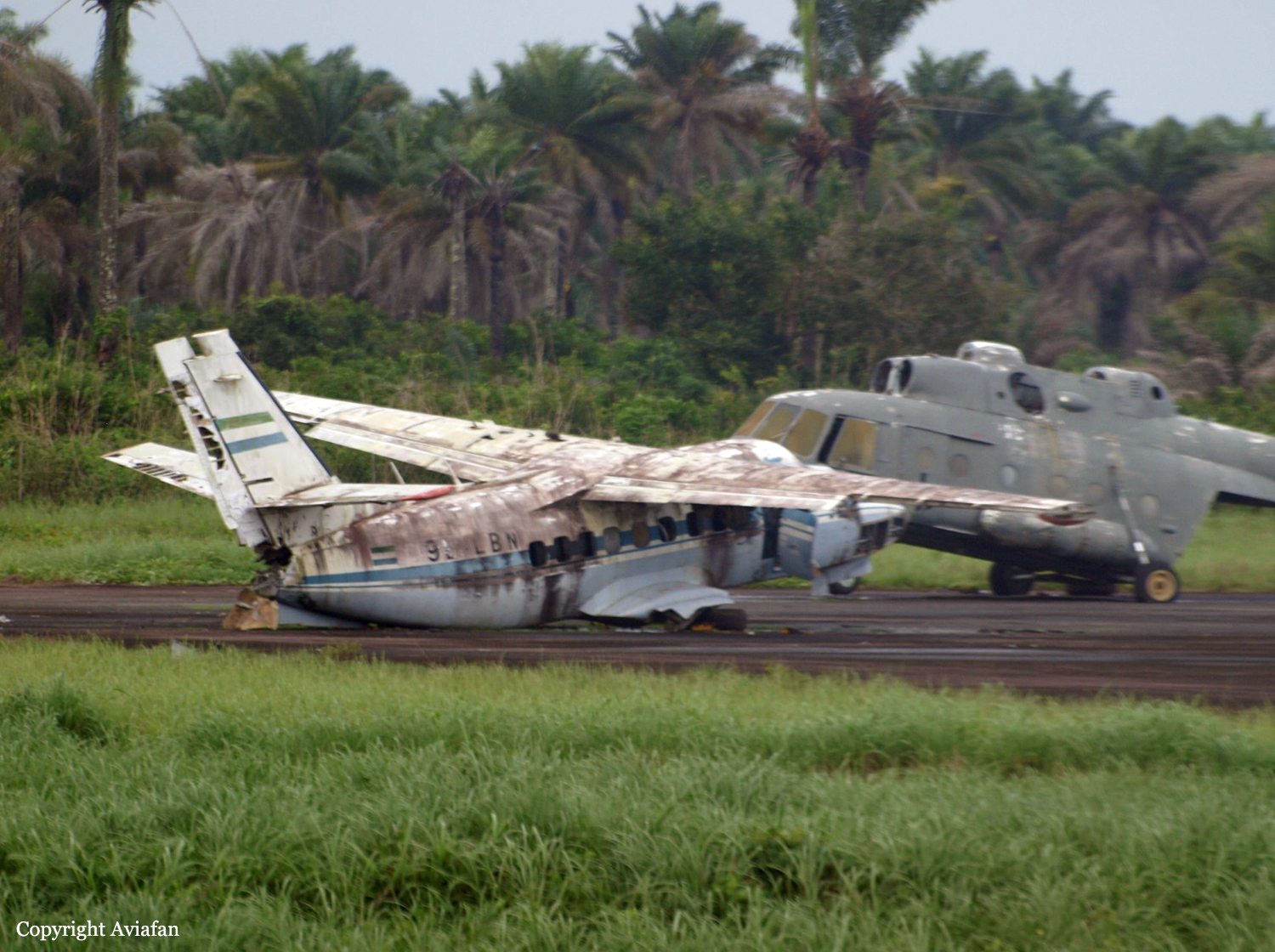
The crew departed Freetown-Lungi Intl Airport on a short positioning flight to Freetown-Hastings Airport. After takeoff, during initial climb, the twin engine aircraft entered clouds at an altitude of about 500 feet. While exiting the clouds, the crew noticed a Mil Mi-8 helicopter flying nearby. His crew was completing a local flight on behalf of the UNO. The crew of the Let attempted an evasive manoeuvre but the rotor of the helicopter struck the base of the aircraft's tail. The crew managed to return for an emergency landing but the undercarriage partially failed upon landing. Both pilots escaped uninjured while the aircraft was damaged beyond repair. The crew of the helicopter was able to land safely.
Probable cause:
It was established that the crew of the Mi-8T helicopter did not pay attention to the radio communication between the controller and the crew of the L-410 aircraft. The crew of the Mi-8T helicopter was distracted because they were talking about the barge that sank on the coast. This barge was located on the left side of the helicopter, while Lungi Airport and the Let L-410 were on the right side.

Crash of a Let L-410UVP-E in San José: 5 killed

Date & Time: Jan 15, 2000 at 1304 LT
Type of aircraft:
Registration:
YS-09-C
Flight Phase:
Survivors:
Yes
Site:
Schedule:
San José - Tortuguero
MSN:
86 16 20
YOM:
1986
Country:
Crew on board:
3
Crew fatalities:
Pax on board:
15
Pax fatalities:
Other fatalities:
Total fatalities:
5
Captain / Total flying hours:
7801
Copilot / Total flying hours:
3000
Circumstances:
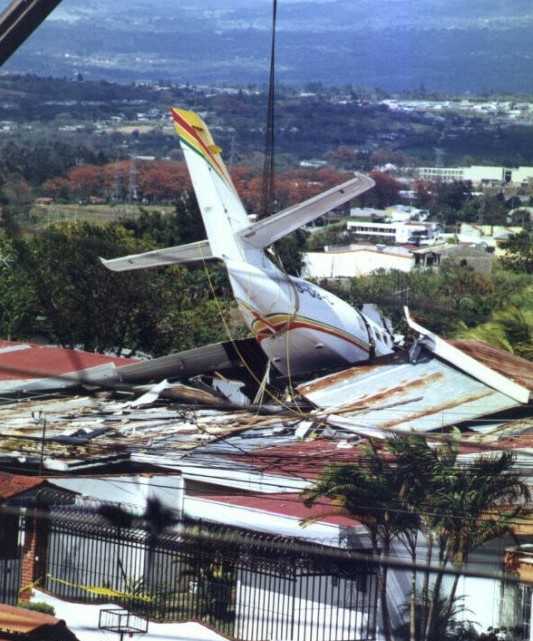
After takeoff from San José-Tobías Bolaños Airport, en route to the Tortuguero National Park, while in initial climb, the aircraft stalled and crashed onto a house located in the district of Rohrmoser, about 3 km southeast of the airport. Four passengers were killed while 14 other occupants were injured, some seriously. Three people in the house, a nurse and two little girls were uninjured. Fifteen days after the accident, on January 30, the captain died from his injuries.
Probable cause:
Possible loss of longitudinal control of the aircraft in flight, due to not reaching the minimum climb speed, due to a wrong takeoff configuration as the flaps were retracted (zero position).
The following contributing factors were identified:
- Inadequate weight distribution that affected the position of the aircraft.
- The CofG was beyond the rear limit, out of the envelope.
- The crew failed to follow the pre-takeoff checklist.
- The total weight of the aircraft was above the MTOW.
- The high density altitude.
- Lack of supervision of the dispatch of the flight by the operator. (Absence of procedures).
- Self-induced pressure from the crew for an expeditious operation.
Final Report:

Crash of a Let L-410UVP-E near Kasibu: 17 killed

Date & Time: Dec 7, 1999 at 0930 LT
Type of aircraft:
Operator:
Registration:
RP-C3883
Flight Phase:
Survivors:
No
Site:
Schedule:
Manila - Cauayan
MSN:
89 22 28
YOM:
1989
Flight number:
RIT100
Country:
Region:
Crew on board:
2
Crew fatalities:
Pax on board:
15
Pax fatalities:
Other fatalities:
Total fatalities:
17
Captain / Total flying hours:
10000
Circumstances:
The twin engine aircraft departed Manila-Ninoy Aquino Airport at 0834LT and was supposed to arrive at Cauayan Airport at 0940LT. At 0919LT, the crew reported his position 96 km from the destination. As he encountered favorable winds, the captain informed ATC about an ETA three minutes earlier at 0937LT. At 0930LT, while flying in clouds, the aircraft struck the slope of a mountain located near Kasibu, about 77 km southwest of Cauayan Airport. The aircraft was destroyed upon impact and all 17 occupants were killed.
Probable cause:
Controlled flight into terrain.

Crash of a Let L-410UVP-E9 in Arusha

Date & Time: Jul 26, 1999 at 1610 LT
Type of aircraft:
Operator:
Registration:
5H-PAB
Flight Type:
Survivors:
Yes
Schedule:
Arusha - Arusha
MSN:
96 27 15
YOM:
1996
Country:
Region:
Crew on board:
2
Crew fatalities:
Pax on board:
0
Pax fatalities:
Other fatalities:
Total fatalities:
0
Captain / Total flying hours:
12000
Captain / Total hours on type:
700.00
Circumstances:
The aircraft took off from Arusha Airport (ARK) at 12:35 hours for a circuit training. It was carrying one instructor, a pilot trainee and three passengers. The aircraft was flying VFR. The instructor said that he intended to execute nine touch and go circuit operations, three of which were to be performed with 42° flaps, another three with 18° flaps and the rest with zero degree flaps. The first six circuits were performed uneventfully. Before initiating the first flapless landing the instructor ordered the trainee to extend his approach and establish a six-mile final to runway 09. When the aircraft was established on the final for runway 09 the instructor saw that the aircraft was a bit too low and ordered the trainee to adjust his approach. After 5H-PAB was established on the approach slope the instructor advised the trainee to call when he needed props fully forward (setting propellers into full coarse pitch). This he subsequently did and the instructor, aware of the relatively high aircraft speed for the configuration advised the trainee to be careful on the flare in order to avoid the possibility of the tail skid hitting the ground. When the aircraft was flared, the tail skid hit and scraped the ground followed by the belly and the nose underside section. After sliding for 164 metres the aircraft came to rest on the runway with the engines still running. The instructor carried out the emergency shut down checks and evacuated the aircraft. It was only after touchdown that the crew realised that they had belly landed. The commander then proceeded to select reverse thrust. There was no fire and none of the occupants was injured. The instructor said that he had forgotten to lower the landing gear because of his preoccupation with the rate of descent and the execution of the flapless flare. The pilot under instruction testified that he had concentrated too much an the technical side of flying to the point of forgetting to call for the gear down selection. There was only one checklist in use in the cockpit which was contained in a book and this was being used by the instructor. The instructor testified to have used the checklist for the first six landings. The checklist was not used for the accident landing. None pilot of the pilots reported to have heard the landing gear horn.
Probable cause:
Failure of the crew to follow the approach checklist and to lower the landing gear.