Country
Crash of a Beechcraft 200 Super King Air in Banjul: 9 killed
Date & Time:
Oct 10, 1997 at 0252 LT
Operator:

Registration:
EC-ERQ
Survivors:
Yes
Schedule:
Las Palmas - Banjul
MSN:
BB-218
YOM:
1977
Crew on board:
2
Crew fatalities:
Pax on board:
8
Pax fatalities:
Other fatalities:
Total fatalities:
9
Circumstances:
Following an uneventful flight from Las Palmas, the crew started the descent to Banjul-Yundum Airport. The visibility was limited due to the night and poor weather conditions with low clouds and heavy rain falls from a tropical storm. On final approach, the aircraft crashed 4,300 metres short of runway 32. The wreckage was found 800 metres to the right of the extended centerline. A passenger was seriously injured while nine other occupants, among them German tourists, were killed.

Crash of a Beechcraft 200 Super King Air in Dalton: 1 killed
Date & Time:
Aug 14, 1997 at 0611 LT
Operator:

Registration:
N74EJ
Survivors:
No
Schedule:
Athens - Dalton
MSN:
BB-340
YOM:
1978
Crew on board:
1
Crew fatalities:
Pax on board:
0
Pax fatalities:
Other fatalities:
Total fatalities:
1
Captain / Total hours on type:
103.00
Aircraft flight hours:
6328
Circumstances:
The pilot was cleared for a localizer approach by Atlanta Center and told to maintain 5,000 feet until crossing the final approach fix (FAF). Normal altitude at the FAF was 2,700 feet. The pilot was unable to land from this approach and performed a missed approach. He was handed off to Chattanooga Approach, then was cleared to cross the FAF at 3,000 feet and perform another localizer approach. About one mile from the FAF, the pilot was told to change to the airport advisory frequency. The pilot acknowledged, then there was no further communication with the aircraft. A short time later, witnesses heard the aircraft crash near the approach end of the runway. Examination of the crash site showed the aircraft had touched down in a grass area about 1,100 feet from the end of the runway, while on the localizer. Propeller slash marks showed both engines were operating at approach power and the aircraft was at approach speed. No evidence of precrash mechanical failure or malfunction of the aircraft structure, flight controls, systems, engines, or propellers was found. The 0621 weather was in part: 300 feet overcast and 1/2 mile visibility with fog. Minimum descent altitude (MDA) for the localizer approach was 1,180 feet msl; airport elevation was 710 feet. The pilot had flown 8 flight hours, was on duty for 13.6 hours the day before the accident, was off duty for about 6 hrs, and had about 4 hours of sleep before the accident flight.
Probable cause:
The pilot's improper IFR procedure, by failing to maintain the minimum descent altitude (MDA) during the ILS localizer approach, until the runway environment was in sight, which resulted in a collision with terrain short of the runway. Factors relating to the accident were: darkness, low ceiling, fog, pilot fatigue, and improper scheduling by the aircraft operator.
Final Report:
Crash of a Beechcraft 200 Super King Air in Luanda
Date & Time:
May 28, 1997
Operator:

Registration:
D2-ECL
Survivors:
Yes
Schedule:
Luanda – Lucapa – Dundo – Lucapa – Luanda
MSN:
BB-44
YOM:
1975
Crew on board:
2
Crew fatalities:
Pax on board:
4
Pax fatalities:
Other fatalities:
Total fatalities:
0
Circumstances:
On final approach to Luanda-4 de Fevereiro Airport, following an uneventful flight from Lucapa, both engines failed simultaneously. The aircraft lost speed then stalled and crashed 510 metres short of runway threshold. All six occupants were injured and the aircraft was destroyed. As no fuel was available at Lucapa and Dundo Airport, the crew prepared the tour with a fuel autonomy of six hours, which should be a minimum as the flight calculation for the all tour was five hours and 20 minutes. It was determined that in-flight, the crew encountered poor weather conditions and was forced to modify his route, increasing flight time and fuel consumption.
Probable cause:
Double engine failure on final approach caused by a fuel exhaustion.
Crash of a Beechcraft B200C Super King Air in Steynsburg
Date & Time:
May 10, 1997 at 1700 LT
Operator:

Registration:
ZS-LNV
Survivors:
Yes
Schedule:
Steynsburg - Pretoria
MSN:
BL-71
YOM:
1983
Crew on board:
2
Crew fatalities:
Pax on board:
5
Pax fatalities:
Other fatalities:
Total fatalities:
0
Circumstances:
During the takeoff roll, the twin engine aircraft struck a dip, causing a propeller to struck the ground and the aircraft to lose power and speed. Unable to take off, the aircraft veered off runway to the left, went through three fences, crossed a dirt road and came to rest in an open field. All seven occupants were rescued, among them one was slightly injured. The aircraft was dispatched in Steynsburg to enable five forensic experts and detectives to conduct an investigation of suspected arson, as the Grand Hotel at the town was destroyed by fire.
Crash of a Beechcraft 200 Super King Air in Salt Lake City: 1 killed
Date & Time:
Mar 2, 1997 at 1913 LT
Registration:
N117WM
Survivors:
Yes
Schedule:
Las Vegas - Salt Lake City
MSN:
BB-662
YOM:
1980
Crew on board:
1
Crew fatalities:
Pax on board:
3
Pax fatalities:
Other fatalities:
Total fatalities:
1
Captain / Total hours on type:
1841.00
Aircraft flight hours:
4692
Circumstances:
The flight was on a coupled instrument landing system (ILS) approach with 1/2 mile visibility in snow showers. Three successive fixes on the localizer are defined by distance measuring equipment (DME) paired with the ILS; prior to the ILS DME commissioning 6 months before the accident, the DME fixes were defined by a VORTAC 4.7 nautical miles past the ILS DME. The aircraft was 800 feet high at the first fix and 1,500 feet high at the second, but approximately on altitude 4.7 nautical miles past the first and second fixes, respectively. It passed the outer marker 900 feet high and captured the glide slope from above about 1.8 nautical miles from the threshold, 500 feet above decision height (DH) and 700 feet above touchdown. The aircraft was on glide slope for 28 seconds, during which time its speed decayed to stall speed; it then dropped below glide slope and crashed 1.3 nautical miles short of the threshold. The pilot's FLT DIR DME-1/ DME-2 switch, which control the DME display on the pilot's horizontal situation indicator (HSI), was found set to DME-2; the NAV-2 radio was set to the VORTAC frequency. Up to 800 feet may be required for stall recovery.
Probable cause:
The pilot's failure to maintain adequate airspeed on the ILS approach, resulting in a stall. Factors included: low visibility; the pilot's selection of the improper DME for the approach; his resulting failure to attain the proper descent profile for the approach; and insufficient altitude available for stall recovery.
Final Report:
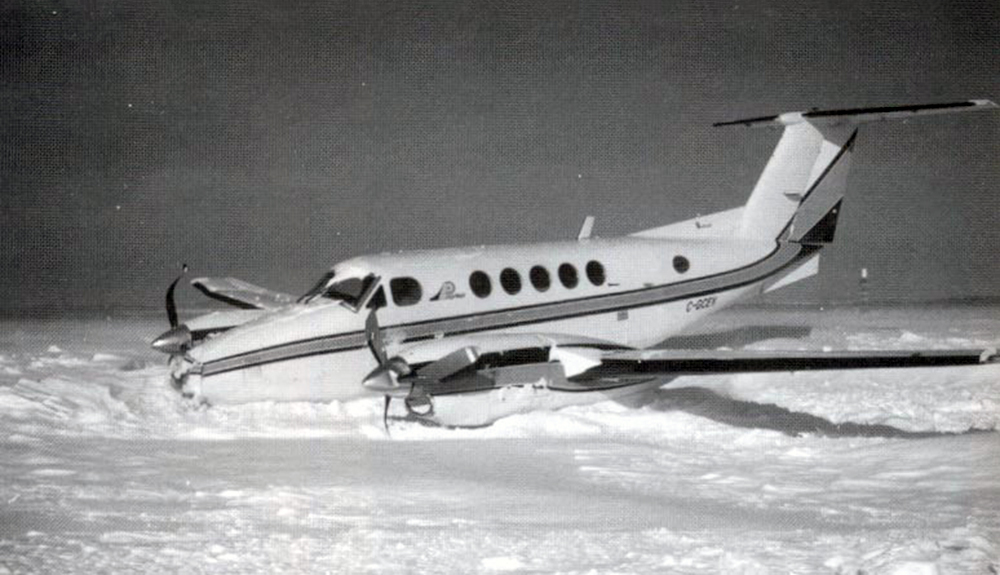
Crash of a Beechcraft 200 Super King Air in Seven Islands
Date & Time:
Jan 28, 1997 at 1700 LT
Operator:

Registration:
C-GCEV
Survivors:
Yes
Schedule:
Seven Islands - Montreal
MSN:
BB-153
YOM:
1976
Crew on board:
2
Crew fatalities:
Pax on board:
9
Pax fatalities:
Other fatalities:
Total fatalities:
0
Captain / Total hours on type:
1300.00
Circumstances:
The Propair Inc. Super King Air 200 (serial number BB-153), with two pilots and ten passengers on board, was preparing to make a charter flight under instrument flight rules from Sept-Îles to Dorval, Quebec. At 1700 eastern standard time (EST), the co-pilot, in the left seat, began the take-off roll on runway 09. At an indicated airspeed of about 90 knots, 5 knots below rotation speed (VR), the aircraft began to drift to the left, toward the runway edge. The copilot attempted unsuccessfully to correct the take-off track using the rudder. At around 100 knots, just before the aircraft exited the runway, the co-pilot pulled the elevator control all the way back and initiated a climb. At about the same moment, the pilot-in-command throttled back, believing that a collision with the snowbank at the runway edge was inevitable. The aircraft descended until it struck the snow-covered surface to the north of the runway and slid on its belly before coming to rest on a heading opposite to the take-off heading. The pilot-in-command was slightly injured. The aircraft sustained considerable damage. The occupants used the main door to evacuate the aircraft.
Probable cause:
The aircraft crashed as a result of the lack of cockpit co-ordination when the pilot-in-command took control of the aircraft as the aircraft was airborne. The following factors contributed to the occurrence: marginal environmental conditions; contaminated runway surface; poor cockpit management; ineffective briefing; and, inadequate training for rejected take-offs.
Final Report:
Crash of a Beechcraft 200 Super King Air near Bouaflé: 3 killed
Date & Time:
Jun 28, 1996 at 0900 LT
Operator:

Registration:
TU-TJE
Survivors:
No
Schedule:
Yamoussoukro - Yamoussoukro
MSN:
BB-163
YOM:
1976
Crew on board:
3
Crew fatalities:
Pax on board:
0
Pax fatalities:
Other fatalities:
Total fatalities:
3
Circumstances:
The crew was engaged in a local training flight at Yamoussoukro Airport. Following several circuits, the crew was cleared to descend from 3,000 to 1,000 feet for a new instrument approach. In limited visibility due to foggy conditions, the aircraft descended below de MDA then struck trees and crashed in a prairie located near Bouaflé, about 40 km northwest of Yamoussoukro Airport. All three pilots were killed.
Probable cause:
Controlled flight into terrain after the crew descended below MDA in poor visibility.