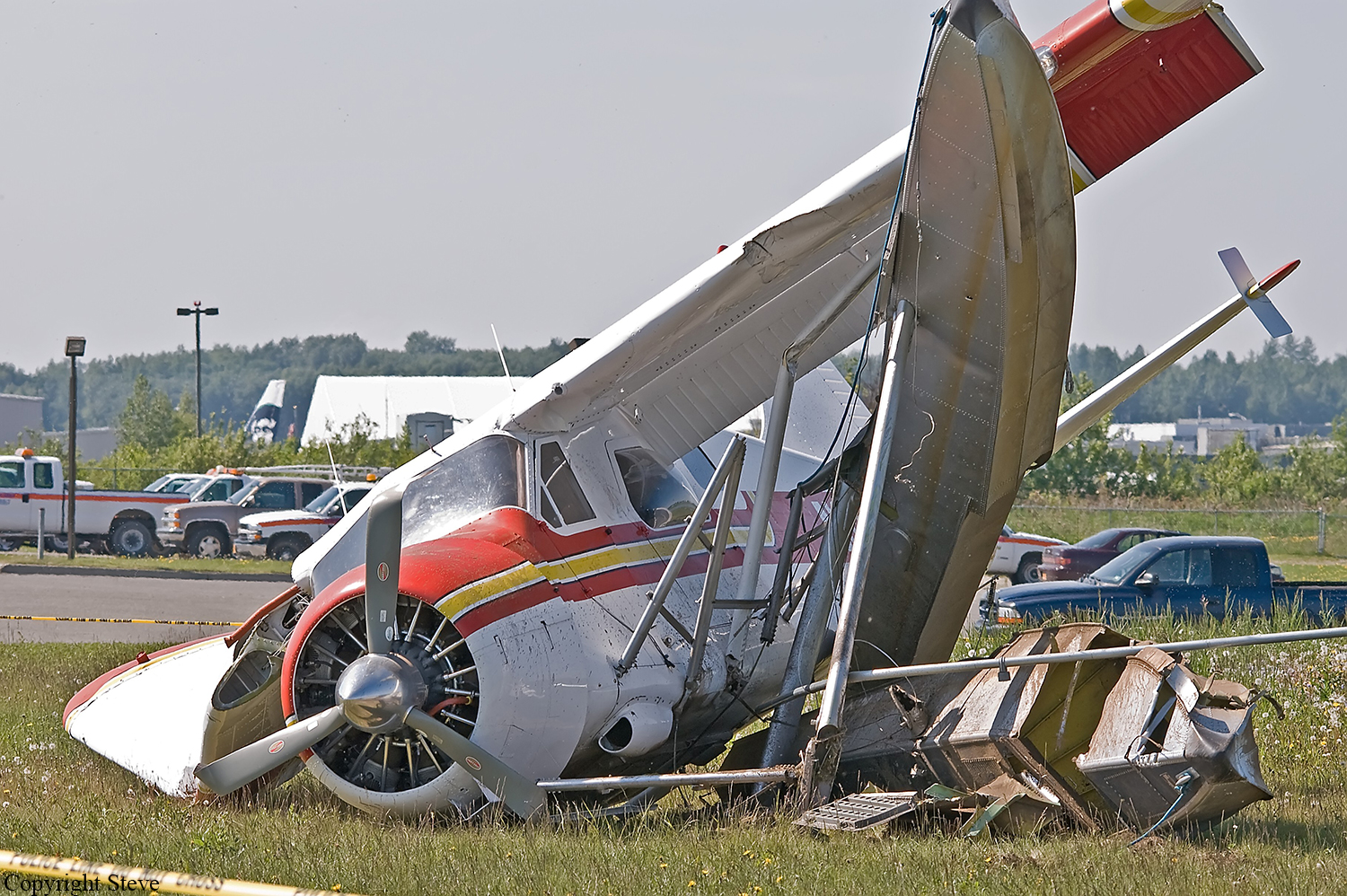
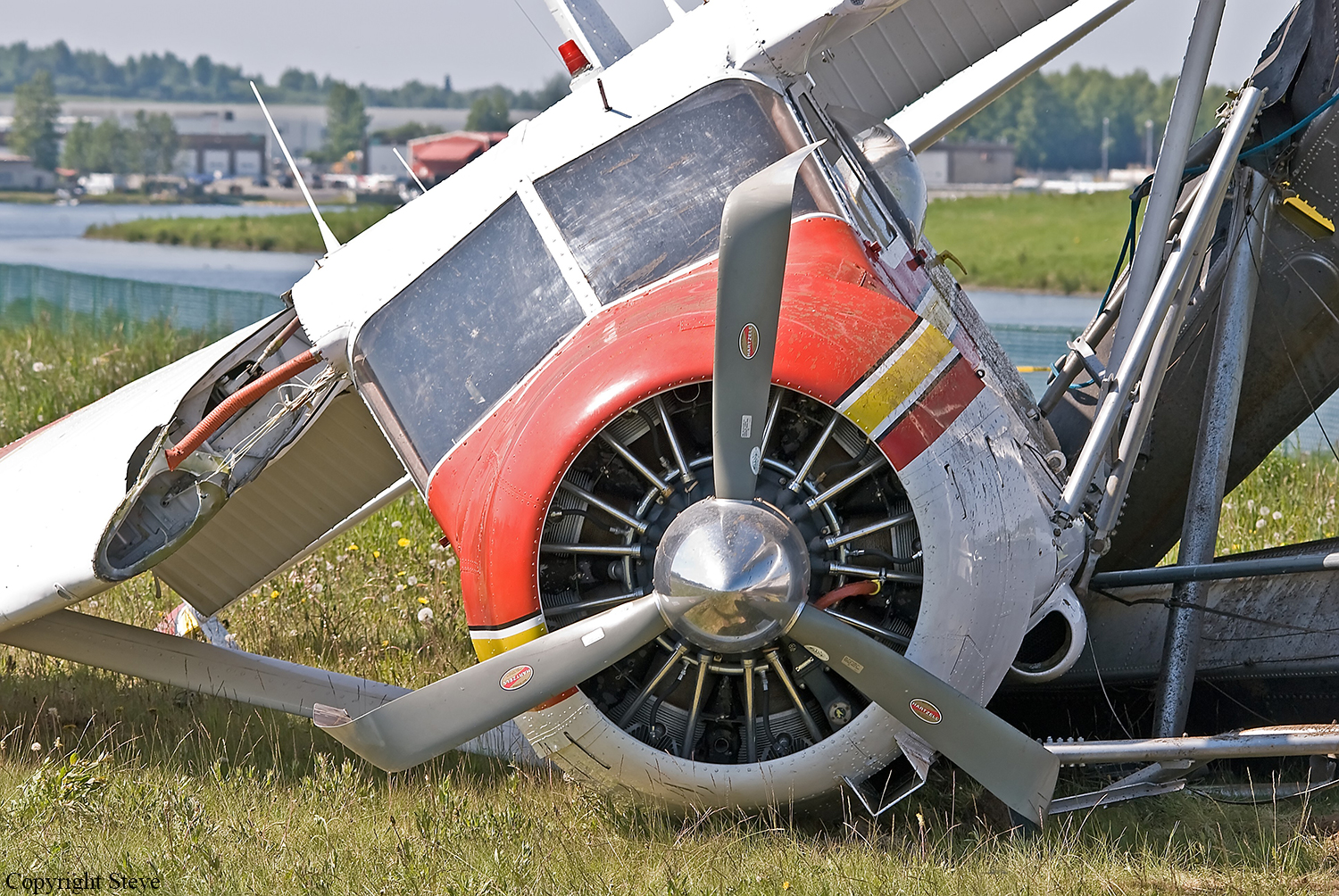
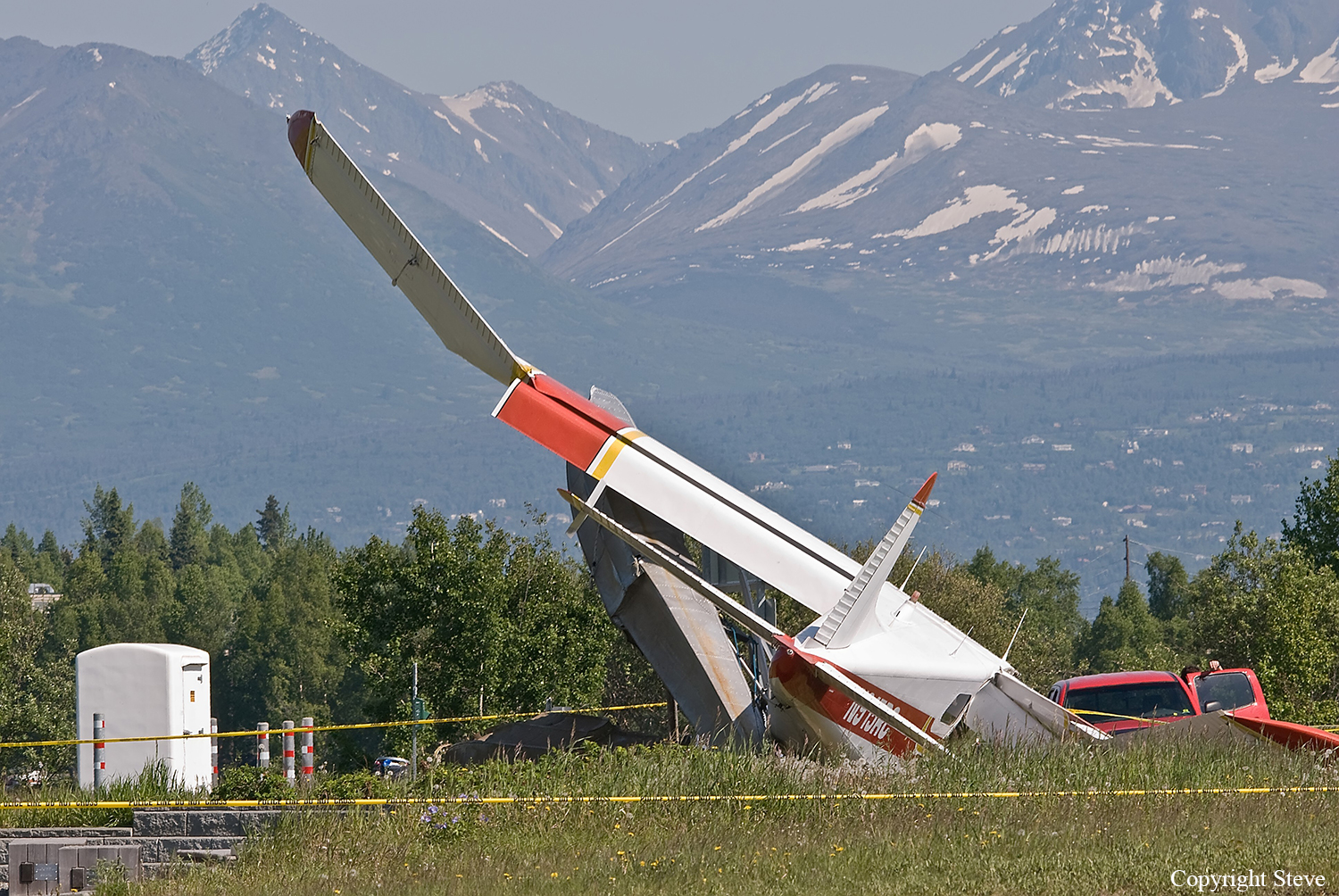
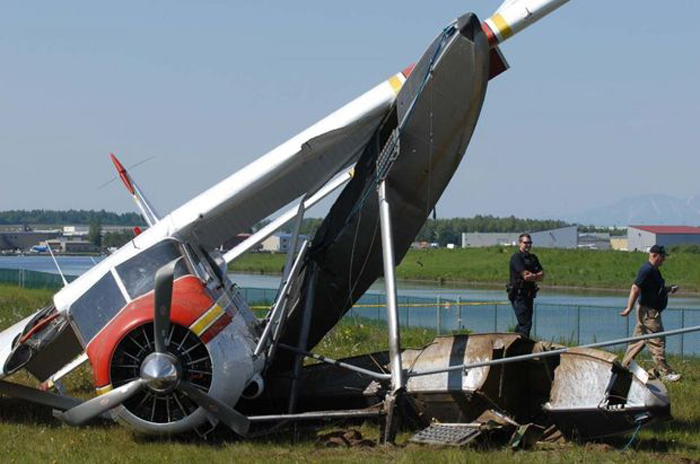
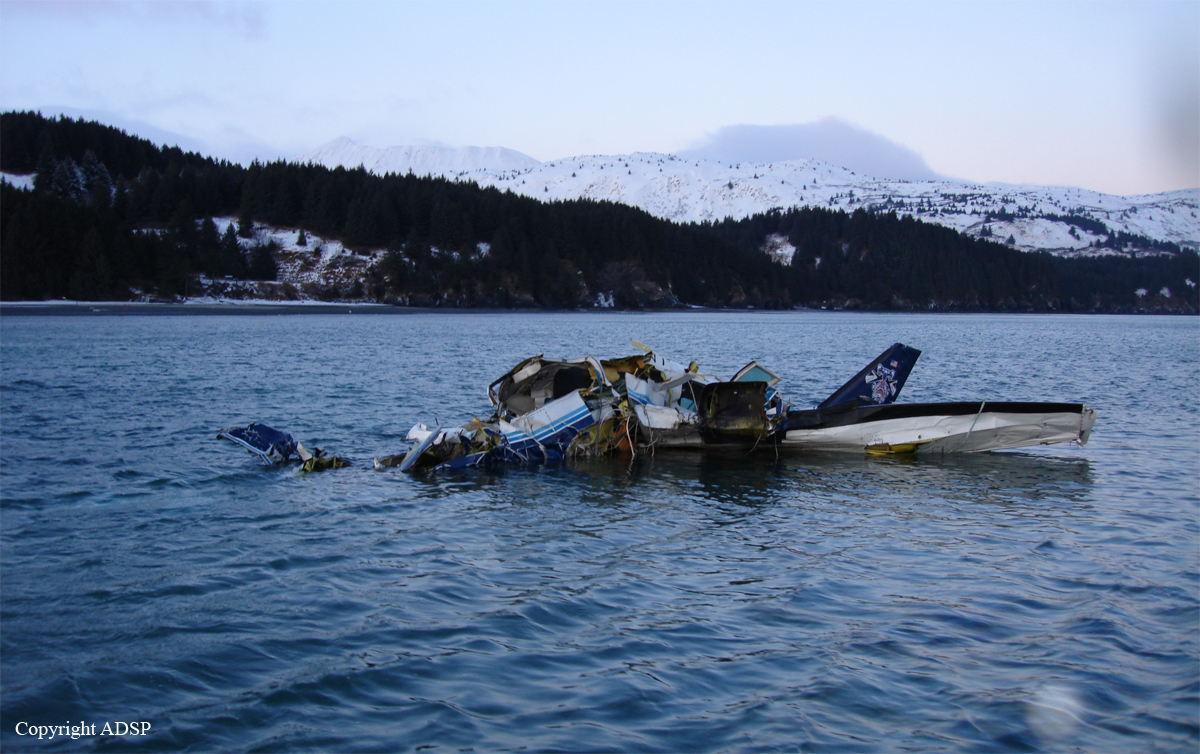
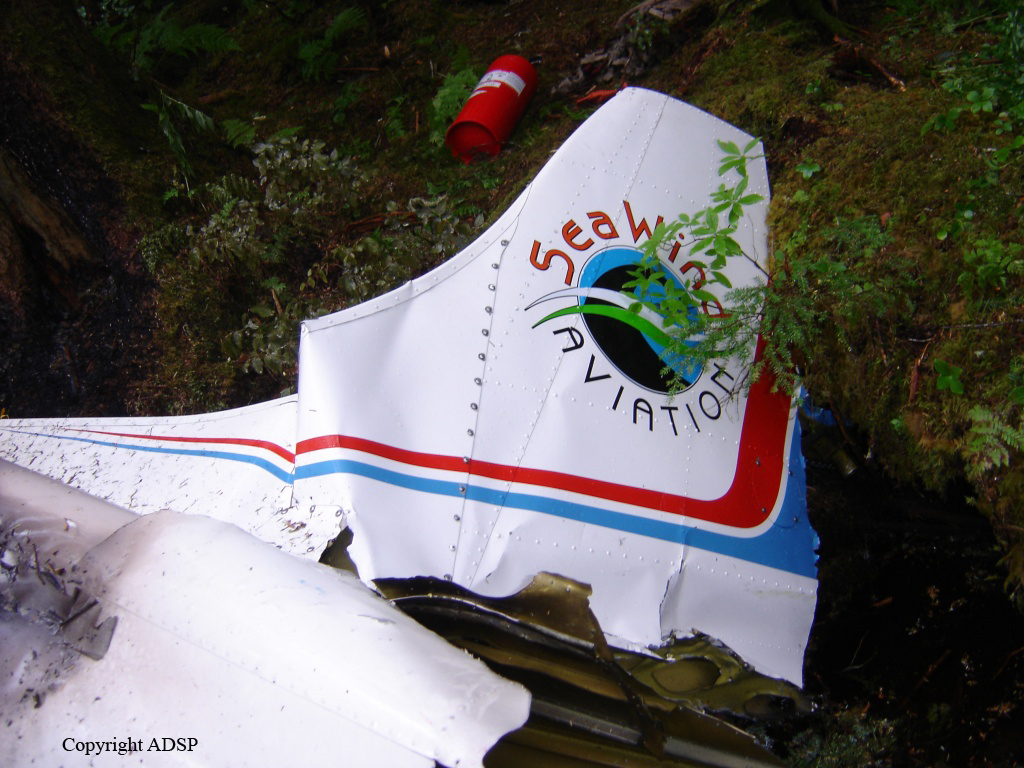
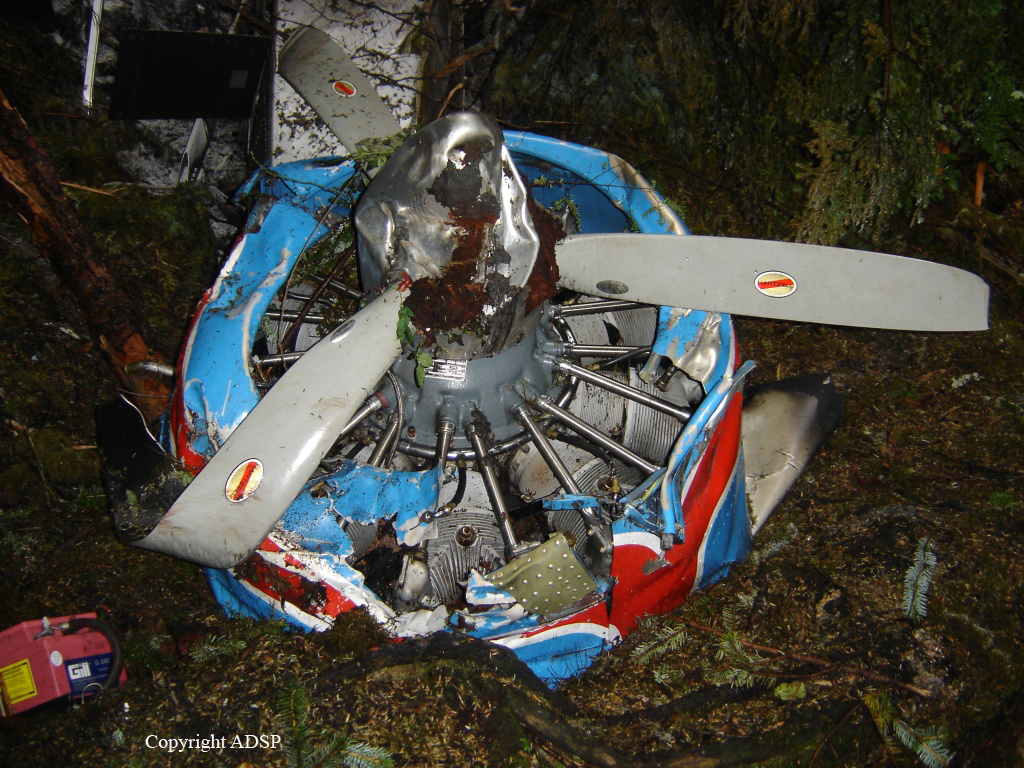
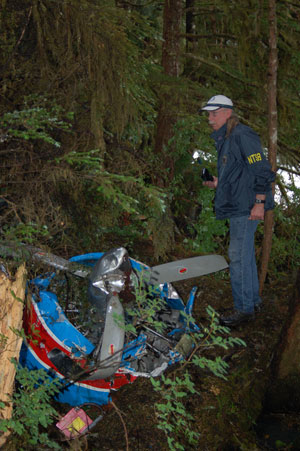
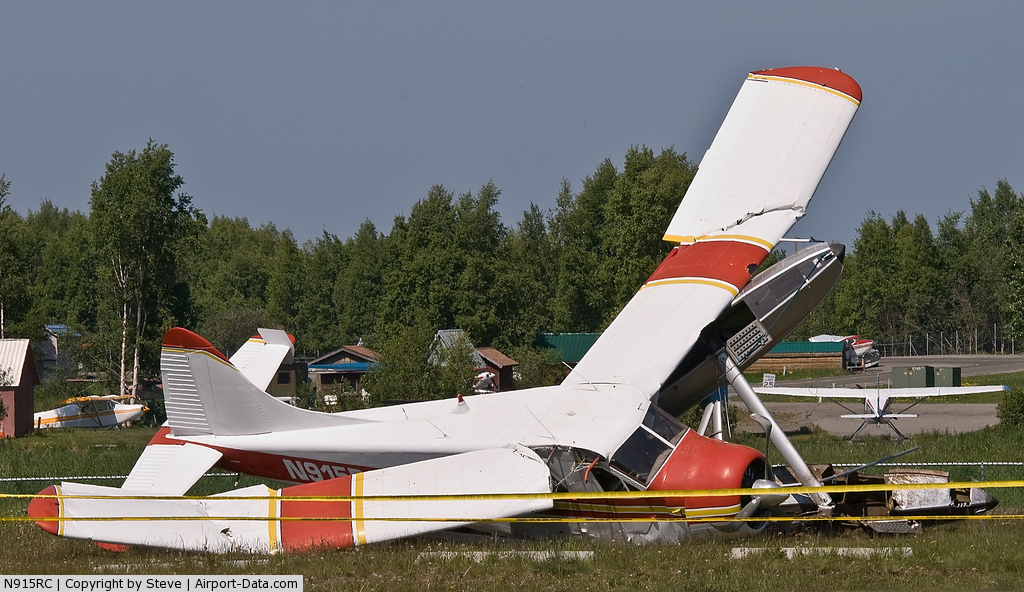
Crash of a De Havilland DHC-2 Beaver in Anchorage

Date & Time: Jun 7, 2009 at 1350 LT
Type of aircraft:
Operator:
Registration:
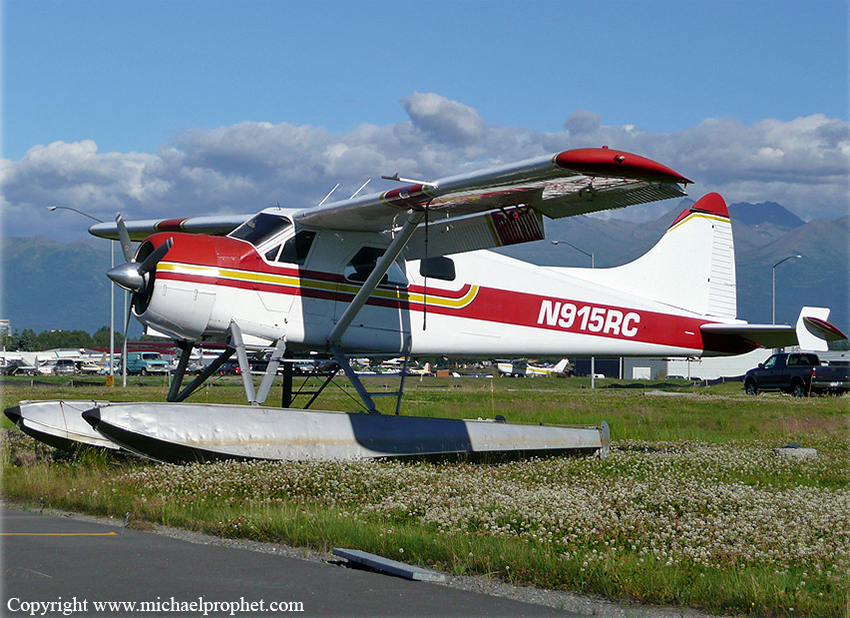
N915RC
Flight Phase:
Flight Type:
Survivors:
Yes
Schedule:
Anchorage - Bulchitna Lake
MSN:
70
YOM:
1950
Crew on board:
1
Crew fatalities:
Pax on board:
3
Pax fatalities:
Other fatalities:
Total fatalities:
0
Captain / Total flying hours:
512
Captain / Total hours on type:
21.00
Aircraft flight hours:
2350
Circumstances:
The private pilot was taking off in the float plane from the lake's west waterway. The airplane was on step, gaining airspeed, and the takeoff run seemed normal to the pilot. The airplane was nearing takeoff speed, and proceeding directly down the waterway, when it encountered a right quartering tailwind gust that lifted up the right wing and float. The airplane veered to the left toward a steep bank, and the pilot was unable to correct the deviation with the rudder. He did not feel that he could reduce power as he would slam into the bank. The airplane lifted off, but the float collided with the top of the bank. The airplane cartwheeled about 160 degrees to the left before coming to rest on its right side. It sustained substantial damage to the wings, fuselage, and floats. The pilot reported that there were no mechanical malfunctions or failures. Reported wind at the airport approximately 3 minutes after the accident was from 020 degrees magnetic at 3 knots, with no recorded gusts.
Probable cause:
The pilot’s failure to maintain directional control during takeoff.
Final Report:
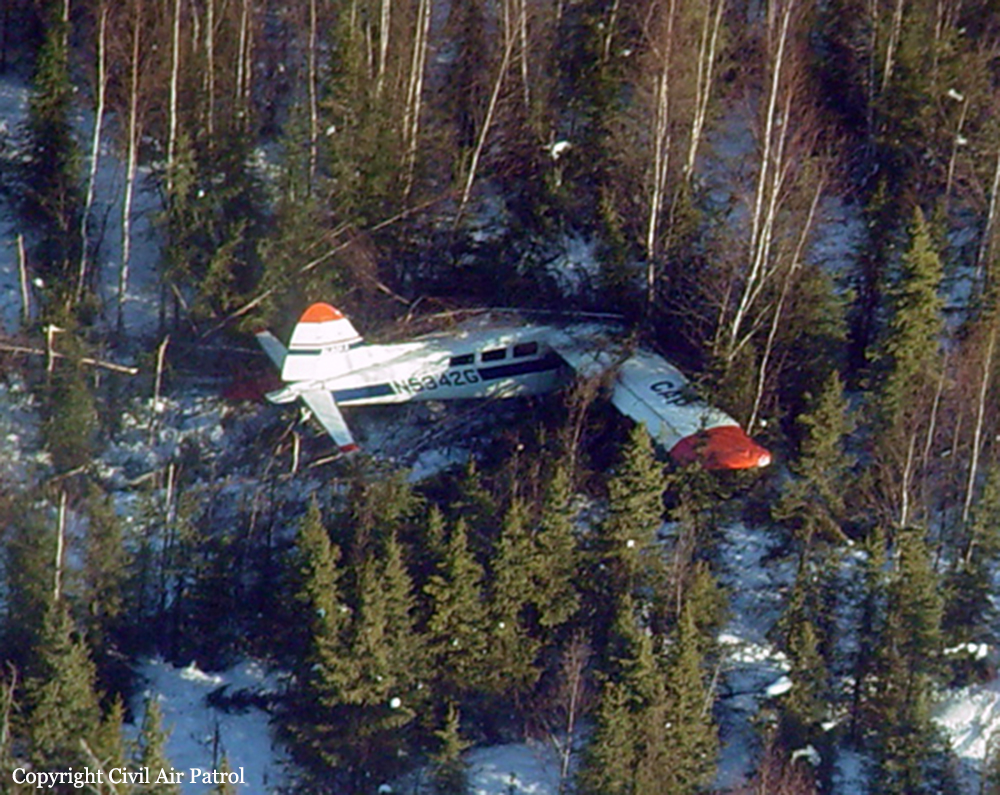
Crash of a De Havilland DHC-2 Beaver near Kenai

Date & Time: Feb 20, 2009 at 1515 LT
Type of aircraft:
Operator:
Registration:
N5342G
Flight Phase:
Flight Type:
Survivors:
Yes
Schedule:
Kenai - Kenai
MSN:
854
YOM:
1956
Location:
Crew on board:
3
Crew fatalities:
Pax on board:
0
Pax fatalities:
Other fatalities:
Total fatalities:
0
Captain / Total flying hours:
14300
Captain / Total hours on type:
9000.00
Copilot / Total flying hours:
799
Copilot / Total hours on type:
30
Aircraft flight hours:
9483
Circumstances:
The certificated flight instructor was familiarizing the second pilot with ski operations in a ski-equipped airplane during an instructional flight. The flight instructor reported that he took the flight controls from the second pilot to demonstrate a touch-and-go landing on a frozen, snow-covered lake. After landing to the east, the instructor said that he kept the tail of the airplane up and the airspeed just below flying speed in order to make ski tracks on the lake to check the snow conditions. About midway along the lake the instructor added full engine power and the airplane became airborne but failed to climb sufficiently to avoid colliding with an area of rising, tree-covered terrain at the departure end of the lake. The airplane sustained substantial damage to the wings, fuselage, and empennage. Postaccident examination revealed no preaccident mechanical anomalies. The instructor noted that after the accident he noticed occasional strong gusts of wind from the west.
Probable cause:
The flight instructor’s decision to attempt a touch-and-go landing toward rising terrain and with a tailwind, resulting in an in-flight collision with terrain during takeoff.
Final Report:

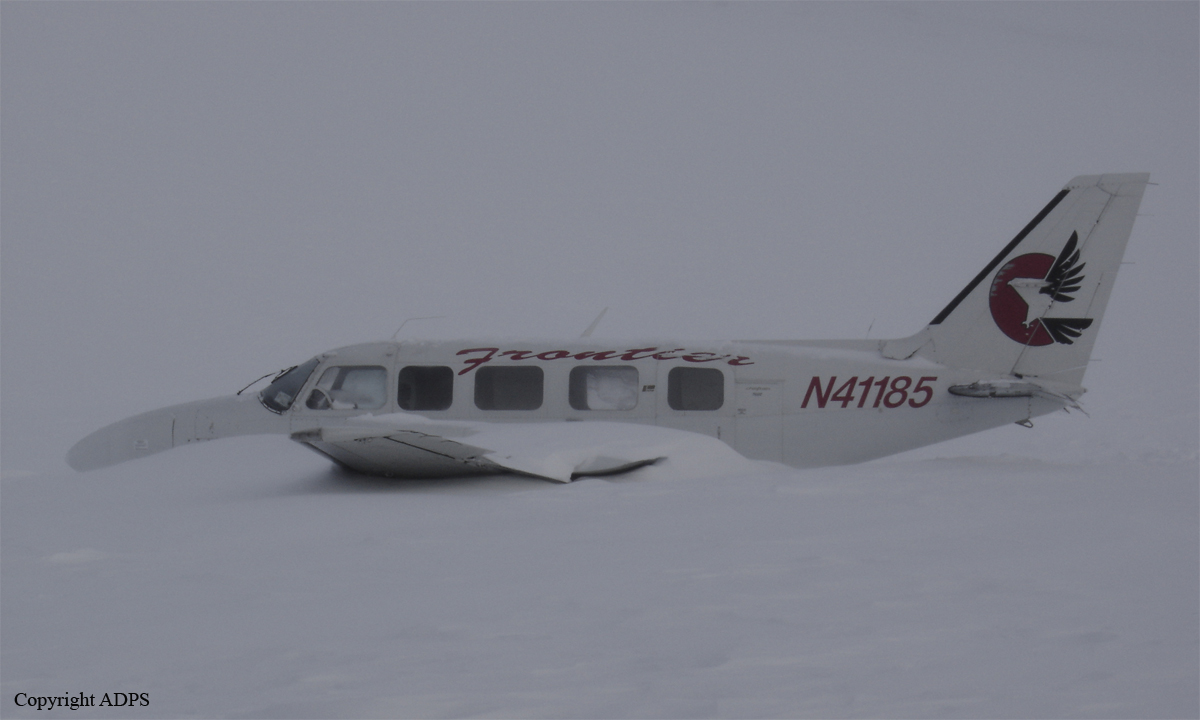
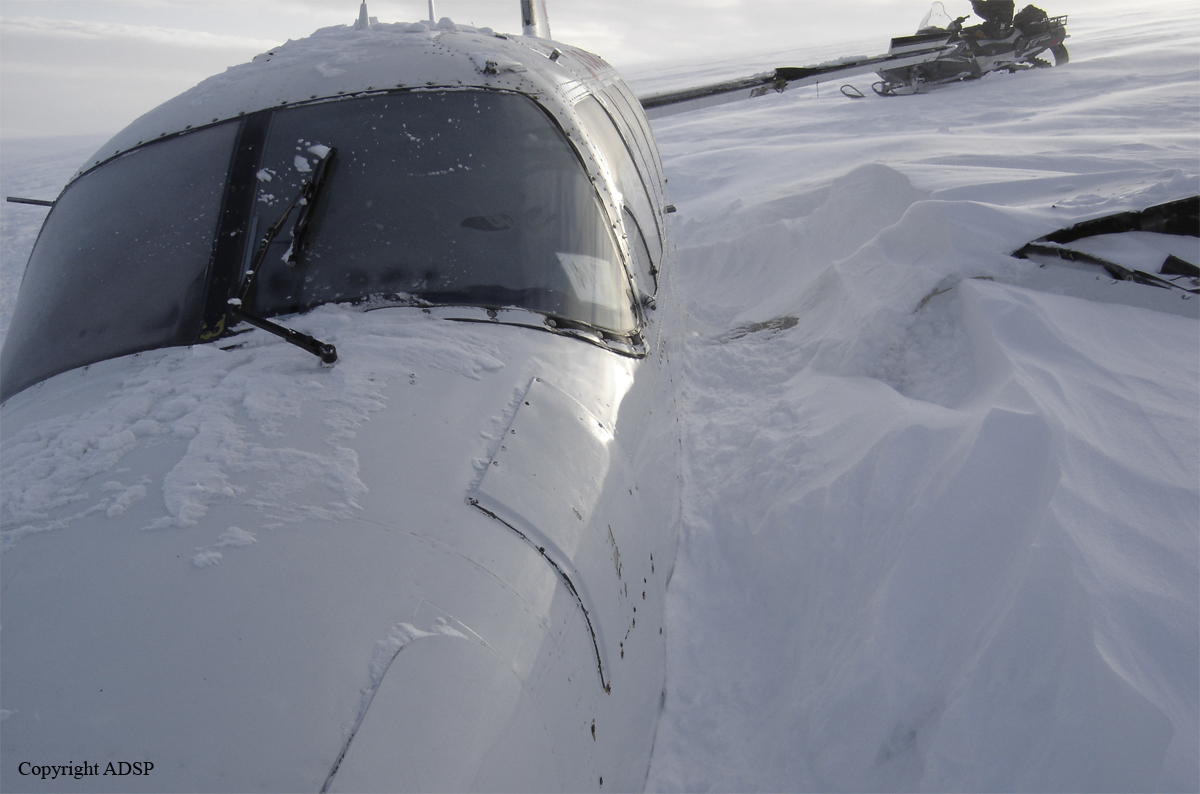
Crash of a Piper PA-31-350 Navajo Chieftain in Nome

Date & Time: Feb 19, 2009 at 1812 LT
Operator:
Registration:
N41185
Survivors:
Yes
Schedule:
Brevig Mission – Nome
MSN:
31-8553001
YOM:
1985
Flight number:
FTA8218
Location:
Crew on board:
1
Crew fatalities:
Pax on board:
5
Pax fatalities:
Other fatalities:
Total fatalities:
0
Captain / Total flying hours:
24850
Captain / Total hours on type:
7500.00
Aircraft flight hours:
10928
Circumstances:
The scheduled commuter flight was about 10 miles north of the destination airport, operating under a special visual-flight-rules clearance, and descending for landing in instrument meteorological conditions. According to the pilot he started a gradual descent over an area of featureless, snow-covered, down-sloping terrain in whiteout and flat light conditions. During the descent a localized snow shower momentarily reduced the pilot’s forward visibility and he was unable to discern any terrain features. The airplane collided with terrain in an all-white snow/ice field and sustained substantial damage. At the time of the accident the destination airport was reporting visibility of 1.5 statute miles in light snow and mist, broken layers at 900 and 1,600 feet, and 3,200 feet overcast, with a temperature and dew point of 25 degrees Fahrenheit. The pilot reported that there were no pre accident mechanical problems with the airplane and that the accident could have been avoided if the flight had been operated under an instrument-flight-rules flight plan.
Probable cause:
The pilot's continued flight into adverse weather and his failure to maintain clearance from terrain while on approach in flat light conditions.
Final Report:

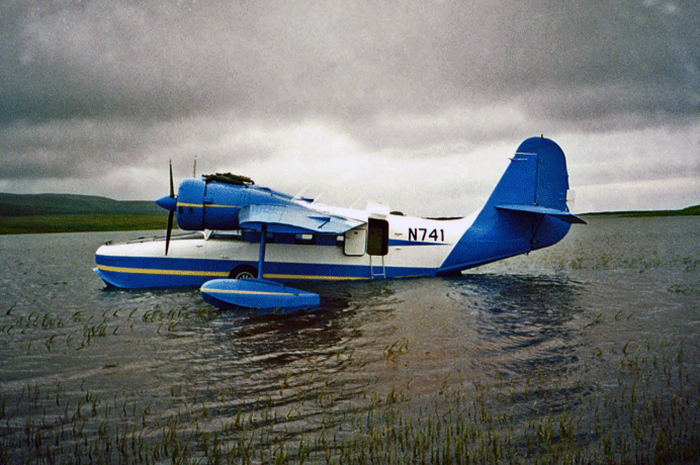
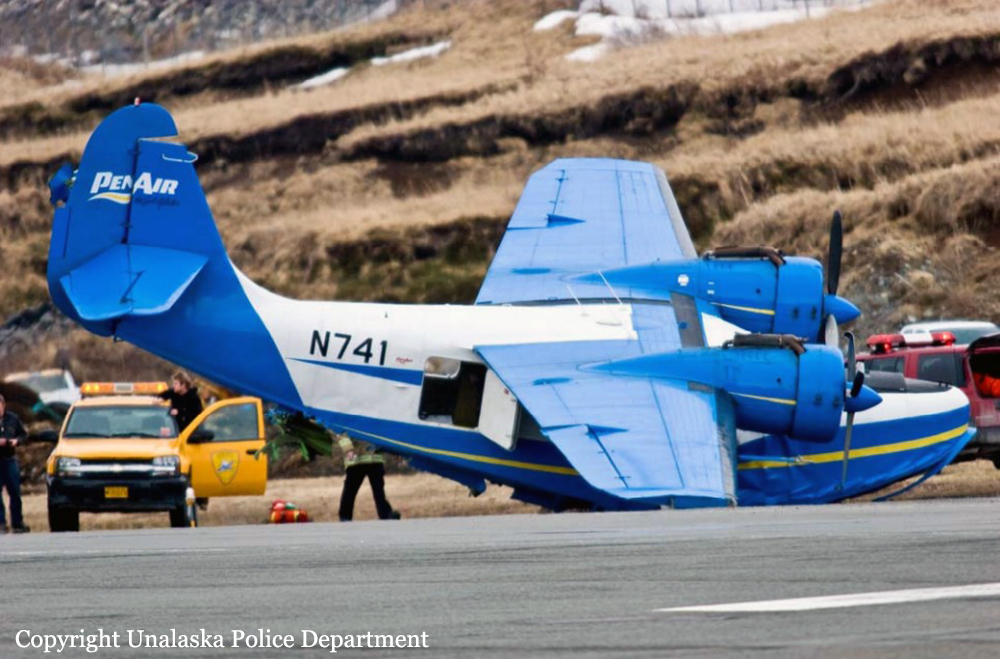
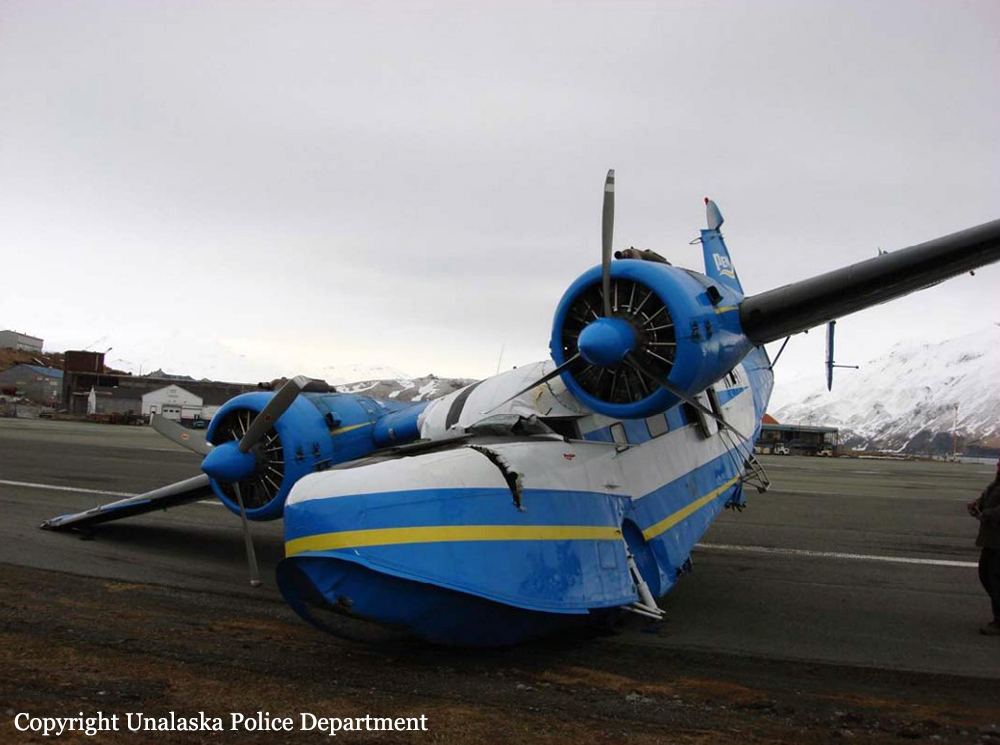
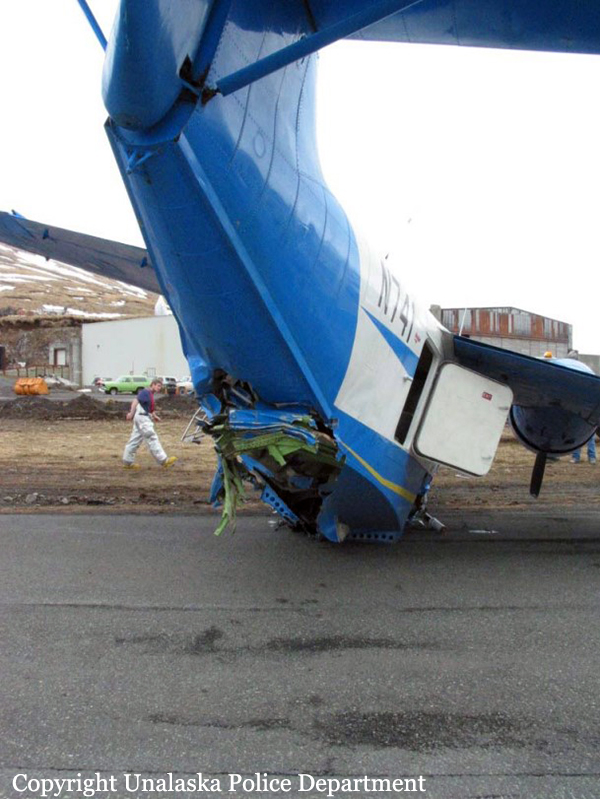
Crash of a Grumman G-21A Goose in Unalaska

Date & Time: Apr 9, 2008 at 1630 LT
Type of aircraft:
Operator:
Registration:
N741
Survivors:
Yes
Schedule:
Akutan - Unalaska
MSN:
B097
YOM:
1944
Crew on board:
1
Crew fatalities:
Pax on board:
8
Pax fatalities:
Other fatalities:
Total fatalities:
0
Captain / Total flying hours:
7040
Captain / Total hours on type:
320.00
Aircraft flight hours:
12228
Circumstances:
The airline transport pilot was on an approach to land on Runway 30 at the conclusion of a visual flight rules (VFR)scheduled commuter flight. Through a series of radio microphone clicks, he activated threshold warning lights for vehicle traffic on a roadway that passes in front of the threshold of Runway 30. Gates that were supposed to work in concert with the lights and block the runway from vehicle traffic were not operative. On final approach, the pilot, who was aware that the gates were not working, noticed a large truck and trailer stopped adjacent to the landing threshold. As he neared the runway, he realized that the truck was moving in front of the threshold area. The pilot attempted to go around, but the airplane's belly struck the top of the trailer and the airplane descended out of control to the runway, sustaining structural damage. The truck driver reported that, as he approached the runway threshold, he saw the flashing red warning lights, but that the gates were not closed. He waited for about 45 seconds and looked for any landing traffic and, seeing none, drove onto the road in front of the threshold. As he did so, he felt the airplane impact the trailer, and saw it hit the runway. The accident truck's trailer is about 45 feet long and 13 feet tall. The Federal Aviation Administration (FAA) Facility Directory/Alaska Supplement recommends that pilots maintain a 25-foot minimum threshold crossing height. The NTSB's investigation revealed that the gate system had been out of service for more than a year due to budgetary constraints, and that there was no Notice to Airman (NOTAM) issued concerning the inoperative gate system. The FAA certificated airport is owned and operated by the State of Alaska. According to the Airport Certification Manual, the airport manager is responsible to inspect, maintain, and repair airport facilities to ensure safe operations. Additionally, the airport manager is responsible for publishing NOTAM's concerning hazardous conditions. A 10-year review of annual FAA certification and compliance inspection forms revealed no discrepancy listed for the inoperative gates until 16 days after the accident.
Probable cause:
The pilot's failure to maintain clearance from a truck while landing, and the vehicle operator's decision to ignore runway warning signals. Contributing to the accident was an inoperative vehicle gate system and the failure of airport management to adequately maintain the gate system and issue a NOTAM.
Final Report:

Crash of a Cessna 207 Skywagon in Aniak

Date & Time: Jan 16, 2008 at 1215 LT
Operator:
Registration:
N1701U
Flight Type:
Survivors:
Yes
Schedule:
Crooked Creek - Aniak
MSN:
207-0301
YOM:
1975
Location:
Crew on board:
1
Crew fatalities:
Pax on board:
0
Pax fatalities:
Other fatalities:
Total fatalities:
0
Captain / Total flying hours:
9455
Captain / Total hours on type:
1914.00
Aircraft flight hours:
18448
Circumstances:
The commercial certificated pilot was returning from a remote village after a round robin flight of about 130 miles over a frozen and snow-covered river. He was in cruise flight about 500 feet agl, but then circled while holding between 6 or 7 miles east of his destination airport, awaiting a special VFR (SVFR) clearance. The weather condition in that area was about 1 mile visibility, with a ceiling of about 1,000 feet agl. After receiving his SVFR clearance, the pilot flew toward the airport, but the engine fuel pressure began fluctuating. The engine rpm began decreasing, along with the airplane's altitude. The pilot switched fuel tanks, selected full flaps, and prepared for a forced landing. He said the weather was near white-out conditions, but he could see the bank of the river. After switching fuel tanks from the left to the right tank, the engine power suddenly returned to full power. He applied forward flight control pressure to prevent the airplane from climbing too fast, but the airplane collided with the surface of the river. The airplane sustained structural damage to the wings and fuselage. At the time of the accident, the ceiling at the airport was 600 feet obscured, with a visibility of 1/2 mile in snow. Neither the fuel status of the accident airplane, nor the mechanical condition of the engine, were verified by either the NTSB or FAA.
Probable cause:
A partial loss of engine power for an undetermined reason. Contributing to the accident were the pilot's inadvertent encounter with IMC conditions, and a whiteout during his attempted go around from an emergency landing approach.
Final Report:

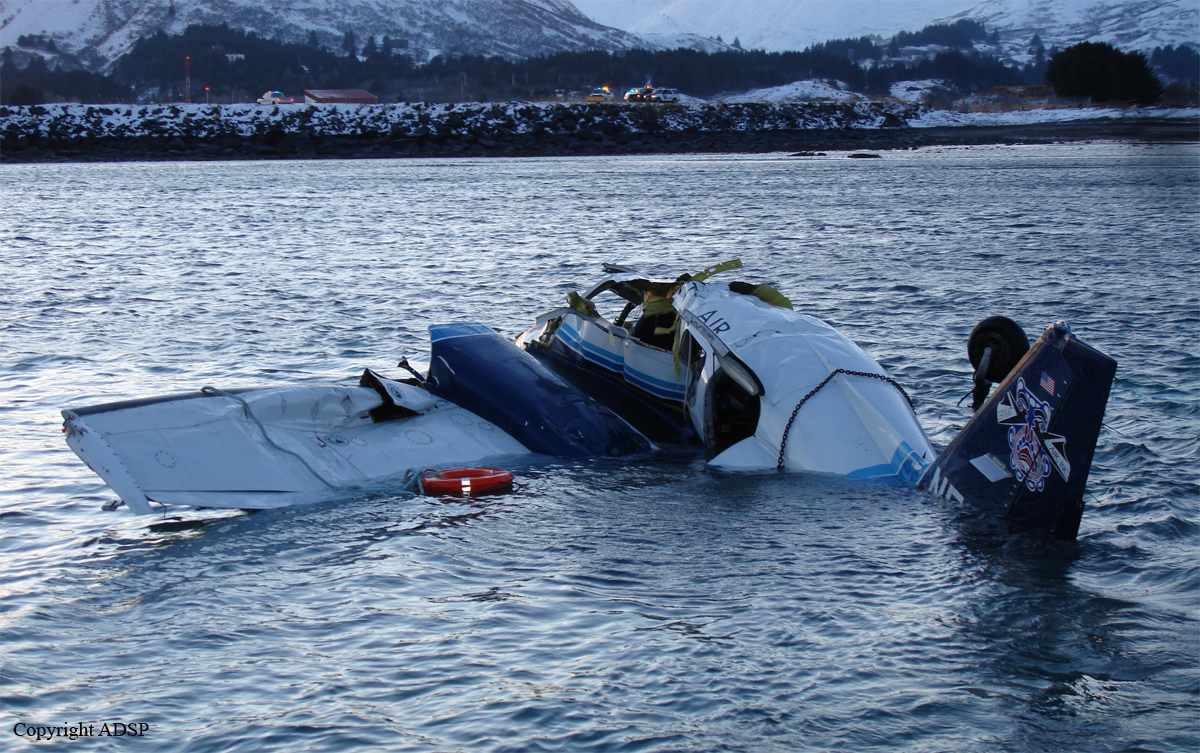
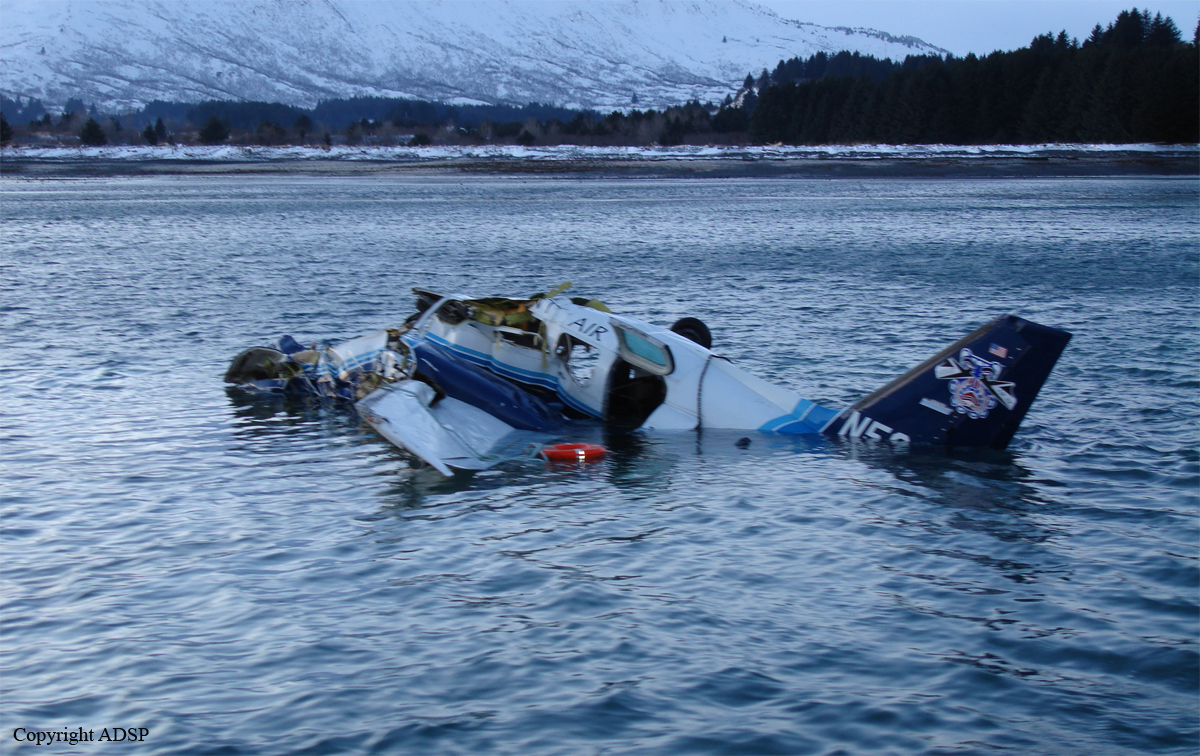
Crash of a Piper PA-31-350 Navajo Chieftain off Kodiak: 6 killed

Date & Time: Jan 5, 2008 at 1343 LT
Operator:
Registration:
N509FN
Flight Phase:
Survivors:
Yes
Schedule:
Kodiak - Homer
MSN:
31-7952162
YOM:
1979
Location:
Crew on board:
1
Crew fatalities:
Pax on board:
9
Pax fatalities:
Other fatalities:
Total fatalities:
6
Captain / Total flying hours:
9437
Captain / Total hours on type:
400.00
Aircraft flight hours:
13130
Circumstances:
The airline transport pilot and nine passengers were departing in a twin-engine airplane on a 14 Code of Federal Regulations Part 135 air taxi flight from a runway adjacent to an ocean bay. According to the air traffic control tower specialist on duty, the airplane became airborne about midway down the runway. As it approached the end of the runway, the pilot said he needed to return to the airport, but gave no reason. The specialist cleared the airplane to land on any runway. As the airplane began a right turn, it rolled sharply to the right and began a rapid, nose- and right-wing-low descent. The airplane crashed about 200 yards offshore and the fragmented wreckage sank in the 10-foot-deep water. Survivors were rescued by a private float plane. A passenger reported that the airplane's nose baggage door partially opened just after takeoff, and fully opened into a locked position when the pilot initiated a right turn towards the airport. The nose baggage door is mounted on the left side of the nose, just forward of the pilot's windscreen. When the door is opened, it swings upward, and is held open by a latching device. To lock the baggage door, the handle is placed in the closed position and the handle is then locked by rotating a key lock, engaging a locking cam. With the locking cam in the locked position, removal of the key prevents the locking cam from moving. The original equipment key lock is designed so the key can only be removed when the locking cam is engaged. Investigation revealed that the original key lock on the airplane's forward baggage door had been replaced with an unapproved thumb-latch device. A Safety Board materials engineer's examination revealed evidence that a plastic guard inside the baggage compartment, which is designed to protect the door's locking mechanism from baggage/cargo, appeared not to be installed at the time of the accident. The airplane manufacturer's only required inspection of the latching system was a visual inspection every 100 hours of service. Additionally, the mechanical components of the forward baggage door latch mechanism were considered "on condition" items, with no predetermined life-limit. On May 29, 2008, the Federal Aviation Administration issued a safety alert for operators (SAFO 08013), recommending a visual inspection of the baggage door latches and locks, additional training of flight and ground crews, and the removal of unapproved lock devices. In July 2008, Piper Aircraft issued a mandatory service bulletin (SB 1194, later 1194A), requiring the installation of a key lock device, mandatory recurring inspection intervals, life-limits on safety-critical parts of forward baggage door components, and the installation of a placard on the forward baggage door with instructions for closing and locking the door to preclude an in-flight opening. Post accident inspection discovered no mechanical discrepancies with the airplane other than the baggage door latch. The airplane manufacturer's pilot operating handbook did not contain emergency procedures for an in-flight opening of the nose baggage door, nor did the operator's pilot training program include instruction on the proper operation of the nose baggage door or procedures to follow in case of an in-flight opening of the door. Absent findings of any other mechanical issues, it is likely the door locking mechanism was not fully engaged and/or the baggage shifted during takeoff, and contacted the exposed internal latching mechanism, allowing the cargo door to open. With the airplane operating at a low airspeed and altitude, the open baggage door would have incurred additional aerodynamic drag and further reduced the airspeed. The pilot's immediate turn towards the airport, with the now fully open baggage door, likely resulted in a sudden increase in drag, with a substantive decrease in airspeed, and an aerodynamic stall.
Probable cause:
The failure of company maintenance personnel to ensure that the airplane's nose baggage door latching mechanism was properly configured and maintained, resulting in an inadvertent opening of the nose baggage door in flight. Contributing to the accident were the lack of information and guidance available to the operator and pilot regarding procedures to follow should a baggage door open in flight and an inadvertent aerodynamic stall.
Final Report:

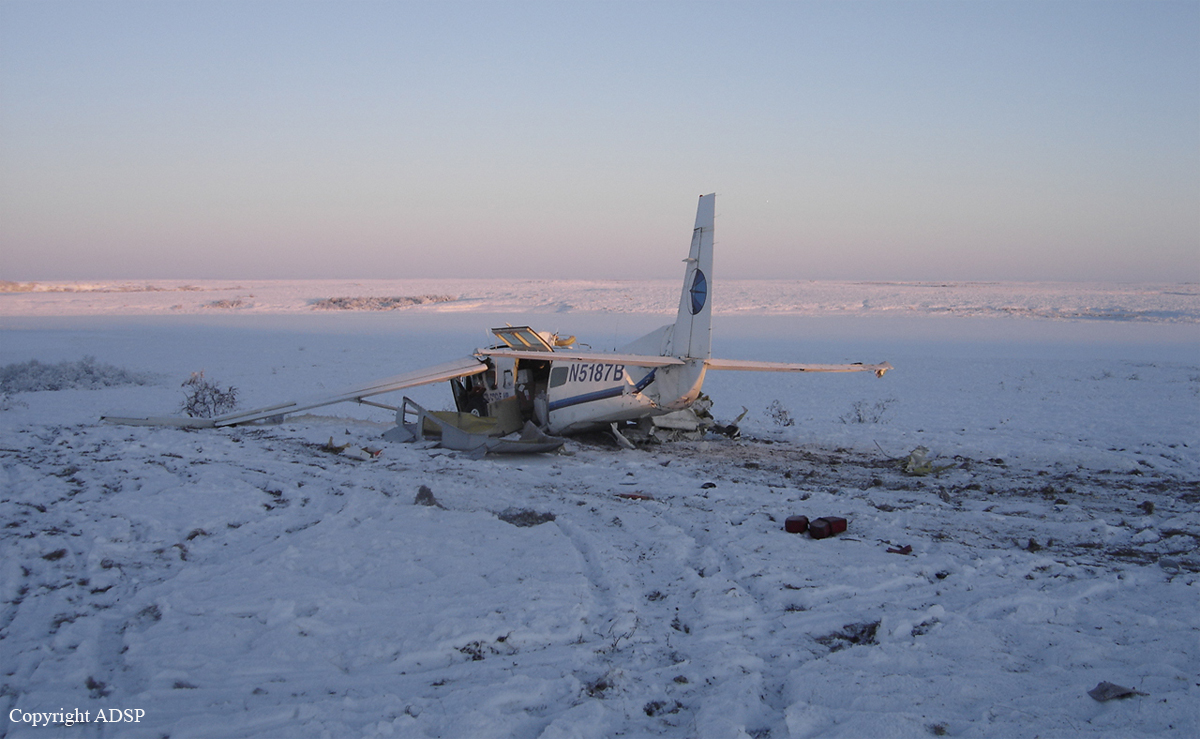
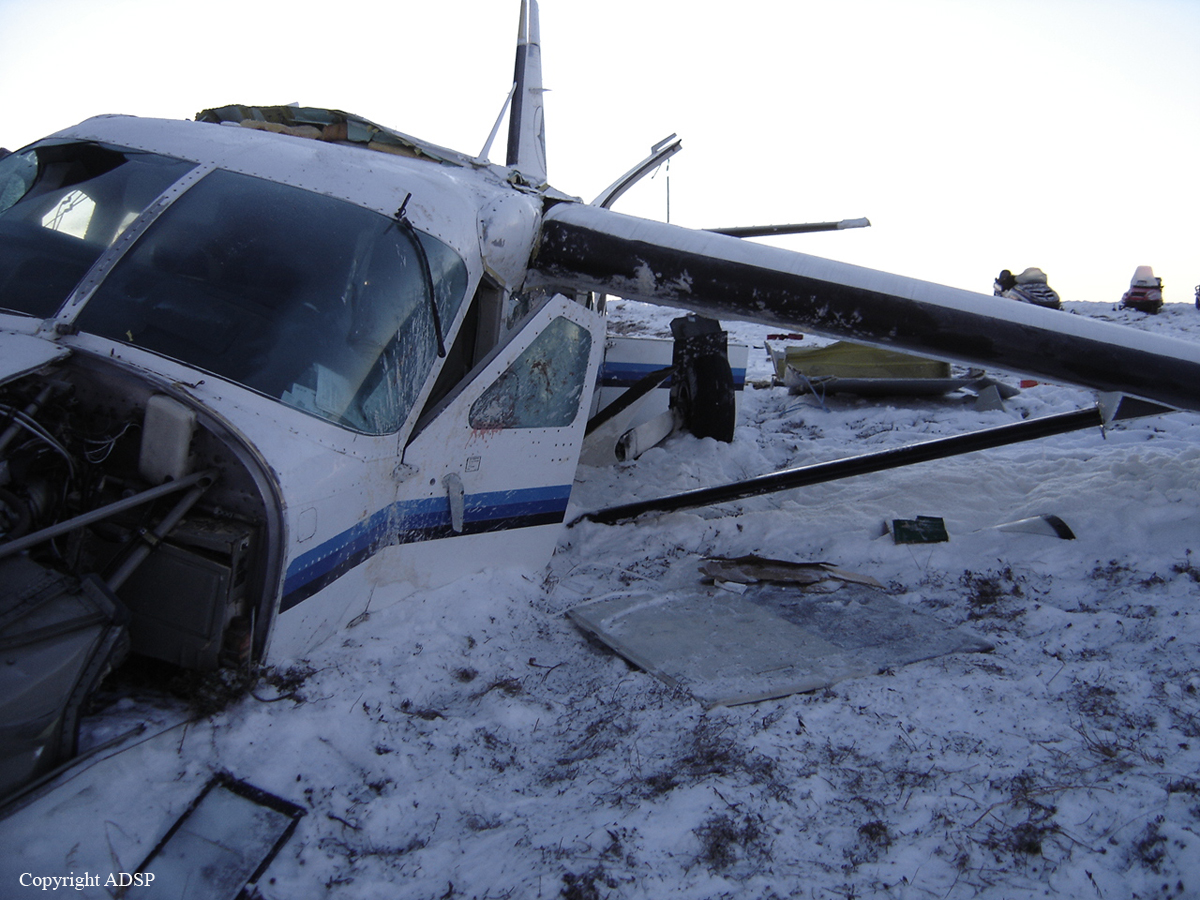
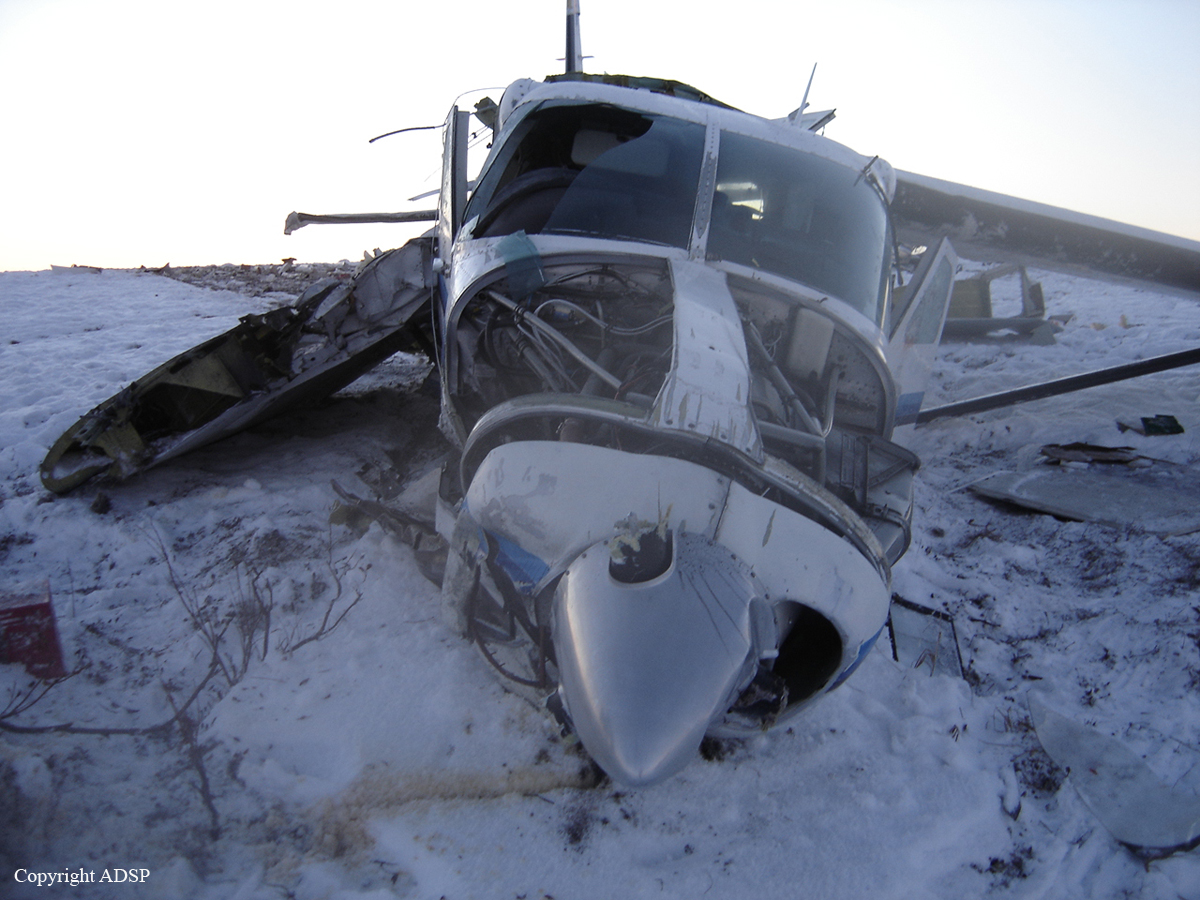
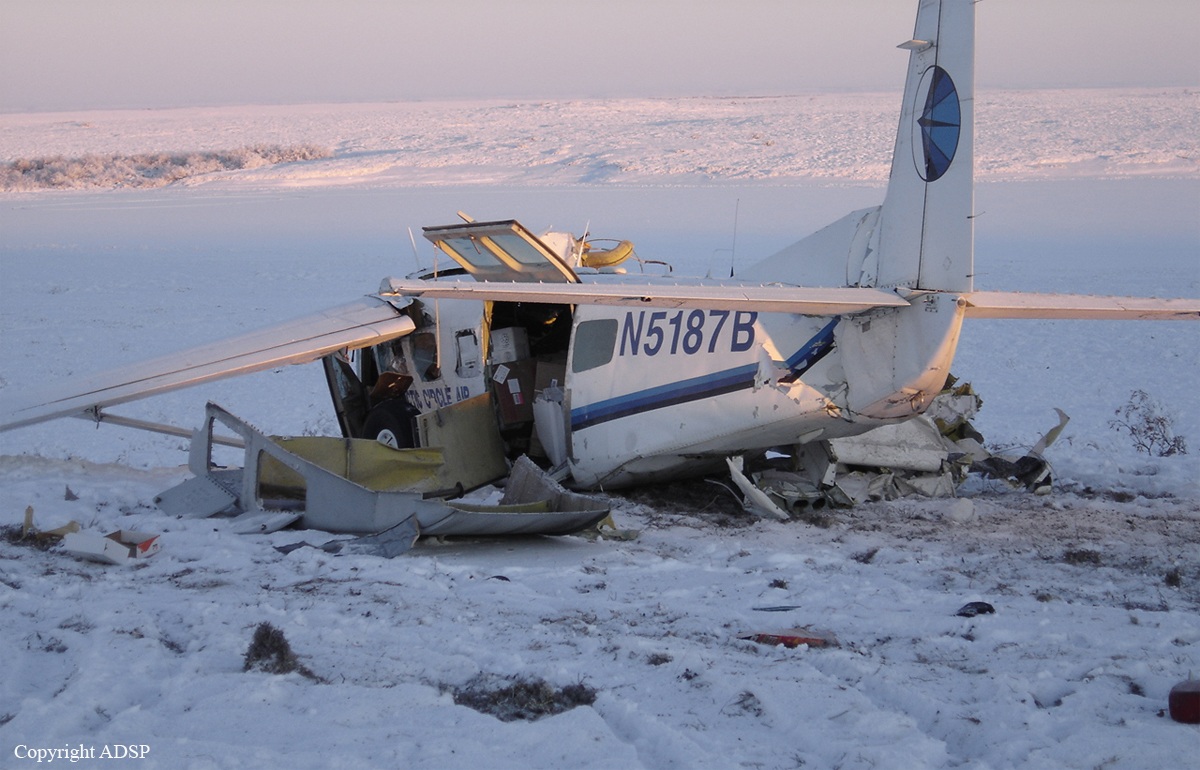
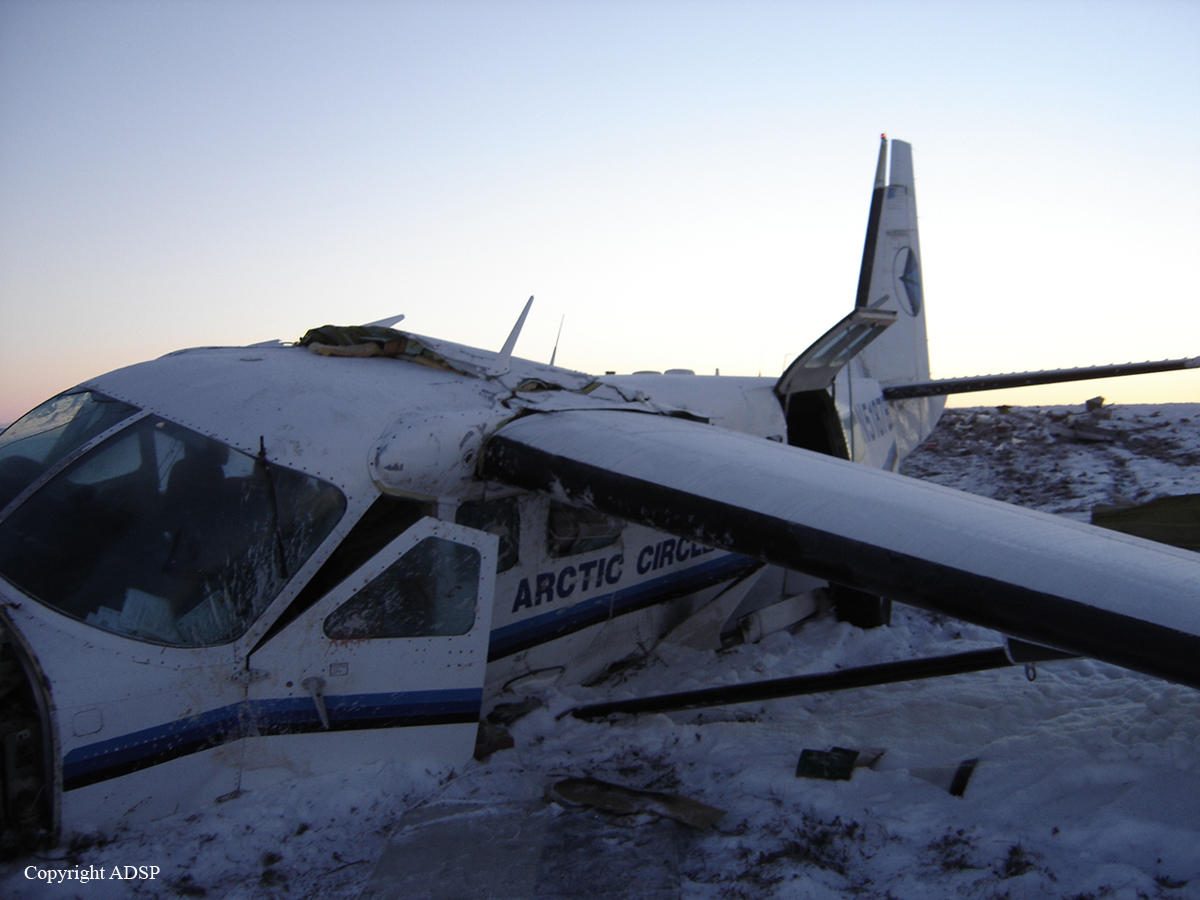
Crash of a Cessna 208B Grand Caravan in Bethel

Date & Time: Dec 18, 2007 at 0856 LT
Type of aircraft:
Operator:
Registration:
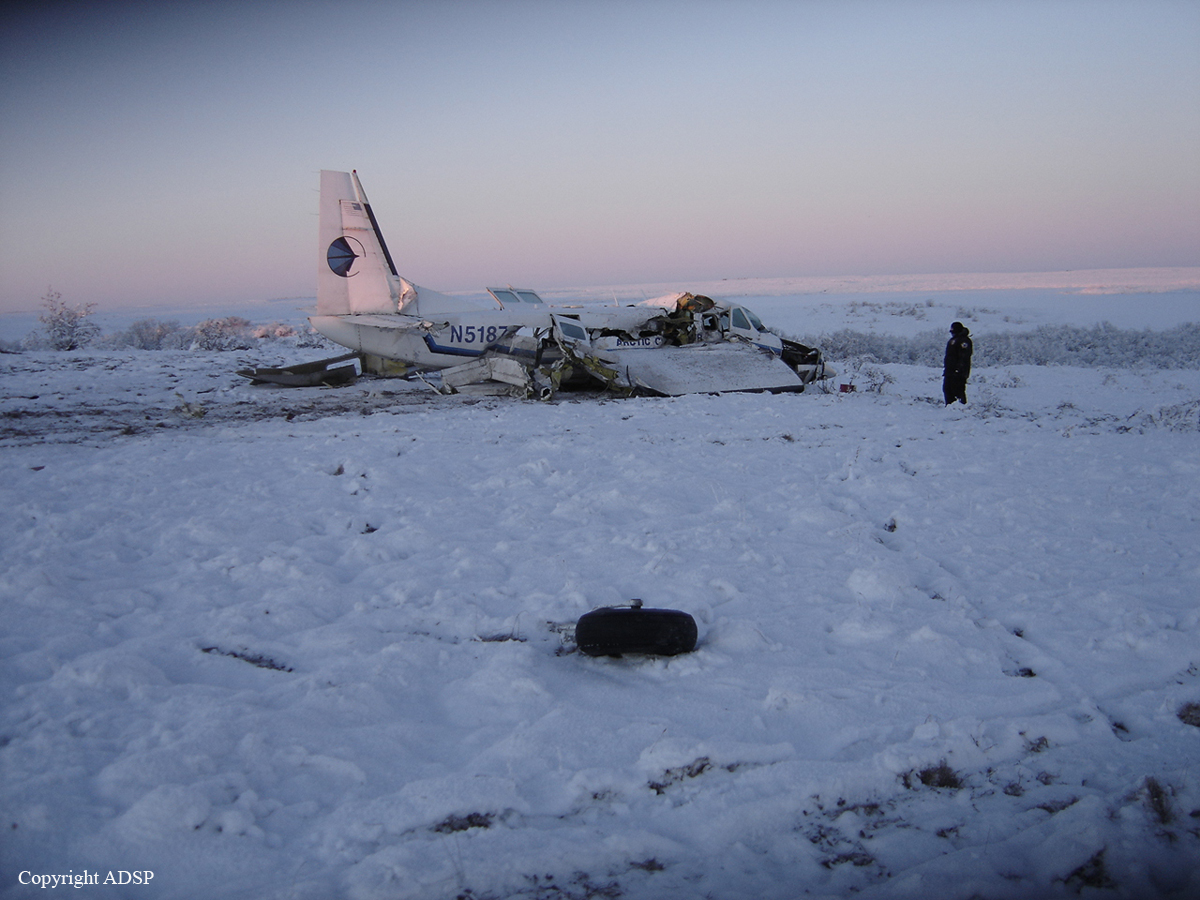
N5187B
Flight Phase:
Flight Type:
Survivors:
Yes
Schedule:
Bethel - Hooper Bay - Scammon Bay
MSN:
208B-0270
YOM:
1991
Flight number:
CIR218
Location:
Crew on board:
1
Crew fatalities:
Pax on board:
1
Pax fatalities:
Other fatalities:
Total fatalities:
0
Captain / Total flying hours:
4054
Captain / Total hours on type:
190.00
Aircraft flight hours:
12204
Circumstances:
About 0800, the commercial pilot did a preflight inspection of the accident airplane, in preparation for a cargo flight. Dark night, visual meteorological conditions prevailed. He indicated that the weather conditions were clear and cold, and frost was on the airplane. He said the frost was not bonded to the skin of the airplane, and he was able to use a broom to clean off the frost, resulting in a clean wing and tail surface. He reported that no deicing fluid was applied. After takeoff, he retracted the flaps to about 5 degrees at 110 knots of airspeed. The airplane then rolled to the right about three times in a manner he described as a wave, or vortex-like movement. He applied left aileron and lowered the flaps to 20 degrees, but the roll to the right was more severe. The pilot said the engine power was "good." He then noticed that the airplane was descending toward the ground, so he attempted to put the flaps completely down. His next memory was being outside the airplane after it collided with the ground. The airplane's information manual contains several pages of limitations and warnings about departing with even small amounts of frost, ice, snow, or slush on the airplane, as it adversely affects the airplane's flight characteristics. The manufacturer requires a visual or tactile inspection of the wings, and horizontal stabilizer to ensure they are free of ice or frost if the outside air temperature is below 10 degrees C, (50 degrees F), and notes that a heated hangar or approved deicing fluids should be used to remove ice, snow and frost accumulations. The weather conditions included clear skies, and a temperature of -11 degrees F. Post accident examination of the airplane revealed no observed mechanical malfunction. An examination of the engine revealed internal over-temperature damage, and minor external fire damage consistent with a massive spike of fuel flow at the time of ground impact. Damage to the propeller blades was consistent with high power at the time of ground impact. The rolling/vortex motion of the airplane was consistent with airframe contamination due to frost.
Probable cause:
The pilot's failure to adequately remove frost contamination from the airplane, which resulted in a loss of control and subsequent collision with terrain during an emergency landing after takeoff.
Final Report:
Crash of a Short SC.7 Skyvan 3 Variant 100 in Mystic Lake Lodge: 1 killed

Date & Time: Sep 20, 2007 at 1430 LT
Type of aircraft:
Operator:
Registration:
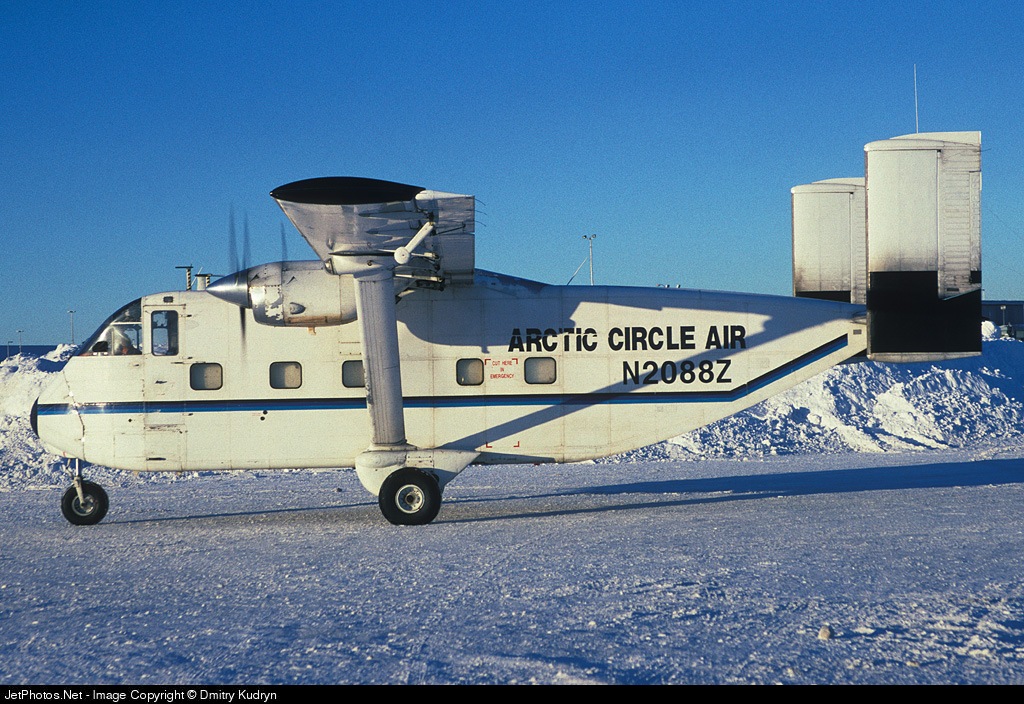
N2088Z
Flight Phase:
Flight Type:
Survivors:
No
Schedule:
Mystic Lake Lodge - Anchorage
MSN:
SH1963
YOM:
1978
Crew on board:
1
Crew fatalities:
Pax on board:
0
Pax fatalities:
Other fatalities:
Total fatalities:
1
Captain / Total flying hours:
15000
Captain / Total hours on type:
2600.00
Aircraft flight hours:
10730
Circumstances:
The airline transport pilot was departing in a twin engine turboprop airplane on a ferry flight from a remote lodge airstrip that was about 1,000 feet long and 40 feet wide. The airplane had previously received substantial damage to the nose wheel assembly on a previous flight to the airstrip. Repairs were made to the airframe, and the pilot was departing for a maintenance facility. The pilot had flown in and out of the airstrip on numerous occasions, but not in the accident type airplane. The lodge owner reported that the pilot started both engines and taxied the length of the airstrip, stopping momentarily several times. The pilot ran the engines for about 20 minutes, and then began a takeoff to the south. The airplane appeared to accelerate and remain on the centerline of the airstrip, but did not liftoff until the very end of the airstrip. The owner did not notice any unusual sounds or appearance of the engines. After liftoff, the wheels of the airplane struck and broke off the tops of trees and shrubs, that were about 6 to 7 feet above the ground. The airplane immediately veered to the right, and went out of the lodge owner's sight, but he continued to hear the airplane hitting trees until final impact. The airplane crashed in a shallow lake, coming to rest about 300 feet from shore, in about 5 feet of water. The entire cockpit area, forward of the wings, was torn off the airframe. The validity of any postaccident cockpit and instrument findings was unreliable due to the extensive damage to the cockpit. Likewise, structural damage to the airframe precluded determining wing flap settings during takeoff. Performance calculations indicated that the airplane's takeoff distance would have been about 950 feet, although the lodge owner said that in his experience, the accident airplane was capable of lifting off about half way down the airstrip without difficulty. The circumstances of the takeoff indicated that the left engine had been producing sufficient power to chop through several trees during the crash. Testing and inspection of the right engine was inconclusive, and although it was run on a test stand at reduced power, full power could not be attained due to ingestion of foreign material during the test run.
Probable cause:
A collision with trees during takeoff-initial climb for an undetermined reason.
Final Report:
Crash of a De Havilland DHC-2 Beaver I in Traitor's Cove: 6 killed

Date & Time: Aug 16, 2007 at 1730 LT
Type of aircraft:
Registration:
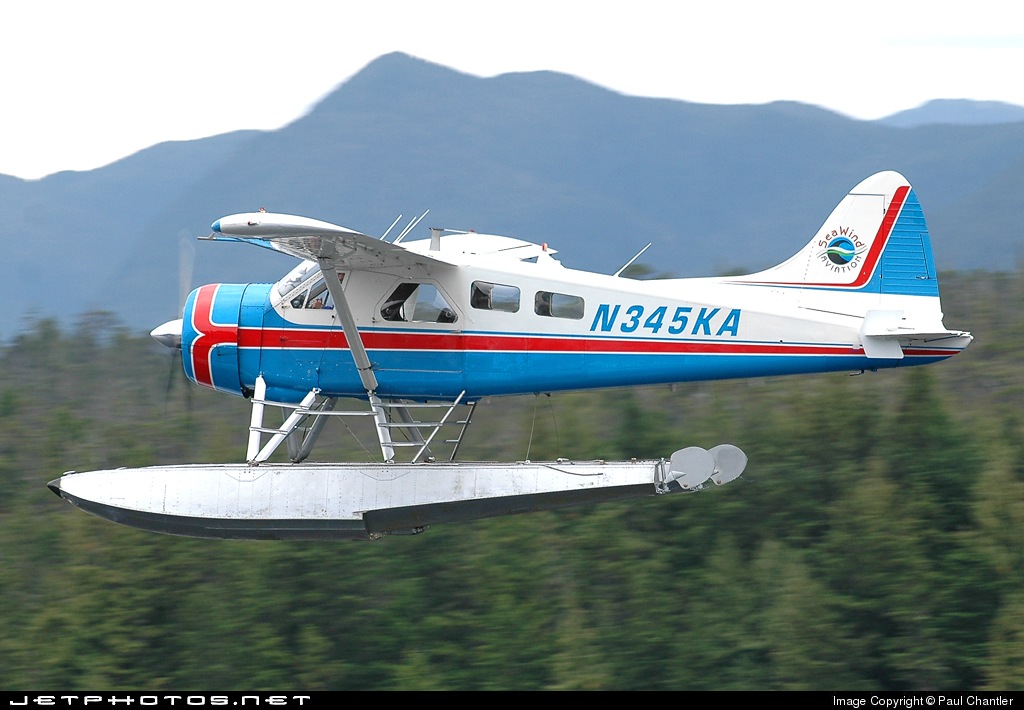
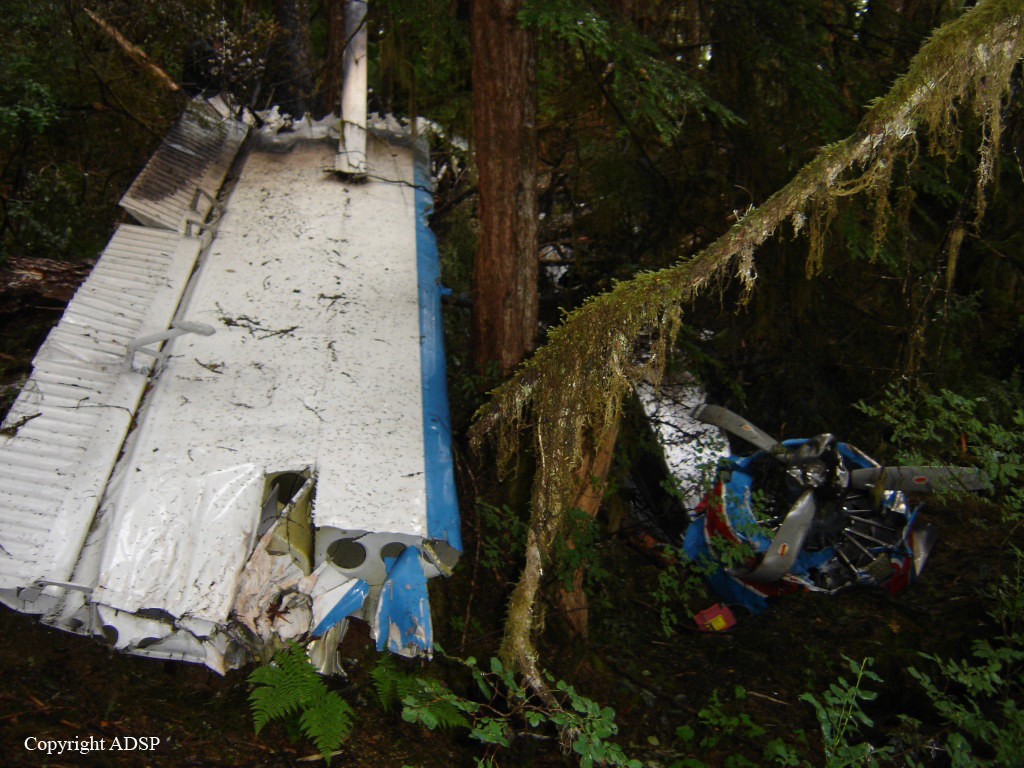
N345KA
Flight Phase:
Survivors:
Yes
Schedule:
Traitor's Cove - Ketchikan
MSN:
1306
YOM:
1959
Crew on board:
1
Crew fatalities:
Pax on board:
8
Pax fatalities:
Other fatalities:
Total fatalities:
6
Captain / Total flying hours:
17000
Captain / Total hours on type:
7000.00
Aircraft flight hours:
22409
Circumstances:
The float-equipped airplane was departing from a remote bay 20 miles north of Ketchikan, Alaska, to return air taxi passengers to Ketchikan after a ground tour. The accident pilot, who reported that he had 17,000 flight hours and 7,000 hours in the make and model of the accident airplane, said that southeasterly winds had begun to increase while he was waiting at the bay for the passengers to return from the tour. He said that, unlike when he had landed about 2.5 hours earlier, it was no longer “nice and calm” when the passengers returned. The pilot noticed choppy waves in parts of a nearby cove. To avoid some of the wind and waves, the pilot elected to take off toward the interior of the bay, in the direction of rising terrain. The pilot said that he had never taken off in that direction before. The pilot also said that he had intended to make a shallow, right-climbing turn toward the mouth of the bay and away from the terrain, but shortly after takeoff, he saw numerous choppy waves concentrated along his proposed departure flightpath, which he said indicated to him that strong winds were likely along that path. The pilot decided to change his plan and continue flying straight temporarily, away from the waves, and to make a left, 180-degree turn inside the bay, which was surrounded by high terrain. The pilot indicated that when the turn was initiated, the airplane was about 400 feet above the water, and he did not recall the indicated airspeed. The attempted 180-degree turn was within the airplane’s performance capabilities but placed it closer to rising terrain. While attempting this turn, the pilot encountered a downdraft, was unable to climb above the terrain, and stalled the airplane about 60 feet above the ground. The downdraft likely made it more difficult to avoid descending into the rising terrain. A weather study by the National Transportation Safety Board confirmed that there was a gust front in the area and an abrupt wind change about the time of the accident. Pilots flying nearby also reported low-level windshear, strong winds, and turbulence. No mechanical anomalies were discovered during postaccident inspections by the Safety Board. Five passengers including two children were killed. A month later, one of the survivor died from his injuries.
Probable cause:
An inadvertent aerodynamic stall resulting from the pilot's poor decision-making and inadequate planning and execution when he took off toward nearby rising terrain, in strong winds, under circumstances where his options for maneuvering were severely limited and where his safety margin was, thus, insufficient.
Final Report:
Crash of a Piper PA-46-350P Malibu Mirage in Sitka: 4 killed

Date & Time: Aug 6, 2007 at 1255 LT
Registration:
N35CX
Flight Type:
Survivors:
No
Schedule:
Victoria - Sitka
MSN:
46-36127
YOM:
1997
Location:
Crew on board:
1
Crew fatalities:
Pax on board:
3
Pax fatalities:
Other fatalities:
Total fatalities:
4
Captain / Total flying hours:
1800
Aircraft flight hours:
2042
Circumstances:
The private, instrument-rated pilot, was on an IFR cross-country flight, and had been cleared for a GPS approach. He reported that he was 5 minutes from landing, and said he was circling to the left, to land the opposite direction from the published approach. The traffic pattern for the approach runway was right traffic. Instrument meteorological conditions prevailed, and the weather conditions included a visibility of 3 statute miles in light rain and mist; few clouds at 400 feet, 1,000 feet overcast; temperature, 55 degrees F; dew point, 55 degrees F. The minimum descent altitude, either for a lateral navigation approach, or a circling approach, was 580 feet, and required a visibility of 1 mile. The missed approach procedure was a right climbing turn. A circling approach north of the runway was not approved. Witnesses reported that the weather included low clouds and reduced visibility due to fog and drizzle. The airplane was heard, but not seen, circling several times over the city, which was north of the runway. Witnesses saw the airplane descending in a wings level, 30-45 degree nose down attitude from the base of clouds, pitch up slightly, and then collide with several trees and an unoccupied house. A postcrash fire consumed the residence, and destroyed the airplane. A review of FAA radar data indicated that as the accident airplane flew toward the airport, its altitude slowly decreased and its flight track appeared to remain to the left side (north) of the runway. The airplane's lowest altitude was 800 feet as it neared the runway, and then climbed to 1,700 feet, where radar contact was lost, north of the runway. During the postaccident examination of the airplane, no mechanical malfunction was found. Given the lack of any mechanical deficiencies with the airplane, it is likely the pilot was either confused about the proper approach procedures, or elected to disregard them, and abandoned the instrument approach prematurely in his attempt to find the runway. It is unknown why he decided to do a circle to land approach, when the tailwind component was slight, and the shorter, simpler, straight in approach was a viable option. Likewise, it is unknown why he flew towards rising terrain on the north side of the runway, contrary to the published procedures. From the witness statements, it appears the pilot was "hunting" for the airport, and intentionally dove the airplane towards what he perceived was an area close to it. In the process, he probably saw
trees and terrain, attempted to climb, but was too low to avoid the trees.
Probable cause:
The pilot's failure to maintain altitude/distance from obstacles during an IFR circling approach, and his failure to follow the instrument approach procedure. Contributing to the accident was clouds.
Final Report: