Country
Operator Image

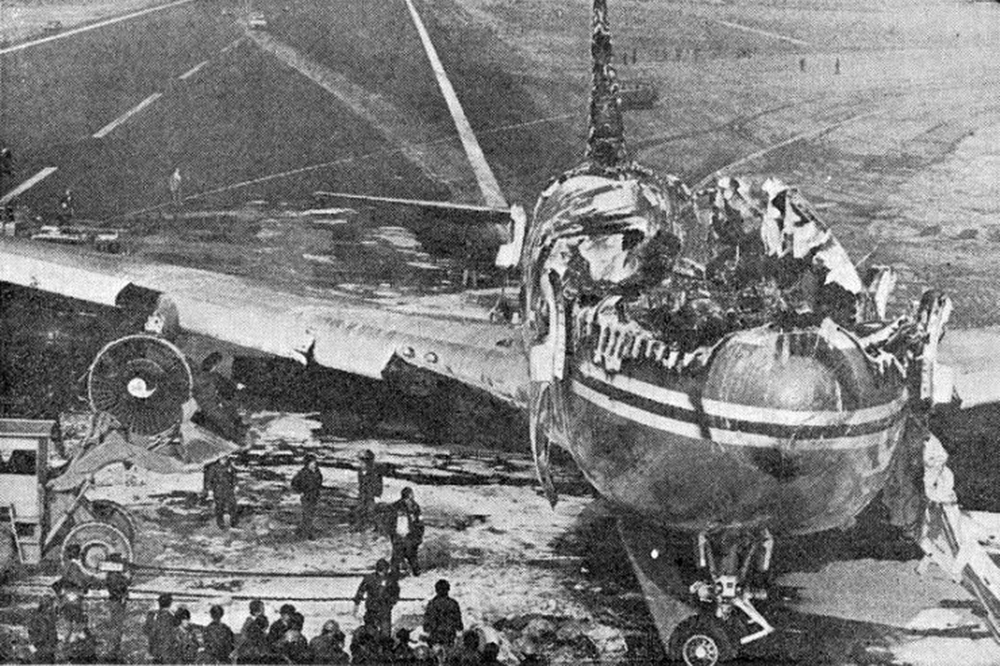
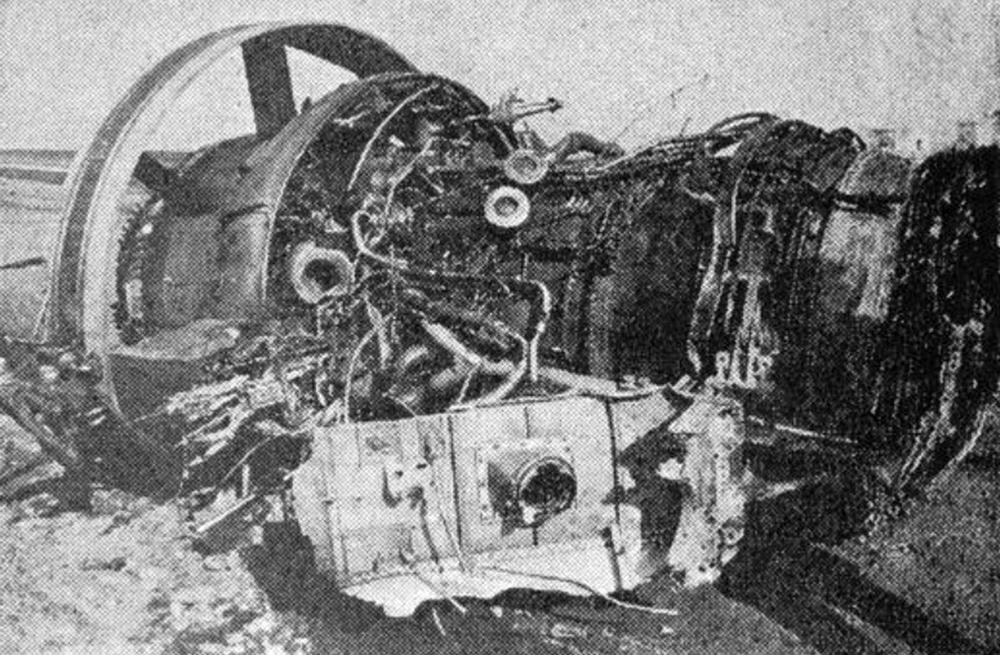
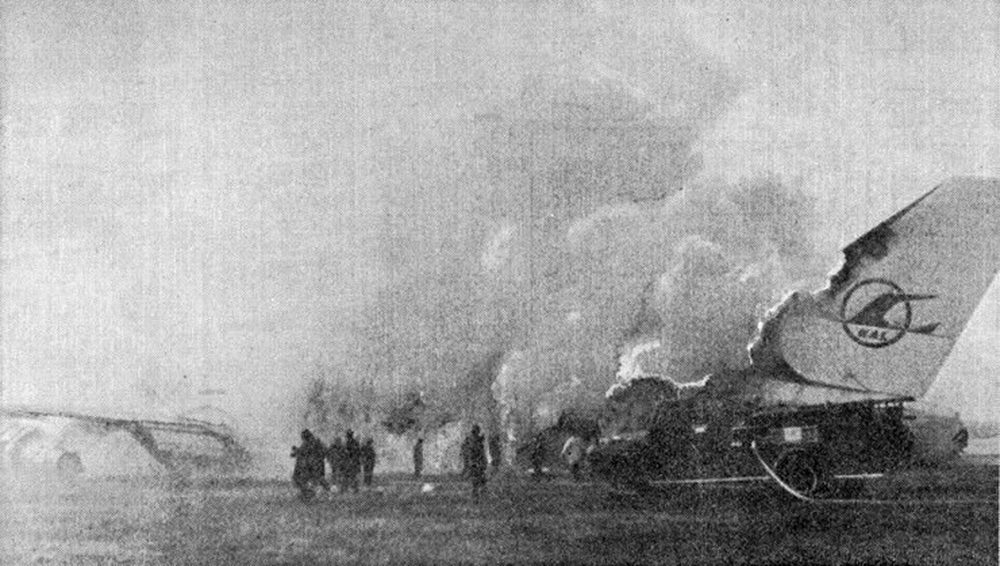
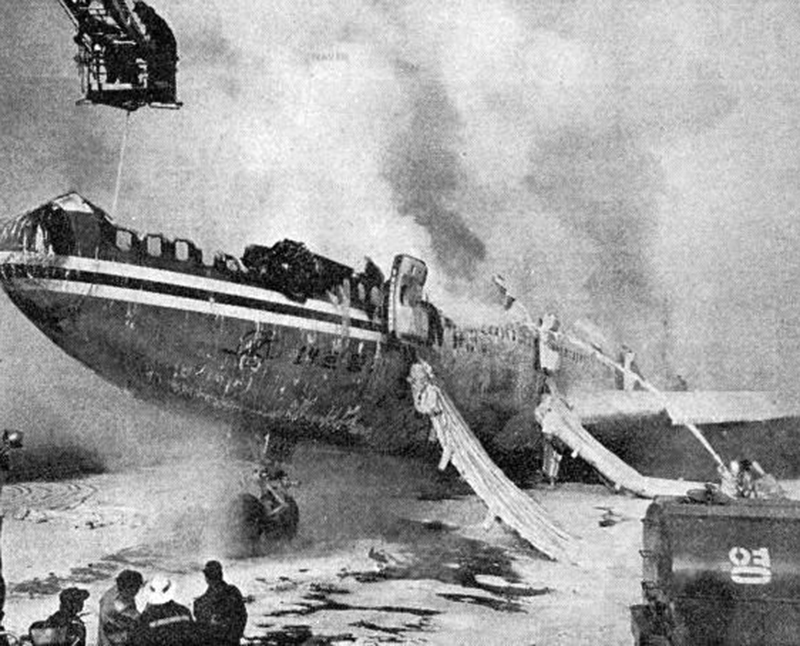
Crash of a Boeing 747-3B5 in Agana: 228 killed

Date & Time: Aug 6, 1997 at 0142 LT
Type of aircraft:
Operator:
Registration:
HL7468
Survivors:
Yes
Schedule:
Seoul - Agana
MSN:
22487
YOM:
1984
Flight number:
KE801
Country:
Region:
Crew on board:
17
Crew fatalities:
Pax on board:
237
Pax fatalities:
Other fatalities:
Total fatalities:
228
Captain / Total flying hours:
8932
Captain / Total hours on type:
1718.00
Copilot / Total flying hours:
4066
Copilot / Total hours on type:
1560
Aircraft flight hours:
50105
Aircraft flight cycles:
8552
Circumstances:
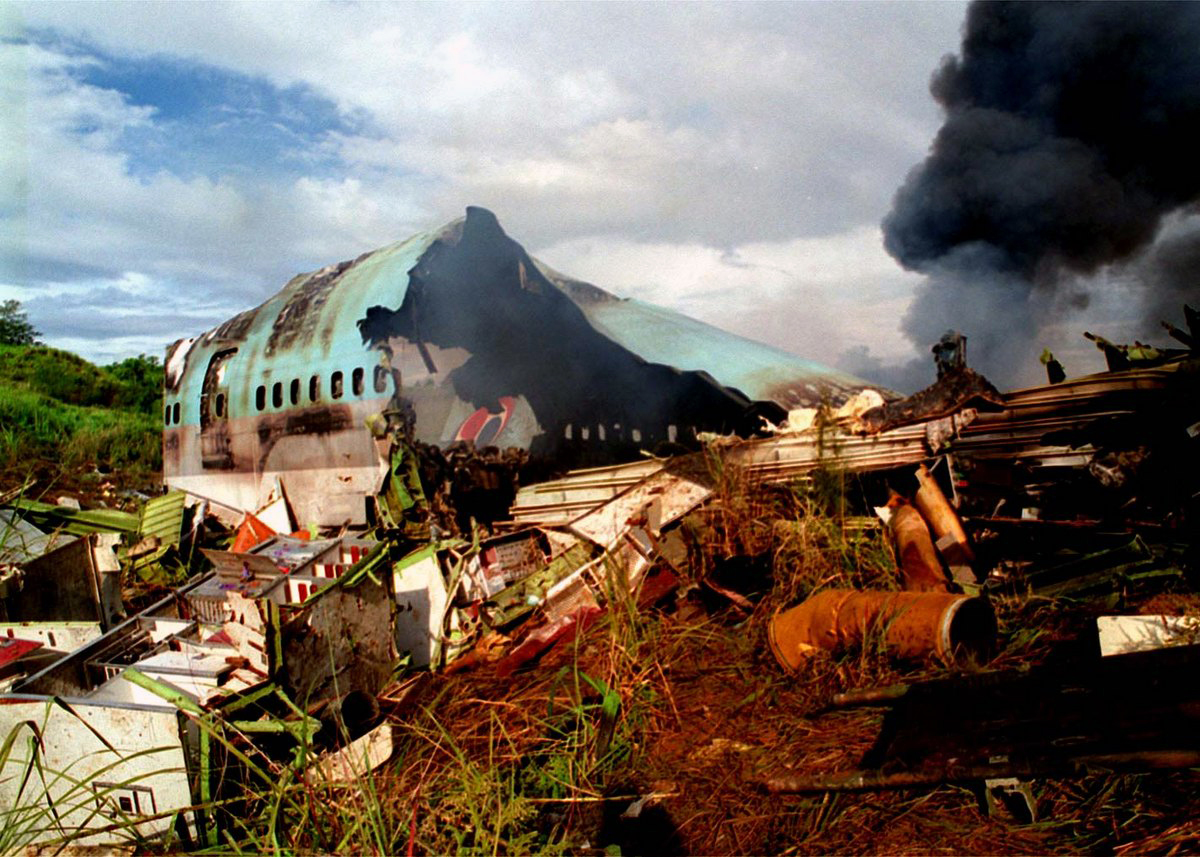
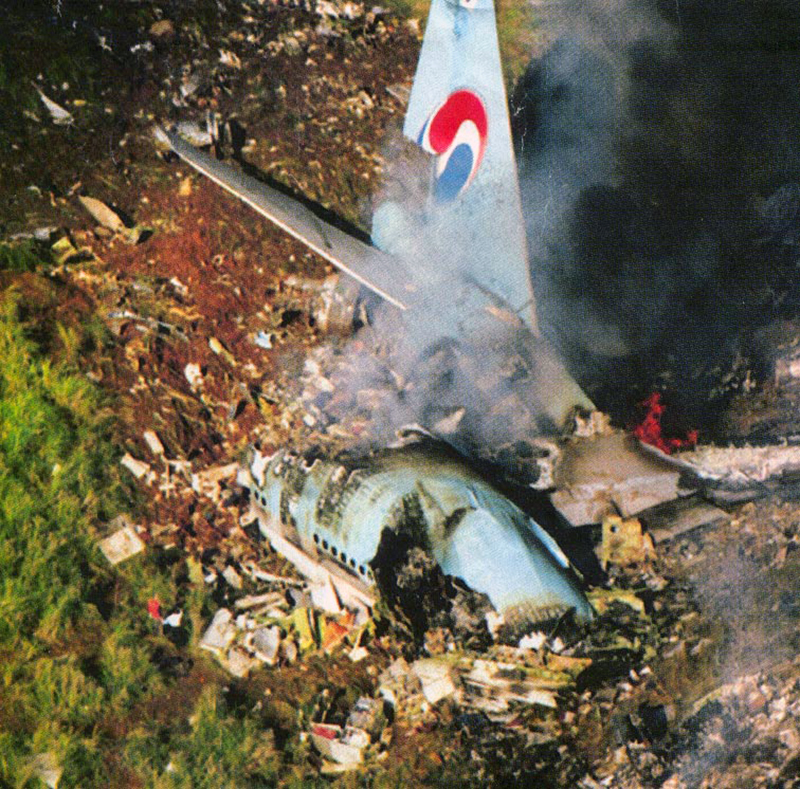
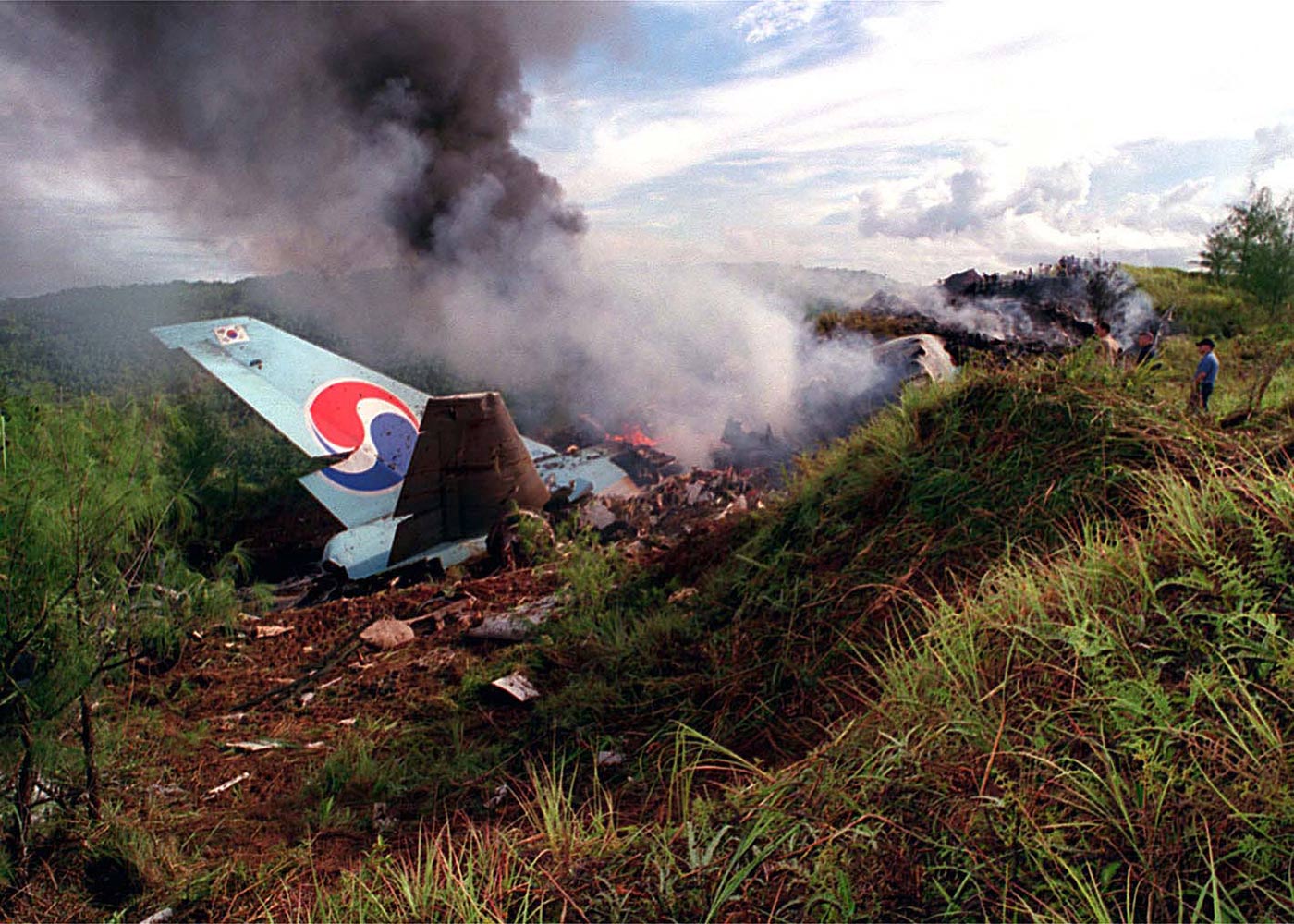
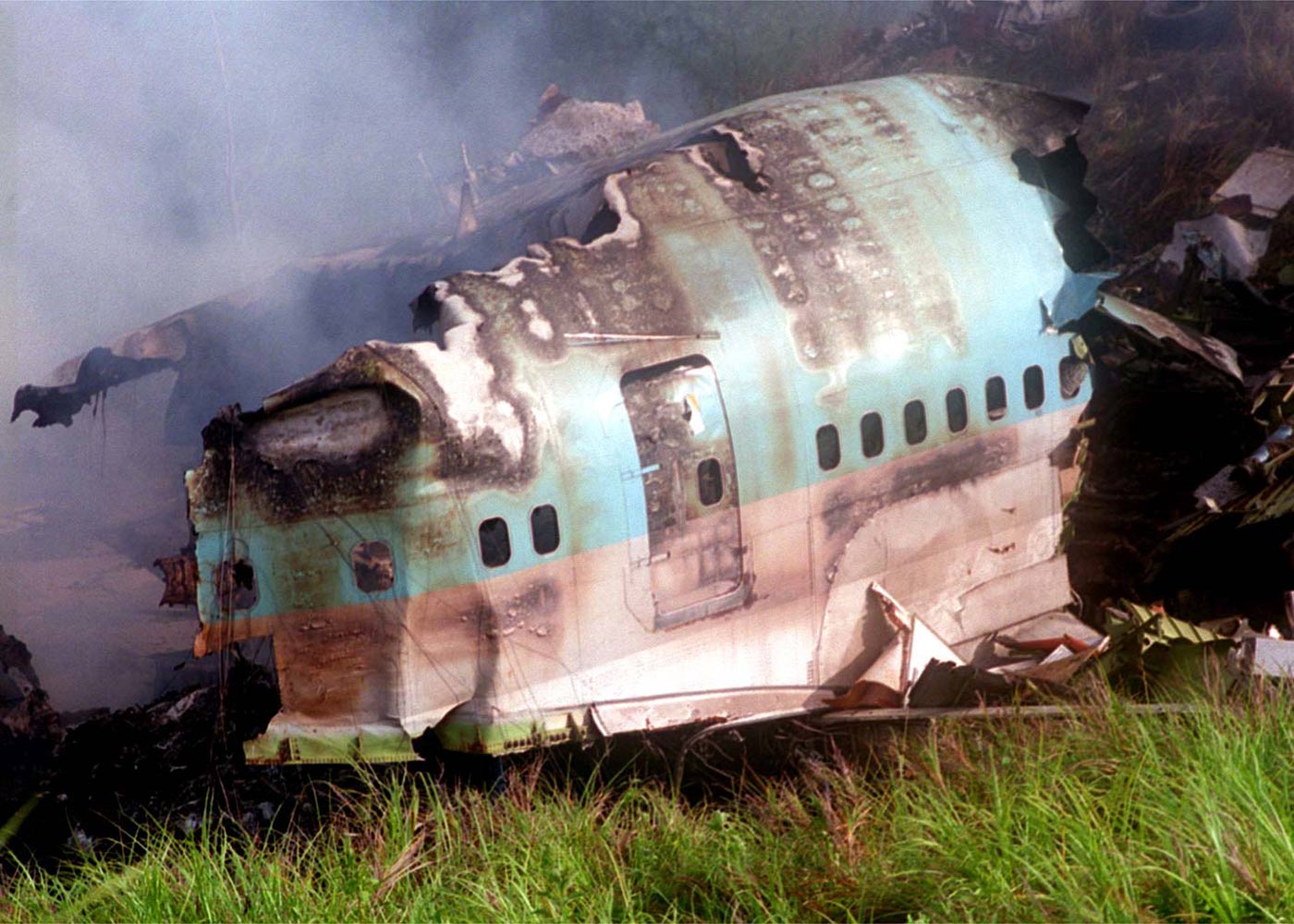
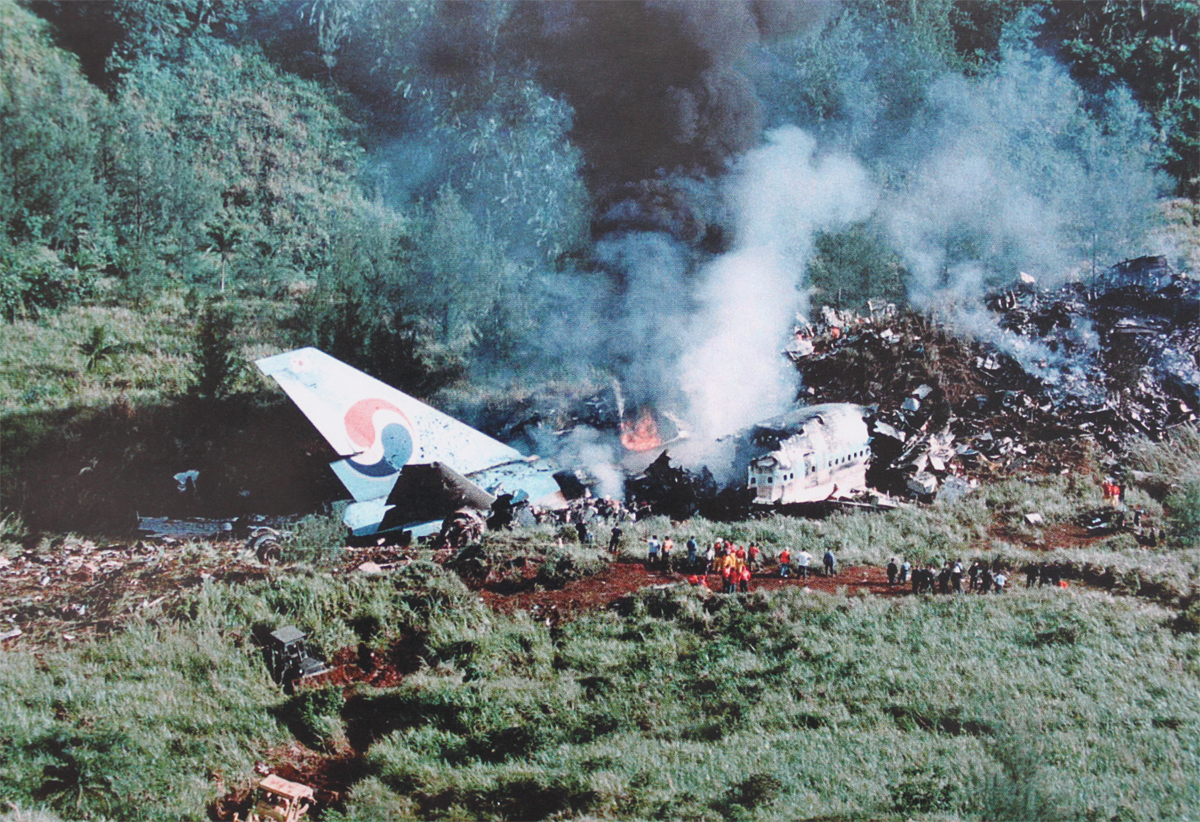
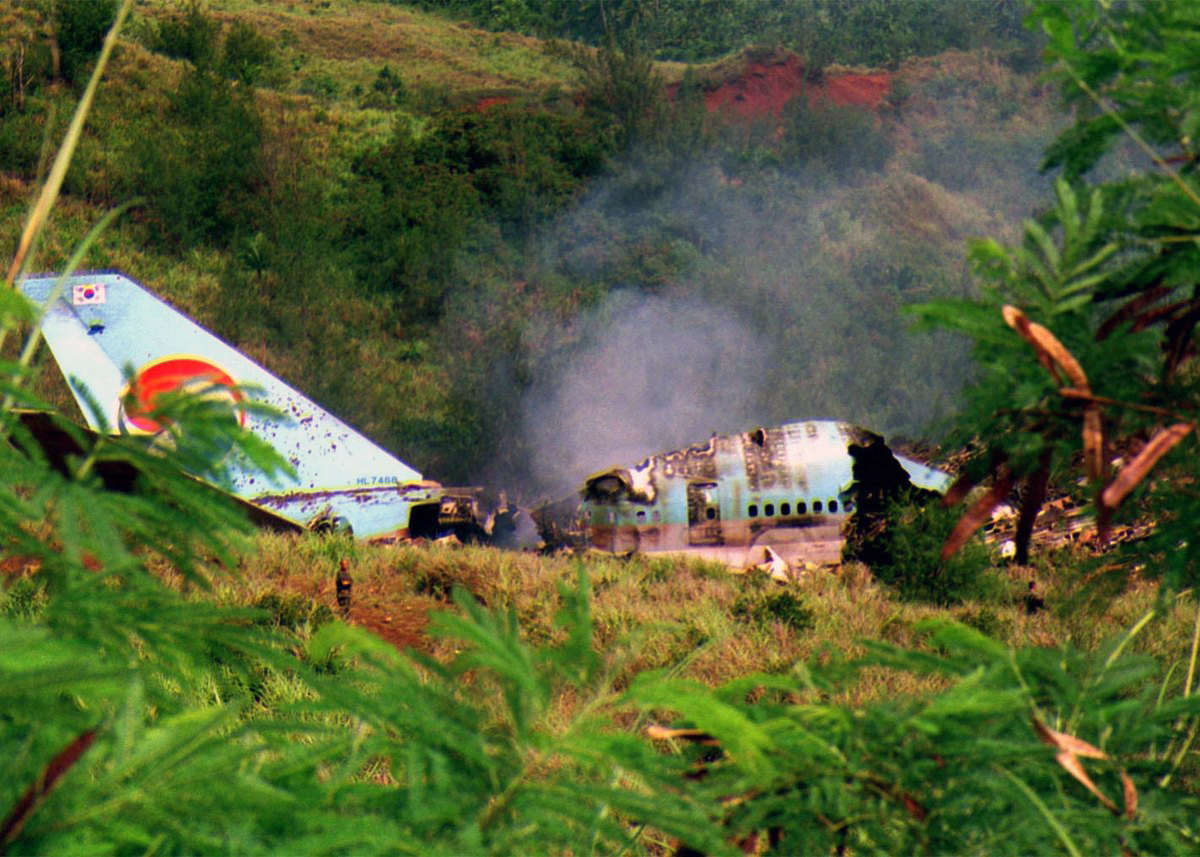
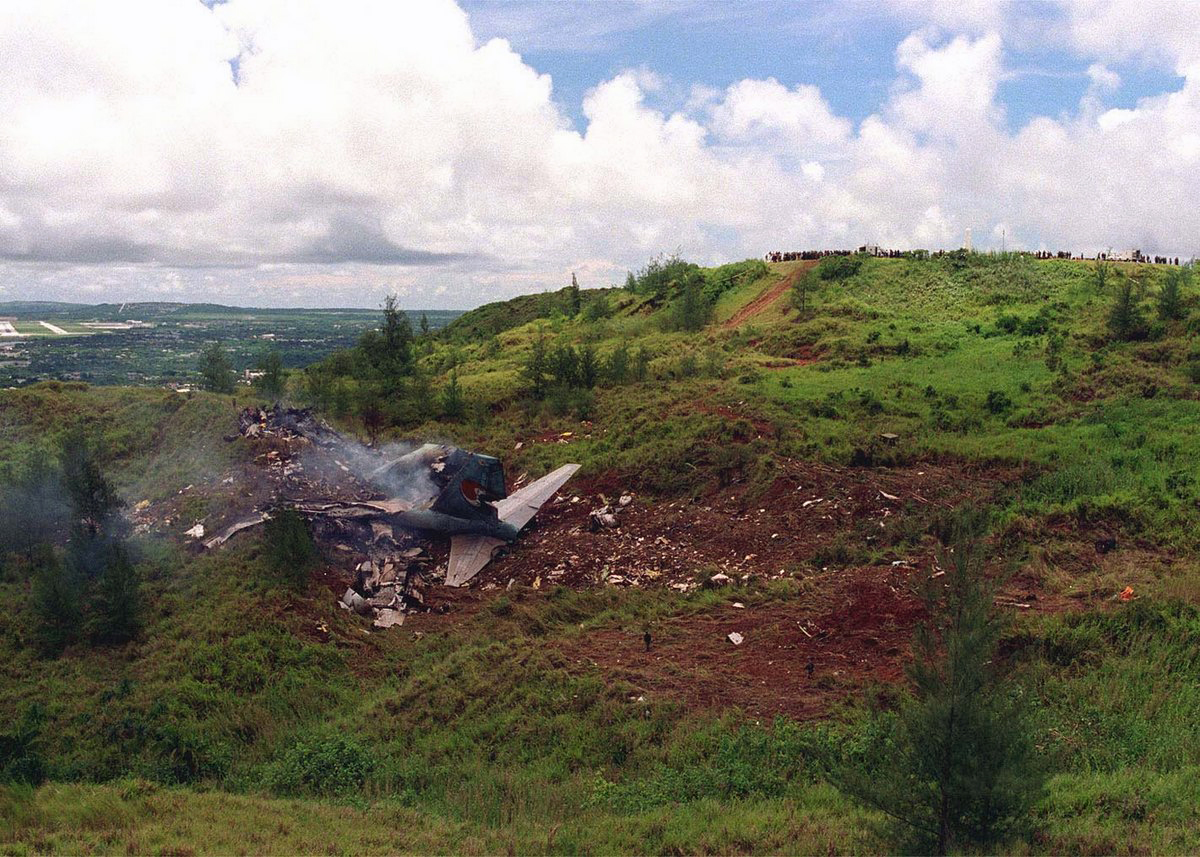
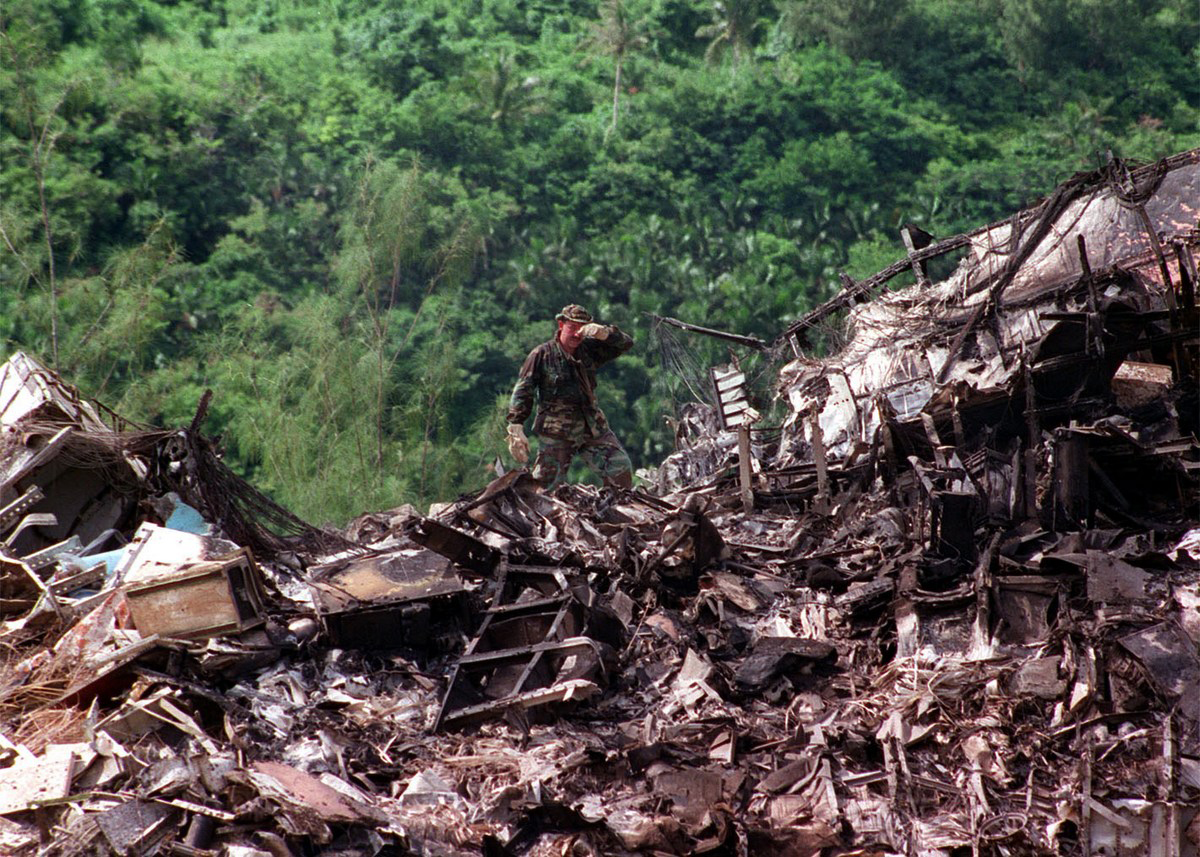
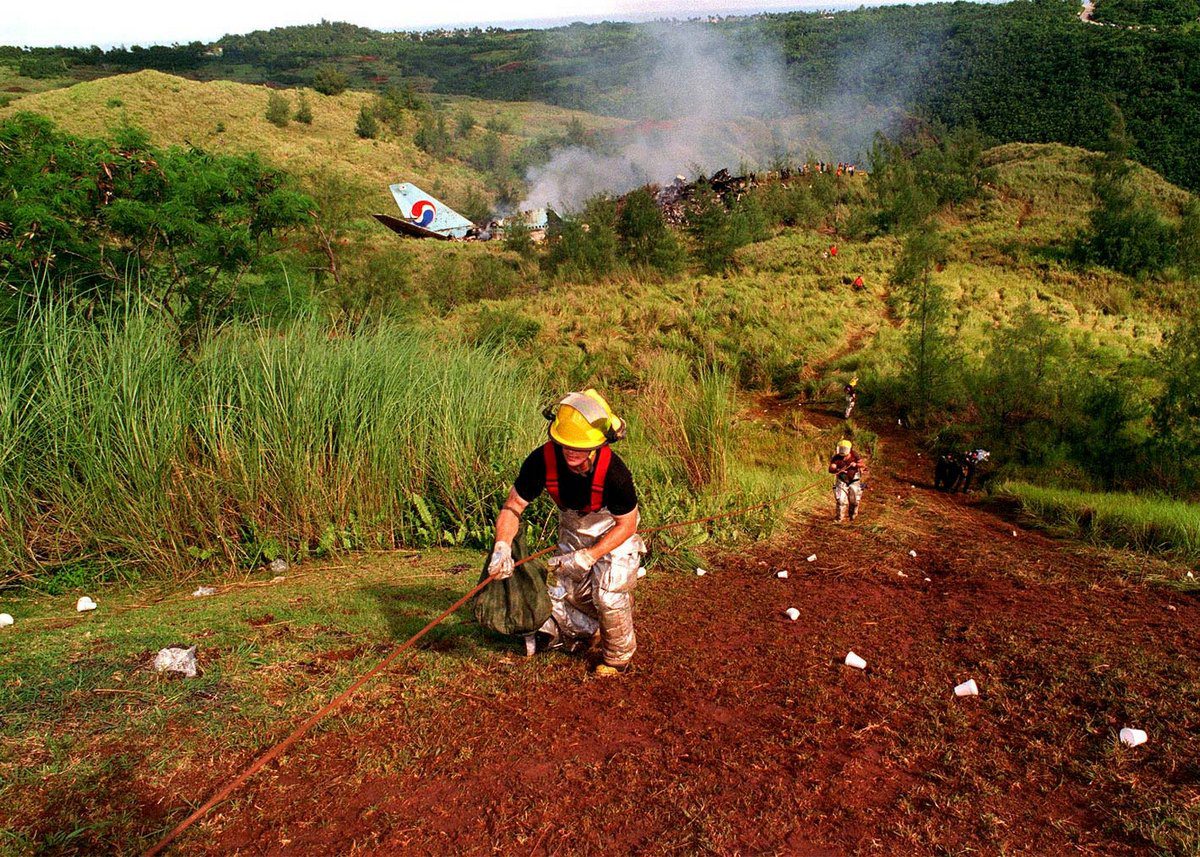
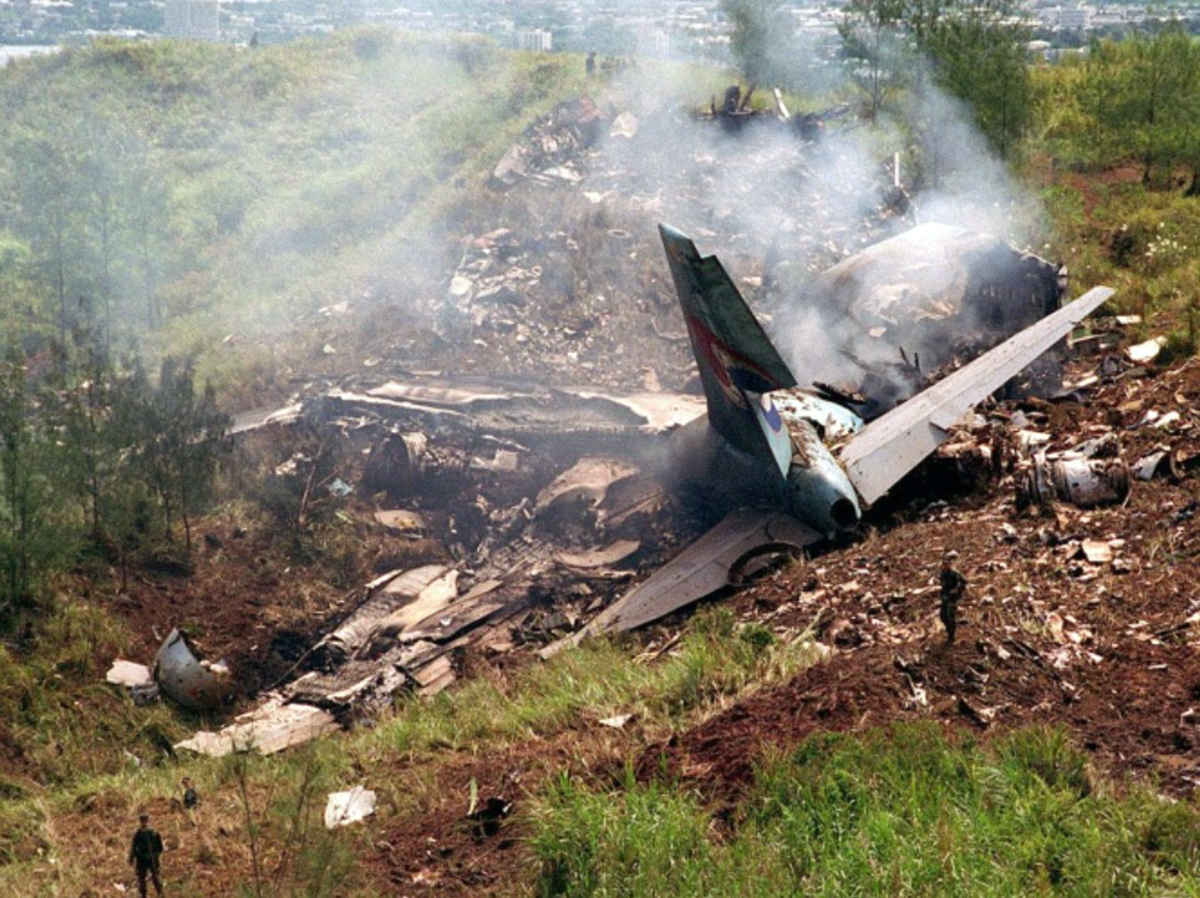
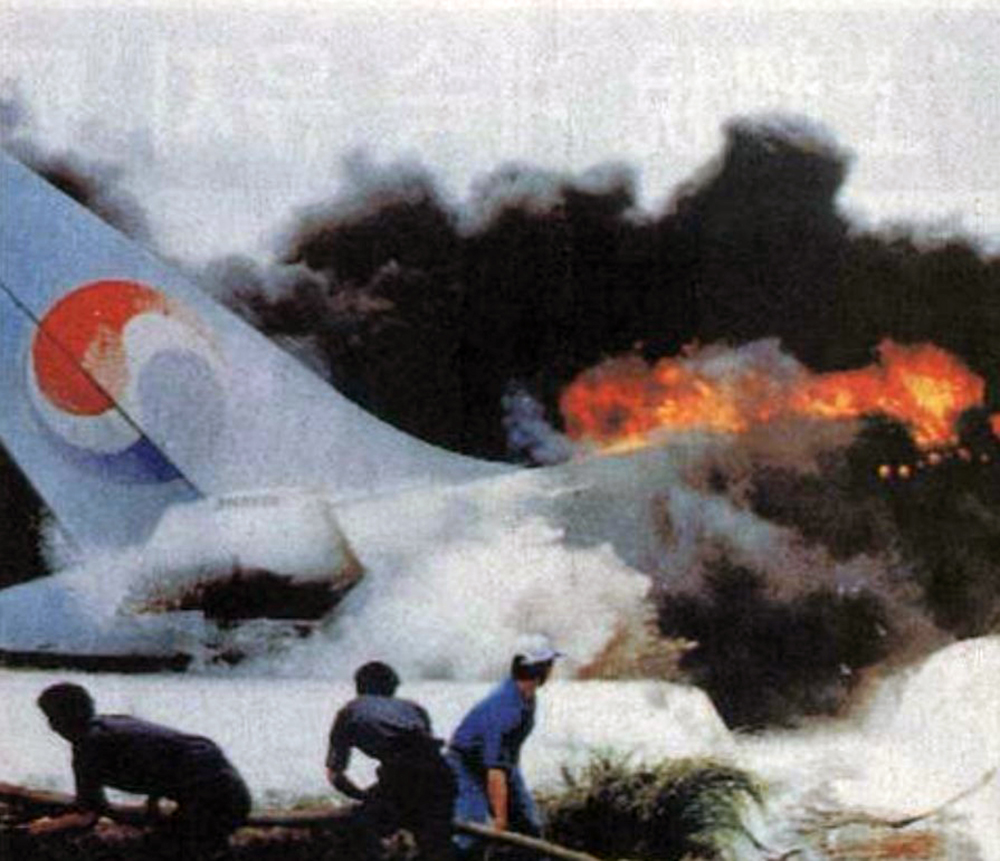
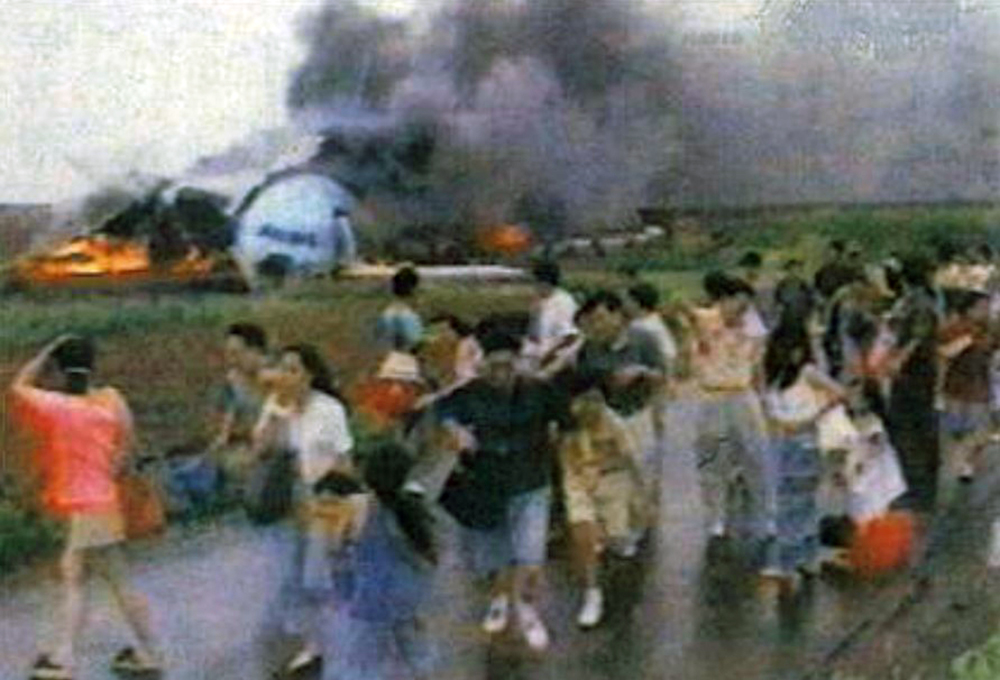
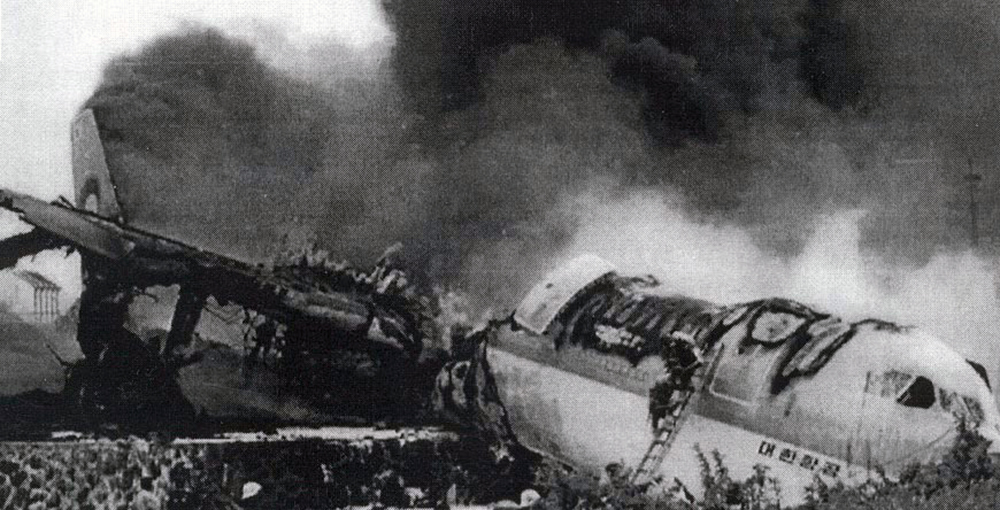
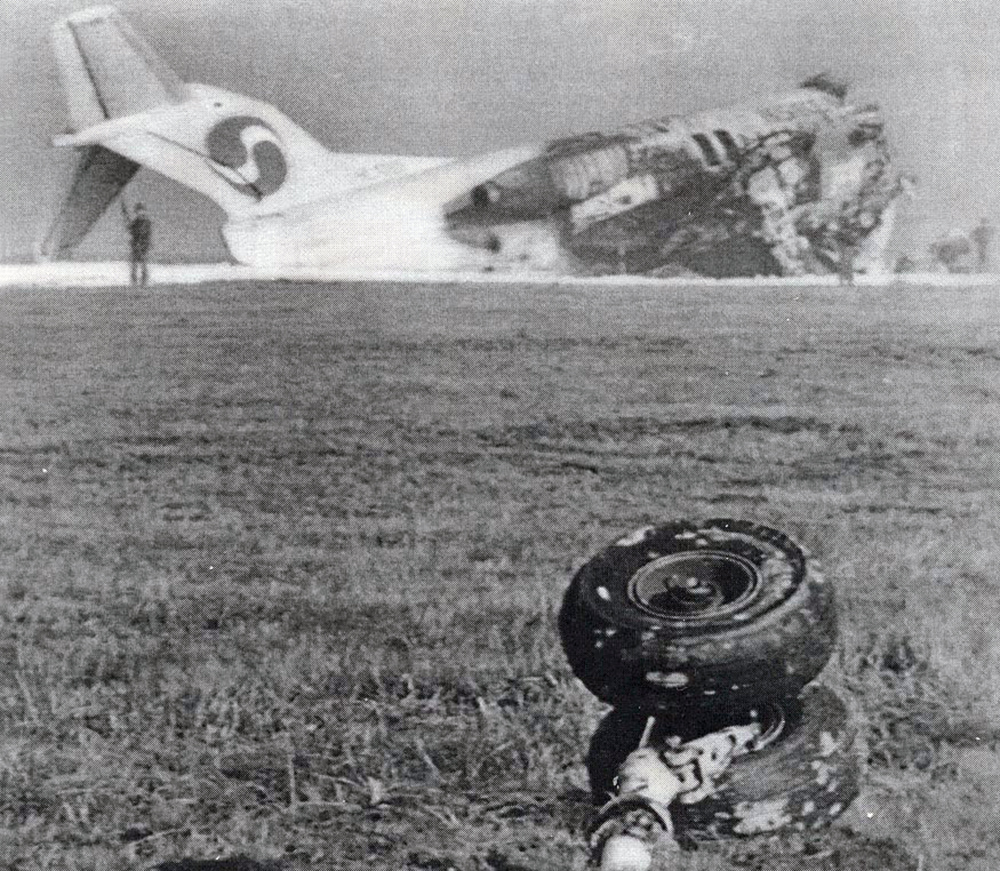
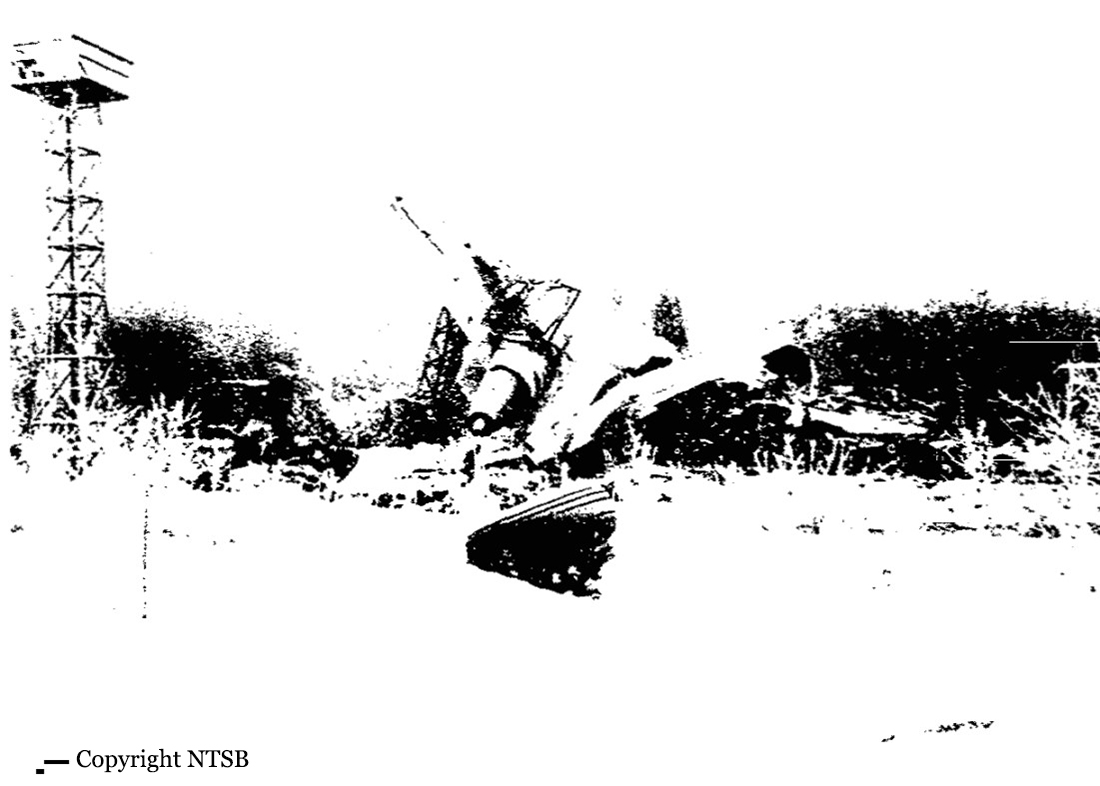
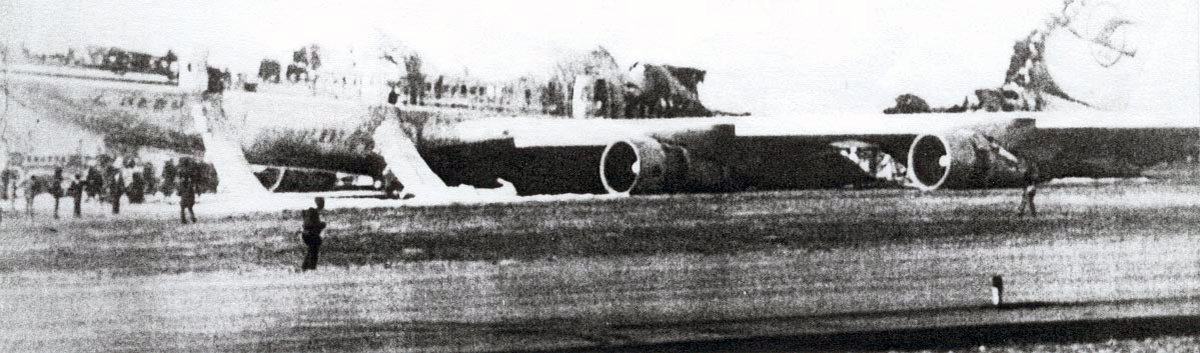
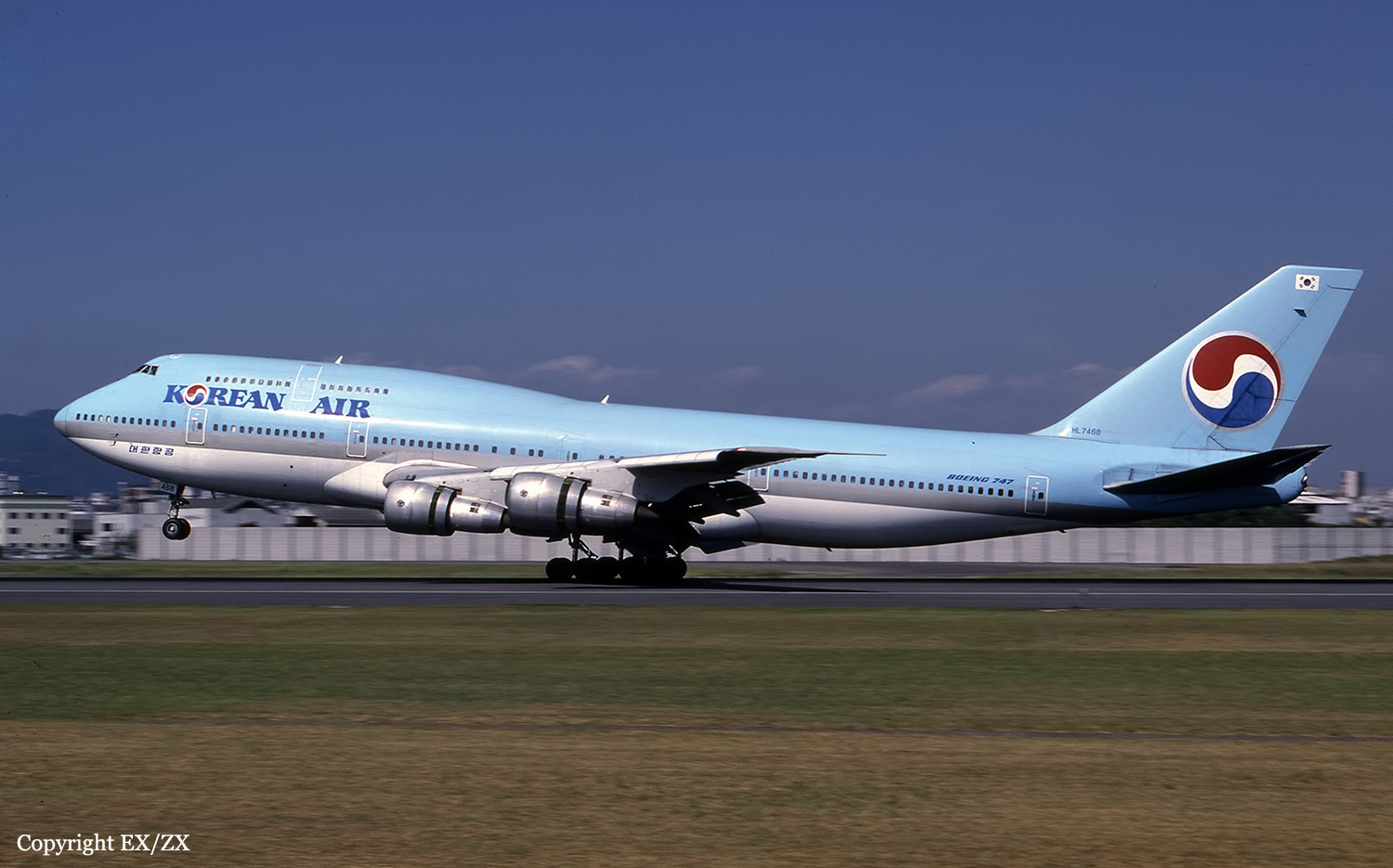
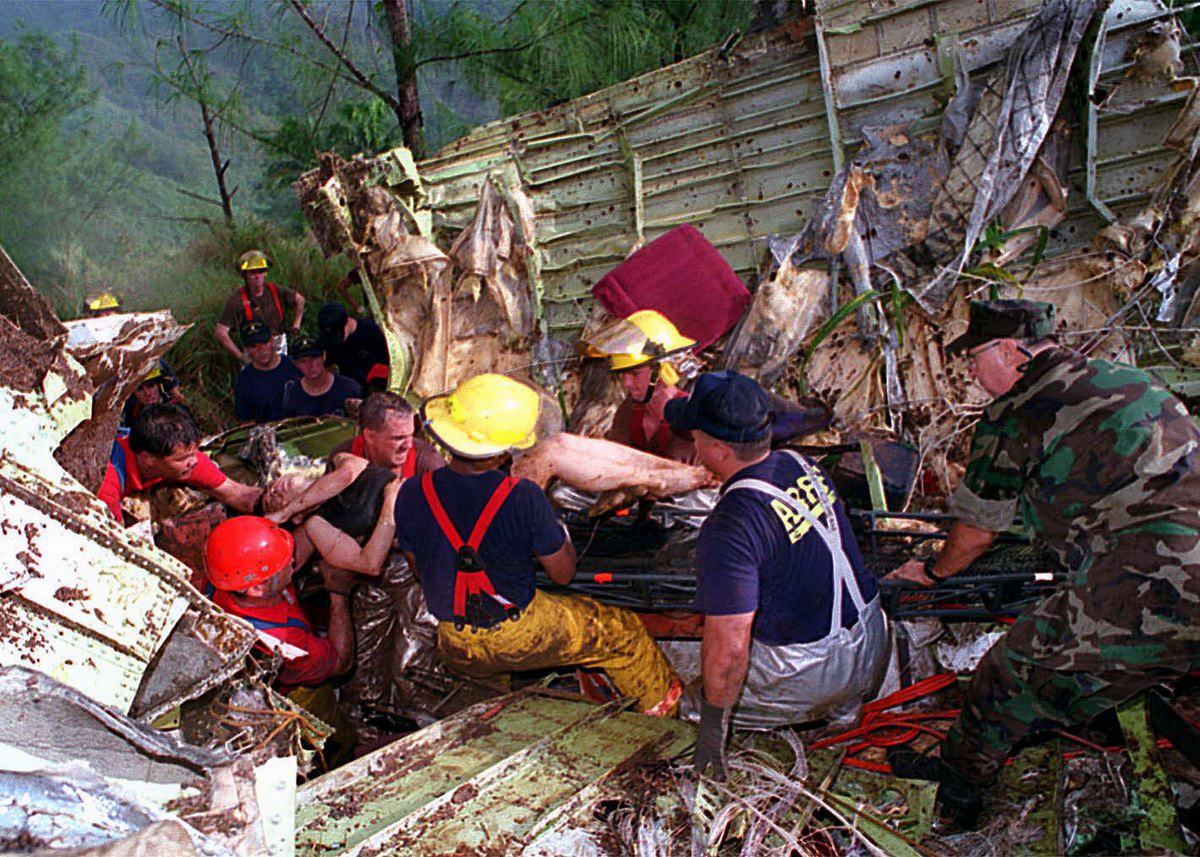
Korean Air Flight 801 was a regular flight from Seoul to Guam. The Boeing 747-300 departed the gate about 21:27 and was airborne about 21:53. The captain was pilot-flying. Upon arrival to the Guam area, the first officer made initial contact with the Guam Combined Center/Radar Approach Control (CERAP) controller about 01:03, when the airplane was level at 41,000 feet and about 240 nm northwest of the NIMITZ VOR/DME. The CERAP controller told flight 801 to expect to land on runway 06L. About 01:10, the controller instructed flight 801 to "...descend at your discretion maintain two thousand six hundred." The first officer responded, "...descend two thousand six hundred pilot discretion." The captain then began briefing the first officer and the flight engineer about the approach and landing at Guam: "I will give you a short briefing...ILS is one one zero three...NIMITZ VOR is one one five three, the course zero six three, since the visibility is six, when we are in the visual approach, as I said before, set the VOR on number two and maintain the VOR for the TOD [top of descent], I will add three miles from the VOR, and start descent when we're about one hundred fifty five miles out. I will add some more speed above the target speed. Well, everything else is all right. In case of go-around, since it is VFR, while staying visual and turning to the right...request a radar vector...if not, we have to go to FLAKE...since the localizer glideslope is out, MDA is five hundred sixty feet and HAT [height above touchdown] is three hundred four feet...." About 01:13 the captain said, "we better start descent;" shortly thereafter, the first officer advised the controller that flight 801 was "leaving four one zero for two thousand six hundred." During the descent it appeared that the weather at Guam was worsening. At 01:24 requested a deviation 10 miles to the left to avoid severe weather. At 01:31 the first officer reported to the CERAP controller that the airplane was clear of cumulonimbus clouds and requested "radar vectors for runway six left." The controller instructed the flight crew to fly a heading of 120°. After this transmission, the flight crew performed the approach checklist and verified the radio frequency for the ILS to runway 06L. About 01:38 the CERAP controller instructed flight 801 to "...turn left heading zero nine zero join localizer;" the first officer acknowledged this transmission. At that time, flight 801 was descending through 2,800 feet msl with the flaps extended 10° and the landing gear up. One minute later the controller stated, "Korean Air eight zero one cleared for ILS runway six left approach...glideslope unusable." The first officer responded, "Korean eight zero one roger...cleared ILS runway six left;" his response did not acknowledge that the glideslope was unusable. The flight engineer asked, "is the glideslope working? glideslope? yeh?" One second later, the captain responded, "yes, yes, it's working." About 01:40, an unidentified voice in the cockpit stated, "check the glideslope if working?" This statement was followed 1 second later by an unidentified voice in the cockpit asking, "why is it working?" The first officer responded, "not useable." The altitude alert system chime sounded and the airplane began to descend from an altitude of 2,640 feet msl at a point approximately 9 nm from the runway 06L threshold. About 01:40:22, an unidentified voice in the cockpit said, "glideslope is incorrect." As the airplane was descending through 2,400 feet msl, the first officer stated, "approaching fourteen hundred." About 4 seconds later, when the airplane was about 8 nm from the runway 06L threshold, the captain stated, "since today's glideslope condition is not good, we need to maintain one thousand four hundred forty. please set it." An unidentified voice in the cockpit then responded, "yes." About 01:40:42, the CERAP controller instructed flight 801 to contact the Agana control tower. The first officer contacted the Agana tower: "Korean air eight zero one intercept the localizer six left." The airplane was descending below 2,000 feet msl at a point 6.8 nm from the runway threshold (3.5 nm from the VOR). About 01:41:01, the Agana tower controller cleared flight 801 to land. About 01:41:14, as the airplane was descending through 1,800 feet msl, the first officer acknowledged the landing clearance, and the captain requested 30° of flaps. The first officer called for the landing checklist and at 01:41:33, the captain said, "look carefully" and "set five hundred sixty feet" (the published MDA). The first officer replied "set," the captain called for the landing checklist, and the flight engineer began reading the landing checklist. About 01:41:42, as the airplane descended through 1,400 feet msl, the ground proximity warning system (GPWS) sounded with the radio altitude callout "one thousand [feet]." One second later, the captain stated, "no flags gear and flaps," to which the flight engineer responded, "no flags gear and flaps." About 01:41:46, the captain asked, "isn't glideslope working?" The captain then stated, "wiper on." About 01:41:53, the first officer again called for the landing checklist, and the flight engineer resumed reading the checklist items. About 01:41:59, when the airplane was descending through 1,100 feet msl at a point about 4.6 nm from the runway 06L threshold (approximately 1.3 nm from the VOR), the first officer stated "not in sight?" One second later, the GPWS radio altitude callout sounded: "five hundred [feet]." About 01:42:14, as the airplane was descending through 840 feet msl and the flight crew was performing the landing checklist, the GPWS issued a "minimums minimums" annunciation followed by a "sink rate" alert about 3 seconds later. The first officer responded, "sink rate okay". At that time the airplane was descending 1,400 feet per minute. About 01:42:19, as the airplane descended through 730 feet msl, the flight engineer stated, "two hundred [feet]," and the first officer said, "let's make a missed approach." About one second later, the flight engineer stated, "not in sight," and the first officer said, "not in sight, missed approach." About 01:42:22, as the airplane descended through approximately 680 feet msl, the nose began to pitch up and the flight engineer stated, "go around." When the captain stated "go around" power was added and airspeed began to increase. As the airplane descended through 670 feet msl, the autopilot disconnect warning sounded. The GPWS radio altitude callouts continued: "one hundred...fifty...forty...thirty...twenty [feet]." About 01:42:26, the airplane impacted hilly terrain at Nimitz Hill, Guam, about 660 feet msl and about 3.3 nm from the runway 06L -threshold. It struck trees and slid through dense vegetation before coming to rest. A post-impact fire broke out. It was established a.o. that the software fix for the Minimum Safe Altitude Warning (MSAW) system at Agana Center Radar Approach Control (CERAP) had rendered the program useless. A software patch had been installed since there had been complaints of the high rate of false MSAW alarms at Guam. This made KAL801's descent below MDA go undetected at the Agana CERAP.
Probable cause:
The captain's failure to adequately brief and execute the nonprecision approach and the first officer's and flight engineer's failure to effectively monitor and cross-check the captain's execution of the approach. Contributing to these failures were the captain's fatigue and Korean Air's inadequate flight crew training. Contributing to the accident was the Federal Aviation Administration's intentional inhibition of the minimum safe altitude warning system and the agency's failure to adequately to manage the system.
Final Report:
Crash of an Airbus A300B4-622R in Jeju

Date & Time: Aug 10, 1994 at 1122 LT
Type of aircraft:
Operator:
Registration:
HL7296
Survivors:
Yes
Schedule:
Seoul - Jeju
MSN:
583
YOM:
1990
Flight number:
KE2033
Country:
Region:
Crew on board:
8
Crew fatalities:
Pax on board:
152
Pax fatalities:
Other fatalities:
Total fatalities:
0
Circumstances:
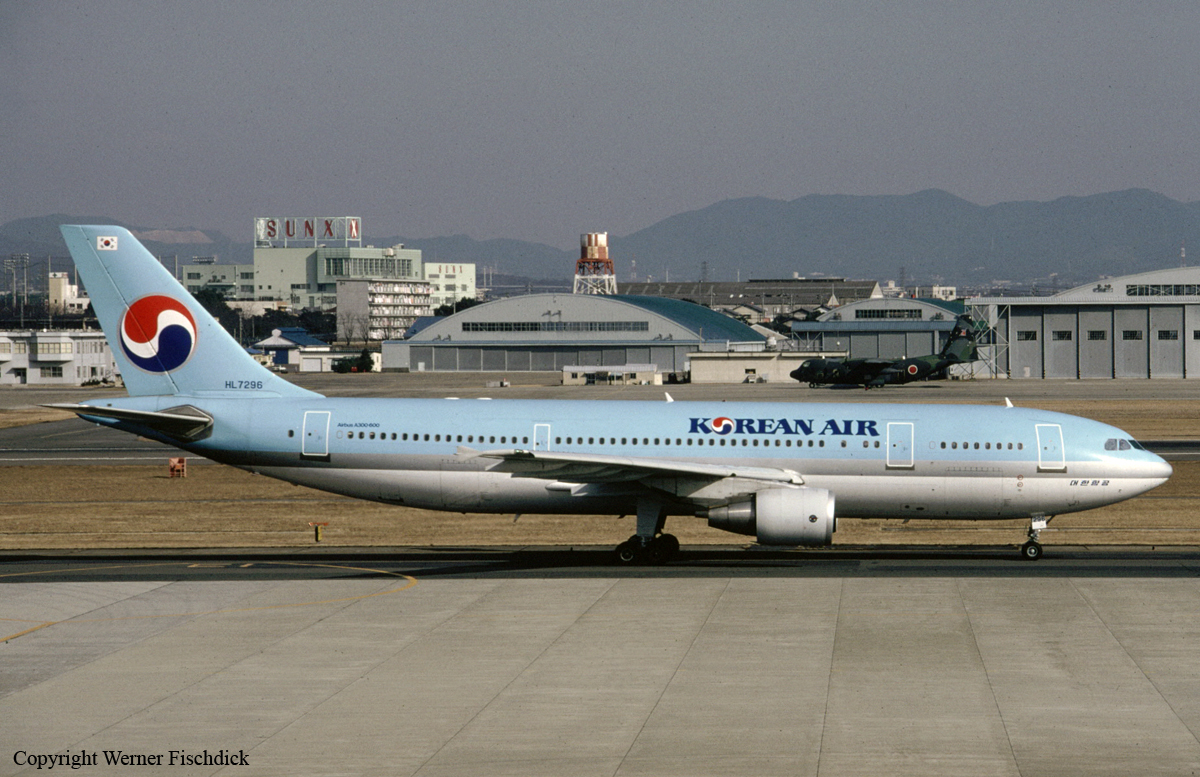
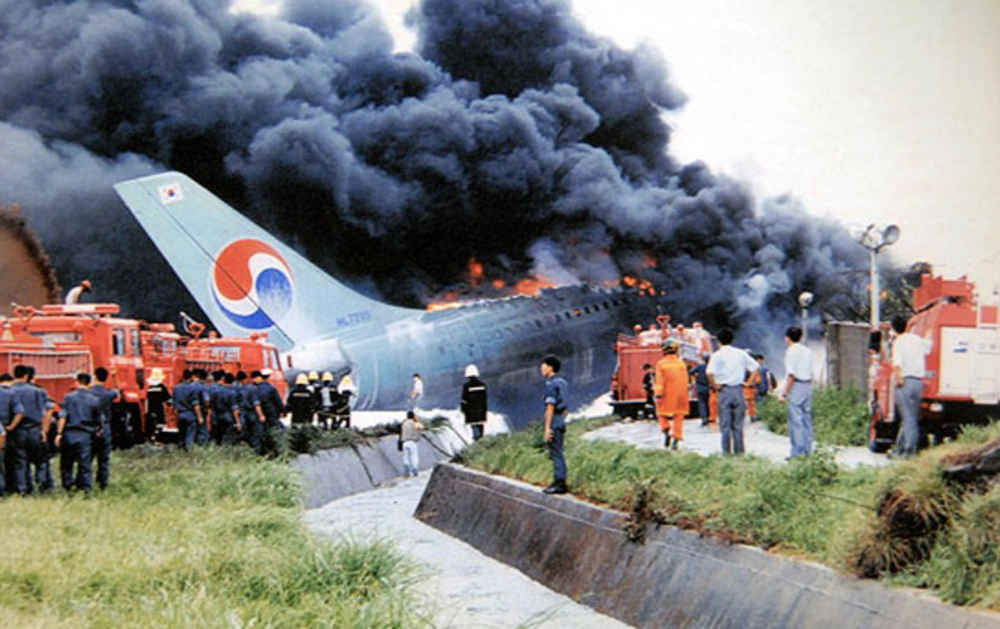
The descent and approach to Jeju Airport was completed in poor weather conditions with turbulences and heavy rain falls as typhoon 'Doug' was passing over. On final approach, flaps were deployed at 15°/20° as the captain was suspecting windshear and microburst conditions. Twice, the copilot informed the captain about the approach speed of 147 knots which was acknowledged. The captain continued the approach but too high on the glide, the aircraft landed too far down the runway, about 1,773 metres past its threshold. On a wet runway surface, the aircraft was unable to stop within the remaining distance (1,227 metres remaining), overran at a speed of 104 knots and eventually collided with a concrete wall and military barracks, bursting into flames. All 160 occupants were quickly evacuated, among them seven were slightly injured.
Probable cause:
Wrong approach configuration on part of the crew who completed the approach at an excessive speed and too high on the glide. Investigations did not confirm any windshear or microburst conditions. The crew failed to initiate a go-around procedure.

Crash of a Boeing 727-281 in Daegu

Date & Time: Jun 13, 1991 at 1841 LT
Type of aircraft:
Operator:
Registration:
HL7350
Survivors:
Yes
Schedule:
Jeju - Daegu
MSN:
20469
YOM:
1970
Country:
Region:
Crew on board:
7
Crew fatalities:
Pax on board:
120
Pax fatalities:
Other fatalities:
Total fatalities:
0
Circumstances:
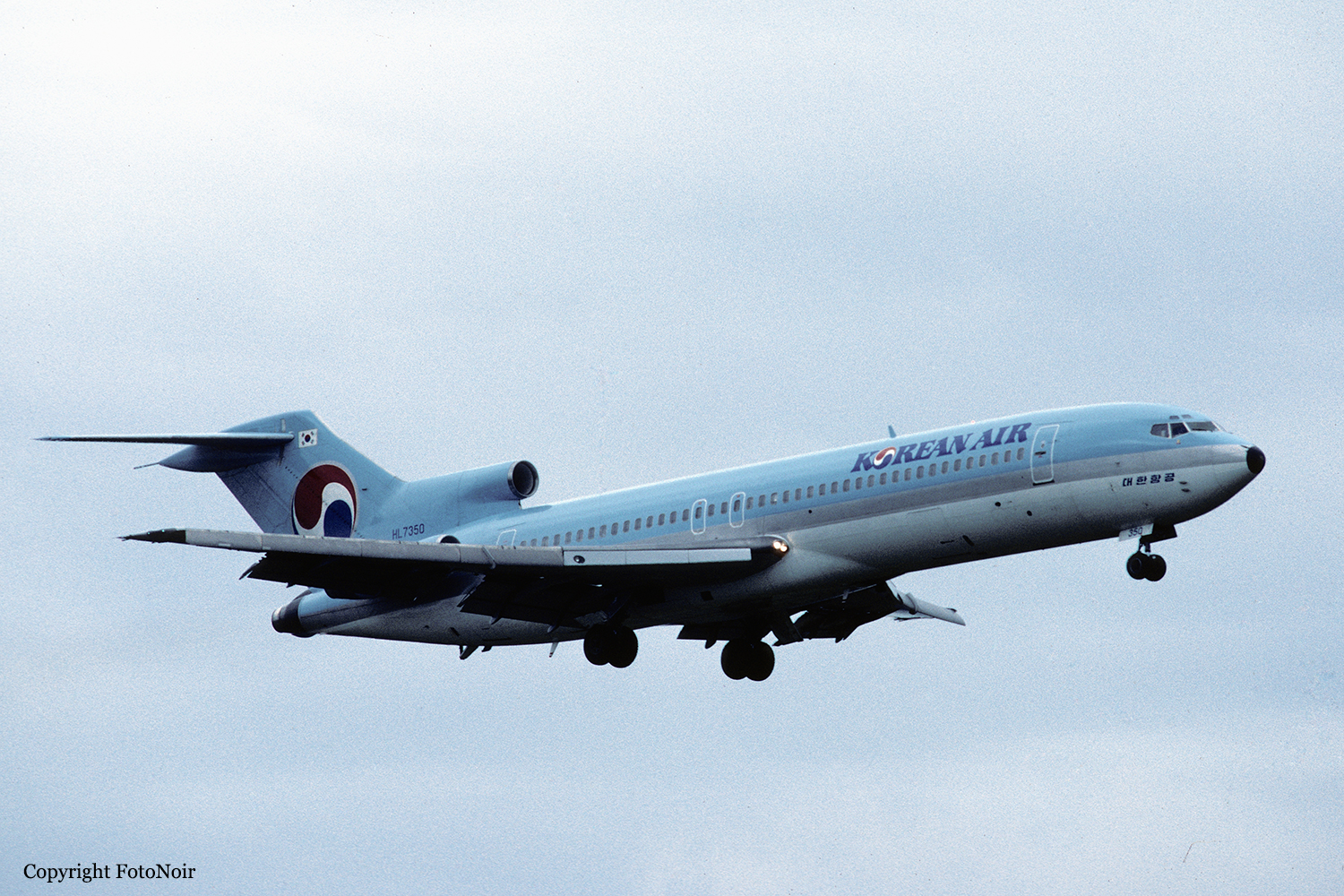
On final approach to Daegu Airport, the crew failed to follow the approach checklist and did not select gear down. An alarm sounded in the cockpit but the crew thought this was an error and pulled out the circuit breaker so the alarm stopped. Despite the situation, the crew failed to double check the three landing gear lights that remained red and continued the approach when the aircraft landed on its belly before coming to rest. All 127 occupants were evacuated, among them 7 passengers were slightly injured. The aircraft was damaged beyond repair.
Probable cause:
Belly landing after the crew failed to follow the approach checklist and forgot to select gear down.

Crash of a Piper PA-42-1000 Cheyenne 400LS on Mt Hallasan

Date & Time: Mar 20, 1991
Type of aircraft:
Operator:
Registration:
HL5204
Flight Type:
Survivors:
Yes
Site:
Schedule:
Jeju - Jeju
MSN:
42-5527043
YOM:
1989
Country:
Region:
Crew on board:
3
Crew fatalities:
Pax on board:
0
Pax fatalities:
Other fatalities:
Total fatalities:
0
Circumstances:
The crew was completing a local training at Jeju-Jungseok Airport. On approach via 'White 2' airway, the captain cancelled his IFR flight plan and continued under VFR when, at an altitude of 2,300 feet, the aircraft struck east side of Mt Hallasan (1,950 meters high). The wreckage was found about 8 km west of the airport at an altitude of about 700 meters. All three crew members were injured and the aircraft was destroyed.
Probable cause:
For unknown reasons, the crew initiated the approach to Jeju-Jungseok Airport from the west while the standard procedure required an approach from the north. At the time of the accident, the visibility was poor due to low clouds and Mt Hallasan was shrouded in clouds.

Crash of a Fokker F28 Fellowship 4000 in Seoul

Date & Time: Nov 25, 1989 at 0748 LT
Type of aircraft:
Operator:
Registration:
HL7285
Flight Phase:
Survivors:
Yes
Schedule:
Seoul - Ulsan
MSN:
11221
YOM:
1985
Country:
Region:
Crew on board:
6
Crew fatalities:
Pax on board:
42
Pax fatalities:
Other fatalities:
Total fatalities:
0
Circumstances:
During the takeoff roll at Seoul-Gimpo Airport, the left engine lost power and severe vibrations were encountered. The captain decided to abandon the takeoff and initiated an emergency braking procedure. Unable to stop within the remaining distance, the aircraft overran, lost its undercarriage, cartwheeled and came to rest, bursting into flames. All 48 occupants were evacuated, among them 21 were injured. The aircraft was totally destroyed.
Probable cause:
It was determined that the loss of power on the left engine was the consequence of ice that detached from the left upper wing and went into the engine. This caused the high pressure compressor to stall, followed by vibrations and a loss of directional control.
The following contributing factors were reported:
- Poor flight preparation on part of the flying crew,
- The aircraft has not been properly deiced prior to takeoff.

Crash of a Douglas DC-10-30 in Tripoli: 81 killed

Date & Time: Jul 27, 1989 at 0725 LT
Type of aircraft:
Operator:
Registration:
HL7328
Survivors:
Yes
Site:
Schedule:
Seoul - Bangkok - Jeddah - Tripoli
MSN:
47887
YOM:
1973
Flight number:
KE803
Country:
Region:
Crew on board:
18
Crew fatalities:
Pax on board:
181
Pax fatalities:
Other fatalities:
Total fatalities:
111
Aircraft flight hours:
49025
Aircraft flight cycles:
11440
Circumstances:
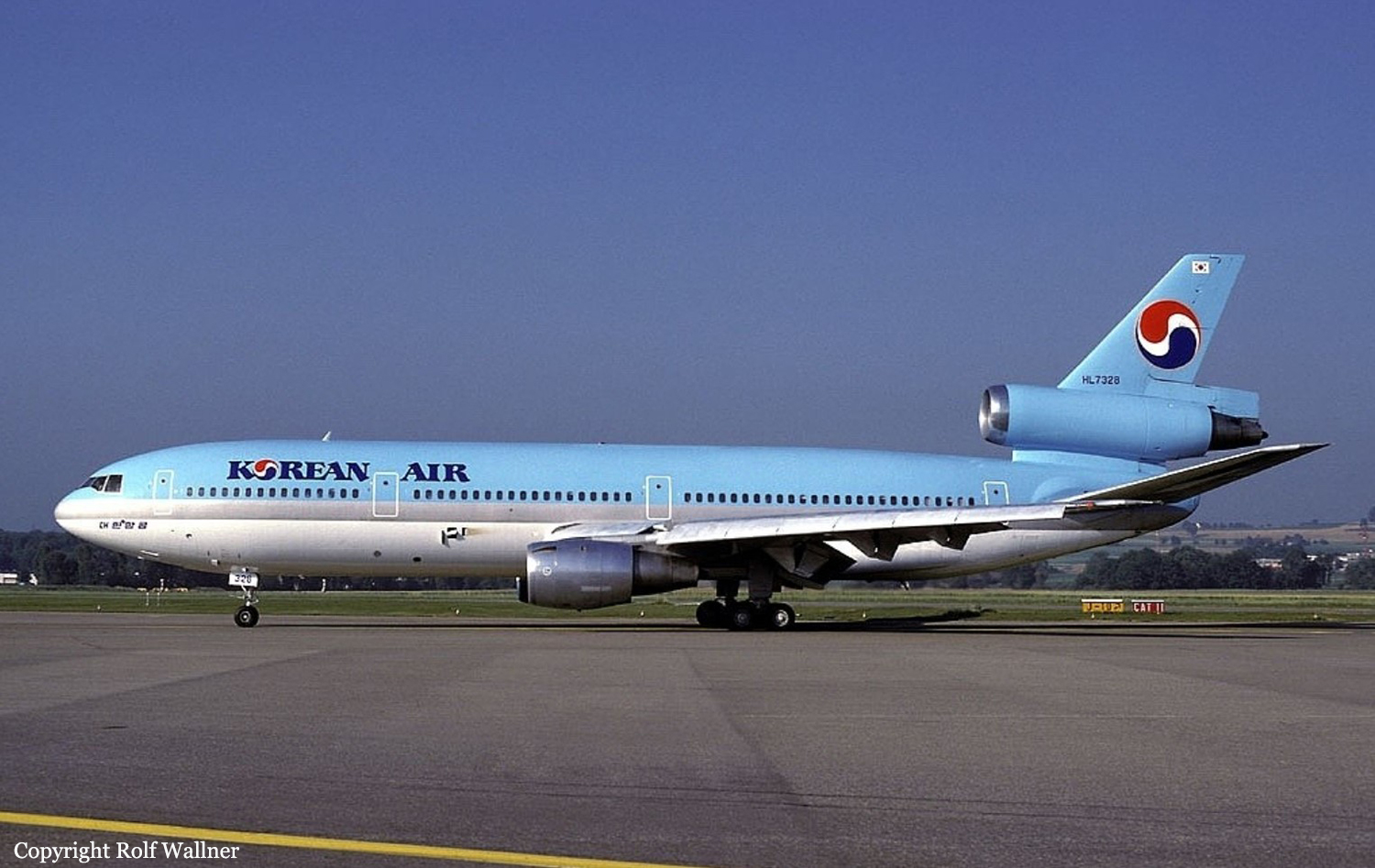
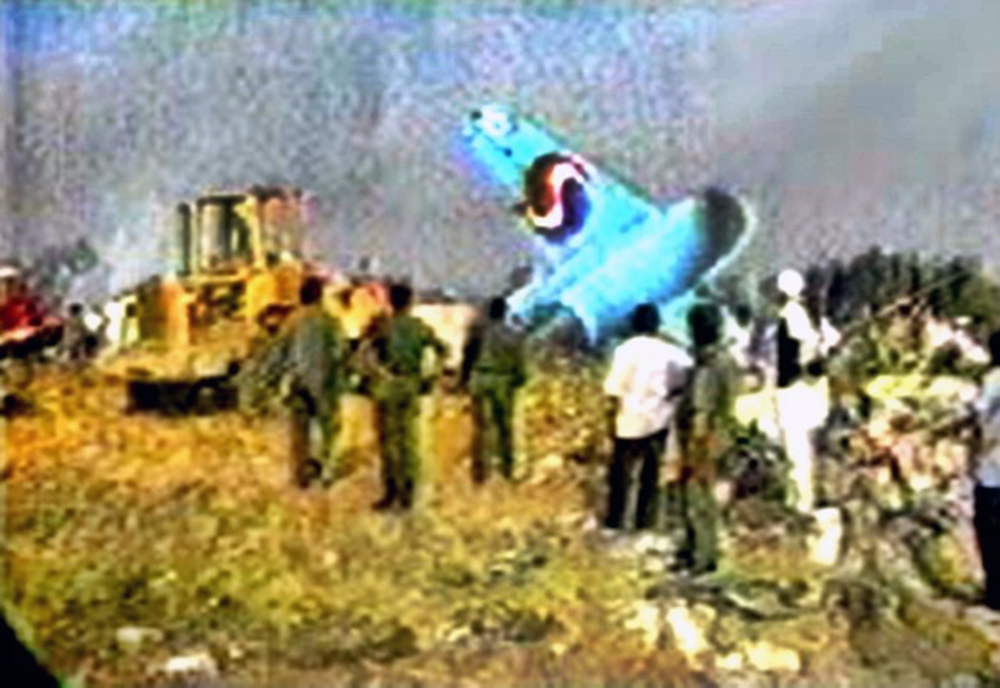
The approach to Tripoli Intl Airport was completed in below weather minima as the visibility was varying between 100 and 800 feet and the ILS on runway 27 was unserviceable. On short final, the crew failed to realize his altitude was too low when the aircraft struck the roof of a house, stalled and crashed in a residential area located 2,4 km short of runway. Three crew members and 72 passengers were killed as well as six people on the ground. 124 people in the aircraft were injured as well as few dozen on the ground.
Probable cause:
The crew decided to continue the descent below the glide until the aircraft struck obstacles and crashed. The following contributing factors were reported:
- Lack of visibility due to foggy conditions,
- Below minima weather conditions,
- The crew failed to initiate a go-around while he did not establish a visual contact with the runway,
- The ILS system for runway 27 was unserviceable,
- The crew failed to follow the approach procedures,
- The crew ignored ATC warnings,
- The approach speed was excessive and the flaps were not deployed in the correct angle,
- The crew of a Russian aircraft diverted to Malta an hour before the accident due to unsafe landing conditions.

Crash of a Boeing 707-3B5C in the Andaman Sea: 115 killed

Date & Time: Nov 29, 1987 at 1152 LT
Type of aircraft:
Operator:
Registration:
HL7406
Flight Phase:
Survivors:
No
Schedule:
Baghdad - Abu Dhabi - Bangkok - Seoul
MSN:
20522
YOM:
1971
Flight number:
KE858
Country:
Region:
Crew on board:
11
Crew fatalities:
Pax on board:
104
Pax fatalities:
Other fatalities:
Total fatalities:
115
Captain / Total flying hours:
11161
Captain / Total hours on type:
5416.00
Copilot / Total flying hours:
3882
Copilot / Total hours on type:
134
Aircraft flight hours:
36047
Aircraft flight cycles:
19941
Circumstances:
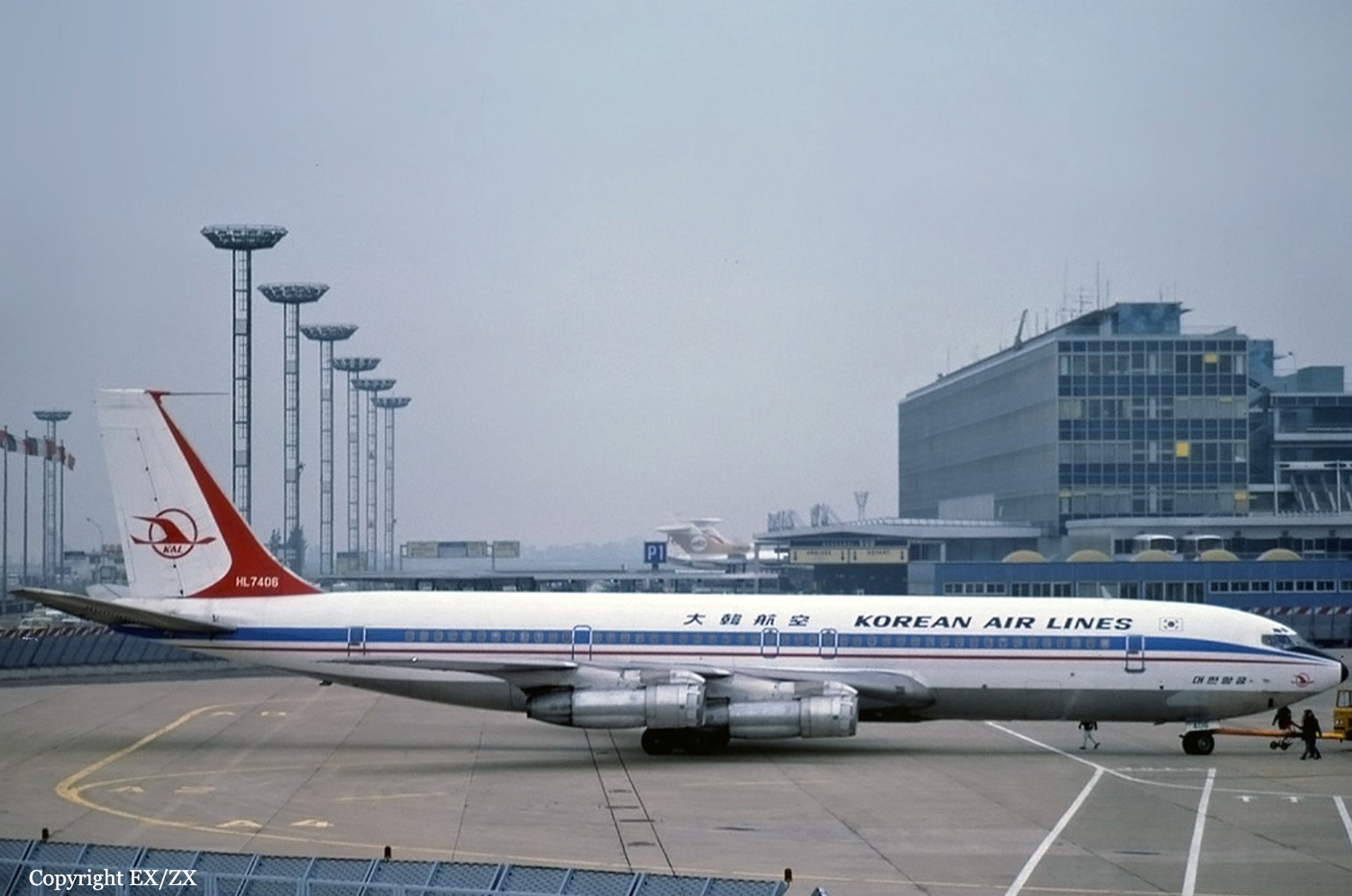
A Boeing 707-300 passenger plane, registered HL7406, was destroyed in an accident in the Indian Ocean, some 100 km off the coast of Myanmar. All 104 passengers and eleven crew members were killed. Korean Air flight 858 departed Baghdad, Iraq on a scheduled service to Seoul, South Korea. En route stops were planned at Abu Dhabi, UAE and Bangkok, Thailand. At 00:01 UTC Flight 858 departed Abu Dhabi, climbing to a cruising altitude of FL370. Last radio contact was at 05:01 UTC when the crew reported that they estimated reaching the TAVOY waypoint over the Andaman Sea at 05:22. Flight 858 was declared missing when it failed to arrive at the destination. On December 13, 1987 a local schooner found pieces of wreckage floating northwest off Tavoy, Myanmar. Korean Authorities, suspecting sabotage after the aircraft became missing, started checking on passengers who disembarked at Abu Dhabi and traced the suspects Mr.Hachiya Shinichi and Miss Hachiya Mayumi to Bahrain where they were apprehended while going through exit formalities at the airport. It was reported that they were found to be holding false Japanese Passports. While being held for interrogation, both committed suicide by taking poison capsules hidden in the cigarettes and Mr.Hachiya Shinichi died. Miss Hachiya Mayumi who survived the attempt was extradited to South Korea. It was reported that the passengers were found to be named Mr. Kim Sung-il and Miss Kim Hyon-hui of North Korean origin. For her role in the bombing Kim Hyun Hui was sentenced to death in March 1989. However, South Korean president Roh Tae-woo pardoned her in 1998.
Probable cause:
In flight explosion of time bomb planted in the aircraft by the two saboteurs disguised as passengers. Investigation revealed that the bomb consisted of a composition C4 type explosive hidden in a battery operated portable transistor radio which was used as a timing device. The timer was activated while they were awaiting embarkation at Baghdad Airport and set to go off 9 hours later. Together with the transistor radio, a liquor bottle containing liquid explosive (type PLX) was taken on board and placed in the overhead baggage rack above seat row n°7 in the forward cabin section of the economy class compartment where they were seated. These timed explosives were left in that place when they disembarked at Abu Dhabi.

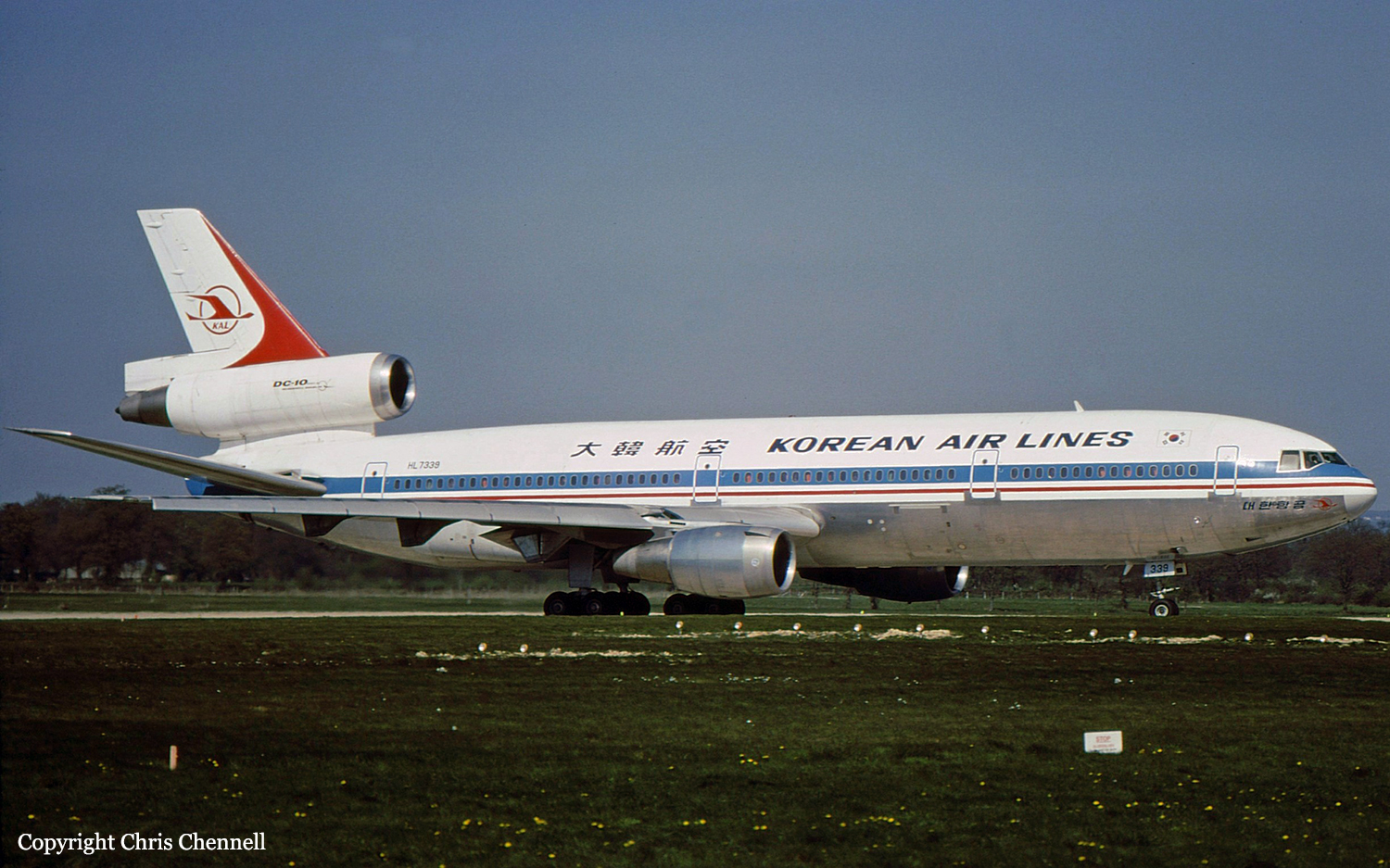
Crash of a Douglas DC-10-30CF in Anchorage

Date & Time: Dec 23, 1983 at 1406 LT
Type of aircraft:
Operator:
Registration:
HL7339
Flight Phase:
Flight Type:
Survivors:
Yes
Schedule:
Seoul - Anchorage - Los Angeles
MSN:
46960
YOM:
1977
Flight number:
KE084
Crew on board:
3
Crew fatalities:
Pax on board:
0
Pax fatalities:
Other fatalities:
Total fatalities:
0
Captain / Total flying hours:
12562
Captain / Total hours on type:
6471.00
Copilot / Total flying hours:
8157
Copilot / Total hours on type:
2995
Circumstances:
While taxiing out in fog, the KAL crew became disoriented and ended up on the wrong runway. During the takeoff run, the aircraft collided head-on with South Central Air Flight 59, a Piper PA-31 which was taking off from runway 06L-24R for a flight to Kenai. The 9 occupants of N35206 were injured. The DC-10 overran the runway by 1434 feet and came to rest 40 feet right of the extended centreline.
Probable cause:
The failure of the pilot of Korean Air Lines Flight 084 to follow accepted procedures during taxi, which caused him to become disoriented while selecting the runway; the failure of the pilot to use the compass to confirm his position; and the decision of the pilot to take off when he was unsure that the aircraft was positioned on the correct runway. Contributing to the accident was the fog, which reduced visibility to a point that the pilot could not ascertain his position visually and the control tower personnel could not assist the pilot. Also contributing to the accident was a lack of legible taxiway and runway signs at several intersections passed by Flight 084 while it was taxiing.
Final Report:
Crash of a Boeing 747-230B off Sakhaline Island: 269 killed

Date & Time: Sep 1, 1983 at 0535 LT
Type of aircraft:
Operator:
Registration:
HL7442
Flight Phase:
Survivors:
No
Schedule:
New York - Anchorage - Seoul
MSN:
20559
YOM:
1972
Flight number:
KE007
Country:
Region:
Crew on board:
23
Crew fatalities:
Pax on board:
246
Pax fatalities:
Other fatalities:
Total fatalities:
269
Circumstances:
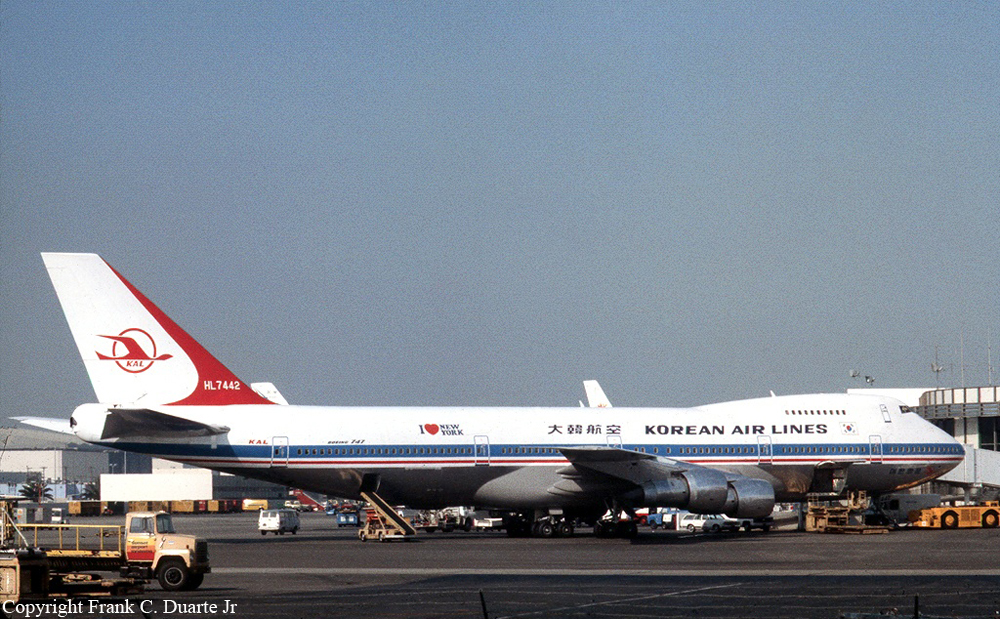
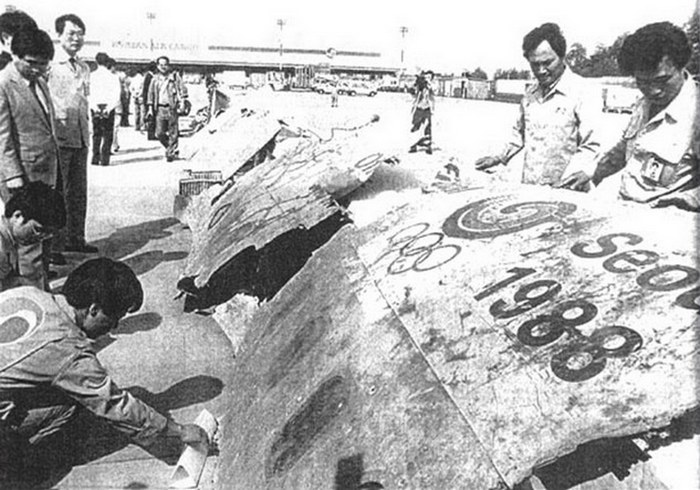
On 31 August 1983, a Korean Air Lines (KAL) Boeing 747, designated KE 007, departed John F. Kennedy International Airport, New York, United States, on a one-stop scheduled flight for Kimpo International Airport, Seoul, Republic of Korea. The en-route stop occurred at Anchorage International Airport, Alaska, United States. At Anchorage, the aircraft was refuelled and serviced for the remainder of the flight to Seoul and, in accordance with company practice, the flight and cabin crews were changed. The flight departed at the planned time of departure which, in keeping with Korean Air Lines' procedure, was calculated for each KE 007 flight. The departure from Anchorage was flexible to ensure arrival in Seoul at the scheduled arrival time of 21:00 hours* (06:00 hours local time). The actual departure time of 13:00 hours on 31 August would have resulted in an on-time arrival of KE 007 in Seoul, had the flight been completed in accordance with its flight plan. On departing Anchorage, the flight had 269 persons on board consisting of 240 passengers, 3 flight crew members, 20 cabin attendants, and 6 crew members of KAL being repositioned to Seoul. Soon after departure from Anchorage, KE 007 deviated to the right (north) of its direct track to Bethel. This deviation resulted in a progressively greater lateral displacement to the right of its planned route which, ultimately, resulted in its penetration of adjacent high seas airspace in flight information regions (FIR_s) operated by the Union of Soviet Socialist Republics (USSR), as well as of sovereign USSR airspace overlying Kamchatka Peninsula and Sakhalin Island and their surrounding territorial waters. No evidence was found during the investigation to indicate that the flight crew of KE 007 was, at any time, aware of the flight's deviation from its planned route in spite of the fact that it continued for over five hours. According to representatives of the United States, military radar installations in Alaska were not aware in real time that the aircraft was proceeding west with an increasing northerly deviation from the recognized airways system. The military radar installations of the Japanese Defence Agency were aware that an aircraft was tracking in USSR airspace over Sakhalin Island. According to representatives of Japan, they were not a\vare that it was a civil aircraft off its intended track. Approximately between 16:40 and 17:08 hours military aircraft operated by the USSR attempted to intercept KE 007 over Kamchatka Peninsula. The interception attempts were unsuccessful. From about 18:00 hours when KE 007 was approaching Sakhalin Island, USSR, the flight was intercepted by USSR military aircraft. At 18:26:02 hours the aircraft was hit by at least one of t\\'o air-to-air missiles fired by the pilot of one of the USSR interceptor aircraft who had been directed, by his ground command and control units, to shoot down an aircraft which they assumed to be a United States RC-135. As a result of the attack, KE 007 collided with the sea and sank off the southwest coast of Sakhalin Island. There were no survivors. The flight recorders, fragmentary pieces of the aircraft and a small number of items of personal property were salvaged by divers from the USSR during a two month period following the accident. In addition, some flotsam from the aircraft was dispersed by tidal currents and recovered later. The cockpit voice recorder (CVR) and the digital flight data recorder (DFDR) tapes were recovered by the USSR in 1983 and were handed over to ICAO in January 1993 by the representatives of the Russian Federation. They also made available recordings and transcripts of the communications between the pilots of the intercepting fighter aircraft and their ground controllers as well as the communications between the command centres. The representatives of the United States made available certified copies and transcripts of the Anchorage ATC tapes, and the representatives of Japan made available the Tokyo ATC tape. In the course of the investigation, all practical steps were taken to confirm the authenticity of the communications tapes. A comprehensive assessment of the physical characteristics of the CVR and the DFDR tapes and the information recorded thereon was made to ensure that they contained authentic records. The material on the communications tapes and the CVR and DFDR tapes showed no evidence of contradiction with known information and correlated well with other sources of data. There was no evidence to suggest that the crew of flight KE 007 was aware that their aircraft was flying to the north of its planned route or that they knew of the presence of the intercepting fighter aircraft. The DFDR record established that flight KE 007 maintained a constant magnetic heading from soon after departure from Anchorage until the attack by the fighter aircraft. The maintenance of the constant magnetic heading was so accurate it could only have resulted from the autopilot controlling the aircraft. The CVR and the DFDR records also established that the aircraft did not sustain an extensive avionics or navigation systems failure or malfunction prior to the attack by the USSR fighter aircraft. The evidence obtained supported the first hypothesis of those listed in the 1983 ICAO report, Le. that the crew inadvertently flew virtually the entire flight on a constant magnetic heading. The maintenance of a constant magnetic heading and the resulting track deviation was due to the KE 007 crew's failure to note that the autopilot had either been left in heading mode or had been switched to INS when the aircraft was beyond the range (7.5 NM) for the INS to capture the desired track.
Concerning the interception and associated identification, signalling and communications the investigation found the following:

1) Interceptions of KE 007 were attempted by USSR military aircraft over Kamchatka Peninsula and made in the vicinity of Sakhalin Island.

2) The USSR command centre personnel assumed that KE 007 was a United States RC-135 aircraft. KE 007's climb from FL 330 to FL350 during the time of the interception over Sakhalin Island was interpreted as being an evasive action, thus further contributing to the USSR presumption that it was an RC-135 aircraft.

3) No attempt was made by the USSR to contact the crew of KE 007 by radio on the distress frequency 121.5 MHz or on any other VHF or HF frequency. However, the interceptor pilot was instructed by his ground control to attempt to attract the attention of the crew of the intruding aircraft by firing his aircraft's cannon and flashing its navigation lights. It was not possible to assess the distance of the interceptor aircraft from the intruder nor their relative positions when the interceptor's lights were flashed and the cannon fired.

4) The USSR command centre personnel on Sakhalin Island were concerned with the position of the intruder aircraft in relation to USSR sovereign airspace as well as its identity. The time factor became paramount as the intruder aircraft was .about to coast out from Sakhalin Island. Therefore, exhaustive efforts to identify the intruder aircraft were not made, although apparently some doubt remained regarding its identity. .5) It was not possible to determine the position of KE 007 at the time of the missile attack in relation to USSR sovereign airspace.
Probable cause:
1. The considerable lateral deviation of the B-747 aeroplane on Flight KAL-007 from the assigned airway R20 was a result of the crew using an air navigation method based on maintaining a constant magnetic heading immediately after take-off (three minutes after the aeroplane lifted oft) and throughout the whole of the subsequent flight. This basically contradicts the generally accepted standards and rules of air navigation, including the regulated documents of Korean Air Lines. Disregarding the need for multiple corrections of the magnetic heading, which were prescribed by the computer flight plan, as well as the resulting current information from the aeroplane's navigation systems when reaching the intermediate waypoints, cannot be explained by an insufficient professional level of crew training, inattention or even negligence, since in this case what one is talking about is the complete refusal of the crew to comply with all the rules and procedures for the performance of the flight prescribed by the airline's instructions, including those in the event of possible abnormalities in the operation of the equipment. A probable explanation for the situation which developed may be the intentional following of the route which was actually taken. The following facts attest to this:
- in accordance with the ATS plan, the crew informed the Anchorage and Tokyo ATC units of their position with respect to the compulsory reporting points. However, the information did not correspond to the actual position of the aeroplane indicated by the airborne navigation systems;

- when reporting with respect to NABIE and NEEVA, the crew did not ask the ATS units about the serviceability of the NDB and DME on St. Paul Island and that of the VOR and elements of the DME/TACAN .0n "Shemya Island, despite the absence of signals from these radio navigation aids, since,possibly, they knew that they were out of coverage;

- having determined their position with respect to NEEVA, the crew, according to the DFDR data, did not make any attempts to contact the Anchorage ARTCC on communications channel VHF-2,

- the recording, of the radio exchanges (CVR) of the crew of Flight KAL-007 with the crew of Flight KAL-015, which was following it at an interval of approximately 4 minutes, indicates the complete lack of alertness on the part of the crew of KAL-007 with regard to the basic differences in wind force and direction according to the data of these two aeroplanes;

- long before entering Japan's ATS radar area, the crew set on the SSR code selector the code 1300, which refers to the phase of exit from this area prior to entry into the Korean area TAEGU, instead of the prescribed code 2000. The flight path of Flight KAL-007, obtained on the basis of the results of modelling taking into account the data from the radar tracking stations of the United States, the USSR and Japan, essentially coincides over a considerable extent (Anchorage-abeam NIPPI) with a great circle flight path Anchorage - FIR Seoul (the deviations do not exceed ± 15 NM. This is determined by the accuracy of the calculations made). If one assumes that a route along the great circle VOR Anchorage - FIR Seoul was programmed on one of the three INS and that the flight was performed according to this programme, then in this case the crew's actions can be logically explained. However, the investigation materials do not 'contain exhaustive evidence confirming this assumption. Thus, the Commission could not determine the reasons which prompted the crew to decide to follow from Anchorage to Seoul the route which was actually taken and which was close to the great circle.

2. The actions of the USSR Air Defence Forces on the territory of Kamchatka Peninsula and Sakhalin Island were based on the conviction that 'a military intruder aeroplane had entered USSR airspace. The absence of civil aircraft, according to the reports of the USSR ATC units, in the airspace monitored by them and the impossibility of visual recognition of the intruder aeroplane type as a civil aircraft under night flying conditions confirmed the certainty of its military affiliation. Given these circumstances, the rules of interception for civil aircraft, recommended by ICAO and established in the USSR AlP, were not applied by the USSR Air Defence Forces. The USSR Air Defence units were guided by the rules regulating the actions of the Air Defence Forces in the event of violation of the USSR State border by military aeroplanes. This led to the stopping of the flight at 1826 hours. As was shown by an analysis of the objective information on the actions of the Air Defence units in intercepting the intruder aeroplane, all available measures were taken to identify and determine the type and State affiliation of this aeroplane. Further evidence of this is the fact that the flight was stopped not when it flew over Kamchatka Peninsula and not when it again violated the USSR State border in the area of Sakhalin Island, but immediately before the intruder aeroplane exited USSR airspace.
Final Report:
Crash of a Boeing 747-2B5B in Seoul: 14 killed

Date & Time: Nov 18, 1980 at 0725 LT
Type of aircraft:
Operator:
Registration:
HL7445
Survivors:
Yes
Schedule:
Los Angeles – Anchorage – Seoul
MSN:
21773
YOM:
1979
Flight number:
KE015
Country:
Region:
Crew on board:
13
Crew fatalities:
Pax on board:
213
Pax fatalities:
Other fatalities:
Total fatalities:
14
Circumstances:
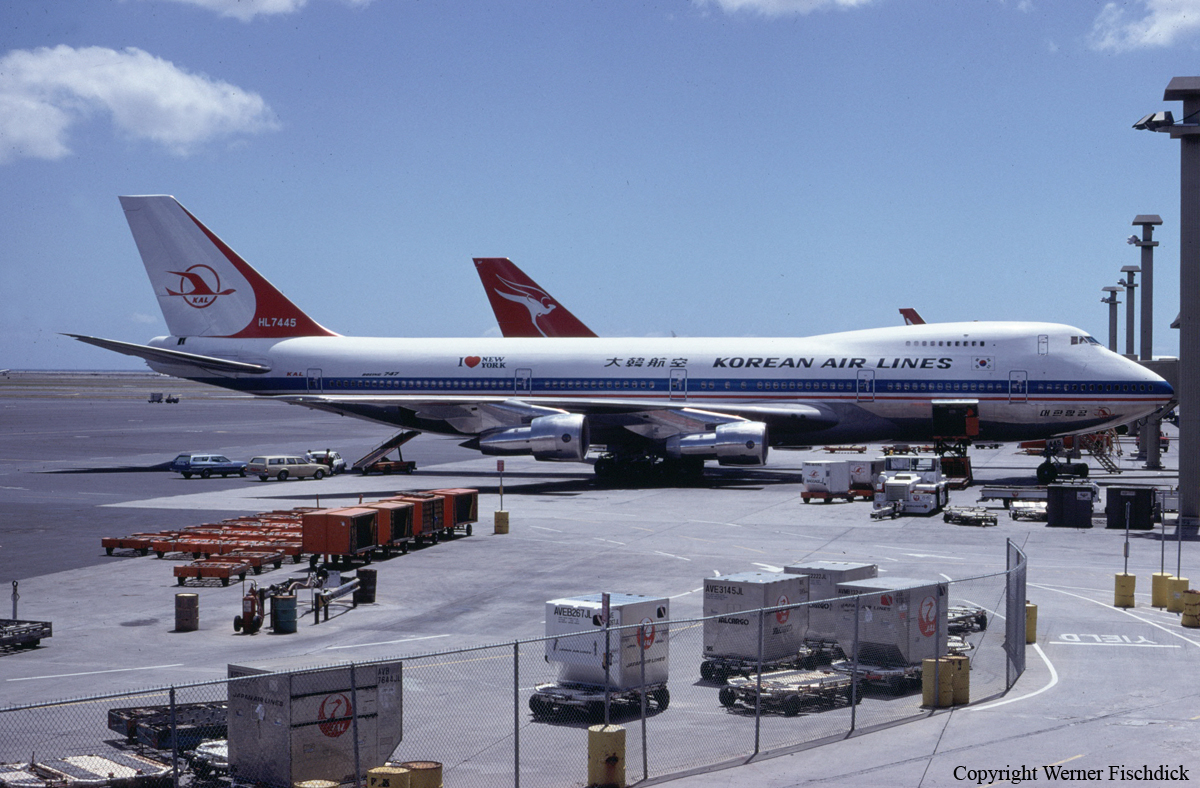
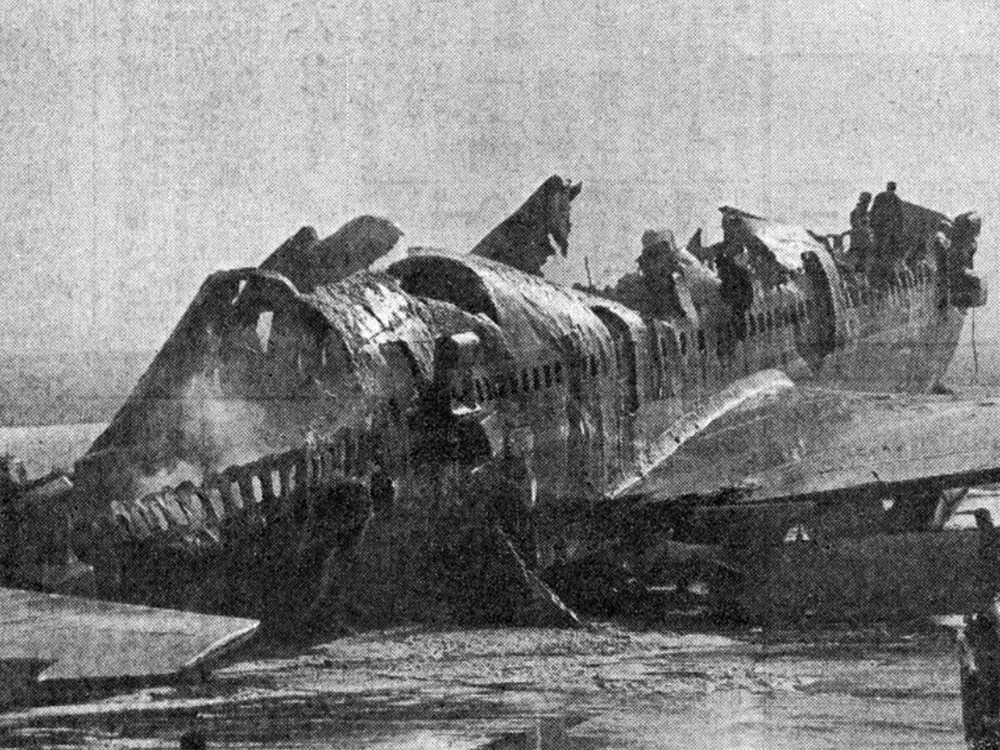
Following an uneventful flight from Los Angeles via Anchorage, the crew started the approach to Seoul-Gimpo Airport in the early morning, just after sunset. On final to runway 14, with a limited visibility of 1,000 meters due to patches of fog, the crew failed to realize his altitude was insufficient when the airplane landed 90 meters short of runway threshold. Then the aircraft struck a concrete wall, causing all main gears to be torn off or to pushed back in their respective wheel well, except the nose gear which remained intact. The airplane slid on its belly for about 1,200 metres before coming to rest in flames on the left side of the runway. 14 occupants escaped uninjured while 198 others were injured. Unfortunately, eight passengers and six crew members, among them both pilots, were killed. The aircraft was destroyed by a fire that probably ignited in a cargo compartment.
Probable cause:
Wrong approach configuration on part of the flying crew who continued the approach below the glide without any visual contact with the ground until the airplane struck the ground short of runway.