Crash of a Piper PA-61 Aerostar (Ted Smith 601P) in Balmorhea

Date & Time: May 4, 1985 at 2030 LT
Operator:

Registration:
N8083J
Flight Type:
Survivors:
Yes
MSN:
61-0624-7962138
YOM:
1979
Location:
Crew on board:
1
Crew fatalities:
Pax on board:
0
Pax fatalities:
Other fatalities:
Total fatalities:
0
Circumstances:
The aircraft was involved in illegal activity when it was intentionally landed in an open pasture. During the landing, the aircraft veered left and struck a 30 inches high concrete culvert. The gear collapsed on contact with the culvert. Unknown personnel subsequently drug the aircraft with a vehicle to a barn. When they attempted to drag the aircraft into the barn, they tore the wings off and damaged the barn.
Probable cause:
Occurrence #1: on ground/water collision with object
Phase of operation: landing - roll
Findings
1. (f) object - building (nonresidential)
2. (c) ground loop/swerve - uncontrolled - pilot in command
----------
Occurrence #2: complete gear collapsed
Phase of operation: landing - roll
Findings
3. Landing gear - failure, total
4. Landing gear - overload
Final Report:


Crash of a Partenavia P.68C Victor near Tilden

Date & Time: Apr 25, 1985 at 1300 LT
Type of aircraft:
Operator:
Registration:
N76L
Flight Phase:
Survivors:
Yes
Schedule:
Corpus Christi - Houston
MSN:
292
YOM:
1983
Location:
Crew on board:
1
Crew fatalities:
Pax on board:
0
Pax fatalities:
Other fatalities:
Total fatalities:
0
Captain / Total flying hours:
6020
Captain / Total hours on type:
712.00
Aircraft flight hours:
727
Circumstances:
After approximately 1.5 hours of pipeline patrol flight at a planned altitude of 500 feet agl the aircraft flew into the flat terrain in a landing attitude. The aircraft went through a wire fence, heavy brush and small trees before coming to rest 437 feet from initial ground contact with all 3 gear collapsed. A physical examination and the pilot's statement indicate that the pilot was operating under an extreme amount of stress which may have resulted in chronic fatigue at the time of the accident. According to the pilot, he was accustomed to a very heavy flight schedule. The chief pilot attempted to assign an additional pilot but company budget constraints prevented such an assignment.
Probable cause:
Occurrence #1: in flight collision with terrain/water
Phase of operation: descent - uncontrolled
Findings
1. (c) proper altitude - not maintained - pilot in command
2. (c) descent - inadvertent - pilot in command
3. (f) fatigue (chronic) - pilot in command
4. Company-induced pressure - company/operator management
5. Terrain condition - ground
----------
Occurrence #2: complete gear collapsed
Phase of operation: other
Findings
6. Landing gear - overload
Final Report:
Crash of a Piper PA-31-310 Navajo in Eagle Lake

Date & Time: Mar 25, 1985
Type of aircraft:
Operator:
Registration:
N23L
Flight Type:
Survivors:
Yes
MSN:
31-76
YOM:
1968
Crew on board:
1
Crew fatalities:
Pax on board:
0
Pax fatalities:
Other fatalities:
Total fatalities:
0
Circumstances:
On or about 3/25/85, the aircraft was landed on a short private strip. During the landing, it overran the strip, then collided with a dirt bank and a tree. The pilot abandoned the aircraft. Neither he nor the new owner could be found. There was evidence that the aircraft had been set afire after the accident. The aircraft bore a registration of N23LX, but the aircraft data plate and FAA records showed that a registration of N23L should have been displayed. During a seemingly unrelated arrest, police found the records of N23L in another aircraft that was loaded with 1,500 lbs of marijuana. The pilot was presumed to have had no injuries.
Probable cause:
Occurrence #1: overrun
Phase of operation: landing - roll
Findings
1. Stolen aircraft/unauthorized use - performed - pilot in command
2. (c) distance - misjudged - pilot in command
3. (c) airspeed - misjudged - pilot in command
----------
Occurrence #2: on ground/water encounter with terrain/water
Phase of operation: landing - roll
Findings
4. (f) terrain condition - dirt bank/rising embankment
----------
Occurrence #3: on ground/water collision with object
Phase of operation: landing - roll
Findings
5. (f) object - tree(s)
Final Report:

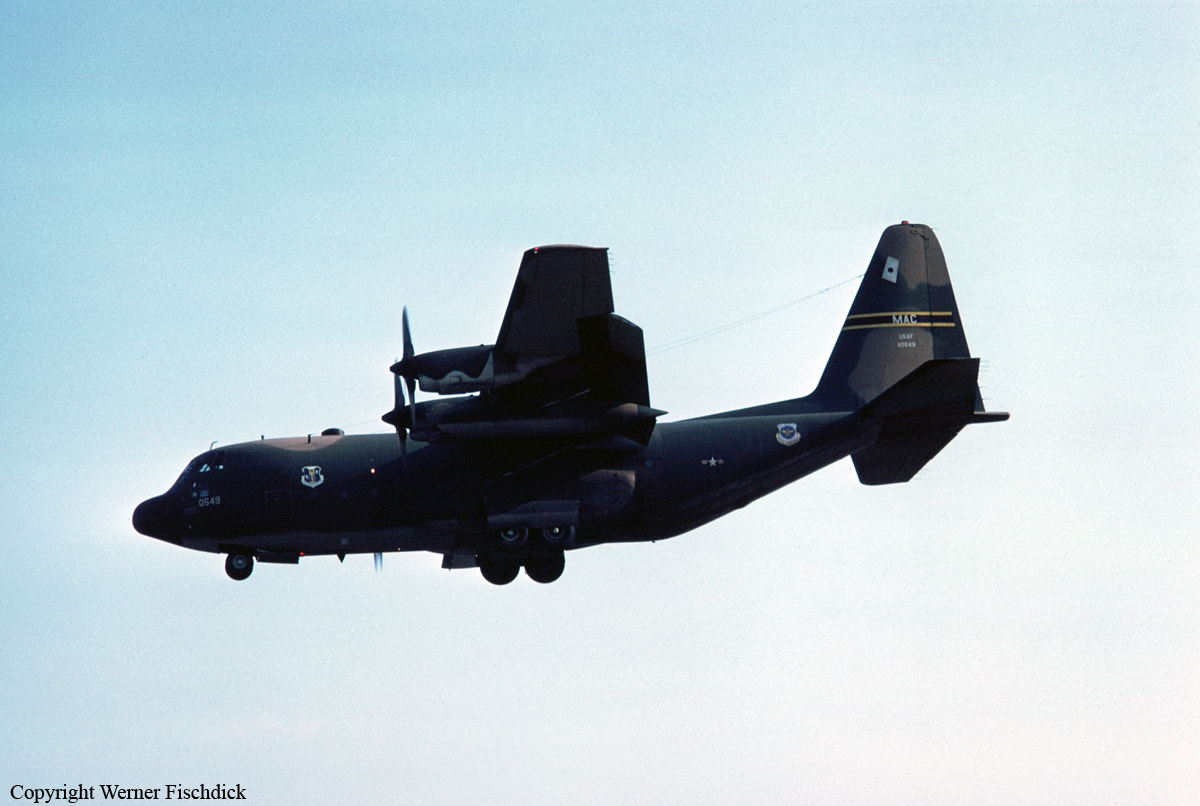
Crash of a Lockheed C-130E Hercules in Fort Hood: 8 killed

Date & Time: Mar 12, 1985
Type of aircraft:
Operator:
Registration:
64-0549
Flight Phase:
Flight Type:
Survivors:
No
Schedule:
Dyess AFB - Gray AAF
MSN:
4044
YOM:
1965
Location:
Crew on board:
8
Crew fatalities:
Pax on board:
0
Pax fatalities:
Other fatalities:
Total fatalities:
8
Circumstances:
The four engine aircraft was completing a training mission from Dyess AFB (Abilene) to the Gray AAF near Killeen, carrying eight crew members. En route, while flying at low height and dropping sand bags, the airplane went out of control and crashed near Fort Hood. All eight crew members were killed.

Crash of a Cessna 441 Conquest in Marble Falls: 1 killed

Date & Time: Dec 25, 1984 at 2020 LT
Type of aircraft:
Registration:
N441CM
Survivors:
No
Schedule:
Aspen - Marble Falls
MSN:
441-0169
YOM:
1980
Crew on board:
1
Crew fatalities:
Pax on board:
0
Pax fatalities:
Other fatalities:
Total fatalities:
1
Captain / Total flying hours:
9165
Captain / Total hours on type:
608.00
Aircraft flight hours:
2799
Circumstances:
The aircraft crashed approximately 1.5 miles south of the departure end of runway 17 during an attempted runway 17 NDB approach. The aircraft was cleared for the approach at 2012 cst and the pilot canceled IFR reporting the airport in sight at 2014. A witness located approximately 1 mile south of the airport reported seeing the aircraft lights through the clouds, mist and fog as it was traveling south-southeast. The aircraft impacted the ground on a heading of 035° in a 10° to 15° left bank. Radar data indicates the aircraft was approximately 8 miles from the airport when IFR was canceled. Witnesses stated visibility in the area was about 1/8 of a mile during the time of the accident. The pilot, sole on board, was killed.
Probable cause:
Occurrence #1: in flight collision with terrain/water
Phase of operation: maneuvering - turn to reverse direction
Findings
1. (f) weather condition - low ceiling
2. (f) weather condition - fog
3. (c) in-flight planning/decision - poor - pilot in command
4. (c) ifr procedure - not followed - pilot in command
5. (f) missed approach - not performed - pilot in command
6. (c) proper altitude - not maintained - pilot in command
Final Report:

Crash of a Learjet 35 in Waco: 3 killed

Date & Time: Dec 20, 1984 at 1638 LT
Type of aircraft:
Operator:
Registration:
N95TC
Flight Phase:
Flight Type:
Survivors:
No
Schedule:
Waco - Dallas
MSN:
35-020
YOM:
1975
Location:
Crew on board:
3
Crew fatalities:
Pax on board:
0
Pax fatalities:
Other fatalities:
Total fatalities:
3
Captain / Total flying hours:
2454
Captain / Total hours on type:
387.00
Aircraft flight hours:
5276
Circumstances:
No evidence of preimpact mechanical failure or malfunction was noted during wreckage examination. The FAA operations inspector who was on board at the time of the accident stated there were no aircraft problems involved. The pic, who was in the process of taking her type rating checkride in the aircraft, failed to maintain directional control during a simulated engine failure after reaching V1 speed during the takeoff run. The total flight experience for the pic was 2,454 hours, most of which was acquired in multi-engine aircraft, with 387 hours being in the make and model aircraft involved in the accident. All listed experience in this make and model was obtained as second-in-command. All three occupants were killed.
Probable cause:
Occurrence #1: loss of control - in flight
Phase of operation: takeoff - initial climb
Findings
1. (f) emergency procedure - simulated - check pilot
2. (c) procedures/directives - not followed - pilot in command
3. (c) directional control - not maintained - pilot in command
----------
Occurrence #2: dragged wing, rotor, pod, float or tail/skid
Phase of operation: takeoff - initial climb
Findings
4. (f) emergency procedure - simulated - check pilot
5. (c) rotation - excessive - pilot in command
----------
Occurrence #3: in flight collision with terrain/water
Phase of operation: takeoff - initial climb
Final Report:

Crash of a Cessna 421C Golden Eagle III in Addison: 1 killed

Date & Time: Oct 18, 1984 at 1452 LT
Registration:
N121BT
Flight Type:
Survivors:
No
Schedule:
Addison - Naples
MSN:
421C-0806
YOM:
1979
Location:
Crew on board:
1
Crew fatalities:
Pax on board:
0
Pax fatalities:
Other fatalities:
Total fatalities:
1
Captain / Total flying hours:
1620
Circumstances:
Approximately 7 minutes after takeoff (at 1441), the pilot declared an emergency and said the left engine had lost power. He feathered the engine, diverted back toward the airport and descended to VFR conditions below the clouds. At 1448, the pilot said he had the airport in sight and turned onto a left downwind for runway 15. Reportedly, he extended the landing gear and began a left turn toward the runway. Reportedly, the aircraft was too close in and/or the pilot chose to make a right turn away from the airport to land. Witnesses lost sight of the aircraft during the turn due to low clouds or obstructions. The pilot lost sight of the airport for a short time, then relocated it, but said he had his 'hands full.' Shortly thereafter, the aircraft entered a steep descent, hit the edge (roof) of a building, crashed into a utility pole and the ground and burned. There was evidence the aircraft was inverted just before impact. An exam of the left engine revealed evidence the #6 connecting rod had failed from oil exhaustion. Only one cup of oil was found in the engine and it had a history of high oil consumption. The pilot, sole on board, was killed.
Probable cause:
Occurrence #1: loss of engine power (total) - mech failure/malf
Phase of operation: climb - to cruise
Findings
1. (f) aircraft preflight - inadequate - pilot in command
2. (f) operation with known deficiencies in equipment - performed - pilot in command
3. (f) fluid, oil - starvation
4. Propeller feathering - performed
5. Initiated
6. Precautionary landing - initiated
----------
Occurrence #2: loss of control - in flight
Phase of operation: descent - normal
Findings
7. (c) emergency procedure - improper - pilot in command
8. (c) gear extension - premature - pilot in command
9. (c) airspeed (vmc) - not maintained - pilot in command
10. (c) aircraft handling - not maintained - pilot in command
----------
Occurrence #3: in flight collision with object
Phase of operation: descent - uncontrolled
Findings
11. Object - building (non residential)
12. Object - utility pole
----------
Occurrence #4: in flight collision with terrain/water
Phase of operation: descent - uncontrolled
Final Report:

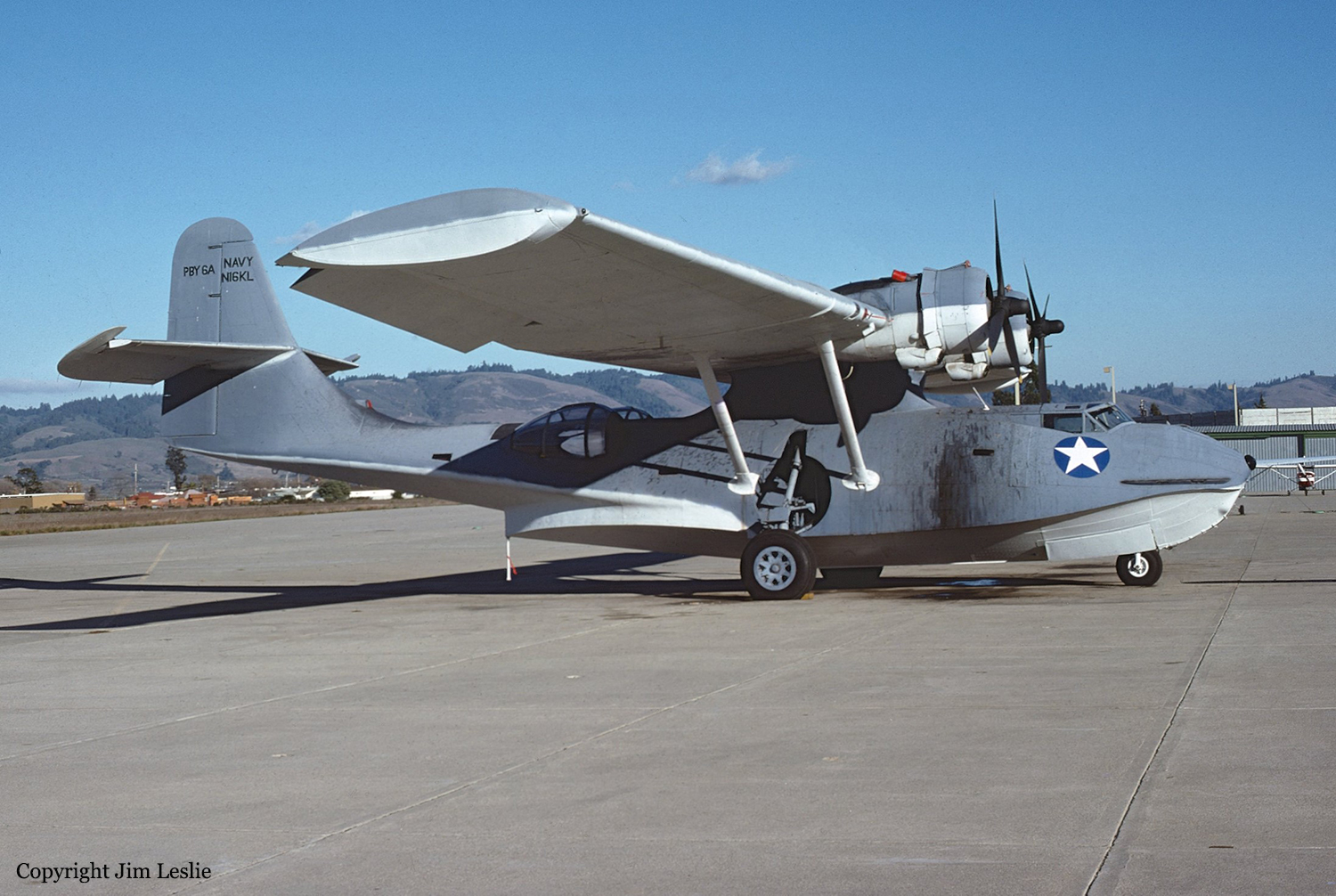
Crash of a Consolidated PBY-6A Catalina off Port Isabel: 7 killed

Date & Time: Oct 13, 1984 at 0803 LT
Type of aircraft:
Operator:
Registration:
N16KL
Flight Phase:
Flight Type:
Survivors:
No
Schedule:
Harlingen - Harlingen
MSN:
2068
YOM:
1944
Crew on board:
3
Crew fatalities:
Pax on board:
7
Pax fatalities:
Other fatalities:
Total fatalities:
7
Captain / Total flying hours:
8695
Captain / Total hours on type:
70.00
Aircraft flight hours:
6457
Circumstances:
Aerial photos were being taken of the mishap aircraft. Mission called for a simulated water landing (actual water landing prohibited) by flying as close as possible to water. Copilot at controls descended aircraft to about 6 feet, then gradually reduced clearance to 6-12 inches above water, airspeed 105 mph. Copilot inadvertently allowed aircraft to touch water. On touchdown, aircraft decelerated violently and broke up, ejecting several of the occupants and coming to rest inverted. Examination of aerial photos shows aircraft hull at touchdown was slightly nose down vice normal landing attitude; water contact made at location of nose landing gear doors. Photos show outward rupturing of forward hull structure, nose gear doors missing. Hull at rear of step showed two parallel, 3-feet long by 2-in wide, fore-to-aft and outboard-to-inboard penetrations. Floor of shallow lagoon known to have scattered debris from petroleum explorations; however, no positive determination of aircraft contact with submerged object could be made. Seven occupants were killed while three others were injured.
Probable cause:
Occurrence #1: in flight collision with terrain/water
Phase of operation: maneuvering
Findings
1. (f) terrain condition - water, glassy
2. (c) clearance - misjudged - copilot/second pilot
3. (c) supervision - inadequate - pilot in command
4. (c) door, landing gear - overload
5. (c) door, landing gear - separation
Final Report:

Crash of a Rockwell Aero Commander 520 in Goliad

Date & Time: Aug 24, 1984
Operator:
Registration:
N4183B
Flight Type:
Survivors:
Yes
MSN:
520-90
YOM:
1953
Location:
Crew on board:
1
Crew fatalities:
Pax on board:
0
Pax fatalities:
Other fatalities:
Total fatalities:
0
Circumstances:
The aircraft was found abandoned. Wreckage scene indicates collision with trees prior to collision with terrain. Aircraft suspected of being used for illegal cargo operations. The pilot was not found.
Probable cause:
Occurrence #1: in flight collision with terrain/water
Phase of operation: unknown
Findings
1. (c) reason for occurrence undetermined
Final Report:

Crash of a Beechcraft 65 Queen Air in Zapata

Date & Time: May 24, 1984 at 2300 LT
Type of aircraft:
Registration:
N404C
Flight Phase:
Flight Type:
Survivors:
Yes
MSN:
LF-7
YOM:
1960
Location:
Crew on board:
1
Crew fatalities:
Pax on board:
0
Pax fatalities:
Other fatalities:
Total fatalities:
0
Circumstances:
According to law enforcement officers, the aircraft experienced double engine failure and made a forced landing in unimproved terrain. During the landing rollout the aircraft struck several trees. An intense post crash fire erupted destroying all but one wing tip of the wreckage. Repeated efforts to contact the pilot and operator have been unsuccessful. It is assumed that there were no injuries and no passengers.
Probable cause:
Occurrence #1: loss of engine power (total) - nonmechanical
Phase of operation: unknown
Findings
1. (c) reason for occurrence undetermined
----------
Occurrence #2: forced landing
Phase of operation: descent - emergency
Final Report: