Country
Operator Image

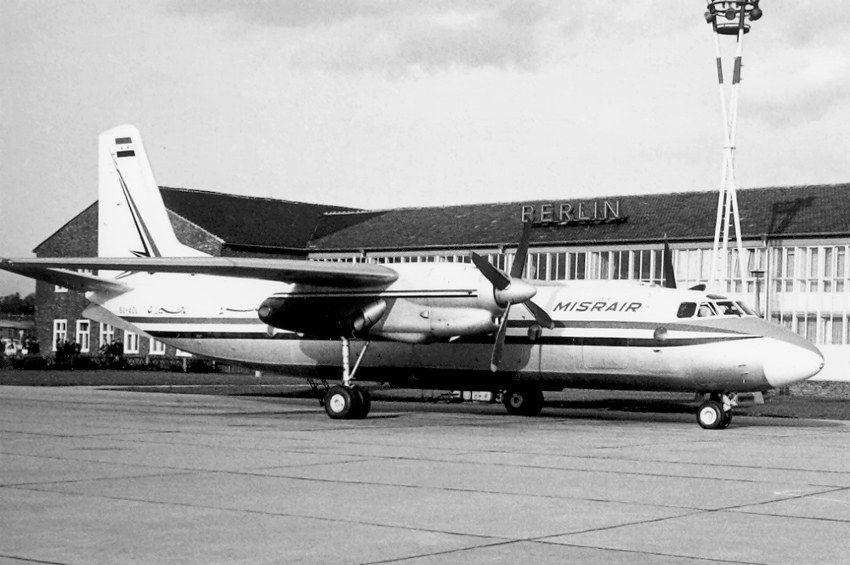
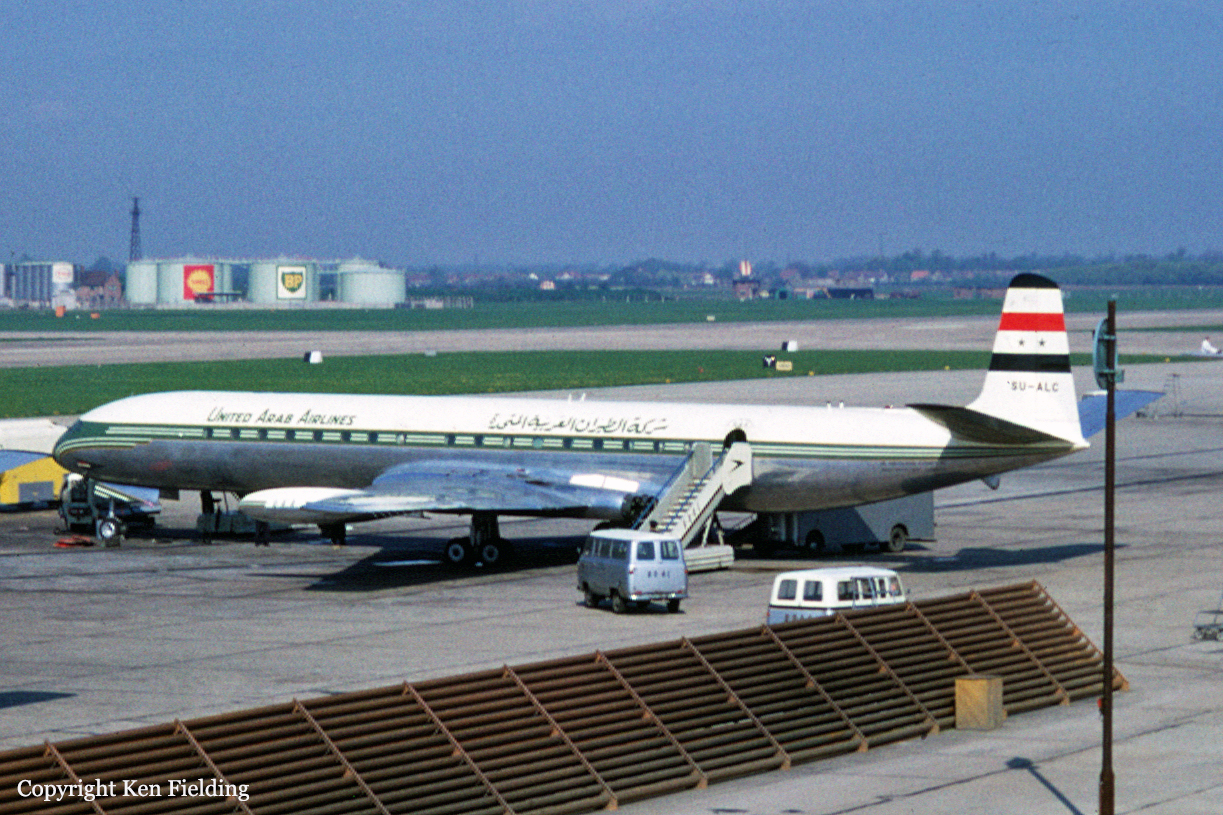
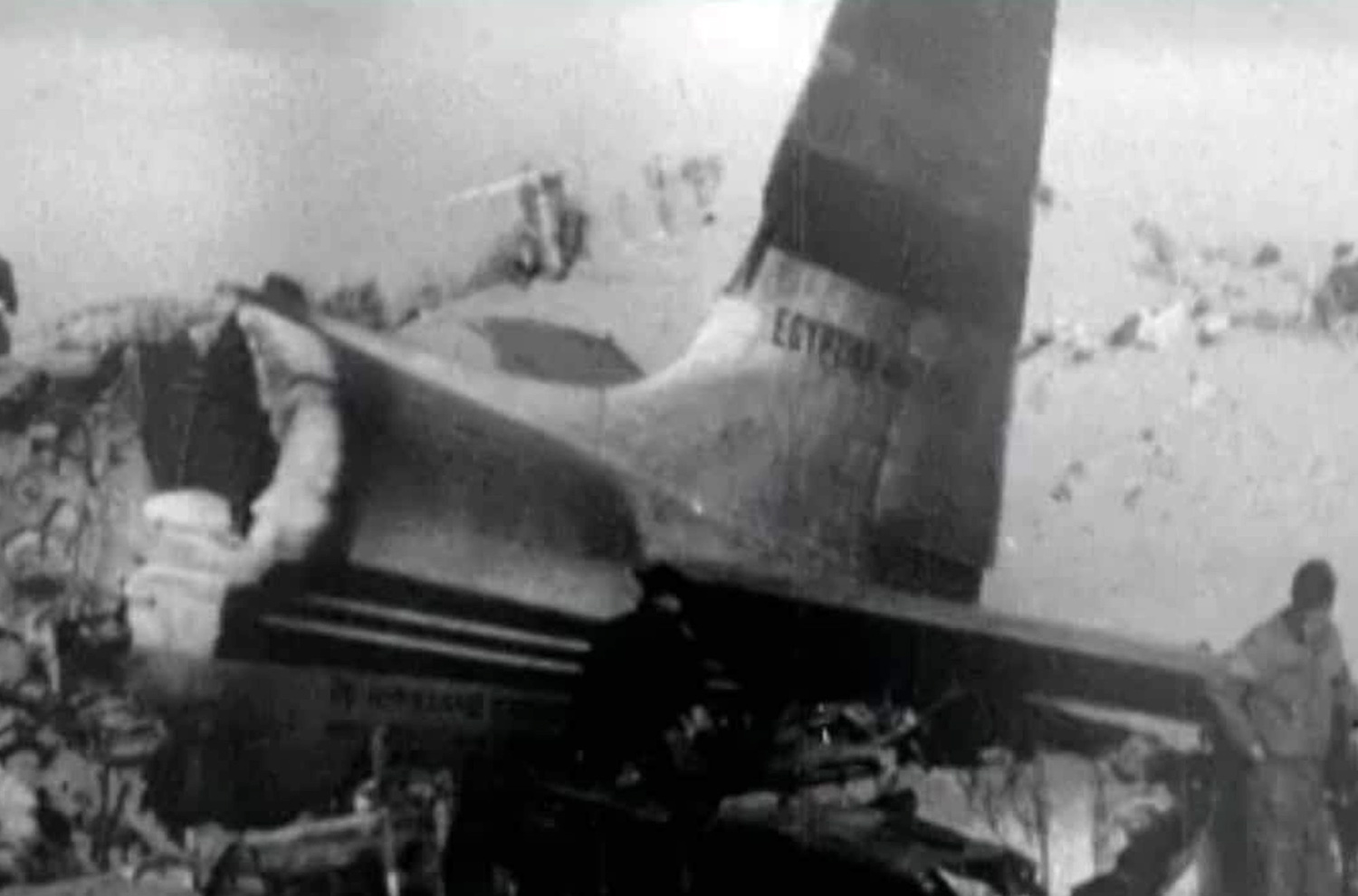
Crash of a De Havilland DH.106 Comet 4C in Tripoli: 16 killed

Date & Time: Jan 2, 1971 at 0325 LT
Type of aircraft:
Operator:
Registration:
SU-ALC
Survivors:
No
Schedule:
Algiers - Tripoli - Cairo
MSN:
6439
YOM:
1960
Flight number:
MS844
Country:
Region:
Crew on board:
8
Crew fatalities:
Pax on board:
8
Pax fatalities:
Other fatalities:
Total fatalities:
16
Aircraft flight hours:
25592
Circumstances:
Flight MS844 was a scheduled international flight from Algiers to Cairo with an intermediate stop at Tripoli. Departure on the outbound flight Cairo - Tripoli - Algiers had been delayed 29 hours due to adverse weather conditions along the route. At Algiers, following testing of the systems, the fire warning light of Zone I in n° 3 engine stayed "ON". Local personnel, who were not familiar with Comet aircraft, attempted to rectify the discrepancy and this caused a further delay of nearly 2 1/2 hours. The light eventually extinguished and the pilot-in-command, who had been considering cancellation of the flight and returning to Cairo without passengers, then decided to proceed with the service. There was no evidence that the crew had asked for, or received, a weather forecast before departing Algiers for Tripoli; however, it is possible that a verbal forecast was obtained. The QNH at Algiers was 1011 mb. As the aircraft entered the Tripoli Control Area, the crew was provided with a weather report which included a horizontal visibility of 1000 meters due to sand haze. This was below the minimum authorized by the airline; however, the vertical visibility was unlimited. The pilot-in-command checked Benina weather and then decided to attempt a landing at Tripoli wfth Malta as the alternative: he stated that he had 3 hours 50 minutes endurance. Both Tripoli Control and Tripoli Tower gave him a QNH of 1008 mb, additionally Tripoli Control gave an opinion that visibility was better than 1 000 m, and Tripoli Tower gave an opinion that he could see "3 kilometres". The airport's VOR was not available as it required calibration; the only ground aid available was the ADF facility. Coming from Algiers, the approach over the beacon located 0.6 NM north of Runway 18, the runway in use, involved joining the holding pattern in the opposite direction to the circuit so that a tear drop turn was necessary to re-approach the beacon on the outbound leg on an ADF procedure turn. Shortly after passing the beacon for the first time, the pilot-in-command reported at 3 000 ft. The last message received was when the aircraft was passing the beacon outbound for an ADF approach procedure turn. The altitude was not stated subsequent to entering the holding pattern.The flight path to Runway 18 crossed an expanse of sand dunes 160 ft AMSL rising steeply to 425 ft AMSL and then falling te the runway threshold elevation of 240 ft. The aircraft struck sand dunes at an elevation of 395 ft approximately 7 km before the threshold of the runway. The accident occurred at 01.25 hours GMT. The aircraft was destroyed and all 16 occupants were killed.
Probable cause:
The probable cause of the accident was the decision of the pilot-in-command to land while the prevailing visibility was below the Airline's minimum for that airport at night, and for undetermined reasons, the aircraft was lower than the altitude it ought to have been for an ADF approach to the runway in use. The weather was a contributing factor.
Final Report:
Crash of an Antonov AN-24B in Cairo: 3 killed

Date & Time: Jul 19, 1970
Type of aircraft:
Operator:
Registration:
SU-ANZ
Flight Phase:
Flight Type:
Survivors:
No
Schedule:
Cairo - Cairo
MSN:
57302007
YOM:
1965
Country:
Region:
Crew on board:
3
Crew fatalities:
Pax on board:
0
Pax fatalities:
Other fatalities:
Total fatalities:
3
Circumstances:
The crew (one instructeur, a captain and a copilot under supervision) was engaged in a local training flight at Cairo-Intl Airport. Following five successful touch-and-goes, the crew initiated a sixth manoeuvre during which the pilot under training was supposed to perform a complete stop on the runway then to increase power and initiate a take off with one engine inoperative. After liftoff, while climbing to a height of some 50 meters, the airplane banked right to an angle of 90° then crashed by the runway shoulder. The airplane was destroyed and all three crew members were killed.
Probable cause:
It was determined that the pilot-in-command failed to observe the takeoff procedures and adopted a wrong takeoff configuration. The lack of supervision on part of the instructor and the captain was considered as a contributing factor.

Crash of an Antonov AN-24B in Cairo

Date & Time: Mar 14, 1970
Type of aircraft:
Operator:
Registration:
SU-AOC
Survivors:
Yes
MSN:
57302103
YOM:
1965
Country:
Region:
Crew on board:
4
Crew fatalities:
Pax on board:
11
Pax fatalities:
Other fatalities:
Total fatalities:
0
Circumstances:
Shortly after takeoff from Alexandria Airport, the crew informed ATC about the explosion of the left engine and requested the permission to divert to Cairo-Intl Airport for an emergency landing. Due to severe damages caused by the explosion, the crew was unable to lower the gear nor the flaps. Eventually, the captain decided to belly landed in a sandy area located near the runway 05. The airplane slid for dozen yards, came to rest and was damaged beyond repair while all 15 occupants escaped uninjured.
Probable cause:
Explosion of the left engine due to the presence of a foreign object in the rear cone of the left engine nacelle.

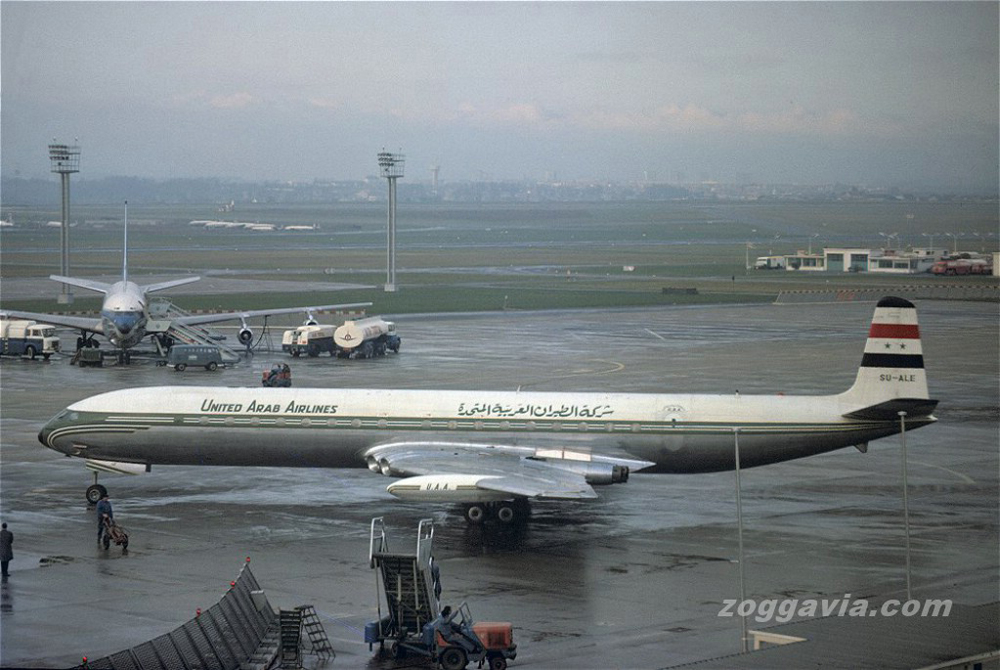
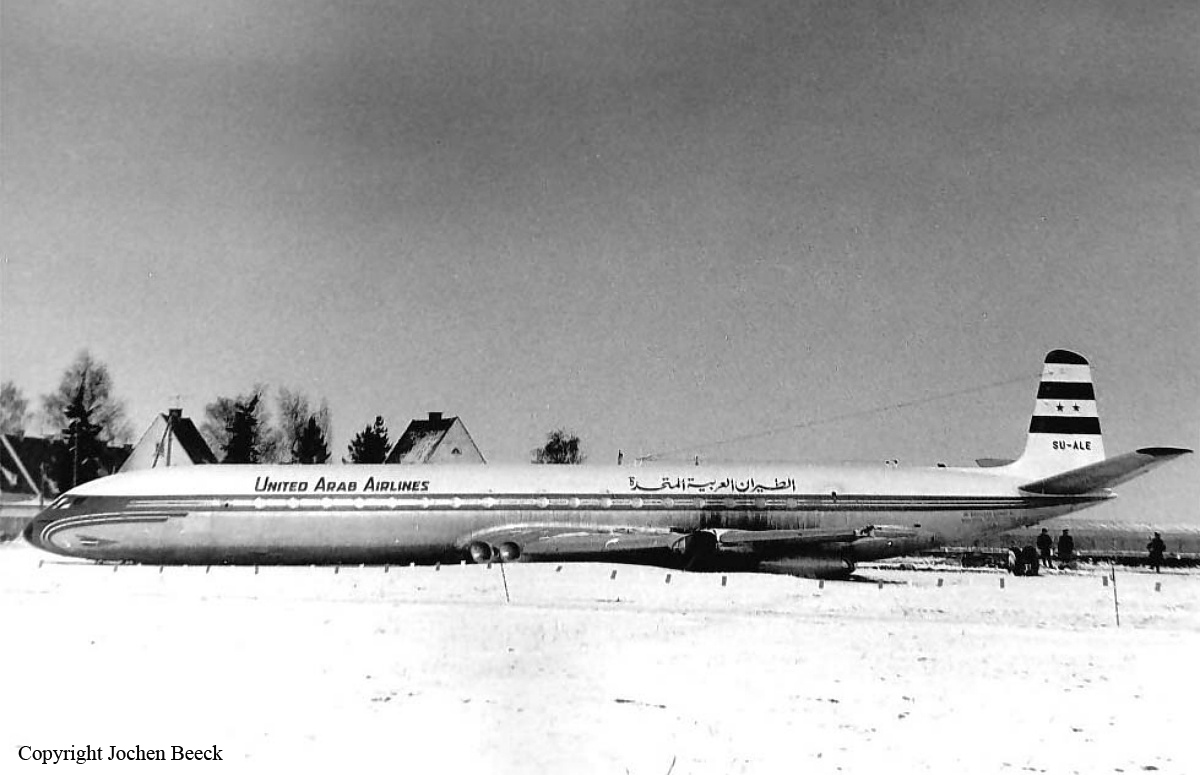
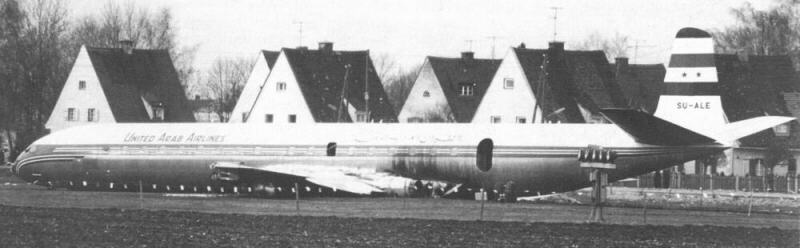
Crash of a De Havilland DH.106 Comet 4C in Munich

Date & Time: Feb 9, 1970 at 2004 LT
Type of aircraft:
Operator:
Registration:
SU-ALE
Flight Phase:
Survivors:
Yes
Schedule:
Munich - Cairo
MSN:
6444
YOM:
1960
Country:
Region:
Crew on board:
9
Crew fatalities:
Pax on board:
14
Pax fatalities:
Other fatalities:
Total fatalities:
0
Circumstances:
Following a normal takeoff roll, the captain pull the control column and started the rotation. During initial climb, at a height of 30 feet, severe vibrations were encountered. The captain decided to land back onto the runway but the available distance was insufficient. Unable to stop within the remaining distance, the airplane overran, lost its undercarriage and came to rest in flames in an open field. Fire was quickly extinguished and all 23 occupants were evacuated safely. Nevertheless, the aircraft was damaged beyond repair.
Probable cause:
Severe vibrations after liftoff caused by an excessive accumulation of ice on the wings. Inappropriate actions on part of the flying crew.

Crash of an Antonov AN-24B in Luxor

Date & Time: Jan 30, 1970
Type of aircraft:
Operator:
Registration:
SU-AOK
Survivors:
Yes
MSN:
67302805
YOM:
1966
Location:
Country:
Region:
Crew on board:
0
Crew fatalities:
Pax on board:
0
Pax fatalities:
Other fatalities:
Total fatalities:
0
Circumstances:
Upon landing at Luxor Airport, one of the main landing gear collapsed. The airplane slid for dozen meters before coming to rest. There were no casualties but the aircraft was damaged beyond repair.
Probable cause:
Gear collapsed on landing for undetermined reason.

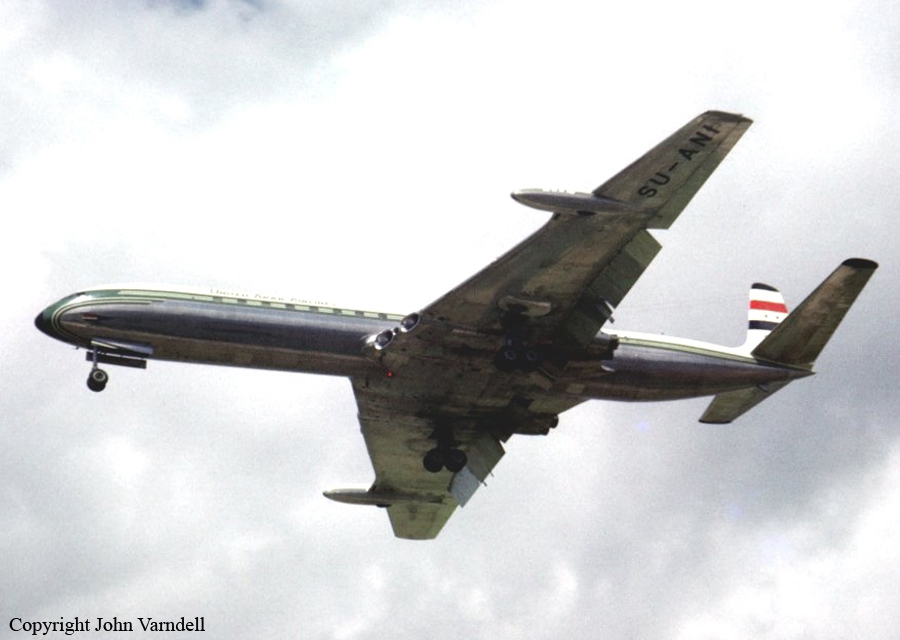
Crash of a De Havilland DH.106 Comet 4C in Addis Ababa

Date & Time: Jan 14, 1970 at 0418 LT
Type of aircraft:
Operator:
Registration:
SU-ANI
Survivors:
Yes
Schedule:
Cairo - Khartoum - Addis Ababa
MSN:
6475
YOM:
1964
Flight number:
MS755
Country:
Region:
Crew on board:
9
Crew fatalities:
Pax on board:
5
Pax fatalities:
Other fatalities:
Total fatalities:
0
Circumstances:
The approach to Addis Ababa-Haile Selassie I Airport was completed by night and marginal weather conditions. On final, at an altitude of 150 feet, the pilot-in-command made a visual contact with runway 32 but the aircraft was 250 feet to the right of the extended centerline. The captain decided to make a turn to the left when the aircraft banked left, lost height and struck the ground. Out of control, it crashed by the runway and came to rest. All 14 occupants were injured and the aircraft was destroyed.
Probable cause:
Wrong approach configuration on part of the flying crew who continued the approach below minima weather conditions and passed the minimum descent altitude without any visual contact with the ground or runway. In such conditions, the captain should make a go-around procedure.

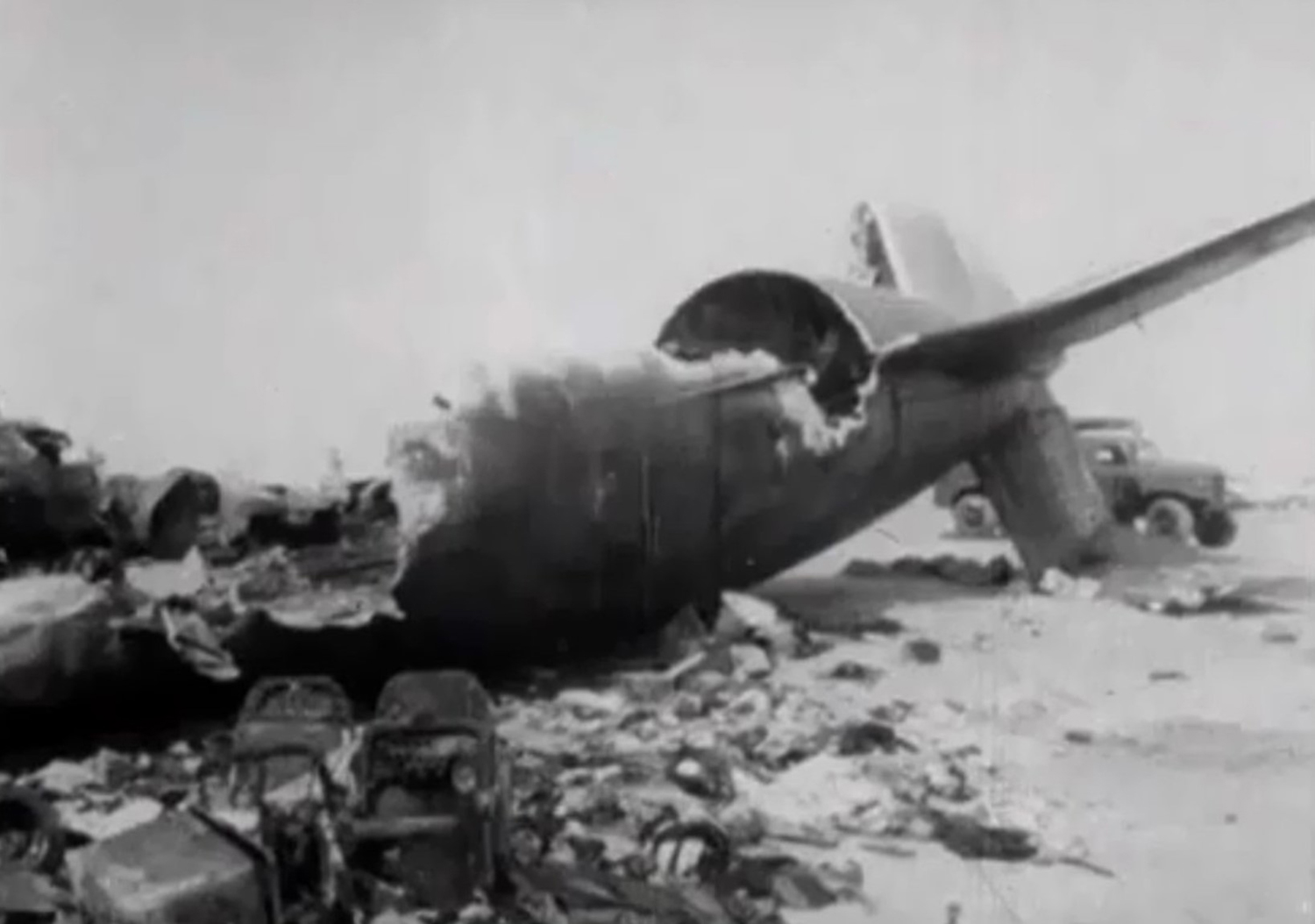
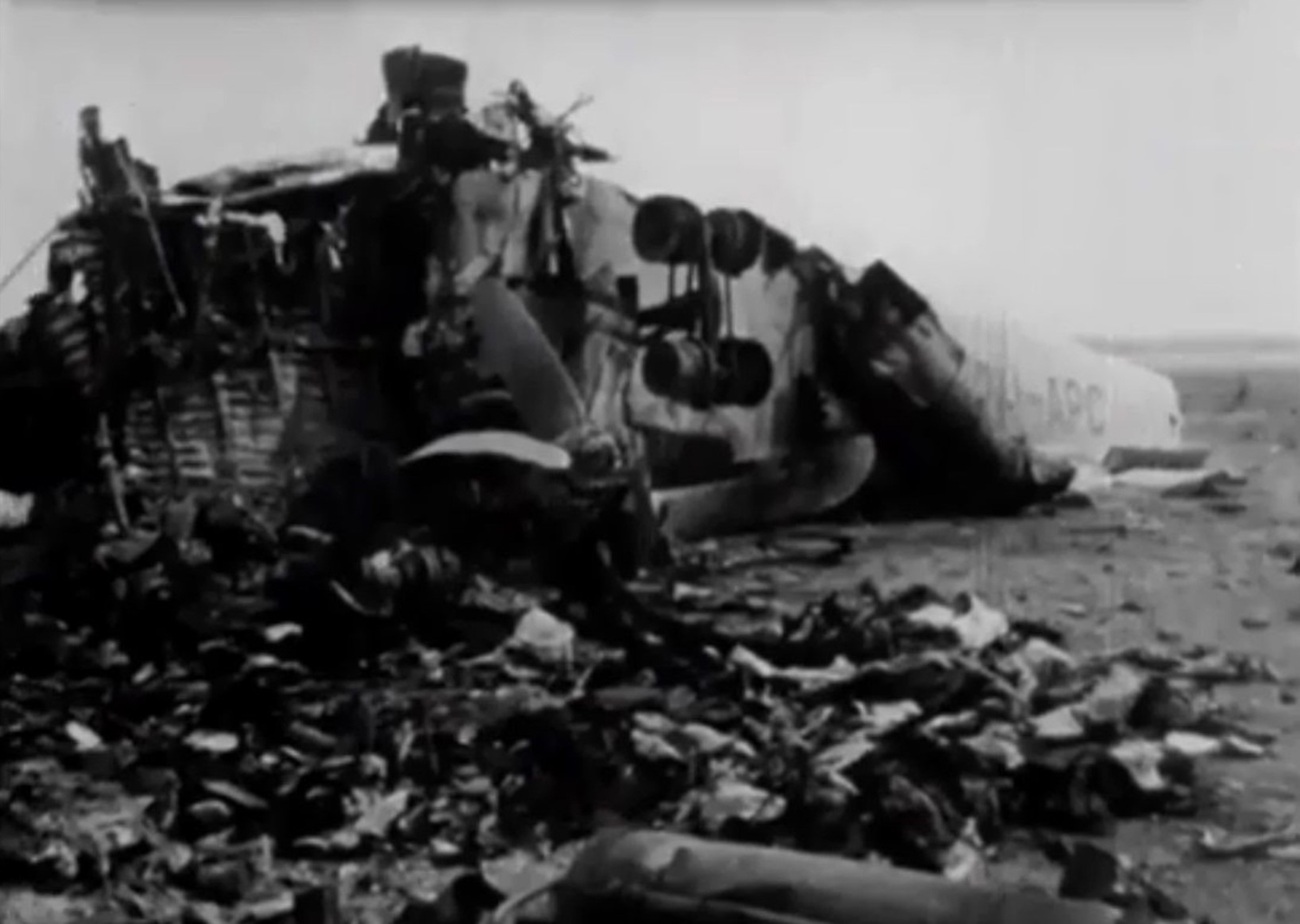
Crash of an Ilyushin II-18D in Aswan: 100 killed

Date & Time: Mar 20, 1969 at 0200 LT
Type of aircraft:
Operator:
Registration:
SU-APC
Survivors:
Yes
Schedule:
Jeddah - Aswan
MSN:
188 0113 01
YOM:
1968
Location:
Country:
Region:
Crew on board:
7
Crew fatalities:
Pax on board:
98
Pax fatalities:
Other fatalities:
Total fatalities:
100
Circumstances:
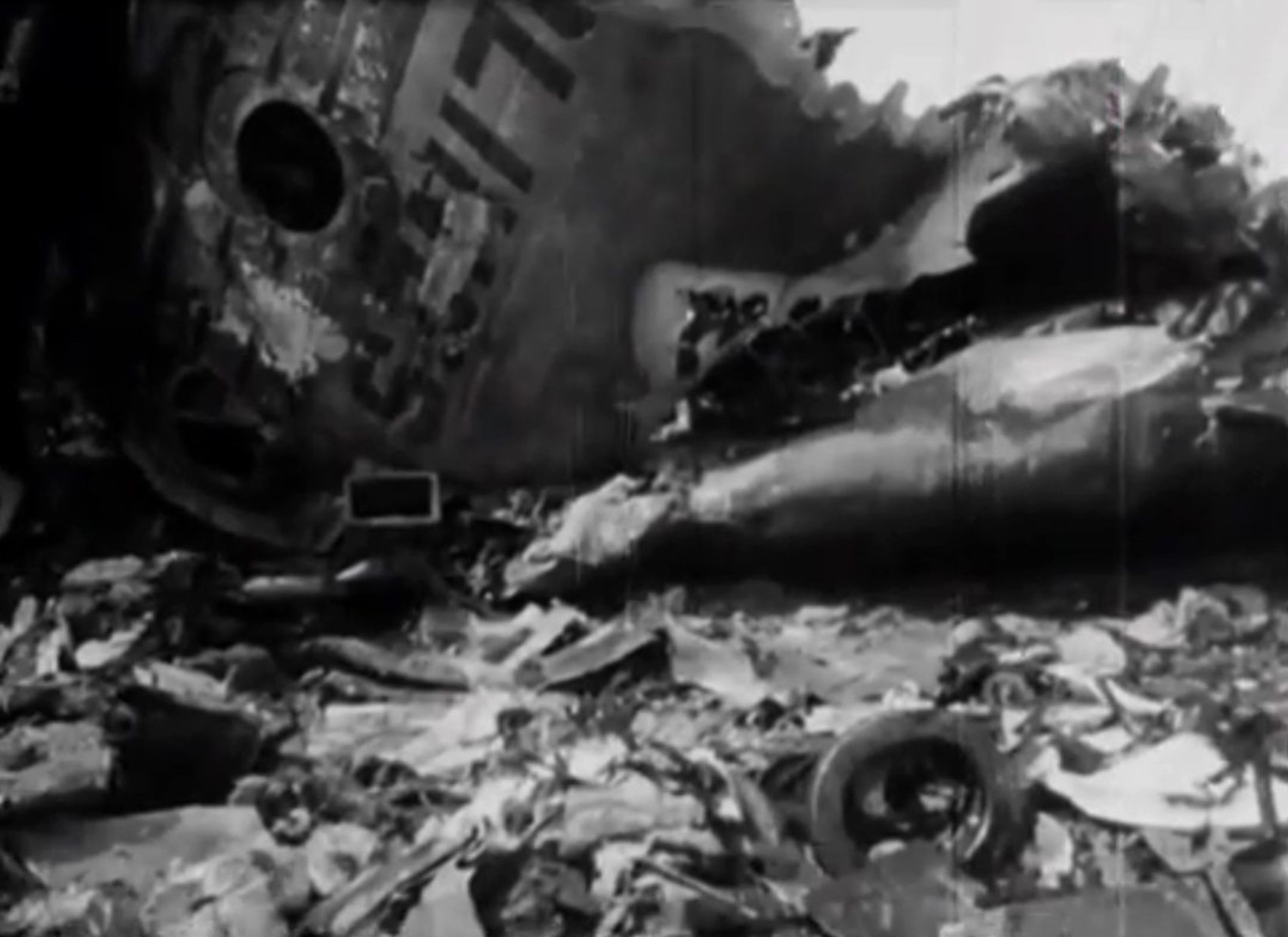
Following an uneventful charter flight from Jeddah, the crew started the descent to Aswan Airport by night but the visibility was poor due to a sandstorm. A first approach was abandoned and a go-around was completed. A second NBD approach was also abandoned few minutes later. During a third attempt do land, with a horizontal visibility of 2-3 km, the captain failed to realize his altitude was insufficient when the right wing struck the top of a hangar. Out of control, the airplane crashed in flames 1,120 meters short of runway threshold. Five passengers were injured while 100 other occupants were killed.
Probable cause:
The pilot descended below the minimum safe altitude without having the runway lights clearly in sight. A contributory factor was fatigue arising from continuous working hours without suitable rest periods and three night approaches.

Crash of an Antonov AN-24B into the Mediterranean Sea: 40 killed

Date & Time: Aug 18, 1968 at 1221 LT
Type of aircraft:
Operator:
Registration:
SU-AOL
Flight Phase:
Survivors:
No
Schedule:
Cairo - Damascus
MSN:
67302806
YOM:
1966
Country:
Region:
Crew on board:
7
Crew fatalities:
Pax on board:
33
Pax fatalities:
Other fatalities:
Total fatalities:
40
Circumstances:
While in cruising altitude over the Mediterranean Sea on a flight from Cairo to Damascus, the aircraft went out of control and crashed in unknown circumstances into the sea. SAR operations were conducted and several debris were found about 180 km south of the Cyprus coast. None of 40 occupants was found alive and the main wreckage was not recovered.
Probable cause:
Due to lack of evidences, the exact cause of the accident could not be determined with certainty.

Crash of a Douglas DC-3 in Zifta: 4 killed

Date & Time: Jan 15, 1968 at 0754 LT
Type of aircraft:
Operator:
Registration:
SU-AJG
Flight Phase:
Flight Type:
Survivors:
No
Site:
Schedule:
Cairo - Beirut
Location:
Country:
Region:
Crew on board:
4
Crew fatalities:
Pax on board:
0
Pax fatalities:
Other fatalities:
Total fatalities:
4
Captain / Total flying hours:
5482
Captain / Total hours on type:
655.00
Copilot / Total flying hours:
3409
Copilot / Total hours on type:
543
Circumstances:
The aircraft was to perform a non-scheduled international cargo flight from Cairo to Beirut. Before departure the operator's chief of the ground operations shift informed the pilot-in-command of the aircraft that bad weather was prevailing both on the route Cairo to Beirut and at Beirut Airport, and that the weather conditions had been confirmed by the crew of another aircraft who had arrived from Beirut at 0200 hours local time. The pilot-in-command then went to the weather office and was again informed that the weather en route was very bad with low and medium altitude clouds, including some cumulonimbus extending from 550 m to 8 500 m, and that moderate to severe icing and turbulence within these clouds were highly probable. He was also informed that a SIGMET had been issued at 0115 hours (see 1.7 below). Back at the operator's ground operations office he obtained once more all necessary weather information, including copies of two SIGMETS issued by Cairo and Beirut respectively and decided to delay his departure until 0700 hours expecting some weather improvement. Although the aircraft had no de-icing equipment, it departed Cairo at 0721 hours and at 0735 hours the crew reported at EL 70 to Cairo Approach. Eight minutes later they reported over Zif ta Beacon at the same flight level and were then instructed by Cairo Approach to contact Area Control. At 0745 hours they contacted and informed Cairo Control that they would return to Cairo due to icing. Shortly thereafter they repeated that message adding that there was some ice accretion on the aircraft. This was the last message from the aircraft. At 1020 hours Cairo ACC received a message that the aircraft had crashed 5 km SE of A1 Mahalla-Al Kobra. All four occupants were killed.
Probable cause:
The accident was due to ice accretion on the lifting surfaces of the aircraft accompanied by moderate to severe turbulence, which resulted in loss of aircraft control by the pilot. When he tried to regain control over the aircraft the lifting surfaces were loaded beyond the approved design limits, which brought about the disintegration of main parts of the aircraft in the air, and its subsequent impact with the ground and the death of all members of the crew. Some of the contributing factors were as follows:
- The load of the aircraft exceeded the approved load by about 500 kg,
- The probable shifting of the cargo and the resulting effect on the aircraft's centre of gravity.
Final Report:

Crash of a Douglas DC-6B in Al Hudaydah

Date & Time: Jan 24, 1967
Type of aircraft:
Operator:
Registration:
SU-ANL
Survivors:
Yes
Schedule:
Cairo – Al Hudaydah
MSN:
44104/397
YOM:
1953
Country:
Region:
Crew on board:
0
Crew fatalities:
Pax on board:
0
Pax fatalities:
Other fatalities:
Total fatalities:
0
Circumstances:
After touchdown at Al Hudaydah Airport, the crew started the braking procedure when control was lost. The airplane veered off runway, lost its undercarriage and came to rest. There were no casualties but the airplane was written off.
Probable cause:
It was determined that the landing configuration was not compliant with the published procedures as the crew used improper reversing techniques.