Country
Operator Image

Crash of an Antonov AN-24B in Cairo

Date & Time: Sep 30, 1966 at 1402 LT
Type of aircraft:
Operator:
Registration:
SU-AOM
Survivors:
Yes
Schedule:
Luxor – Cairo
MSN:
67302809
YOM:
1966
Flight number:
MS322
Country:
Region:
Crew on board:
6
Crew fatalities:
Pax on board:
37
Pax fatalities:
Other fatalities:
Total fatalities:
0
Captain / Total flying hours:
3304
Captain / Total hours on type:
675.00
Copilot / Total flying hours:
1233
Copilot / Total hours on type:
807
Aircraft flight hours:
201
Circumstances:
Flight 322 was a scheduled domestic flight from Cairo to Aswan and return with an intermediate stop at Luxor. It departed Cairo at 0700 hours GMT and the sectors Cairo - Luxor, Luxor - Aswan and Aswan - Luxor were uneventful. At 1128 hours the aircraft was ready for the last sector Luxor - Cairo and at 1130 hours it entered the second taxiway to Runway 20 at Luxor and shortly thereafter it was cleared for take-off. Instead of back-tracking on Runway 20 the pilot took off directly from the point he entered the runway, approximately 400 m from its threshold. During the take-off run the pilot-in-command and the co-pilot saw a camel entering the runway from east to west approximately 700 m in front of them. The speed of the aircraft at that time was about 160 km/h. In an attempt to avoid a collision with the camel, the pilot-in-command deviated the aircraft slightly to the right and took off as soon as he could; however, the right wheel struck the camel while the aircraft was about 2 m above the ground. The right landing gear bracing was broken by the impact and although several attempts to retract the undercarriage were made the right gear could not be retracted whilst the left and nose gears were locked in the "up" position. The pilot-in-command decided to complete the flight and to carry out a wheels-up landing at Cairo Airport where more ground facilities were available. He landed the aircraft wheels up at 1402 hours on a sand strip to the right of Runway 34 at Cairo Airport. There were no injuries among the 43 occupants while the aircraft was damaged beyond repair.
Probable cause:
Collision of the aircraft with a camel which entered the runway during take-off because neither the pilot-in-command nor the tower controller noticed the camel in proper time. In addition, attempts of the pilot-in-command to avoid the collision after he first saw the camel were unsuccessful.
Final Report:
Crash of an Antonov AN-24B in Cairo: 30 killed

Date & Time: Mar 18, 1966 at 1658 LT
Type of aircraft:
Operator:
Registration:
SU-AOA
Survivors:
No
Schedule:
Berlin – Nicosia – Cairo
MSN:
57302009
YOM:
1965
Flight number:
MS749
Country:
Region:
Crew on board:
5
Crew fatalities:
Pax on board:
25
Pax fatalities:
Other fatalities:
Total fatalities:
30
Circumstances:
Flight 749 took off from Nicosia at 15:49 for a flight to Cairo. Bad weather existed along the route and weather at destination Cairo was also worsening. The crew contacted Misrair Operations and requested information about possible airports for a diversion. The crew also reported they where flying in a thunderstorm with turbulent and icing conditions. One altimeter read 24000 feet while the other read 25000 feet, the magnetic compass was unserviceable and there was a crack in a cockpit window panel due to the thunderstorm. Possible like Alexandria, Port Said and El Arish were discussed, but the flight continued to Cairo. The flight was cleared for a runway 23 approach and landing, but nothing more was heard from the flight. The aircraft had crashed and caught fire 5 km from the runway.
Probable cause:
The accident arose from the descent of the aircraft below the safe flight altitude in the final approach and the impact of the port wing against the sand dunes lying to the northeast of the aerodrome. As a result the pilot lost control of his aircraft and hit the ground. It is probable that the cause of descent of the aircraft below the safe level was due to the change from IFR to VFR, taking into consideration that considerable time would have been needed for the pilot to have adapted to this change in the prevailing weather conditions.

Crash of an Antonov AN-24B in Luxor: 4 killed

Date & Time: Feb 2, 1966
Type of aircraft:
Operator:
Registration:
SU-AOB
Flight Phase:
Flight Type:
Survivors:
No
Schedule:
Luxor - Luxor
MSN:
57302101
YOM:
1965
Location:
Country:
Region:
Crew on board:
4
Crew fatalities:
Pax on board:
0
Pax fatalities:
Other fatalities:
Total fatalities:
4
Circumstances:
Crashed in unknown circumstances near Luxor Airport while completing a local test flight. All four crew members were killed.

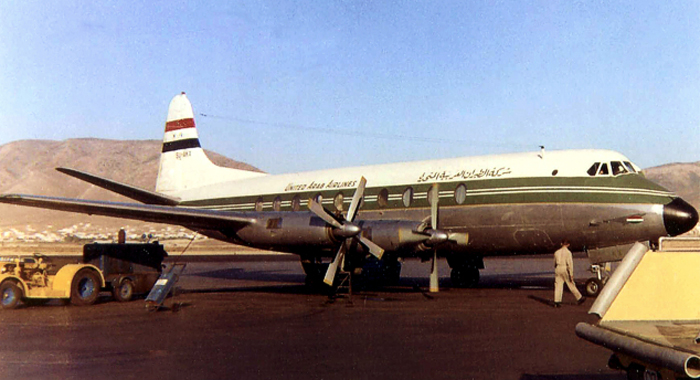
Crash of a Vickers 732 Viscount in Beirut

Date & Time: Feb 23, 1964 at 1920 LT
Type of aircraft:
Operator:
Registration:
SU-AKX
Survivors:
Yes
Schedule:
Cairo – Beirut
MSN:
76
YOM:
1955
Country:
Region:
Crew on board:
48
Crew fatalities:
Pax on board:
5
Pax fatalities:
Other fatalities:
Total fatalities:
0
Circumstances:
Following an uneventful flight from Cairo, the crew started the approach to Beirut Airport in heavy rain falls and strong cross winds. On short final, during the last segment, the airplane was suddenly caught by a downdraft, lost height and struck the runway surface. It bounced and climbed to a height of 30 feet before descending and striking the runway again. Upon impact, the right main gear was sheared off, causing the propellers of both engines number three and four to struck the ground as well. Out of control, the airplane veered off runway and came to rest. While all 53 occupants were evacuated safely, the aircraft was damaged beyond repair.
Probable cause:
Failure of the pilot-in-command to take action: firstly to counteract the effect of a downdraft on final approach and, secondly, to react correctly to a bounce to a height of approximately thirty feet.

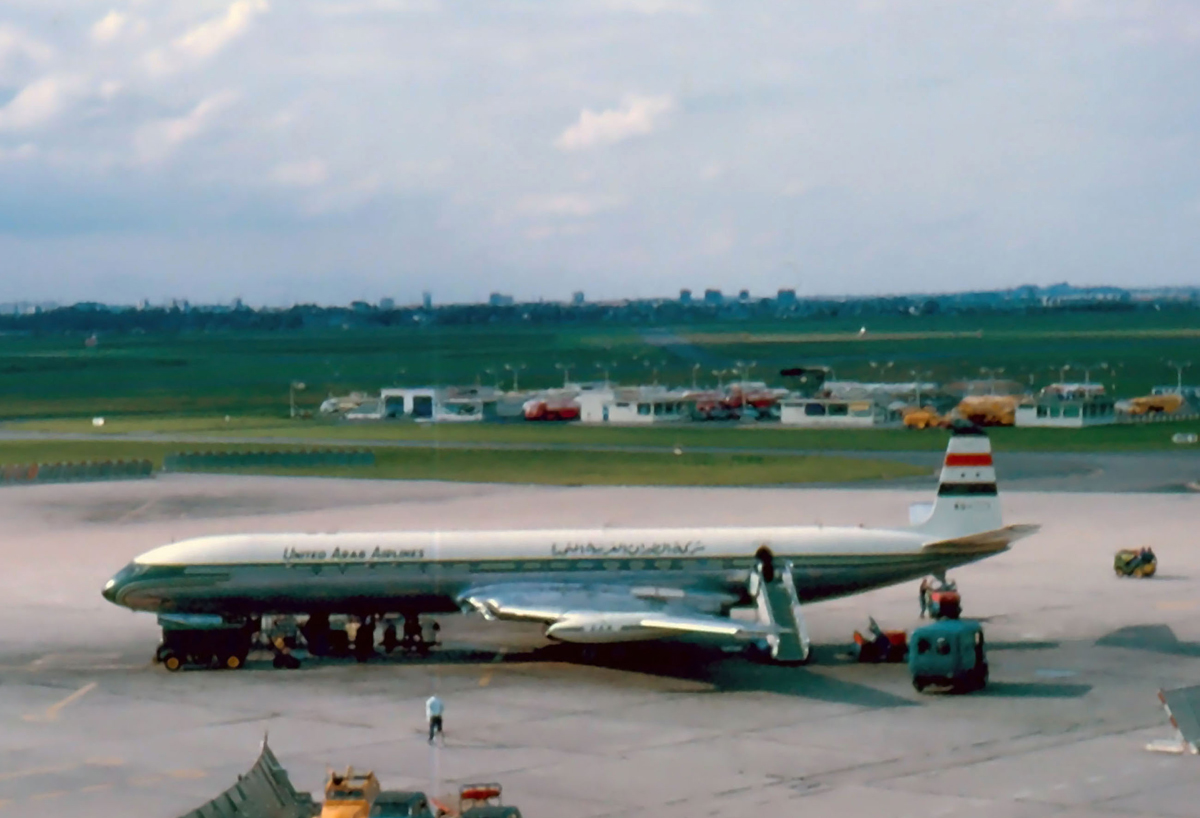
Crash of a De Havilland DH.106 Comet 4C off Mumbai: 63 killed

Date & Time: Jul 28, 1963 at 0150 LT
Type of aircraft:
Operator:
Registration:
SU-ALD
Survivors:
No
Schedule:
Tokyo – Hong Kong – Bangkok – Bombay – Bahreïn – Cairo
MSN:
6441
YOM:
1960
Flight number:
MS869
Country:
Region:
Crew on board:
8
Crew fatalities:
Pax on board:
55
Pax fatalities:
Other fatalities:
Total fatalities:
63
Captain / Total flying hours:
14841
Captain / Total hours on type:
1473.00
Copilot / Total flying hours:
5463
Copilot / Total hours on type:
475
Circumstances:
Flight 869 was a scheduled international flight from Tokyo, Japan to Cairo, United Arab Republic via Hong Kong, Bangkok, Bombay and Bahrain. A crew change was effected at Bangkok. Based on the tape recordings of messages exchanged between the aircraft and Santa Cruz approach and radar control, the flight was reconstructed. It was uneventful until 2016 hours GMT when it reported arriving over the Santa Cruz VOR at 7 000 ft. It was cleared to descend to 4 000 ft over the VOR and was requested to report what type of approach would be carried out for landing on runway 09. The aircraft reported it would follow the ILS back beam procedure. It was advised by Santa Cruz approach that the back beam of the ILS was not flyable but that it could home on the 270° radial of the VOR. The aircraft agreed to do a VOR letdown for runway 09, and shortly thereafter reported it was leaving 7 000 ft outbound over the sea on the 272° radial of the VOR. At 2018 Santa Cruz radar, which was monitoring the flight, warned it that if it flew more than 6 or 7 miles west of the field it would run into very heavy turbulence. Shortly thereafter the flight requested permission to make a left-hand procedure turn instead of the normal right-hand turn. This was granted. At 2019 the flight commenced the procedure turn inbound. Santa Cruz radar advised the flight that it was then 6 miles west-northwest of the field. Flight 869 acknowledged this message and was not heard from again. During the turn in severe turbulence and heavy rain the pilot lost control of the aircraft. It was found later on that the air- craft had crashed into the sea 9 NM west of Madh Island at approximately 2020 hours.
Probable cause:
The committee was faced with difficulties during the course of the investigation due to the fact that neither the exact location of the wreckage could be fixed no the wreckage salvaged. Moreover, the accident occurred suddenly with no airborne emergency reported and late at night over the sea in limited visibility. There were no eyewitnesses. However, in the presence of the facts available, it can be concluded that the accident was probably due to loss of control while turning in severe turbulence and heavy rain.
Final Report:

Crash of a Douglas DC-3 in Az Zahawiyyin: 34 killed

Date & Time: May 12, 1963
Type of aircraft:
Operator:
Registration:
SU-AJX
Flight Phase:
Survivors:
No
Schedule:
Cairo – Alexandria
Country:
Region:
Crew on board:
6
Crew fatalities:
Pax on board:
28
Pax fatalities:
Other fatalities:
Total fatalities:
34
Circumstances:
After takeoff from Cairo-Intl Airport, while climbing in a sandstorm, the aircraft went out of control and crashed in an orange plantation located in Az Zahawiyyin, some 18 km north of the airfield. The aircraft disintegrated on impact and all 34 occupants were killed.

Crash of a De Havilland DH.106 Comet 4C on Mt Khao Yai: 26 killed

Date & Time: Jul 19, 1962 at 2244 LT
Type of aircraft:
Operator:
Registration:
SU-AMW
Flight Phase:
Survivors:
No
Site:
Schedule:
Tokyo – Hong Kong – Bangkok – Bombay – Bahrain – Cairo
MSN:
6464
YOM:
1962
Flight number:
MS869
Country:
Region:
Crew on board:
8
Crew fatalities:
Pax on board:
18
Pax fatalities:
Other fatalities:
Total fatalities:
26
Circumstances:
Flight UA869 departed from Hong Kong for Bangkok, an intermediate stop, on a scheduled service to Cairo. Takeoff time was 13:30 UTC. The flight climbed to 31000 ft, the selected cruising altitude. At 15:14 UA869 advised Bangkok ATC that the flight had crossed the Bangkok FIR boundary at 15:08 and passed over Ubol NDB at 15:13 and requested to fly direct from Ubol NDB to Bangkok VOR. This request was granted by Bangkok ATC. At this time UA869 advised Bangkok ATC that the ETA for Bangkok VOR would be 15:47. At 15:27 the flight advised Bangkok ATC that it would be over the 100 mile perimeter at 15:30. After reporting that it was 90 miles out the crew requested descent clearance to a lower altitude. Bangkok control cleared the flight to descend to 4000 ft on the Bangkok VOR radial of 073 degrees and to report when commencing descent from 31000 ft. The flight was instructed to contact Bangkok approach control at 15:39. At 15:35 the flight was cleared to 3000 ft and informed that the altimeter setting was 1007.8 mb. At 15:40 the flight transferred to the Bangkok approach control. Immediately after this UA869 reported to approach control that it was descending from 13000 ft and estimating Bangkok VOR at 15:44. Approach control advised the flight to adjust the altimeter setting to 1007.8 mb and then cleared the flight to cross Bangkok VOR for final approach on runway 21R and report immediately on descending from 3000 ft. This was the last contact with the flight. The Comet flew into the side of Khao Yai Mountain, 52 nm NE of Bangkok.
Probable cause:
The principal cause of the accident was the pilot's action in commencing descent at 1530 hours when the aircraft was 137 miles and not 90 miles from the Bangkok VOR as reported to Bangkok Control, and the aircraft, therefore, collided with a mountain at a point 52 miles distant. It is probable that the pilot-in-command did not actually pass over the point he reported to the Flight Control Units, but only estimated he had passed three points which resulted in grave errors of time and distance in his computations. It is also probable that the pilot-in-command had been too self-confident so that his actions were not according to the fundamental principles of air navigation.
Final Report:

Crash of a Douglas DC-3 in Cairo: 3 killed

Date & Time: May 15, 1962
Type of aircraft:
Operator:
Registration:
SU-AJM
Flight Phase:
Flight Type:
Survivors:
No
Schedule:
Cairo – Beirut
Country:
Region:
Crew on board:
3
Crew fatalities:
Pax on board:
0
Pax fatalities:
Other fatalities:
Total fatalities:
3
Circumstances:
Shortly after takeoff from Cairo-Intl Airport, while climbing, the airplane went out of control and crashed near the runway end. All three crew members were killed.

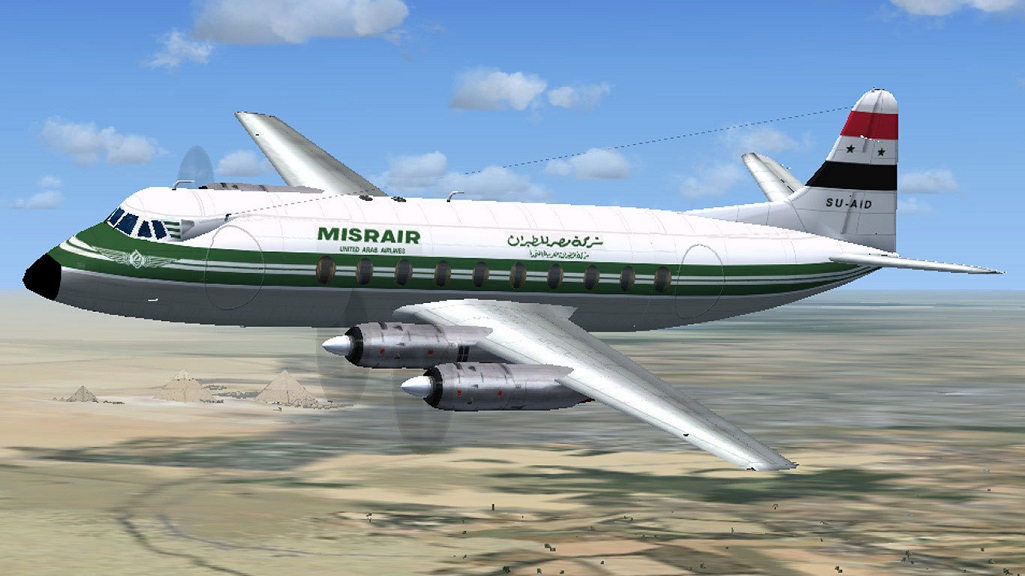
Crash of a Vickers 739 Viscount in Wadi Halfa

Date & Time: Mar 16, 1962
Type of aircraft:
Operator:
Registration:
SU-AID
Survivors:
Yes
Schedule:
Jerusalem – Cairo
MSN:
86
YOM:
1955
Country:
Region:
Crew on board:
6
Crew fatalities:
Pax on board:
10
Pax fatalities:
Other fatalities:
Total fatalities:
0
Circumstances:
While descending to Cairo-Intl Airport, the crew was informed about poor weather conditions at destination and decided to divert to Wadi Halfa, some 900 km south of Cairo. On final approach to Wadi Halfa Airport, all four engines failed. The aircraft stalled and crashed in a desert area located five km short of runway threshold. The aircraft was damaged beyond repair while all 16 occupants were slightly injured.
Probable cause:
Failure of all four engines due to fuel exhaustion.

Crash of a Douglas C-47B-5-DK in Kameshli

Date & Time: May 6, 1961
Operator:
Registration:
SU-ALP
Survivors:
Yes
Schedule:
Cairo – Damascus – Aleppo – Kameshli
MSN:
14662/26107
YOM:
1944
Country:
Region:
Crew on board:
5
Crew fatalities:
Pax on board:
2
Pax fatalities:
Other fatalities:
Total fatalities:
0
Circumstances:
On final approach to Kameshli Airport, the aircraft was too low, struck the ground 300 meters short of runway threshold and came to rest in flames. All seven occupants were injured and the aircraft was destroyed.