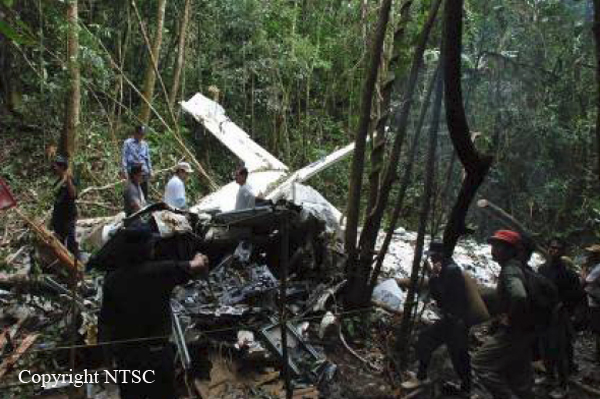
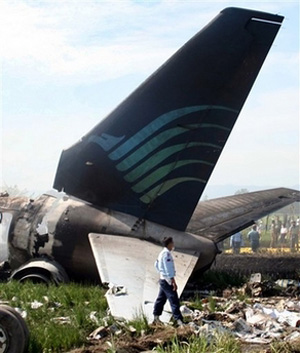
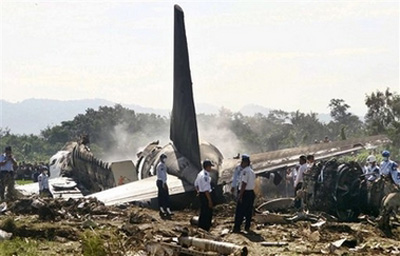
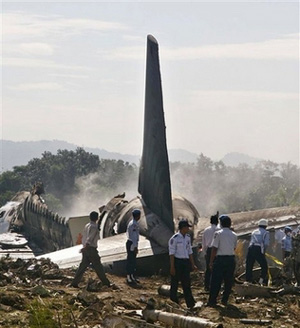
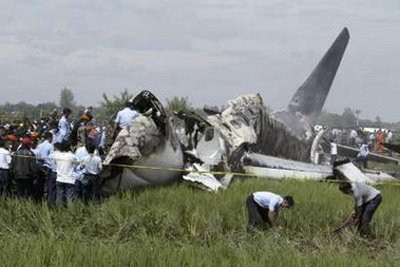
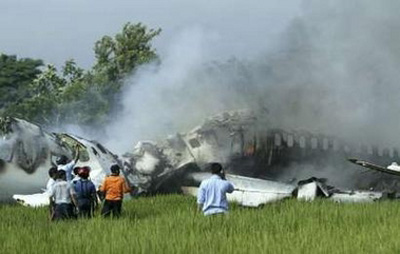
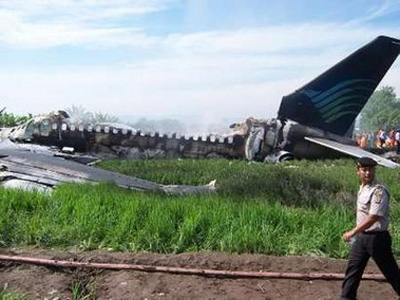
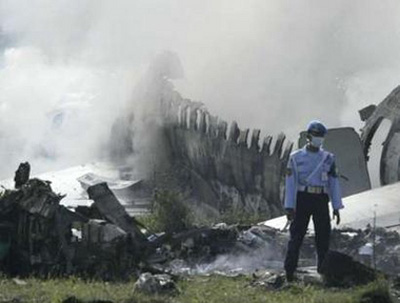
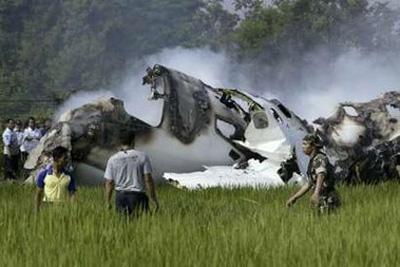
Crash of a Casa 212 Aviocar 200M on Mt Salak: 18 killed

Date & Time: Jun 26, 2008 at 1100 LT
Type of aircraft:
Operator:
Registration:
A-2106
Flight Phase:
Flight Type:
Survivors:
No
Site:
Schedule:
Jakarta – Bogor
MSN:
228/N68
YOM:
1984
Country:
Region:
Crew on board:
5
Crew fatalities:
Pax on board:
13
Pax fatalities:
Other fatalities:
Total fatalities:
18
Circumstances:
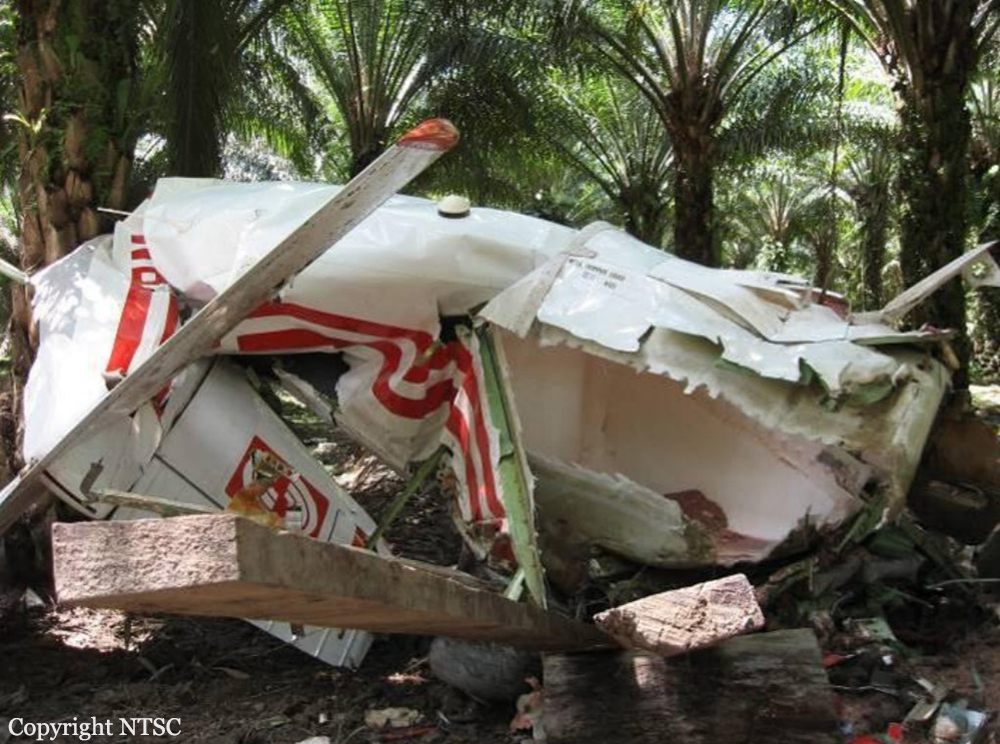
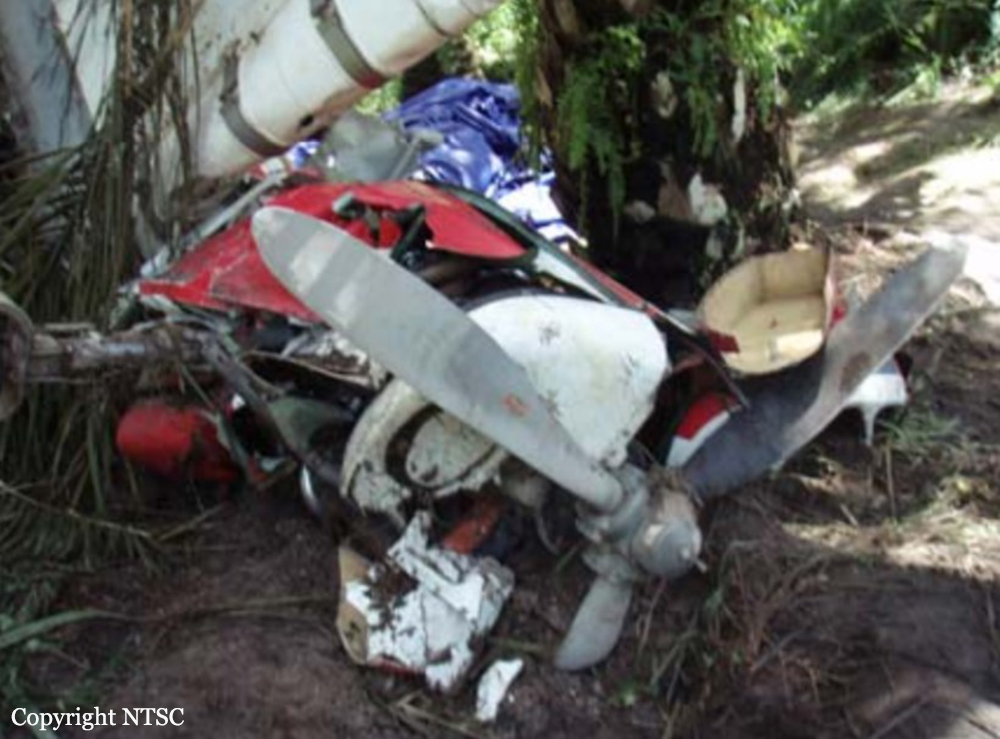
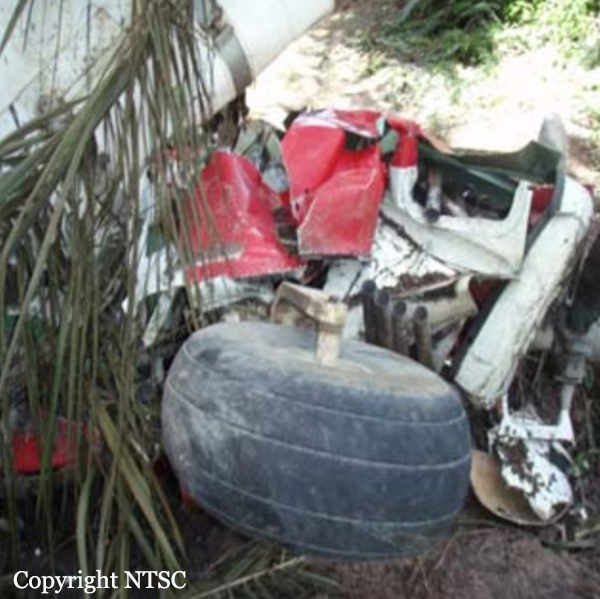
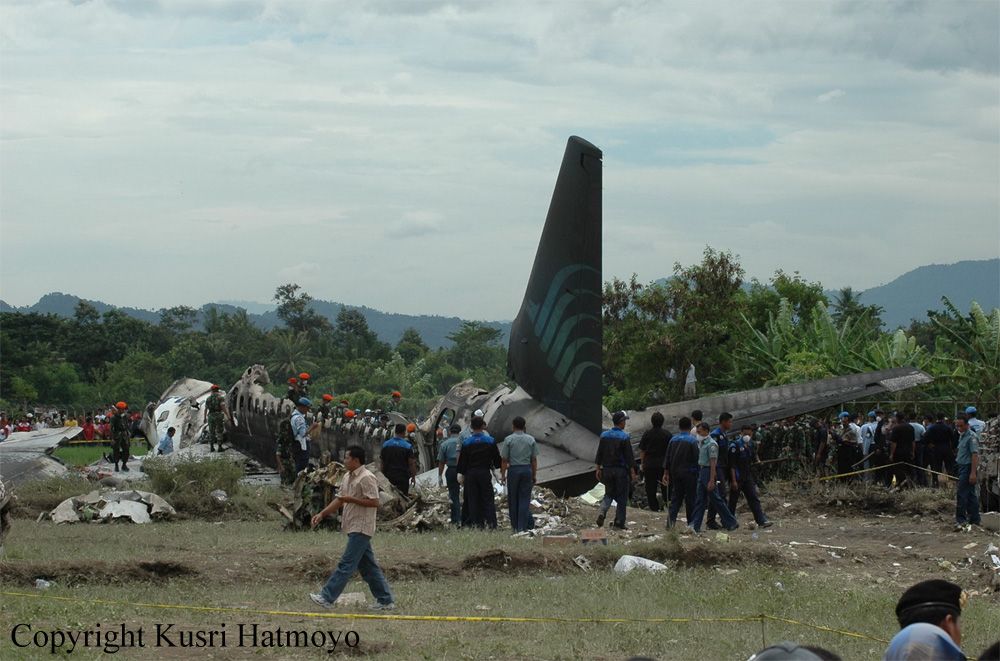
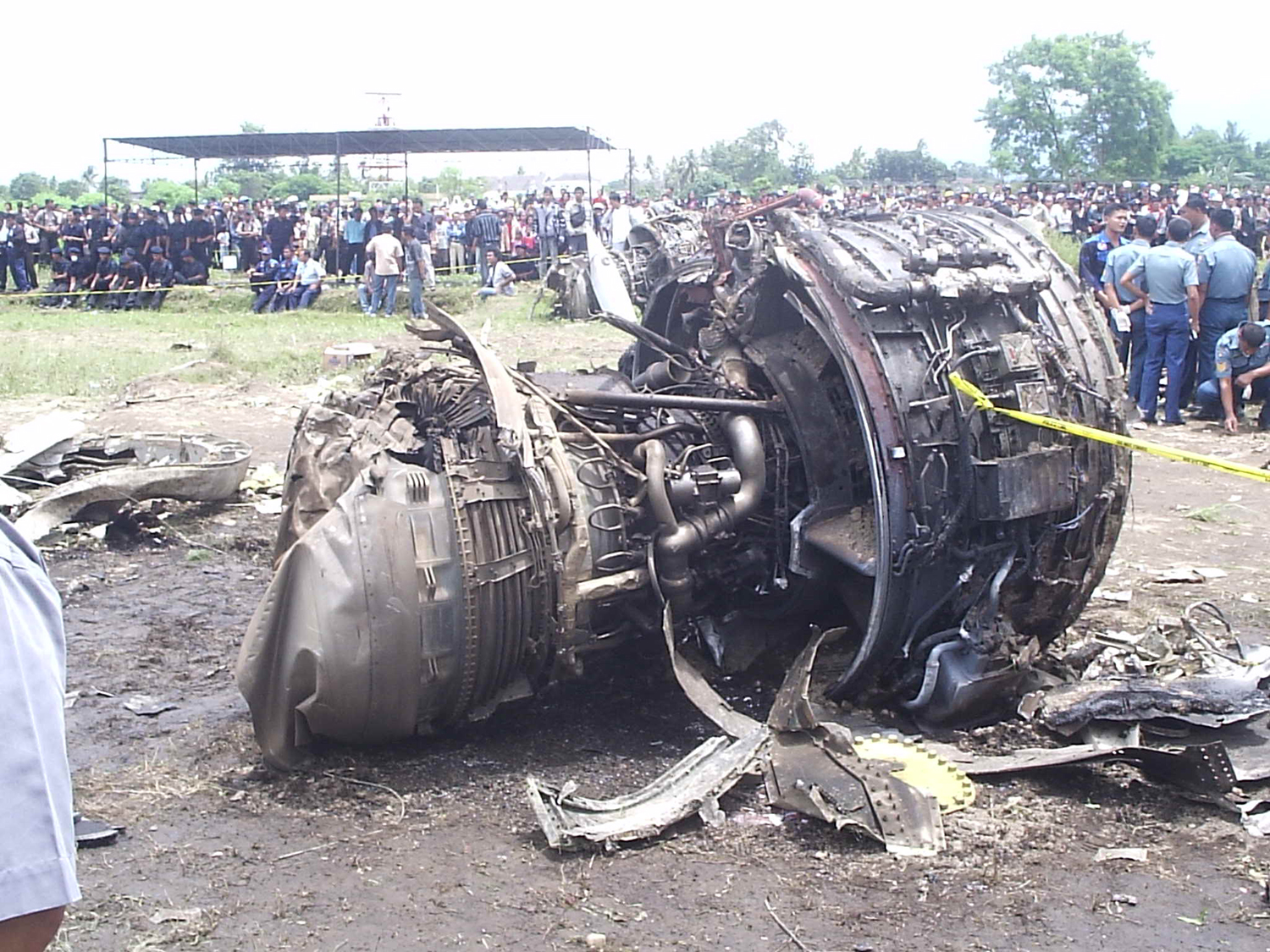
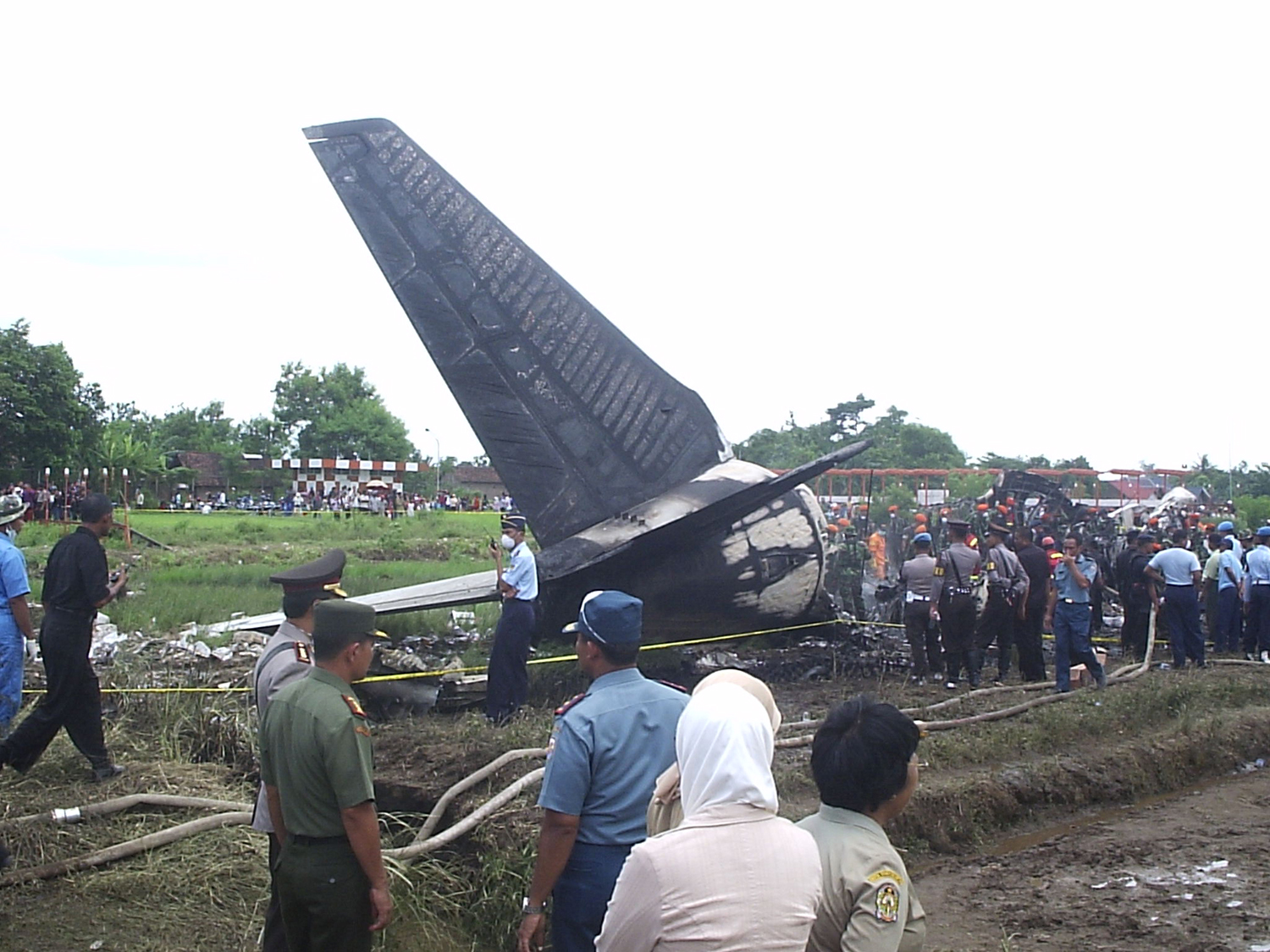
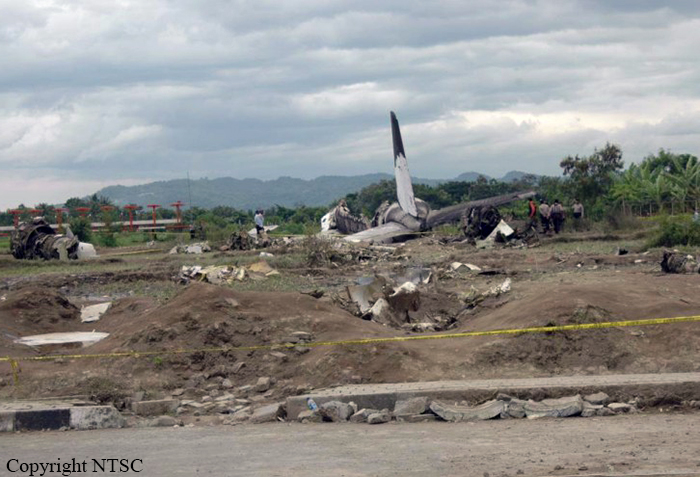
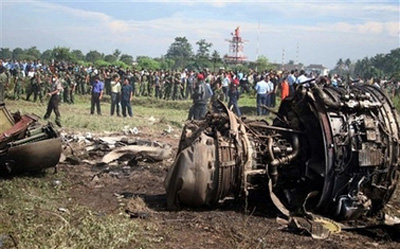
While flying in poor weather conditions, the twin engine aircraft struck the slope of Mt Salak located about 55 km south of Jakarta. All 18 occupants were killed.
Probable cause:
Controlled flight into terrain.

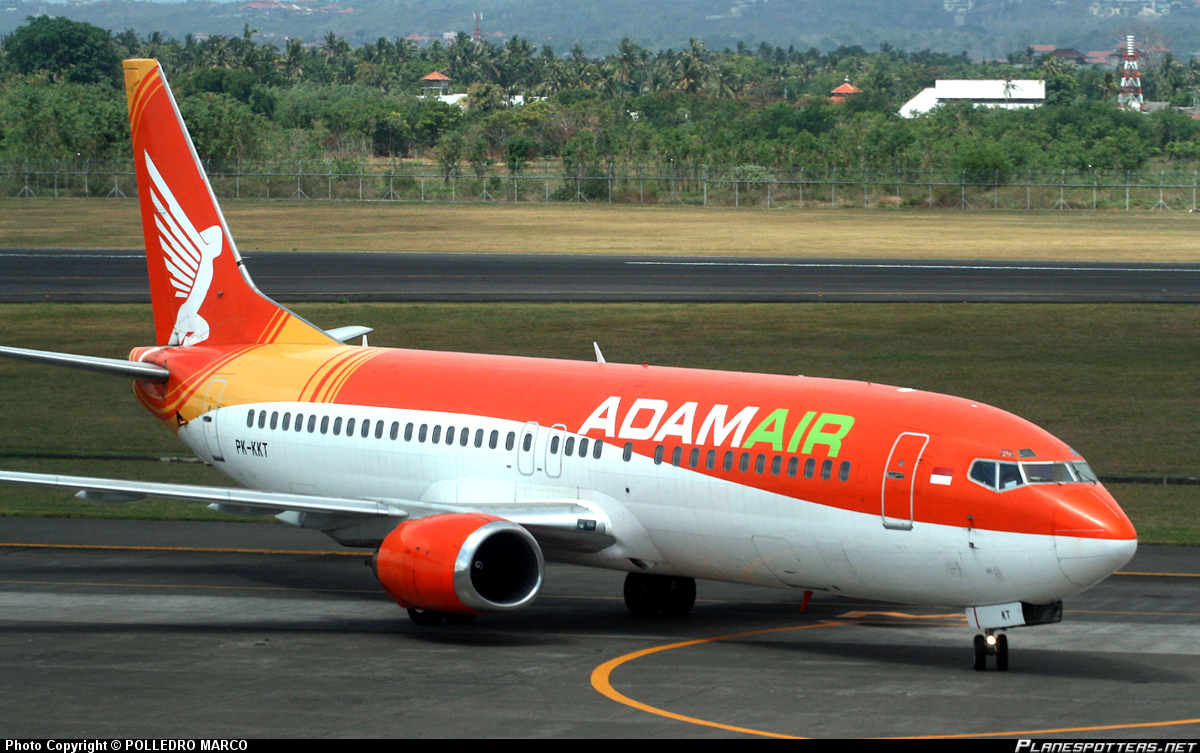
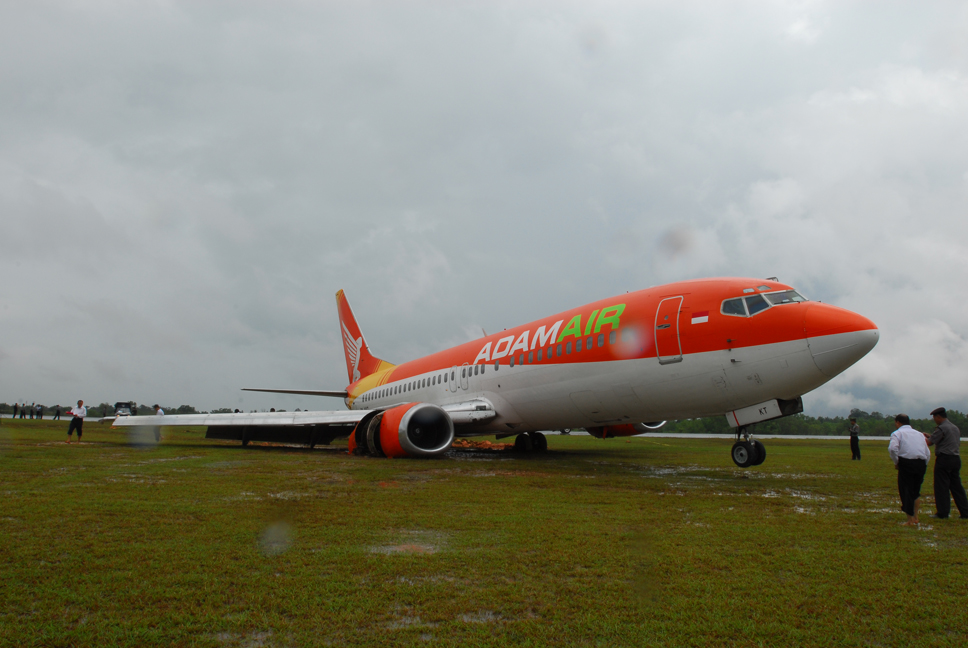
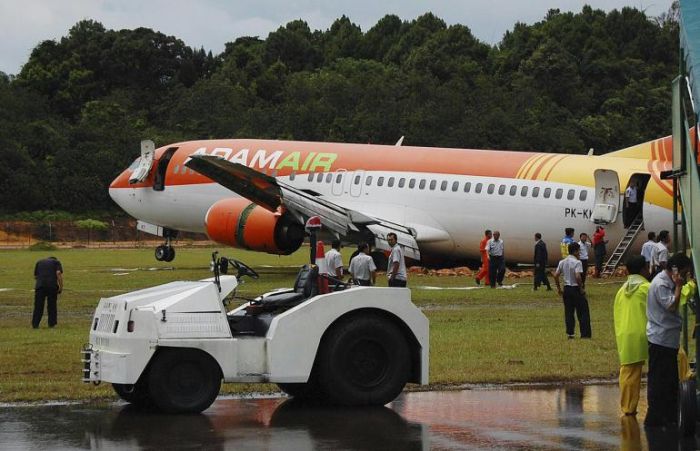
Crash of a Boeing 737-408 in Batam

Date & Time: Mar 10, 2008 at 1020 LT
Type of aircraft:
Operator:
Registration:
PK-KKT
Survivors:
Yes
Schedule:
Jakarta - Batam
MSN:
24353/1721
YOM:
1989
Flight number:
DHI292
Country:
Region:
Crew on board:
6
Crew fatalities:
Pax on board:
171
Pax fatalities:
Other fatalities:
Total fatalities:
0
Circumstances:
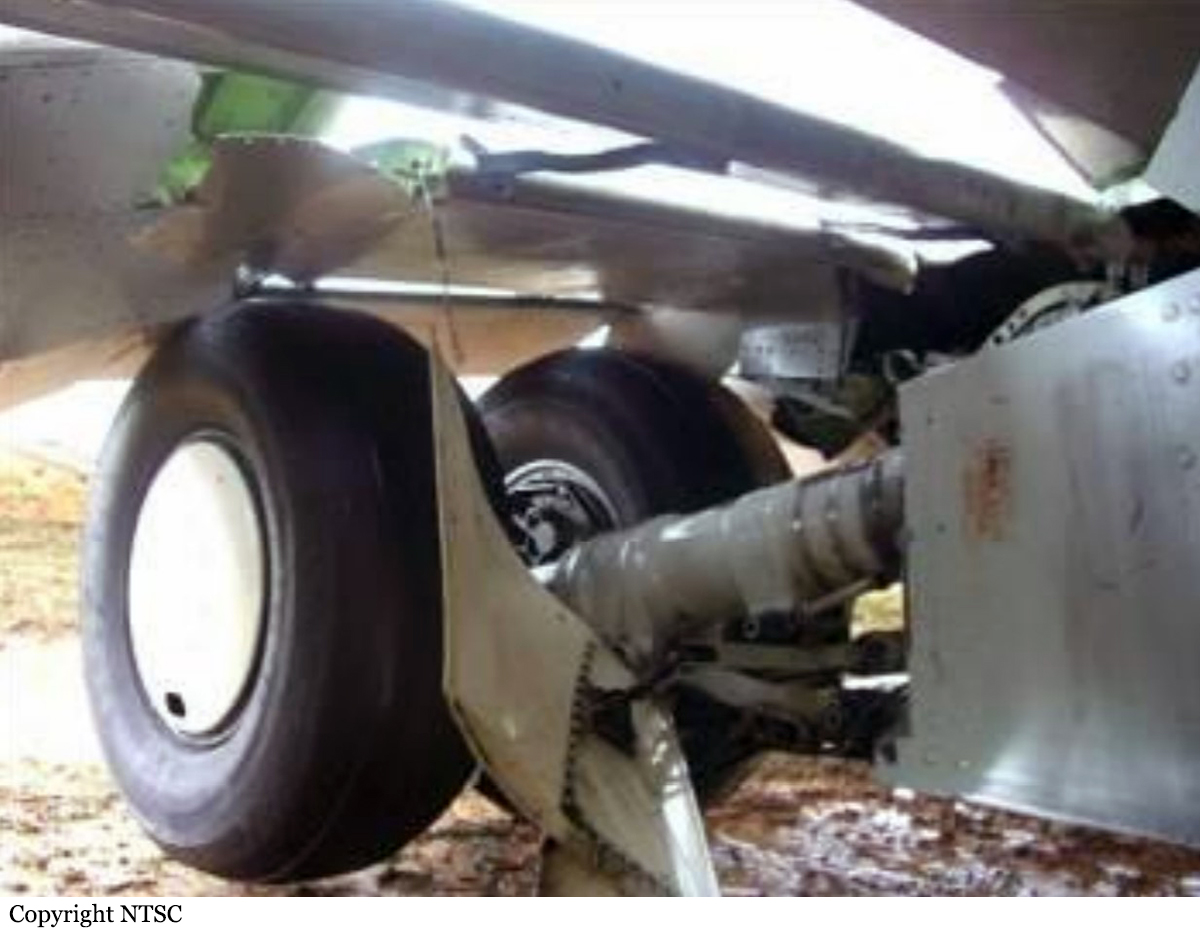
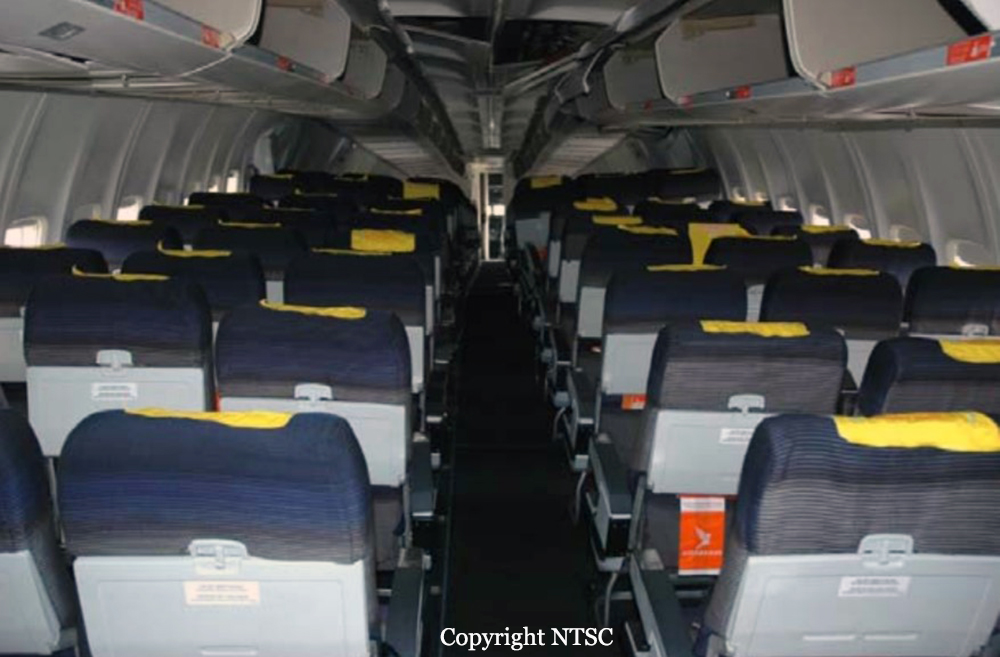
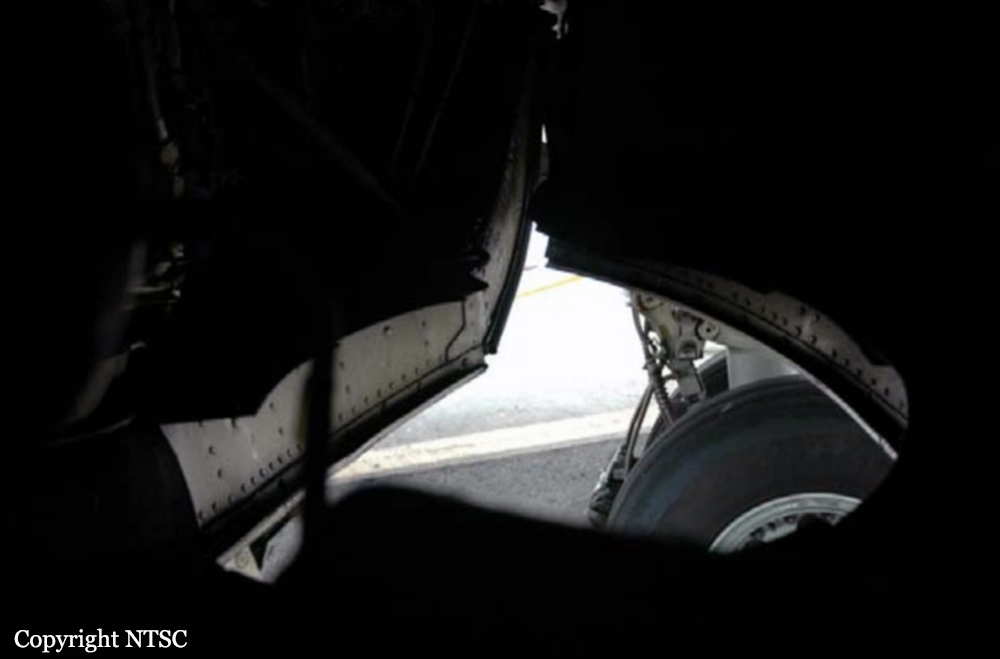
On 10 March 2008, a Boeing Company 737-400 aircraft, registered PK-KKT, was being operated by Adam SkyConnection Airlines (Adam Air) as scheduled passenger flight with flight number DHI292. The flight departed Soekarno – Hatta Airport, Jakarta at 01:30 UTC with destination Hang Nadim Airport, Batam and the estimated time of arrival was 03:05 UTC. On board in this flight were 177 people consisted of two pilots, four flight attendants, and 171 passengers. The Pilot in Command (PIC) acted as pilot flying (PF) and the Second in Command (SIC) acted as pilot monitoring (PM). The flight until commencing descend was uneventful. Prior to descend, the flight crew received weather information indicating that the weather was fine. At 0302 UTC the flight crew contacted Hang Nadim tower controller and informed them that the visibility was 1,000 meters and they were sequence number three for landing runway 04. The flight crew of the aircraft on sequence number two informed to Hang Nadim tower controller that the runway was insight at an altitude of about 500 feet. The Hang Nadim tower controller forwarded the information to the flight crew of DHI 292, and followed this by issuing landing clearance, and additional information that the wind velocity was 360 degrees at 8 knots and heavy rain. The DHI 292 flight crew acknowledged the information. The landing configuration used flaps 40 degrees with landing speed of 136 knots. The flight crew were able to see the runway prior to the Decision Altitude (DA), however the PIC was convinced that continuing the approach to landing was unsafe and elected to go around. The Hang Nadim tower controller instructed the flight crew to climb to 3000 feet, maintain runway heading, and contact Singapore Approach. At 0319 UTC, DHI 292 was established on the localizer runway 04, and the Hang Nadim tower controller informed them that the visibility improved to 2,000 meters. While on final approach, the flight crew DHI 292 reported that the runway was in sight and the Hang Nadim tower controller issued a landing clearance. On touchdown, the crew felt that the main wheels barely touch the runway first. During the landing roll, as the ground speed decreased below 30 knots, the aircraft yawed to the right. The flight crew attempted to steer the aircraft back to centerline by applying full left rudder. The aircraft continued yaw to the right and came to stop on the runway shoulder at approximately 40 meters from the right side of the runway edge, and 2,760 meters from the runway 04 threshold. No one was injured in this accident. The aircraft was seriously damaged with the right main landing gear assembly detached and collapsing backward and damaging the right wing and flaps. The right engine was displaced from its attachment point.
Probable cause:
The Flight Data Recorder (FDR) and the Cockpit Voice Recorder (CVR) data were downloaded. The CVR data showed that the aircraft was flying below the correct glide path indicated by a glide slope aural warning, and the crew had difficulty in recovering the condition. The CVR also recorded landing gear warning after touchdown which indicated the landing gear had collapsed. The FDR data showed that the vertical acceleration during landing was 2.97 g, however this amount of vertical acceleration should not damage the landing gear. The FDR data showed that just after touchdown, the right main landing gear collapsed. The FDR also recorded that the aircraft experienced hard landing and had bounced on a previous flight, and the value of the vertical acceleration recorded was 1.78 g. It was most likely that the hard landing and bounce had affected the strength of the landing gear. The examination of the failed landing gear also found corrosion on the fracture surface of the right main landing gear strut.
Final Report:

Ground fire of a Transall C-160NG in Wamena

Date & Time: Mar 6, 2008 at 0920 LT
Type of aircraft:
Operator:
Registration:
PK-VTQ
Flight Type:
Survivors:
Yes
Schedule:
Jayapura – Wamena
MSN:
F235
YOM:
1985
Country:
Region:
Crew on board:
7
Crew fatalities:
Pax on board:
0
Pax fatalities:
Other fatalities:
Total fatalities:
0
Circumstances:
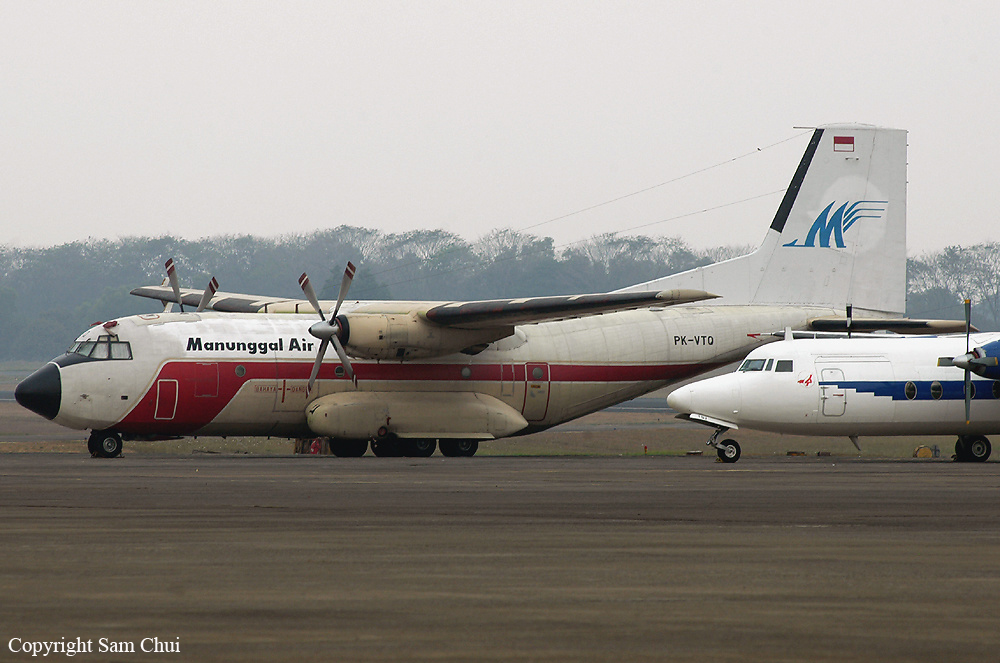
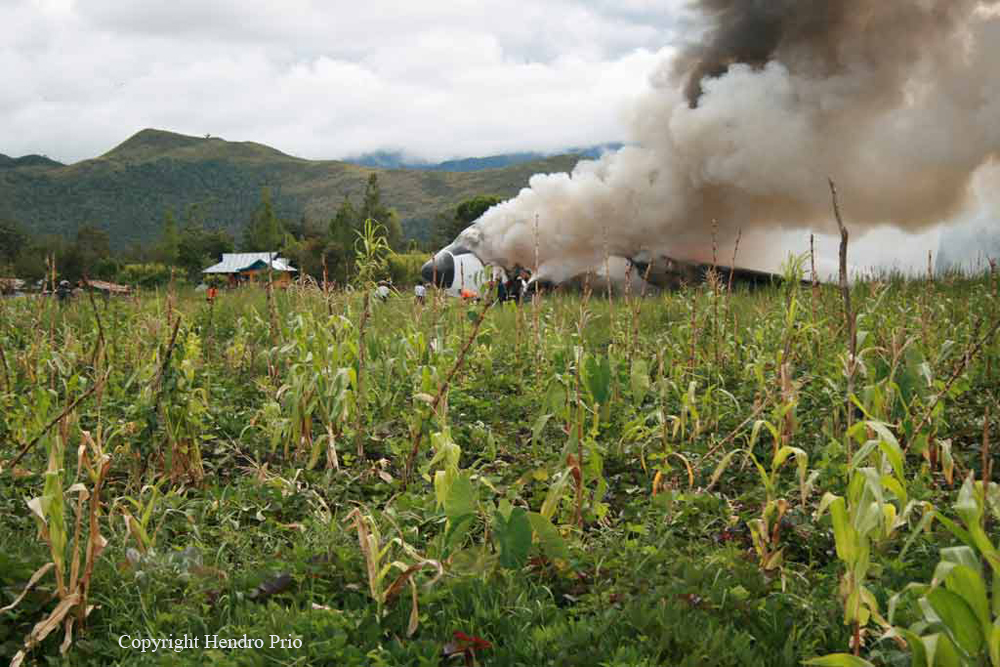
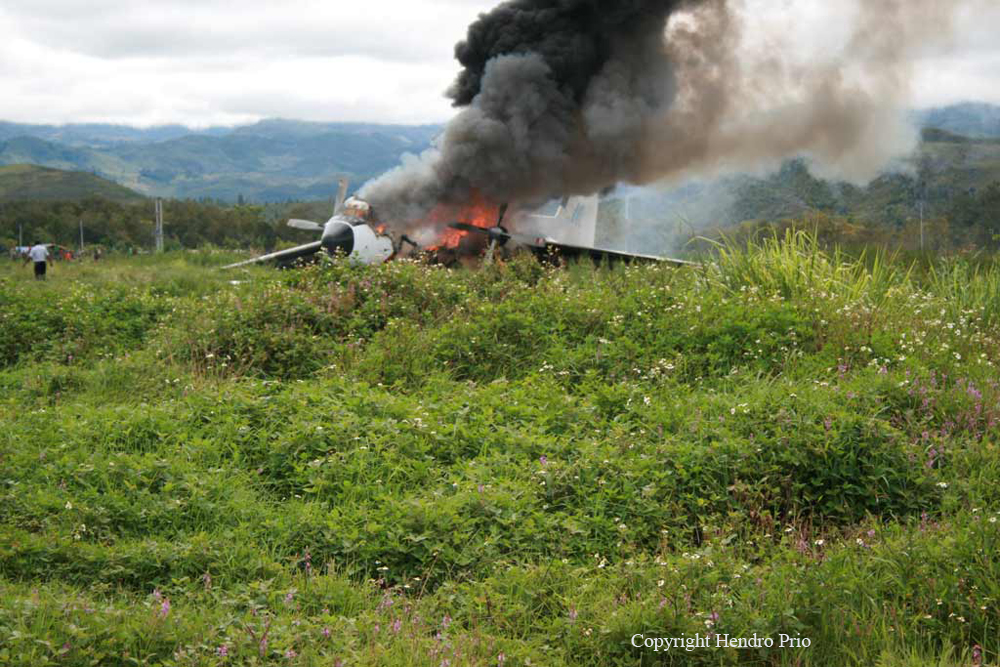
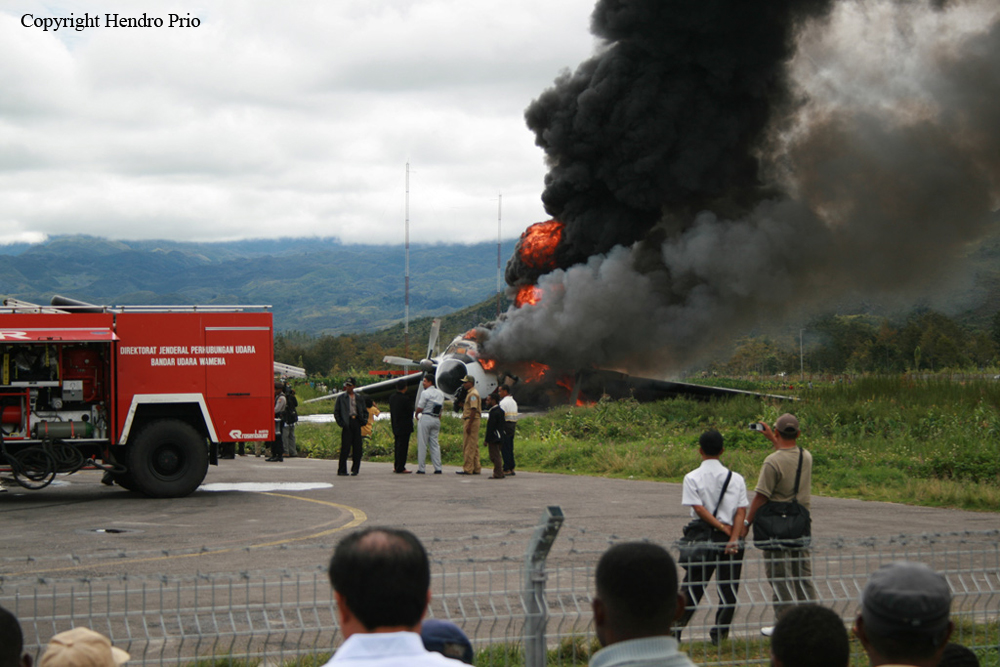
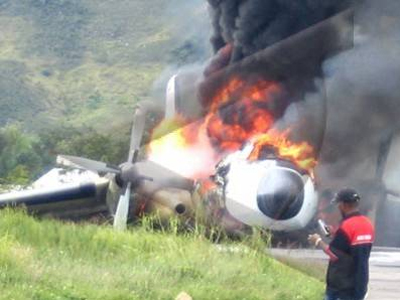
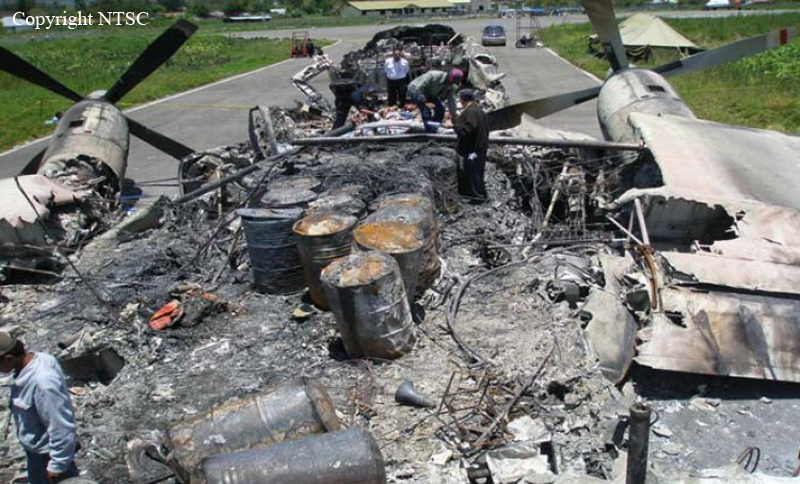
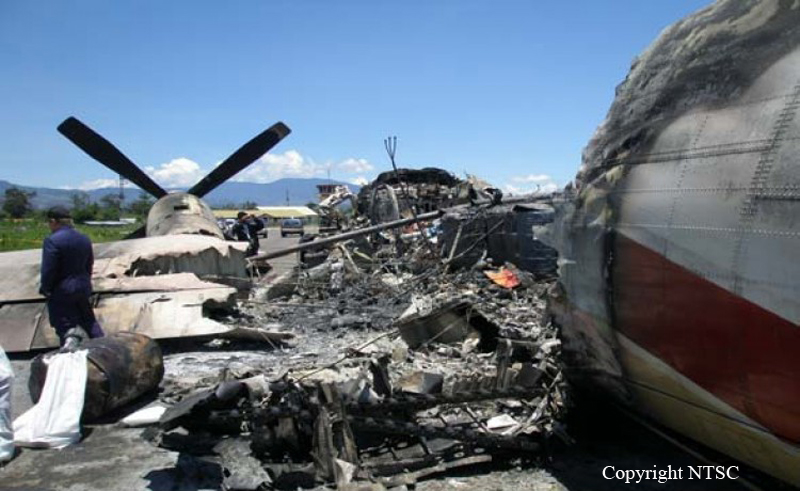
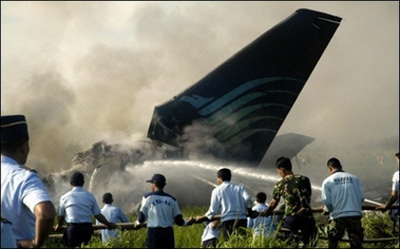
On 6 March 2008, a Transall C-160 aircraft, registered PK-VTQ, operated by PT. Manunggal Air, was on an unscheduled freight flight from Sentani Airport, Jayapura, to Wamena Airport, Papua. There were seven people on board; two pilots, two engineers, and three flight officers. The pilots reported that the approach and landing were normal. However, they told the investigators that both Beta lights did not illuminate during the landing roll, so they could not use reverse thrust. They reported that they used maximum brakes to slow the aircraft, and rolled through to the end of runway 15. During the 180-degree right turn at the end of the runway, they felt the left brakes grabbing, and had to use increased thrust on the left engine to assist the turn. After completing the turn, the pilots backtracked the aircraft towards taxiway “E”, about 450 meters from the departure end of runway 15. The air traffic controller informed the Transall crew that heavy smoke was coming from the left main wheels, and that they should proceed to taxiway “E” and stop on the taxiway. Before the aircraft entered taxiway “E”, the controller activated the crash alarm. The pilots stopped the aircraft on taxiway “E”, and the occupants disembarked and attempted to extinguish the wheel-bay fire with a hand held extinguisher. The airport rescue fire fighting service (RFFS) arrived at the aircraft 10 minutes after the aircraft came to a stop on taxiway “E”. It took a further 5 minutes to commence applying foam. The attempts to extinguish the fire were unsuccessful, and the fire destroyed the aircraft and its cargo of fuel in drums. Investigators found molten metal on the runway along the left wheel track for about 16 meters, about 100 meters from taxiway “E”, between taxiway “E” and the departure end of runway 15. There was also molten metal along the left wheel track on taxiway “E”.
Probable cause:
The aircraft’s left main wheels’ brakes overheated during the landing roll and a fire commenced in the brake assembly of one or more of the left main landing gear wheels. The evidence indicated that a brake cylinder and/or hydraulic line may have failed. It is likely that brake system hydraulic fluid under pressure, was the propellant that fed the fire. There was no Emergency Response Plan at Wamena. The RFFS delay in applying fire suppressant resulted in the fire engulfing the aircraft.
Final Report:

Crash of a Casa 212 Aviocar 200 in Long Apung: 3 killed

Date & Time: Jan 26, 2008 at 0936 LT
Type of aircraft:
Operator:
Registration:
PK-VSE
Flight Type:
Survivors:
No
Schedule:
Tarakan – Long Apung
MSN:
412/92N
YOM:
1993
Country:
Region:
Crew on board:
3
Crew fatalities:
Pax on board:
0
Pax fatalities:
Other fatalities:
Total fatalities:
3
Captain / Total flying hours:
21019
Captain / Total hours on type:
14234.00
Copilot / Total flying hours:
16849
Copilot / Total hours on type:
16849
Aircraft flight hours:
11750
Aircraft flight cycles:
13749
Circumstances:
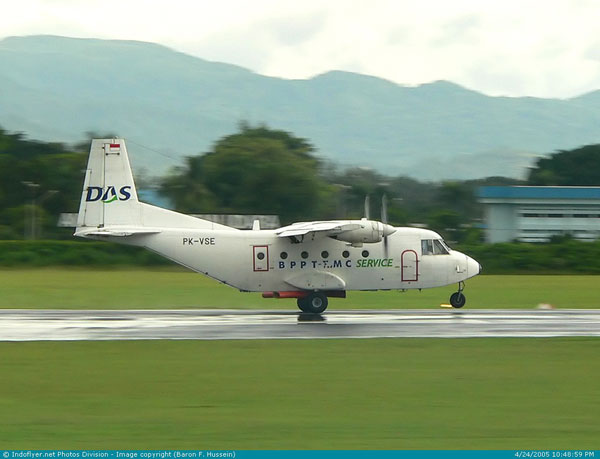
On 26 January 2008, a Casa 212-200 aircraft, registered PK-VSE, was being operated by PT. Dirgantara Air Service as a cargo charter flight from Tarakan Airport to Long Apung Airport. There were 3 persons on board; two pilots and one aircraft maintenance engineer/load master. The aircraft was certified as being airworthy prior to departure. The aircraft departed from Tarakan at 0011 UTC (08:11 local time), and the estimated time arrival at Long Apung was 0136. At 0411 the pilot of another aircraft received a distress signal and informed air traffic services at Tarakan. Searchers subsequently found the aircraft wreckage at an elevation of 2,766 feet, about 3.4 NM from Long Apung Airport. The coordinates of the accident site were 01° 39.483′ S and 115° 00.265′ E near Lidung Payau Village, Malinau, East Kalimantan. The accident site was on the left downwind leg of the runway 35 circuit.
Probable cause:
The following findings were identified:
• The aircraft was certified as being airworthy prior to departure.
• All crew members held appropriate and valid flight crew licenses.
• The pilots continued flight into instrument meteorological conditions.
• The aircraft impacted terrain in controlled flight.
• The cargo was not adequately restrained.
Causes:
The crew did not appear to have awareness of the aircraft’s proximity with terrain until impact with terrain was imminent. The pilot attempted to continue the flight in instrument meteorological
conditions, below the lowest safe altitude.
Final Report:

Crash of a GAF Nomad N.22B off Sabang: 5 killed

Date & Time: Dec 30, 2007 at 1130 LT
Type of aircraft:
Operator:
Registration:
P-833
Survivors:
Yes
Schedule:
Sabang - Medan
MSN:
168
YOM:
1983
Location:
Country:
Region:
Crew on board:
2
Crew fatalities:
Pax on board:
5
Pax fatalities:
Other fatalities:
Total fatalities:
5
Circumstances:
The twin engine aircraft departed Sabang-Maimum Saleh airport at 1110LT on a maritime survey flight to Medan. About 15 minutes into the flight, the crew informed ATC about engine problems and elected to return to Sabang. On final approach in poor weather conditions, the aircraft crashed in the sea and sank about 200 metres offshore. Two people were rescued while five others were killed.

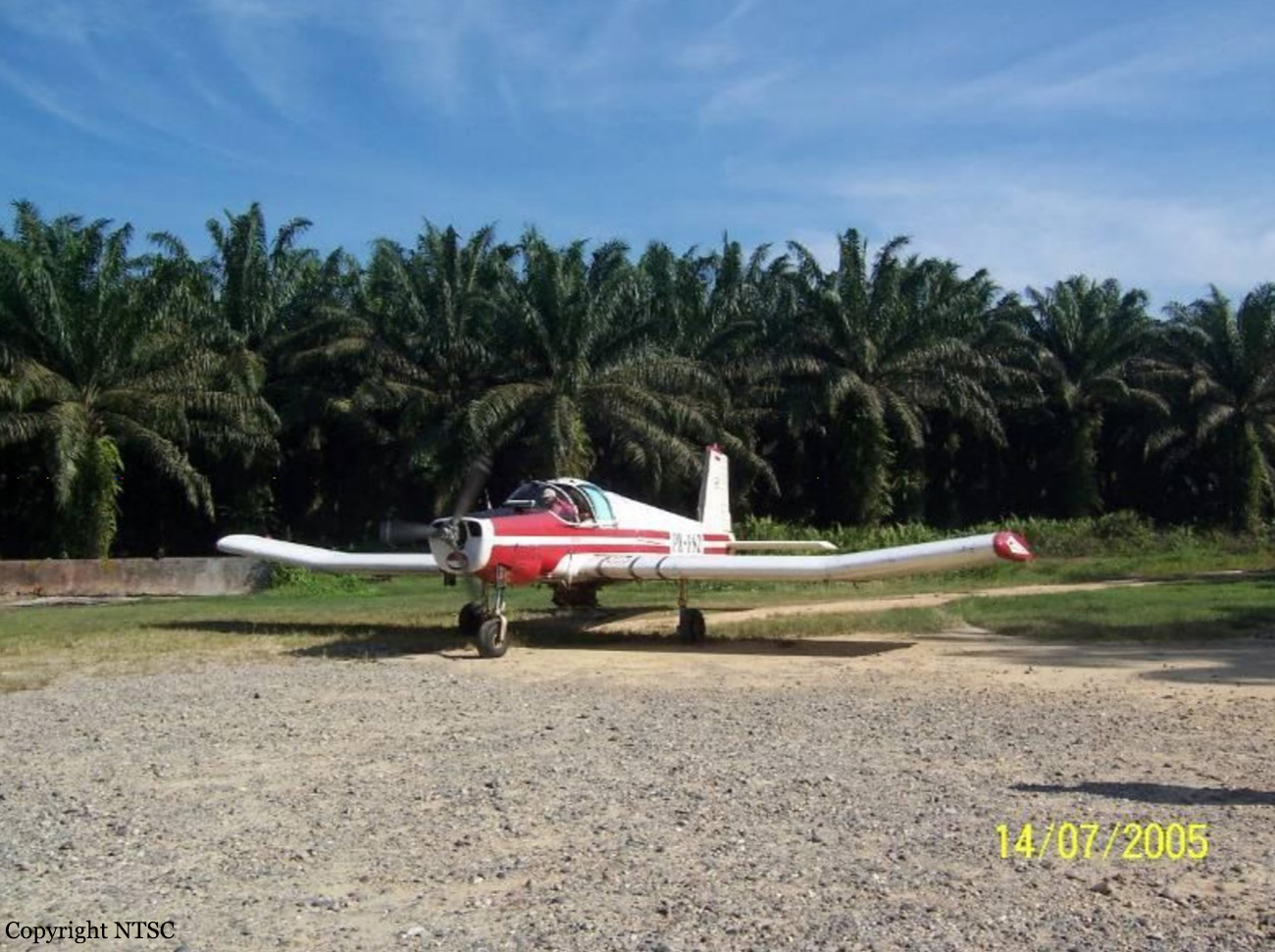
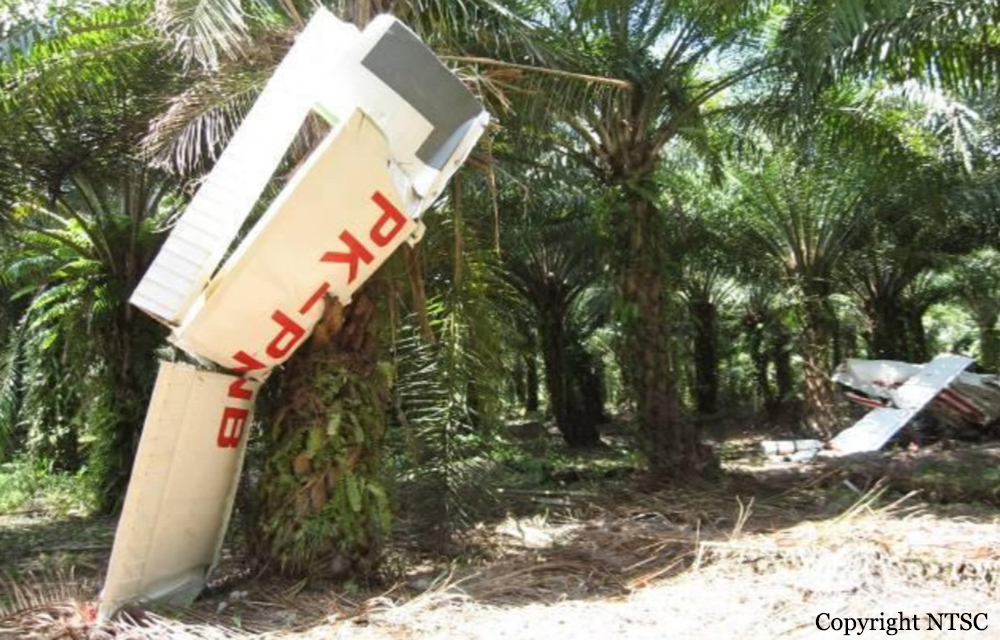
Crash of a Fletcher FU-24-950 in Desa Lereh: 1 killed

Date & Time: Dec 11, 2007 at 0930 LT
Type of aircraft:
Operator:
Registration:
PK-PNB
Flight Phase:
Survivors:
No
Schedule:
Desa Lereh - Desa Lereh
MSN:
248
YOM:
1978
Country:
Region:
Crew on board:
1
Crew fatalities:
Pax on board:
0
Pax fatalities:
Other fatalities:
Total fatalities:
1
Aircraft flight hours:
12812
Circumstances:
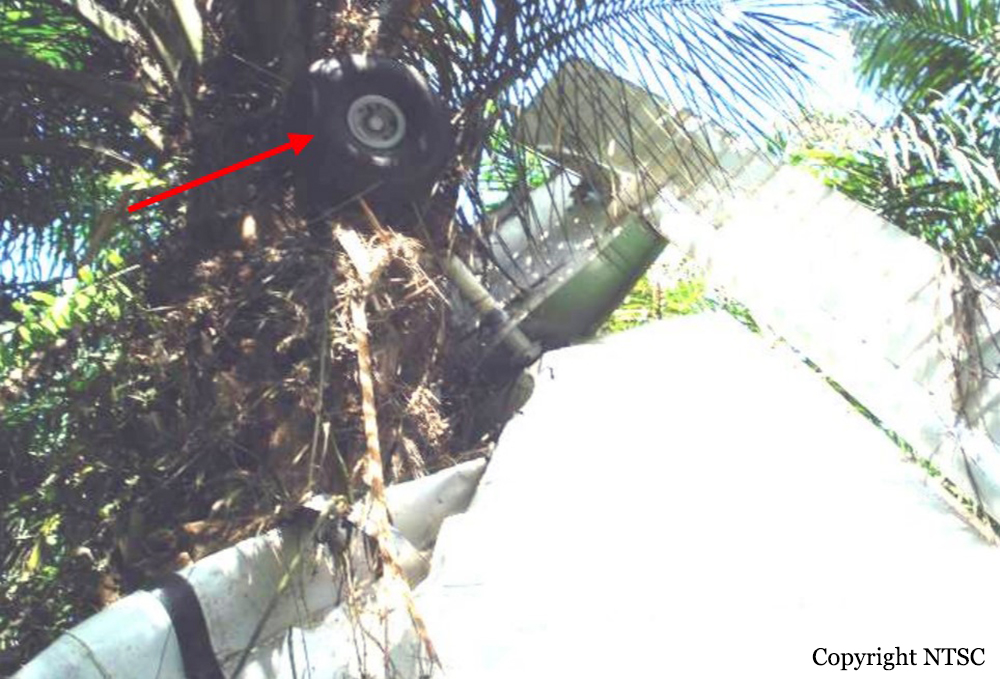
The pilot, sole on board, was completing a spraying mission on a palm tree plantation located in the region of Desa Lereh, Papua. After he completed 10 sorties, the pilot returned to Desa Lereh Aerodrome where the aircraft was filled with 1,300 kilos of fertilizers. After takeoff, the pilot made a turn to the left when the left wing impacted trees and the aircraft crashed 4 km from the airfield. The aircraft was destroyed and the pilot was killed.
Final Report:

Crash of a Boeing 737-230 in Malang

Date & Time: Nov 1, 2007 at 1324 LT
Type of aircraft:
Operator:
Registration:
PK-RIL
Survivors:
Yes
Schedule:
Jakarta – Malang
MSN:
22137/788
YOM:
1981
Flight number:
RI260
Country:
Region:
Crew on board:
5
Crew fatalities:
Pax on board:
89
Pax fatalities:
Other fatalities:
Total fatalities:
0
Captain / Total flying hours:
19357
Captain / Total hours on type:
10667.00
Copilot / Total flying hours:
2300
Copilot / Total hours on type:
1528
Aircraft flight hours:
57823
Circumstances:
On 1 November 2007, a Boeing Company B737-200 aircraft, registered PK-RIL, operated by PT. Mandala Airlines as flight number MDL 260, was on a scheduled passenger flight from Jakarta Soekarno-Hatta International Airport, Jakarta, to Abdurrachman Saleh Airport, Malang, East Java. The pilot in command (PIC) was the handling pilot, and the copilot was the support/monitoring pilot. There were 94 persons on board the aircraft, consisting of two pilots, three cabin crew, and 89 passengers. The aircraft landed at Malang at 1324 Western Indonesian Standard Time (06:24 Coordinated Universal Time (UTC). It was reported to have been raining heavily when the aircraft landed on runway 35 at Malang. The aircraft bounced twice after the initial severe hard landing, and the lower drag strut of the nose landing gear fractured, resulting in the rearwards collapse of the nose landing gear and separation of the lower nose landing gear shock strut and wheel assembly. The aircraft’s nose then contacted the runway, and the aircraft came to rest 290 metres before the departure end of runway 17. The crew subsequently reported that during the visual segment of the landing approach, they realized that the aircraft was too high with reference to the precision approach path indicator (PAPI) for runway 35. The PIC increased the aircraft’s rate of descent (ROD) to capture the PAPI. The high ROD was not arrested, and as a consequence, the severe hard landing occurred which substantially damaged the aircraft. No one of the passengers or crew was injured.
Probable cause:
The flight crew did not appear to have an awareness that the aircraft was above the desired approach path to runway 35 at Malang until they sighted the visual approach slope indication lighting system. The pilot in command continued the approach in reduced visibility and heavy rain; marginal visual meteorological conditions. Non-adherence by the flight crew to stabilized approach procedures, which resulted in the initial severe hard landing at Malang, together with the omission of a high bounced landing recovery, resulted in substantial damage to the aircraft. The following findings were identified:
- The PIC allowed the approach at Malang to become unstabilized and did not correct that condition.
- The PIC continued the approach in reduced visibility and heavy rain; marginal visual meteorological conditions.
- Neither pilot responded appropriately to the ground proximity warning system voice aural ‘SINK RATE’ or ‘PULL UP’ warnings that sounded during the final approach to Malang.
- The PIC did not initiate action to recover from the high bounced landing following the initial severe hard landing impact.
- The PIC did not ensure that effective crew coordination was maintained during the landing approach.
Final Report:

Crash of a Fletcher FU-24-950 in Libo

Date & Time: Oct 5, 2007 at 1200 LT
Type of aircraft:
Operator:
Registration:
PK-PNZ
Flight Phase:
Survivors:
Yes
Schedule:
Libo - Libo
MSN:
172
YOM:
1971
Country:
Region:
Crew on board:
1
Crew fatalities:
Pax on board:
0
Pax fatalities:
Other fatalities:
Total fatalities:
0
Aircraft flight hours:
14333
Circumstances:
On 5 October 2007, a Fletcher FU24-950M aircraft operated by PT. Sinar Mas Super Air, registered PK-PNZ was conducting aerial agriculture spraying activities at palm plantations of Rokan Estate, Pekanbaru, Riau. The aerial agriculture spraying divided into two sessions. Session #1 was in the morning at 23:35 UTC (06:35 LT) and conducted 27 cycles for about 3 hours flight. Session #1 was in the afternoon after daybreak at 05:00 UTC and conducted 28 cycles. The session #1 was carried out with normal and safely. One Pilot was on-board in the aircraft. The session #2, the aircraft was take-off at 05:00 using runway 18. After take-off, the pilot turned to the left to the fertilization area. The fertilization area was on the left of the runway. The pilot informed while the aircraft turned to the left, he felt the strong wind from the right. Then the aircraft was descending and the left wing hit the palm tree. After losing the wing tip, the aircraft difficult to control and crashed into the palm trees on the left runway for about 238 meters from the end of runway 18. The aircraft was substantial damaged. The pilot suffered minor injured. The weather of that day was clear and wind speed around 6 – 10 knots.
Probable cause:
Findings:
1. AIRCRAFT
- The aircraft had a valid Certificate of Airworthiness and Certificate of Registry.
- The aircraft was airworthy when dispatched for the flight.
- There was no system malfunction recorded or reported on the maintenance record.
2. PILOTS
- The pilot was held valid licensed.
- There was no information that the pilot has been trained for agricultural operation.
3. FLIGHT Technique
- The very low level and speed turning was potentially high risk to be sank while the cross wind came through.
- When the aircraft take-off and then turned to the left, the strong wind was blowing in the right wing. The pilot encounter of the downdraft while climbing
- The pilot’s actions indicated that his knowledge and understanding of the flight technique was inadequate.
4. OPERATIONS
- The operator did not have training syllabus and program for new pilot other than for the agriculture experience pilot.
5. Airstrip
- Wind shock position was under the palm trees, so that the wind speeds different from above and under the palm trees, the wind direction could not be observed by pilot prior takeoff.
- The runway strip width was 12 meters and the palm trees between the airstrip for about 30 meters and height 15 meters. It indicated the airstrip look likes a tunnel.
Contributing Factors
- The pilot was not well train on the agriculture operation,
- The pilot failed to encounter the aircraft experienced a sinking during very low level and speed,
- The operator did not have training syllabus and program for new pilot other than for the agriculture experience pilot,
- There were no agriculture operation regulations prior the accident.
Final Report:

Crash of a Boeing 737-497 in Yogyakarta: 21 killed

Date & Time: Mar 7, 2007 at 0758 LT
Type of aircraft:
Operator:
Registration:
PK-GZC
Survivors:
Yes
Schedule:
Jakarta - Yogyakarta
MSN:
25664
YOM:
1992
Flight number:
GIA200
Country:
Region:
Crew on board:
7
Crew fatalities:
Pax on board:
133
Pax fatalities:
Other fatalities:
Total fatalities:
21
Captain / Total flying hours:
13421
Captain / Total hours on type:
3703.00
Copilot / Total flying hours:
1528
Copilot / Total hours on type:
1353
Aircraft flight hours:
35207
Aircraft flight cycles:
37360
Circumstances:
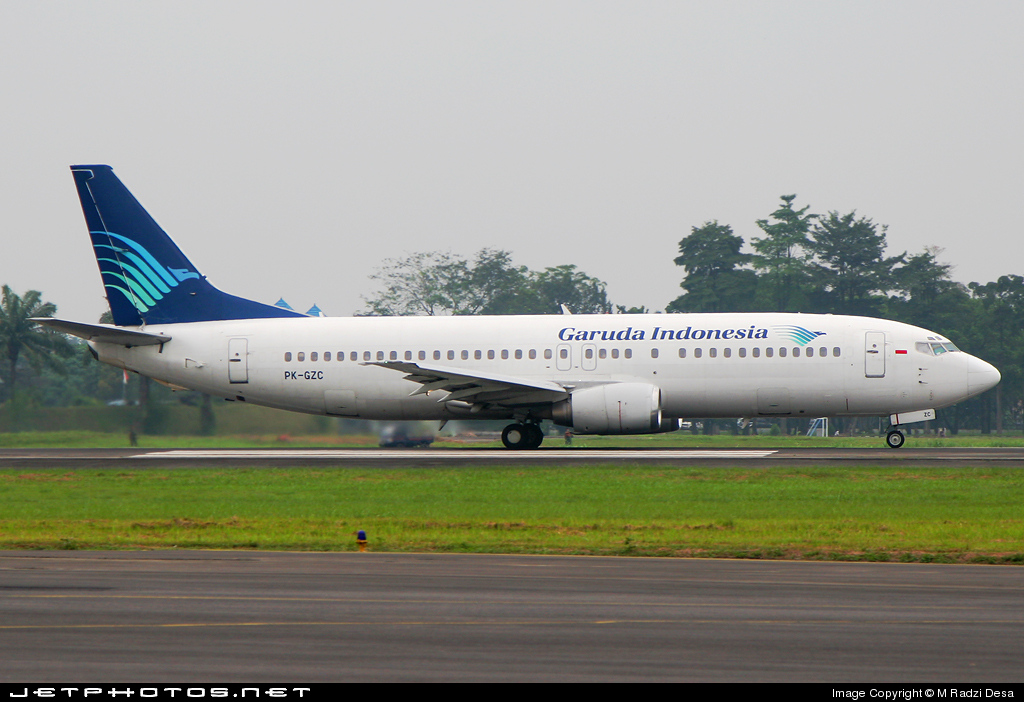
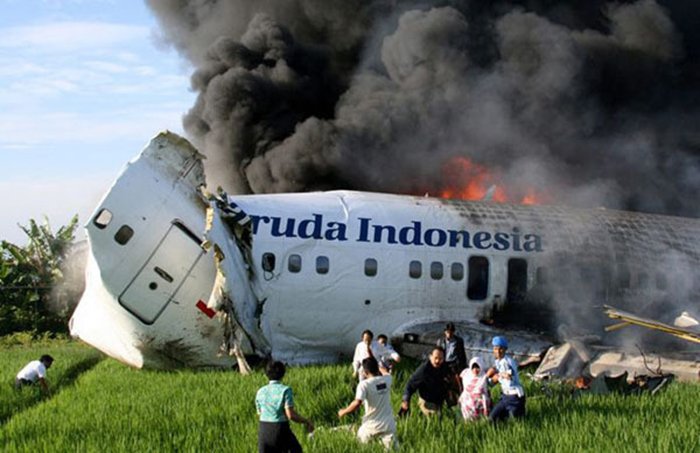
On 7 March 2007, a Boeing Company 737-497 aircraft, registered PK-GZC, was being operated by Garuda Indonesia on an instrument flight rules (IFR), scheduled passenger service, as flight number GA200 from Soekarno-Hatta Airport, Jakarta to Adisutjipto Airport, Yogyakarta. There were two pilots, five flight attendants, and 133 passengers on board. The pilot in command (PIC) and copilot commenced duty in Jakarta at about 21:30 Coordinated Universal Time (UTC), or 04:30 local time, for the flight to Yogyakarta. Prior to departing Jakarta, during the push back, the PIC contacted the ground engineers and informed them that the number-1 (left) engine thrust reverser fault light on the cockpit instruments had illuminated. The engineers reset the thrust reverser in the engine accessories unit and the fault light extinguished. The scheduled departure time was 23:00. The aircraft took off from Jakarta at 23:17, and the PIC was the pilot flying for the sector to Yogyakarta. The copilot was the monitoring/support pilot. During the cruise, just before top of descent, the crew was instructed by Jakarta Control to ‘maintain level 270 and contact Yogya Approach 123.4’. The copilot acknowledged; ‘contact Yogya 123.4, Indonesia 200’. The PIC started to give a crew briefing at 23:43 stating: ‘in case of holding, heading of 096’. The briefing was interrupted by a radio transmission from Yogya Approach, giving GA200 a clearance to Yogyakarta via airway W 17 for runway 09, and a requirement to report when leaving flight level 270. When radio communication was completed, the PIC continued with the crew briefing for an ILS approach, stating:
When clear approach ILS runway 09, course 088. (C) Frequency 1091, aerodrome elevation three hundred fifty, (C) leaving two thousand five hundred by 6 point 6 DME ILS, (C) to check four DME one thousand six hundred seventy, (C) crossing two DME one thousand thirty seven. Decision Altitude ILS Cat I, five eight seven, two three seven both set, approach flap forty, auto brake two. Speed one three six, one five one, two twenty. Timing from final approach-fix to VOR 6 DME. (C) With airspeed approximately one four one, two minutes thirty six. (C) In case localizer, MDA seven hundred, localizer, miss approach, at point six. (C) DME ILS India Juliet oscar golf. (C) On landing, to the left standby parking stand. Go-around missed approach climb one thousand five hundred turn left. To holding fix via Yogya VOR, continue climb four thousand feet, to cross Yogya at or above two thousand five hundred DME eight. (C).
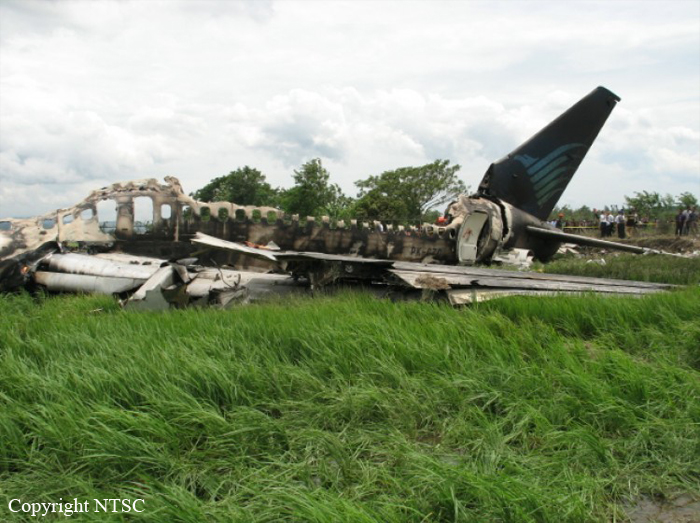
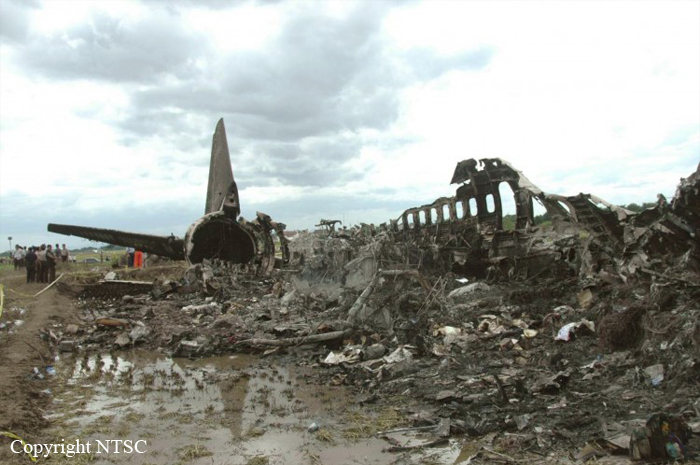
Twelve minutes and 17 seconds later, Yogya Approach cleared GA200 ‘for visual approach runway zero nine, proceed to long final, report runway in sight’. The copilot acknowledged the clearance and asked for confirmation that they were cleared to descend to circuit altitude, Yogya Approach replied ‘descend to two thousand five hundred initially’. The crew informed the investigation that they were conducting an Instrument Landing System (ILS) approach to runway 09, in visual meteorological conditions (VMC). However they did not inform Yogya Approach or Yogyakarta Tower that they were flying the 09 ILS approach. At 23:58:10, the aircraft overran the departure end of runway 09 at Yogyakarta Airport. The PIC reported that as the aircraft was about to leave the runway, he shut down both engines. The aircraft crossed a road, and impacted an embankment before stopping in a rice paddy field 252 meters from the threshold of runway 27 (departure end of runway 09). The aircraft was destroyed by the impact forces and an intense, fuel-fed, post impact fire. There were 119 survivors. One flight attendant and 20 passengers were fatally injured. One flight attendant and 11 passengers were seriously injured.
Probable cause:
Causes:
1) Flight crew communication and coordination was less than effective after the aircraft passed 2,336 feet on descent after flap 1 was selected. Therefore the safety of the flight was compromised.
2) The PIC flew the aircraft at an excessively high airspeed and steep descent during the approach. The crew did not abort the approach when stabilized approach criteria were not met.
3) The pilot in command did not act on the 15 GPWS alerts and warnings, and the two calls from the copilot to go around.
4) The copilot did not follow company instructions and take control of the aircraft from the pilot in command when he saw that the pilot in command repeatedly ignored warnings to go around.
5) Garuda did not provide simulator training for its Boeing 737 flight crews covering vital actions and required responses to GPWS and EGPWS alerts and warnings such as ‘TOO LOW TERRAIN’ and ‘WHOOP, WHOOP PULL UP’.
Other Factors:
1) The airport did not meet the ICAO Standard with respect to runway end safety areas.
2) The airport did not meet the ICAO Standard with respect to rescue and fire fighting equipment and services for operation outside the airport perimeter and in swampy terrain.
Final Report:

Crash of a Boeing 737-33A in Surabaya

Date & Time: Feb 21, 2007 at 1525 LT
Type of aircraft:
Operator:
Registration:
PK-KKV
Survivors:
Yes
Schedule:
Jakarta - Surabaya
MSN:
27284/2606
YOM:
1994
Flight number:
DHI172
Country:
Region:
Crew on board:
7
Crew fatalities:
Pax on board:
148
Pax fatalities:
Other fatalities:
Total fatalities:
0
Aircraft flight hours:
37936
Aircraft flight cycles:
23824
Circumstances:
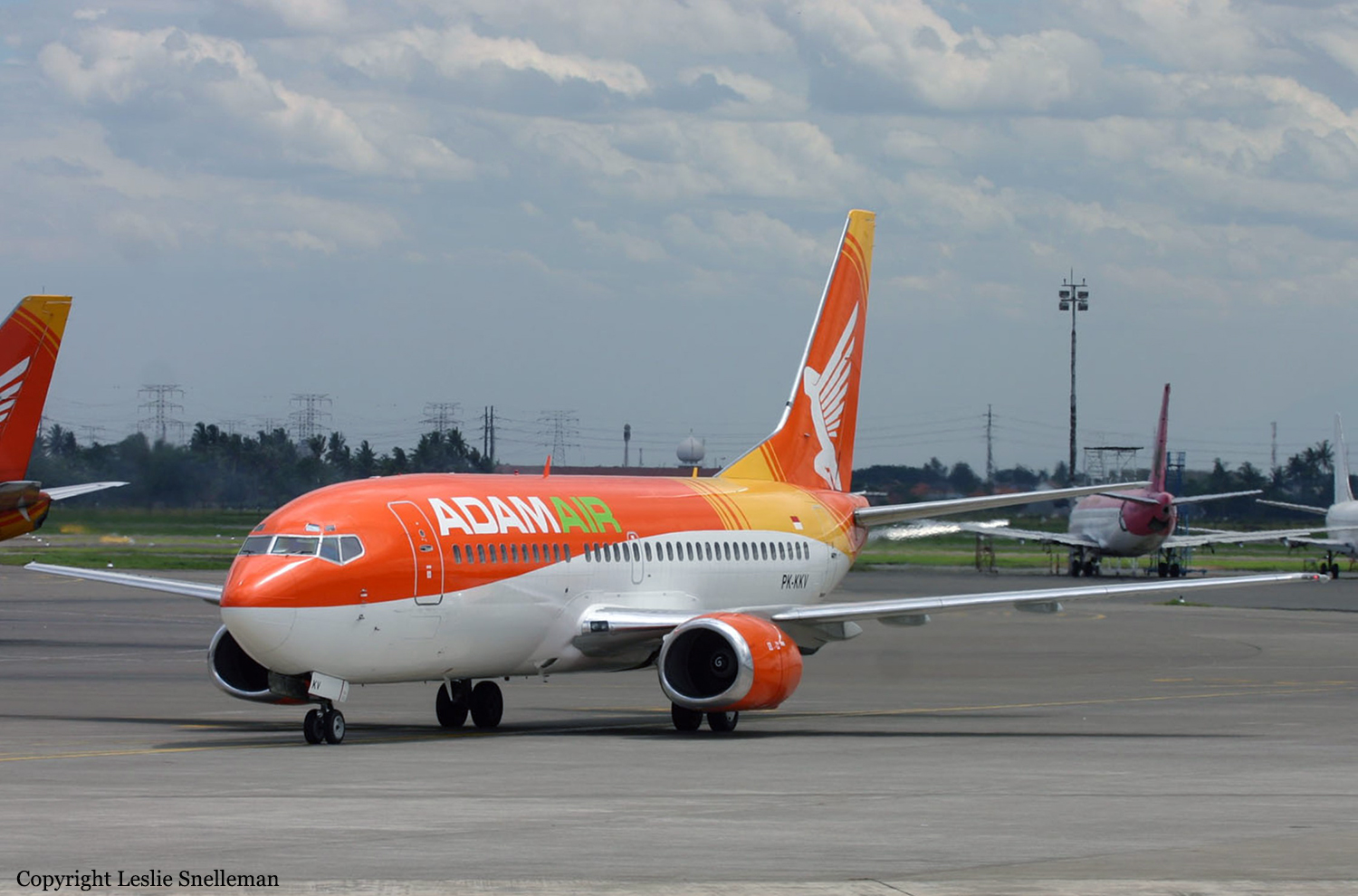
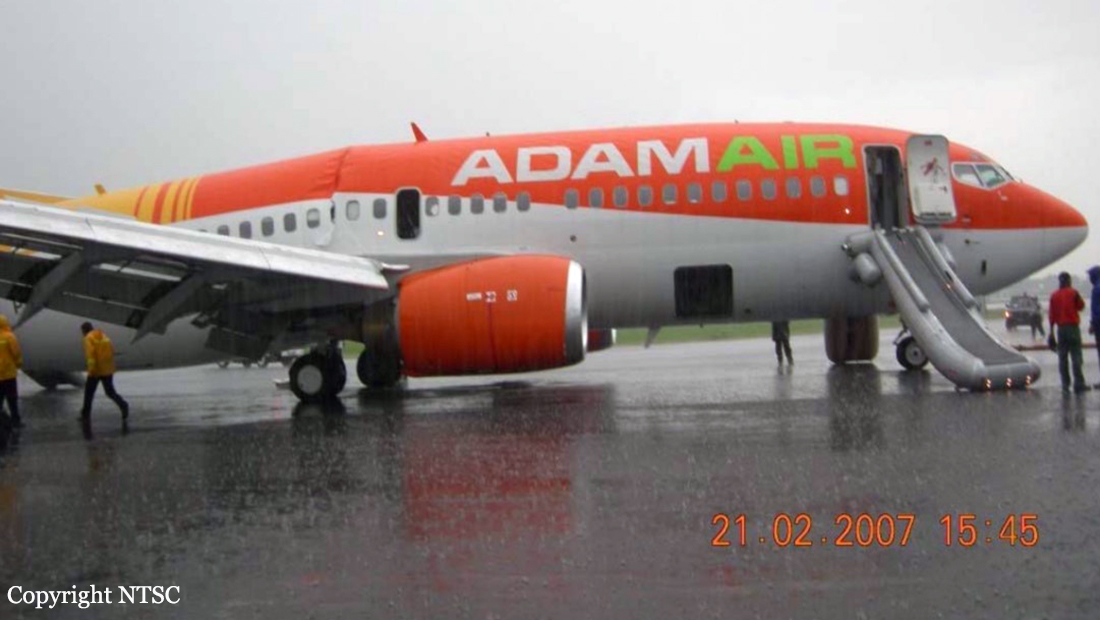
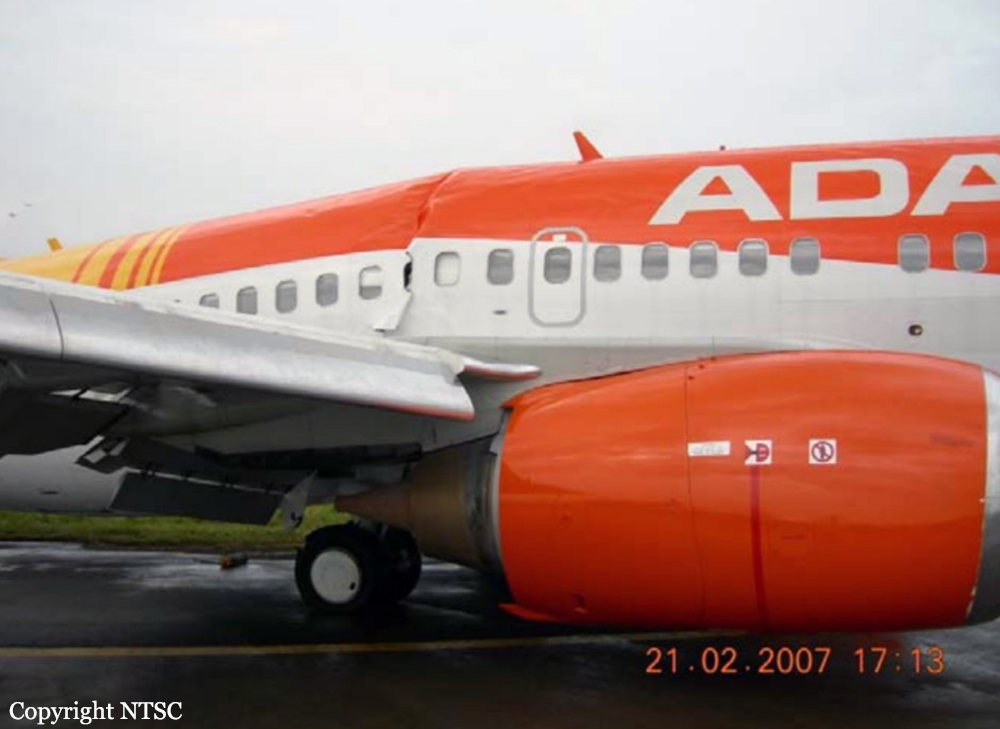
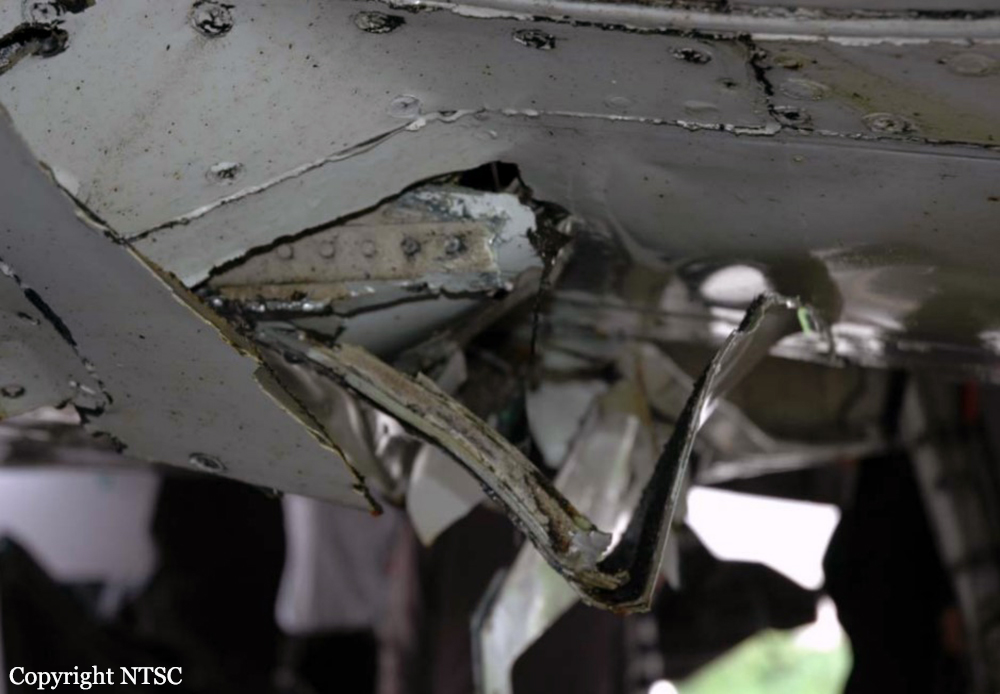
The aircraft was on a scheduled passenger flight from Soekarno-Hatta Airport, Jakarta to Juanda Airport, Surabaya, East Java. There were 155 persons on board, consist of 7 crew and 148 passengers. During the flight there was no abnormality declare by the flight crew. Weather condition at Surabaya was thunderstorm and rain, wind 240/7 knots with visibility 8,000 meters. The CVR revealed that there was conversation in the cockpit that was not related to the progress of the flight, the conversation was relating to the company fuel policy and training program until 2000 feet. The CVR did not reveal approach briefing and any checklist reading. On final approach of runway 28 passing 800 feet approach light insight and landing clearance was received. Prior to touchdown, control of the aircraft was transferred from co-pilot to PIC. The CVR recorded that the Ground Proximity Warning Systems (GPWS) warned “Sink Rate” and “Pull Up”. The right wheel track was found out of the runway for about 4 meter away and return to the runway. The aircraft stopped for about 100 meters from taxiway N3. After aircraft touched down, the fuselage aft of passenger seat row 16 was bended down. The passengers were panic. Flight attendants evacuated the passengers via all exits available and door slides were inflated. The two passengers were minor injured, and the aircraft suffered severe damage.
Probable cause:
From the findings, it is concluded that the aircraft experienced excessive sink rate upon the touch-down. The aircraft was in unstable approach even at below 200 feet. The high vertical acceleration caused severe damage to the aircraft structure. The flight crew did not comply to several procedures published by the Boeing company. The flight crew did not respond to the GPWS alert and warnings.
Final Report: