Crash of a Rockwell Aero Commander 560A in East Greenwich: 1 killed

Date & Time: Nov 22, 1971 at 0915 LT
Registration:
N87K
Survivors:
Yes
Schedule:
Chatham - Newark
MSN:
560-314
YOM:
1956
Crew on board:
2
Crew fatalities:
Pax on board:
4
Pax fatalities:
Other fatalities:
Total fatalities:
1
Captain / Total flying hours:
5000
Captain / Total hours on type:
1300.00
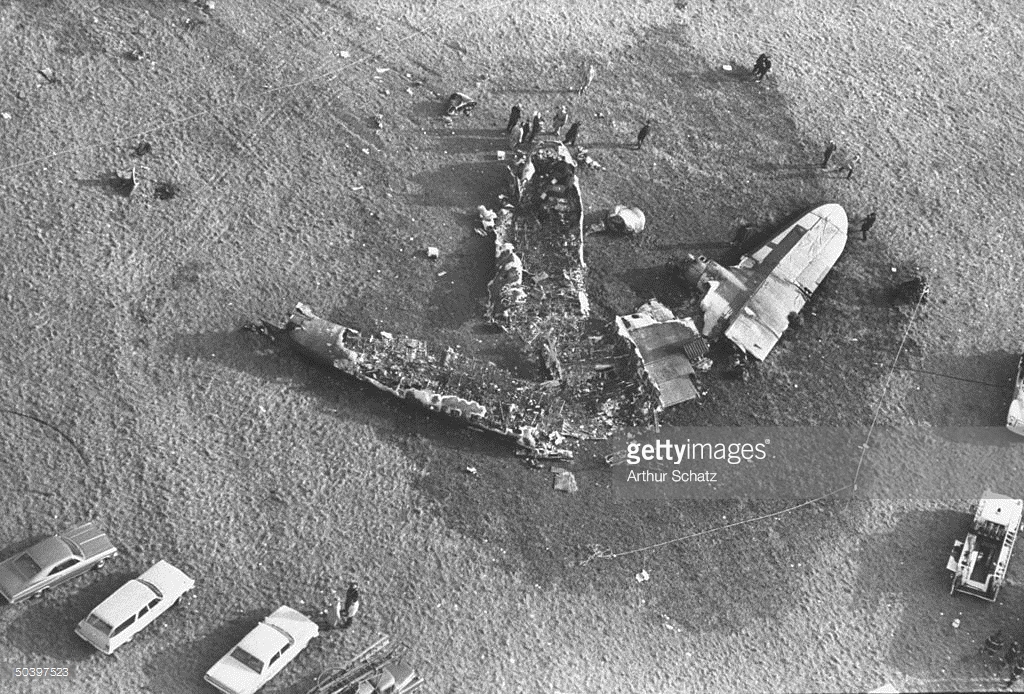
Circumstances:
While in cruising altitude on a flight from Chatham to Newark, the captain informed ATC about the failure of the left engine and was cleared to divert to the nearest airport located in East Greenwich, east Rhode Island. Unable to maintain a safe altitude, the crew attempted an emergency landing when the aircraft stalled and crashed in a field. A passenger was killed while five other occupants were injured.
Probable cause:
Inadequate preflight preparation and/or planning on part of the pilot-in-command. The following factors were reported:
- Improper operation of powerplant and powerplant controls,
- Improper operation or failed to use the anti-icing/deicing equipment,
- Conditions conducive to carburetor system icing,
- Icing conditions including sleet and freezing rain,
- Low ceiling and snow,
- Partial loss of power on one engine,
- Complete engine failure on one engine,
- Left engine lost power, propeller feathered. Unable to maintain safe altitude.
Final Report:

Crash of a Cessna 402 in Newark: 4 killed

Date & Time: Mar 18, 1970 at 1934 LT
Type of aircraft:
Operator:
Registration:
N3218Q
Survivors:
No
Schedule:
Sherbrooke - Newark
MSN:
402-0018
YOM:
1967
Crew on board:
1
Crew fatalities:
Pax on board:
3
Pax fatalities:
Other fatalities:
Total fatalities:
4
Captain / Total flying hours:
10461
Captain / Total hours on type:
83.00
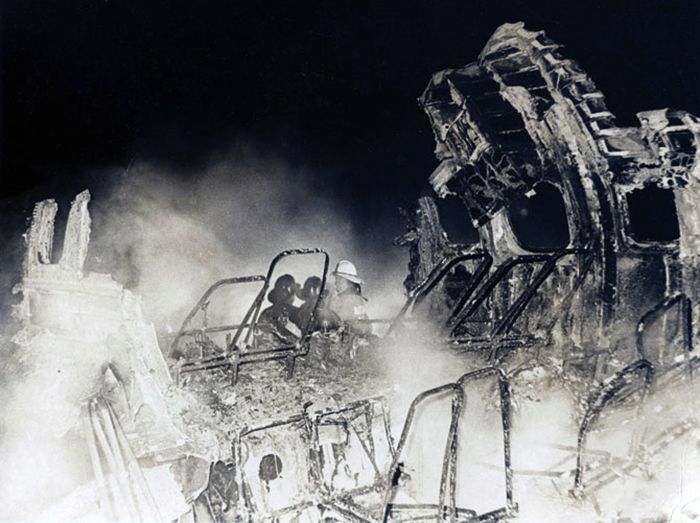
Circumstances:
The pilot initiated the approach to Newark Airport in marginal weather conditions (heavy rain falls). On final, he failed to realize his altitude was insufficient when the airplane crashed onto a natural gas storage tank located in Elizabeth, few miles short of runway 04L threshold. The aircraft was totally destroyed and all four occupants were killed.
Probable cause:
Ground collision during initial approach caused by the combination of the following factors:
- The pilot-in-command failed to follow the approved procedures,
- Improper IFR operation on part of the pilot-in-command,
- Instruments misread or failed to read,
- Obstructions to vision,
- Rain,
- No second pilot on board,
- Descended below glide slope on an ILS approach to runway 04L.
Final Report:

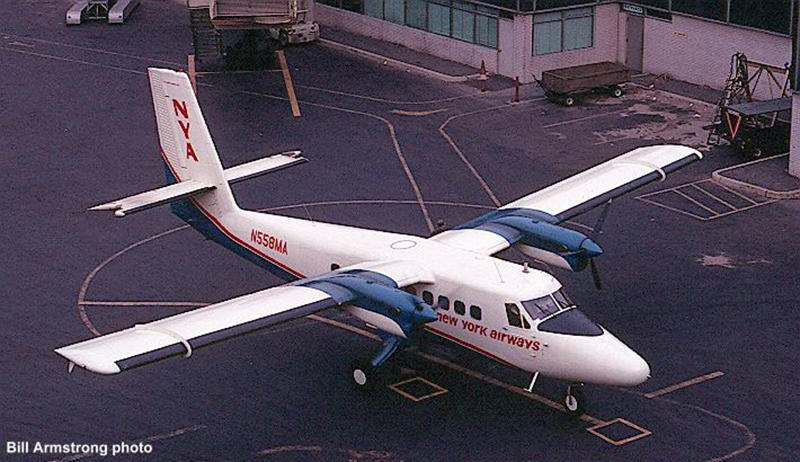
Crash of a De Havilland DHC-6 Twin Otter 200 in New York: 3 killed

Date & Time: Jul 15, 1969 at 0657 LT
Operator:
Registration:
N558MA
Flight Phase:
Survivors:
Yes
Schedule:
New York - Newark
MSN:
175
YOM:
1968
Flight number:
NY901
Crew on board:
3
Crew fatalities:
Pax on board:
11
Pax fatalities:
Other fatalities:
Total fatalities:
3
Captain / Total flying hours:
12110
Captain / Total hours on type:
180.00
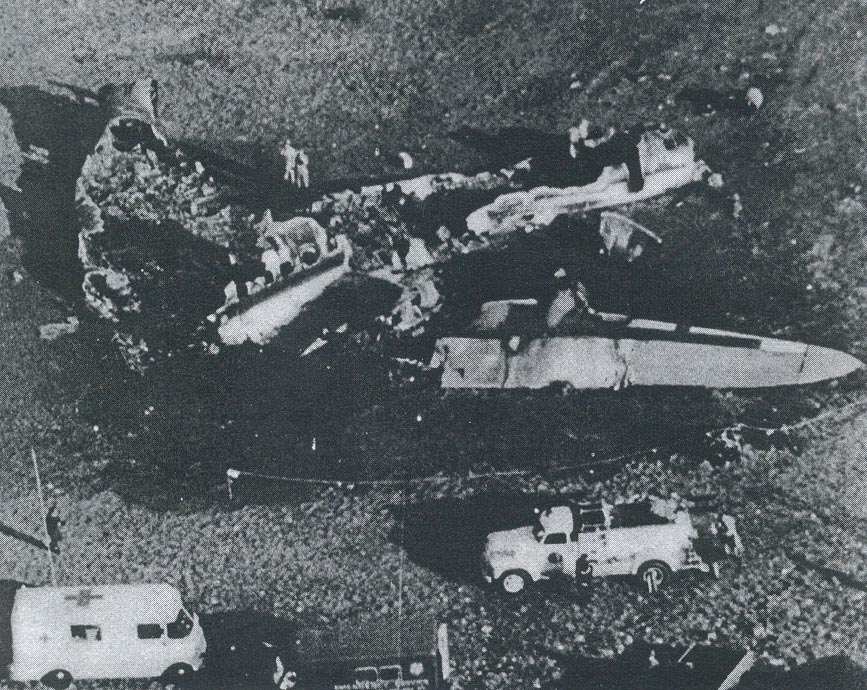
Circumstances:
As the crew was 12 minutes behind the schedule, he decided to start the takeoff procedure from an intersection and the departure was precipitated despite ATC warned the crew about the recent takeoff of a Boeing 707 from the same runway. Just after liftoff, while in initial climb, the airplane became unstable then stalled and crashed. Both pilots and a passenger were killed while 11 other occupants were injured, some of them seriously.
Probable cause:
It was determined that the crew lost control of the airplane due to wake turbulences caused by a Boeing 707 that just took off from the same runway. The crew failed to consider the warning from ATC.
Final Report:

Crash of a Curtiss C-46A-45-CU Commando in Newark

Date & Time: Jul 28, 1966 at 0850 LT
Type of aircraft:
Operator:
Registration:
N9905F
Flight Phase:
Flight Type:
Survivors:
Yes
MSN:
30316
YOM:
1944
Flight number:
VK7990
Crew on board:
2
Crew fatalities:
Pax on board:
0
Pax fatalities:
Other fatalities:
Total fatalities:
0
Captain / Total flying hours:
17491
Captain / Total hours on type:
6191.00
Circumstances:
Shortly after takeoff from runway 22 at Newark Airport, while climbing to a height of 200 feet, the left engine failed. The crew immediately reduced his altitude and completed an emergency belly landing in a field. The airplane slid for several yards before coming to rest. Both pilots were slightly injured while the aircraft was damaged beyond repair.
Probable cause:
Failure of the left engine during initial climb after the master and connecting rods and piston rings failed. At the time of the accident, the total weight of the airplane was 9,114 pounds above the MTOW. Poor supervision on part of the operational personnel of the company who dispatched an overloaded aircraft.
Final Report:

Crash of a Lockheed L-1049C Super Constellation in Carmel: 4 killed

Date & Time: Dec 4, 1965 at 1619 LT
Operator:
Registration:
N6218C
Flight Phase:
Survivors:
Yes
Schedule:
Boston – Newark
MSN:
4526
YOM:
1953
Flight number:
EA853
Location:
Crew on board:
5
Crew fatalities:
Pax on board:
49
Pax fatalities:
Other fatalities:
Total fatalities:
4
Captain / Total flying hours:
11508
Captain / Total hours on type:
1947.00
Copilot / Total flying hours:
8090
Copilot / Total hours on type:
899
Aircraft flight hours:
32883
Circumstances:
Trans World Airlines, Inc., Flight 42, (TW 42), a Boeing 707, N748TW, and Eastern Air Lines, Inc., Flight 853, (EA 853), a Lockheed 1049C, N6218C, were involved in a midair collision over the Carmel, New York VORTAC while en route to the New York City area at approximately 1619 e.s.t., December 4, 1965. TW 42 departed San Francisco, California, and was approaching the New York area from the northwest for an approach and landing at the John F. Kennedy International Airport. The flight was on an IFR flight plan at an assigned altitude of 11,000 feet mean sea level (m.s.l.). EA 853 departed Boston, Massachusetts, and was approaching the New York area from the northeast for an approach and landing at the Newark Airport. This flight was on an IFR flight plan at an assigned altitude of 10,000 feet m.s.l. As EA 853 was approaching the Cannel VORTAC on a southwesterly heading, the first officer saw TW 42 at his two o'clock position. Because he believed the jet was at his altitude and on a collision course he called "Look Out" and grasped the control wheel to assist the captain in a pull up. At approximately the same time, the captain of TW 42 observed EA 853 at his ten o'clock position on what he believed to be a collision course. He rolled into a right turn and pulled back on the yoke. He decided this maneuver would not clear EA 853 and he, assisted by his first officer, attempted to reverse the turn by rolling to the left and pushing on the yoke. The aircraft collided at an altitude of approximately 11,000 feet m.s.l. While cruising at an altitude of some 10,000 feet over Carmel on approach to Newark, the four engine aircraft collided with a TWA Boeing 707-131B registered N748TW. While the crew of the B707 was able to complete an emergency landing at JFK Airport despite the fact that a piece of 7.5 meters from the left wing was torn off, the crew of the Constellation first lost control of his aircraft but then regain control and was able to make an emergency landing in a prairie located on Titicus mountain, near Carmel. Three passengers died, plus the Constellation's pilot, Captain Charles J. White, who had returned to the aircraft's cabin to help the last passenger.
Probable cause:
Misjudgment of altitude separation by the crew of EA853 because of an optical illusion created by the up-slope effect of cloud tops resulting in an evasive manoeuvre by the EA853 crew and a reactionary evasive manoeuvre by the B707 crew as well.
Final Report:

Crash of a Convair CV-440 Metropolitan in Williamsport

Date & Time: Jul 23, 1965 at 1506 LT
Operator:
Registration:
N8415H
Flight Phase:
Survivors:
Yes
Schedule:
Pittsburgh-Du Bois-Phillipsburg-Williamsport-Wilkes-Barre-Newark
MSN:
125
YOM:
1953
Flight number:
AL604
Crew on board:
4
Crew fatalities:
Pax on board:
36
Pax fatalities:
Other fatalities:
Total fatalities:
0
Captain / Total flying hours:
10071
Captain / Total hours on type:
1296.00
Copilot / Total flying hours:
5061
Copilot / Total hours on type:
1410
Aircraft flight hours:
26266
Circumstances:
Allegheny Airlines, Inc., Flight 604, a Convair 340/440, N8415H, crashed 5 miles east-northeast of the Williamsport-Lycoming County Airport, Montoursville, Pennsylvania, on July 23, 1965. The 36 passengers, 3 crew members, and 1 jumpseat rider survived but received varying degrees of injuries. The flight, regularly scheduled from Pittsburgh, Pennsylvania to Newark, New Jersey, with intermediate stops at Dubois, Phillipsburg, Williamsport and Wilkes-Barre, Pennsylvania, departed Runway 09 at 1503. e.d.t. Shortly after takeoff smoke and fire were observed coming from the right engine and at approximately 1505:30 the captain advised "Six oh four is coming back in, we've got the right engine feathered.” The crash occurred moments later on the crest of a ridge approximately 600 feet above the airport elevation. The aircraft was destroyed by fire. The failure of the right engine is attributed to the failure of the front row master rod and all the associated link rods. Damage to the rod ends precluded any determination of the cause of the master rod failure.
Probable cause:
The Board determines that the probable cause of this accident was the failure of the crew to implement proper procedures for an engine failure on takeoff.
Final Report:

Ground accident of a Martin 202 in Newark

Date & Time: Nov 2, 1963
Type of aircraft:
Operator:
Registration:
N177A
Flight Phase:
Survivors:
Yes
MSN:
9147
YOM:
1948
Crew on board:
0
Crew fatalities:
Pax on board:
0
Pax fatalities:
Other fatalities:
Total fatalities:
0
Circumstances:
Suffered a ground accident while taxiing at Newark Airport. There were no injuries but the aircraft was damaged beyond repair.

Crash of a Vickers 745D Viscount in Ellicott City: 17 killed

Date & Time: Nov 23, 1962 at 1224 LT
Type of aircraft:
Operator:
Registration:
N7430
Flight Phase:
Survivors:
No
Schedule:
Newark – Washington DC
MSN:
128
YOM:
1956
Flight number:
UA297
Crew on board:
4
Crew fatalities:
Pax on board:
13
Pax fatalities:
Other fatalities:
Total fatalities:
17
Captain / Total flying hours:
16230
Captain / Total hours on type:
5263.00
Aircraft flight hours:
18809
Circumstances:
United Air Lines Flight 297, a Vickers-Armstrong Viscount Model 745D, N7430, crashed in a wooded area six miles west-southwest of Ellicott City, Maryland, at approximately 1224 e.s.t., on November 23, 1962. All thirteen Passengers and a crew of four were fatally injured. Flight 297 was en route from Newark, New Jersey to Washington, D. C. The flight was operating at an assigned altitude of' 6,000 feet when it apparently penetrated a flock of Whistling Swans. At least two of these a were struck by the aircraft. One swan collided with the right horizontal stabilizer inflicting superficial damage only. The other bird punctured the left horizontal stabilizer, traveled through the structure, and dented the elevator as it egresses. The weakened structure failed in this area. rendered the aircraft uncontrollable, and resulted in, the aircraft striking the ground in a nose-low inverted attitude.
Probable cause:
The Board determines that the probable cause of this accident was a loss of control following separation of the left horizontal stabilizer which had been weakened by a collision with a Whistling Swan.
Final Report:

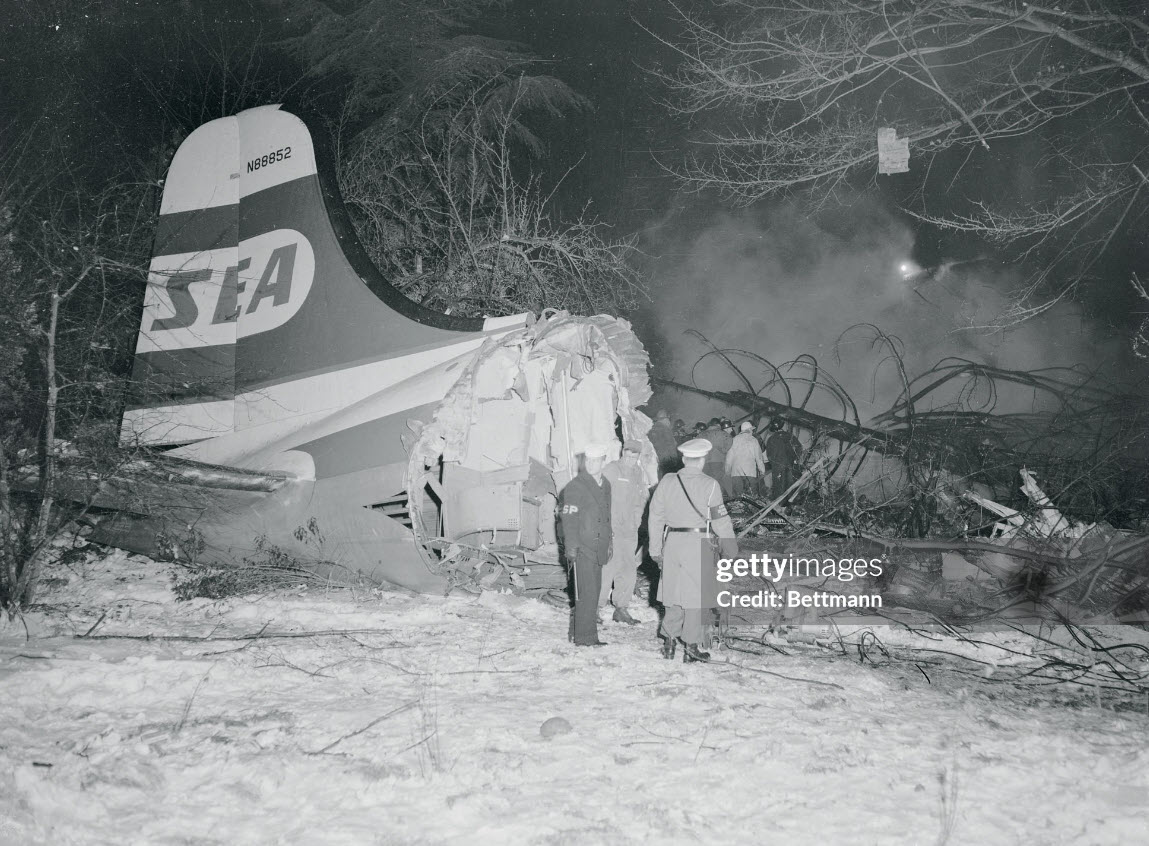
Crash of a Douglas C-54-DO Skymaster in Seattle: 28 killed

Date & Time: Nov 17, 1955 at 2359 LT
Type of aircraft:
Registration:
N88852
Flight Phase:
Survivors:
Yes
Site:
Schedule:
Seattle – Newark
MSN:
3123
YOM:
1942
Flight number:
PNS17K
Crew on board:
4
Crew fatalities:
Pax on board:
70
Pax fatalities:
Other fatalities:
Total fatalities:
28
Captain / Total flying hours:
5920
Captain / Total hours on type:
1000.00
Copilot / Total flying hours:
5778
Copilot / Total hours on type:
531
Aircraft flight hours:
19630
Circumstances:
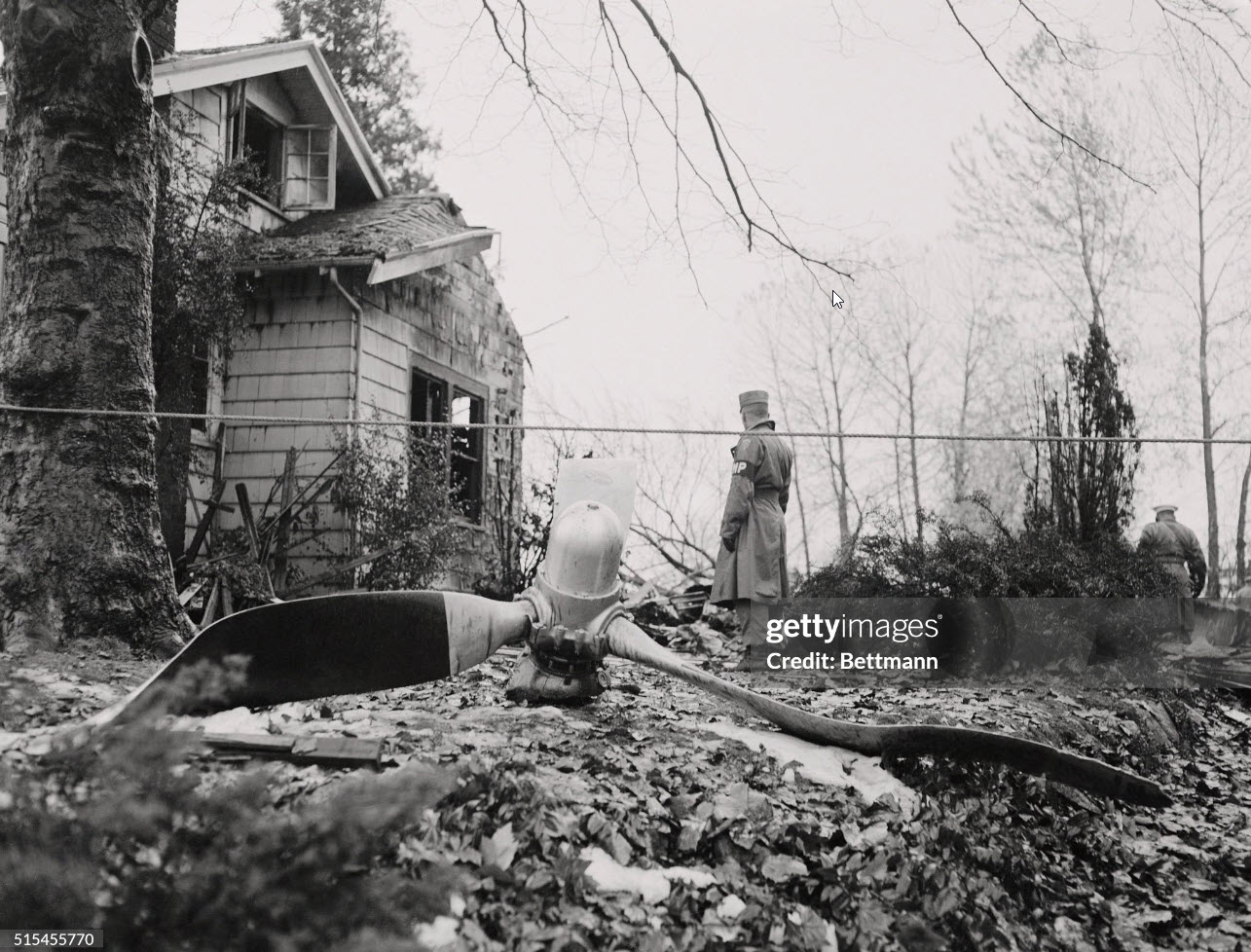
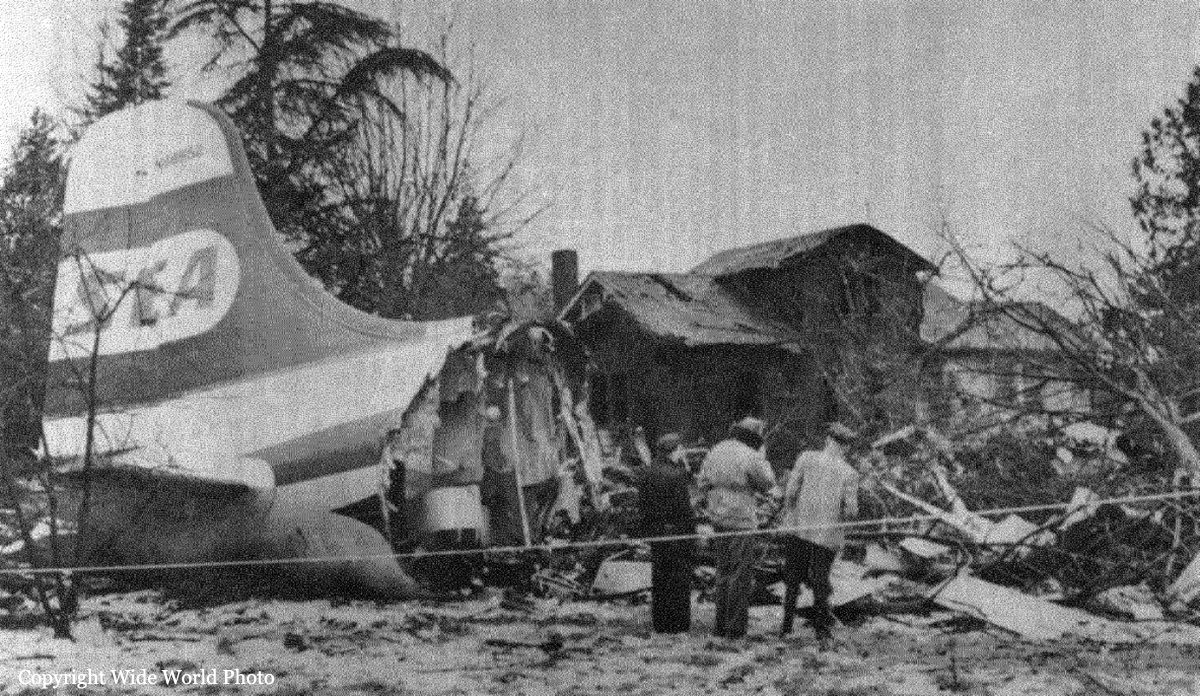
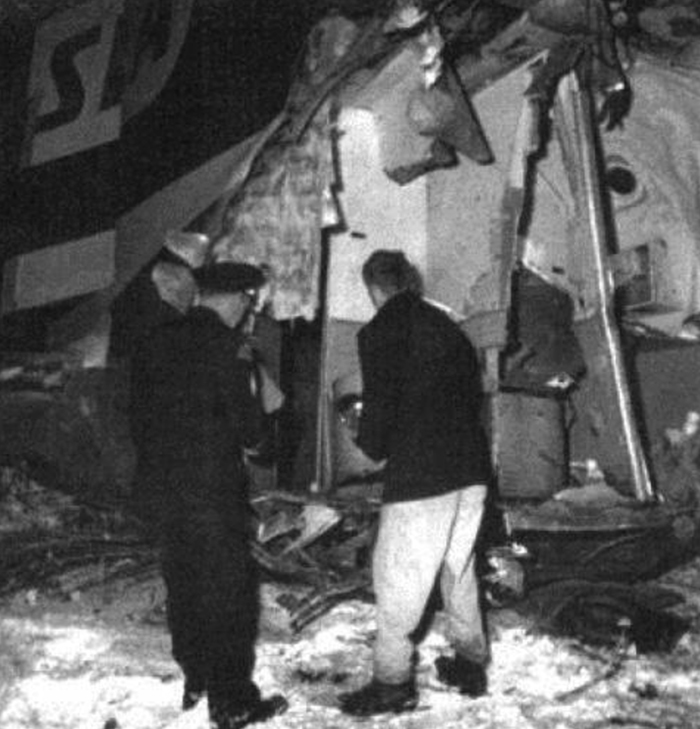
Peninsular Air Transport Common Carriage Flight 17K was scheduled to originate at Boeing Field and terminate at Newark, New Jersey, with intermediate refueling stops. The assigned crew consisted of Captain W. J. McDougall, First Officer F. C. Hall, and Steward J. O. Adams. The third pilot, Edward, McGrath, deadheading to Miami, Florida, occupied the jump seat with no crew duties. The flight, scheduled to depart at 2030, was delayed because of a heavy snowfall during the afternoon and early evening of November 17 which delayed passenger arrivals and necessitated removal of snow from the aircraft before departure. At 2332 the flight taxied to runway 13, holding off the runway waiting its turn behind other flights to take off, During this time the crew completed pre-takeoff cheeks and received an IFR (Instrument Flight Rules) clearance. This, in part, instructed them to turn right after takeoff and climb on the northwest course of the Seattle Range to 5,000 feet m. s. 1. (mean sea level). The takeoff was started at 2358 and appeared normal as the landing gear retracted and right turn was begun. When approximately 300-400 feet above the ground the first reduction of power, from takeoff to normal rated power, was made and about five of the 15 degrees of flaps extended, were retracted. At this time the No. 4 propeller surged and engine r. p. m. increased to about 2,800. Unable to reduce the r. p. m. of No. 4 by reducing its power an attempt was made to feather the propeller; this also was unsuccessful. As the aircraft then began to descend takeoff power was reapplied to Nos. 1, 2, and 3 engines and the power from No. 4 was further reduced. This action did not reduce the r. p. m. of No. 4 which surged again and increased to more than 3,000. The aircraft veered to the right and continued to descend. Realising that a crash-landing was imminent Captain McDougall reduced the airspeed until the aircraft was nearly stalled and applied full power to all four engines. The aircraft continued to settle. It then struck a telephone pole and several trees before crash-landing in a nose-high attitude. Fire and rescue equipment was dispatched to the scene from both the Seattle Fire Department and the Seattle-Tacoma Airport. The units arrived promptly and gave first aid to the survivors. Fire which followed the crash was quickly extinguished but not before extensive property was burned and the aircraft was nearly consumed. One crew member and 27 passengers were killed.
Probable cause:
The Board determines that the probable cause of this accident was the excessively high drag resulting from the improperly indexed propeller blades and inability to feather. These conditions were the result of a series of maintenance errors and omissions. The following findings were reported:
- Weather conditions at takeoff were above minim with respect to ceiling and visibility,
- There was no snow or ice on the aircraft when it took off,
- During the first power reduction the No. 4 engine r. p. m. fluctuated, became uncontrollable, and shortly thereafter increased to more than 3,000,
- Efforts to reduce the r. p. m. and feather the malfunctioning propeller were unsuccessful,
- The propeller dome retaining nut was not tightened sufficiently permitting oil to leak around the dome seal,
- The leaking oil resulted in a lack of oil for reducing the r. p. m. or feathering the No. 4 propeller,
- Poor maintenance procedures, omissions during maintenance, and lack of proper inspection were evident in the maintenance work performed by Seattle Aircraft Repair, Inc,
- Improper indexing of the No. 4 propeller blades occurred during the work at Seattle,
- Propeller drag from the overspeeding No. 4 propeller greatly increased by the incorrect indexing of the blades made continued flight difficult if not impossible,
- The aircraft was unairworthy following the Seattle maintenance work.
Final Report:

Crash of a Douglas C-47A-90-DL in Pittsburgh: 10 killed

Date & Time: Dec 22, 1954 at 2300 LT
Operator:
Registration:
N24320
Survivors:
Yes
Schedule:
Newark – Pittsburgh – Colorado Springs – Monterey – Seattle
MSN:
20197
YOM:
1944
Flight number:
JFS4844C
Crew on board:
5
Crew fatalities:
Pax on board:
23
Pax fatalities:
Other fatalities:
Total fatalities:
10
Captain / Total flying hours:
7600
Captain / Total hours on type:
1500.00
Copilot / Total flying hours:
2450
Copilot / Total hours on type:
800
Aircraft flight hours:
5738
Circumstances:
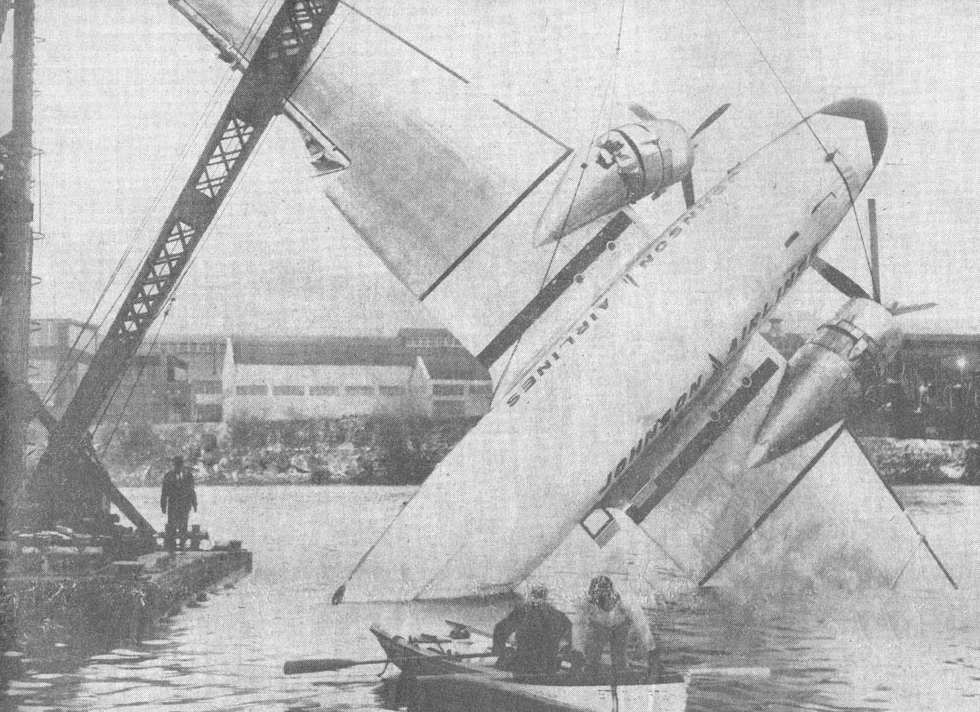
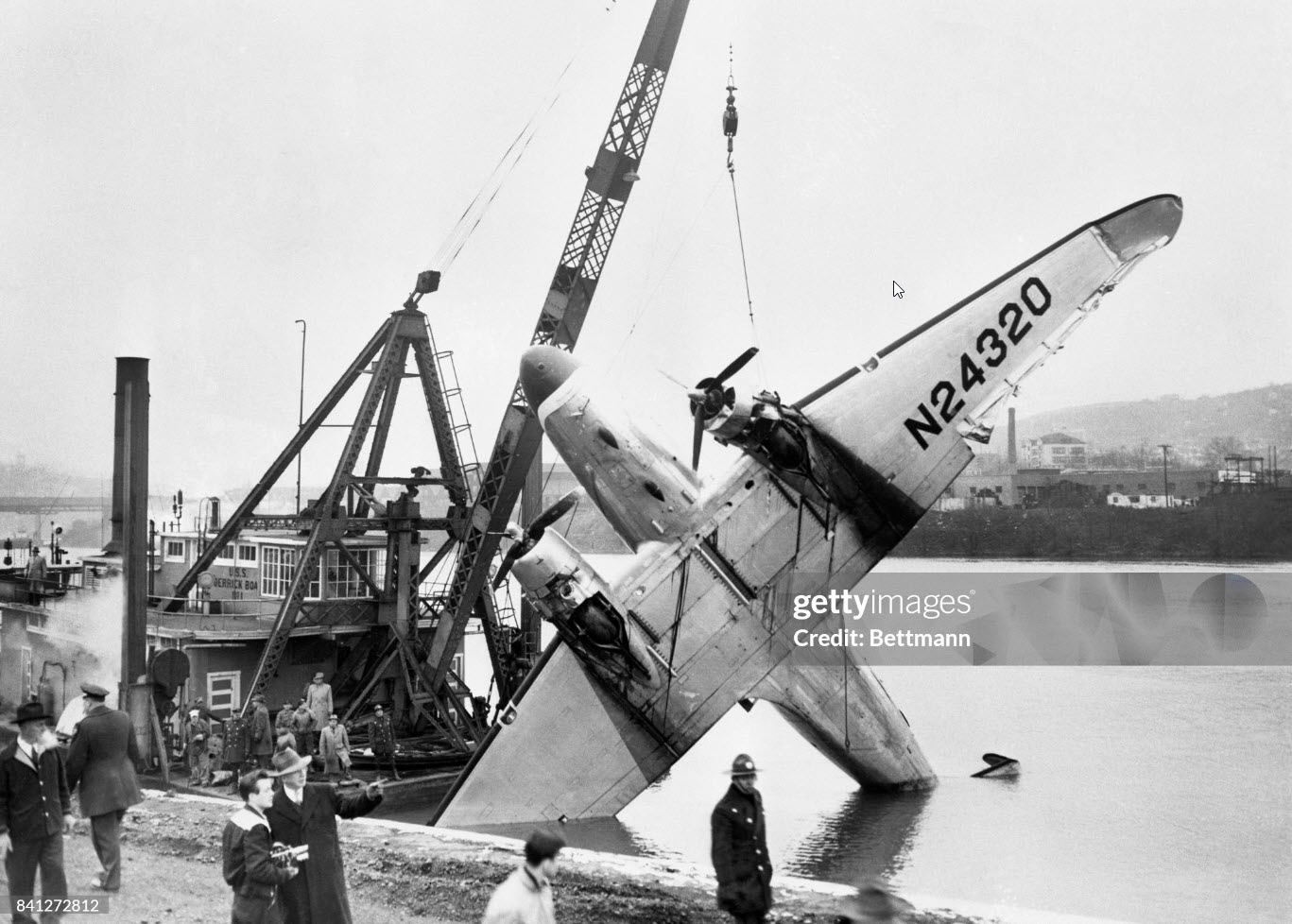
Johnson Flying Service's Plight 4844-C, December 22, 1954, was a CAM (civil air movement of military personnel) flight from Newark, New Jersey, to Tacoma, Washington, with planned intermediate stops among which were Pittsburgh, Pennsylvania; Colorado Springs, Colorado; Monterey, California; and Tacoma, Washington. The crew consisted of Captain Harold A. Poe., Captain Joseph J. Grekowicz, and Copilots Clarence E. Chapman and Charles R. Carter, Captain Robert P. Walker, the fifth crew member, was employed by the company as cabin attendant prior to the departure from Newark. The aircraft was serviced with 170 gallons of 100 octane fuel which was placed in the two main tanks in equal amounts, making a total of 225 gallons according to the weight and balance manifest. A preflight inspection of the aircraft was performed by Captain Grekowicz with no discrepancies found. According to the company's Weight and Balance Manifest the aircraft at the time of departure weighed 25,317 pounds, which was within the allowable gross weight of 25,346 pounds; the load was distributed within the prescribed limits with respect to the center of gravity of the aircraft. Prior to departing Newark, Captain Poe filled with the CAA by telephone a flight plan indicating a flight to be made in accordance with visual flight rules (VFR) to the Allegheny County Airport, Pittsburgh, Pennsylvania. The route to be followed was via Amber 7, Green 3, and Red 21 Airways. 2 The flying time to Pittsburgh was estimated to be one hour and forty minutes, at an airspeed of 155 knots 3 with two hours and forty minutes of available fuel. The flight departed Newark at 2038 with 23 passengers on board. Routine en route position reports were made and at 2206 the flight reported over Philipsburg, Pennsylvania, VFR, estimating Westover, Pennsylvania, at 2219. At approximately 2220, the Pittsburgh combined CAA station/center (INSAC and Air Route Traffic Control) heard the flight calling Altoona, Pennsylvania, radio (INSAC) on the radio frequency of 126.7 mc. As several calls to Altoona were unanswered, Pittsburgh radio attempted to contact the aircraft but was unsuccessful. Two minutes later, at 2222, Pittsburgh radio heard N 24320 calling Westover on 126.7 mc. Since Westover is a radio beacon and has no voice facilities, Pittsburgh radio again tried to contact the aircraft, but was unsuccessful. At 2225 the flight reported to Brookville, Pennsylvania, radio that it was over Westover at 2220, VFR, estimating Pittsburgh at 2252. Pittsburgh radio received a call from the flight at 2238 asking if fuel was available at "Johnson Marker." Pittsburgh interpreted this to mean Johnstown, Pennsylvania, and replied "Reference fuel at Johnstown, they do have 91/96 octane and lower and we're attempting to contact Allegheny Airlines at Johnstown now to see if they would be open at this time of night. The Air Guide doesn't list any hours that they are open. You'll have enough fuel to land at Allegheny County, original destination, won't you, over?" The pilot advised he was not sure, and then requested that the runway lights at the Johnstown Airport be turned on. Pittsburgh radio attempted to contact the Johnstown Airport by telephone and inter phone without success and advised the flight that they were unable to contact them at this time but would continue trying. At 2244, N 24320 called Pittsburgh radio and advised that it was over the Johnstown Airport. The pilot was asked to stand by and as soon as it was determined that Johnstown could not be contacted, Pittsburgh radio so advised. N 24320, at 2247, told Pittsburgh radio that it had passed Johnstown and was continuing to the Allegheny County Airport. Two minutes later Pittsburgh again asked the flight if it wished them to continue attempting to contact the Johnstown Airport. The pilot then said he would continue to Pittsburgh and asked for information on other fields where he might land. This was answered, "Douglas 4320 Pittsburgh radio. Nothing for a DC-3 Douglas 4320, it's either Greater Pittsburgh or Allegheny County, over." At 2251, Pittsburgh gave the flight the current Allegheny County weather as: Clear, temperature 20, dew-point 10, wind south-southwest 9. When asked his altitude the pilot answered 3,200 feet. He was then given the winds aloft at 3,000 feet as being 260 degrees 10 knots. A minute later the flight advised that it was 7 miles east of the Allegheny County Airport and could see it; that it was crossing the river and could see the field lights. Pittsburgh radio then called the Allegheny County tower and advised that N 24320, a DC-3, was approximately 10 miles east, low on fuel, and was landing at that airport. The tower requested that the aircraft change to tower frequency. Pittsburgh radio called the flight at 2254, and asked it to contact the tower on 121.3 mc. In reply the pilot said that he did not have 121.3 mc. but would contact the tower on 126.18 mc. He was advised that frequency was satisfactory. The flight immediately called the tower and requested landing information. It was then cleared for a straight-in approach to runway 27 and asked to report when 3 miles out. The weather was given as: Wind southwest variable south, calm to 10, altimeter 29.84. At 2256, the flight reported it was 3 miles east on final approach; it was then cleared to land. At 2257, the flight reported that it was out of gas. At this time the tower observed the aircraft to be approximately 2 miles from the airport on final approach. The tower immediately asked if the pilot believed he could make the field. The pilot replied, "I doubt it very much. We have both engines feathered, we are coming down over the red lights. I don't know if we'll make it or not. We are 2,000 feet." At 2258 the pilot advised, "We are going to set it down." The tower observed the aircraft make a left turn and head toward the south. It then disappeared from the controller's view below the hills southeast of the airport. Necessary calls pertaining to the emergency were Immediately effected. The aircraft, heading in a southerly direction, was ditched wheels up in the Monongahela River at approximately 2300. The captain, Harold A. Poe, who was flying the aircraft, and nine passengers were drowned.
Probable cause:
The Board determines that the probable cause of this accident was fuel exhaustion brought about by inadequate flight planning. Contributing factors were inadequate crew supervision and training. The following findings were reported:
- The company did not properly check the competency of the crew in accordance with their operations manual prior to flight assignment,
- The aircraft was overloaded at time of takeoff,
- The flight was improperly planned, and was not conducted in accordance with the company's operations manual,
- The captain, contrary to the company's operations manual, passed a suitable refueling facility after being advised that if the flight continued to its destination it would be necessary to use reserve fuel,
- Weather along the route was good and approximately as forecast,
- The aircraft was ditched in the Monongahela River, two miles from its destination because of fuel exhaustion.
Final Report: