


Country
Crash of a Cessna 414 Chancellor in Alpine
Date & Time:
Aug 28, 1999 at 1021 LT
Registration:
N67JM
Survivors:
Yes
Schedule:
Alpine - Lajitas
MSN:
414-0066
YOM:
1970
Crew on board:
1
Crew fatalities:
Pax on board:
3
Pax fatalities:
Other fatalities:
Total fatalities:
0
Captain / Total hours on type:
24.00
Aircraft flight hours:
5581
Circumstances:
The pilot had the main and auxiliary fuel tanks filled and performed an abbreviated preflight prior to departing the Alpine Airport. The pilot did not perform an engine run-up prior to takeoff. The pilot stated that while the airplane was climbing through 100 feet agl, the left engine 'started to surge.' The pilot reported that he knew the airplane would not be able to climb at field elevation with one engine inoperative. The pilot switched the left engine's boost pump from low to high; however, the left engine continued to surge while the airplane lost altitude. The pilot initiated a forced landing with the landing gear and flaps retracted and the left propeller unfeathered. The airplane impacted the ground left wing tip first and a fire erupted, which damaged the left wing and left side of the fuselage. The left engine's spark plugs were found covered with thick black soot. The left engine's magnetos were rotated using an electric hand-held drill, and the left magneto did not produce any spark and the right magneto produced a spark in three of its six distributor cap posts. The left magneto's primary winding resistance and capacitor leakage were found to be beyond the manufacturer's specified limits. The internal components of both magnetos were covered in a dark oil and debris. The maximum takeoff weight for the accident airplane was 6,350 pounds; however, the takeoff weight at the time of the accident was calculated to be 6,509 pounds. The aircraft's single engine performance charts indicated that the airplane would obtain a 29 fpm climb at maximum gross weight with the inoperative engine feathered. The pilot operating handbook's supplement section indicated that the auxiliary fuel pump should only be used when the engine-driven fuel pump failed. A caution statement states in bold print, 'If the auxiliary fuel pump switches are placed in the HIGH position with the engine-driven fuel pump(s) operating normally, total loss of engine power may occur.'
Probable cause:
The pilot's improper use of the emergency fuel boost pump, which resulted in excessive fuel flow to the engine and subsequent total loss of left engine power. Factor's were the high density altitude, the pilot exceeding the airplane's weight and balance, the partial loss of left engine power as a result of the faulty magnetos, and the pilot's inadequate preflight inspection by not performing an engine run-up.
Final Report:
Crash of a Cessna 414 Chancellor in Monrovia: 6 killed
Date & Time:
Aug 10, 1999 at 2005 LT
Registration:
N373BC
Survivors:
No
Schedule:
Harper - Monrovia
MSN:
414-0411
YOM:
1973
Crew on board:
1
Crew fatalities:
Pax on board:
5
Pax fatalities:
Other fatalities:
Total fatalities:
6
Circumstances:
The twin engine aircraft departed Harper on a charter flight to Monrovia, carrying five police officers and one pilot. On a night approach to Monrovia-Roberts Airport, the aircraft crashed in unknown circumstances 4 km short of runway. The aircraft was destroyed and all six occupants were killed.
Crash of a Cessna 414 Chancellor in Orland
Date & Time:
May 21, 1999 at 1725 LT
Registration:
N8153Q
Survivors:
Yes
Schedule:
San Jose – Redding
MSN:
414-0053
YOM:
1970
Crew on board:
1
Crew fatalities:
Pax on board:
0
Pax fatalities:
Other fatalities:
Total fatalities:
0
Captain / Total hours on type:
480.00
Aircraft flight hours:
4471
Circumstances:
The pilot refueled the auxiliary tanks of the airplane at a different airport 1 month prior to the accident, and had not flown on the auxiliary tanks since that time. He was repositioning the airplane back to home base after a series of revenue flights when the accident occurred. About 20 minutes after takeoff he positioned the left and right engines to their respective auxiliary fuel tanks, and then returned to the mains 30 minutes later. The right engine began to surge and subsequently stopped running. Turning on the fuel boost pump restarted the engine. Five minutes later the engine quit and he secured it after unsuccessful restart attempts. Then the left engine began to surge and was developing only partial power. He diverted to an alternate airport with decaying altitude and power in the remaining engine. Crossing the airport, he saw he was too high to land with a tailwind so he circled to land into the wind. On the base leg he made the decision to land straight ahead in a field due to power lines in his path, rapidly decaying altitude, and power. During the landing roll, the airplane collided with a ditch. The left and right main fuel filters contained a foreign substance, which upon laboratory examination, was found to be a polyacrylamide. This is a manmade synthetic polymer that is used as an agricultural soil amendment that aids in reducing soil erosion. Distribution of the polymer is typically not done by aircraft. Inspection of the fueling facility revealed that the employees who do refueling did not have any formal or on-the-job training. There was no record that the delivery system filters had been examined or changed. The maintenance to the truck, delivery system, and storage facility are done by the employees on an as needed, time permitted basis. The fuel truck was found to be improperly labeled, and the fuel nozzle was lying in a compartment amid dirt, gravel, and other contaminates with no caps or covers for protection.
Probable cause:
A loss of engine power in both engines due to fuel contamination, which resulted from the fueling facilities improper quality control procedures.
Final Report:
Crash of a Cessna 414A Chancellor off Mattapoisett: 1 killed
Date & Time:
Nov 20, 1998 at 1220 LT
Registration:
N6820J
Survivors:
No
Schedule:
Hyannis - New Bedford
MSN:
414A-0671
YOM:
1981
Crew on board:
1
Crew fatalities:
Pax on board:
0
Pax fatalities:
Other fatalities:
Total fatalities:
1
Aircraft flight hours:
2675
Circumstances:
The airplane was level at 2,000 feet, in instrument meteorological conditions, when the pilot reported 'we've just lost our ahh artificial horizon.' About 5 minutes later, air traffic control lost radar contact, and communications with the airplane. A witness about 1 mile north of the accident site stated he heard the sound of engine noise coming from the water and he described the sound as loud and constant. The sound lasted for about 30 seconds and was followed by an 'explosive collision/impact sound.' He further stated he walked to the shore and attempted to locate the source of the sound, but 'because of the fog, I couldn't see anything at all.' The airplane was located in about 25 feet of water, and was scattered over a 150 to 200 foot area. The recovered wreckage consisted of both engines, parts of the airplane's left wing, empennage, fuselage, seats, and interior. The airplane's attitude indicator was not recovered. A faint needle impression was found on the face of the airplane's vertical speed indicator between minus 2,500 and 3,000 feet per minute. Examination of the left and right vacuum pumps did not reveal any malfunctions or failures.
Probable cause:
The pilot's failure to maintain control of the airplane after an undetermined failure of the airplane's attitude indicator. A factor in this accident was fog.
Final Report:
Crash of a Cessna 414 Chancellor in Monroe
Date & Time:
Nov 17, 1998 at 1855 LT
Registration:
N30ML
Survivors:
Yes
Schedule:
Monroe - Dallas
MSN:
414-0005
YOM:
1969
Crew on board:
2
Crew fatalities:
Pax on board:
0
Pax fatalities:
Other fatalities:
Total fatalities:
0
Captain / Total hours on type:
54.00
Aircraft flight hours:
6415
Circumstances:
The airplane impacted terrain during takeoff initial climb in dark night conditions with a 100 ft ceiling and 1/4 mile visibility in fog. The instrument rated private pilot sustained serious injuries and does not recall the flight. No discrepancies were found with the aircraft, flight instruments, or engines that would have contributed to the accident. A weather briefing was obtained and an IFR flight plan was filed. The pilot had 312.8 hrs total time (54.2 hrs in this aircraft), 61 hrs night flight time (36.9 hrs in this aircraft) and 26.8 hrs actual instrument time (19.6 hrs in this aircraft). Toxicological findings were positive for benzoylecgonine (metabolite of cocaine), ethanol, and cocaethylene (substance formed when cocaine and alcohol are simultaneously ingested) in a urine sample subpoenaed by the NTSB from the hospital that treated the pilot. Benzoylecgonine can be found in urine for 3 to 5 days after cocaine use. Since blood was not available for analysis, it could not be determined how much of each substance was ingested and when they were ingested. The pilot stated that he was not under the influence of cocaine or alcohol on the day of the crash.
Probable cause:
The pilot's spatial disorientation which resulted in a loss of aircraft control. Factors were fog, low ceilings, and dark night conditions.
Final Report:
Crash of a Cessna 414 Chancellor in North Platte
Date & Time:
May 28, 1998 at 1300 LT
Registration:
N888AA
Survivors:
Yes
Schedule:
North Platte - Kearney
MSN:
414-0468
YOM:
1974
Crew on board:
1
Crew fatalities:
Pax on board:
2
Pax fatalities:
Other fatalities:
Total fatalities:
0
Captain / Total hours on type:
312.00
Aircraft flight hours:
6159
Circumstances:
The airplane had just taken off and was at approximately 300 agl when the right engine 'had a sudden and catastrophic failure.' The right propeller stopped spinning with the blades in the low-pitch position. The pilot initiated a right turn back toward the airport, but the airplane would not maintain altitude. The pilot rolled out of the turn, but the descent continued until the airplane struck the trees. Examination of the airplane's right engine revealed that the crankshaft was broken at the number 3 short cheek, just forward of the number two cylinder piston rod. The number two crankshaft bearing was broken and melted. The oil feed line to the number two bearing was blocked by a piece of the broken bearing. The Single Engine Climb Data table in the Cessna 414 Pilot's Operating Handbook indicates that an airplane weighing 5,680 pounds, with gear and flaps retracted and the inoperative propeller in feather, operating at a density altitude of 5,055 feet, will have a best climb indicated airspeed of 115 knots. The rate of climb will be 308 feet per minute.
Probable cause:
The slipped number two bearing in the airplane's right engine, which blocked the bearing's oil feed line, causing the bearing and the crankshaft to overheat and fracture. A factor contributing to this accident was the trees.
Final Report:
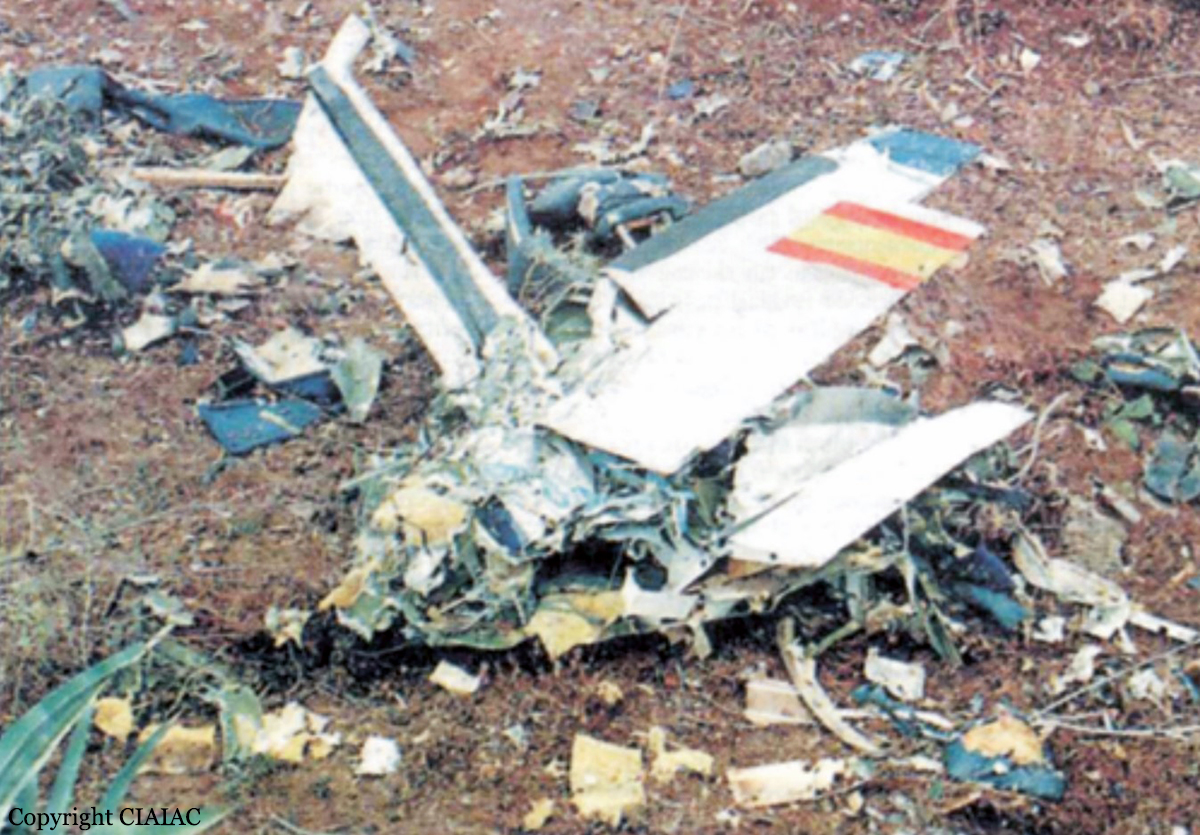
Crash of a Cessna 414 Chancellor in Tenerife: 2 killed
Date & Time:
May 9, 1998 at 1240 LT
Registration:
EC-CVV
Survivors:
No
Schedule:
Tenerife-Sur - Tenerife-Norte
MSN:
414-0631
YOM:
1975
Crew on board:
1
Crew fatalities:
Pax on board:
1
Pax fatalities:
Other fatalities:
Total fatalities:
2
Captain / Total hours on type:
20.00
Aircraft flight hours:
750
Circumstances:
The twin engine aircraft departed Tenerife-Sur-Reina Sofia Airport on a taxi flight to Tenerife-Norte-Los Rodeos Airport, carrying one passenger and one pilot. While descending to Los Rodeos Airport runway 12, weather conditions worsened and the pilot was instructed by ATC to make an approach to runway 30 via a special VFR clearance. Few minutes later, while approaching at an insufficient altitude, the aircraft collided with a house under construction and crashed in a garden. The aircraft was totally destroyed and both occupants were killed. The accident occurred in IMC conditions.
Probable cause:
Collision with obstacle while approaching under VFR mode in IMC conditions. The following factors were identified:
- The pilot did not have sufficient experience,
- Marginal weather conditions,
- The pilot failed to see and avoid the obstacles and may have suffered a spatial disorientation,
- Excessive workload in the cockpit during the approach associated with lack of visibility, low experience and too many radio communications on the frequency.
- The pilot did not have sufficient experience,
- Marginal weather conditions,
- The pilot failed to see and avoid the obstacles and may have suffered a spatial disorientation,
- Excessive workload in the cockpit during the approach associated with lack of visibility, low experience and too many radio communications on the frequency.
Final Report:
Crash of a Cessna 414 Chancellor in Guyton: 2 killed
Date & Time:
Dec 29, 1997 at 0845 LT
Registration:
N414MT
Survivors:
No
Schedule:
Orlando – White Sulphur
MSN:
414-0205
YOM:
1971
Crew on board:
1
Crew fatalities:
Pax on board:
1
Pax fatalities:
Other fatalities:
Total fatalities:
2
Captain / Total hours on type:
1545.00
Aircraft flight hours:
3872
Circumstances:
About 26 minutes after takeoff while at 21500 feet, the pilot requested a non existent route. Seven minutes later, the passenger stated the pilot was light headed and fading then he had passed out. The passenger had once held a student pilot certificate and about 5 years earlier she had accrued 73 hours of flight time in Cessna 150/152 aircraft. The air traffic controller, and other pilots on the radio frequency tried to assist the passenger. The passenger was advised to provide oxygen for herself and the pilot, but she was unable. The airplane climbed to 34,200 feet where the airplane departed controlled flight, recovered, then departed controlled flight several more times before beginning a nose low descent. Witnesses reported hearing the airplane orbiting several times while flying above a cloud layer then observed the airplane orbiting beneath the clouds. While in a descending right wing low attitude, the airplane impacted the ground and came to rest submerged in a pond. Examination of the flight controls, engines, and propellers revealed no evidence of preimpact failure or malfunction. A discrepancy with the regulating valve was noted. Two small holes were noted in the cabin door seal. The left wing pressurization duct had been replaced about 8 years earlier but the right wing pressurization duct, had not been replaced. The ducts are on-condition components. There was no preimpact failure or malfunction noted with the barometric pressure switch, the cabin altitude annunciator bulbs, the safety valve, solenoid valve, or differential pressure/cabin altitude gauge. Testing for carbon monoxide for both was negative.
Probable cause:
Inadequate maintenance of the cabin pressurization system, which resulted in inadequate pressurization and incapacitation of the pilot due to the hypoxia. Also causal was the pilot's failure to adequately monitor the cabin pressurization system.
Final Report:

