Crash of a Curtiss C-46E-1-CS in Cheyenne: 3 killed

Date & Time: Oct 9, 1949 at 1754 LT
Type of aircraft:
Operator:
Registration:
NC59485
Flight Type:
Survivors:
No
Schedule:
Las Vegas – Denver
MSN:
2939
YOM:
1945
Flight number:
SL118
Crew on board:
2
Crew fatalities:
Pax on board:
1
Pax fatalities:
Other fatalities:
Total fatalities:
3
Captain / Total flying hours:
5514
Captain / Total hours on type:
2654.00
Copilot / Total flying hours:
4583
Copilot / Total hours on type:
2515
Aircraft flight hours:
8585
Circumstances:
At Las Vegas, Trip 11-8 remained on the ground 35 minutes. During this time, the crew obtained weather forecasts for the trip to Denver and had the aircraft serviced with 370 gallons of fuel. These forecasts indicated that between south-western Utah and Denver there would be broken to overcast clouds with bases and tops ranging from 8,000 to 20,000 feet in altitude, and that below 8,000 feet there would be light rain showers with light snow showers above this level. The flight was cleared under Instrument Flight Rules to cruise at 13,000 feet to Grand Junction, Colorado, 14,000 feet to Eagle, Colorado, and 16,000 feet to the Dupont Intersection, 5 miles north of Denver, with Laramie, Wyoming, designated as the alternate airport The computed elapsed time was three hours and five minutes with sufficient fuel aboard to fly five hours and five minutes. A forecast for Denver, at 1700, when the flight was estimated to arrive, indicated a ceiling of 700 feet with icing in the clouds above 8,000 feet. At Laramie, the chosen alternate airport, a ceiling of 2,000 feet occasionally lowering to 1,000 feet was forecast with light rain showers expected to change to light snow showers after dark. At 1403, the flight departed Las Vegas, and two hours and two minutes later, at 1605, reported over Grand Junction at an altitude of 13,000 feet, climbing to 14,000. At this time the flight received from INSAC (Interstate Airways Communication) at Grand Junction the 1530 weather observations for Grand Junction, Denver, Eagle and Pueblo, Colorado. Denver was reported having a variable ceiling of 600 feet, overcast and lower broken clouds, visibility six miles, light rain and wind from the north-northwest at 12 miles per hour. When over Eagle, at 1637, the flight reported at an altitude of 14,000 feet and climbing to 16,000. Forty-five minutes later, at 1708, over the Dupont Intersection the flight reported to the Denver Tower and was given the Denver weather as ceiling 200 feet and visibility two miles. As the ceiling and visibility were expected to remain that way for several hours and as the company's landing minimums for Denver were ceiling 400 feet and visibility one mile, the crew requested a change of flight plan. Rock Springs, Wyoming, was chosen as the new alternate and permission was requested to land at Laramie, weather permitting. Denver Air Traffic Control approved and cleared the flight to Rock Springs to maintain 14,000 feet. Twenty-five miles south of Laramie, at 1732, Trip 11 called the Cheyenne Tower and asked permission to change course and to proceed direct to Cheyenne. This was approved by Denver ATC and the crew was further advised by the tower that there was a squall line between Laramie and Cheyenne. The Cheyenne weather reported to the flight at that time was ceiling 3,500 feet, overcast, lower broken clouds and visibility 20 miles. At 1740, the flight reported over the Cheyenne range at 14,000 feet and a special Cheyenne weather report was given the crew which showed the ceiling had lowered to 900 feet and that there was light sleet, and a visibility of 12 miles. Proceeding out the east course of the Cheyenne range, the flight notified the tower that it was low on fuel, taking on ice, and having difficulty in maintaining altitude. A few minutes later clearance was given the flight to descend to 8,000 feet on the north course of Cheyenne range. 2 This was acknowledged and seconds later it encountered severe turbulence. At approximately 1750, an unreadable transmission was heard by the tower. There was definite hysteria in the voice making this transmission. The tower then called the flight several times but no answer was received. Two minutes later at 1752, the tower received the following transmission "We are O. K and are out of it now." About one-half minute later a noise believed to be caused by a surge of power of the aircraft's engines was heard northwest of the tower. Shortly after this a flash of light was seen about two miles northwest of the airport.
Probable cause:
The Board determines that the probable cause of this accident was the loss of control of the aircraft during an instrument approach to Cheyenne, Wyoming, under conditions of heavy icing and severe turbulence.
The following findings were noted:
- Wings and tail surfaces of the aircraft were not equipped with deicing boots, however, anti-icing equipment had been installed on the propellers,
- Forecasts issued by the U. S. Weather Bureau and available to the crew before departure from Los Vegas, indicated icing conditions would be encountered enroute to Denver,
- At the time the flight departed Las Vegas the weather at Denver was above the company's minimums and was expected to remain above these minimums until the arrival of the flight at Denver,
- Being unable to land at Denver because of adverse weather conditions, the flight proceeded first to Laramie and then to Cheyenne where the weather had been reported as ceiling 3,500 feet, visibility 20 miles,
- The front moved toward Cheyenne more rapidly than was anticipated by either the Weather Bureau or the captain, and it arrived at Cheyenne before a landing could be accomplished,
- During the descent at Cheyenne, the flight encountered severe turbulence and heavy icing.
Final Report:

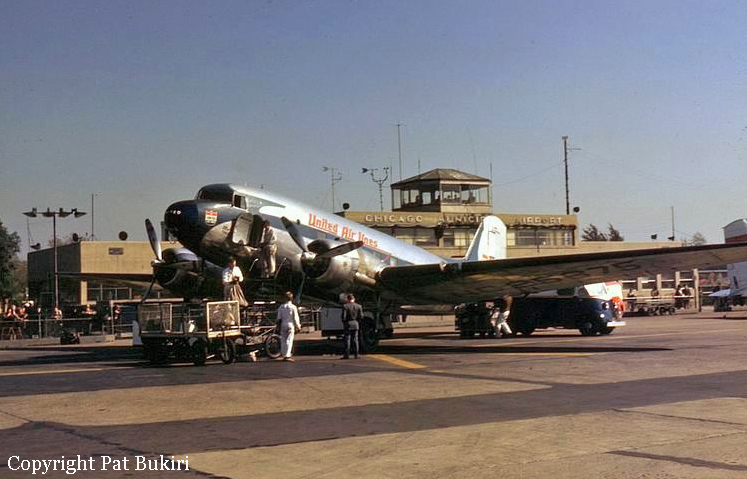
Crash of a Douglas C-47 in Laramie: 13 killed

Date & Time: Oct 17, 1946 at 0057 LT
Registration:
NC38942
Survivors:
No
Schedule:
Oakland – Cheyenne – Newark
MSN:
12971
YOM:
1944
Crew on board:
3
Crew fatalities:
Pax on board:
10
Pax fatalities:
Other fatalities:
Total fatalities:
13
Captain / Total flying hours:
3222
Captain / Total hours on type:
840.00
Copilot / Total flying hours:
1500
Aircraft flight hours:
1861
Circumstances:
Enroute, the crew was informed that weather conditions in Cheyenne were poor and was rerouted to Laramie. Unfortunately, upon arrival, weather conditions were not so good with light snow and a visibility of two miles. The captain decided to attempt to land but was unable to locate the airport and passed over without seeing it. Shortly later, while at an altitude of 75 feet and in a left bank of 70°, the aircraft hit the ground with its left wing, crashed and burned. All 13 occupants were killed.
Probable cause:
On the basis of the above, the Board determines that the probable cause of this accident was the action of the pilot in maneuvering the aircraft at a dangerously low altitude under extremely adverse weather conditions in an attempt to land. A contributing factor was the negligence of the pilot in planning a flight into an area in which adverse weather conditions were forecast without making adequate provisions for a suitable alternate airport.
Final Report:

Crash of a Douglas DC-4 in Cheyenne: 2 killed

Date & Time: Oct 8, 1946 at 0433 LT
Type of aircraft:
Operator:
Registration:
NC30051
Survivors:
Yes
Schedule:
San Francisco – Cheyenne – Chicago
MSN:
10471
YOM:
1944
Flight number:
UA028
Crew on board:
4
Crew fatalities:
Pax on board:
43
Pax fatalities:
Other fatalities:
Total fatalities:
2
Captain / Total flying hours:
12573
Captain / Total hours on type:
2425.00
Copilot / Total flying hours:
3551
Copilot / Total hours on type:
831
Aircraft flight hours:
3077
Circumstances:
An approach from the west was then decided on by the Captain as visibility there had been fair. The First Officer contacted the tower and was cleared to land on Runway 12 (to the southeast). While headed west the Captain started a gradual left turn at the western boundary of the field, continued it for a short time and then entered a right turn in an attempt to line up with and land on Runway 12. This right turn was continued at an altitude of some 200 feet above the ground with, wheels down, 15 degree of flap and airspeed of approximately 120 mph (once as low as 110 mph). The Captain instructed the First Officer, who occupied the right hand pilot seat, (on the low and field side of the turn) to "sing out" when he saw the field. When the First Officer did see it he said "There's the field at 2 o'clock" (at a relative bearing of 60 degree). The Captain then leaned to the right to see the field himself and during this momentary diversion from the instruments enough altitude was lost to permit the right wing tip to strike the ground. The site was on rolling prairie approximately 20 feet higher than, and about 1 1/2 miles northwest of the Cheyenne Airport, on the U. S. Military Reservation of Fort Warren. At the instant of impact the aircraft was still in a right turn, banked approximately 15 degree and headed northeast. It came to rest about 700 feet beyond the point of first impact. A gasoline fire developed on the ground along the crash path and the right wing, which had been torn from the fuselage, was partly burned. Two passengers were killed while most of the other occupants were injured, some of them seriously.
Probable cause:
The Captain started a standard instrument approach to the Cheyenne Airport but did not follow through with the prescribed missed-approach procedure after descending below the minimum altitude. During the final attempt to land, the aircraft struck the ground with its right wing while in a right turn. The Board determines that the probable cause of this accident was a loss of altitude during a turn preparatory to a final approach while the pilot was maneuvering in an attempt to land.
Final Report:

Crash of a Douglas DC-3-194H in Elk Mountain: 21 killed

Date & Time: Jan 31, 1946 at 0247 LT
Type of aircraft:
Operator:
Registration:
NC25675
Flight Phase:
Survivors:
No
Site:
Schedule:
Portland – Pendleton – Boise – Denver
MSN:
2147
YOM:
1939
Flight number:
UA014
Crew on board:
3
Crew fatalities:
Pax on board:
18
Pax fatalities:
Other fatalities:
Total fatalities:
21
Captain / Total flying hours:
13003
Captain / Total hours on type:
2909.00
Copilot / Total flying hours:
2021
Copilot / Total hours on type:
21
Aircraft flight hours:
16333
Circumstances:
On the non stop leg from Boise to Denver, while flying by night and poor visibility, the aircraft hit the slope of Mt Elk located southeast of Elk Mountain, south Wyoming. The wreckage was found few hours later in a deep snow and in poor weather conditions, about 340 feet from the summit. The aircraft was destroyed by impact forces and all 21 occupants were killed. At the time of the accident, the aircraft deviated from the prescribed flight path by 4,5 miles and its altitude was 11,000 feet.
Probable cause:
On the basis of the foregoing the Board finds that the probable cause of this accident was the deviation from the prescribed route at an altitude insufficient to assure adequate clearance over Elk Mountain.
Final Report:

Crash of a Douglas C-47-DL in Casper: 11 killed

Date & Time: Nov 13, 1944 at 2328 LT
Operator:
Registration:
41-7834
Flight Phase:
Flight Type:
Survivors:
No
Schedule:
Casper - Casper
MSN:
4333
YOM:
1942
Location:
Crew on board:
2
Crew fatalities:
Pax on board:
9
Pax fatalities:
Other fatalities:
Total fatalities:
11
Circumstances:
Shortly after take off from runway 25 at Casper Airport, while in initial climb, the aircraft went out of control and crashed in a field located 3 miles northwest of the airfield. All eleven occupants were killed.

Crash of a Boeing B-17F-55-DL Flying Fortress on Mt Bomber: 10 killed

Date & Time: Jun 28, 1943 at 2359 LT
Operator:
Registration:
42-3399
Flight Phase:
Flight Type:
Survivors:
No
Site:
Schedule:
Pendleton – Grand Island
MSN:
8335
Crew on board:
10
Crew fatalities:
Pax on board:
0
Pax fatalities:
Other fatalities:
Total fatalities:
10
Circumstances:
The crew was returning to his base in Grand Island in order to prepare to join the European operations. En route, the crew inform ground about his position over Powder River. This was the last communication. Around 2359LT, the aircraft hit the slope of a mountain located in the Bighorn Mountain Range, in the north part of Wyoming. All SAR operations were suspended after few days as no trace of the aircraft nor the 10 crew members was found. Two cowboys found the wreckage on August 12, 1945. The aircraft was off course at the time of the accident. After a petition by veterans groups in Wyoming, the unnamed mountain on which the aircraft crashed was christened 'Bomber Mountain' on 22 August 1946 by the U.S. Forest Service.
Crew (318th BS):
Lt William R. Ronaghan, pilot,
Lt Anthony S. Tilotta, copilot,
Lt Leonard H. Phillips, navigator,
Lt Charles H. Suppes, bombardier,
Sgt James A. Hinds, flight engineer,
Sgt Lee V. Millar, assistant to the flight engineer,
Sgt Ferguson T. Bell, radio operator,
Sgt Charles E. Newburn Jr., assistant to the radio operator,
Sgt Jake E. Penick, air gunner,
Sgt Lewis M. Shepherd, air gunner.
Probable cause:
At the time of the accident, the aircraft was nearly 120 miles off course to the north and flying below the prescribed flight altitude, thus below the elevation of the Bighorn Mountain Range.

Crash of a Boeing B-17F-35-BO Flying Fortress near Glenrock: 10 killed

Date & Time: Feb 25, 1943 at 2135 LT
Operator:
Registration:
42-5102
Flight Phase:
Flight Type:
Survivors:
No
Schedule:
Casper - Casper
MSN:
3641
YOM:
1942
Crew on board:
10
Crew fatalities:
Pax on board:
0
Pax fatalities:
Other fatalities:
Total fatalities:
10
Circumstances:
The airplane departed Casper on a practice bombing exercise. While cruising in poor weather conditions and icing conditions, the pilot lost control of the airplane that dove into the ground and crashed some 40 km north of Glenrock. All 10 crew members were killed.
Crew:
2nd Lt Louis E. Machala Jr., pilot,
2nd Lt Ned J. DeVries, copilot,
S/Sgt John W. Madden Jr., flight engineer,
S/Sgt John F. Elson, assistant flight engineer,
2nd Lt Harry M. Cannon, navigator,
S/Sgt Eugene D. Giles Jr., radio operator,
S/Sgt Alfred W. Fuller, assistant radio operator,
2nd Lt Joseph N. Hershman, bombardier,
S/Sgt Robert C. Parrott Jr., air gunner,
Sgt James C. Fisher, air gunner.
Probable cause:
It is believed that the loss of control occurred after the pilot suffered a spatial disorientation while cruising in poor weather conditions.

Crash of a Boeing B-17F-45-BO Flying Fortress in Casper

Date & Time: Jan 15, 1943
Operator:
Registration:
42-5339
Flight Type:
Survivors:
Yes
MSN:
3878
YOM:
1942
Location:
Crew on board:
0
Crew fatalities:
Pax on board:
0
Pax fatalities:
Other fatalities:
Total fatalities:
0
Circumstances:
On approach to Casper Airport, the crew encountered poor weather conditions when the airplane crashed in a field. There were no fatalities.

Crash of a Douglas A-20A Havoc I near Elk Mountain: 1 killed

Date & Time: Feb 15, 1942 at 1800 LT
Operator:
Registration:
AL477
Flight Phase:
Flight Type:
Survivors:
No
Site:
Schedule:
Ogden - Cheyenne
Crew on board:
1
Crew fatalities:
Pax on board:
0
Pax fatalities:
Other fatalities:
Total fatalities:
1
Circumstances:
The airplane was on a flight to Canada to be delivered to the Royal Air Force. En route from Ogden to Cheyenne, the pilot encountered poor weather conditions. In heavy snow falls, the airplane contacted ground and crashed near Elk Mountain. SAR operations were initiated but eventually suspended six days later. The wreckage was found in July. The pilot was killed.
Crew:
Robert S. Gleghorn, pilot.

Crash of a Consolidated LB-30A Liberator near Hanna: 1 killed

Date & Time: Jan 8, 1942
Operator:
Registration:
AL607
Flight Phase:
Flight Type:
Survivors:
Yes
Site:
MSN:
105
YOM:
1941
Location:
Crew on board:
8
Crew fatalities:
Pax on board:
0
Pax fatalities:
Other fatalities:
Total fatalities:
1
Circumstances:
En route from McDill AFB, the heavy bomber was abandoned by the crew for unknown reasons. Out of control, the airplane crashed about 16 km south of Hanna, and was destroyed. Seven crew members parachuted to safety and a eighth was killed.
Crew:
Frank W. Potter, pilot,
2nd Lt Phillip T. Wolking +6. †