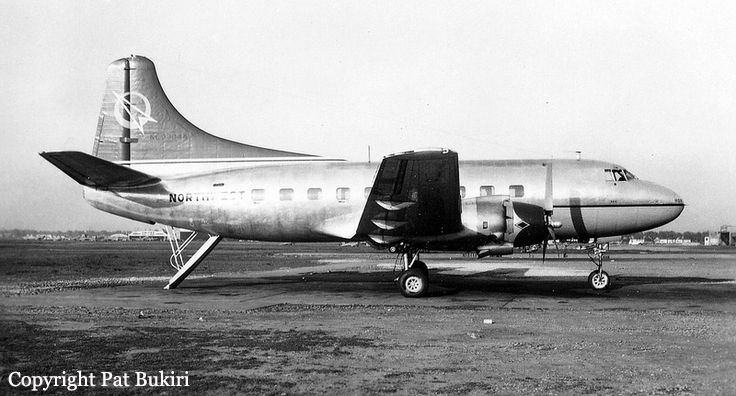
Crash of a Martin 202 in Butte: 21 killed

Date & Time: Nov 7, 1950 at 0815 LT
Type of aircraft:
Operator:
Registration:
N93040
Survivors:
No
Schedule:
Chicago – Minneapolis – Billings – Great Falls – Helena – Butte – Seattle
MSN:
9161
YOM:
1947
Flight number:
NW115
Location:
Crew on board:
4
Crew fatalities:
Pax on board:
17
Pax fatalities:
Other fatalities:
Total fatalities:
21
Captain / Total flying hours:
8291
Captain / Total hours on type:
610.00
Copilot / Total flying hours:
2873
Copilot / Total hours on type:
80
Aircraft flight hours:
6166
Circumstances:
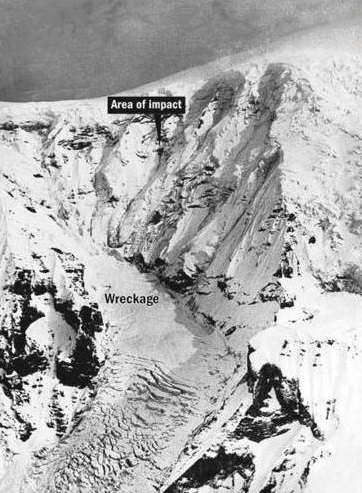
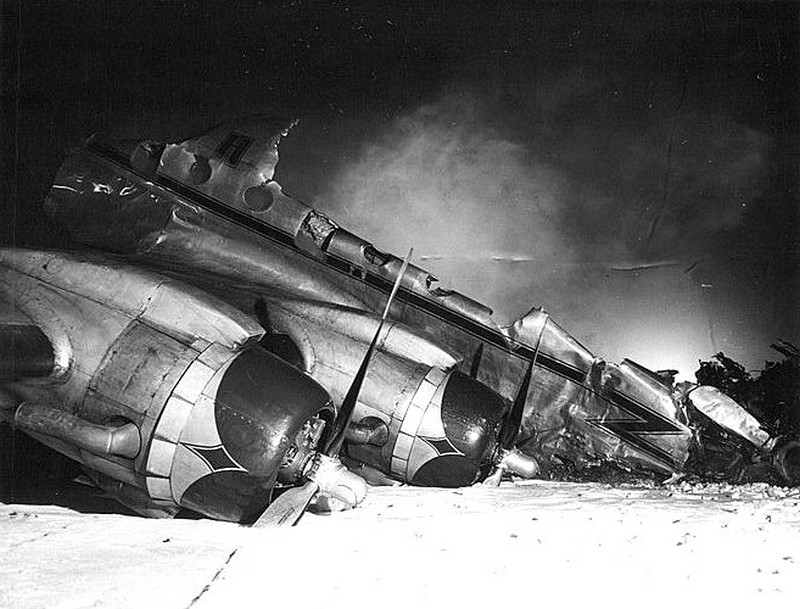
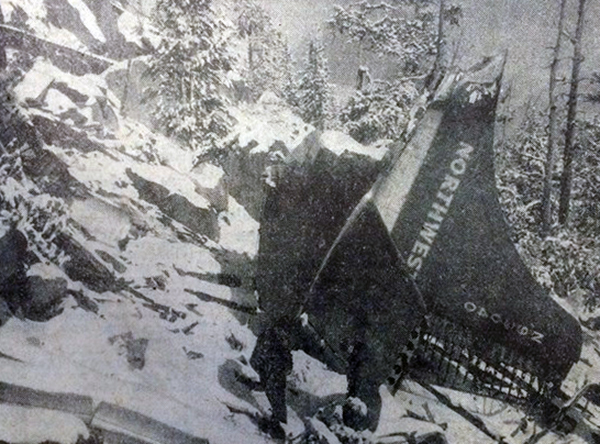
The flight left Helena at 0753LT, using Runway 29. The flight plan, amended before takeoff, specified an altitude of 10,500 feet MSL under instrument flight rules via Amber Airway number 2 to the Whitehall (Montana) Range Station and from there to the Butte Airport via Red Airway number 2. Also, before taking off, the pilot asked the Helena Tower if the Homestake Fan normally and was informed that Butte Radio advised that it was. Following takeoff from Runway 29, the aircraft was flown in a climbing right turn so that it passed approximately over the Station as it headed south toward the Whitehall Range Station. At 0801 the flight reported to Helena that it had reached its cruising altitude. This message was acknowledged. The next message from the flight was to Butte at 0814 stating that it was over Whitehall (Range Station) at 0811 and starting descent. Butte acknowledged this message, gave that flight the station altimeter setting of 29.97, advised that the wind was south, calm, and that the Weather Bureau advised what the ceiling was lower to the east and north and better to the south and southwest. Flight 115 replied that it had vertical visibility at 10,500 feet. This was the last radio contact with the flight. A search was instituted after several futile attempts to contact the aircraft. On the following morning, the wreckage was sighted from a local search aircraft at about 0900. Ground parties immediately started for the crash site. All debris were found in a snow covered wooded area and all 21 occupants were killed.
Probable cause:
The Board determines that the probable cause of this accident was the failure of the captain to conduct the flight in accordance with the proscribed approach procedure. The following findings were reported:
- The pilot failed to follows the carrier's prescribed number 2 instrument approach procedure to the Butte Airport, which procedure is approved by the Civil Aeronautics Administration,
- The aircraft struck a mountain at about the 8,250-foot level, while on a heading of approximately 290 degrees magnetic,
- The accident occurred during a local snowstorm and under conditions of variable ceiling and visibility.
Final Report:
Crash of a Martin 202 in Almelund: 6 killed

Date & Time: Oct 13, 1950 at 1049 LT
Type of aircraft:
Operator:
Registration:
NC93037
Flight Phase:
Flight Type:
Survivors:
No
Schedule:
Minneapolis - Minneapolis
MSN:
9158
YOM:
1947
Crew on board:
3
Crew fatalities:
Pax on board:
3
Pax fatalities:
Other fatalities:
Total fatalities:
6
Captain / Total flying hours:
9800
Captain / Total hours on type:
769.00
Copilot / Total flying hours:
8228
Copilot / Total hours on type:
368
Aircraft flight hours:
5289
Circumstances:
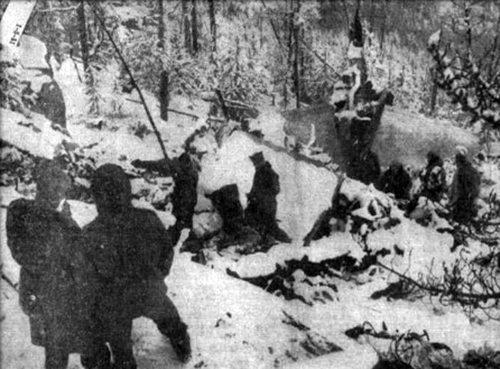
Northwest Airlines' NC93037 departed from the Minneapolis- St Paul International Airport at 0946LT on a local flight. The purpose of the flight was a six-month instrument competency check of Captain John R. Galt under the supervision of Captain Ray Render, a company cheek pilot. Also on board and listed as official observers were William H Solomon, CAA air carrier agent, who was sitting on the jump seat between and immediately behind the pilots' seats, and CAA personnel from the Minneapolis Control Tower, E. Bergstrom, R. Olsen and B. Erickson, who were sitting in the main cabin. At the time of takeoff there were 800 gallons of fuel on board which resulted in a total aircraft weight of 32,943 pounds. This weight was within the allowable limit of 38,000 pounds and the aircraft was properly loaded. The weather was clear and visibility was unlimited. Following takeoff, two simulated US (Instrument landing system) approaches were made to the airport and at 1025LT the crew radioed the control tower that this phase of the check flight was completed. This was the last known contact with the flight. After departing the Minneapolis area, the aircraft was first seen near Center City, Minnesota, 43 miles northwest of Minneapolis. At this time it was making a steep left turn at an altitude estimated to he between 4,000 and 5,000 feet, and landing gear was down. At the completion of this turn a shallow climb was started. Throughout these maneuvers the engines sounded as if they were operating in a normal manner. The attention of the ground witness was then diverted for a few moments, and when he again saw the aircraft it was in a partially inverted position and starting a steep dive. After losing approximately 2,500 feet in the dive, an apparently normal recovery was made to a level flight attitude and the aircraft proceeded in a northeasterly direction. Shortly thereafter it was seen to make two or three pitching oscillations about its lateral axis. These maneuvers may he described as a series of steps made by the aircraft as it was being lowered abruptly, followed by a recovery to level flight. During each oscillation approximately 400 feet in altitude was lost and a noise was heard such as is usually associated with a surge of engine power. The aircraft continued on a northeast heading. Two miles south of Almelund, Minnesota, which is 14 miles northeast of Center City, the aircraft was seen to make a shallow right turn of approximately 270 degrees and once more to return to a level attitude heading in a northwesterly direction. Throughout the above-mentioned maneuvers, the aircraft was gradually losing altitude, and the right propeller was observed to be turning slowly during the latter part of the flight. Nearing Almelund and at an altitude of approximately 500 or 600 feet above the ground, a steep right turn was begun. Altitude was lost rapidly and after turning approximately 90 degrees, the aircraft's right wing struck the ground. All but one of the six occupants were killed at impact, the injured person died several days later without regaining consciousness. The aircraft was demolished.
Probable cause:
The Board determines that the probable cause of this accident was the unwanted reversal of the right propeller during flight, as a result of which the crew was unable to maintain control of the aircraft. The following findings were reported:
- The fuel feed valve of the right engine malfunctioned when tested,
- The right propeller was found in 7 degrees to 10 degrees of reverse thrust,
- A review of the evidence of a similar occurrence indicated that with a propeller in the reverse thrust position the aircraft would assume dangerous flight characteristics,
- The fact that the aircraft's wing flaps were retracted may have contributed to the uncontrollability of the aircraft at speeds below 140 miles per hour.
Final Report:

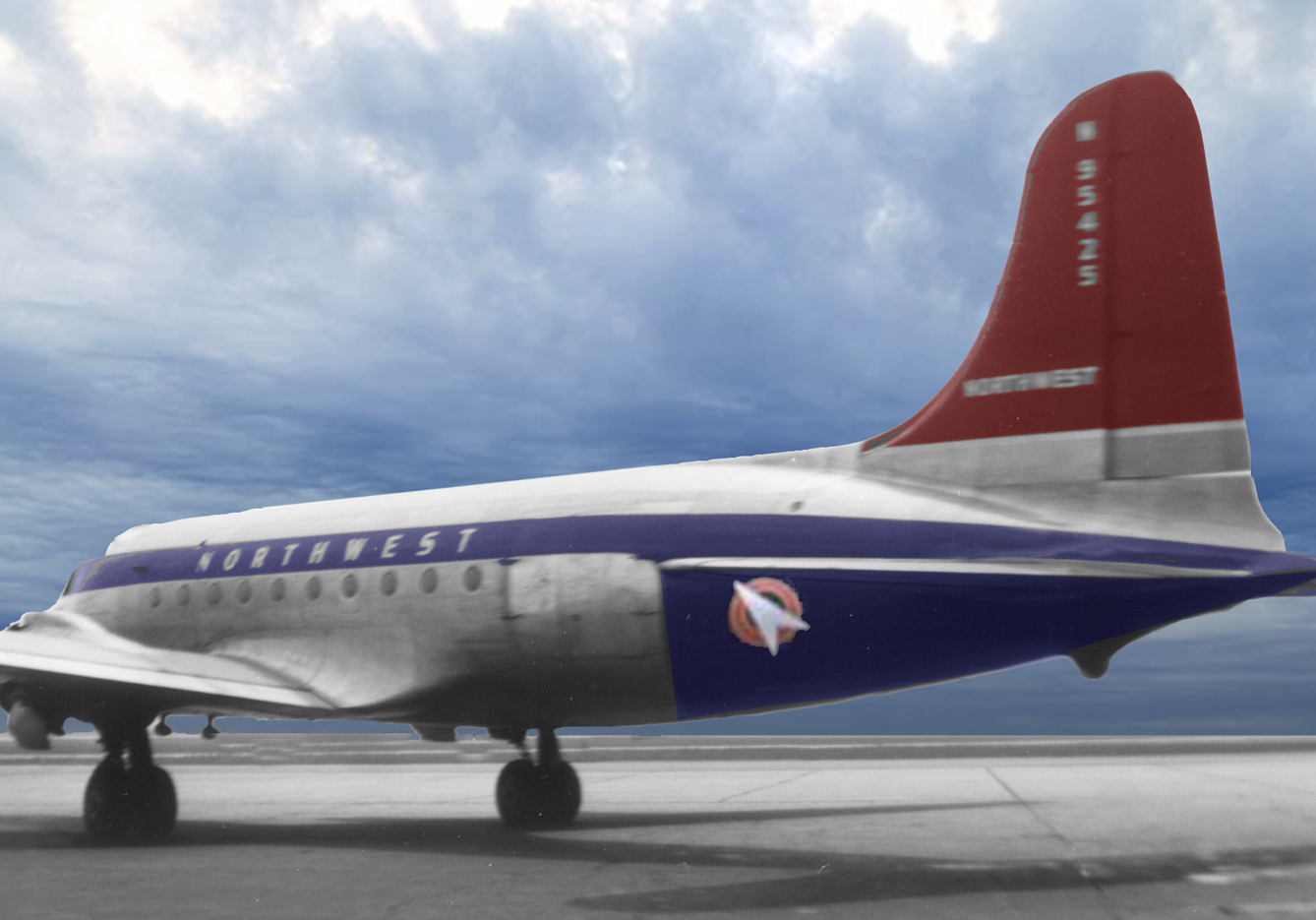
Crash of a Douglas DC-4 into Lake Michigan: 58 killed

Date & Time: Jun 23, 1950 at 2325 LT
Type of aircraft:
Operator:
Registration:
N95425
Flight Phase:
Survivors:
No
Schedule:
New York – Minneapolis – Spokane – Seattle
MSN:
10270
YOM:
1943
Flight number:
NW2501
Crew on board:
3
Crew fatalities:
Pax on board:
55
Pax fatalities:
Other fatalities:
Total fatalities:
3
Captain / Total flying hours:
8662
Captain / Total hours on type:
1968.00
Copilot / Total flying hours:
8821
Copilot / Total hours on type:
400
Aircraft flight hours:
15902
Circumstances:
The flight 2501, was scheduled to operate between the terminal points of New York, N. Y., and Seattle, Wash, via intermediate points of Minneapolis, Minn., and Spokane, Wash. At approximately 1931 the flight departed from LaGuardia Airport for Minneapolis with a crew consisting of Robert C. Lind, captain, Verne F. Wolfe, first officer, and Bonnie A. Feldman, stewardess. On board were 55 passengers, 2, 500 gallons of fuel, 80 gallons of oil, and 490 pounds of express, which resulted in an aircraft weight of 71, 342 pounds for takeoff. This was 58 pounds below the maximum permissible takeoff weight, and the load was distributed so that the center of gravity was within approved limits. The flight plan filed with ARTC (Air Route Traffic Control) specified a cruising altitude of 6 000 feet to Minneapolis. An altitude of 4,000 feet had been originally requested because of forecast en route thunderstorms, but denied by ARTC because other traffic was assigned at that level. At 2149, when over Cleveland, Ohio, a cruising altitude of 4,000 feet was again requested by the flight and this time approved by ARTC. Forty minutes later the flight was requested by ARTC to descend to 3, 500 feet because there was an eastbound flight at 5,000 feet over Lake Michigan which was experiencing severe turbulence and difficulty in maintaining its assigned altitude. ARTC estimated that the two flights would pass each other in the vicinity of Battle Creek, Mich., and that the standard separation of 1,000 feet would not be sufficient because of the turbulence. At 2251, Flight 2501 reported that it was over Battle Creek at 3,500 feet, and that it would be over Milwaukee at 2337. When in the vicinity of Benton Harbor, at 2313, the flight requested a cruising altitude of 2,500 feet, however, no reason was given for the request. ARTC was unable to approve this altitude because of other traffic. Acknowledgement that ARTC could not approve descent to 2,500 feet was received at 2315, and this was the last communication received from the flight. At 2337, Northwest Radio at Milwaukee advised the company at LaGuardia and Minneapolis, and ARTC at Chicago, that the flight was ten minutes overdue since they had incorrectly copied the 2251 flight report as 2327. At 2345 Northwest Radio at Milwaukee transmitted to the flight instructions to circle the range station at Madison, Wis., if its radio transmitter was inoperative. During the same period, all CAA (Civil Aeronautics Administration) radio stations in the Chicago-Minneapolis area tried to contact the flight on all frequencies. At 2358, Chicago ARTC, at the request of Northwest Airlines, alerted air-sea rescue facilities in the area, which included the Air Force, Navy, Coast Guard, and the state police of Illinois, Michigan, Wisconsin, and Indiana. The missing aircraft was assumed to have been involved in an accident at 0530 since the fuel supply at that time would have been exhausted. An intensive search of the Lake Michigan area was commenced at daylight June 24. On the following day, at 1830, the United States Coast Guard cutter Woodbine found an oil slick, aircraft debris, and the aircraft log book in Lake Michigan approximately 18 miles north-northwest of Benton Harbor. At 0530, June 25, underwater search operations were conducted with divers and sonar equipment. Divers descended at the points where strong sonar contacts were made. At those locations, the lake bottom was 150 feet below the surface of the water and was covered by a layer of silt and mud estimated to be 30 to 40 feet deep. Visibility was less than eight inches. The possibility of locating anything was slight, and movement was severely restricted. In addition to diving operations, the entire area was dragged with grapnel but without results. After two days of operation, the Navy suspended their search because of the difficult conditions, and because nothing had been found which would indicate that the aircraft could be recovered. Since then, the Coast Guard and aircraft flying in that area have maintained a sea and air surveillance. The only parts of the aircraft that were recovered were those with sufficient buoyancy to float a fuel tank float, foam rubber cushions, arm rests, clothing, blankets, pillows, pieces of luggage, cabin lining, plywood flooring and other wooden parts. The cushions and arm rests, shredded from impact forces and cutting edges of the fuselage, indicated that the aircraft struck the water at high speed. A plywood oxygen bottle support bracket, which had been installed in the forward left side of the fuselage, showed that the inertia forces acted in a forward, downward, and to the left direction. There was no sign of fire found on any parts recovered. All 58 occupants have been killed.
Probable cause:
The Board determines that there is not sufficient evidence upon which to make a determination of probable cause. At the approximate time of the accident a squall line was located in the area where the aircraft crashed. Despite an intensive surface and underwater search, the aircraft was not located with the exception of a few fragments.
Final Report:

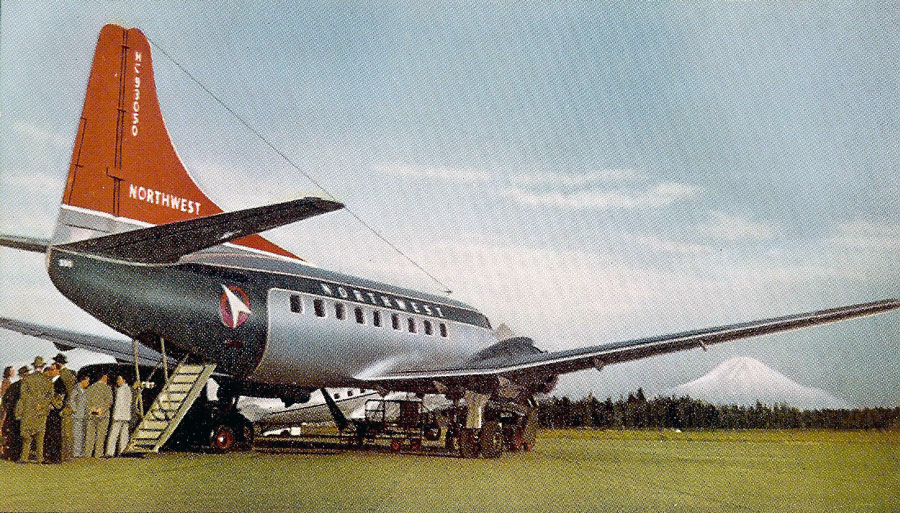
Crash of a Martin 202 in Minneapolis: 15 killed

Date & Time: Mar 7, 1950 at 2059 LT
Type of aircraft:
Operator:
Registration:
NC93050
Survivors:
No
Schedule:
Washington-Detroit-Madison-Rochester-Minneapolis-Winnipeg
MSN:
9134
YOM:
1948
Flight number:
NW307
Crew on board:
3
Crew fatalities:
Pax on board:
10
Pax fatalities:
Other fatalities:
Total fatalities:
15
Captain / Total flying hours:
7619
Captain / Total hours on type:
988.00
Copilot / Total flying hours:
2432
Copilot / Total hours on type:
585
Circumstances:
The aircraft departed Washington DC at 1230LT destined for Winnipeg, Manitoba, Canada, with intermediate stops in Detroit, Rochester, Madison and Minneapolis. With the exception of an hour and 23 minute delay at Detroit, required for the replacement of a ring seal in the hydraulic system, the flight proceeded in air routine manner to Madison, Wisconsin After arrival at Madison the aircraft was serviced with 1,010 gallons of fuel and 38 gallons of oil. Also on board were 10 passengers and 1,799 pounds of cargo which resulted in an aircraft weight of 36,842 pounds. This weight was well within the allowable limit of 39,100 pounds, and so far as is known, the aircraft was properly loaded. Weather information available to the flight prior to its departure from Madison showed that Rochester, 75 miles south southeast of Minneapolis, was reporting a ceiling of 700 feet with visibility of five miles, and that Minneapolis was reporting a ceiling of 900 feet with visibility of 1/2 mile 3. In addition, there was fog and blowing snow at these stations. Turbulence was expected in the clouds, and icing above the freezing level of 8,000 feet. The trip was planned to Minneapolis at an altitude of 4 000 feet, the schedule stop at Rochester being made contingent upon weather conditions at the time of the flight’s arrival. Madison, Wis., and Jamestown, N. Dak where weather conditions were well above landing minimums, were designated as alternate airports. Flight 307 arrived over Rochester at 2023, and because there was light freezing rain, did not land. Twelve minutes later the flight made a routine report to company radio that it was over Stanton which is a radio beacon 30 miles south of the Twin Cities Airport at Minneapolis, and at 2041 contacted Minneapolis Approach Control for landing clearance. The tower advised Flight 307 of existing, weather conditions. There was a precipitation ceiling of 900 feet, visibility was variable 1/2 to 3/4 of a mile, and the wind was from the north 27 miles per hour with gusts up to 40 miles per hour. The tower informed the flight that there had been two electric power failures at the field, and that if no further communication were received from the tower, it would be in all probability the result of another power failure The flight was also told that the ILS was serviceable, but that it had not been flight checked. As Flight 307 approached, another NWA flight, a Boeing 377, was standing at the approach end of the instrument runway, Runway 35, checking engines prior to flight Takeoff clearance was given to the Boeing 377. When it had proceeded half-way down the runway, Flight 307 reported that it was over the outer marker, which was 4.7 miles south of the approach end of the runway. The high intensity runway lights were increased in intensity, their coning device was set to 1/2 mile, the prevailing visibility at the time, and Flight 307 was cleared to land. Flight 307 was not seen from the tower during its approach, but it was heard to pass overhead at which time the controllers received the call, “I have got to get in Clearance was again given to land, following which the flight advised that it would climb to 2,400 feet on the northwest course of the Minneapolis radio range. After a pause, the flight transmitted. “We are going in-we are going in.” After the aircraft had flown over the field, it was observed flying straight and level 3.8 miles northwest of the airport. A wing was seen to fall. Then, the aircraft was observed to dive almost vertically from an altitude of about 300 feet, and crash into a residence in the city of Minneapolis Fire which started immediately after the crash consumed the house and much of the aircraft wreckage. All of the 13 occupants of the aircraft and two of the occupants of the house were killed.
Probable cause:
The Board determines that the probable cause of this accident was the attempt to complete a landing approach by visual means during which time visual reference to the ground was lost.
The following findings were noted:
- Weather conditions were precipitation ceiling, 900 feet, visibility 1/2 mile variable reduced by blowing snow wind from the north at 27 miles an hour with gusts to 40 miles per hour air, cold and dry, and, turbulence over the lending approach flight path,
- During the period preceding and following the accident slant visibility was relatively good, which permitted other flights to complete their landing approaches by visual reference to the runway,
- Flight 307 was flown 128 feet below the ILS glide path and 650 feet to the left of the localizer at a point 4,180 feet south from the approach end of Runway 35 where the aircraft struck a flagpole well marked by red neon obstruction lights.
Final Report:

Crash of a Douglas C-54A-15-DC Skymaster near Edmonton: 2 killed

Date & Time: Oct 27, 1948 at 1650 LT
Type of aircraft:
Operator:
Registration:
NC88785
Flight Phase:
Flight Type:
Survivors:
Yes
Schedule:
Minneapolis – Edmonton – Anchorage – Tokyo
MSN:
10406
YOM:
1944
Flight number:
NW6427
Country:
Crew on board:
5
Crew fatalities:
Pax on board:
0
Pax fatalities:
Other fatalities:
Total fatalities:
2
Captain / Total flying hours:
8114
Captain / Total hours on type:
1669.00
Copilot / Total flying hours:
2406
Copilot / Total hours on type:
406
Circumstances:
First Officer Upham made the takeoff, and shortly after the airplane became airborne Captain Christian cut the left outboard engine and feathered the propeller, creating a simulated engine failure on takeoff. The purpose was to instruct the first officer in emergency procedures. The airplane climbed very slowly and, veering slightly to the left, passed over the center of Edmonton at an altitude of 400 to 500 feet. Then the flight turned to the right approximately 180 degrees to get on course toward Anchorage. This brought it back over town and Captain Christian unfeathered the propeller. Power was restored to left outboard engine and the airplane continued to climb. During this interval the tower asked the crew if they had taken off on three engines and received a negative reply. At 1645 Trans-Canada Airlines Communications received the following message from Flight 6427, "We were off at 32, cruising 7000 at 44, estimating Whitecourt at 02, out (from the ramp) at 22." No indication of trouble was given and no further messages were received from the flight. Although this message indicates the flight had reached its assigned cruising altitude of 7000 feet MSL, all evidence points to the fact that it was never above 3000 feet MSL, (700 feet above the terrain). Surviving crew members stated that after reaching an altitude of approximately 700 feet above the terrain, Captain Christian feathered the propellers of both left engines and continued to instruct First Officer Upham in emergency procedures. Shortly after this, the crew began to realize that the airplane was getting dangerously low over a wooded area and rising terrain and that the situation was rapidly developing into an actual emergency. The captain took over the controls and attempted to restart the left engines. However, before sufficient power could be restored the airplane began striking the tree tops. It crashed and burned several hundred feet beyond the point of initial contact with the trees. Two crew members were killed while three others were injured. The aircraft was destroyed by impact forces and a post crash fire.
Probable cause:
Investigation disclosed no evidence of mechanical failure or malfunctioning of the aircraft or engines and, according to surviving crew members, the only irregularity during the flight was the intentional cutting of the left engines. According to Northwest Airlines, this flight, while not subject to scheduled air carrier rules, was to be operated in a manner similar to their scheduled flights operating over the same route. A company representative stated that Northwest has at no time authorized the practicing of emergency procedures while the airplane is at a low altitude over a congested area, or the feathering of propellers immediately after takeoff. Simulated emergency procedures are permissible only during pilot checks and training flights. The Board determines that the probable cause of the accident was the captain's action in undertaking simulated emergency procedures at a dangerously low altitude.
Final Report:

Crash of a Martin 202 near Winona: 37 killed

Date & Time: Aug 29, 1948 at 1705 LT
Type of aircraft:
Operator:
Registration:
NC93044
Flight Phase:
Survivors:
No
Schedule:
Chicago – Minneapolis
MSN:
9165
YOM:
1947
Flight number:
NW421
Crew on board:
4
Crew fatalities:
Pax on board:
33
Pax fatalities:
Other fatalities:
Total fatalities:
37
Captain / Total flying hours:
5502
Captain / Total hours on type:
311.00
Copilot / Total flying hours:
2380
Copilot / Total hours on type:
155
Aircraft flight hours:
1321
Circumstances:
Northwest Airlines' Flight 421 departed from Chicago for Minneapolis at 1550, August 29, 1948. On board were 33 passengers, four crew members, 800 gallons of fuel, and 1,038 pounds of baggage. Total aircraft weight was 38,015 pounds which was within the certificated limit and it was properly loaded in reference to the center of gravity. Weather information available to the flight prior to departure indicated that relatively good flying conditions existed en route with the exception of scattered rain showers and thunderstorms which were in the vicinity of La Crosse, Wisconsin and Rochester, Minnesota. Routine position reports were received from the flight as it progressed on course at Its flight plan altitude of 8,000 feet. At 1655, one hour and five minutes after takeoff from Chicago, the flight reported over La Crosse, 125 miles southeast of Minneapolis, and was at that time cleared to start an en route descent. Four minutes later, at 1659, the flight reported passing through the 7,000-foot altitude level. No indication of any trouble was contained in this transmission. This was the last word beard from the flight. Between 1645 and 1700 several persons in the vicinity of Winona, Minnesota, approximately 95 miles southeast of Minneapolis were watching a thunderstorm which was approaching from the northwest, AS the storm moved over Winona, the wind increased in intensity and considerable lightning and thunder were observed. At this time, about 1705, Flight 421 was seen flying below the overcast. As it passed over Winona, the aircraft appeared to enter the roll cloud or the leading edge of the thunderstorm at which time it was lost from view. Seconds later parts of the airplane were observed falling. It was later found that the flight had crashed approximately 4 miles northwest of Winona on a bluff on the east side of the Mississippi River. All 37 occupants were killed.
Probable cause:
The Board determines that the probable cause of this accident was the loss of the outer panel of the left wing which separated from the aircraft as a result of a fatigue crack in the left front outer panel attachment fitting which had been induced by a faulty design of that fitting, the fatigue crack having been aggravated by severe turbulence encountered in the thunderstorm.
Final Report:

Crash of a Douglas C-54G-1-DO Skymaster on the Mt Sanford: 30 killed

Date & Time: Mar 12, 1948 at 2114 LT
Type of aircraft:
Operator:
Registration:
NC95422
Flight Phase:
Survivors:
No
Site:
Schedule:
Shanghai – Anchorage – New York
MSN:
35966
YOM:
1945
Flight number:
NW4422
Crew on board:
6
Crew fatalities:
Pax on board:
24
Pax fatalities:
Other fatalities:
Total fatalities:
30
Captain / Total flying hours:
4453
Captain / Total hours on type:
733.00
Copilot / Total flying hours:
8324
Copilot / Total hours on type:
728
Aircraft flight hours:
3306
Circumstances:
Take-off from Anchorage was accomplished at 2012, March 12, 1948, and the flight proceeded en route. 2 At 2028 the flight reported over the Wasilla Intersection, which is the intersection of the north course of the Anchorage radio range and the east course of the Skwentna radio range. This intersection is located 35 miles north 3 of Anchorage. Three minutes later, at 2031, the flight reported that it was at its cruising altitude of 11,000 feet. At 2042 the flight reported over Sheep Mountain, a non-directional radio beacon located 85 miles airways distance, 31 degrees, from Anchorage. At 2103 the flight reported being over the Gulkana radio range station, 159 miles, 34 degrees, from Anchorage, and at this time it estimated that it would be over Northway, Alaska, 283 miles from Anchorage, at 2136. Gulkana did not establish communication with the flight. However, the flight repeated its clearance into the Fairbanks area back to Northway, indicating that the flight could receive on 400 kcs, the frequencies for both the Northway radio range and communication. Shortly before the position report of 2103, the flight was observed flying an easterly heading approximately 4 miles south of the Gulkana radio range station. Approximately 42 miles, 51 degrees, from the Gulkana radio range station is Mt. Sanford, the elevation of which is 16,208 feet. In order to provide a safe lateral distance from Mt. Sanford for aircraft flying the route, the airway from Gulkana east is deflected to the north, its course being 23 degrees. Fifteen minutes after the flight was observed flying easterly from Gulkana a fire was observed on the western slope of Mt. Sanford. Except for a repeat transmission of the flight's Gulkana position report, overheard by Northway Radio 124 miles northeast of Gulkana and approximately one minute before the fire was observed on Mt. Sanford, no communication was received from the flight after 2103. Northwest Airlines, at 2150, requested from Anchorage Radio the reported time of the flight over Northway, at which time Anchorage Radio advised that neither the Northway nor the Gulkana stations had been able to contact the flight, and that a fire had been reported on Mt. Sanford. Radio facilities over the route were immediately alerted. Since all attempts to contact the flight were unsuccessful, it was concluded that the flight had struck Mt. Sanford and burned.
Probable cause:
The Board determines that the probable cause of this accident was the pilot's failure to see Mt. Sanford, which was probably obscured by clouds or the aurora borealis or both while flying a course off the airway.
Final Report:

Crash of a Douglas C-54B-5-DO Skymaster in Chicago

Date & Time: Jan 6, 1947
Type of aircraft:
Operator:
Registration:
NC95412
Survivors:
Yes
Schedule:
Minneapolis – Chicago
MSN:
18330
YOM:
1944
Crew on board:
4
Crew fatalities:
Pax on board:
37
Pax fatalities:
Other fatalities:
Total fatalities:
0
Circumstances:
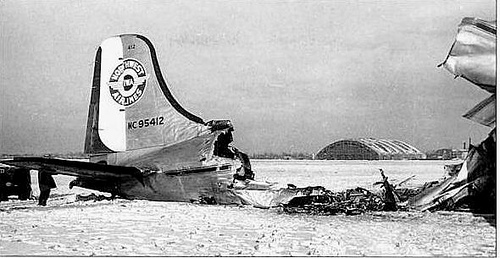
On final approach to Chicago-Midway Airport, the four engine aircraft was too low and hit a concrete marker. After impact, the aircraft nosed down and crashed in flames few hundred yards short of runway. All 41 occupants were quickly evacuated while the aircraft was destroyed by a post crash fire.

Crash of a Douglas DC-3A-269 in Miles City: 3 killed

Date & Time: May 12, 1942 at 1151 LT
Type of aircraft:
Operator:
Registration:
NC21714
Survivors:
Yes
Schedule:
Chicago – Minneapolis – Fargo – Bismarck – Miles City – Butte – Spokane – Seattle
MSN:
2129
YOM:
1939
Flight number:
NW001
Crew on board:
3
Crew fatalities:
Pax on board:
11
Pax fatalities:
Other fatalities:
Total fatalities:
3
Captain / Total flying hours:
13899
Captain / Total hours on type:
2273.00
Copilot / Total flying hours:
437
Copilot / Total hours on type:
77
Circumstances:
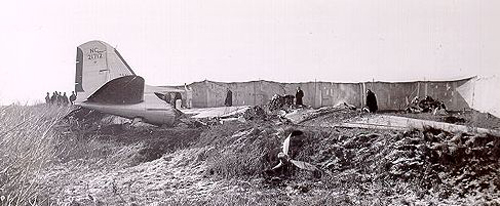
After touchdown at Miles City Airport, the crew was unable to stop the aircraft within the landing distance available. The aircraft overran, rolled for several metres and eventually collided with construction equipment, bursting into flames. Both pilots and a passenger were killed while 11 other occupants escaped with various injuries. Delivered to Northwest Airlines in June 1939, the aircraft was destroyed.
Probable cause:
Upon the basis of all of the evidence available to the Board at this time, CAB find that the probable cause of the accident was the failure of the captain to complete the landing run in the time to avoid the obstruction at the end of the runway, for reasons undetermined, and his action in attempting to take off after striking the obstruction.
Final Report:

Crash of a Douglas DC-3A-269 in Moorhead: 14 killed

Date & Time: Oct 30, 1941 at 0204 LT
Type of aircraft:
Operator:
Registration:
NC21712
Survivors:
Yes
Schedule:
Chicago – Minneapolis – Fargo – Billings – Butte – Spokane – Seattle
MSN:
2124
YOM:
1939
Flight number:
NW005
Crew on board:
3
Crew fatalities:
Pax on board:
12
Pax fatalities:
Other fatalities:
Total fatalities:
14
Captain / Total flying hours:
7000
Captain / Total hours on type:
2275.00
Copilot / Total flying hours:
1300
Copilot / Total hours on type:
367
Circumstances:
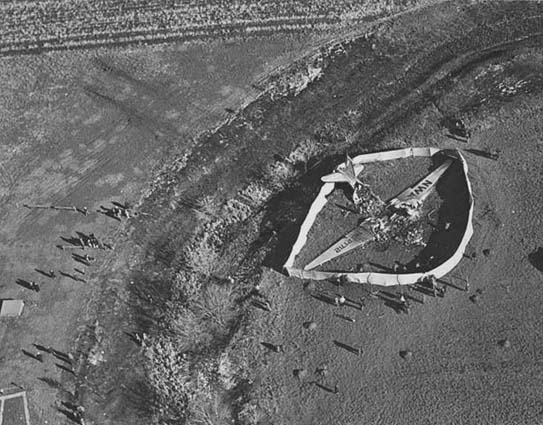
The airplane departed Minneapolis-Wold Chamberlain on a flight to Seattle with several intermediate stops. Approaching Fargo-Hector Field at night, the crew encountered icing conditions. The airplane became unstable and pitched up and down. The captain increased engine power when the airplane stalled and crashed in a prairie located in Moorhead, bursting into flames. The airplane was destroyed by a post crash fire. A pilot survived while 14 other occupants were killed.
Probable cause:
Upon the basis of the foregoing findings and of the entire record available at this time, investigation team found that the probable cause of the accident was the failure of the aircraft, when the inboard portions of the wings were stalled, to respond to the application of full power in the manner reasonably to be expected in the light of the aeronautical knowledge then available.
Contributing factors:
- Accumulation of ice on the wings and other surfaces of the airplane, increasing the stalling speed and the drag of the airplane on the power required to maintain flight.
- Failure of the captain, due to his having lost confidence in the air-speed mete to realize his close approach to a stalled condition.
- Action of the captain in descending to attempt a landing at Fargo with known icing conditions and critical ceiling conditions, instead of proceeding to an available alternate.
- Failure of the dispatcher to recognize the seriousness of weather conditions in the vicinity of Fargo and to direct the pilot to proceed to his alternate.
Final Report: