Crash of a Cessna 208B Super Cargomaster in Portland

Date & Time: Dec 24, 2005 at 0743 LT
Type of aircraft:
Operator:
Registration:
N753FE
Flight Phase:
Flight Type:
Survivors:
Yes
Schedule:
Portland - Medford
MSN:
208B-0248
YOM:
1991
Crew on board:
1
Crew fatalities:
Pax on board:
0
Pax fatalities:
Other fatalities:
Total fatalities:
0
Captain / Total flying hours:
4625
Captain / Total hours on type:
2450.00
Aircraft flight hours:
7375
Circumstances:
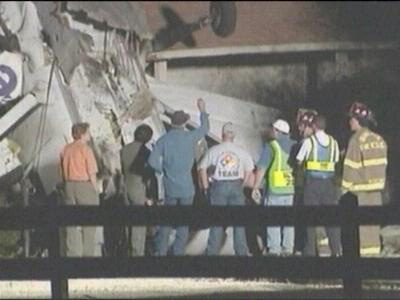
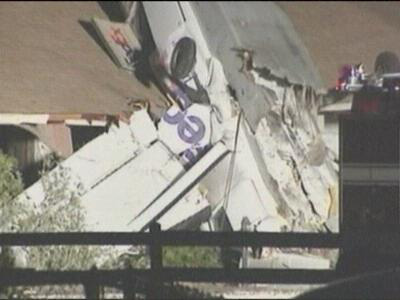
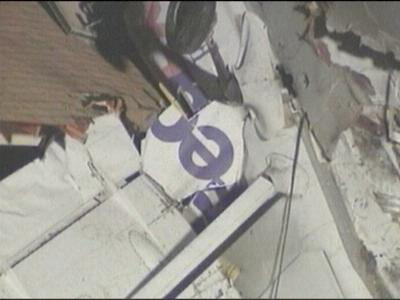
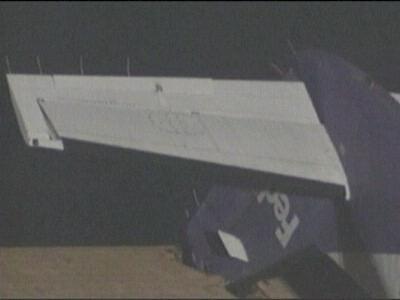
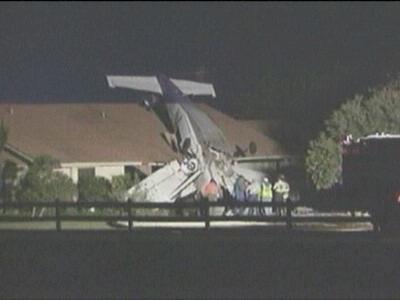
The pilot stated that during takeoff, "after becoming airborne, the airplane quit accelerating and a positive climb rate was not established." He pushed the power lever all the way forward, but did not feel a response from the airplane. Witnesses reported that the airplane became airborne, but failed to gain altitude and struck an antenna array and a fence off the departure end of the runway. The airplane continued across a slough, struck an embankment and came to rest about 900 feet from the departure end of the runway on a golf course located adjacent to the airport. Examination of the airplane revealed no pre-mishap airframe anomalies. Examination of the engine revealed that the compressor and power turbines displayed moderate circular rubbing damage to the blades suggesting engine operation at impact, likely in the low to mid power range. Examination of the airframe and engine revealed no anomalies that would have prevented the engine from producing power prior to impact. The reason for the partial loss of engine power was not determined.
Probable cause:
A partial loss of engine power for an undetermined reason during the initial takeoff climb resulting in an in-flight collision with objects.
Final Report:


Crash of a Cessna 208B Super Cargomaster in Round Rock

Date & Time: Oct 18, 2005 at 2315 LT
Type of aircraft:
Operator:
Registration:
N978FE
Flight Phase:
Flight Type:
Survivors:
Yes
Site:
Schedule:
Austin - Fort Worth
MSN:
208B-0105
YOM:
1988
Crew on board:
1
Crew fatalities:
Pax on board:
0
Pax fatalities:
Other fatalities:
Total fatalities:
0
Captain / Total flying hours:
6600
Captain / Total hours on type:
2000.00
Aircraft flight hours:
10623
Circumstances:
The airplane was fueled with 65-gallons of jet-A in preparation for the evening's flight. The 6,600-hour pilot stated that no abnormalities were noted during the engine start, and takeoff. However; shortly after departure, and after the pilot had leveled off at 7,000-feet, he reported to air traffic control that he had an engine failure and a total power loss. During the descent, the pilot attempted both an air and battery engine restart, but was not successful. The inspection on the engine was conducted on November 30, 2005. The accessory gearbox had a reddish-brown stain visible beneath the fuel pump/fuel control unit. The accessory gearbox was turned; rotation of the drive splines in the fuel pump (splines for the fuel control unit) was not observed. The fuel pump unit was then removed, the area between the fuel pump and accessory gearbox was stained with a reddish brown color. The fuel pump drive splines were worn. Additionally, the internal splines on the fuel pump drive coupling were worn. The wear on the spline drive and coupling prevented full engagement of the spline drives. Both pieces had evidence of fretting, with a reddish brown material present. The airplane had approximately 130 hours since a maintenance inspection (which included inspection of the fuel pump). The engine had accumulated approximately a total time of 9,852 hours, with 5,574 hours since overhaul.
Probable cause:
The loss of engine power due to the failure of the engine-driven fuel pump. A contributing factor was the inadequate inspection of the engine driven fuel pump.
Final Report:

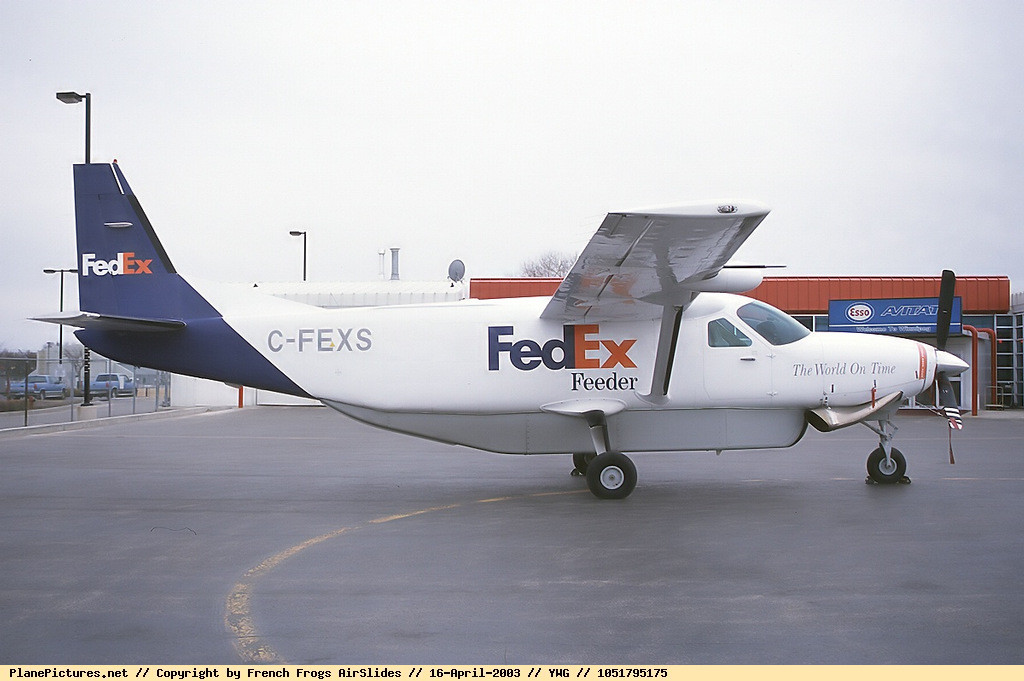
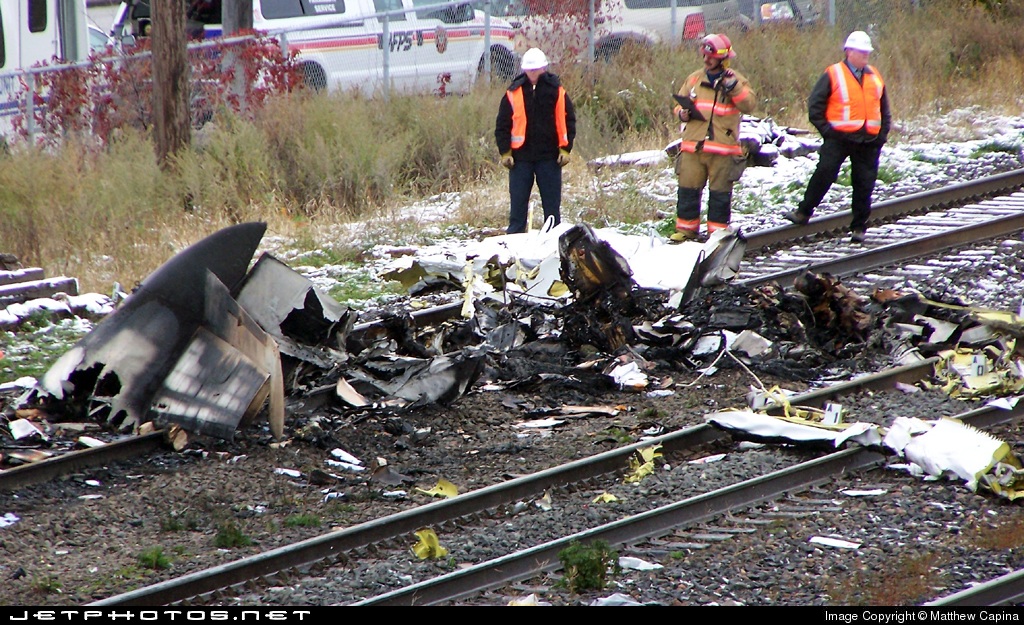
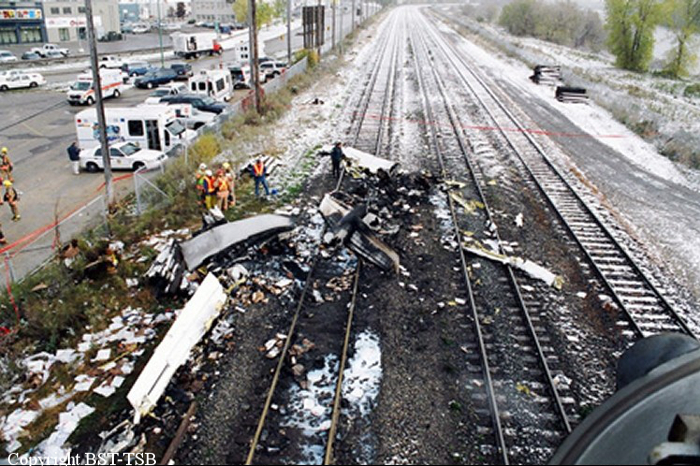
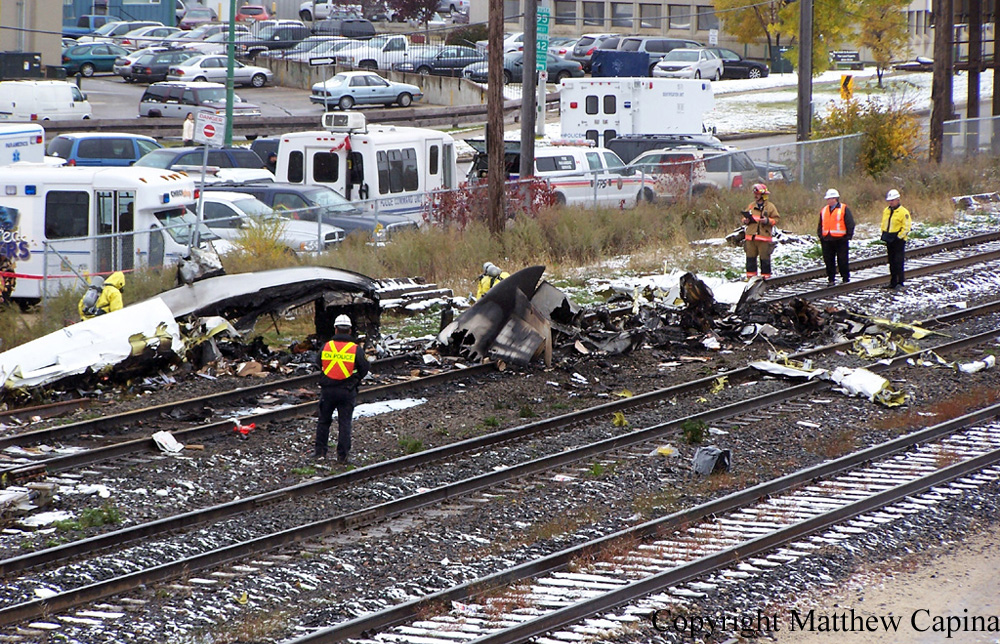
Crash of a Cessna 208B Super Cargomaster in Winnipeg: 1 killed

Date & Time: Oct 6, 2005 at 0543 LT
Type of aircraft:
Operator:
Registration:
C-FEXS
Flight Phase:
Flight Type:
Survivors:
No
Schedule:
Winnipeg – Thunder Bay
MSN:
208B-0542
YOM:
1996
Flight number:
FDX8060
Country:
Crew on board:
1
Crew fatalities:
Pax on board:
0
Pax fatalities:
Other fatalities:
Total fatalities:
1
Captain / Total flying hours:
4570
Captain / Total hours on type:
1500.00
Aircraft flight hours:
6724
Circumstances:
On the day before the occurrence, the accident aircraft arrived in Winnipeg, Manitoba, on a flight from Thunder Bay, Ontario. The aircraft was parked in a heated hangar overnight and was pulled outside at about 0410 central daylight time. The pilot reviewed the weather information and completed planning for the flight, which was estimated to take two hours and six minutes. The aircraft was refuelled and taxied to Apron V at the Winnipeg International Airport, where it was loaded with cargo. After loading was complete, the pilot obtained an instrument flight rules (IFR) clearance for the flight to Thunder Bay, taxied to Runway 36, received take-off clearance, and departed. The aircraft climbed on runway heading for about one minute to an altitude of 1300 feet above sea level (asl), 500 feet above ground level (agl). The flight was cleared to 9000 feet asl direct to Thunder Bay, and the pilot turned on course. The aircraft continued to climb, reaching a maximum altitude of 2400 feet asl about 2.5 minutes after take-off. The aircraft then started a gradual descent averaging about 400 feet per minute (fpm) until it descended below radar coverage. The accident occurred during hours of darkness at 0543. The Winnipeg Fire Paramedic Service were notified and responded from a nearby station.
Probable cause:
Findings as to Causes and Contributing Factors:
1. The aircraft departed at a weight exceeding the maximum take-off weight and the maximum weight for operation in icing conditions.
2. After departure from Winnipeg, the aircraft encountered in-flight icing conditions in which the aircraftís performance deteriorated until the aircraft was unable to maintain altitude.
3. During the attempt to return to the Winnipeg International Airport, the pilot lost control of the aircraft, likely with little or no warning, at an altitude from which recovery was not possible.
Findings as to Risk:
1. Aviation weather forecasts incorporate generic icing forecasts that may not accurately predict the effects of icing conditions on particular aircraft. As a result, specific aircraft types may experience more significant detrimental effects from icing than forecasts indicate.
2. Bulk loading prevented determining the cargo weight in each zone, resulting in a risk that the individual zone weight limits could have been exceeded.
3. The aircraftís centre of gravity (CG) could not be accurately determined, and may have been in the extrapolated shaded warning area on the CG limit chart. Although it was determined that the CG was likely forward of the maximum allowable aft CG, bulk loading increased the risk that the CG could have exceeded the maximum allowable aft CG.
4. The incorrect tare weight on the Toronto cargo container presented a risk that other aircraft carrying cargo from that container could have been inadvertently overloaded.
Other Findings:
1. The pilotís weather information package was incomplete and had to be updated by a telephone briefing.
2. The operatorís pilots were not pressured to avoid using aircraft de-icing facilities or to depart with aircraft unserviceabilities.
3. The aircraft departed Winnipeg without significant contamination of its critical surfaces.
4. The biological material on board the aircraft was disposed of after the accident, with no indication that any of the material had been released into the ground or the atmosphere.
5. The fact that the aircraft was not equipped with flight data recorder or cockpit voice recorder equipment limited the information available for the occurrence investigation and the scope of the investigation.
Final Report:

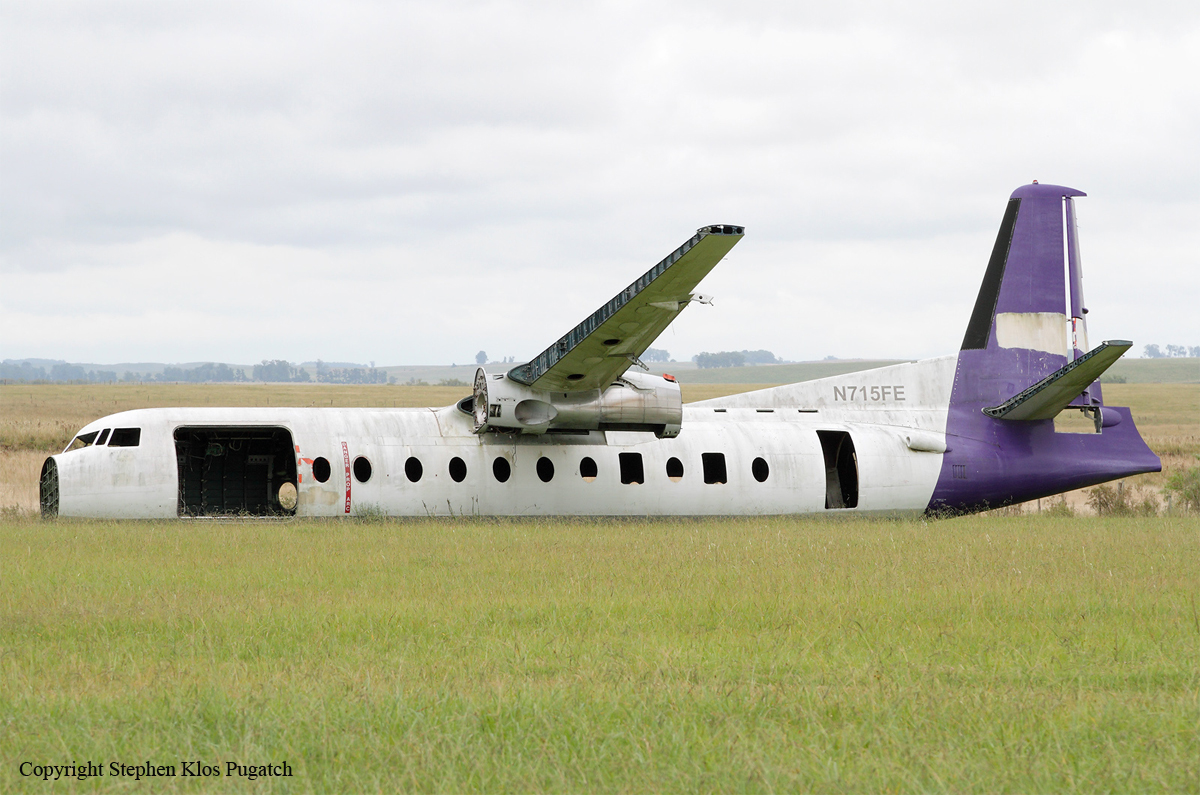
Crash of a Fokker F27 Friendship 500 in Melo

Date & Time: Apr 27, 2004 at 0415 LT
Type of aircraft:
Operator:
Registration:
N715FE
Flight Type:
Survivors:
Yes
Schedule:
Buenos Aires – Porto Alegre – Campinas
MSN:
10468
YOM:
1971
Flight number:
FDX7145
Country:
Crew on board:
3
Crew fatalities:
Pax on board:
0
Pax fatalities:
Other fatalities:
Total fatalities:
0
Circumstances:
The crew departed Buenos Aires-Ezeiza-Ministro Pistarini Airport on a night cargo service to Campinas-Viracopos with an intermediate stop in Porto Alegre. While cruising at an altitude of 17,000 feet, smoke was detected in the cargo compartment. The crew elected to extinguish the fire but without success. The crew contacted ATC, declared an emergency and attempted to divert to Montevideo Airport but ATC suggested the crew to divert to Melo which was the nearest airport. As this airfield was closed to traffic at this time, ATC contacted a night guard who switched on the runway lights and alerted the local emergency services. The aircraft landed 340 metres past the runway 07 threshold and stopped 640 metres further. The crew evacuated via the cockpit windows and was uninjured. The aircraft was damaged beyond repair.
Probable cause:
Numerous oil samples, plant tissues, and several animals that were transported, would have reacted on contact with an exothermic chemical reaction and associated combustion. The event originated with the spilling of liquid from containers not suitable for differential pressure, with little excess capacity for expansion and filled with indiscriminate materials. Low stringency in filling forms for description of product delivered for shipment in company offices and little control or careless handling of the load would have contributed to the occurrence of the accident.

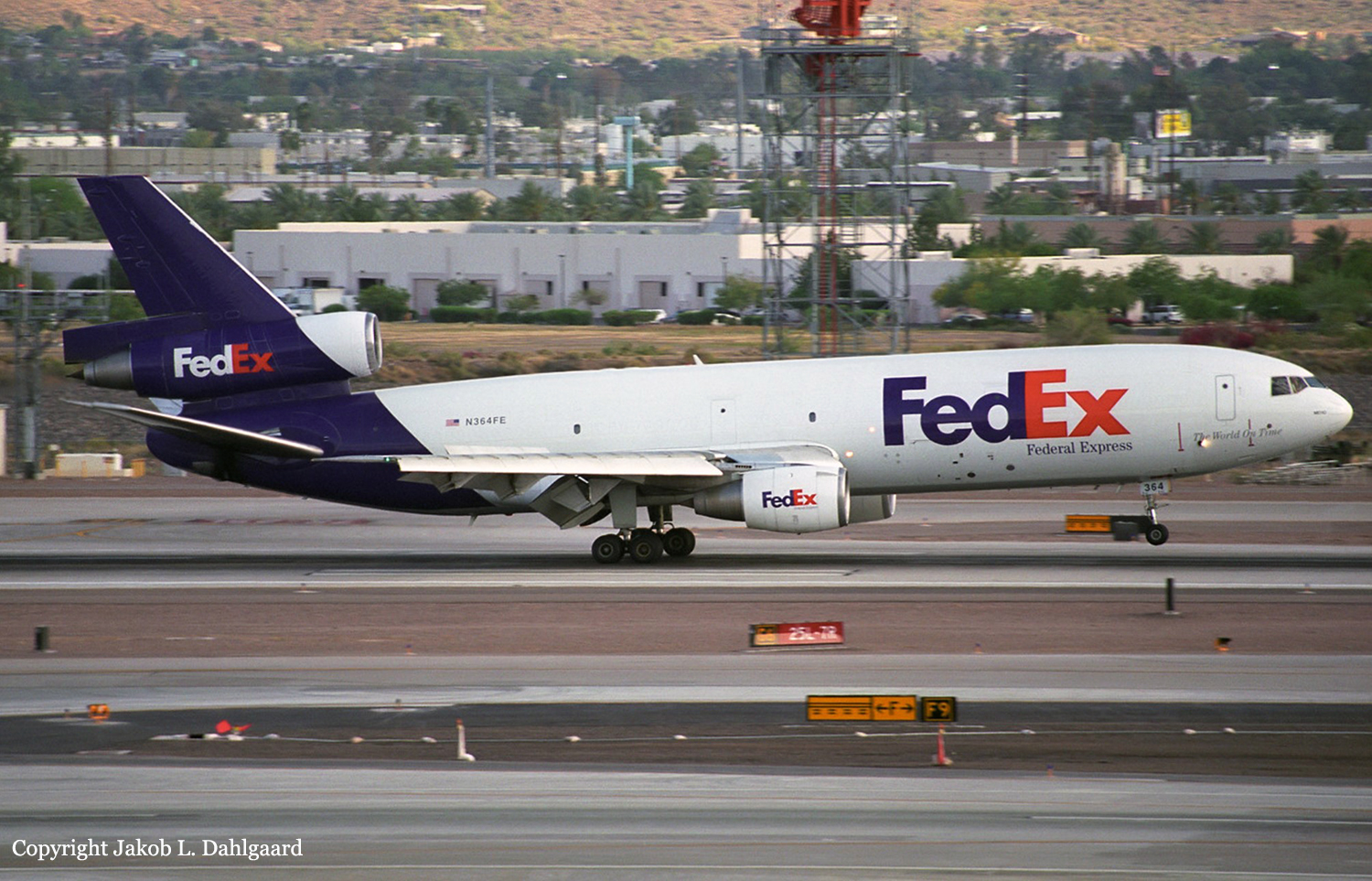
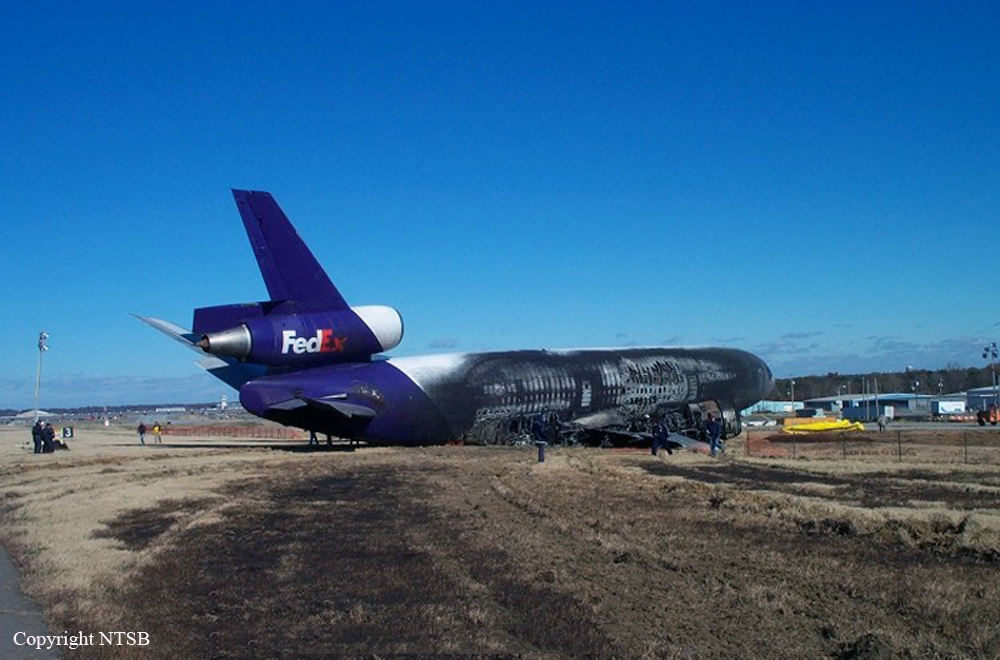
Crash of a Douglas DC-10-10 in Memphis

Date & Time: Dec 18, 2003 at 1226 LT
Type of aircraft:
Operator:
Registration:
N364FE
Flight Type:
Survivors:
Yes
Schedule:
Oakland – Memphis
MSN:
46600
YOM:
1971
Flight number:
FDX647
Crew on board:
2
Crew fatalities:
Pax on board:
5
Pax fatalities:
Other fatalities:
Total fatalities:
0
Captain / Total flying hours:
21000
Captain / Total hours on type:
2602.00
Copilot / Total flying hours:
15000
Copilot / Total hours on type:
1918
Aircraft flight hours:
65375
Aircraft flight cycles:
26163
Circumstances:
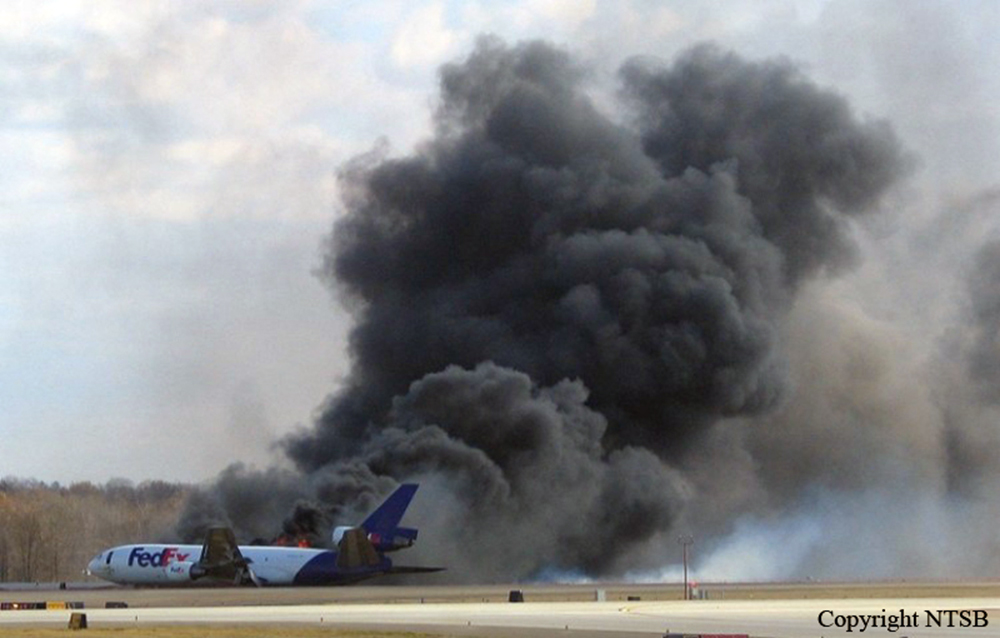
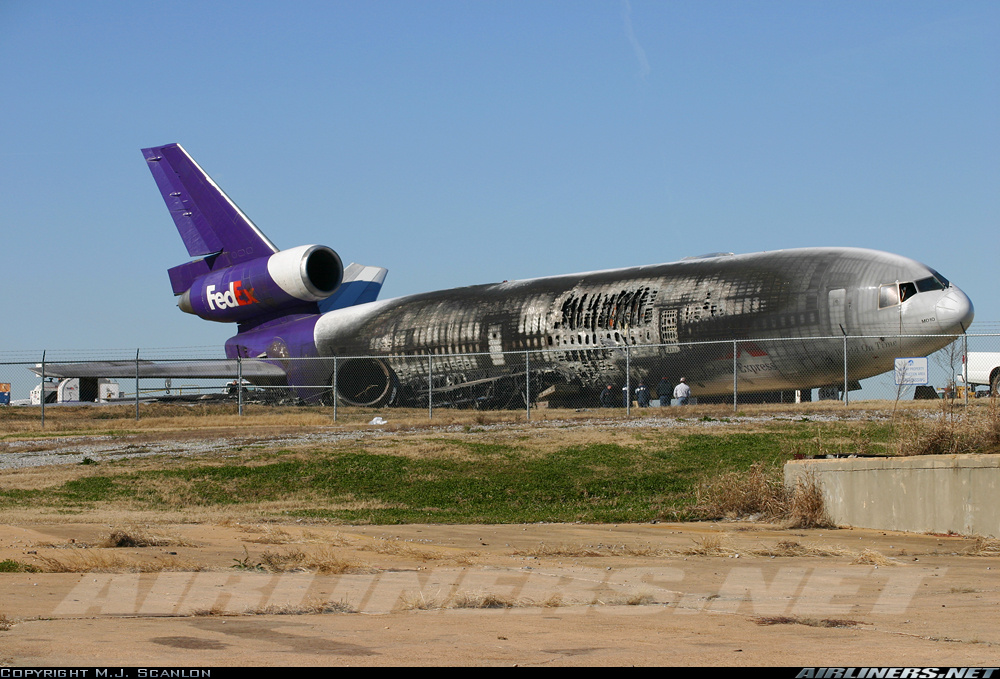
On December 18, 2003, about 1226 central standard time, Federal Express Corporation (FedEx) flight 647, a Boeing MD-10-10F (MD-10), N364FE, crashed while landing at Memphis International Airport (MEM), Memphis, Tennessee. The right main landing gear collapsed after touchdown on runway 36R, and the airplane veered off the right side of the runway. After the gear collapsed, a fire developed on the right side of the airplane. Of the two flight crewmembers and five non revenue FedEx pilots on board the airplane, the first officer and one non revenue pilot received minor injuries during the evacuation. The post crash fire destroyed the airplaneís right wing and portions of the right side of the fuselage. Flight 647 departed from Metropolitan Oakland International Airport (OAK), Oakland, California, about 0832 (0632 Pacific standard time) and was operating under the provisions of 14 Code of Federal Regulations (CFR) Part 121 on an instrument flight rules flight plan.
Probable cause:
The National Transportation Safety Board determines that the probable causes of the accident were:
1) the first officerís failure to properly apply crosswind landing techniques to align the airplane with the runway centerline and to properly arrest the airplaneís descent rate (flare) before the airplane touched down; and
2) the captain's failure to adequately monitor the first officerís performance and command or initiate corrective action during the final approach and landing.
Final Report:

Crash of a Cessna 208B Super Cargomaster in Cody: 1 killed

Date & Time: Oct 29, 2003 at 0854 LT
Type of aircraft:
Operator:
Registration:
N791FE
Flight Type:
Survivors:
No
Schedule:
Casper – Cody
MSN:
208B-0289
YOM:
1991
Flight number:
FDX8773
Location:
Crew on board:
1
Crew fatalities:
Pax on board:
0
Pax fatalities:
Other fatalities:
Total fatalities:
1
Captain / Total flying hours:
11094
Captain / Total hours on type:
5821.00
Aircraft flight hours:
6885
Aircraft flight cycles:
6599
Circumstances:
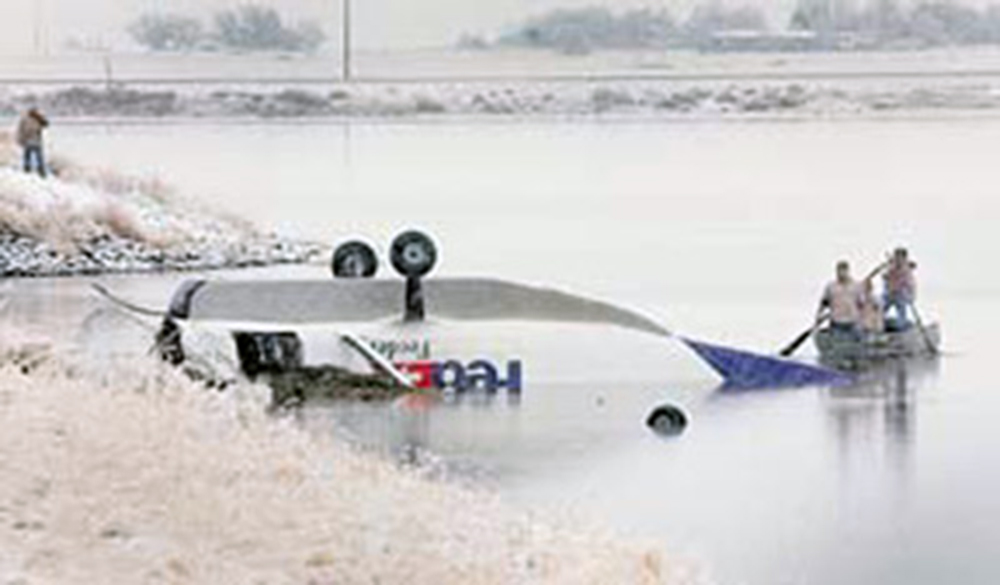
ARTCC asked the pilot of Airspur 8773 if he would be able to execute the VOR instrument approach. The pilot said he could, but he wanted to "hold for a while to see if [the weather] gets a little better" [according to the METAR, visibility was 1.75 statute miles and there was a 200-foot overcast ceiling]. He was cleared to hold north of the VOR at 12,000 feet msl. While holding, the pilot filed the following PIREP indicating light rime icing. Shortly thereafter, he was cleared for the approach. Three witnesses saw the airplane on the downwind leg, just past midfield, at an estimated altitude of 500 feet. Shortly thereafter, one of them heard the engine "spool up to high power...[like reversing] the pitch of the propeller to slow down," and he thought the airplane had landed. Five witnesses said the airplane emerged from the overcast and banked "sharply to the left, then back to the right, then back to the left, then took a hard bank to the right," rolled inverted and struck the highway just south of the airport perimeter. The airplane slid down the embankment and out into a lake, becoming partially submerged. Witnesses said it was "snowing hard" and the highway was covered with 1 to 2 inches of slush. Wreckage examination revealed the flaps were down 30 degrees, the wing deice boots were "ribbed," and the inertial separator was open. According to the toxicological report, chlorpheniramine, desmethylsertraline, sertraline, and pseudoephedrine were detected in blood. In addition, chlorpheniramine, sertraline, phenylpropanolamine, and pseudoephedrine were detected in the urine. The urine also contained acetaminophen. Sertraline (trade name Zoloft) is a prescription antidepressant medication. According to the Guide for Aviation Medical Examiners, "The use of a psychotropic medication is considered disqualifying. This includes all... antidepressant drugs..." Chlorpheniramine is an over-the-counter sedating antihistamine used primarily for the treatment of allergies. Pseudophedrine (trade name Sudafed) is a decongestant. Acetaminophen (trade name Tylenol) is an over-the-counter pain reliever and fever-reducer. According to Dr. Stanley R. Mohler's "Medication and Flying: A Pilot's Guide," the adverse side effects of chlorpheniramine include drowsiness, dizziness, and lessened coordination. The side effects of pseudophedrine are usually mild and infrequent, but may include sleepiness, dizziness, restlessness, headache, and perhaps some loss of coordination and alertness or confusion.
Probable cause:
The pilot's failure to maintain aircraft control. Contributing factors include the pilot's failure to divert to an alternate airport, an inadvertent stall, and the snow and icing conditions.
Final Report: