Crash of an Avro 683 Lancaster on the Mt Beinn Eighe: 8 killed

Date & Time: Mar 14, 1951 at 0225 LT
Type of aircraft:
Operator:
Registration:
TX264
Flight Phase:
Flight Type:
Survivors:
No
Site:
Schedule:
Kinloss - Kinloss
Region:
Crew on board:
8
Crew fatalities:
Pax on board:
0
Pax fatalities:
Other fatalities:
Total fatalities:
8
Circumstances:
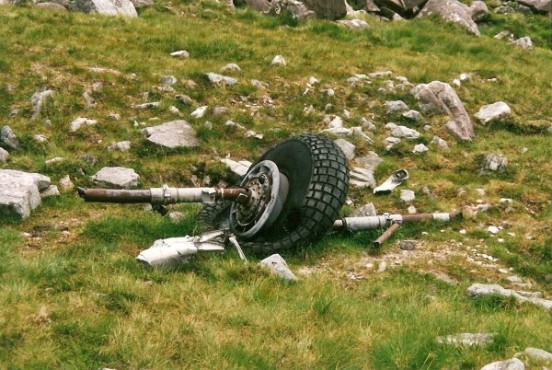
The aircraft left RAF Kinloss at 1800LT on March 13 for a night navigation training exercise. Some 6 1/2 hours after leaving Kinloss, the crew reported that they were approximately 60 miles to the North of Cape Wrath. After this point there was no further radio contact with aircraft, as by the following morning the aircraft had failed to return to base or land at another airfield a search was initiated. This was carried out by numerous aircraft from airfields in Scotland but there were no sightings. On the 17th March as report was received that a red flash had been seen in the Torridon area around the time the aircraft disappeared. An aerial search of the Torridon mountains was carried out and the burnt out wreckage of air aircraft was spotted high on the northern side of Beinn Eighe at the top of the cliffs of the Triple Buttress. Ground units set out to attempt to reach the site to confirm that is was the missing Lancaster but could not reach the site due to deep lying snow and further poor weather, together with a lack of suitable equipment. It was the end of March before members of the RAF Mountain Rescue Team from Kinloss were able to reach the wreck to begin the task of recovering the bodies of the crew. The recovery of the last missing airmen was not carried out until August 1951 when enough snow had melted to uncover his body.
Crew (120th Squadron):
Fl/Lt Harry Smith Reid, pilot,
Sgt Ralph Clucas, copilot,
Sgt Robert Strong, navigator,
Sgt Peter Tennison, signaller,
Sgt James Naismith, signaller,
Sgt Wilfred D. Beck, signaller,
Sgt James W. Bell, signaller,
Sgt George Farquhar, signaller.
Source and photo:
http://www.peakdistrictaircrashes.co.uk/crash_sites/scotland/avro-lancaster-tx264-beinn-eighe/

Crash of an Avro 683 Lancaster GR.3 in RAF Kinloss: 5 killed

Date & Time: Jan 12, 1950
Type of aircraft:
Operator:
Registration:
SW363
Flight Phase:
Flight Type:
Survivors:
No
Schedule:
Kinloss - Kinloss
Region:
Crew on board:
5
Crew fatalities:
Pax on board:
0
Pax fatalities:
Other fatalities:
Total fatalities:
5
Circumstances:
Shortly after takeoff, while in initial climb, the aircraft went out of control and crashed in flames. All five crew members were killed.
Crew (236th OCU):
F/Lt Richard Gwynn Williams,
F/Lt Leslie George Harris,
F/Lt Alfred Enos Stephens,
Nav John Cunningham,
Sig Ernest Geal.
Probable cause:
The exact cause of the accident could not be determined with certainty. However, it was reported by the crew at the end of the preceding flight that it smelled fuel in the cabin. Also, it was stated that the aircraft was already on fire on takeoff. The assumption that a spark occurred during takeoff and created a fire when contacting with fuel vapors was not ruled out.

Crash of an Avro 683 Lancaster III in RAF Kinloss: 8 killed

Date & Time: Aug 23, 1948
Type of aircraft:
Operator:
Registration:
SW361
Flight Type:
Survivors:
No
Schedule:
Kinloss - Kinloss
Region:
Crew on board:
8
Crew fatalities:
Pax on board:
0
Pax fatalities:
Other fatalities:
Total fatalities:
8
Circumstances:
The crew was completing a training sortie in RAF Kinloss. The final approach was completed in heavy cross winds (up to 50 knots) and during the last segment, the captain decided to abandon the landing procedure and started a go around maneuver. During initial climb, while at a height of 250 feet, the four engine aircraft went out of control and crashed in a huge explosion. All eight crew members were killed.
Probable cause:
The exact cause of the accident remains unknown but it is possible that the pilot lost control of the aircraft due to the heavy cross winds.

Crash of an Avro 683 Lancaster III in Tain

Date & Time: Feb 17, 1948 at 1740 LT
Type of aircraft:
Operator:
Registration:
SW326
Flight Phase:
Flight Type:
Survivors:
Yes
Schedule:
Kinloss - Kinloss
Region:
Crew on board:
5
Crew fatalities:
Pax on board:
0
Pax fatalities:
Other fatalities:
Total fatalities:
0
Circumstances:
The crew (236th OCU) was engaged in a night training sortie from RAF Kinloss. While flying in the vicinity of Tain, the aircraft went out of control and crashed in flames in a prairie. All five crew members were injured while the aircraft was destroyed.

Crash of an Avro 652 Anson I on Mt Turf Law: 3 killed

Date & Time: Feb 1, 1945 at 1543 LT
Type of aircraft:
Operator:
Registration:
NK945
Flight Phase:
Flight Type:
Survivors:
No
Site:
Schedule:
Kinloss - Kinloss
Region:
Crew on board:
3
Crew fatalities:
Pax on board:
0
Pax fatalities:
Other fatalities:
Total fatalities:
3
Circumstances:
While flying in a snowstorm, the twin engine aircraft hit the slope of Mt Turf Law located in the Lammermuir Hills, Huddingtonshire. All three crew members were killed.
Crew:
F/Lt Ronald Cameron Ferguson, pilot,
F/Lt Václav Jícha, pilot,
F/O Arthur Scarlett Davidson, flight engineer.

Crash of a Handley Page H.P.57 Halifax II near Keswick: 2 killed

Date & Time: Jan 24, 1944
Operator:
Registration:
JP182
Flight Phase:
Flight Type:
Survivors:
No
Site:
Schedule:
Kinloss - Kemble
Location:
Region:
Crew on board:
2
Crew fatalities:
Pax on board:
0
Pax fatalities:
Other fatalities:
Total fatalities:
2
Circumstances:
Crew was performing a ferry flight from RAF Kinloss to RAF Kemble, Wiltshire. En route, while cruising at low altitude, aircraft hit Mt Crag located near Keswick. Both crew were killed.

Crash of an Armstrong Whitworth AW.38 Whitley V near Dalwhinnie: 5 killed

Date & Time: Jul 3, 1943 at 2350 LT
Operator:
Registration:
LA877
Flight Phase:
Flight Type:
Survivors:
No
Site:
Schedule:
Kinloss - Kinloss
MSN:
2915
YOM:
1942
Region:
Crew on board:
5
Crew fatalities:
Pax on board:
0
Pax fatalities:
Other fatalities:
Total fatalities:
5
Circumstances:
The aircraft was being used for a screened bombing exercise followed by a cross country navigation exercise. The crew took off from Forres on the Moray coast, a satellite of RAF Kinloss, at 2230LT for the practice bombing portion of the exercise, which they completed and landed back at Forres at 2320LT where the instructor left the aircraft. The next part of the flight was to be the crew’s first cross country exercise without an instructor onboard, they took off again at 2335LT for the second part of their flight, which was to be Kinloss – Gigha – Douglas – Gigha – Kinloss. At 2355LT it was seen by a Royal Observer Corps post on the ground and its track was plotted at Dalwhinnie, at this point it was flying normally at about 9,000 feet to the northern side of Loch Ericht. At 0003LT while towards the south western end of Loch Ericht black smoke was seen coming from the aircraft and it made an 80° turn to starboard. Fire was observed shortly afterwards and soon this had clearly taken hold and caused serious structural damage to aircraft. The port wing broke away after which the aircraft went into an uncontrolled dive.
Crew:
Sgt Dennys Cyril Hunt, pilot,
Sgt Edwin Albert Deacon, navigator,
F/Sgt Donald James Gillies, bomb aimer,
Sgt Robert Norman Cowie, wireless operator,
Sgt Keith Pratt Gemmel, air gunner.
Source: https://www.peakdistrictaircrashes.co.uk/crash_sites/scotland/armstrong-whitworth-whitley-la877-meallan-odhar/
Probable cause:
The AIB inspector who was tasked with investigating the crash stated that the wing showed clear signs of having been subjected to fire before it failed. It fell half a mile away from the main wreckage which struck the ground at a steep angle and was completely destroyed. At the request of the investigating officer the port engine was excavated from the crash site and sent to Rolls Royce who examined it. They said that there been a failure of one of the pistons with hot gases passing beyond the piston rings of that piston which caused the gudgeon pin to fail and the connecting rod to break away which then broke through the crank case. This allowed a fuel/air mixture as well as engine oil to escape under pressure into the nacelle were it ignited and in less than one minute caused the failure of the forward wing spar and lower skin of the port wing. A number of other Whitleys were lost in almost identical circumstances around the same time, with engine fires leading to structural failure of the affected wing. If it was at a high enough altitude this was usually followed by break-up of the whole aircraft.

Crash of an Armstrong Whitworth AW.38 Whitley V near Nairn: 5 killed

Date & Time: May 17, 1943 at 0200 LT
Operator:
Registration:
BD295
Flight Phase:
Flight Type:
Survivors:
Yes
Site:
Schedule:
Kinloss - Kinloss
MSN:
2602
YOM:
1942
Region:
Crew on board:
7
Crew fatalities:
Pax on board:
0
Pax fatalities:
Other fatalities:
Total fatalities:
5
Circumstances:
The airplane departed RAF Kinloss on a night navigation exercise. While cruising at low altitude in limited visibility, it impacted the slope of a mountain in Cawdor Moor, near Nairn. Three crew members were seriously injured while four others were killed. Two days later, one of the survivor died from injuries sustained.
Crew (19th OTU):
F/Lt Raymond Wilson Pitts McFarland, pilot,
Sgt Kenneth Johnson Sampson, pilot, †
F/O Alexander Chalmers Barrie, navigator, †
Sgt Ronald Hartley, air bomber, †
F/Sgt Arthur Thomas Hawkins, wireless operator and air gunner, †
Sgt Ronald Alfred Hartwell, wireless operator and air gunner, †
Sgt Padley, air gunner.
Probable cause:
Controlled flight into terrain.

Crash of an Avro 652 Anson I on Mt Cross Fell

Date & Time: Feb 18, 1943 at 0945 LT
Type of aircraft:
Operator:
Registration:
DJ453
Flight Phase:
Flight Type:
Survivors:
Yes
Site:
Schedule:
Kinloss – Kirkbride
Region:
Crew on board:
5
Crew fatalities:
Pax on board:
0
Pax fatalities:
Other fatalities:
Total fatalities:
0
Circumstances:
En route from RAF Kinloss to RAF Kirkbride and while flying over the Pennines Mountain Range, east of Penrith, the pilot encountered poor weather conditions with icing. He decided to modify his route, passing via the Alston valley. Few minutes later, while cruising in limited visibility, the twin engine airplane impacted the slope of Mt Cross Fell then slid for few dozen meters and came to rest. All five crew members were injured.
Crew (4th AOS):
Sgt Victor Henry Hill, pilot,
Sgt W. C. A. Hughes,
Lac L. V. Fussell,
Lac A. D. Walker,
Lac J. Henbury.
Probable cause:
Controlled flight into terrain.

Crash of an Avro 652 Anson I on Mt Ben Macdui: 5 killed

Date & Time: Aug 21, 1942
Type of aircraft:
Operator:
Registration:
DJ106
Flight Phase:
Flight Type:
Survivors:
No
Site:
Schedule:
Kinloss - Kinloss
Region:
Crew on board:
5
Crew fatalities:
Pax on board:
0
Pax fatalities:
Other fatalities:
Total fatalities:
5
Circumstances:
The crew departed RAF Kinloss on a cross country navigation exercise. While cruising in limited visibility, the twin engine airplane impacted the slope of Mt Ben Macdui (1,309 metres high) located about 17 km northwest of Braemar. The airplane disintegrated on impact and all five occupants were killed.
Crew:
Sgt John Llewelyn, pilot,
F/Sgt Geoffrey Fillingham, observer,
P/O William Gilmour, navigator,
Sgt Kenneth Edmondson Carruthers, wireless operator,
Sgt John Beaton Robertson, air gunner.
Probable cause:
Controlled flight into terrain.