Crash of a Boeing C-97A Stratofreighter into the Pacific Ocean: 7 killed

Date & Time: Jan 19, 1958
Operator:

Registration:
49-2597
Flight Phase:
Flight Type:
Survivors:
No
Schedule:
Travis – Hickam – Wake Island – Tokyo
MSN:
16219
YOM:
1949
Country:
Region:
Crew on board:
7
Crew fatalities:
Pax on board:
0
Pax fatalities:
Other fatalities:
Total fatalities:
7
Circumstances:
The crew was performing a flight from Travis AFB to Tokyo with intermediate stops at Hickam (Hawaii) and Wake Island. On the leg from Hawaii to Wake Island, the airplane crashed into the ocean in unknown circumstances. SAR operations were conducted for several days but eventually suspended as no trace of the aircraft nor the crew was ever found. The last position of the airplane was reported 375 miles southwest of Honolulu.

Crash of a Fairchild C-119G Flying Boxcar into the Pacific Ocean: 1 killed

Date & Time: Nov 9, 1955
Operator:
Registration:
52-5891
Flight Phase:
Flight Type:
Survivors:
Yes
Schedule:
Pope – McClellan – Hickam – Tachikawa
MSN:
11058
YOM:
1952
Country:
Region:
Crew on board:
5
Crew fatalities:
Pax on board:
0
Pax fatalities:
Other fatalities:
Total fatalities:
1
Circumstances:
The crew was completing a flight from Pope AFB to Tachikawa with intermediate stops at McClellan AFB and Hickam AFB. While cruising about 1,046 km northeast of Hickam AFB, a propeller blade failed. As the crew was unable to feather the propeller, they decided to bail out and abandoned the airplane that crash into the ocean. A crew member was killed while four others were rescued.
Probable cause:
Propeller blade failure in flight.

Crash of a Douglas R6D-1 on Mt Waianae: 66 killed

Date & Time: Mar 22, 1955 at 0203 LT
Type of aircraft:
Operator:
Registration:
131612
Flight Type:
Survivors:
No
Site:
Schedule:
Tokyo – Hickam – Travis
MSN:
43715
YOM:
1953
Crew on board:
6
Crew fatalities:
Pax on board:
60
Pax fatalities:
Other fatalities:
Total fatalities:
66
Circumstances:
The four engine aircraft was completing a personnel transfer flight from Tokyo to Travis AFB, California, with an intermediate stop at Hickam AFB, Honolulu. Few minutes after his departure from Hickam Field, the pilot informed ground he encountered technical issues with the high frequency transmission system and elected to return for a safe landing. Approaching by night from the northwest, the aircraft hit the slope of Mt Waianae located about 18 miles from the airfield. The aircraft disintegrated on impact and all 66 occupants were killed.
Crew:
Lt Cdr Harold M. Oleary, pilot,
Lt Cdr Mark M. Teague, copilot,
Lt Lee A. Thoroux, navigator,
Ad1 Charles L. Osborne,
At3 Charles M. Preston,
An James B. Quinn Jr.
Passengers:
US Air Force Personnel:
T/Sgt Albert E. Dawsey
T/Sgt John T. Powell,
T/Sgt Roland B. Wilhelm,
S/Sgt Samuel J. Alvarado,
S/Sgt William F. Britt,
S/Sgt Carlyle J. Hummel,
S/Sgt Eugene L. Lofton,
S/Sgt Thaddeus F. Shyda,
A1c Willie G. Harrell,
A1c Milton O. Matthews,
A1c Aubrey G. Morgan,
A1c Earl G. Sisson,
A1c Alvin Alxander,
A2c John D. Anthony,
A2c David L. Boyle,
A2c Stanley B. Horton,
A3c Daniel K. Eaton.
US Army:
Cpl Donald B. Anderson,
Pfc Paul B. Bayer,
Cpl Dean C. Bullen,
Pvt Robert E. Delhager,
Sgt Raymond L. Smith,
Sgt Robert L. Thompson,
Sgt Rexie L. Dewesse,
Sgt Larry P. Dieuolo,
Pfc Robert G. Duncan,
Cpl Edward J. Halvey Jr.,
Cpl William B. Hendon,
Pfc Robert E. Hill,
Cpl Kenneth G. Hoffman,
Cpl David A. Horne,
Pvt Charles J. Combs,
Sgt Warren R. Huler,
Pfc John R. Irwin Jr.,
Pvt Charles M. Johnson,
Pfc Bernard J. Kuras,
Pvt Louis F. Montanez,
Pvt John R. Panetti,
Sgt James L. White.
US Marine Corps:
M/Sgt Frederick L. Williamson,
M/Sgt Eugene E. Bennett,
Cpl Richard C. Harrison,
Lt Col C. G. Edwards,
M/Sgt Gordon B. Murray,
S/Sgt Morgan L. Ogden,
Cpl Walter W. Chase,
Cpl Dale L. Lake,
Cpl Michael J. Meszaros,
Cpl Almeron Freeman,
Cpl Cecil A. Brittain,
Cpl Richard R. Brooks.
US Navy:
An Charles Wayne Enloe,
Na William Richard Rimer,
Sa Gerald Joseph Robichaux,
Ae3 Alfred Dewey Schroeder,
Charles Edward Sheehan,
Te1 Nathan Webb,
Mrs. Rita Laverne Webb and her daughter,
Gerald Dean White.
Probable cause:
It was determined that the aircraft was off course about 8 miles at the time of the accident, apparently due to a navigation error on part of the flying crew who failed to adhere to the approach procedures. Low visibility caused by night, clouds and rain falls was considered as a contributing factor.

Crash of a Boeing RB-50G Superfortress in Offutt AFB: 5 killed

Date & Time: Feb 26, 1952 at 0200 LT
Type of aircraft:
Operator:
Registration:
47-152
Flight Type:
Survivors:
Yes
Schedule:
Hickam - Offutt
MSN:
15836
YOM:
1947
Crew on board:
4
Crew fatalities:
Pax on board:
17
Pax fatalities:
Other fatalities:
Total fatalities:
5
Circumstances:
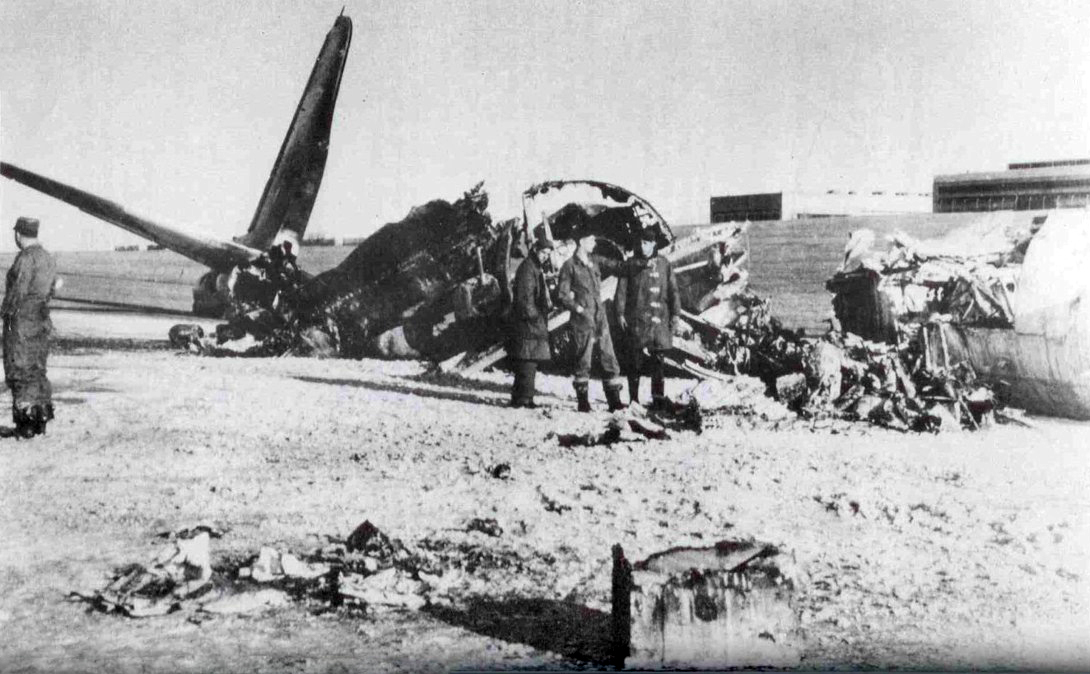
On final approach by night, the heavy bomber was too low when it hit a mound of dirt and crashed in a fiery explosion few dozen yards short of runway threshold. Five occupants were killed while 12 others were injured, some of them seriously. The aircraft was destroyed by fire.

Crash of a Boeing B-29-40-BW Superfortress at Hickam AFB: 16 killed

Date & Time: Aug 24, 1948 at 1938 LT
Type of aircraft:
Operator:
Registration:
42-24641
Flight Type:
Survivors:
Yes
Schedule:
Barbers Point – Kwajalein – Kadena
MSN:
4302
YOM:
1942
Crew on board:
20
Crew fatalities:
Pax on board:
0
Pax fatalities:
Other fatalities:
Total fatalities:
16
Circumstances:
Shortly after takeoff from Barbers Point NAS, bound for Kadena via Kwajalein, the pilot informed ground that an engine failed and elected to return. ATC guided the crew to Hickam Field in Honolulu and eight minutes later, while on approach, the airplane overshot so the pilot-in-command decided to make a go around when control was lost. The airplane crashed in flames and skidded for about 600 yards before coming to rest in flames. Sixteen crew members were killed while four others were injured.
Probable cause:
Engine failure.

Crash of a Boeing B-17G-110-BO Fortress into the Pacific Ocean: 3 killed

Date & Time: Aug 16, 1947
Operator:
Registration:
43-39465
Flight Phase:
Flight Type:
Survivors:
Yes
Schedule:
Tokyo – Honolulu – Los Angeles – Washington DC
MSN:
10443
Country:
Region:
Crew on board:
4
Crew fatalities:
Pax on board:
9
Pax fatalities:
Other fatalities:
Total fatalities:
3
Circumstances:
While approaching the Hawaiian coast of Oahu Island on a flight from Tokyo, the crew encountered a fuel exhaustion and was forced to ditch the aircraft about 60 miles west of Hickam Field where it should land. Ten people were rescued while three others were killed, among them George Acheson, personal advisor of General McArthur and President of the Allied Council in Japan.
Probable cause:
Fuel exhaustion.

Crash of a Douglas C-47A-15-DK in the Pacific Ocean: 5 killed

Date & Time: Apr 2, 1944
Operator:
Registration:
42-92815
Flight Phase:
Flight Type:
Survivors:
No
Schedule:
Fairfield AFB - Hickam AFB
MSN:
12657
YOM:
1944
Country:
Region:
Crew on board:
5
Crew fatalities:
Pax on board:
0
Pax fatalities:
Other fatalities:
Total fatalities:
5
Circumstances:
The aircraft left Fairfield-Saisun AFB in California at 0237LT on a flight to Hickam Field, Honolulu, with a crew of five on board. At 0805LT (PST), the last radio contact was heard. As the aircraft never arrived at destination, SAR operations were conducted and eventually suspended one week later on April 9, 1944. No trace of the aircraft nor the crew was ever found.

Crash of a Douglas C-47A-40-DL into the Pacific Ocean: 14 killed

Date & Time: Oct 20, 1943
Operator:
Registration:
42-23965
Flight Phase:
Flight Type:
Survivors:
No
Schedule:
Hickam - Palmyra Island
MSN:
9827
YOM:
1943
Country:
Region:
Crew on board:
6
Crew fatalities:
Pax on board:
8
Pax fatalities:
Other fatalities:
Total fatalities:
14
Circumstances:
En route from Hickam AFB (Honolulu) to Cooper Airfield on Palmyra Atoll, the aircraft disappeared into the ocean while approaching Palmyra. As the aircraft did not arrive, SAR operations were conducted but eventually suspended few days later as no trace of the aircraft nor the 14 crew members was found. The last radio contact with the crew reported a position about 80 km northeast of Palmyra Atoll.
Crew:
Lt Col James P. Barr Jr.,
Maj Elmer C. Best,
1st Lt Charles F. Bowers,
Cpt Jack E. Copeland,
S/Sgt Raymond G. Curtis,
T/Sgt Thomas W. Graves,
1st Lt William H. Henderson,
S/Sgt Carmelo A. Lauricella,
2nd Lt Vincent Leonard,
Cpt Floyd S. Lewis,
Cpt George H. McIlwain,
Cpt Marvin F. Stahl,
Pfc Louis A. Tomasulo,
1st Lt John J. Zidzik.

Crash of a Boeing B-17D Flying Fortress in the Pacific Ocean: 1 killed

Date & Time: Oct 21, 1942
Operator:
Registration:
40-3089
Flight Phase:
Flight Type:
Survivors:
Yes
Schedule:
Hickam - Topham
MSN:
2117
YOM:
1940
Country:
Region:
Crew on board:
6
Crew fatalities:
Pax on board:
2
Pax fatalities:
Other fatalities:
Total fatalities:
1
Circumstances:
The airplane departed Hickam Field AFB, Hawaii, on a special mission to Australia, with a intermediate stop in Topham, Canton Island. On board were eight crew members, among them Edward V. 'Eddie' Rickenbacker, WWI flyer ace, who was sent on a tour of the Pacific theater to review conditions, operations, and to personally deliver a secret message from President Roosevelt to General MacArthur. After takeoff from Hawaii, the airplane went off course due to a navigation error caused by an out-of-adjustment celestial navigation instrument, a bubble octant that gave a systematic bias to all of its readings. That octant reportedly had suffered a severe shock in a pre-takeoff mishap during the first attempt to takeoff in a different bomber, but the landing gear's brakes seized mid-takeoff. The navigator kept the same damaged bubble octant which caused the navigational failure. The plane's aircraft commander was forced to ditch close to Japanese-held islands but the Americans were never spotted by Japanese patrol planes. The USAAF and USN searched for more than two weeks, but failed to find anything. Rickenbacker's wife convinced them to extend the search another week. The press reported that Rickenbacker had died. The seven crew used two life rafts. Rickenbacker still suffered from the airplane crash, his friend sustained serious injuries in the water landing, and others in the crew were hurt to varying degrees. The crew's food supply ran out after three days. They drifted at sea without food or water aside from an occasional fish and rain. On the eighth day a seagull landed on Rickenbacker's head, he caught it and the men meticulously divided it equally and used some for fishing bait. On the thirteenth day, one of the crew died and was buried at sea, leaving only six survivors. Rickenbacker assumed a role of leadership, encouragement, and browbeating to help the others survive, and encouraged them to turn to the Lord for solace. According to Rickenbacker, each person on the rafts converted to Christianity after the experience. Three of the survivors decided to separate and departed together. They found a small island, close to another, inhabited one. The natives of the second one were hosting an allied radio station. They were taken to an English missionary on the island, until rescued by a US Navy tender. On the seventeenth day, the other survivors saw an aircraft, but it failed to spot them. More planes were spotted on the eighteenth and nineteenth days, but they failed to spot them. US Navy pilots located the surviving crew members off the coast of Island X near Samoa. A Navy patrol plane spotted the captain on the evening of the twenty-first day, 12NOV42 and a PT Boat rescued him. Twenty-two days after the crash, 13NOV42 an OS2U Kingfisher crew spotted the raft with Rickenbacker and two other crew members off the coast of Nukufetau in Tuvalu and landed. Already dark, the Kingfisher loaded one inside the cockpit. Rickenbacker and the other crew member were strapped to the wing. The Kingfisher taxied on the surface for more than thirty minutes to a nearby PT Boat, where they were transferred. Rickenbacker completed his assignment and delivered MacArthur's secret message.
Source: Joe Baugher.
Crew:
Cpt William Cherry Jr., pilot,
2nd Lt James C. Whittaker, copilot,
Lt John J. DeAngelis, navigator,
Sgt Alexander T. Kaczmarczyk, navigator, †
Sgt James W. Reynolds, radio operator,
Pvt John F. Bartek, flight engineer.
Passengers:
Col Hans C. Adamson,
Cpt Edward V. 'Eddie'Rickenbacker.
Probable cause:
Ditched in the sea following a navigational error caused by an out-of-adjustment celestial navigation instrument, a bubble octant that gave a systematic bias to all of its readings.

Crash of a Martin B-26 Marauder at Hickam AFB

Date & Time: Oct 1, 1942
Type of aircraft:
Operator:
Registration:
40-1397
Flight Phase:
Survivors:
Yes
Schedule:
Hickam - Hickam
MSN:
1397
YOM:
1940
Crew on board:
0
Crew fatalities:
Pax on board:
0
Pax fatalities:
Other fatalities:
Total fatalities:
0
Circumstances:
Crashed for unknown reasons while taking off from Hickam Field, Honolulu. There were no casualties.