Crash of a Boeing RB-29A-70-BN Superfortress in Carswell AFB: 4 killed

Date & Time: Aug 14, 1950
Type of aircraft:
Operator:
Registration:
44-62296
Flight Type:
Survivors:
Yes
MSN:
11773
YOM:
1944
Crew on board:
12
Crew fatalities:
Pax on board:
0
Pax fatalities:
Other fatalities:
Total fatalities:
4
Circumstances:
On final approach to Carswell AFB, the airplane crashed in flames for unknown reason. Four crew members were killed while eight others were rescued. The plane was assigned to 324th Strategic Reconnaissance Squadron, 91st Strategic Reconnaissance Group.
Those killed were:
Cpt Bernard J. McKenna, navigator,
1st Lt Michael J. Joyce, navigator,
1st Lt William Nicholson, navigator,
1st Lt Armand S. Trepanier, observer.

Crash of a Boeing B-29MR-85-BW Superfortress in Fairfield AFB: 19 killed

Date & Time: Aug 5, 1950 at 2200 LT
Type of aircraft:
Operator:
Registration:
44-87651
Flight Phase:
Flight Type:
Survivors:
Yes
MSN:
12454
YOM:
1944
Crew on board:
20
Crew fatalities:
Pax on board:
0
Pax fatalities:
Other fatalities:
Total fatalities:
19
Circumstances:
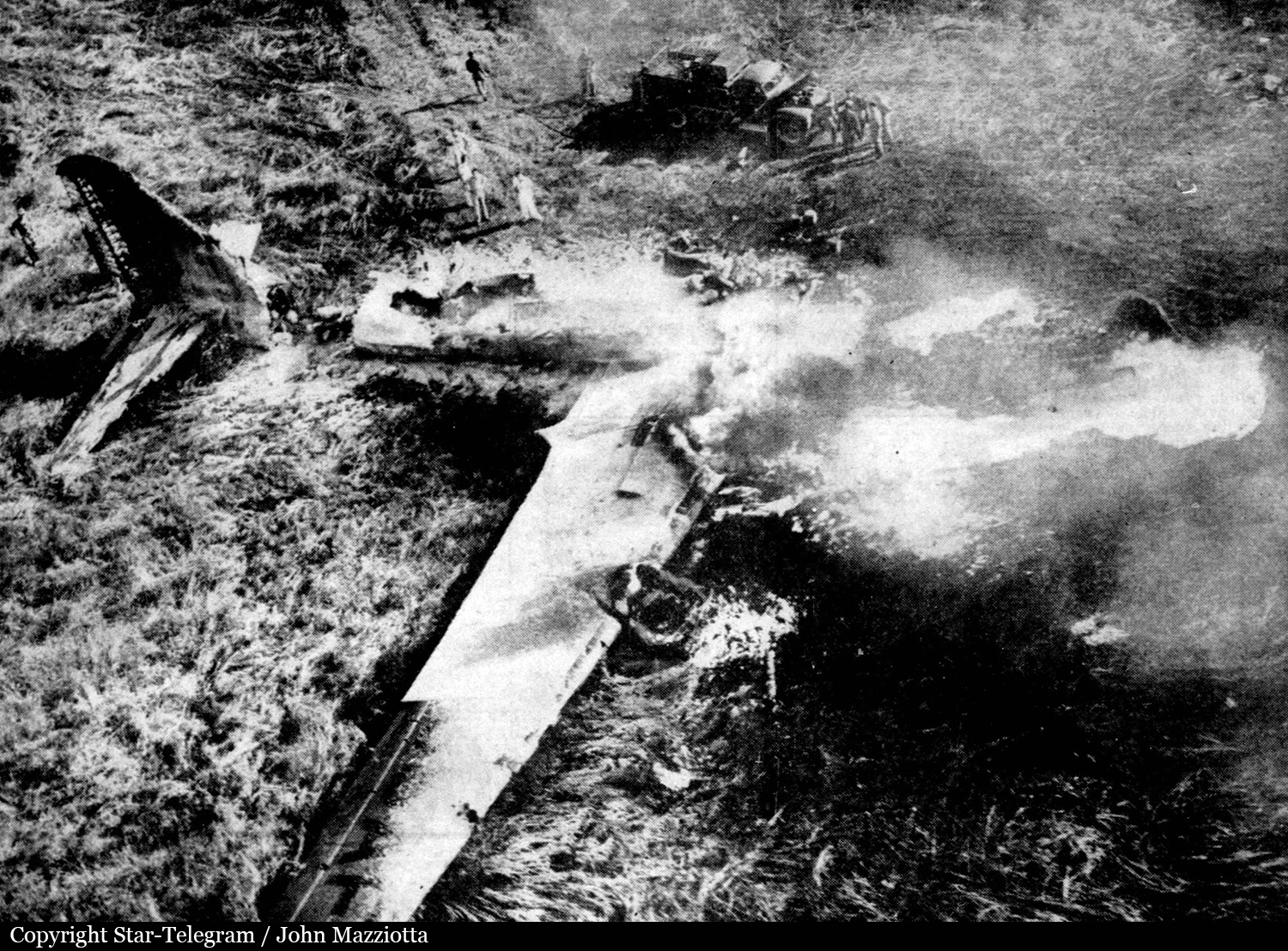
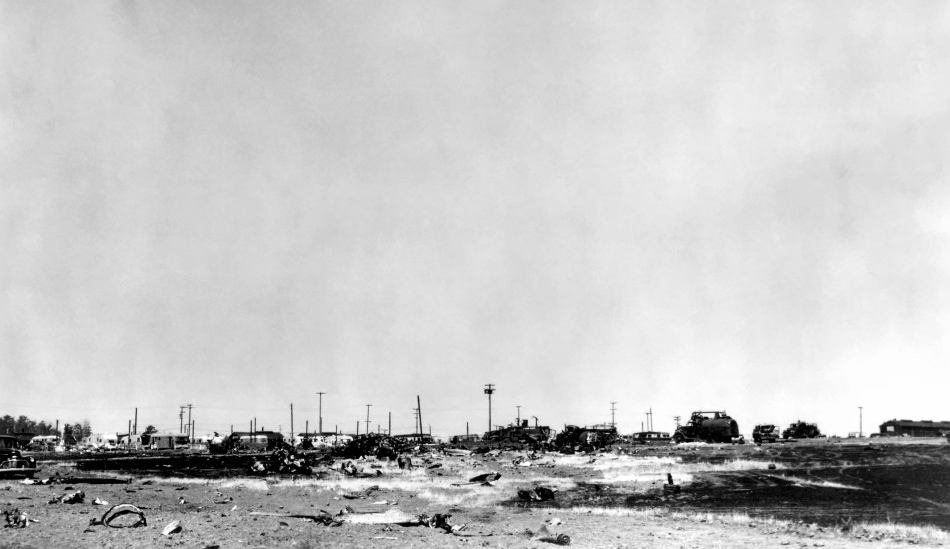
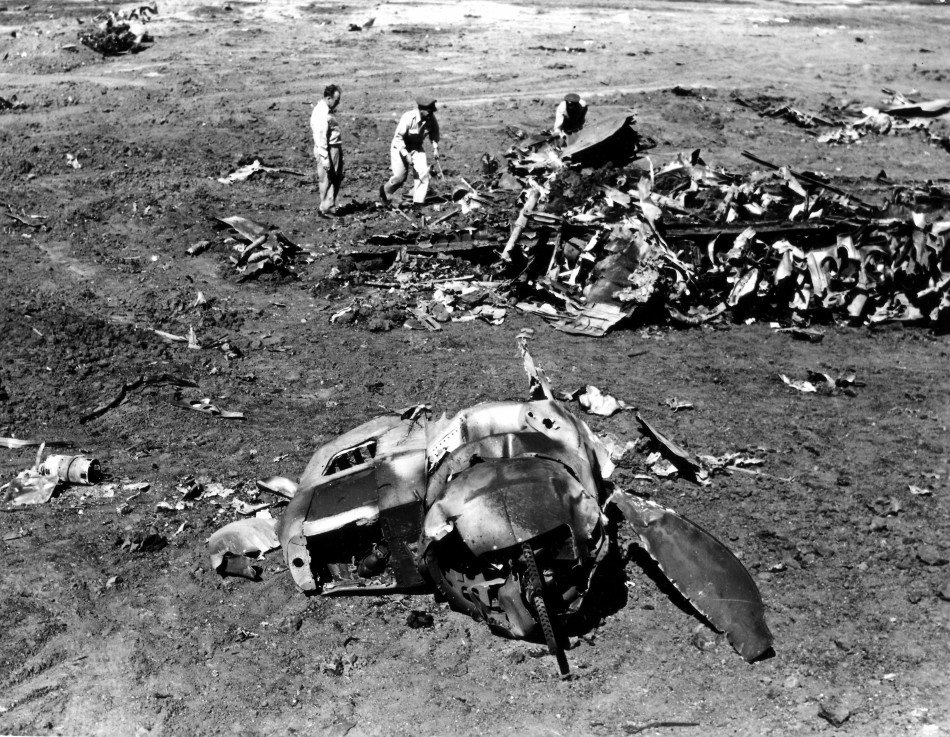
The heavy bomber aircraft was engaged in a flight to Korea, carrying twenty crew members and a load of high explosive devices. Five minutes after takeoff from runway 21L, while climbing, the crew encountered technical problems with the engines number two and three on which the propeller was over speeding. The pilot in command tried to return to the airfield but the aircraft crashed, burned, and exploded five minutes after takeoff, causing fatal injuries to 12 crewmen. Eight other crew members were injured. Extensive damage to private and government property and injuries to both civilian and military personnel were caused by a subsequent explosion of the bomb on the aircraft. The pilot, Cpt Eugene Q. Steffes, was at the controls, with Brigadier General Robert F. Travis acting as second pilot. At 2200LT, the aircraft was cleared for takeoff from runway 21L (8,000 feet long). The wind was 17 knots from the southwest. A full power check (2,800 ROM and 48 inches) was made and the brakes were released for takeoff. Just prior to liftoff, the number two engine propeller malfunctioned, and the aircraft commander ordered the number two propeller be feathered. After liftoff, the pilot actuated the gear switch to the up position, and the gear did not retract. Due to the increased drag (feathered number two engine and the lowered gear), the rising terrain ahead and to the left, and the inability of the aircraft to climb, the aircraft commander elected to make a 180-degree turn to the right back toward the base. Upon completion of the turn, the left wing became difficult to hold up. The aircraft commander allowed the aircraft to slide to the left to avoid a trailer court. A crash landing was imminent as the altitude of the aircraft was only a few feet above the ground. The aircraft struck the ground with the left wing down at approximately 120 mph. All ten people in the rear compartment were fatally injured. General Travis and one passenger in the forward compartment received fatal injuries, all other crew members were rescued. About twenty minutes after the crash occurred, the high explosives in the bomb casing ignited. The blast, felt and heard over 30 miles away, caused severe damage to the nearby trailer park on base. In addition to those killed or injured in the initial crash, as a result in large part to the explosion that occurred shortly after the crash, 180 military, civilian and dependents were killed or injured. (Seven people were killed, 49 were admitted to the hospital and 124 others received superficial injuries).
Following this catastrophe, the Fairfield-Saisun AFB was rechristened to the honor of the General Travis.
Crew:
Gen Robert Falligant Travis, †
Cpt Eugene Q. Steffes,
Cpt Jack R. Cox,
1st Lt Carter W. Johnson,
1st Lt Matthew A. Midura,
1st Lt William G. Braz,
T/Sgt Donald W. Moore,
Pfc Jack Lloyd Gould, †
Pfc Roy Sellars, †
1st Lt Robert G. Brotherton,
S/Sgt Lloyd Francis Knapp, †
S/Sgt Joseph Maconi, †
1st Lt Charles E. Voyce,
S/Sgt Joseph Prachinack, †
1st Lt James Arthur Stubblebine, †
Sgt Richard D. Vanderpool, †
Pfc Leonard Andrew Reeve, †
M/Sgt James Land Mclelland, †
Pfc Merrit Donald Judd, †
Cpl John L. Tucker. †
Probable cause:
Investigations revealed that some technical anomalies occurred on the electrical system shortly before takeoff and that the crew failed to follow properly the pre-flight checklist. It was determined that the propellers on engines number two and three have been reinstalled against the manufacturer published standard procedures. Five days prior to the accident, some technicians at the airbase proceeded to a maintenance on these two propellers where the switches have been modified. For unknown reason, these two propellers were not correctly adjusted on the engine axis, causing them to overspeed. After any modification, all Curtiss Electric engine type must be checked during a test flight, which was apparently not performed by the present case. Investigations also revealed that the number of crew members on board was too high and that the total weight of the aircraft was above the admissible MTOW. The aircraft was not equipped with sufficient seatbelts at the time of the accident and only few crew members were properly attached, which contributed to the high number of casualties. Thus, it was recommended that a maximum of 16 crew members would be allowed on board this type of aircraft for all future operations.


Crash of a Boeing B-29A-35-BN Superfortress at Castle AFB

Date & Time: Aug 3, 1950
Type of aircraft:
Operator:
Registration:
44-61517
Flight Type:
Survivors:
Yes
Schedule:
Castle - Castle
MSN:
10994
YOM:
1944
Crew on board:
20
Crew fatalities:
Pax on board:
0
Pax fatalities:
Other fatalities:
Total fatalities:
0
Circumstances:
Belly landed and slid for few hundred metres before coming to rest. There were no casualties among the 20 crew members but the aircraft was written off.

Crash of a Boeing RB-29-95-BW Superfortress in Hamilton

Date & Time: Jul 14, 1950
Type of aircraft:
Operator:
Registration:
45-21790
Flight Phase:
Flight Type:
Survivors:
Yes
Schedule:
Hamilton - Hamilton
MSN:
13684
YOM:
1945
Country:
Crew on board:
0
Crew fatalities:
Pax on board:
0
Pax fatalities:
Other fatalities:
Total fatalities:
0
Circumstances:
The crew was performing a local training flight when, at lift off, the aircraft stalled and crashed while the crew was simulating an engine failure. There were no casualties.

Crash of a Boeing B-29A-55-BN Superfortress off Dōgo Island: 7 killed

Date & Time: Jul 13, 1950
Type of aircraft:
Operator:
Registration:
44-61923
Flight Phase:
Flight Type:
Survivors:
Yes
MSN:
11400
YOM:
1944
Country:
Region:
Crew on board:
12
Crew fatalities:
Pax on board:
0
Pax fatalities:
Other fatalities:
Total fatalities:
7
Circumstances:
The crew was taking part to a bombing mission in the Korean War and was enroute to Korea with a load of bomb on board. While cruising in a formation of several B-29 bombers, the crew encountered an engine failure and the captain decided to return to his base. Unable to maintain a safe altitude, it was decided to jettison the bombs. A 500 pounds bomb hung up in the racks and while attempting to release the bomb, it detonated either within the bomb bay or immediately beneath the belly of the plane. Out of control, the aircraft christened 'Hoxie's Hoax' crashed into the Japan Sea off the Dōgo Island. Seven crew members were killed while five others were rescued in their dinghy about two days later.
Crew (325th BS):
S/Sgt Gilbert Bear,
1st Lt Neil A. Chapman, †
S/Sgt Claude M. Engler Jr., †
Cpt Thomas Hoxie,
S/Sgt Jesse M. Hughes, †
Cpt Leo F. McGeough, †
1st Lt Donald D. Miller,
S/Sgt Robert R. O'Daniel Jr., †
Cpt Allan Thomas,
Cpl Jerry Ursini, †
Sgt Harrison Utz,
S/Sgt Kenneth P. Wallan. †
Probable cause:
Detonation of a bomb.

Crash of a Boeing B-29-65-BW Superfortress into the Yellow Sea

Date & Time: Jul 12, 1950 at 1520 LT
Type of aircraft:
Operator:
Registration:
44-69866
Flight Phase:
Flight Type:
Survivors:
Yes
Schedule:
Kadena - Kadena
MSN:
10698
YOM:
1944
Country:
Region:
Crew on board:
13
Crew fatalities:
Pax on board:
0
Pax fatalities:
Other fatalities:
Total fatalities:
0
Circumstances:
The crew left Kadena AFB on a mission over South Korea. While cruising in the region of Seoul, the heavy bomber was attacked by the pilots of three North Korean AF (KPAFAC) Yakovlev Yak-9. The crew was able to leave the area and while over the Yellow Sea, was forced to abandon the airplane that dove into the sea and crashed. All 13 occupants were rescued. This was the first B-29 Superfortress shot down by enemy fire during the Korean War.
Probable cause:
Shot down by three North Korean fighters.

Crash of a Boeing B-29-55-BA Superfortress into the Pacific Ocean: 3 killed

Date & Time: Jun 23, 1950
Type of aircraft:
Operator:
Registration:
44-84014
Flight Phase:
Flight Type:
Survivors:
Yes
Schedule:
Kadena - Andersen
Country:
Region:
Crew on board:
11
Crew fatalities:
Pax on board:
0
Pax fatalities:
Other fatalities:
Total fatalities:
3
Circumstances:
Crashed in unknown circumstances into the Pacific Ocean about 140 miles southeast of Guam Island. Three crew members were killed while eight others were rescued.

Crash of a Boeing B-29-65-BW Superfortress in RAF Lakenheath

Date & Time: Jun 16, 1950
Type of aircraft:
Operator:
Registration:
44-69861
Flight Type:
Survivors:
Yes
MSN:
10693
YOM:
1944
Region:
Crew on board:
0
Crew fatalities:
Pax on board:
0
Pax fatalities:
Other fatalities:
Total fatalities:
0
Circumstances:
Crashed on landing. No casualties.

Crash of a Boeing B-29A-10-BN Superfortress into the East China Sea

Date & Time: Jun 16, 1950
Type of aircraft:
Operator:
Registration:
42-93903
Flight Phase:
Survivors:
Yes
Schedule:
Kadena - Kadena
MSN:
7310
YOM:
1942
Country:
Region:
Crew on board:
0
Crew fatalities:
Pax on board:
0
Pax fatalities:
Other fatalities:
Total fatalities:
0
Circumstances:
Following an uneventful mission, the crew was returning to Kadena AFB, Okinawa, when on approach, he was unable to lower the undercarriage. After several trials, the crew decided to leave the area and went over the East China Sea to abandon the aircraft. After all crew members bailed out, the aircraft was shot down by the pilot of a Lockheed F-80C Shooting Star and crashed into the sea. All occupants were rescued.

Crash of a Boeing RB-29A-30-BN Superfortress into the North Sea: 11 killed

Date & Time: Jun 7, 1950
Type of aircraft:
Operator:
Registration:
42-94081
Flight Phase:
Survivors:
Yes
Schedule:
Sculthorpe - Sculthorpe
Location:
Country:
Region:
Crew on board:
13
Crew fatalities:
Pax on board:
0
Pax fatalities:
Other fatalities:
Total fatalities:
11
Circumstances:
The aircraft crashed in unknown circumstances into the North Sea, about 100 km northeast of RAF Sculthorpe, Norfolk, while on a maritime patrol flight. Two crew members were rescued while 11 others were killed.