Country
Operator Image

Crash of a Curtiss C-46A-55-CK Commando off Itaipu

Date & Time: Dec 12, 1961 at 1600 LT
Type of aircraft:
Operator:
Registration:
PP-VBM
Flight Phase:
Flight Type:
Survivors:
Yes
Schedule:
Rio de Janeiro - Rio de Janeiro
MSN:
134
YOM:
1944
Country:
Crew on board:
2
Crew fatalities:
Pax on board:
0
Pax fatalities:
Other fatalities:
Total fatalities:
0
Circumstances:
The crew departed Rio de Janeiro-Santos Dumont for a local training flight. En route, the pilot voluntarily shut down the left engine to simulate a failure. As the crew elected to feather its propeller, the prop went into reverse. The crew decided to return to Santos Dumont Airport but as he was unable to maintain a safe altitude, he decided to ditch the aircraft 50 meters off the Itaipu beach. Both occupants were rescued while the aircraft was damaged beyond repair.

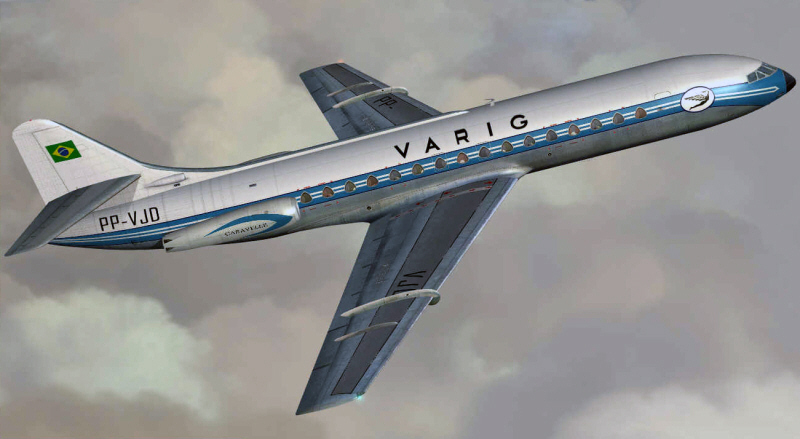
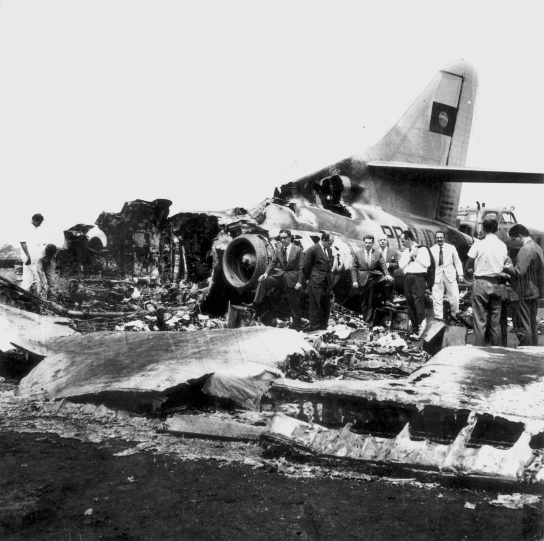
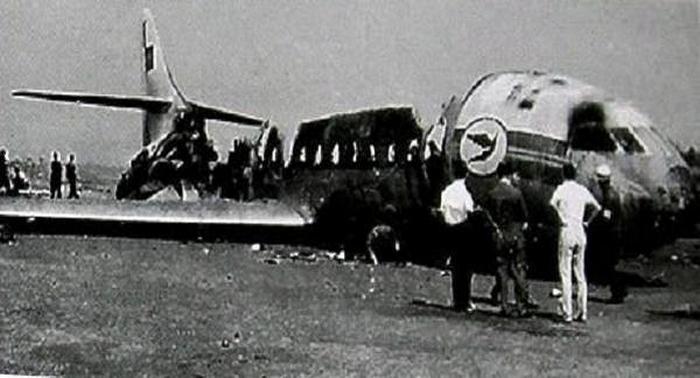
Crash of a Sud-Aviation SE-210 Caravelle III in Brasília

Date & Time: Sep 27, 1961 at 1822 LT
Operator:
Registration:
PP-VJD
Survivors:
Yes
Schedule:
Rio de Janeiro – Brasília
MSN:
15
YOM:
1959
Flight number:
RG592
Country:
Crew on board:
9
Crew fatalities:
Pax on board:
62
Pax fatalities:
Other fatalities:
Total fatalities:
0
Circumstances:
Following an uneventful flight from Rio de Janeiro, the pilot-in-command completed the approach at Brasília Airport. Following a wrong approach configuration, the aircraft landed hard and struck violently the runway surface. On impact, the undercarriage were damaged and the airplane went out of control and veered off runway to the left. While contacting soft ground, the undercarriage were sheared off and the airplane came to rest in flames. All 71 occupants were quickly evacuated and the aircraft was totally destroyed by a post crash fire.
Probable cause:
The accident was the consequence of the combination of the following factors:
- Wrong approach configuration,
- Poor preparation of the approach and landing procedure,
- Lack of crew coordination,
- The pilot-in-command was under conversion training on this type of aircraft and under supervision at the time of the accident.

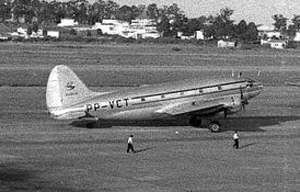
Crash of a Curtiss C-46C Commando in São Paulo

Date & Time: Dec 18, 1960
Type of aircraft:
Operator:
Registration:
PP-VCT
Flight Type:
Survivors:
Yes
MSN:
260
YOM:
1945
Country:
Crew on board:
3
Crew fatalities:
Pax on board:
0
Pax fatalities:
Other fatalities:
Total fatalities:
0
Circumstances:
After touchdown at São Paulo-Congonhas, the airplane encountered difficulties to decelerate properly. It overran, lost its undercarriage and came to rest few dozen yards farther. All three crew members evacuated safely while the aircraft was damaged beyond repair.
Probable cause:
It was determined that the crew failed to follow the published procedure for the landing maneuver and failed to take advantage of all braking systems after landing. A lack of coordination was considered as a contributing factor.

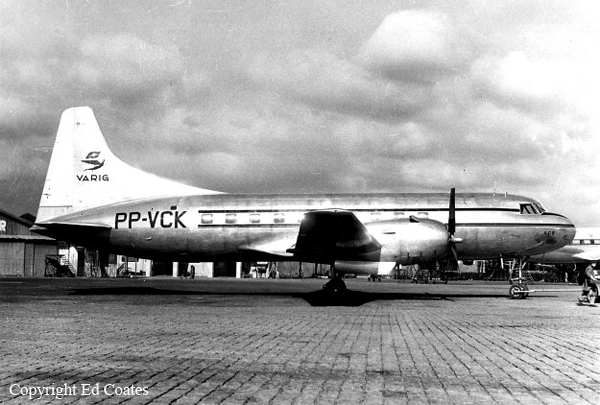
Crash of a Convair CV-240-2 in Brasilia

Date & Time: Sep 22, 1958
Type of aircraft:
Operator:
Registration:
PP-VCK
Flight Type:
Survivors:
Yes
Schedule:
Brasília - Brasília
MSN:
39
YOM:
1948
Country:
Crew on board:
3
Crew fatalities:
Pax on board:
0
Pax fatalities:
Other fatalities:
Total fatalities:
0
Circumstances:
The crew was completing a local training flight at Brasília Airport, consisting of touch and go maneuvers. Following several uneventful circuits, the crew started a new descent in poor weather conditions due to heavy rain falls when the wipers failed. As the pilot-in-command lost visual contact with the runway, he decided to open the window that was sheared off and struck the control column. In such conditions, the crew increased power on both engines and attempted a go around when the airplane stalled and crashed in flames few hundred yards short of runway threshold. All three crew members were injured and the aircraft was destroyed by a post crash fire.

Crash of a Douglas DC-3-277D in Porto Alegre

Date & Time: Jan 3, 1958
Type of aircraft:
Operator:
Registration:
PP-VDL
Flight Type:
Survivors:
Yes
Schedule:
Porto Alegre - Porto Alegre
MSN:
4115
YOM:
1941
Country:
Crew on board:
2
Crew fatalities:
Pax on board:
0
Pax fatalities:
Other fatalities:
Total fatalities:
0
Circumstances:
The crew (one pilot under check and one instructor) were conducting a local training flight at Porto Alegre-Salgado Filho Airport. While passing over the runway at low height, the instructor shut down the right engine to simulate a failure when the airplane rolled to the right. The instructor elected to correct the situation by an action on the rudder but the airplane reached a critical attitude. Power was reduced on the second engine and the aircraft crash landed. Both occupants were slightly injured and the aircraft was damaged beyond repair.
Probable cause:
Error of judgement on the part of the instructor.

Crash of a Douglas C-47A-80-DL in Porto Alegre: 3 killed

Date & Time: Oct 18, 1957
Operator:
Registration:
PP-VCS
Flight Phase:
Flight Type:
Survivors:
No
Schedule:
Porto Alegre – São Paulo
MSN:
19757
YOM:
1944
Country:
Crew on board:
3
Crew fatalities:
Pax on board:
0
Pax fatalities:
Other fatalities:
Total fatalities:
3
Circumstances:
During the takeoff roll, the airplane started to skid and deviated from the centerline to the right. The pilot-in-command decided to rotate but as the aircraft's speed was too low, it stalled and hit the ground. It then overran and took off again. While facing a hill, the crew attempted a sharp turn to the left when the left wing hit the roof of a house. Out of control, the airplane stalled and crashed in flames. All three crew members were killed.
Probable cause:
Wrong takeoff techniques and configuration on part of the flying crew. The presence of turbulences at low height may have contribute to the accident. Also, the assumption that the left engine failed during takeoff was not ruled out.

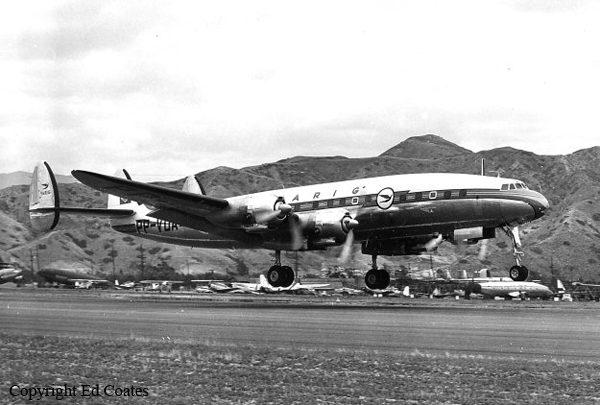
Crash of a Lockheed L-1049G Super Constellation off Cabarete: 1 killed

Date & Time: Aug 16, 1957
Operator:
Registration:
PP-VDA
Flight Phase:
Flight Type:
Survivors:
Yes
Schedule:
Ciudad Trujillo - Miami - New York
MSN:
4610
YOM:
1955
Crew on board:
11
Crew fatalities:
Pax on board:
0
Pax fatalities:
Other fatalities:
Total fatalities:
1
Circumstances:
The aircraft arrived at Ciudad Trujillo on the morning of 16 August with No, 2 engine inoperative. It was decided to disembark the passengers there and continue the flight to New York via Miami, using only three engines, in order that the defective engine could be changed in New York. The aircraft, therefore, carrying only the crew, took off from General Andrews Airport, Ciudad Trujillo at 1516 hours with No. 2 propeller feathered. About 50 minutes after take-off, No. 4 engine propeller oversped and proved to be impossible to control or feather. It then tore free from the engine, damaging No. 3 engine propeller as it parted; No. 3 propeller was, therefore, feathered. In the meantime, No. 4 engine caught fire, and only No. 1 engine remained operative. As it was not possible to reach Ciudad Trujillo, an attempt was made to land on the road or the beach, but this failed owing to the large number of trees and the narrowness of the beach. Under these circumstances the aircraft was ditched parallel to the coast about 500 metres from it. It was considered that in carrying out the three-engined ferry flight without passengers, the operator acted in accordance with para. 6.2. 2, Part II of the ICAO International Standards and Recommended Practices, Annex 8 to the Convention, "when the State of Registry considers that the damage sustained is of a nature such that the aircraft is no longer airworthy, it shall prohibit the aircraft from resuming flight until it is restored to an airworthy condition; the State of Registry may, however, in exceptional circumstances, prescribe particular limiting conditions to permit the aircraft to fly without fare-paying passengers to an aerodrome at which it can be restored to an airworthy condition". After ditching, the aircraft sank to a depth of about 40 feet. On a second attempt the weather permitted a diving operation to be carried out, and inspection of the wreckage revealed the following in- formation: All six flap sections of the port wing were entirely separated from the aircraft. No. 1 engine propeller tore free at the time of impact, splitting the propeller shaft next to the propeller thrust bearing. No. 2 power plant was wrenched free from its nacelle and remained attached to it only by pipes and control cables. This propeller was feathered. The two inner flap sections of the starboard wing were fractured and partially detached from the aircraft. The No. 3 engine propeller also was feathered and the tip of one of its blades was broken a point 18 inches from the leading edge to 12 inches from the trailing edge. The trailing edge of the same blade also had two deep dents. Marks, apparently made by a propeller blade, were found on the right side of the No. 3 engine cowling, No. 4 engine propeller was missing but only a small part of the nose section of the No. 4 engine was broken. The diaphragm and the pitch reducing mechanism were in their original places. The fuselage was fractured and the crack extended diagonally across the main part from the front towards the right rear wall.
Probable cause:
Due to the fact that three of its engines were inoperative, the aircraft had to be ditched in the sea.
Final Report:

Crash of a Curtiss C-46A-45-CU Commando in Bagé: 40 killed

Date & Time: Apr 7, 1957
Type of aircraft:
Operator:
Registration:
PP-VCF
Survivors:
No
Schedule:
Bagé – Porto Alegre
MSN:
30283
YOM:
1944
Country:
Crew on board:
5
Crew fatalities:
Pax on board:
35
Pax fatalities:
Other fatalities:
Total fatalities:
40
Circumstances:
Just after take-off, the pilot noticed an incipient fire in the left engine. Acting in accordance with airline regulations, he feathered the damaged engine, returning to the traffic pattern for a landing circuit and carrying out routine radio communications. On final approach, when he considered that a safe landing could be made, he operated the undercarriage lowering mechanism. Because of the intensity of th'e fire, which was in the undercarriage housing and not, as the pilot thought, in the engine, some parts must already have melted and the undercarriage did not respond to the mechanism. Apparently the critical situation had already passed, since the fire, although intense, was not producing much smoke. The pilot, therefore, decided to give full throttle, in order to avoid a belly landing. In this he was still following airline regulations. After this action, when the aircraft reached the intersection of runways 05 and 23, flames enveloped the left wing and detached it from the fuselage. The aircraft hit the ground and was destroyed. All occupants, 5 crew members and 35 passengers, were killed.
Probable cause:
The main cause of the accident was fire in the undercarriage housing and consequent breaking-off of the left wing in flight. A contributing cause was an error in judgment. The pilot failed to assess the intensity of the fire in the undercarriage housing, having thought that the fire was in the left engine and that by applying the procedure prescribed in "Regulations for C-46", the fire had been extinguished or had become inconsequential.
Final Report:

Crash of a Curtiss C-46A-45-CU Commando in São Paulo: 3 killed

Date & Time: Jun 4, 1954 at 1100 LT
Type of aircraft:
Operator:
Registration:
PP-VBZ
Flight Phase:
Flight Type:
Survivors:
No
Schedule:
São Paulo – Porto Alegre
MSN:
30400
YOM:
1944
Country:
Crew on board:
3
Crew fatalities:
Pax on board:
0
Pax fatalities:
Other fatalities:
Total fatalities:
3
Circumstances:
Just after liftoff, while in initial climb, the airplane stalled and crashed near the runway end. The aircraft was destroyed and all three crew members were killed.
Probable cause:
It was determined that the crew failed to prepare the flight properly and failed to adhere to the operator procedures. As the crew did not follow the pre-departure checklist, he failed to remove the elevator lock prior to takeoff.