Country
Operator Image

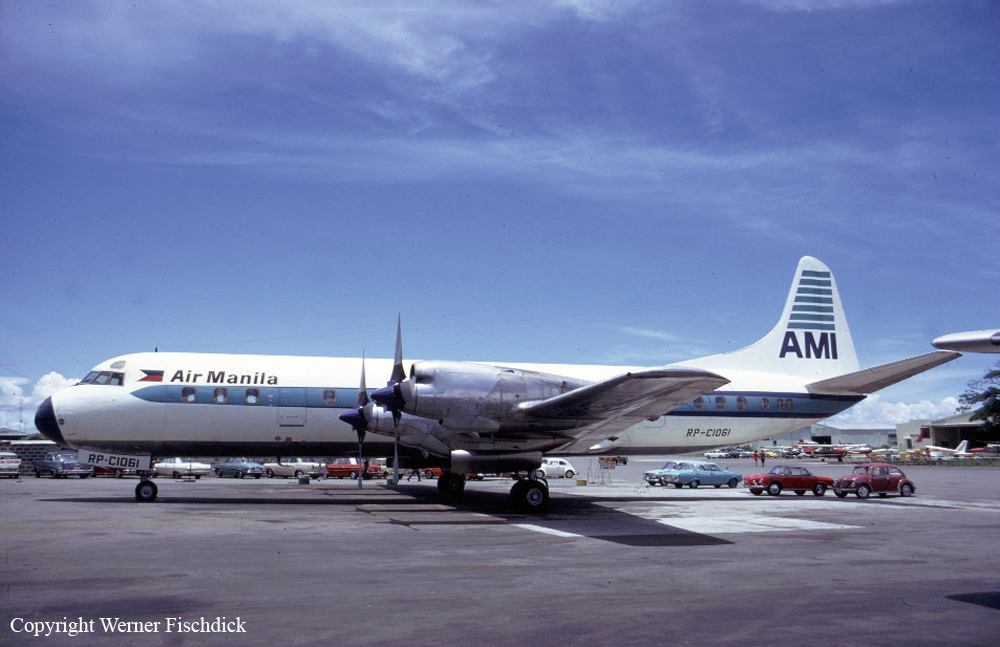
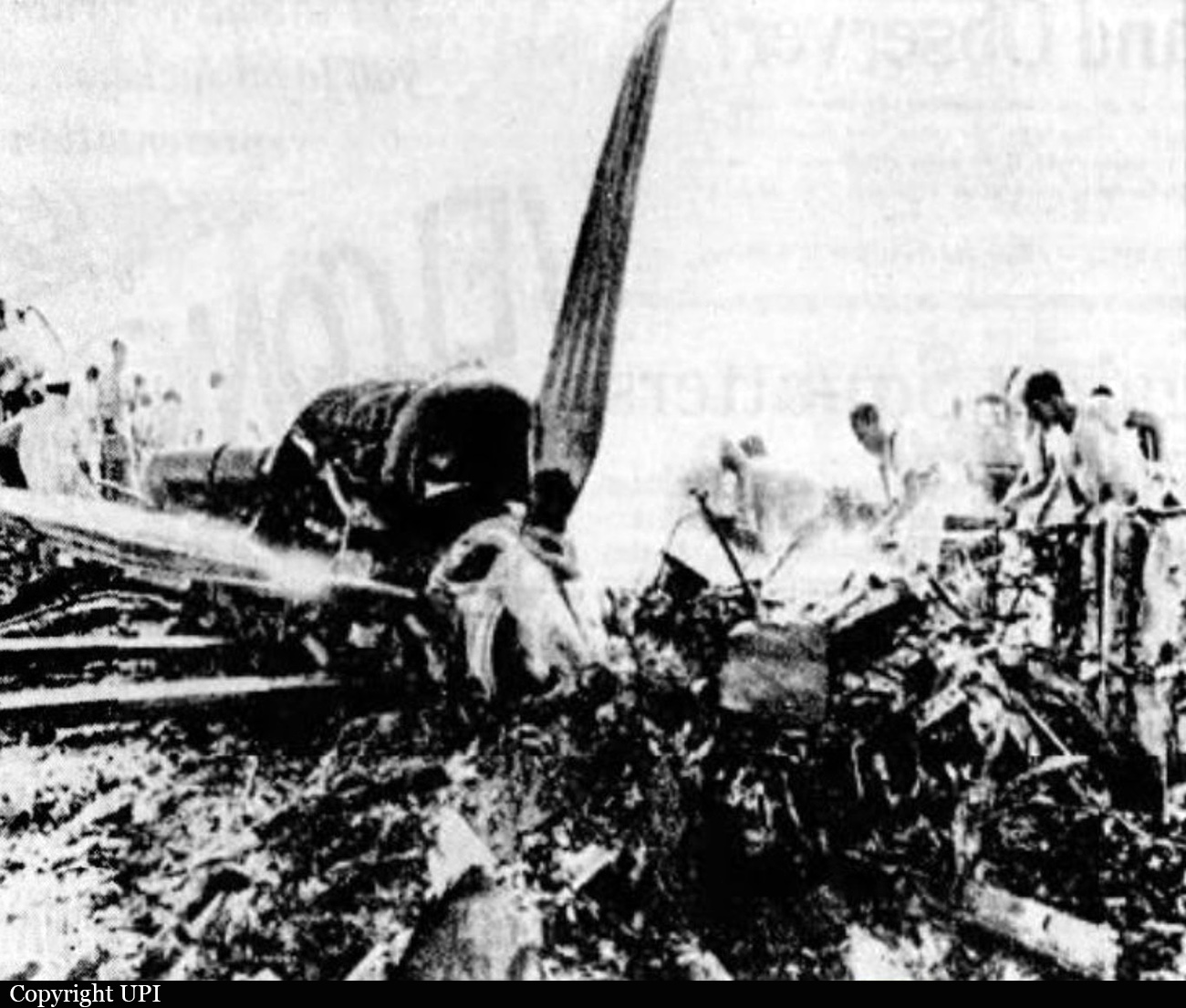
Crash of a Lockheed L-188A Electra in Agana: 46 killed

Date & Time: Jun 5, 1976 at 0047 LT
Type of aircraft:
Operator:
Registration:
RP-C1061
Flight Phase:
Survivors:
No
Schedule:
Wake - Agana - Manila
MSN:
1007
YOM:
1958
Flight number:
UM702
Country:
Region:
Crew on board:
12
Crew fatalities:
Pax on board:
33
Pax fatalities:
Other fatalities:
Total fatalities:
46
Captain / Total flying hours:
10016
Captain / Total hours on type:
2422.00
Copilot / Total flying hours:
8906
Copilot / Total hours on type:
2037
Aircraft flight hours:
22895
Circumstances:
The aircraft lifted off the 10,015-foot runway about 7,500 feet down the runway. During or just after liftoff the n°3 propeller was feathered. The aircraft climbed to 100 feet while yawing to the right. The crew retracted the landing gear and flaps before the aircraft reached the apex of the climb. It then rotated to a nose-high attitude, appeared to become laterally unstable, and struck the rising terrain in a tail-low attitude. Impact was about 4,300 feet beyond the end of the runway. The aft portion of the aircraft fuselage dragged along the ground for 220 feet in a right wing down attitude, after which the aircraft slid off the brow of a 13-foot embankment, crashed through the chain link perimeter fence at Agana NAS, crossed a highway, and burst into flames. The aircraft came to rest in an open area between residential areas, about 4,900 feet beyond the end of runway 06L. As the aircraft slid across the highway, it struck an automobile on the highway; the driver of the car was killed. A woman and her son, who were standing outside their residence just south of the impact site, were seriously burned by the heat of the burning fuel and were seriously injured by flying debris. All 45 occupants on board the Electra were killed.
Probable cause:
he loss of climb capability after the crew retracted the flaps at too low an altitude to clear the rising terrain. The flaps were retracted after the no.3 propeller feathered as the aircraft lifted off the runway. Contributing to the accident was the captain's decision to continue the take-off after an engine failed before reaching the rotation speed.
Final Report:
Crash of a Fairchild F27 in Baguio

Date & Time: Mar 29, 1975
Type of aircraft:
Operator:
Registration:
RP-C874
Flight Type:
Survivors:
Yes
MSN:
17
YOM:
1958
Country:
Region:
Crew on board:
5
Crew fatalities:
Pax on board:
0
Pax fatalities:
Other fatalities:
Total fatalities:
0
Circumstances:
Upon touchdown at Baguio-Loakan Airport, the right main gear collapsed. The airplane slid on runway for few meters before coming to rest. All five crew members who were completing a positioning flight were uninjured while the aircraft was damaged beyond repair.
Probable cause:
Failure of the lower lug of the oleo strut due to corrosion.

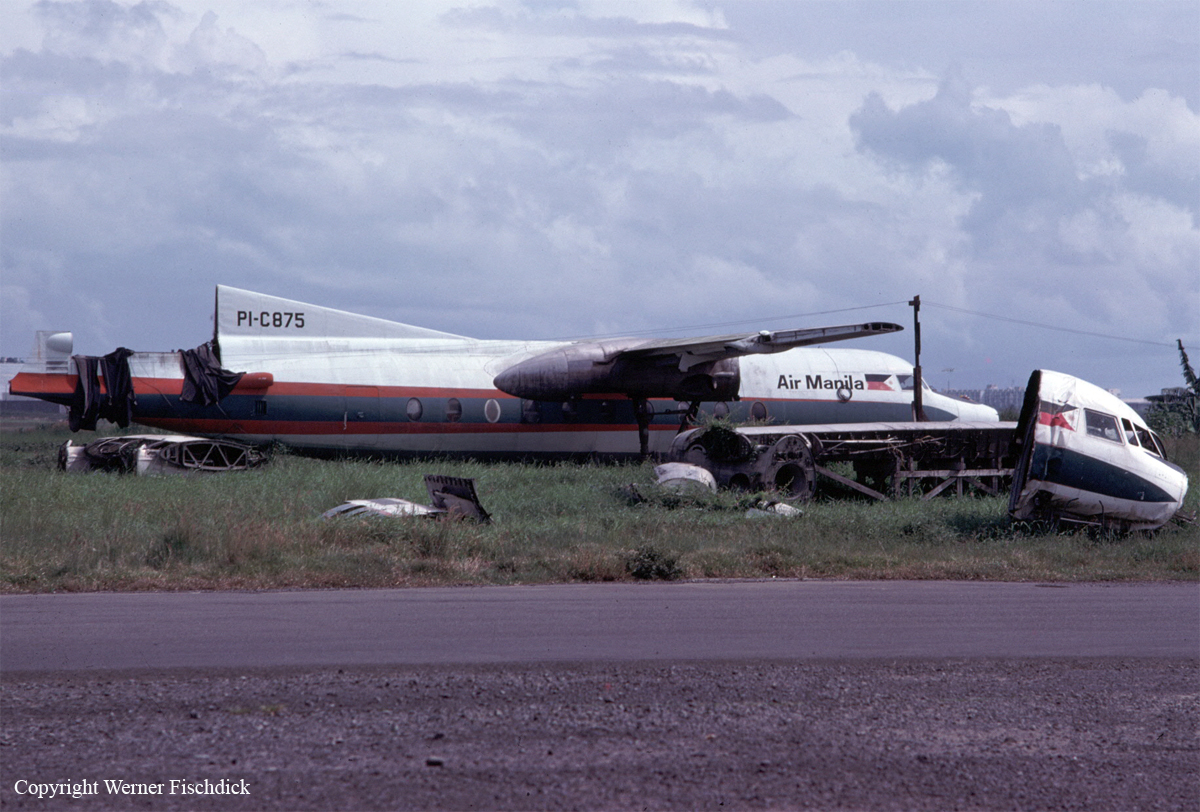
Crash of a Fairchild F27 in Daet

Date & Time: Sep 6, 1973
Type of aircraft:
Operator:
Registration:
PI-C875
Flight Phase:
Survivors:
Yes
MSN:
10
YOM:
1958
Country:
Region:
Crew on board:
4
Crew fatalities:
Pax on board:
20
Pax fatalities:
Other fatalities:
Total fatalities:
0
Circumstances:
During the takeoff roll on runway 06, while at a speed of 60 knots, the crew encountered technical problems with the nosewheel steering system. The airplane deviated to the right, veered off runway and came to rest against a pile of gravel. All 24 occupants escaped uninjured while the aircraft was damaged beyond repair.

Crash of a Lockheed L-188A Electra in Manila

Date & Time: Jan 9, 1972
Type of aircraft:
Operator:
Registration:
PI-C1060
Flight Type:
Survivors:
Yes
Schedule:
Manila - Manila
MSN:
1021
YOM:
1959
Country:
Region:
Crew on board:
4
Crew fatalities:
Pax on board:
0
Pax fatalities:
Other fatalities:
Total fatalities:
0
Circumstances:
The crew was completing a local training flight at Manila Intl Airport. After landing, the four engine airplane went out of control, veered off runway and came to rest. While all four crew members escaped uninjured, the aircraft was damaged beyond repair.

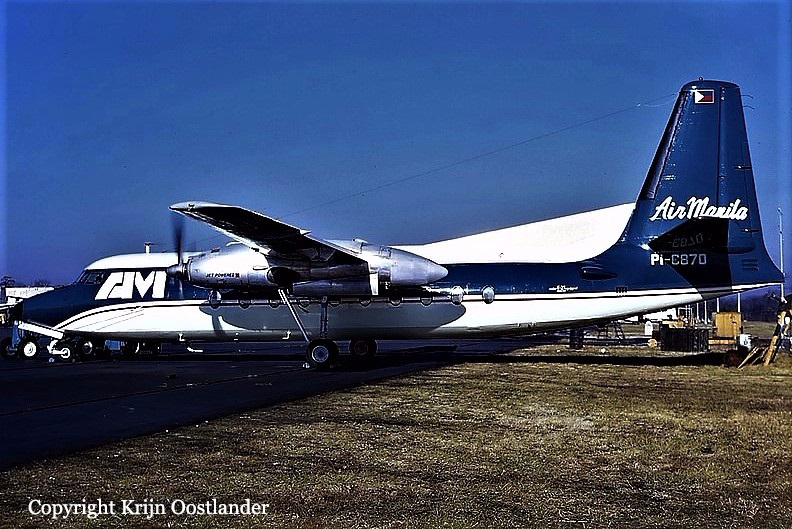
Crash of a Fairchild F27 in Roscas

Date & Time: Apr 14, 1969
Type of aircraft:
Operator:
Registration:
PI-C870
Survivors:
Yes
MSN:
20
YOM:
1958
Country:
Region:
Crew on board:
0
Crew fatalities:
Pax on board:
0
Pax fatalities:
Other fatalities:
Total fatalities:
0
Circumstances:
While landing at Roscas, near Manila, the airplane suffered a gear collapse. There were no injuries but the aircraft was damaged beyond repair.
Probable cause:
Gear collapsed on landing.

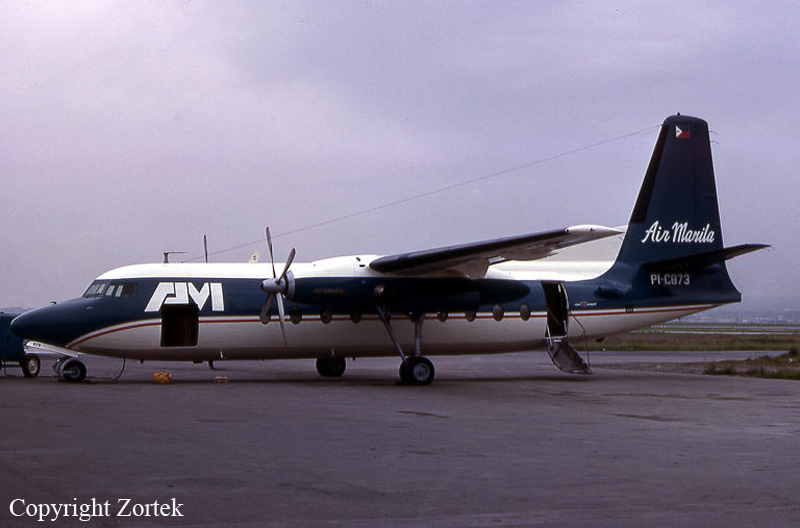
Crash of a Fairchild F27 in Davao City

Date & Time: May 9, 1968
Type of aircraft:
Operator:
Registration:
PI-C873
Survivors:
Yes
MSN:
8
YOM:
1958
Country:
Region:
Crew on board:
0
Crew fatalities:
Pax on board:
0
Pax fatalities:
Other fatalities:
Total fatalities:
0
Circumstances:
Crashed upon landing at Davao City-Mati Airport for unknown reason. There were no casualties but the aircraft was written off.

Crash of a Fairchild F27 off Ibajay: 14 killed

Date & Time: Mar 8, 1968 at 1918 LT
Type of aircraft:
Operator:
Registration:
PI-C871
Flight Phase:
Survivors:
No
Schedule:
Manila - Mactan
MSN:
19
YOM:
1958
Flight number:
UM507
Location:
Country:
Region:
Crew on board:
4
Crew fatalities:
Pax on board:
10
Pax fatalities:
Other fatalities:
Total fatalities:
14
Captain / Total flying hours:
5709
Captain / Total hours on type:
158.00
Copilot / Total flying hours:
3300
Copilot / Total hours on type:
92
Aircraft flight hours:
21194
Circumstances:
Flight UM507 was a scheduled domestic flight from Manila International Airport to Lapu-Lapu/Mactan International Airport. Before departure the pilot was briefed by the Air Manila dispatcher on the existence of a cold front across the route and was provided with an en-route weather forecast valid from 1200 to 2400 hours which mentioned "Isolated thunderstorm over Eastern Visayas and generally fair elsewhere". No information regarding thunderstorms on the route was given to the pilot. The flight took off from Manila at 1814 hours and was cleared to Mactan at FL 130 by the ATC, via Track 5, Amber 4 and Amber 1. The flight plan proposed an airspeed of 210 kt and an estimated time en route of 1 hour 45 minutes. Normal radio contact was maintained at all time between the flight and the air traffic services. At 1908 hours the flight reported over Romblon at FL 130, estimating Mactan at 1954 hours. This was the last message from the aircraft. Several residents of Ibajay, a coastal town in Aklan, stated that at approximately 1918 hours they had heard a sound similar to that of an aircraft flying at high altitude in a southeast direction along the coastline. They then heard several loud explosions and saw fireballs falling into the sea. They all agreed that the initial fire- ball they saw could not have been the result of a prolonged fire, but rather a small fire which rapidly developed into a large orange-yellow-red ball and then disappeared. After a few moments, smaller fireballs emerged from the large one, some dying out before reaching the sea, some reaching the sea and developing into a large fire. At the same time a large object resembling an airplane was seen to emerge from thick clouds and fall into the sea followed by a trail of smaller objects. Approximately one hour later two bodies were recovered from approximately 2 km offshore of Bo. Colong-Colong, Ibajay, Aklan.
Probable cause:
The Board determined that the probable cause of the accident was an in-flight structural failure due to air loads exceeding the design strength, while flying in a thunderstorm cell. It was also determined the following:
- The flight transmitted its last position report over Romblon at 1908 hours, approximately 10 minutes before the accident, and did not report any operating difficulty,
- The aircraft disintegrated at a high altitude with considerable speed,
- None of the aircraft parts recovered showed evidence of fatigue, or explosion due to combustible gas mixtures, or concentrated explosives such as dynamite,
- Over the area at approximately the time of the accident, there were thunderstorm cells and two other flights deviated and avoided the area,
- The crash location was about 10 NM right of the assigned airway,
- Only two bodies were recovered; the other occupants and the rest of the wreckage could not be recovered due to the depth of the sea in the general area of the accident and their exact location is unknown.
Final Report:

Crash of a Douglas C-47A-25-DK in Iligan

Date & Time: May 23, 1967
Operator:
Registration:
PI-C854
Survivors:
Yes
MSN:
13559
YOM:
1944
Country:
Region:
Crew on board:
0
Crew fatalities:
Pax on board:
0
Pax fatalities:
Other fatalities:
Total fatalities:
0
Circumstances:
After landing at Iligan Airport, the airplane encountered difficulties to stop within the remaining distance. It overran and came to rest in a river. There were no casualties but the aircraft was written off.

Crash of a Douglas DC-3A in Legazpi: 2 killed

Date & Time: Dec 16, 1965 at 1722 LT
Type of aircraft:
Operator:
Registration:
PI-C856
Survivors:
Yes
Schedule:
Manila – Legazpi
Flight number:
AM101
Location:
Country:
Region:
Crew on board:
3
Crew fatalities:
Pax on board:
18
Pax fatalities:
Other fatalities:
Total fatalities:
2
Captain / Total flying hours:
1957
Captain / Total hours on type:
1256.00
Copilot / Total flying hours:
2596
Copilot / Total hours on type:
709
Circumstances:
Flight AM101 was a scheduled domestic flight from Manila to Legaspi. It took off from Manila International Airport at 1505 hours. At 1640 hours it established initial contact with Legaspi Radio, reported 7 minutes north-west of the field and requested weather and landing information. Legaspi Radio transmitted the following information: 1600H surface wind 0400/8 kt, visibility 5 km clouds 6 oktas 450 metres, 8 oktas 2,100 metres; temperature 24°, dewpoint 24°, runway in use 06 QNH 29.81 inches. At 1707 hours the flight requested information regarding the traffic in the circuit and was informed that there was none. At 1715 hours the sound of an aircraft, presumably AM101, was heard south of the airport but the aircraft was hardly visible. At 1716 hours the flight inquired again about the present weather and the 1700 hours weather observation was passed to the aircraft. Subsequent inquiry about present visibility, wind direction and speed was made by the flight which was advised that the wind was 040 18 kt and the visibility approximately 4 km. At 1718 hours the flight was seen turning for a landing on Runway 24. The landing roll was described by witnesses as unusually fast after the aircraft made a two-wheel touchdown, tail wheel high approximately 300 m after the threshold of Runway 24. Before the tail wheel came into contact with the runway full power was applied and the aircraft was observed airborne. At approximately 200 ft altitude, it initiated a tight left turn, collided with the top of a tree and then hit a building located two miles southwest of Legaspi Airport. Both pilots were killed while all other occupants were injured.
Probable cause:
The Board determined that the probable cause of this accident was a power stall during a tight turn manoeuvre at too low an altitude from which successful recovery was impossible.
Final Report: