Crash of a Douglas DC-8-61 in Jeddah: 261 killed

Date & Time: Jul 11, 1991 at 0838 LT
Type of aircraft:
Operator:
Registration:
C-GMXQ
Survivors:
No
Schedule:
Jeddah - Sokoto
MSN:
45982
YOM:
1968
Flight number:
WT2120
Country:
Region:
Crew on board:
14
Crew fatalities:
Pax on board:
247
Pax fatalities:
Other fatalities:
Total fatalities:
261
Aircraft flight hours:
49318
Aircraft flight cycles:
30173
Circumstances:
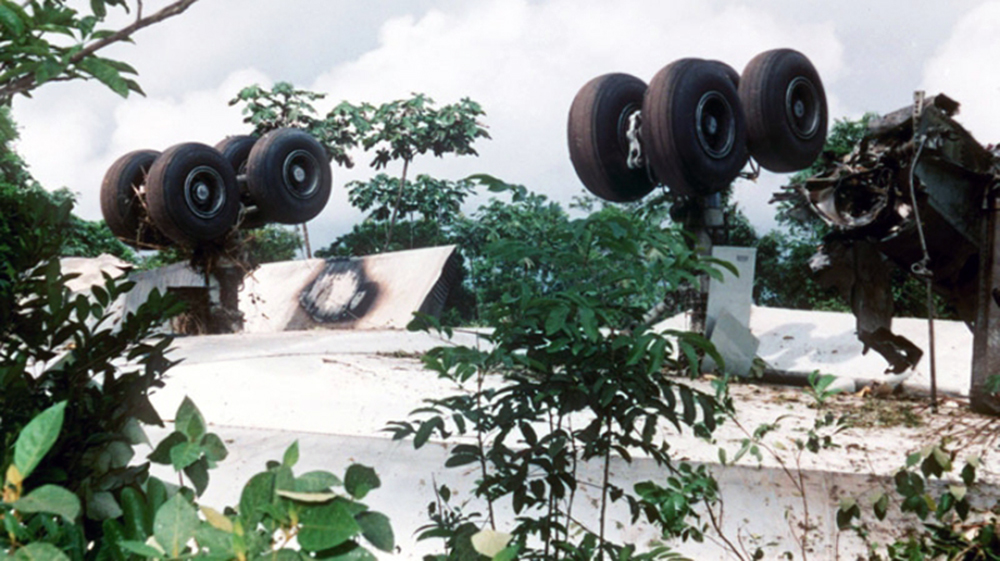
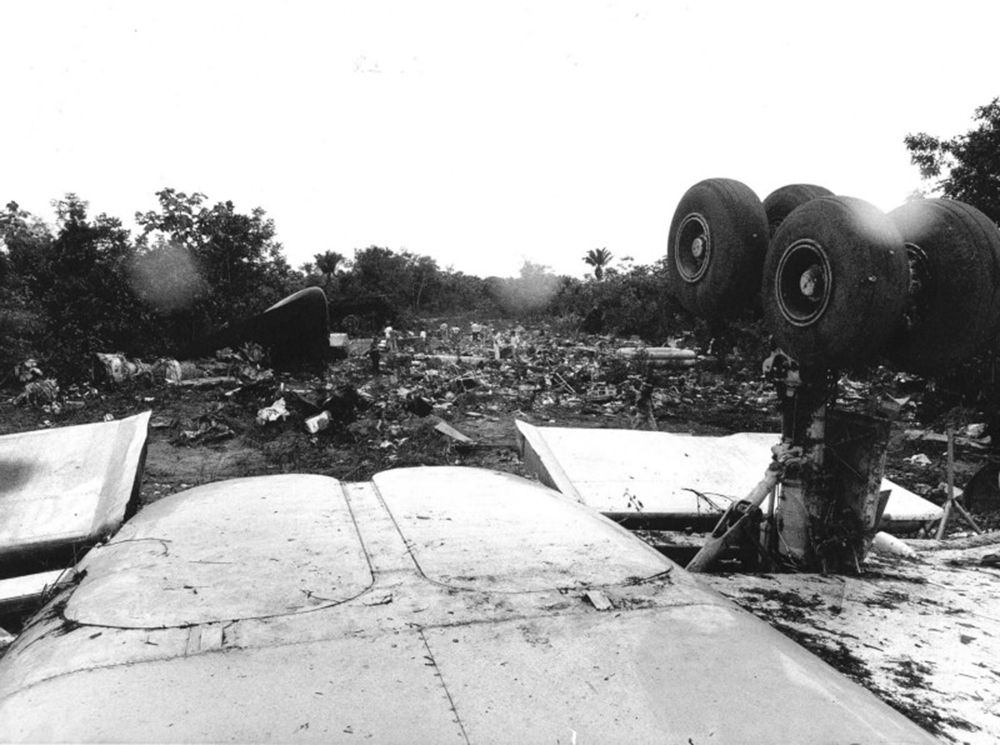
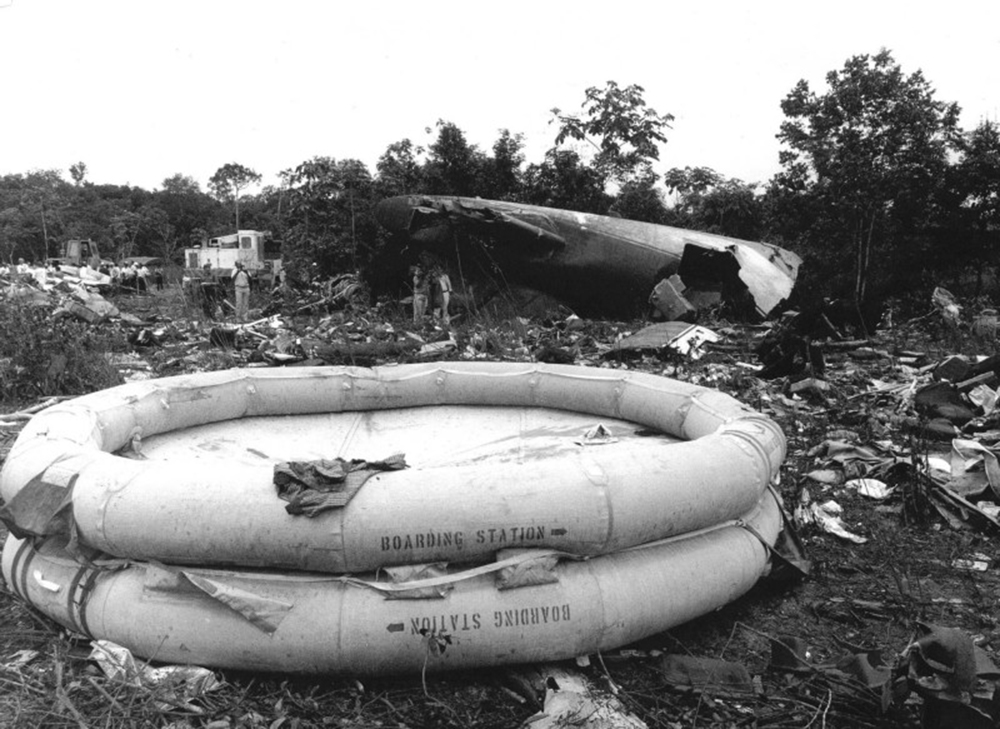
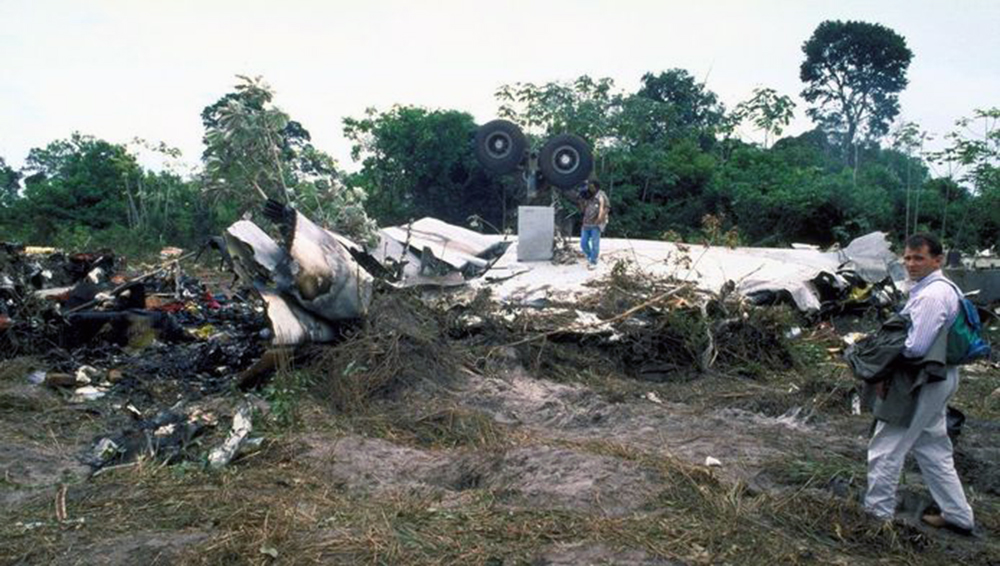
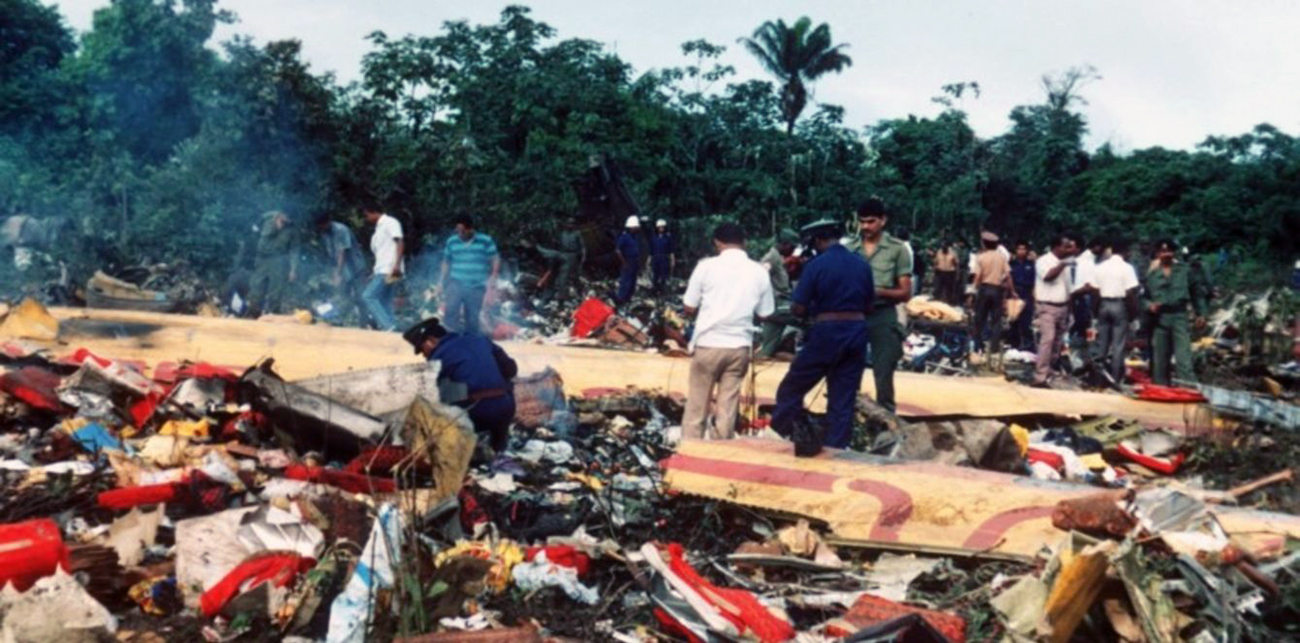
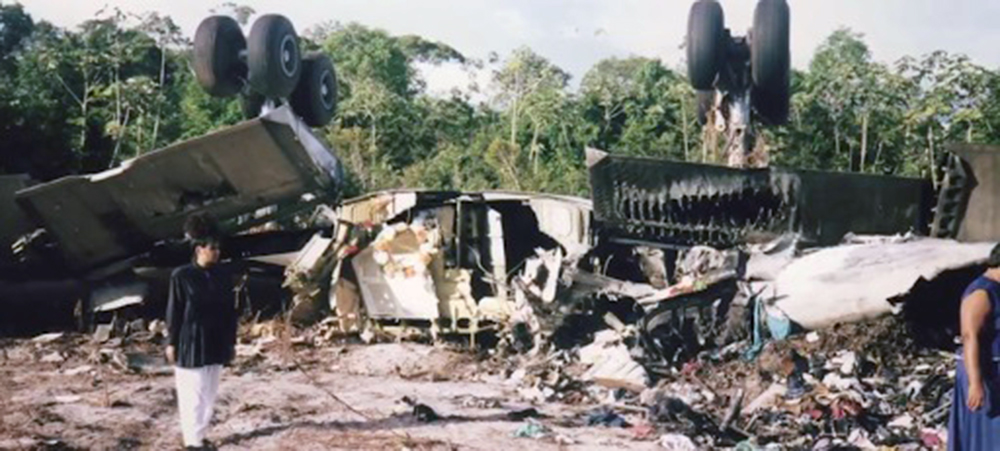
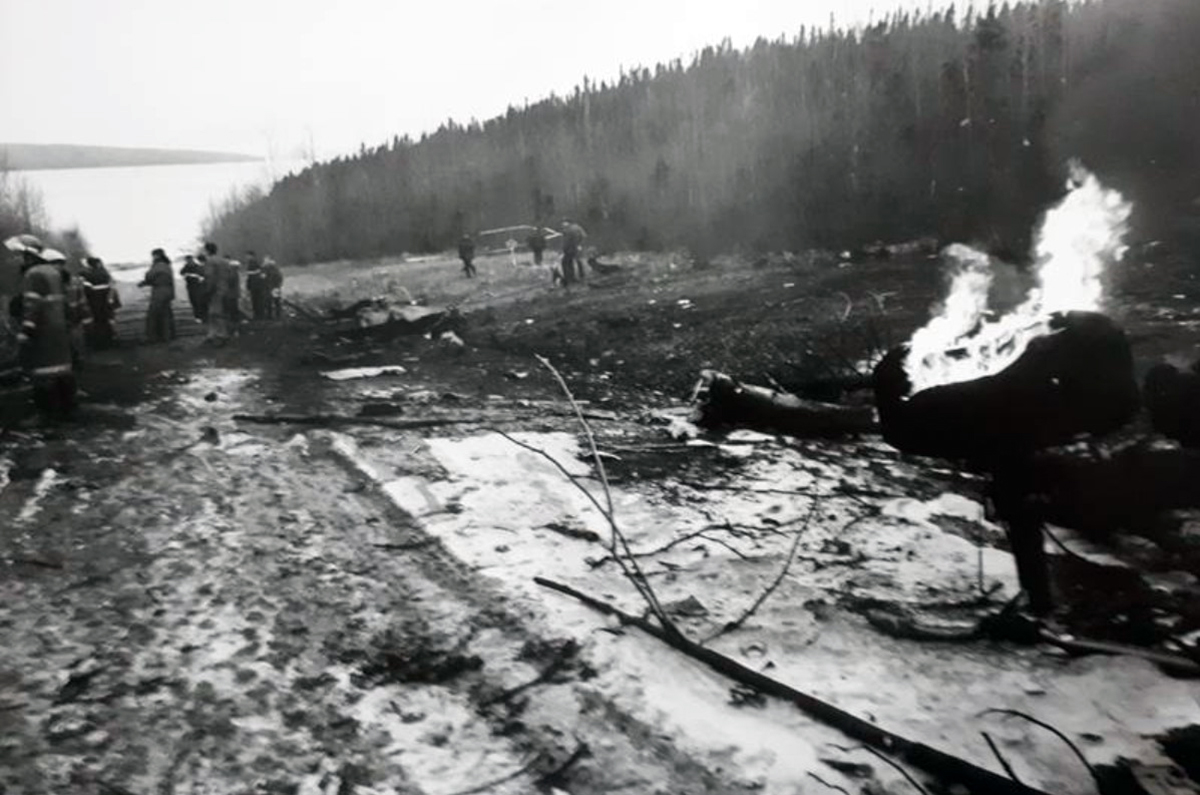
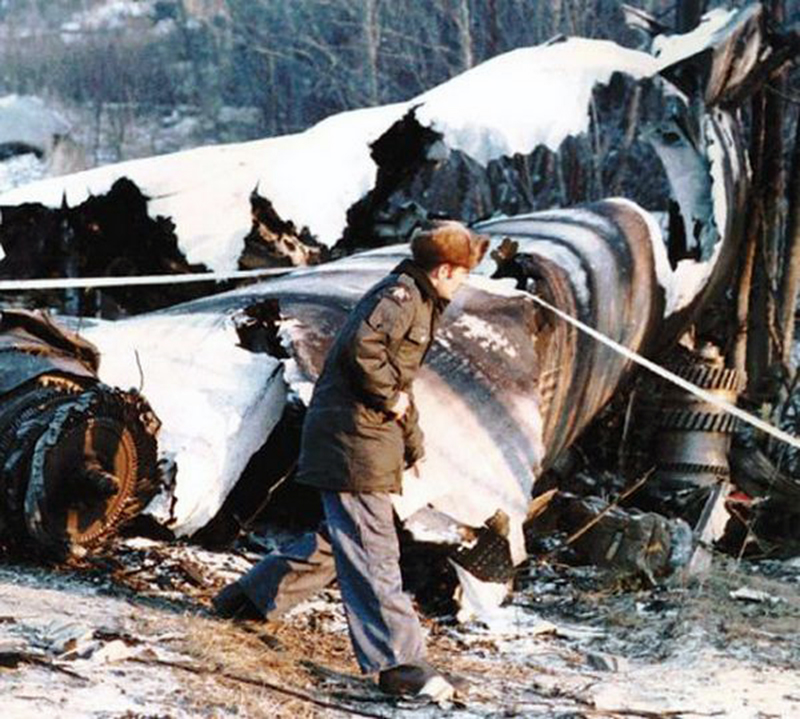
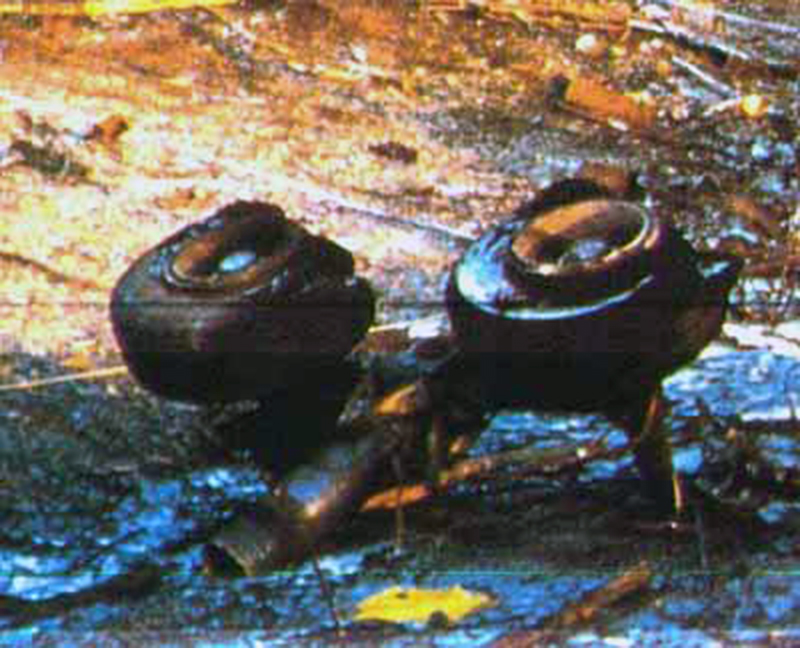
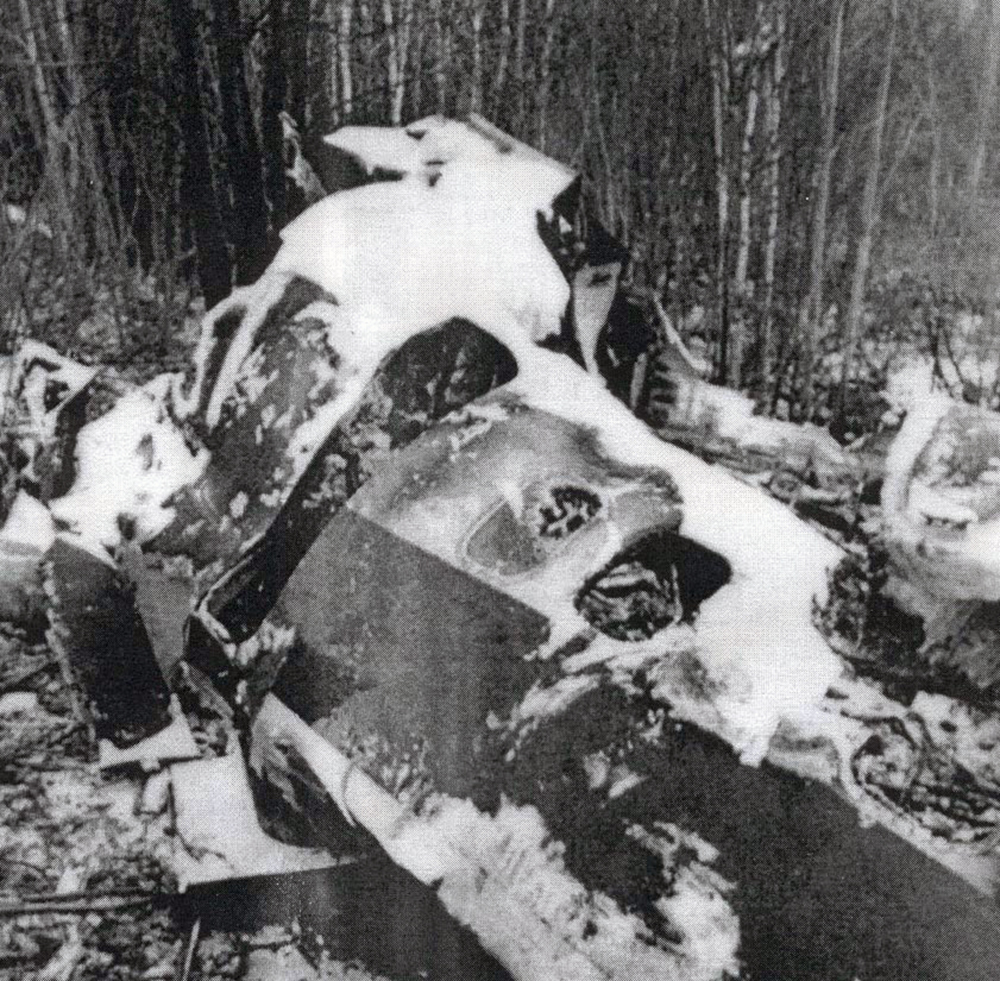
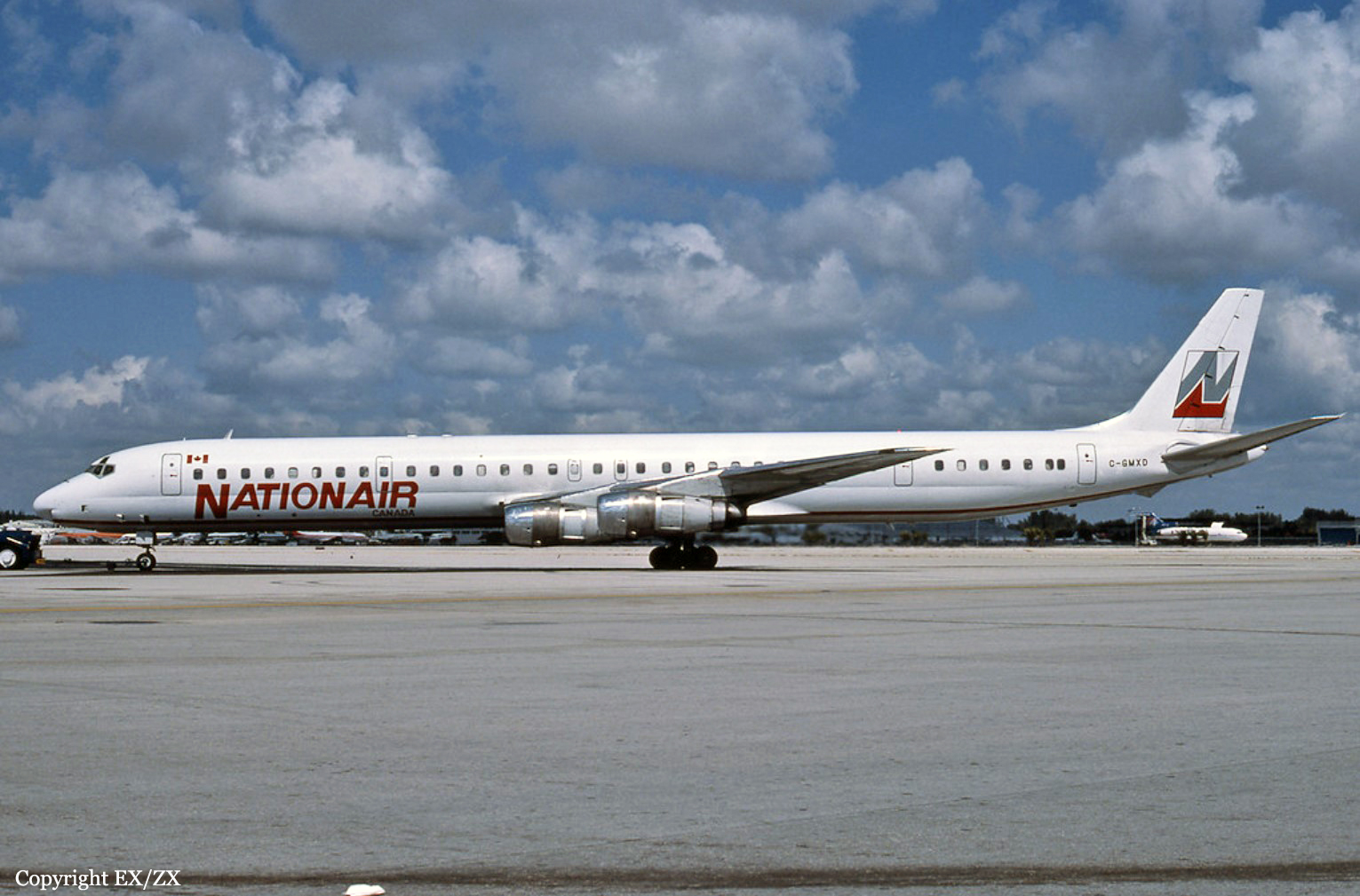
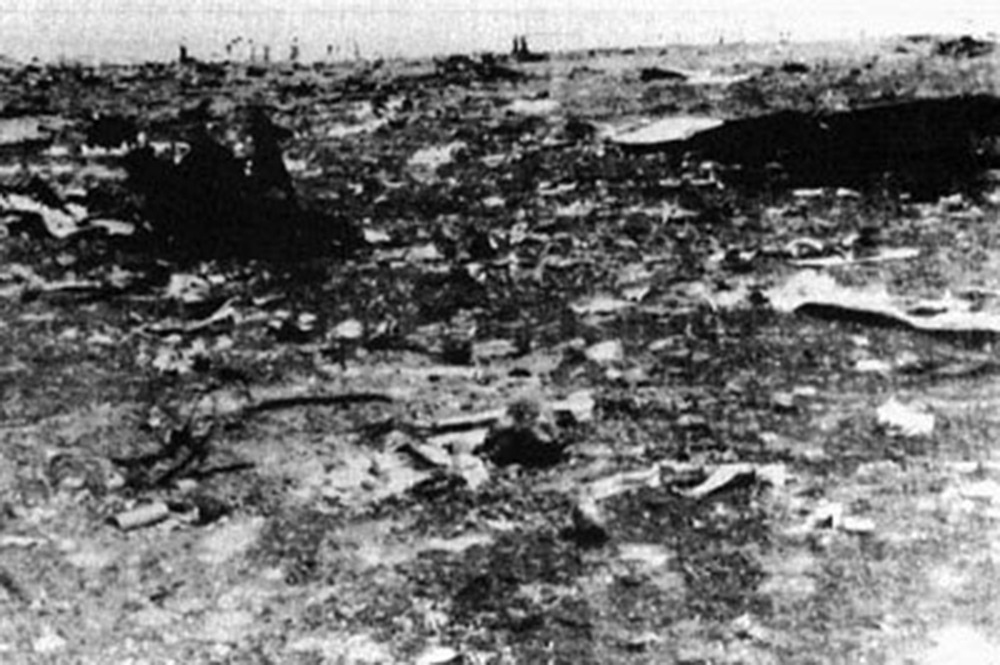
A McDonnell Douglas DC-8-61 passenger plane, registered C-GMXQ was destroyed in an accident near Jeddah-King Abdulaziz International Airport (JED), Saudi Arabia. All 261 on board were killed. The DC-8 jetliner was owned by Canadian airline Nationair which operated the plane on behalf of Nigeria Airways to fly hajj pilgrims between Nigeria and Saudi Arabia. Nigeria Airways flight 2120 took off from Jeddah's runway 34L at 08:28, bound for Sokoto (SKO), Nigeria. About 15 seconds after brake release an oscillating sound was heard in the cockpit. Within two seconds, the flight engineer said: "What's that?" The first officer replied: "We gotta flat tire, you figure?" Two seconds later, an oscillating sound was again heard. The captain asked the first officer: "You're not leaning on the brakes, eh?" The first officer responded: "No, I 'm not, I got my feet on the bottom of the rudder." By this time, the aircraft had accelerated to about 80 knots. Marks on the runway showed that the No.1 wheel started to break up at about this time. In addition, the left and right flanges of No.2 wheel began to trace on the runway; rubber deposit from No.2 tire continued which appeared to be from a deflated tire between the flanges. At 28 seconds after brake release, a speed of 90 knots was called by the captain and acknowledged by the first officer. The captain called V1 about 45 seconds after brake release. Two seconds later, the first officer noted "sort of a shimmy like if you're riding on one of those ah thingamajigs." The captain called "rotate" 51 seconds after brake release and the airplane lifted off the runway. Witnesses noticed flames in the area of the left main landing gear. The flames disappeared when the undercarriage was retracted. During the next three minutes several indications of system anomalies occurred, which included a pressurization system failure, a gear unsafe light and a loss of hydraulics. The captain requested a level-off at 2000 feet because of the pressurization problem. In his radio call the captain used the callsign "Nationair 2120" instead of "Nigerian 2120" and the controller mistook the transmission to be from a Saudi flight returning to Jeddah and cleared The Jeddah bound aircraft to 3000 feet. The captain of the accident aircraft, however, acknowledged the ATC transmission without a call sign, saying "understand you want us up to 3000 feet." This misunderstanding continued for the next three minutes with ATC assuming that all calls were from the Saudi flight, not from the accident aircraft. About four minutes after brake release the captain called ATC and reported that the aircraft was leveling at 3000 feet. The first officer then interrupted with " ... declaring an emergency. We 're declaring an emergency at this time. We believe we have ah, blown tires." As the aircraft continued on the downwind heading, a flight attendant came into the cockpit and reported "smoke in the back ... real bad." A few moments later, the first officer said "I've got no ailerons." The captain responded: "OK, hang on, I've got it." It was the last record on the CVR, which failed (along with the flight data recorder [FDR]) at 08:33:33. The ATC controller gave a heading to intercept the final approach and thereafter continued to give heading information. Meanwhile, during the downwind and base legs, the fire had consumed the cabin floor above the wheel wells , permitting cabin furnishing to sag into the wheel wells. When the gear was probably extended at 11 miles on the final approach, the first body fell out because fire had burned through the seat harness. Subsequently, with the gear down and a forceful air supply through the open gear doors, rapid destruction of more floor structure permitted the loss of more bodies and seat assemblies. Despite the considerable destruction to the airframe, the aircraft appeared to be controllable. Eight minutes after brake release and 10 miles from the runway, the captain declared an emergency for the third time, saying, "Nigeria 2120 declaring an emergency, we are on fire, we are on fire, we are returning to base immediately." The aircraft came in nose down and crashed 9,433 feet (2,875 meters) short of the runway at 08:38.
Probable cause:
The following findings were reported:
1. The organisational structure for the deployment team was ill-defined and fragmented.
2. Deployment maintenance personnel were not qualified or authorised to perform the function of releasing the aircraft as being fit to fly.
3. The release of the aircraft as being fit to fly was delegated to non-practising Aircraft Maintenance Engineers whose primary function was to operate the aircraft as flight crew members.
4. The aircraft was signed-off as fit for flight, in an unairworthy condition, by the operating flight engineer who had no involvement in the aircraft servicing.
5. The #2 and #4 tyre pressures were below the minimum for flight dispatch. Other tyres may also have been below minimum pressures.
6. Maintenance personnel were aware of the low tyre pressures but failed to rectify the faults.
7. The mechanic altered the only record of the actual low pressures, measured by the avionics specialist on 7 July, four days before the accident.
8. There was no evidence that the tyre pressures had been checked, using a tyre pressure gauge, after 7 July.
9. The lead mechanic was aware of the low tyre pressures.
10. The persons who were aware of the low pressures had insufficient knowledge of the hazards of operating at low tyre pressures.
11. The project manager was aware of a low tyre pressure but was not qualified to assess its importance.
12. The project manager was responsible for the aircraft schedule and directed that the aircraft depart without servicing the tyre.
13. The lead mechanic who was aware of the requirement for, and had requested nitrogen for tyre servicing, did not countermand the decision of the project manager.
14. There was no evidence to indicate that this flight crew were ever informed of the low tyre pressures.
15. The aircraft departed the ramp in an unairworthy condition.
16. During the taxi from the ramp to the runway, the transfer of the load from the under-inflated #2 tyre to #1 tyre on the same axle, resulted in over deflection, over-heating and structural weakening of the #1 tyre.
17. The #1 tyre failed very early on the take-off roll due to degeneration of the structure, caused by over-deflection.
18. The #2 tyre failed almost immediately after #1 due to over-deflection and rapid overheating when the load was transferred from the #1 tyre.
19. The #2 wheel stopped rotating for reasons not established. Friction between the wheel/brake assembly and the runway generated sufficient heat to raise the temperature of tyre remnants above that required for a tyre fire to be self-sustaining. Rubber remnants ignited during the take-off roll.
20. Numbers 1 and 2 wheels were severely damaged and at least one piece of #1 wheel rim struck the airframe, becoming embedded in the left flap.
21. The crew were aware of unusual symptoms early and throughout the takeoff roll; the captain continued the take-off.
22. The aircraft was not equipped with warning systems which would have provided the flight crew with adequate information on which to make a decision to reject the take-off after tyre(s) failure.
23. The captain did not receive sufficient cues to convince him that a rejected take-off was warranted.
24. The crew retracted the gear, consistent with company procedures, and burning rubber was brought into close proximity with hydraulic and electrical system components.
25. The evidence indicates that the wheel well fire involved tyres, hydraulic fluid, magnesium alloy and fuel. The fuel was probably introduced as a result of "burn through" of the centre fuel tank.
26. Fire within the wheel wells spread and intensified until the cabin floor was breached and control systems were disabled.
27. The fuel increased the intensity of the fire until, shortly before impact, airframe structural integrity was lost.
28. Tyre characteristics and performance are not adequately addressed during training and licensing of both flight crews and technical personnel.
29. The aircraft operator's tyre inflation pressures did not accurately reflect what was contained in the aircraft manufacturer's maintenance manual.
30. The operator's maintenance and operating documentation for the DC-8 does not contain adequate information for the proper maintenance and operation of aircraft tyres.
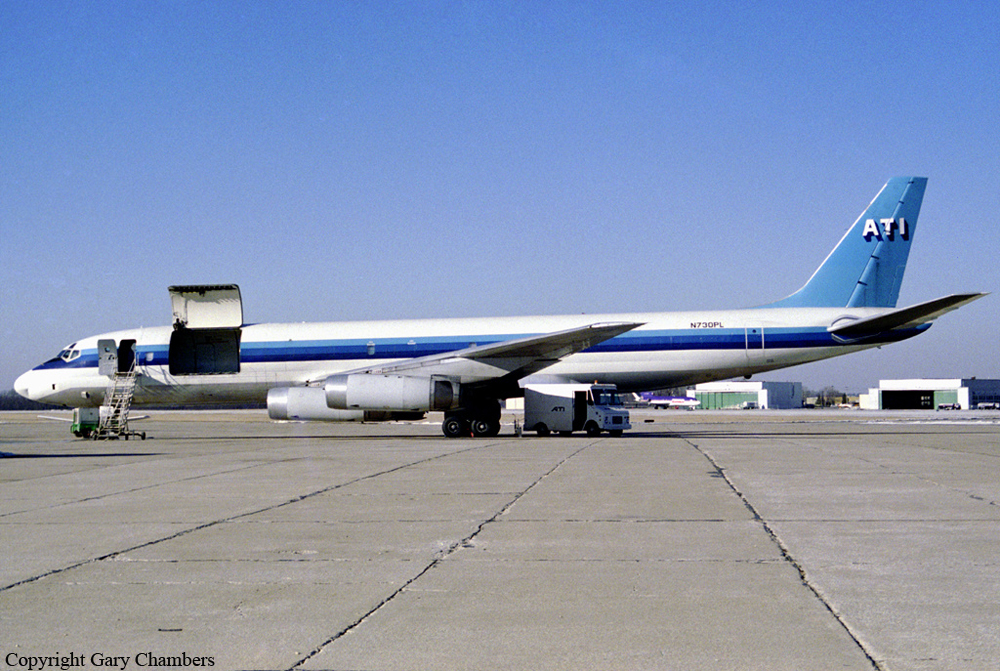
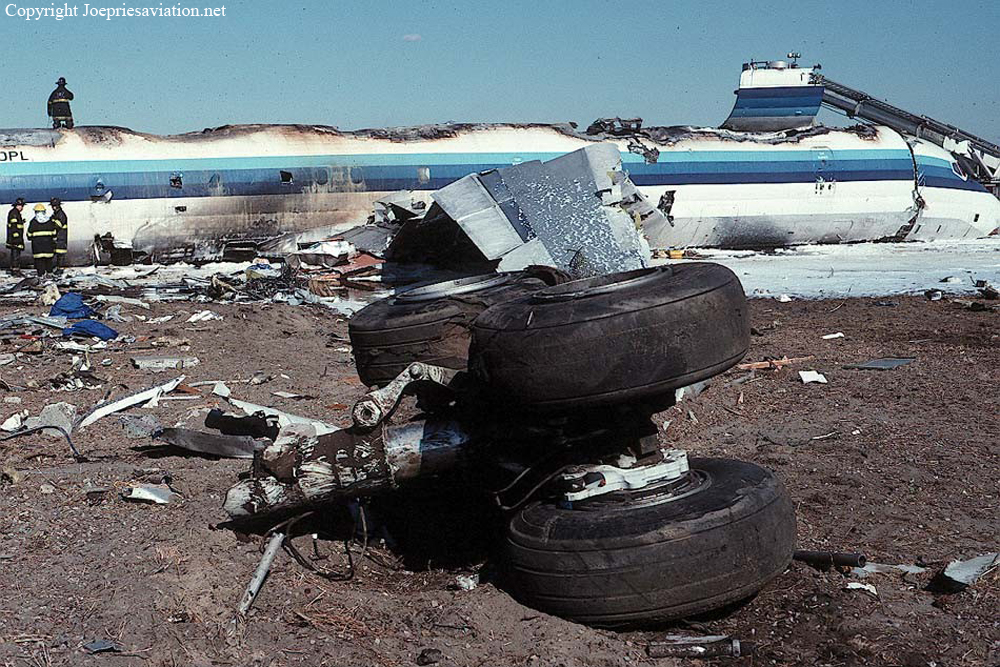
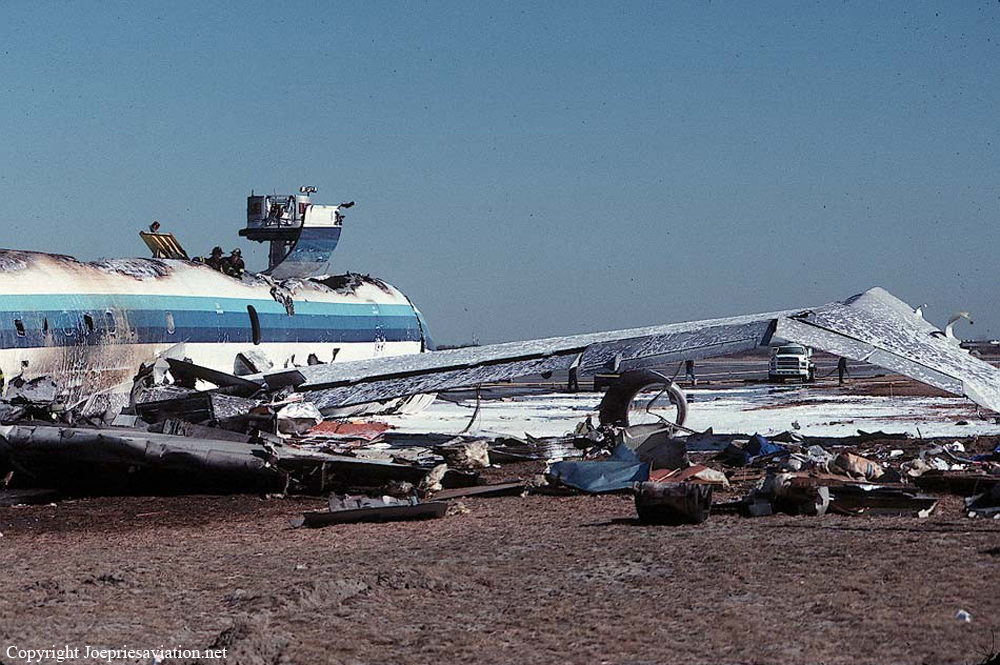
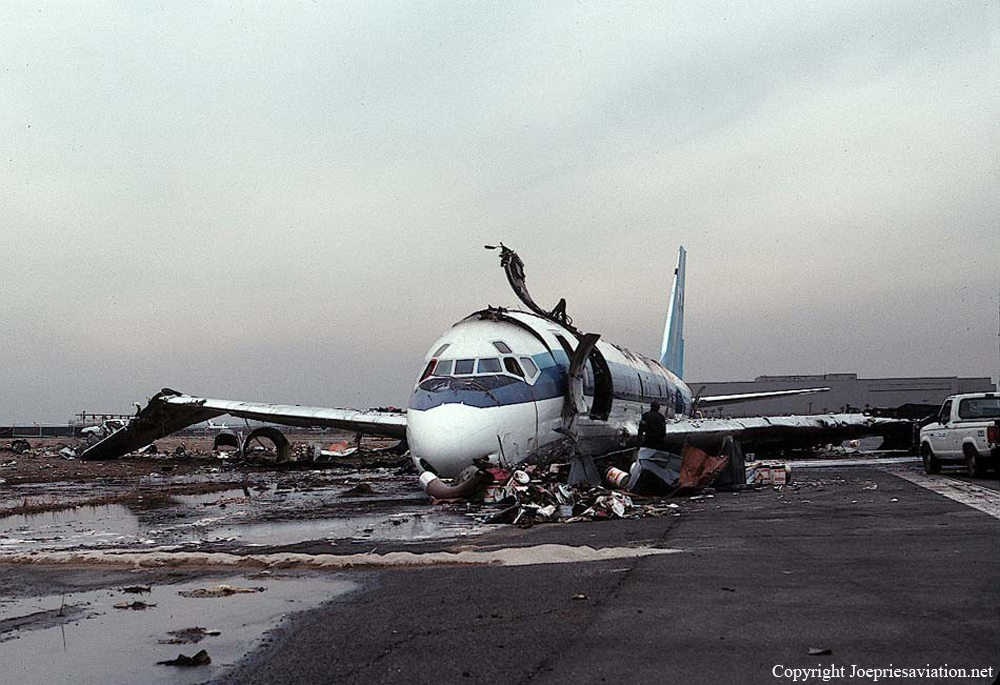
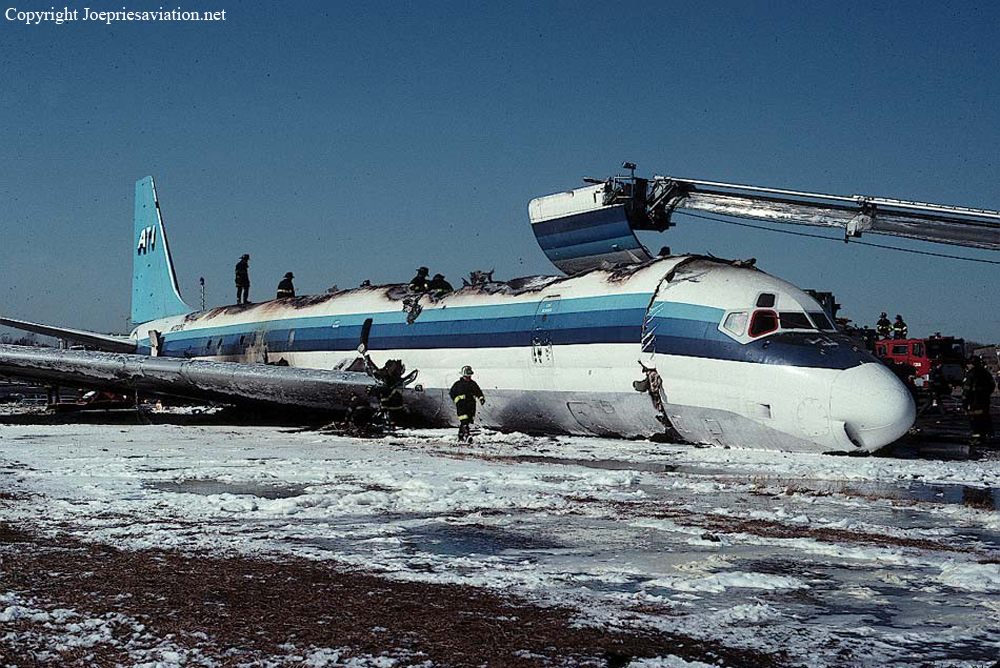
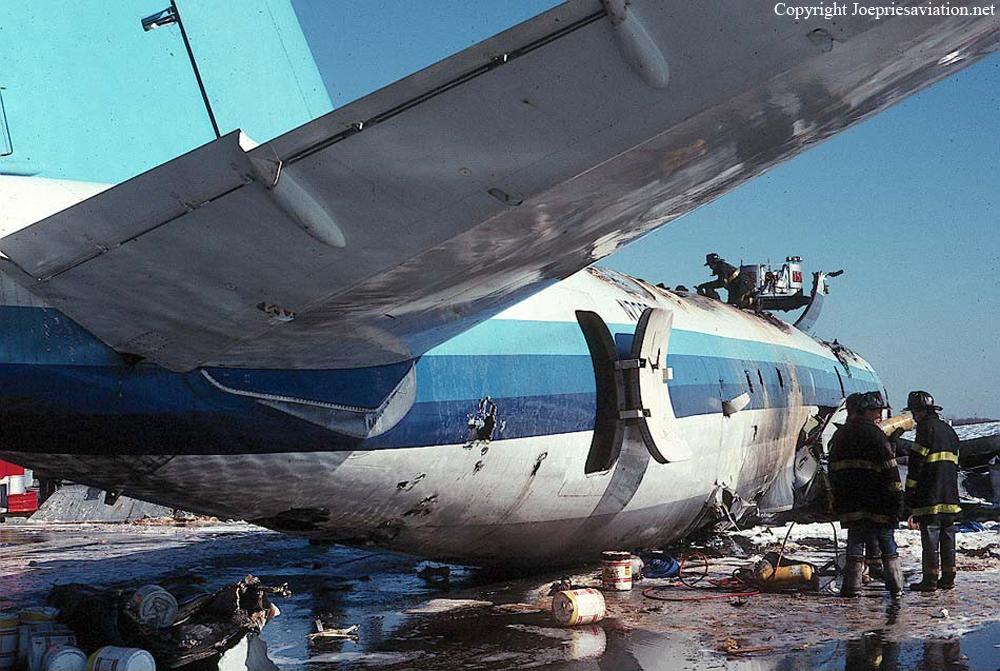
Crash of a Douglas DC-8-62F in New York

Date & Time: Mar 12, 1991 at 0906 LT
Type of aircraft:
Operator:
Registration:
N730PL
Flight Phase:
Flight Type:
Survivors:
Yes
Schedule:
New York - Brussels
MSN:
46161
YOM:
1971
Flight number:
8C102
Crew on board:
3
Crew fatalities:
Pax on board:
2
Pax fatalities:
Other fatalities:
Total fatalities:
0
Captain / Total flying hours:
12800
Captain / Total hours on type:
3000.00
Aircraft flight hours:
50145
Circumstances:
Before flight, the flight engineer (f/e) had calculated 'v' speeds and horizontal stabilizer trim setting for takeoff, but neither the captain nor the 1st officer (f/o) had verified them. During rotation for takeoff, the captain noted that the forced needed to pull the yoke aft was greater than normal and that the aircraft would not fly (at that speed). Subsequently, he aborted the attempted takeoff. Realizing the aircraft would not stop on the remaining runway, he elected to steer it to the right to avoid hitting traffic on a highway near the departure end. The aircraft struck ILS equipment; the landing gear collapsed and all 4 engines tore away. Subsequently, the aircraft was destroyed by fire. Investigations revealed the f/e had improperly computed the takeoff data. He had calculated the 'v' speeds and horizontal stabilizer trim setting for 242,000 lbs; however, the actual takeoff wt was 342,000 lbs. Rotation speed (Vr) for this weight was 28 knots above the speed that was used. Investigations revealed shortcomings in the operator's flightcrew training program and questionable scheduling of qualified (but marginally experienced) crew members for the accident flight.
Probable cause:
Improper preflight planning/preparation, in that the flight engineer miscalculated (misjudged) the aircraft's gross weight by 100,000 lbs and provided the captain with improper takeoff speeds; and improper supervision by the captain. Factors related to the accident were: improper trim setting provided to the captain by the flight engineer, inadequate monitoring of the performance data by the first officer, and the company management's inadequate surveillance of the operation.
Final Report:

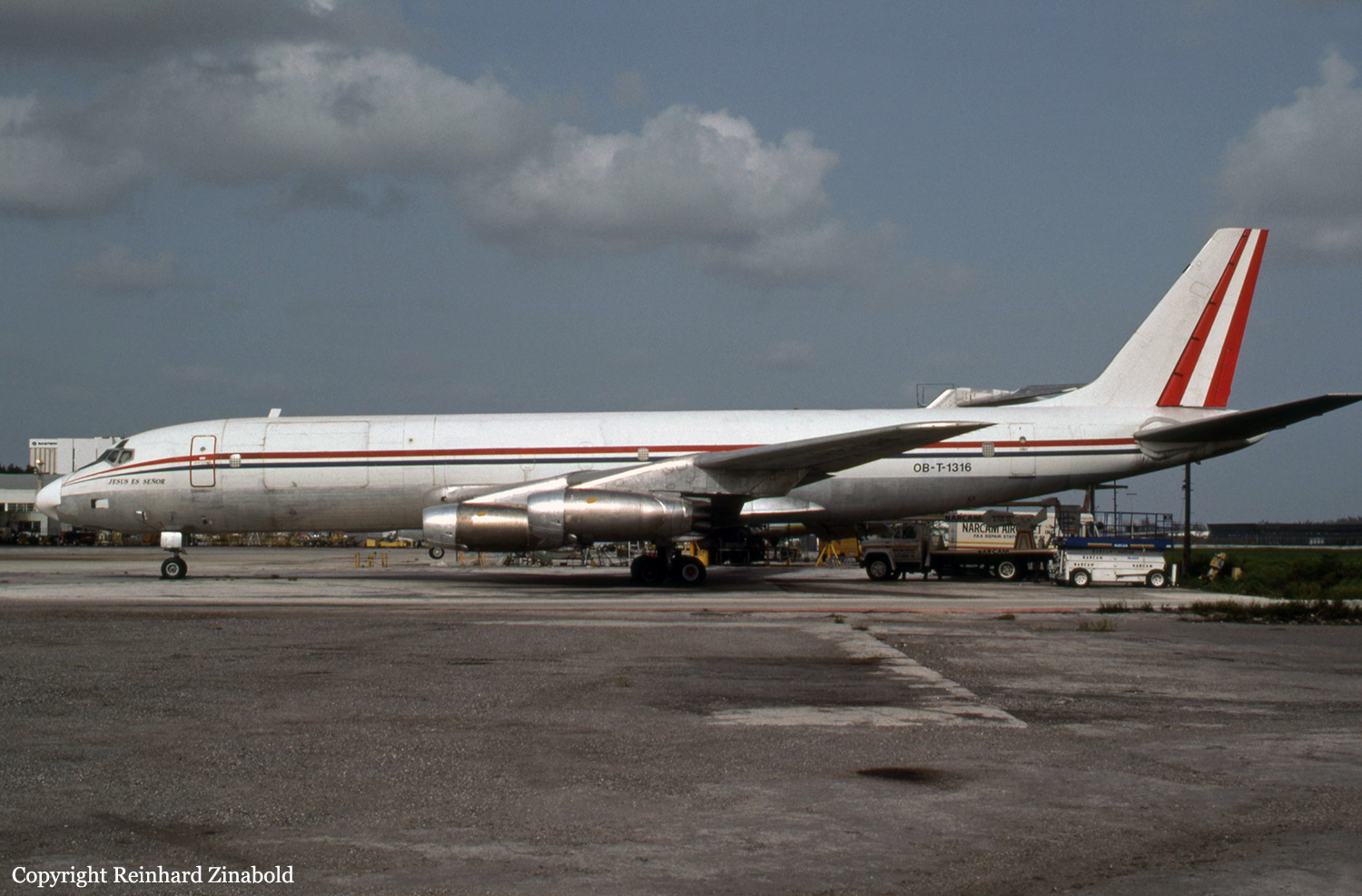
Crash of a Douglas DC-8-32 in Iquitos

Date & Time: Aug 10, 1989
Type of aircraft:
Operator:
Registration:
OB-T-1316
Flight Type:
Survivors:
Yes
Schedule:
Lima - Iquitos
MSN:
45384
YOM:
1960
Country:
Crew on board:
4
Crew fatalities:
Pax on board:
0
Pax fatalities:
Other fatalities:
Total fatalities:
0
Circumstances:
The four engine aircraft landed too far down a wet runway at Iquitos-Coronel Francisco Secada Vignetta Airport. After touchdown, the crew started the braking procedure but the aircraft was unable to stop within the remaining distance. It overran, lost its undercarriage and came to rest few dozen meters further. All four crew members evacuated safely while the aircraft was damaged beyond repair.
Probable cause:
Wrong approach configuration on part of the crew who landed the aircraft too far down the runway, reducing the landing distance available. At the time of the accident, the runway was wet, which was considered as a contributing factor.

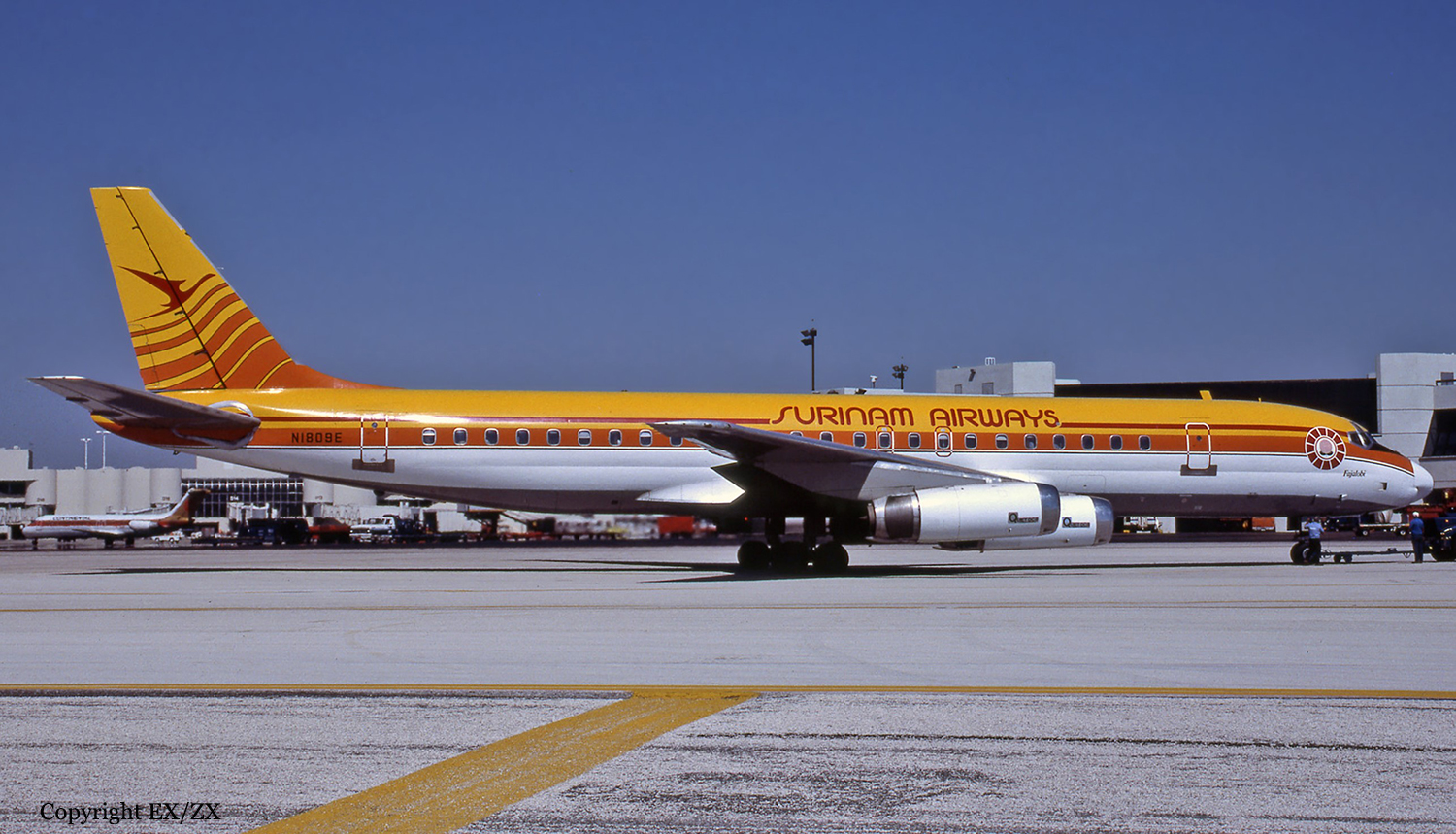
Crash of a Douglas DC-8-62 in Paramaribo: 176 killed

Date & Time: Jun 7, 1989 at 0427 LT
Type of aircraft:
Operator:
Registration:
N1809E
Survivors:
Yes
Schedule:
Amsterdam - Paramaribo
MSN:
46107
YOM:
1969
Flight number:
PY764
Country:
Crew on board:
9
Crew fatalities:
Pax on board:
178
Pax fatalities:
Other fatalities:
Total fatalities:
176
Captain / Total flying hours:
19450
Captain / Total hours on type:
8800.00
Copilot / Total flying hours:
6600
Aircraft flight hours:
52706
Aircraft flight cycles:
20342
Circumstances:
Surinam Airways (SLM) carried out regular flights between Amsterdam-Schiphol Airport (AMS) and Paramaribo (PBM) using McDonnell Douglas DC-8-60 planes. One of these was a US-registered plane, N1809E, named "Anthony Nesty". The air crew was furnished by Air Crew International (ACI). The contract between Surinam Airways and ACI stipulated that ACI would furnish SLM with qualified crew members who held FAA certificates and who met the regulatory requirements to fly the DC-8. ACI did not provide for proficiency checks but left it to the individual pilots to meet the training and other requirements of their profession. One of the captains provided by ACI was involved in several incidents while operating on SLM flights. After investigation, SLM instructed ACI not to use this captain in future SLM assignments. However, he still acted as a crew member on several flights since. The captain was again scheduled on the accident flight PY764. According to regulations, the captain was not even qualified to act as pilot-in-command of that flight because of his age. He was 66 years old and Surinam regulations stipulated that "the holder of a pilot certificate is not authorized to act as pilot during commercial flights when he/she has reached age 60". Also, his most recent proficiency check flight was on a GA-7 Cougar twin instead of a DC-8. Flight 764 departed Amsterdam-Schiphol Airport at 23:25 (June 6) on a flight to Paramaribo (PBM). The en route part of the flight was uneventful and about 20 minutes before arrival in Paramaribo the crew received the 07:00 UTC weather for Zanderij Airport: Wind calm, visibility 900 m in fog, temperature/dewpoint 22°C/22°C. This caught the crew by surprise since the previous weather information had included a visibility of 6 km. Because the ILS was not to be used for operational purposes, the copilot said: "We don't legally have an ILS ... we have to use it". The captain responded affirmatively. The crew were confident that they could land because they assumed that the fog was localized given the fact that they were able to see the airport during the descent. Zanderij Tower then cleared the flight for a VOR/DME approach to runway 10. The captain tuned in to the ILS and instructed the first officer to set the final approach course for the published VOR/DME approach on the first officer's side. During the approach the first officer reported that he could see the airport:"Runway's at twelve o'clock". A minute later he commented "A little bit of low fog comin' up I reckon just a little bit". He was still able to see the runway and reported the runway in sight. The DC-8 then entered some stratus clouds the captain told the first officer to "Tell him [tower controller] to turn the runway lights up ... Tell him to put the runway lights bright". The captain attempted to capture the unreliable ILS glide slope signal, but failed to capture it. The Ground Proximity Warning System (GPWS) sounded several times: "Glideslope ... glideslope..." until it was deactivated. The captain was flying the aircraft below the minimum altitude for the ILS/DME approach procedure (260 ft asl) as well as below the minimum descent altitude for the VOR/DME approach procedure (560 ft). The first officer called out: "Two hundred feet". Thirteen seconds later the no. 2 engine contacted a tree. The right wing then struck another tree, causing the aircraft to roll, striking the ground inverted. The airplane broke up and a fire erupted.


Probable cause:
The Commission determines:
a) That as a result of the captain's glaring carelessness and recklessness the aircraft was flown below the published minimum altitudes during the approach and consequently collided with a tree.
b) As underlying factor in the accident was the failure of SLM's operational management to observe the pertinent regulations as well as the procedures prescribed in the SLM Operations Manual concerning qualification and certification during recruitment and employment of the crew members furnished by ACI.
Final Report:

Crash of a Douglas DC-8-55F in Cairo: 4 killed

Date & Time: Mar 31, 1988 at 0407 LT
Type of aircraft:
Operator:
Registration:
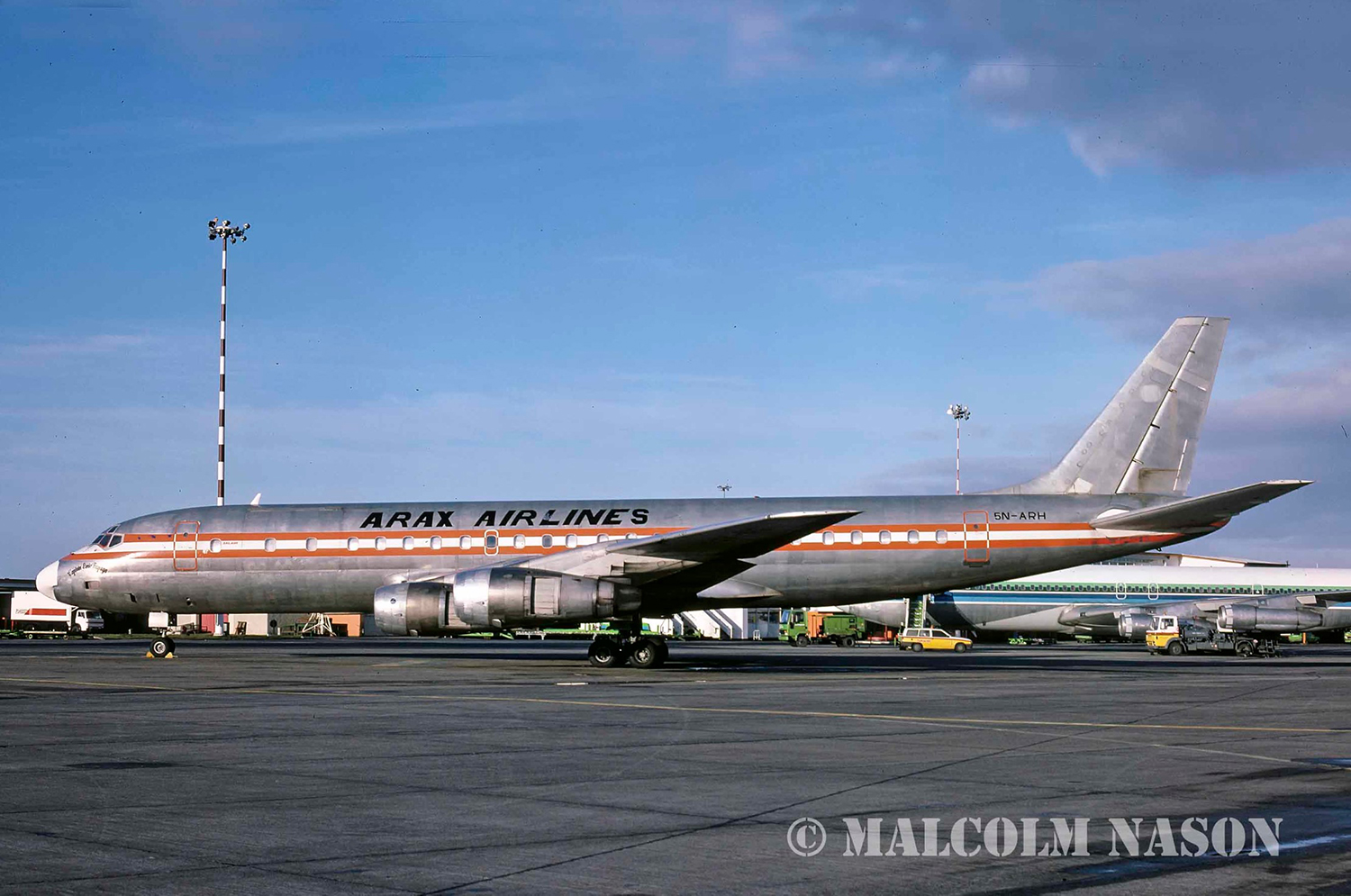
5N-ARH
Flight Phase:
Flight Type:
Survivors:
No
Schedule:
Billund – Cairo – Sharjah
MSN:
45859
YOM:
1966
Country:
Region:
Crew on board:
4
Crew fatalities:
Pax on board:
0
Pax fatalities:
Other fatalities:
Total fatalities:
4
Circumstances:
The aircraft was completing a cargo flight from Billund to Sharjah with an intermediate stop in Cairo, carrying a crew of four and a load of about 100 Danish cows. Just after a night takeoff from runway 27R, while in initial climb, the aircraft stalled and crashed 700 meters past the runway end, bursting into flames. All four occupants and all animals were killed.
Probable cause:
It was determined that one of the engine failed and caught fire shortly after rotation for unknown reasons. The crew already abandoned a first attempt to takeoff few minutes earlier for similar reasons.

Crash of a Douglas DC-8-63CF in Gander: 256 killed

Date & Time: Dec 12, 1985 at 0645 LT
Type of aircraft:
Operator:
Registration:
N950JW
Flight Phase:
Survivors:
No
Schedule:
Cairo – Cologne – Gander – Fort Campbell
MSN:
46058
YOM:
1969
Flight number:
MF1285R
Country:
Crew on board:
8
Crew fatalities:
Pax on board:
248
Pax fatalities:
Other fatalities:
Total fatalities:
256
Captain / Total flying hours:
7001
Captain / Total hours on type:
1081.00
Copilot / Total flying hours:
5549
Copilot / Total hours on type:
918
Aircraft flight hours:
50861
Circumstances:
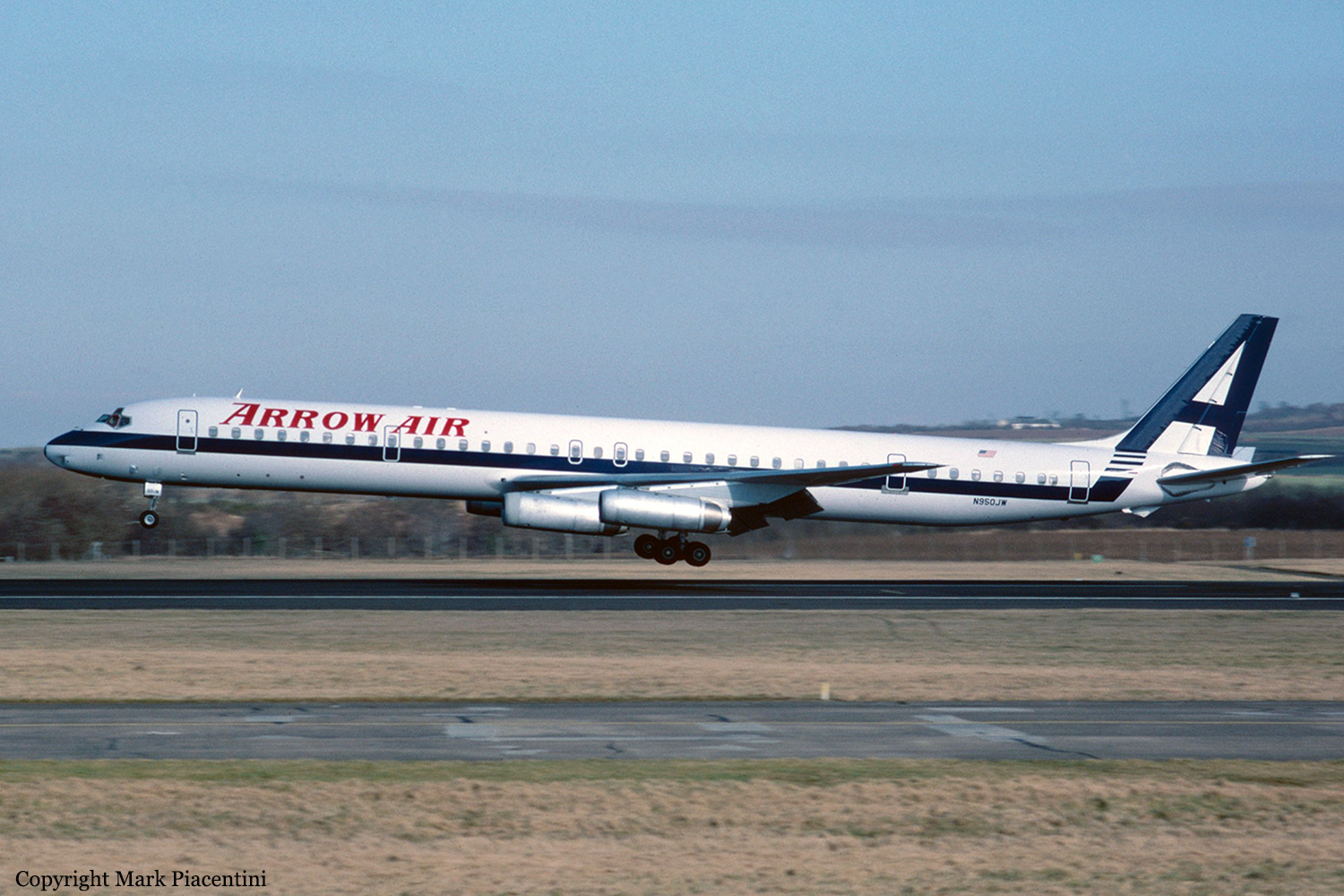
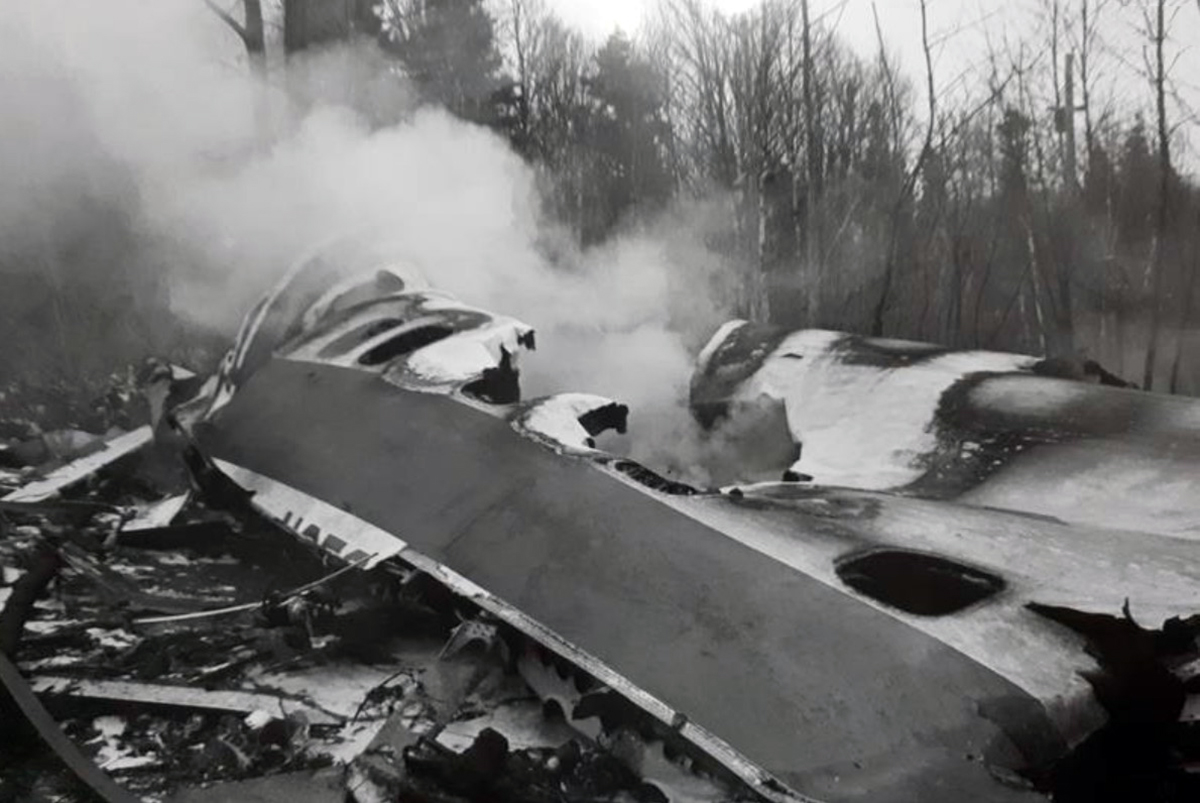
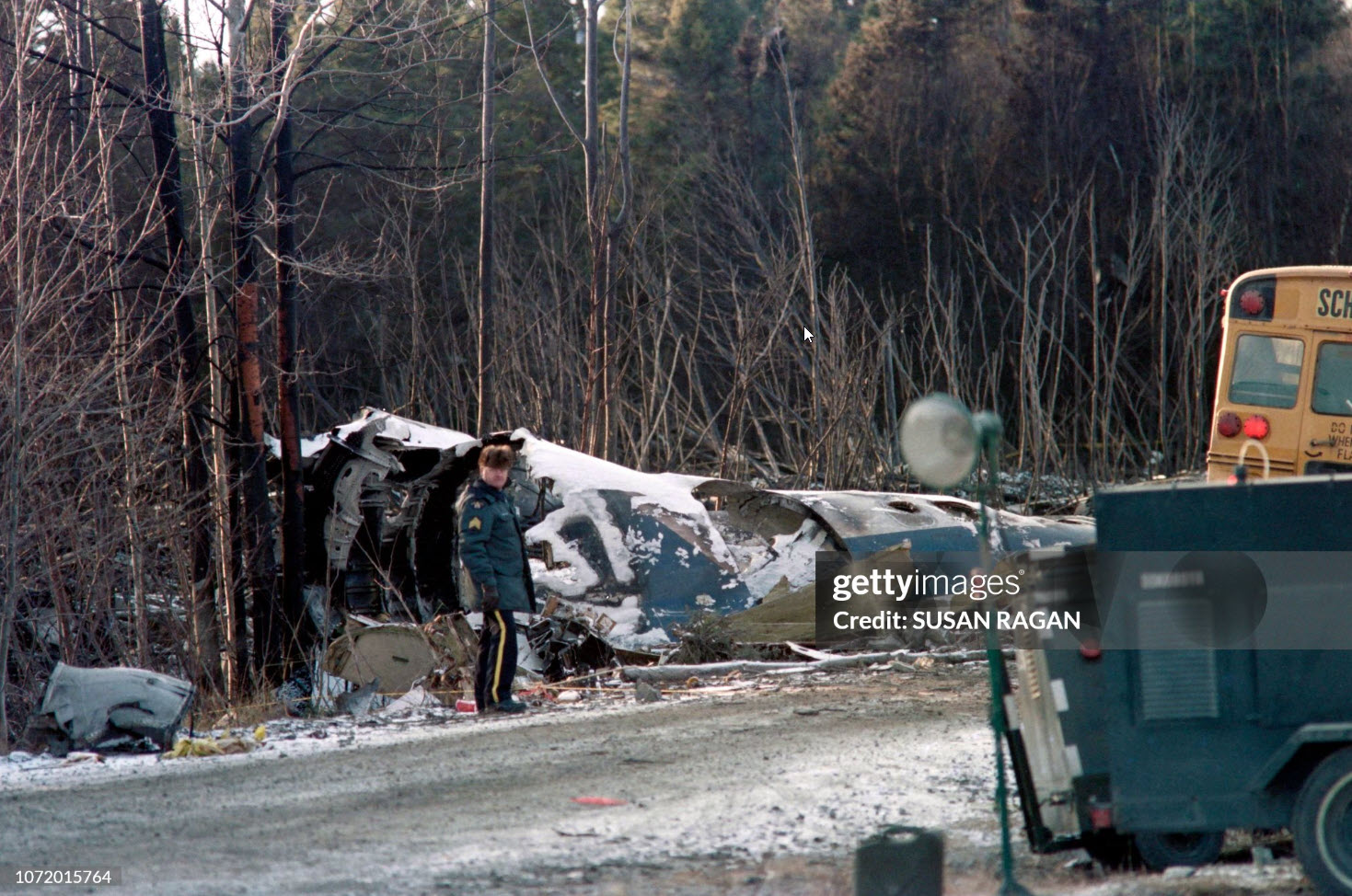
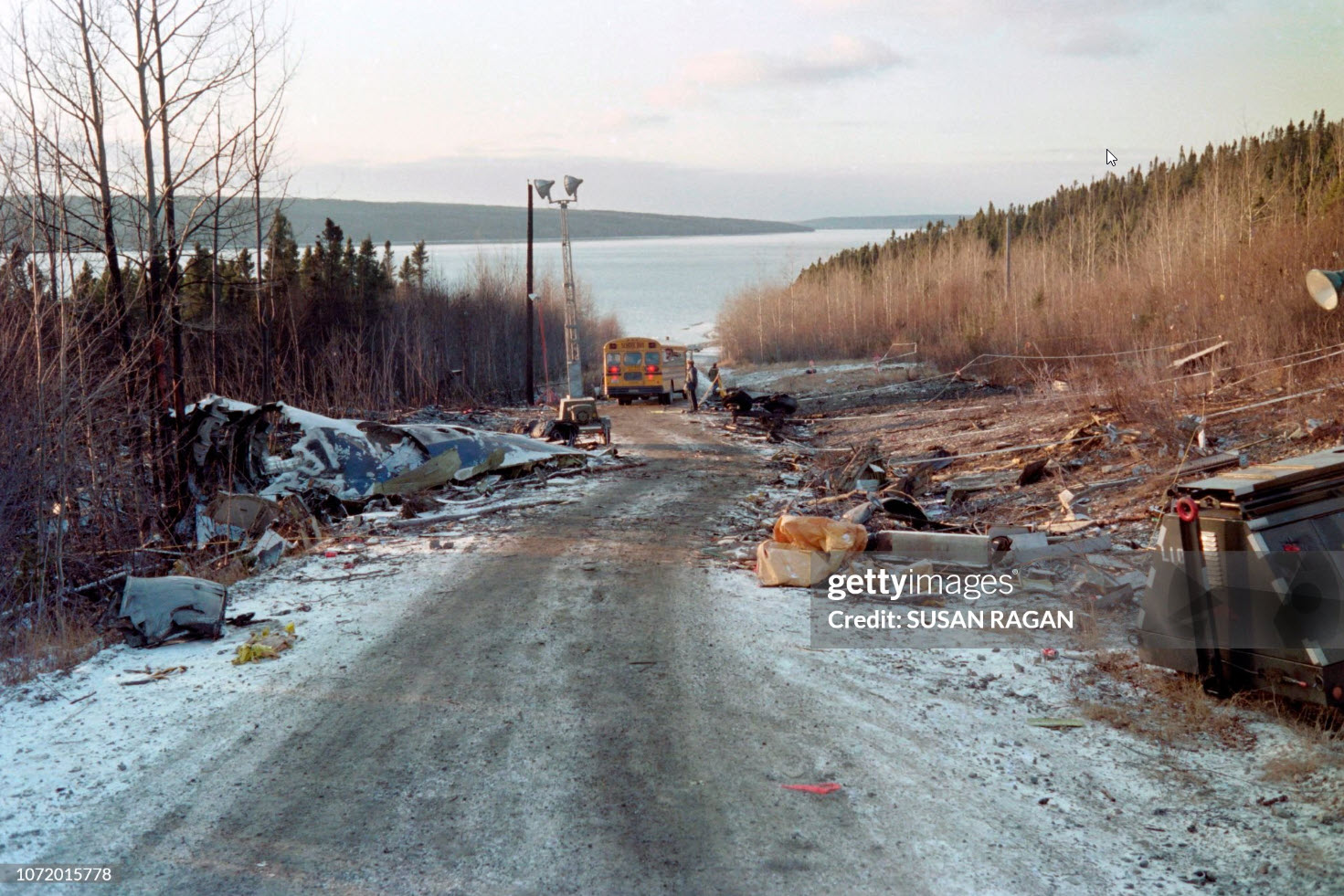
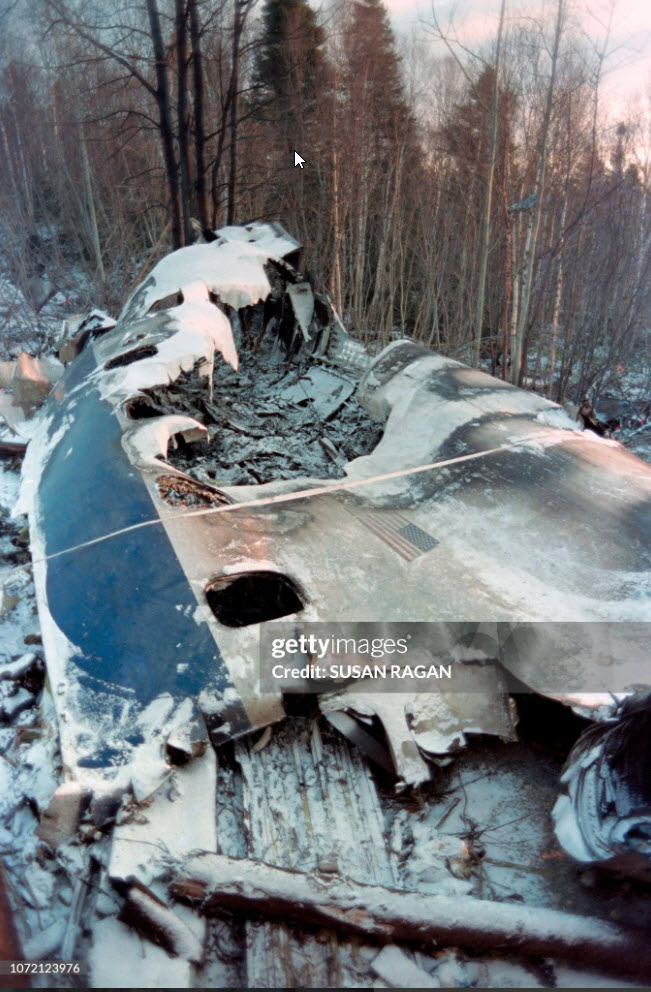
On 11 December 1985, Arrow Air Flight MF1285R, a Douglas DC-8-63, U.S. registration N950JW, departed Cairo, Egypt on an international charter flight to Fort Campbell, Kentucky (Ky), U.S.A. via Cologne, Germany, and Gander, Newfoundland. On board were 8 crew members and 248 passengers. The flight was the return portion of the second in a series of three planned troop rotation flights originating at McChord Air Force Base (AFB), Washington, U.S.A. and terminating in Fort Campbell. The flight had been chartered by the Multinational Force and Observers (MFO) to transport troops, their personal effects, and some military equipment to and from peacekeeping duties in the Sinai Desert. All 248 passengers who departed Cairo on 11 December 1985 were members of 101st Airborne Division (United States Army), based in Fort Campbell. The flight departed Cairo at 2035 Greenwich Mean Time (GMT) and arrived at Cologne at 0121, 12 December 1985 for a planned technical stop. A complete crew change took place following which the flight departed for Gander at 0250. The flight arrived at Gander at 0904. Passengers were deplaned, the aircraft was refuelled, trash and waste water were removed, and catering supplies were boarded. The flight engineer was observed to conduct an external inspection of portions of the aircraft. The passengers then reboarded. Following engine start-up, the aircraft was taxied via taxiway "D" and runway 13 to runway 22 for departure. Take-off on runway 22 was begun from the intersection of runway 13 at 1015. The aircraft was observed to proceed down the runway and rotate in the vicinity of taxiway "A". Witnesses to the take-off reported that the aircraft gained little altitude after rotation and began to descend. Several witnesses, who were travelling on the Trans-Canada Highway approximately 900 feet beyond the departure end of runway 22, testified that the aircraft crossed the highway, which is at a lower elevation than the runway, at a very low altitude. Three described a yellow/orange glow emanating from the aircraft. Two of the witnesses testified that the glow was bright enough to illuminate the interior of the truck cabs they were driving. The third attributed the glow to the reflection of the runway approach lighting on the aircraft. Several witnesses observed the aircraft in a right bank as it crossed the Trans-Canada Highway. The pitch angle was also seen to increase, but the aircraft continued to descend until it struck downsloping terrain approximately 3,000 feet beyond the departure end of the runway. The aircraft was destroyed by impact forces and a severe fuel-fed fire. All 256 occupants on board sustained fatal injuries.
Probable cause:
The Canadian Aviation Safety Board was unable to determine the exact sequence of events which led to this accident. The Board believes, however, that the weight of evidence supports the conclusion that, shortly after lift-off, the aircraft experienced an increase in drag and reduction in lift which resulted in a stall at low altitude from which recovery was not possible. The most probable cause of the stall was determined to be ice contamination on the leading edge and upper surface of the wing. Other possible factors such as a loss of thrust from the number four engine and inappropriate take-off reference speeds may have compounded the effects of the contamination.
Final Report:

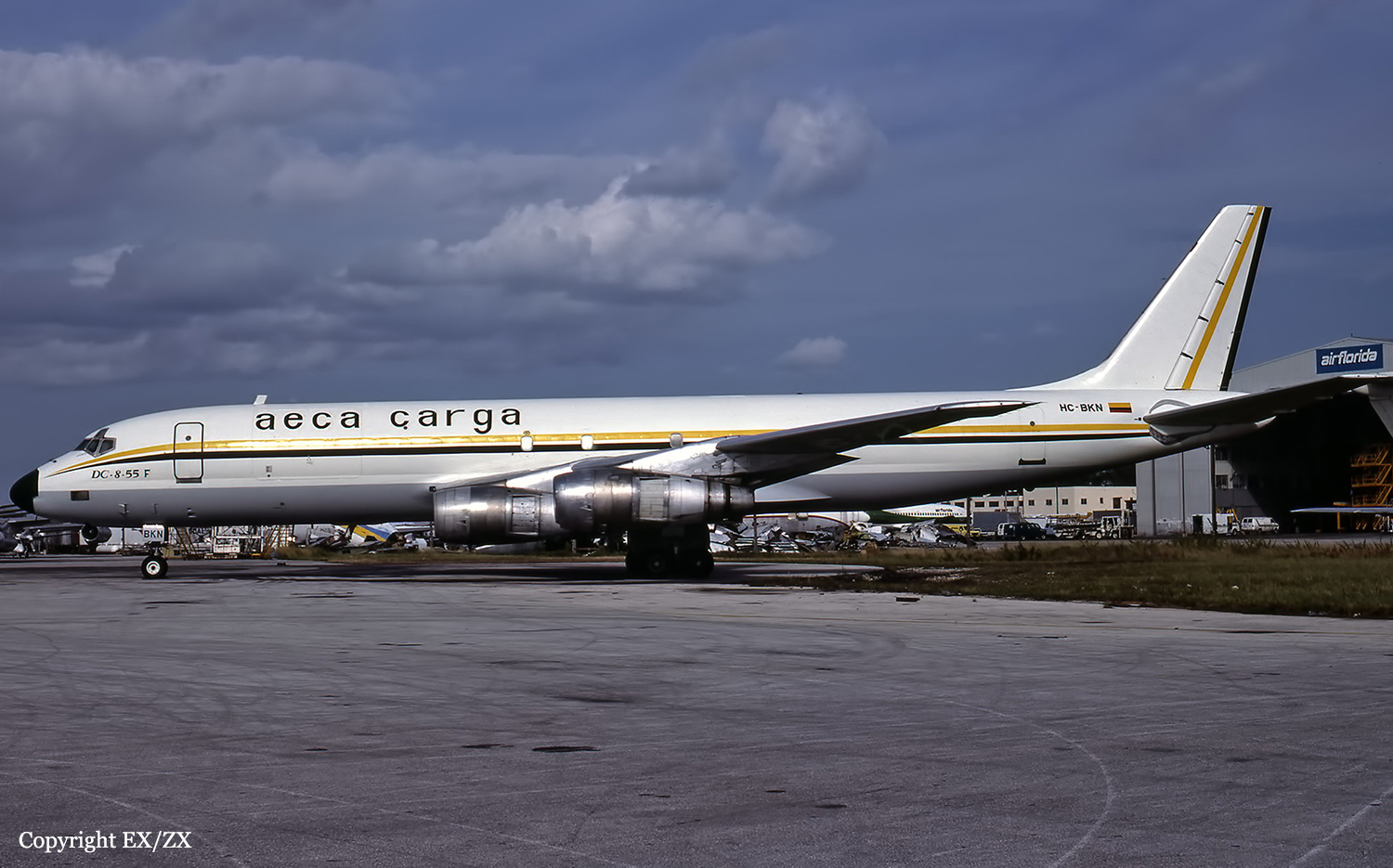
Crash of a Douglas DC-8-55F in Quito: 53 killed

Date & Time: Sep 18, 1984 at 1104 LT
Type of aircraft:
Operator:
Registration:
HC-BKN
Flight Phase:
Flight Type:
Survivors:
No
Site:
Schedule:
Miami – Quito – Guayaquil
MSN:
45754
YOM:
1965
Flight number:
2A103
Country:
Crew on board:
4
Crew fatalities:
Pax on board:
0
Pax fatalities:
Other fatalities:
Total fatalities:
53
Aircraft flight hours:
60070
Aircraft flight cycles:
17003
Circumstances:
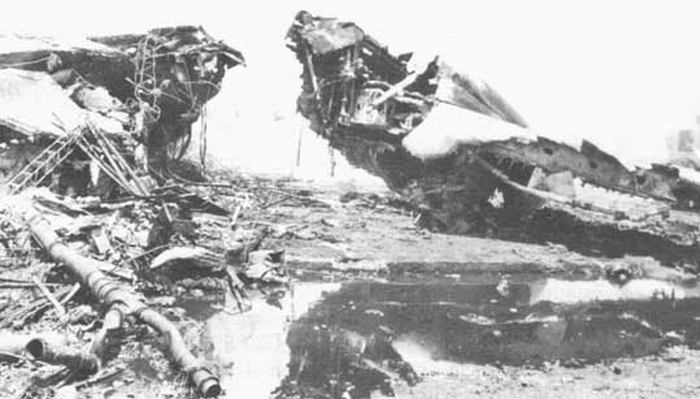
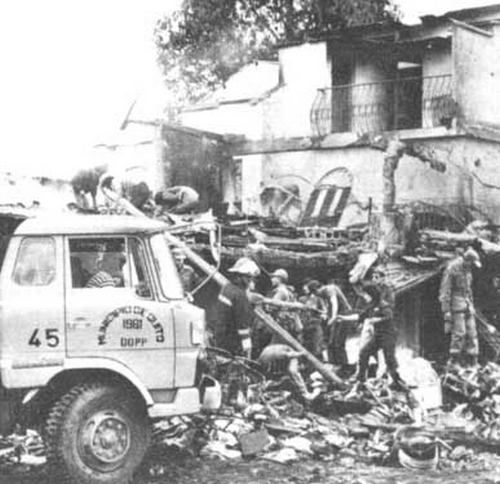
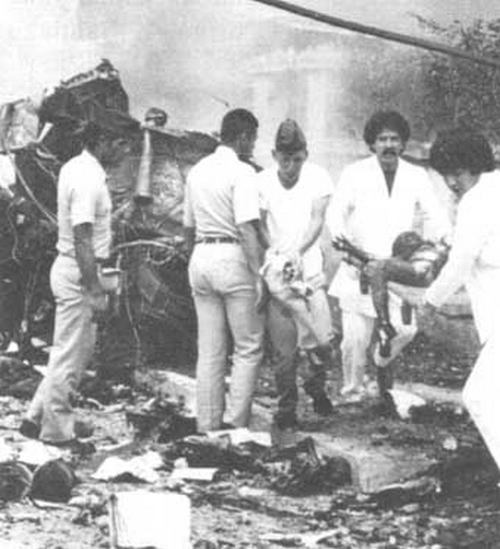
The DC-8 landed at Quito at 06:52 after a flight from Miami. Shortly after scheduled departure time of 09:00 members of the Ecuadorian Federation of Aircrews (FEDTA) requested and were granted permission to board the aircraft and discuss subjects relating to the aircrews' strike. The four Aeroservicios Ecuatorianos crew members didn't comply with the strike, after consulting AECA management. After a delay of about two hours, the n°4 engine was started. The crew then ordered the aircraft to be towed to the runway, perhaps in order to hasten the departure. The other engines were started during the towing operation. Pre-takeoff checks were not (or improperly) carried out. This caused the 0.5° horizontal stabilizer nose-up to go undetected, while 8° nose-up is required for takeoff. The DC-8 thus barely climbed after a ground run, extended to 48 meters beyond the runway end. The horizontal stabilizer struck the wooden structure of the ILS aerial, 83 meters past the runway 35 end. The aircraft then crashed into houses, 460 meters past the runway end and 35 meters to the right of the extended centreline. A total of 25 houses were demolished. All four crew members as well as 49 people on the ground were killed. At least 50 other people on the ground were injured, some of them seriously.
Probable cause:
The incorrect position of the horizontal stabilizer in relation to the aircraft's centre of gravity, which prevented the aircraft from reaching rotation and lift-off speed within the runway distance available. The following contributing factors were reported:
- Clearance of the aircraft from Quito was done incorrectly, since the MTOW permissible for the existing runway, wind and temperature conditions, the real take-off weight, the useful load distribution and the position of the aircraft's centre of gravity were not determined,
- The crew's state of mind may have been a contributing factor in the accident. It is assumed that it prevented the crew from concentrating on all aspects of the operation they were performing.

Crash of a Douglas DC-8-54F in Barranquilla

Date & Time: Sep 18, 1984
Type of aircraft:
Operator:
Registration:
HK-2380
Flight Type:
Survivors:
Yes
MSN:
45879
YOM:
1966
Country:
Crew on board:
4
Crew fatalities:
Pax on board:
0
Pax fatalities:
Other fatalities:
Total fatalities:
0
Circumstances:
The approach to Barranquilla-Ernesto Cortissoz Airport was completed in poor weather conditions with a limited visibility due to heavy rain falls. The aircraft was too high on the glide and landed too far down the runway. The captain attempted to veer off runway to the left but on a wet surface, the aircraft overran the runway, lost two engines and its undercarriage before coming to rest. All four crew members evacuated safely while the aircraft was destroyed.
Probable cause:
Wrong approach configuration on part of the crew who landed too far down the runway. In such conditions, the landing distance available was insufficient. The crew failed to initiate a go around. Poor weather conditions and wet runway surface conditions were considered as contributing factors.

Crash of a Douglas DC-8-54F in Detroit: 3 killed

Date & Time: Jan 11, 1983 at 0252 LT
Type of aircraft:
Operator:
Registration:
N8053U
Flight Phase:
Flight Type:
Survivors:
No
Schedule:
Cleveland - Detroit - Los Angeles
MSN:
46010
YOM:
1968
Flight number:
UA2885
Crew on board:
3
Crew fatalities:
Pax on board:
0
Pax fatalities:
Other fatalities:
Total fatalities:
3
Captain / Total flying hours:
16102
Captain / Total hours on type:
2711.00
Copilot / Total flying hours:
9360
Copilot / Total hours on type:
6493
Aircraft flight hours:
31902
Aircraft flight cycles:
13474
Circumstances:
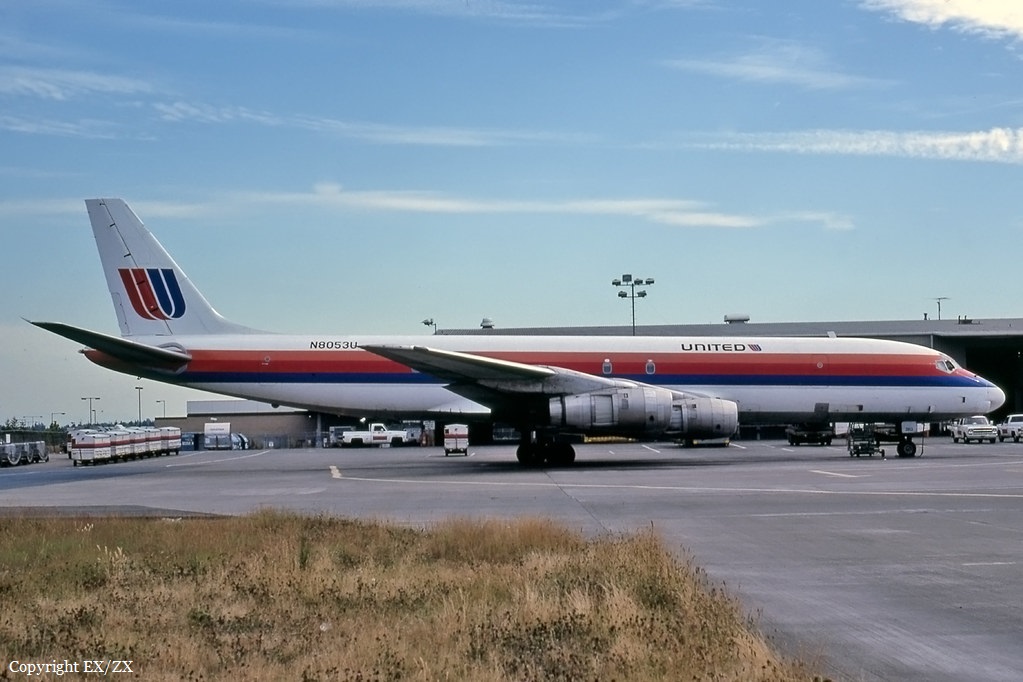
United Flight 2885 departed Cleveland at 01:15 for a cargo flight to Los Angeles via Detroit. The DC-8 arrived at Detroit at 01:52. Cargo for Detroit was unloaded, the airplane was refueled, and cargo for Los Angeles was loaded. The engines were started, and then the crew called for taxi instructions at 02:45:58. During the taxi, the flightcrew accomplished the before takeoff checklist. The second officer called "trim" and the first officer responded "set". The flightcrew however, inadvertently overlooked setting the stabilizer trim for takeoff, and the setting of 7.5 units ANU was the previous landing trim setting. At 02:49:16, the captain, the first officer, and the second officer discussed the idea of the first officer switching seats with the second officer. They then switched seats about 02:49:40. United 2885 called for clearance onto runway 21R at 02:49:58 and was cleared for takeoff at 02:50:03. The throttles were advanced for takeoff at 02:51:05 and power stabilized 7 seconds later. Speed callouts "eighty knots" and "Vee One" were called by the captain and the airplane broke ground about 02:51:41. The airplane continued to climb with wings level to about 1,000 feet. The airplane then rolled to the right in a gradual right turn until it was in a wings vertical position (right wing down, left wing up) and crashed into a freshly plowed farm field.
Probable cause:
The flight crew's failure to follow procedural checklist requirements and to detect and correct a mistrimmed stabilizer before the aircraft became uncontrollable. Contributing to the accident was the captain allowing the second officer, who was not qualified to act as a pilot, to occupy the seat of the first officer and to conduct the take-off.
Final Report:

Crash of a Douglas DC-8-61 in Shanghai

Date & Time: Sep 17, 1982 at 1430 LT
Type of aircraft:
Operator:
Registration:
JA8048
Survivors:
Yes
Schedule:
Shanghai - Tokyo
MSN:
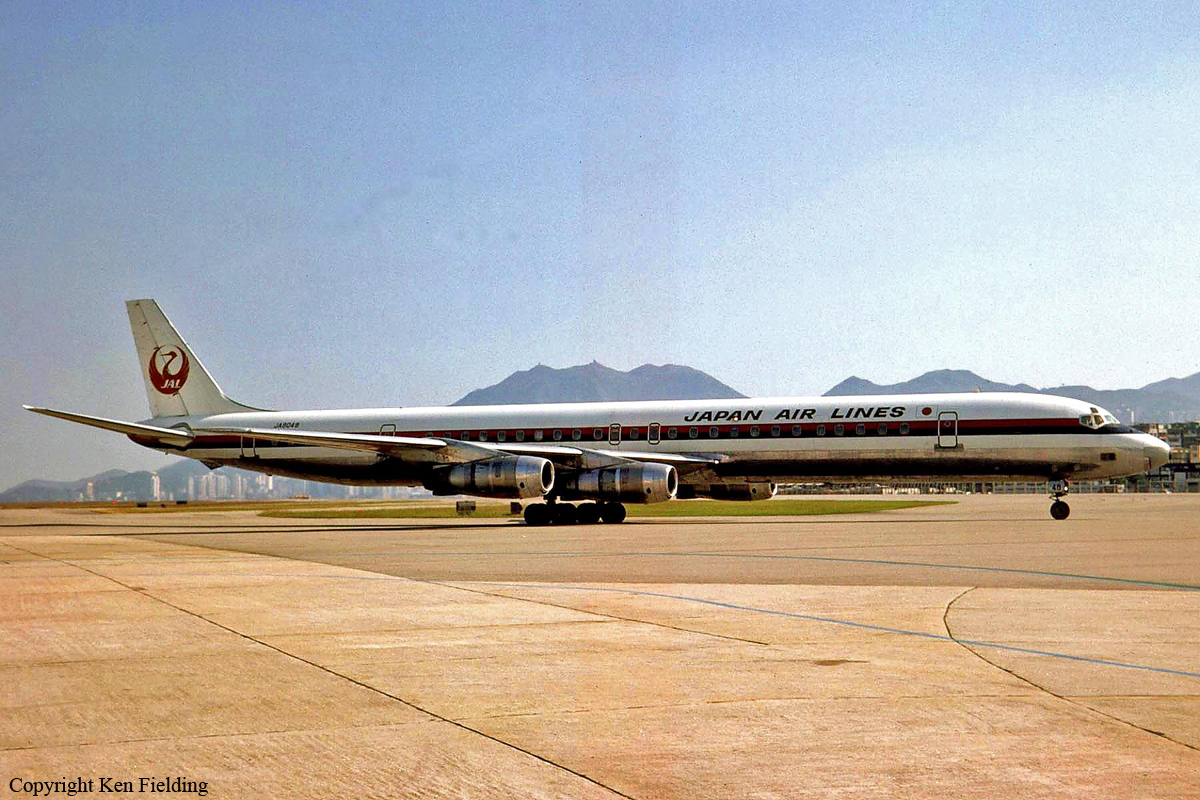
46160
YOM:
1971
Flight number:
JL792
Country:
Region:
Crew on board:
11
Crew fatalities:
Pax on board:
113
Pax fatalities:
Other fatalities:
Total fatalities:
0
Circumstances:
The airplane departed Shanghai-Hongqiao Airport at 1357LT on a flight to Tokyo, carrying 113 passengers and a crew of 11. Nine minutes after takeoff, the crew heard a strange noise coming from the lower middle part of the aircraft. This was immediately followed by a hydraulic low level warning, a hydraulic reservoir air low pressure warning, a complete loss of hydraulic system pressure, abnormal flap position indications, and a complete loss of air brake pressure. The crew elected to return to Shanghai for a emergency landing. The DC-8 touched down fast on runway 36, overran and came to rest in a drainage ditch. All 124 occupants were evacuated, 23 of them were injured.
Probable cause:
The explosion of the air brake bottle damaging 13 hydraulic system tubes and 2 emergency air brake system tubes, some of which resulted in the failure of extension of flaps and a loss of normal as well as emergency wheel braking, thus increasing the roll after touchdown distance to a value greater than available runway and stop way length. These factors prevented the captain from stopping the aircraft within the runway and stop way confines.