Country
Crash of a Beechcraft 200 Super King Air in Perth
Date & Time:
Apr 9, 2007 at 1703 LT
Operator:

Registration:
VH-SGT
Survivors:
Yes
Schedule:
Perth - Mount Hale
MSN:
BB-73
YOM:
1975
Crew on board:
1
Crew fatalities:
Pax on board:
9
Pax fatalities:
Other fatalities:
Total fatalities:
0
Circumstances:
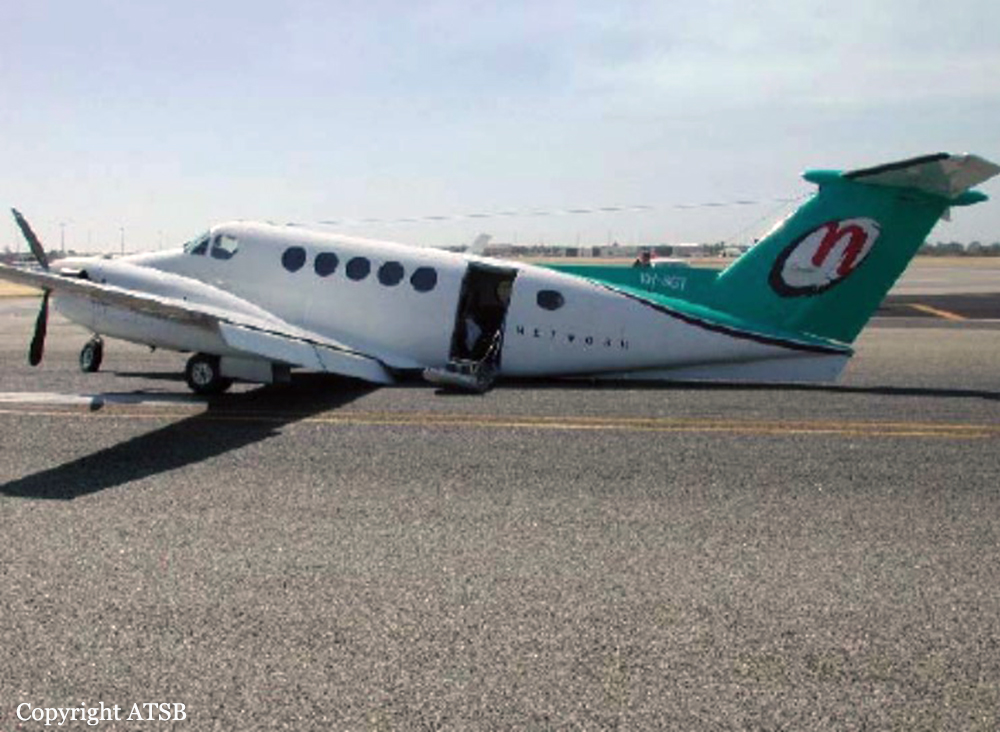
On 9 April 2007, at 1703 Western Standard Time (WST), the main landing gear from a Beech Super King Air 200 aircraft, registered VH-SGT, collapsed on landing at Perth airport. Approximately two hours earlier, the aircraft was chartered to fly from Perth to Mount Hale, WA when shortly after takeoff from Perth the aircraft experienced a malfunction of the landing gear system. The main wheels and nose gear had become jammed and were unable to fully retract when selected up by the pilot. The pilot completed the emergency checklist actions contained in the Aircraft Flight Manual, but was unable to retract or extend the gear using either the automated control or the manual emergency system. The pilot then requested assistance from a passenger to operate the manual emergency extension system. The landing gear remained jammed despite the additional force applied to the lever from the passenger. The pilot contacted air traffic services and requested further assistance from company engineering personnel to visually assess the extension state of the landing gear. Two aerodrome passes were completed throughout the troubleshooting exercise and the pilot remained in radio contact with both groups during this phase. Following the flyovers and after holding over Rottnest Island at 5,000 ft for a period of approximately two hours, the pilot flew the King Air back to Perth airport. With the gear still jammed in the partially retracted position, both the left and right main landing gear assemblies collapsed after the aircraft touched down on Runway 24. The aircraft was substantially damaged as a result of the collapse (Figure 1). The airport Rescue and Fire Fighting (RFF) services and other relevant agencies had been alerted and were waiting in response when the King Air landed. No injuries were sustained by the pilot or any of the nine passengers on board.
Probable cause:
From the evidence available, the investigation revealed that two major system components had failed which could have prevented the Beechcraft Super King Air 200 landing gear from properly retracting after takeoff. The following findings with respect to those failed landing gear system components should not be read as apportioning blame or liability to any particular organisation or individual.
Contributing safety factors:
• The left torque tube support bearing had not been lubricated and had seized due to the accumulation of dirt and grit contaminants that had migrated from the external service environment and into the bearing.
• The geared components within the right main landing gear actuator prematurely failed.
Other safety factors:
• The aircraft manufacturer’s maintenance manual contained insufficient instruction or guidance for operators and maintainers of Super King Air 200 aircraft for the lubrication of the landing gear torque tube support bearings.
Other key findings:
• Both component assemblies were integral to the function and normal operation of the Super King Air 200 mechanical landing gear system. A break down of either component assembly would have prevented any attempt by the pilot to retract or extend the aircraft’s main landing gear. However, while either failure could have produced the landing gear difficulties sustained, the investigation was not able to determine which mechanism was the principal contributor to the event.
• The investigation was unable to conclusively establish why the geared components within the right main landing gear actuator had prematurely failed.
• The lower thrust bearing within the right main landing gear actuator had been correctly installed.
Contributing safety factors:
• The left torque tube support bearing had not been lubricated and had seized due to the accumulation of dirt and grit contaminants that had migrated from the external service environment and into the bearing.
• The geared components within the right main landing gear actuator prematurely failed.
Other safety factors:
• The aircraft manufacturer’s maintenance manual contained insufficient instruction or guidance for operators and maintainers of Super King Air 200 aircraft for the lubrication of the landing gear torque tube support bearings.
Other key findings:
• Both component assemblies were integral to the function and normal operation of the Super King Air 200 mechanical landing gear system. A break down of either component assembly would have prevented any attempt by the pilot to retract or extend the aircraft’s main landing gear. However, while either failure could have produced the landing gear difficulties sustained, the investigation was not able to determine which mechanism was the principal contributor to the event.
• The investigation was unable to conclusively establish why the geared components within the right main landing gear actuator had prematurely failed.
• The lower thrust bearing within the right main landing gear actuator had been correctly installed.
Final Report:


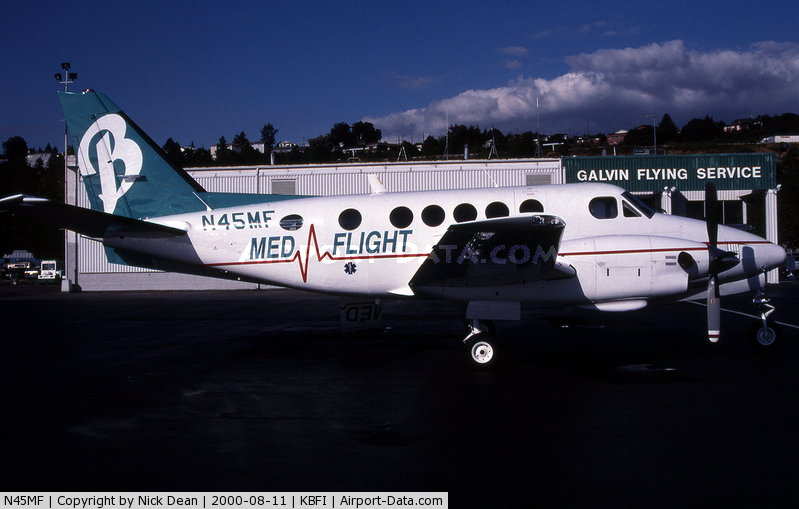
Crash of a Beechcraft 200 Super King Air in Bozeman: 3 killed
Date & Time:
Feb 6, 2007 at 2104 LT
Operator:

Registration:
N45MF
Survivors:
No
Schedule:
Great Falls - Bozeman
MSN:
BB-234
YOM:
1977
Crew on board:
1
Crew fatalities:
Pax on board:
2
Pax fatalities:
Other fatalities:
Total fatalities:
3
Captain / Total hours on type:
1318.00
Aircraft flight hours:
5992
Circumstances:
The cross-country flight was on an instrument flight rules (IFR) flight plan, approximately 42 nautical miles from the tower-controlled destination airport, when the pilot was cleared for the visual approach. Dark night visual meteorological conditions prevailed, and there was an overcast layer of clouds at 11,000 feet. After the en route radar service was terminated, the pilot contacted the local control tower and made a garbled and partially unintelligible transmission. Shortly after the time of the transmission, local law enforcement personnel received reports of a downed aircraft. The wreckage was located later that evening approximately 80 feet below the peak of a ridge that rose to an elevation of approximately 5,700 feet. From the initial point of contact with terrain, the debris path was scattered over the crest of the ridge and continued down the opposing side, in a south-southeast direction, toward the airport. The ridge was the highest obstruction between the accident location and the destination airport. The airport is located in a large valley and is surrounded by rising mountainous terrain. At night, clouds and terrain are difficult for pilots to see, and a gradual loss of visual cues can occur as flight is continued toward darker terrain. Additionally, the horizon is less visible and less distinct at night than during the day. Because the pilot was descending the airplane over rural, mountainous terrain that provided few visual ground reference cues, and because the overcast cloud layer would have prevented moonlight from illuminating the terrain, it is likely that the pilot did not see the rising terrain as the airplane continued toward it. The airplane was equipped with an Enhanced Ground Proximity Warning System; however, impact damage to the unit precluded post accident testing. It is not known how the unit was configured during the flight or what type of alerts the pilot received prior to impact. Post accident examination of the wreckage, to include both engines, did not disclose evidence of a mechanical malfunction prior to impact. Additionally, no evidence was found to suggest an in-flight structural failure.
Probable cause:
The pilot's failure to maintain an adequate altitude and descent rate during a night visual approach. Dark night conditions and mountainous terrain are factors in the accident.
Final Report:
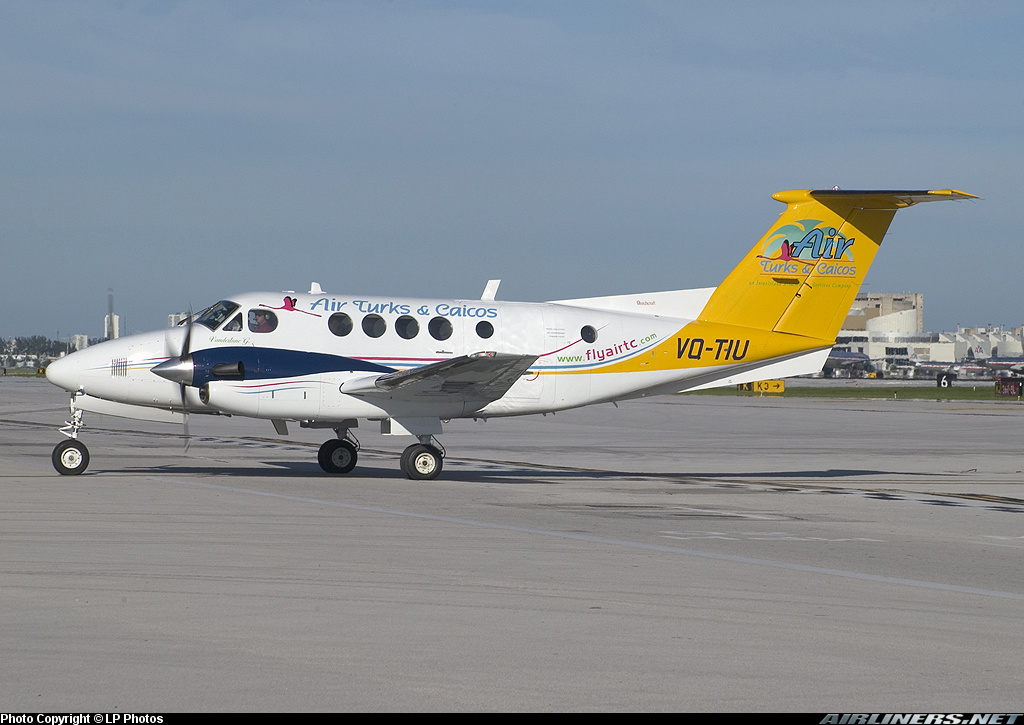
Crash of a Beechcraft 200C Super King Air off East Bay Cay: 1 killed
Date & Time:
Feb 6, 2007 at 1842 LT
Operator:

Registration:
VQ-TIU
Survivors:
Yes
Schedule:
East Bay Cay - Grand Turk
MSN:
BL-131
YOM:
1988
Crew on board:
1
Crew fatalities:
Pax on board:
5
Pax fatalities:
Other fatalities:
Total fatalities:
1
Captain / Total hours on type:
394.00
Aircraft flight hours:
24578
Aircraft flight cycles:
31684
Circumstances:
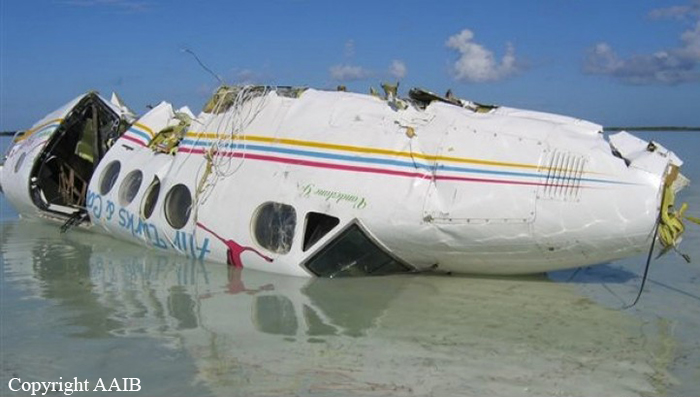
The aircraft was parked on the small apron at North Caicos Airport while the pilot went home to collect some personal items. One of the intended passengers saw the aircraft arrive. He remained in the vicinity until the pilot returned, and reported that the aircraft was unattended in the intervening time. When the pilot returned, four of the five passengers were gathered near the aircraft, and the last passenger arrived soon afterwards. The pilot, a local man well-known to the passengers, appeared to be his normal self and in good spirits. As most inter-island travel in the TCI is by air, the passengers were also familiar with the operator’s aircraft and used to travelling by air. Some had flown frequently on VQ-TIU. The pilot supervised embarkation and gave an emergency briefing. One passenger reported that the pilot made a mobile telephone call, which he presumed to be to Air Traffic Control (ATC) at Providenciales to notify them of the proposed flight. Prior to seating himself at the controls, the pilot told the passengers that they may expect some turbulence. The aircraft taxied onto the runway at its eastern end and along its length for a departure from Runway 08. It was about one hour after sunset and outside the airport’s normal operating hours, so there were no ATC personnel on duty. The runway lights were operated by the operator’s station manager. The aircraft took off at 1840 hrs. Soon after takeoff the aircraft was seen to start a turn to the right, which was consistent with its routing to Grand Turk, some 54 nm to the south-east. However, the aircraft reached a relatively large angle of bank and started to descend. The descent continued until it crashed with significant forward speed into an area of very shallow water. The aircraft broke up on impact, with the fuselage section coming to rest nearly inverted but comparatively intact. All those on board survived the impact sequence with varying degrees of injury. However, the pilot died before he could receive specialist medical treatment.
Probable cause:
The investigation identified the following causal factors:
1. The aircraft adopted an excessive degree of right bank soon after takeoff. This led to a descending, turning flight path which persisted until the aircraft was too low to make a safe recovery.
2. The pilot probably became spatially disoriented and was unable to recognise or correct the situation in time to prevent the accident.
The investigation identified the following contributory factors:
1. The environmental conditions were conducive to a spatial disorientation event.
2. The pilot had probably consumed alcohol prior to the flight, which made him more prone to becoming disorientated.
3. The flight was operated single-pilot when two pilots were required under applicable regulations. The presence of a second pilot would have provided a significant measure of protection against the effects of the flying pilot becoming disoriented.
1. The aircraft adopted an excessive degree of right bank soon after takeoff. This led to a descending, turning flight path which persisted until the aircraft was too low to make a safe recovery.
2. The pilot probably became spatially disoriented and was unable to recognise or correct the situation in time to prevent the accident.
The investigation identified the following contributory factors:
1. The environmental conditions were conducive to a spatial disorientation event.
2. The pilot had probably consumed alcohol prior to the flight, which made him more prone to becoming disorientated.
3. The flight was operated single-pilot when two pilots were required under applicable regulations. The presence of a second pilot would have provided a significant measure of protection against the effects of the flying pilot becoming disoriented.
Final Report:
Crash of a Beechcraft B200 Super King Air in Cape Girardeau
Date & Time:
Feb 2, 2007 at 0930 LT
Registration:
N777AJ
Survivors:
Yes
Schedule:
Rogers - Staunton
MSN:
BB-1638
YOM:
1998
Crew on board:
2
Crew fatalities:
Pax on board:
0
Pax fatalities:
Other fatalities:
Total fatalities:
0
Captain / Total hours on type:
110.00
Copilot / Total hours on type:
28
Aircraft flight hours:
1834
Circumstances:
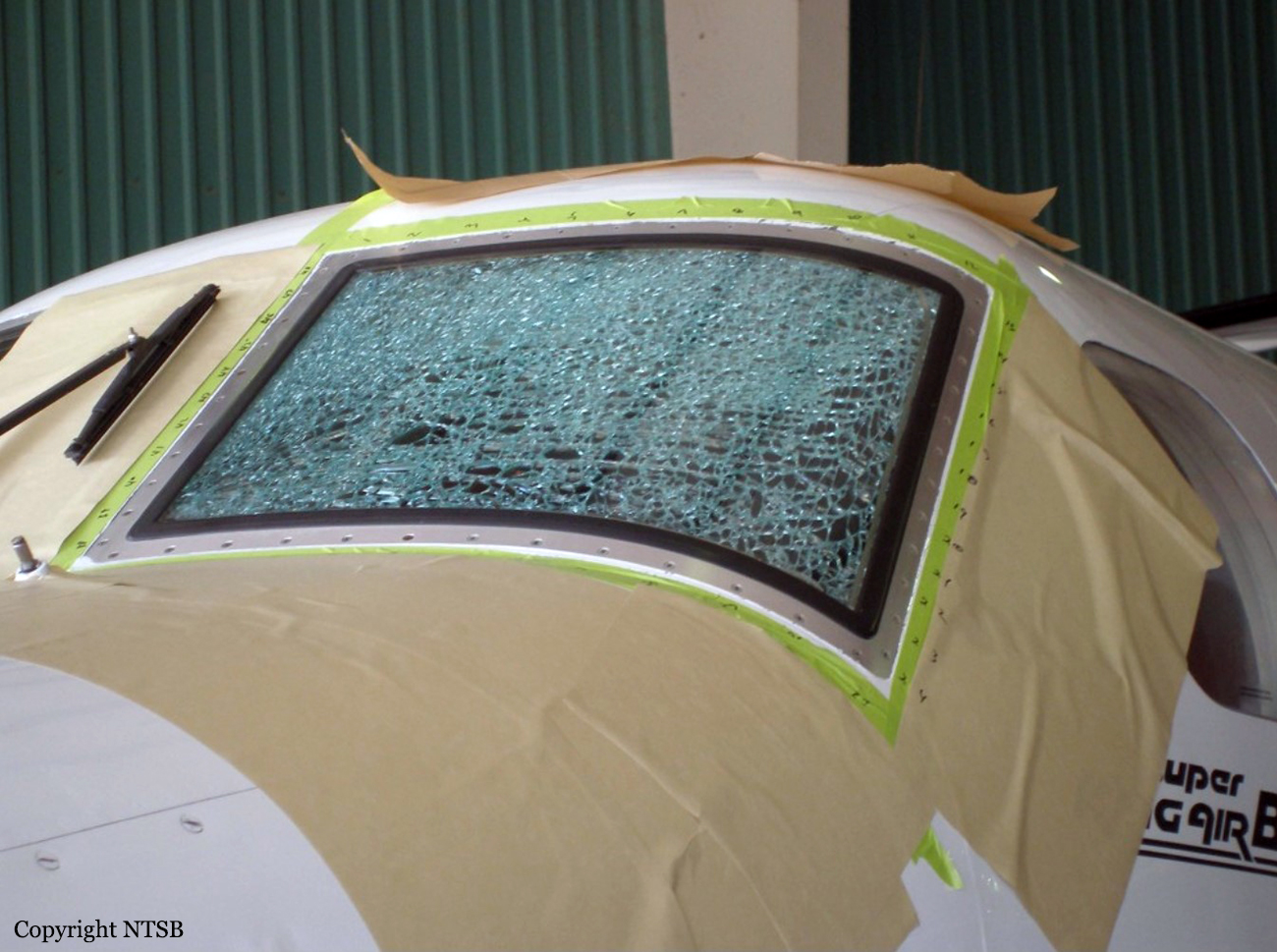
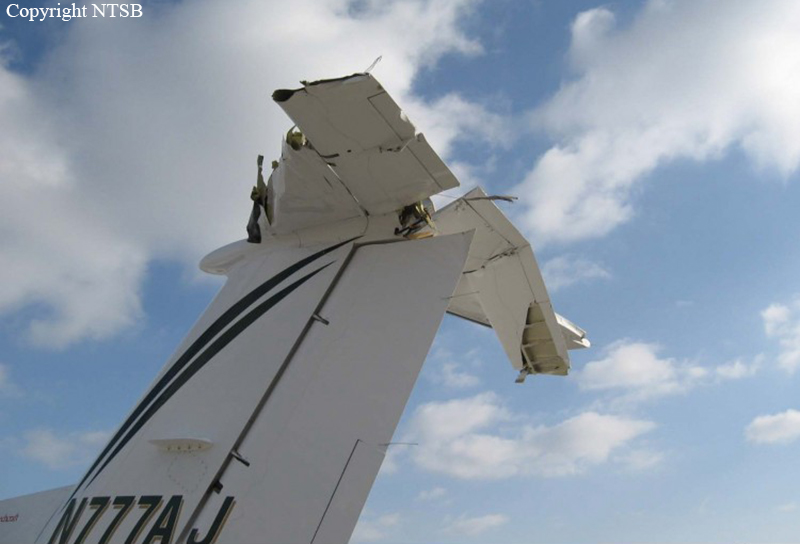
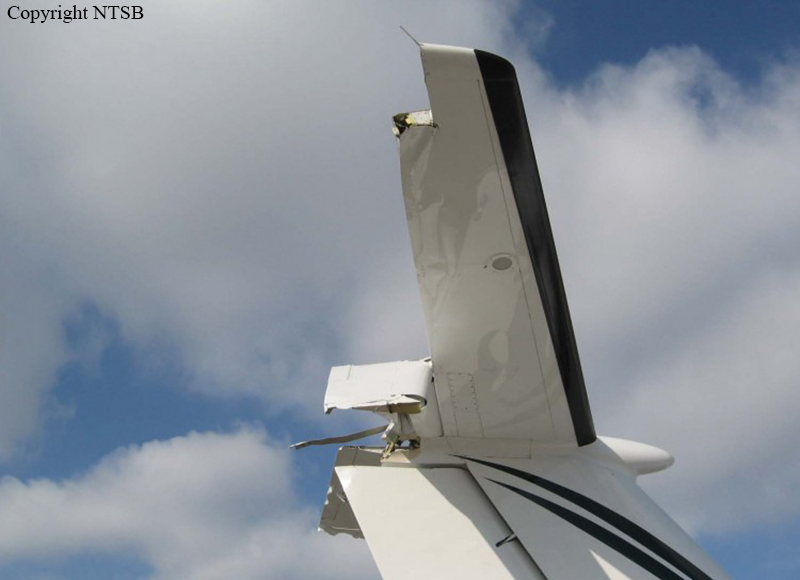
The airplane was operated by a company pilot. A noncompany pilot, who had not attended or completed a training course or received a checkout for Raytheon Aircraft Company Beech King Air 200 airplanes, was asked by the pilot to accompany him on the flight so that the noncompany pilot could accumulate flight time. The flight only required one pilot. While the airplane was in cruise flight (27,000 feet mean sea level), the cockpit voice recorder (CVR) recorded the sound of the windshield fracturing. The CVR transcript indicated that the company pilot was not in the cockpit when the windshield fractured because he was emptying trash in the cabin. This action showed poor judgment considering the noncompany pilot was not qualified in the airplane. Although the windshield stayed in place, the company pilot stated that “within seconds” after it fractured, he depressurized the airplane because he was unsure about the windshield’s “integrity.” However, the Beech King Air Airplane Flight Manual (AFM) states to maintain cabin pressurization in the event of a fractured windshield and further states that the airplane can continue flight for up to 25 hours with the windshield fractured. During the on-scene examinations, an unapproved document (not derived from the AFM) that contained several checklists was found on the airplane. The company pilot stated that he used this document and that it “came with the airplane.” The document did not include a checklist addressing a cracked or shattered windshield. The company pilot most likely was not aware that the airplane should not have been depressurized nor that it could operate for 25 hours after the fracture occurred and, therefore, that the fractured windshield did not present an in-flight emergency. The CVR transcript revealed that, after depressurizing the airplane, the pilots attempted to use the oxygen masks but were unable to receive any oxygen. (The pilots most likely did not turn the oxygen on once they needed it because they either forgot as a result of the emergency or because they did not have time to do so before they lost consciousness.) According to the company pilot, during his preflight inspection of the airplane, the oxygen system was functional. He stated that, after the inspection, he turned the oxygen system ready switch to the OFF position because he wanted to “save” the oxygen, which was not in accordance with the Before Start checklist in the AFM. Post accident functional testing of the oxygen system revealed normal operation. The unapproved checklists document did not include the instruction to leave the oxygen system on. Regardless, the pilot stated that he knew the approved checklist stated to leave the oxygen system on but that he still chose to turn it off. The pilot exhibited poor judgment by using an unapproved, incomplete checklists document and by knowingly deviating from approved preflight procedures. About 1 minute after the pilots tried to get oxygen, the CVR recorded the last comment by either pilot. For about the next 7 minutes until it stopped recording, the CVR recorded the sounds of increased engine propeller noise, the landing gear and overspeed warning horns, and altitude alerts indicating that the airplane had entered an uncontrolled descent. (The CVR’s 4-g impact switch was found in the open position during the on-scene examination, indicating that the airplane experienced at least 4 acceleration of gravity forces.) Further, a plot of two radar data points, recorded after the last pilot comment, showed that the airplane descended from 25,400 feet to 7,800 feet within 5 minutes. Shortly thereafter, the pilots regained consciousness and recovered from the uncontrolled descent. The airplane was substantially damaged by the acceleration forces incurred during the uncontrolled descent and subsequent recovery. Examination of the windshield revealed that a dense network of fractures was located on the inner glass ply; however, the windshield did not lose significant pieces of glass and maintained its structural integrity. Therefore, the fractures did not preclude safe continued flight. Post accident examinations revealed evidence that the fracture initiated due to a design deficiency in the glass. The manufacturer redesigned the windshield in 2001 (the accident airplane was manufactured in 1998), and no known similar fractures have occurred in the newly designed windshield. The manufacturer chose not to issue a service bulletin for a retrofit of the new windshield design in airplanes manufactured before 2001 because the fracture of one pane of glass is not a safety-of-flight issue.
Probable cause:
The company pilot’s poor judgment before and during the flight, including turning the oxygen system ready switch to the OFF position after he conducted the preflight inspection and using an unapproved checklist, which did not provide guidance for a fractured windshield and resulted in his depressurizing the airplane. Members Hersman and Sumwalt did not approve this probable cause. Member Hersman filed a dissenting statement, with which Member Sumwalt concurred. The statement can be found in the public docket for this accident.
Final Report: