Crash of a Lockheed L-1049H Super Constellation on Mt Ōyama: 8 killed

Date & Time: Sep 9, 1958
Operator:

Registration:
N6920C
Flight Type:
Survivors:
No
Site:
Schedule:
Travis – Hickam – Wake Island – Tachikawa
MSN:
4822
YOM:
1957
Country:
Region:
Crew on board:
6
Crew fatalities:
Pax on board:
2
Pax fatalities:
Other fatalities:
Total fatalities:
8
Circumstances:
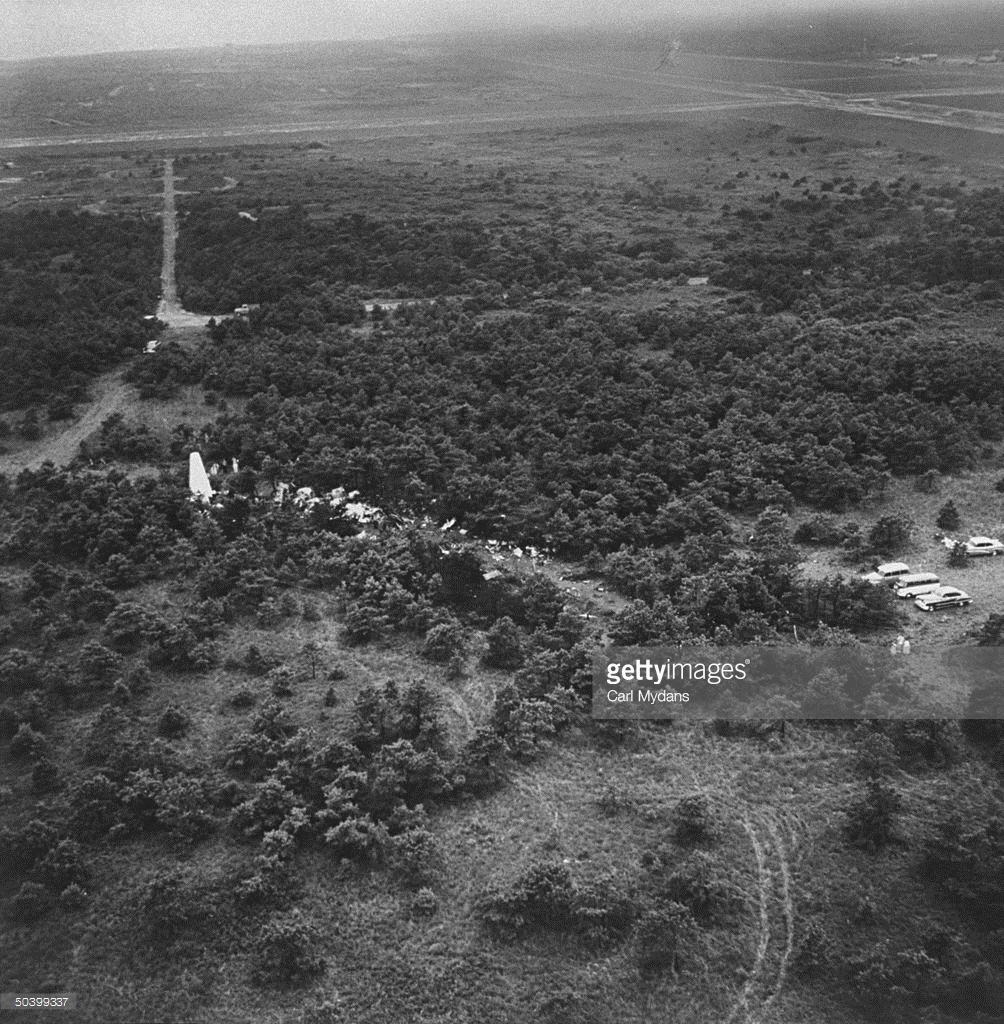
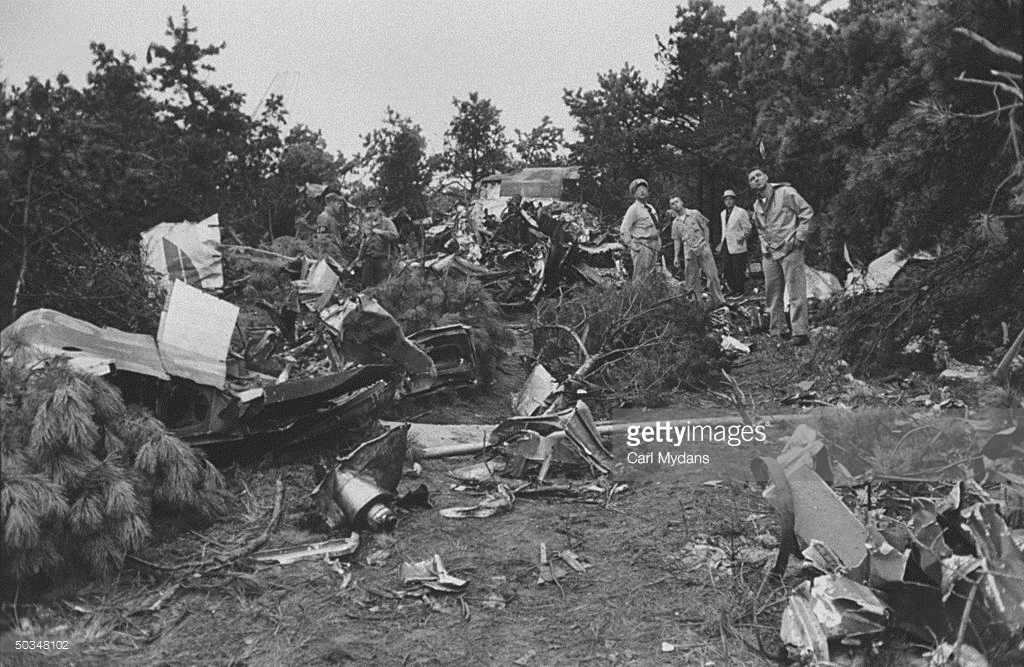
The crew was performing a flight from Travis AFB to Tachikawa AFB with intermediate stops at Hickam Field and Wake Island, carrying a load of various goods. While approaching Tachikawa AFB in poor weather conditions, the four engine aircraft struck the slope of Mt Ōyama (1,252 metres high) located 24 km west of the airbase. The aircraft disintegrated on impact and all eight occupants were killed.
Probable cause:
The crew continued the approach below the minimum safe altitude, maybe following a wrong altimeter setting.

Crash of a Boeing B-52D-40-BW Stratofortress in Fairchild AFB: 5 killed

Date & Time: Sep 8, 1958 at 1920 LT
Type of aircraft:
Operator:
Registration:
56-0681
Flight Type:
Survivors:
Yes
Schedule:
Fairchild - Fairchild
MSN:
464052
YOM:
1956
Crew on board:
7
Crew fatalities:
Pax on board:
0
Pax fatalities:
Other fatalities:
Total fatalities:
5
Circumstances:
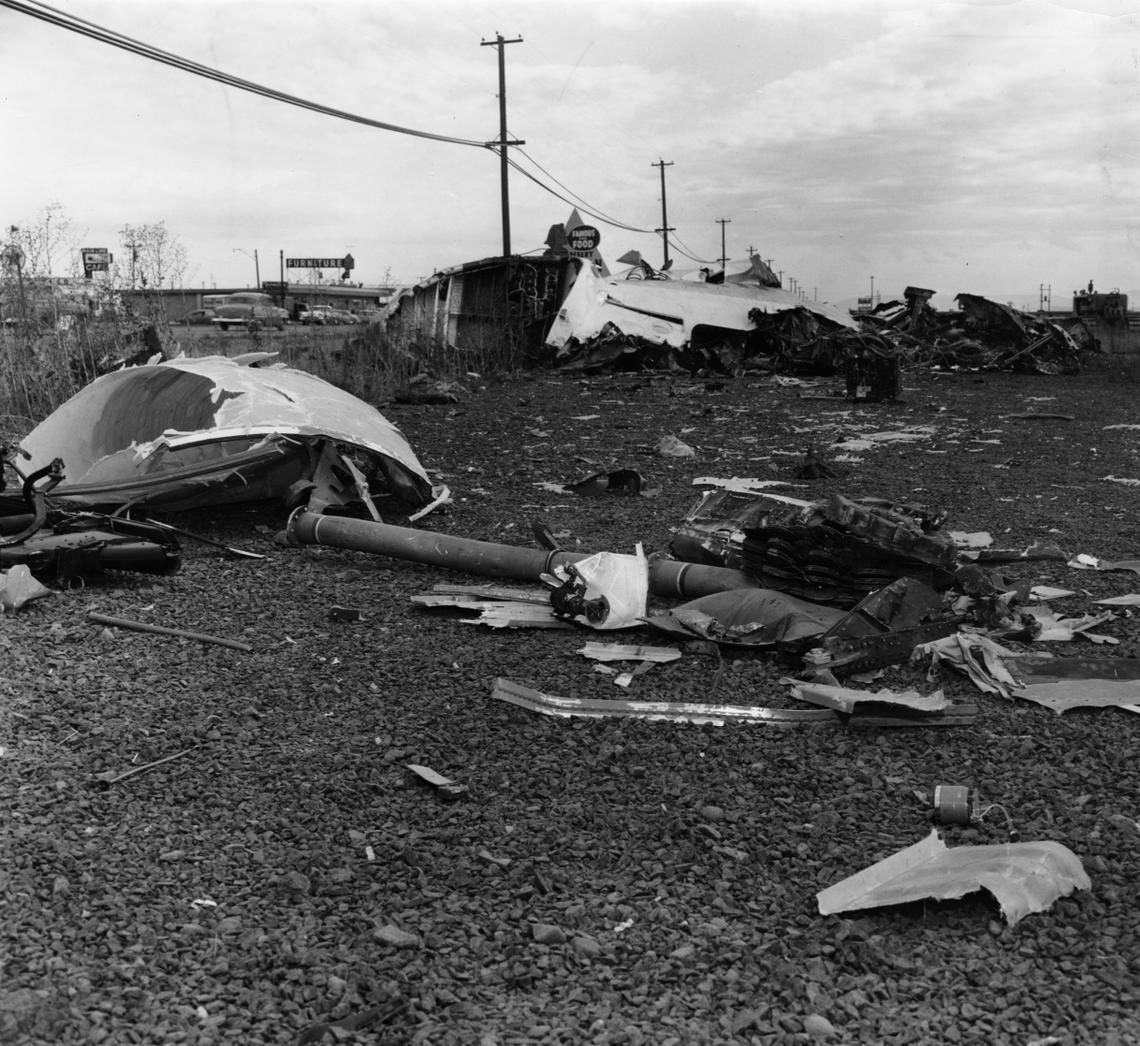
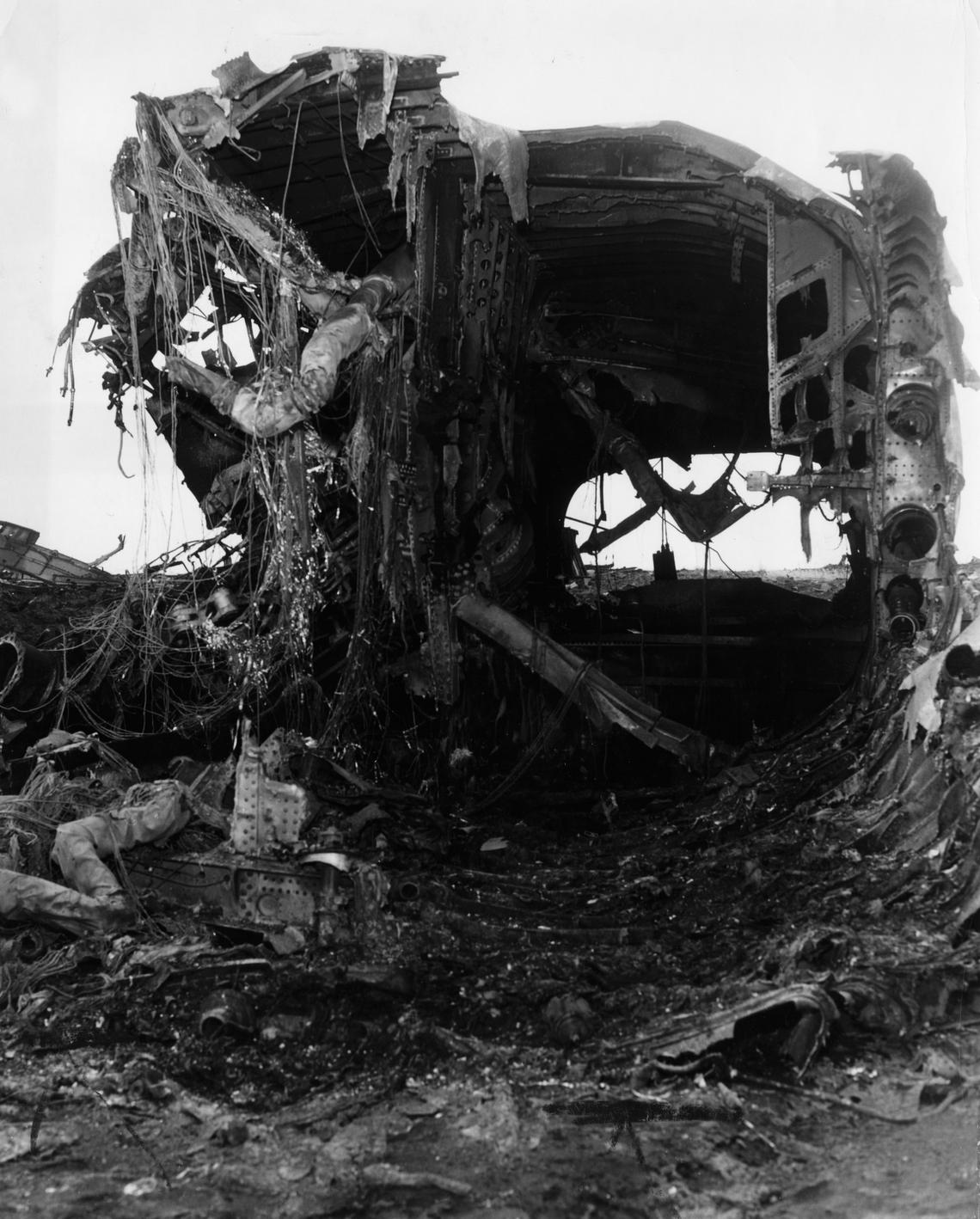
The crew was engaged in a local training flight at Spokane AFB, consisting of visual and instruments approaches and landings. While approaching runway 23, at a distance of about three miles from the threshold, the crew cancelled his instruments approach to continue on visual mode. In the mean time, the second B-52 registered 56-0661 which was on second position must switch from visual mode to instruments approach procedures. To follow the approach procedures and as both crews were not coordinated, the approach controller instructed the first crew to gain altitude while turning to the right and instructed the second crew to reduce his altitude while turning to the left. Few seconds later, at an altitude of 900 feet, both aircraft collided and crashed. On board 56-0681, five crew members were killed while two others were seriously injured. On board 56-0661, only one crew survived, all eight others have been killed.
Probable cause:
The collision was the result of the approach procedures not being followed by the crew. The two bombers were practicing landing and takeoff maneuvers that included using instrument rules for parts of their flights and visual rules for other parts. The B-52 closer to the runway had just switched off its instrument maneuvers the B-52 farther away had not yet switched on its instruments. The control tower didn’t pick up the more distant B-52 until it was about three miles from the runway, when the closer bomber was on its final approach. The tower ordered the first plane to go up and to the right – a standard breakaway maneuver – while the closer one should have followed procedures to go down and to the left, to land. Instead, both planes pulled up and to the right, and into each other. Investigations were unable to determine the reason why the crew failed to follow the standard procedures and ATC instructions.

Crash of a Boeing B-52D-30-BW Stratofortress in Fairchild AFB: 8 killed

Date & Time: Sep 8, 1958 at 1920 LT
Type of aircraft:
Operator:
Registration:
56-0661
Flight Type:
Survivors:
Yes
Schedule:
Fairchild - Fairchild
MSN:
464033
YOM:
1956
Crew on board:
9
Crew fatalities:
Pax on board:
0
Pax fatalities:
Other fatalities:
Total fatalities:
8
Circumstances:
The crew was engaged in a local training flight at Spokane AFB, consisting of visual and instruments approaches and landings. While approaching runway 23, at a distance of about three miles from the threshold, the crew switched from visual mode to instruments. In the mean time, another B-52 registered 56-0681 which was on first position must switch from instruments to visual mode. To follow the approach procedures and as both crews were not coordinated, the approach controller instructed the first crew to gain altitude while turning to the right and instructed the second crew to reduce his altitude while turning to the left. Few seconds later, at an altitude of 900 feet, both aircraft collided and crashed. On board 56-0681, five crew members were killed while two others were seriously injured. On board 56-0661, only one crew survived, all eight others have been killed.
Probable cause:
The collision was the result of the approach procedures not being followed by the crew. The two bombers were practicing landing and takeoff maneuvers that included using instrument rules for parts of their flights and visual rules for other parts. The B-52 closer to the runway had just switched off its instrument maneuvers the B-52 farther away had not yet switched on its instruments. The control tower didn’t pick up the more distant B-52 until it was about three miles from the runway, when the closer bomber was on its final approach. The tower ordered the first plane to go up and to the right – a standard breakaway maneuver – while the closer one should have followed procedures to go down and to the left, to land. Instead, both planes pulled up and to the right, and into each other. Investigations were unable to determine the reason why the crew failed to follow the standard procedures and ATC instructions.

Crash of a Douglas C-54A-DO Skymaster in Chennai

Date & Time: Sep 8, 1958
Type of aircraft:
Operator:
Registration:
VT-DIA
Survivors:
Yes
MSN:
3094
YOM:
1943
Country:
Region:
Crew on board:
4
Crew fatalities:
Pax on board:
27
Pax fatalities:
Other fatalities:
Total fatalities:
0
Circumstances:
En route to Madras, the primary hydraulic system failed. The crew failed to identify the failure properly and after touchdown at Madras Airport, the brake systems were partially inoperative. Unable to stop within the remaining distance, the airplane overran, struck obstacles, lost its undercarriage and came to a halt. All 31 occupants were evacuated safely while the aircraft was considered as damaged beyond repair.
Probable cause:
Failure of the primary hydraulic system in flight due a wrong installed gasket.

Crash of a Curtiss C-46A-45-CU Commando in Campina Grande: 14 killed

Date & Time: Sep 5, 1958 at 1730 LT
Type of aircraft:
Operator:
Registration:
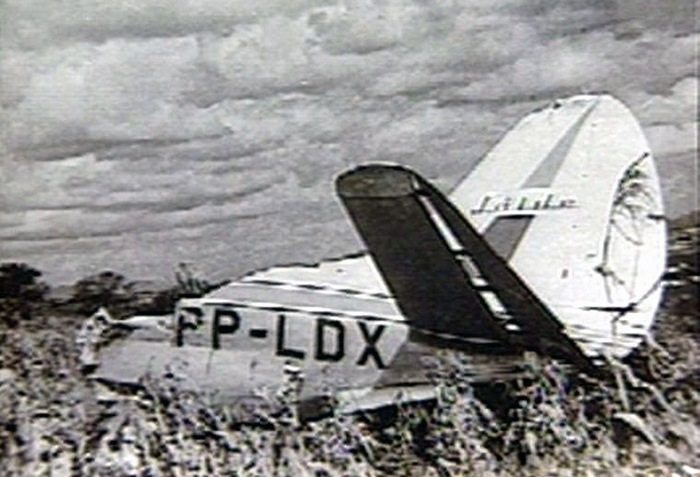
PP-LDX
Survivors:
Yes
Schedule:
Recife – Campina Grande
MSN:
30288
YOM:
1944
Flight number:
LDE652
Country:
Crew on board:
4
Crew fatalities:
Pax on board:
14
Pax fatalities:
Other fatalities:
Total fatalities:
14
Circumstances:
Clearance was given for the route segment PPRF - PPKG at the approved altitude of 1 800 metres. Upon reaching the position Nazaré, the pilot descended without clearance to 1 200 metres and passed over the PPKG facility at 1000 metres, or 200 metres below the minimum altitude provided for initiating the procedure as prescribed by the Directorate of Air Routes. Having passed over the facility, the pilot consulted the procedure for PPKG and replaced it in the file. When the copilot asked him whether it should not be kept out, he said no, as he already knew it by heart. The procedure was initiated normally, the aircraft returning on a heading unknown to the Investigating Commission until it was at 520 metres (critical altitude 647 metres), when vertical visual contact with the runway was established; but it was not possible to come in, the aircraft having passed the critical point and being over the runway. The pilot tried to enter the traffic visual, so as not to lose sight of the runway, but this proved impossible on reaching final approach, with the result that the landing starting the return, on heading 200 degrees, he began to descend, turning on the aircraft lights. After a few moments of flight, the copilot tried unsuccessfully to obtain visual reference by looking outside. At this time he felt a violent impact and heard the pilot shout that he was "hitting". Two crew and eleven passengers were killed, and two crew and three passengers were seriously injured in the accident. The inbound heading of 200 degrees observed by the copilot and checked by the Investigating Commission showed that the procedure carried out by the pilot was not in accordance with that indicated in the approach chart approved by the Directorate of Air Routes. It was also found that at the time vertical visual contact with the runway was established, the aircraft was at most 40 metres from the ground, despite the fact that the meteorological information supplied by the Loide station at PPKG was ceiling 130 metres with visibility 6 km.
Probable cause:
The accident was due to pilot error - improper procedure during an authorized instrument flight. A contributing cause was an error on the part of other personnel - the meteorological forecast was incorrect.
Final Report:

Crash of a Vickers 621 Viking 1 in Southall: 7 killed

Date & Time: Sep 2, 1958 at 0632 LT
Type of aircraft:
Registration:
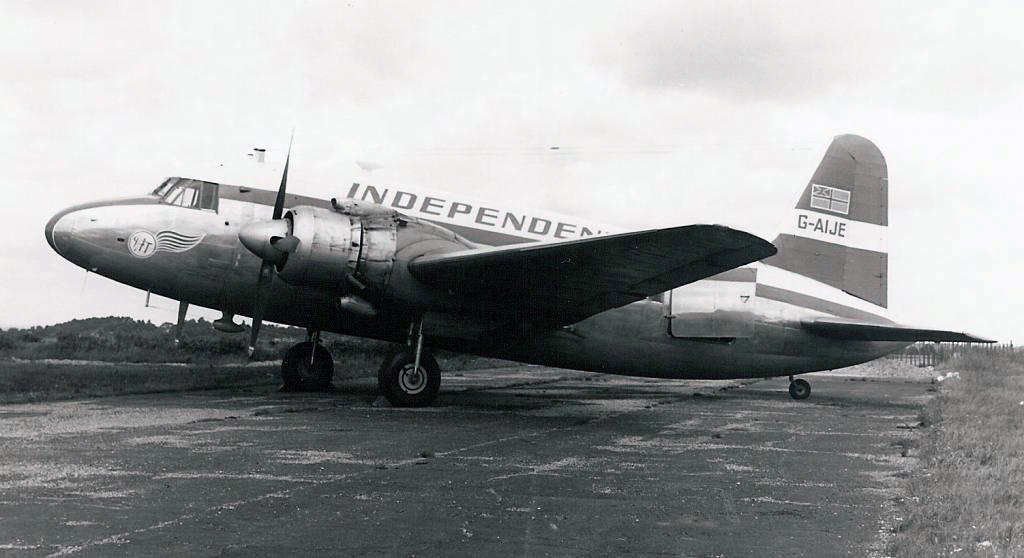
G-AIJE
Flight Type:
Survivors:
No
Site:
Schedule:
London – Nice – Brindisi – Athens – Tel Aviv
MSN:
127
YOM:
1946
Region:
Crew on board:
3
Crew fatalities:
Pax on board:
0
Pax fatalities:
Other fatalities:
Total fatalities:
7
Captain / Total flying hours:
13000
Copilot / Total flying hours:
1000
Aircraft flight hours:
2319
Circumstances:
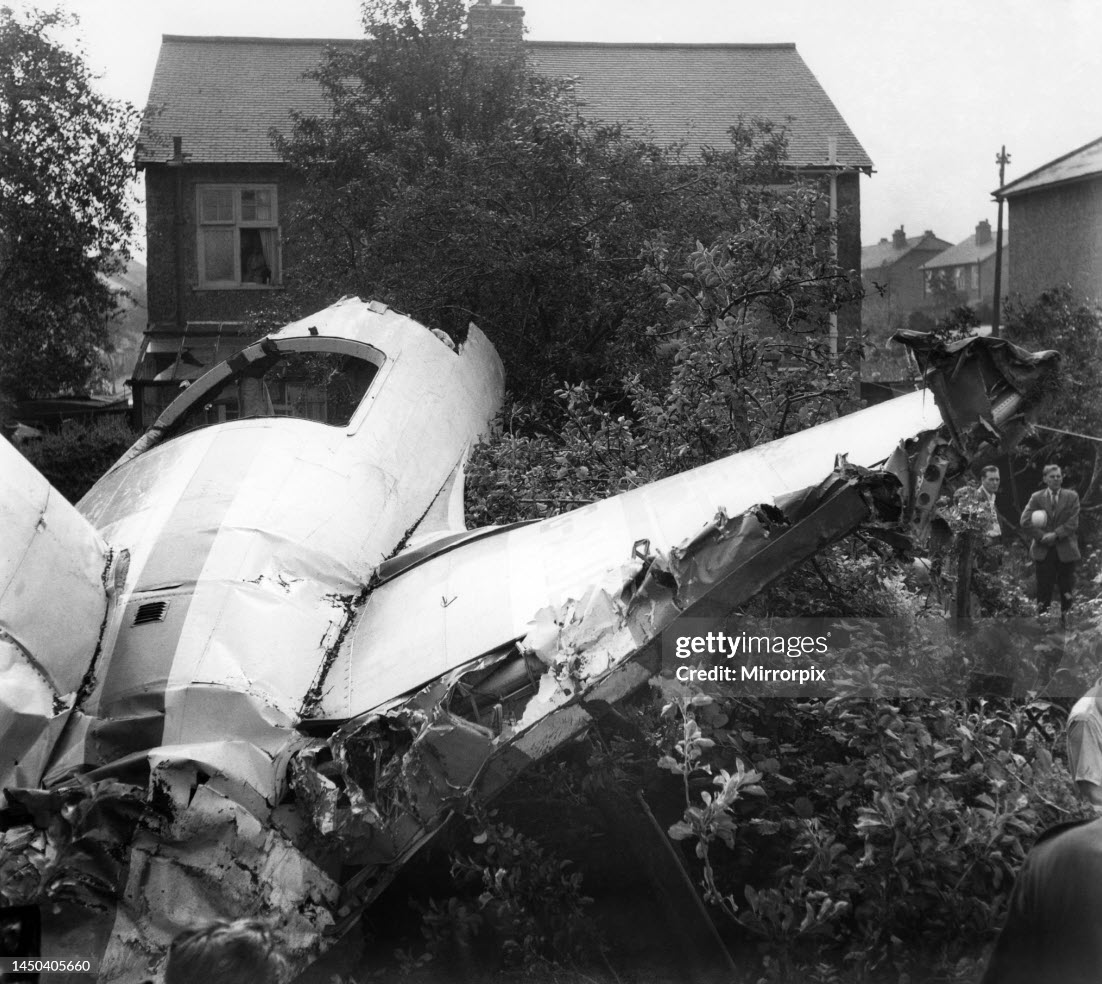
The Viking took off from London Airport at 0554 hours GMT with a crew of 3 for a flight to Nice, Brindisi, Athens and Tel Aviv. Fifteen minutes later the cap tain informed London Airport that he had engine trouble and wished to return to Blackbushe. During the return flight the aircraft initially maintained 7,000 feet. Clearance was given to descend to 3000 feet but the descent was apparently continued to 1,000 feet without informing control. Shortly afterwards the aircraft reported "having difficulty maintaining height" and six minutes later, at 0632LT, it crashed in Southall, about 3 miles from the airport. The aircraft was totally destroyed upon impact as well as several houses. All three crew members and four people on the ground were killed. Fifteen other people on the ground were injured.
Probable cause:
The aircraft was allowed to lose height and flying speed with the result that the pilot was no longer able to exercise asymmetric control. The conduct of the pilot and the whole course of events outlined were contributed to by the deliberate policy of this Company, which was to keep its aircraft in the air and gainfully employed regardless of the regulations or of the elementary requirements which should enjoin consideration for the conditions of working of its employees or the maintenance of its aircraft. Any responsibility of the captain is to be viewed in the light of his position as an employee upon whose shoulders an intolerable burden was placed. At the time of the accident, the airplane was overloaded and the captain was overduty as he had been on duty for 31 hours 30 minutes, a gross breach of Article 34E of the Order, since the maximum permissible flying duty period for a two-pilot crew is 16 hours.
Final Report:

Crash of an Avro 652A Anson I in Yajalón: 11 killed

Date & Time: Aug 25, 1958 at 0945 LT
Type of aircraft:
Registration:
XB-YUB
Survivors:
No
Schedule:
Tuxtla Gutiérrez – Yajalón
Country:
Crew on board:
2
Crew fatalities:
Pax on board:
9
Pax fatalities:
Other fatalities:
Total fatalities:
11
Circumstances:
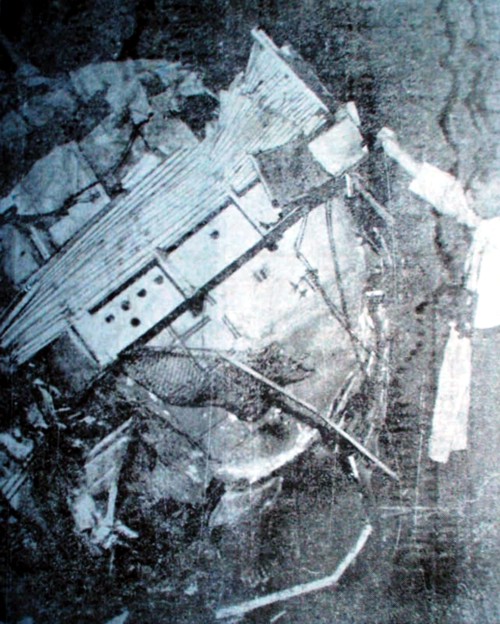
The twin engine aircraft departed Tuxtla Gutierrez Airport at 0915LT for a 30 minutes flight to Yajalón. While approaching Yajalón Airport, the airplane collided with a second Anson registered XB-YUZ and also operated by Servicios Aéreos de Chiapas. Inbound from San Cristóbal de Las Casas, the second Anson was carrying four passengers and a crew of two. Following the collision, both aircraft dove into the ground and crashed in a prairie. All 17 occupants on both aircraft were killed. The exact circumstances of the collision remains unclear.

Crash of an Avro 652A Anson I in Yajalón: 6 killed

Date & Time: Aug 25, 1958 at 0945 LT
Type of aircraft:
Registration:
XB-YUZ
Survivors:
No
Schedule:
San Cristóbal de Las Casas – Yajalón
Country:
Crew on board:
2
Crew fatalities:
Pax on board:
4
Pax fatalities:
Other fatalities:
Total fatalities:
6
Circumstances:
The twin engine aircraft departed San Cristóbal de Las Casas around 0920LT on a flight to Yajalón. While approaching Yajalón Airport, the airplane collided with a second Anson registered XB-YUB and also operated by Servicios Aéreos de Chiapas. Inbound from Tuxtla Gutiérrez , the second Anson was carrying nine passengers and a crew of two. Following the collision, both aircraft dove into the ground and crashed in a prairie. All 17 occupants on both aircraft were killed. The exact circumstances of the collision remains unclear.

Crash of a Douglas C-47-DL in Navegantes

Date & Time: Aug 19, 1958
Operator:
Registration:
PP-CDI
Survivors:
Yes
MSN:
4684
YOM:
1942
Country:
Crew on board:
0
Crew fatalities:
Pax on board:
0
Pax fatalities:
Other fatalities:
Total fatalities:
0
Circumstances:
On final approach to Navegantes-Itajaí Airport, the airplane was too high and the captain decided to reduce the engine power to bring the aircraft in a steep descent. On short final, the airplane stalled, struck a building, lost several elements and eventually crashed short of runway threshold. There were no injuries but the airplane was damaged beyond repair.
Probable cause:
Wrong approach configuration on part of the flying crew.

Crash of a Convair CV-240-2 in Nantucket: 25 killed

Date & Time: Aug 15, 1958 at 2334 LT
Type of aircraft:
Operator:
Registration:
N90670
Survivors:
Yes
Schedule:
LaGuardia – Nantucket
MSN:
90
YOM:
1948
Flight number:
NE258
Crew on board:
3
Crew fatalities:
Pax on board:
31
Pax fatalities:
Other fatalities:
Total fatalities:
25
Captain / Total flying hours:
5603
Captain / Total hours on type:
1416.00
Copilot / Total flying hours:
614
Copilot / Total hours on type:
132
Aircraft flight hours:
18019
Circumstances:
During a night approach to Nantucket, the aircraft went through an area of fog. The crew decided to continue the approach when the airplane struck the ground, crashed and burned about 1,450 feet short of runway 24. All three crew members and 22 passengers were killed while nine others were injured, some of them seriously.
Probable cause:
The Board determines that the probable cause of this accident was the deficient judgment and technique of the pilot during an instrument approach in adverse weather conditions in failing to abandon the approach when a visibility of one-eights mile was reported, and descending to a dangerously low altitude while still a considerable distance from the runway.
Final Report: