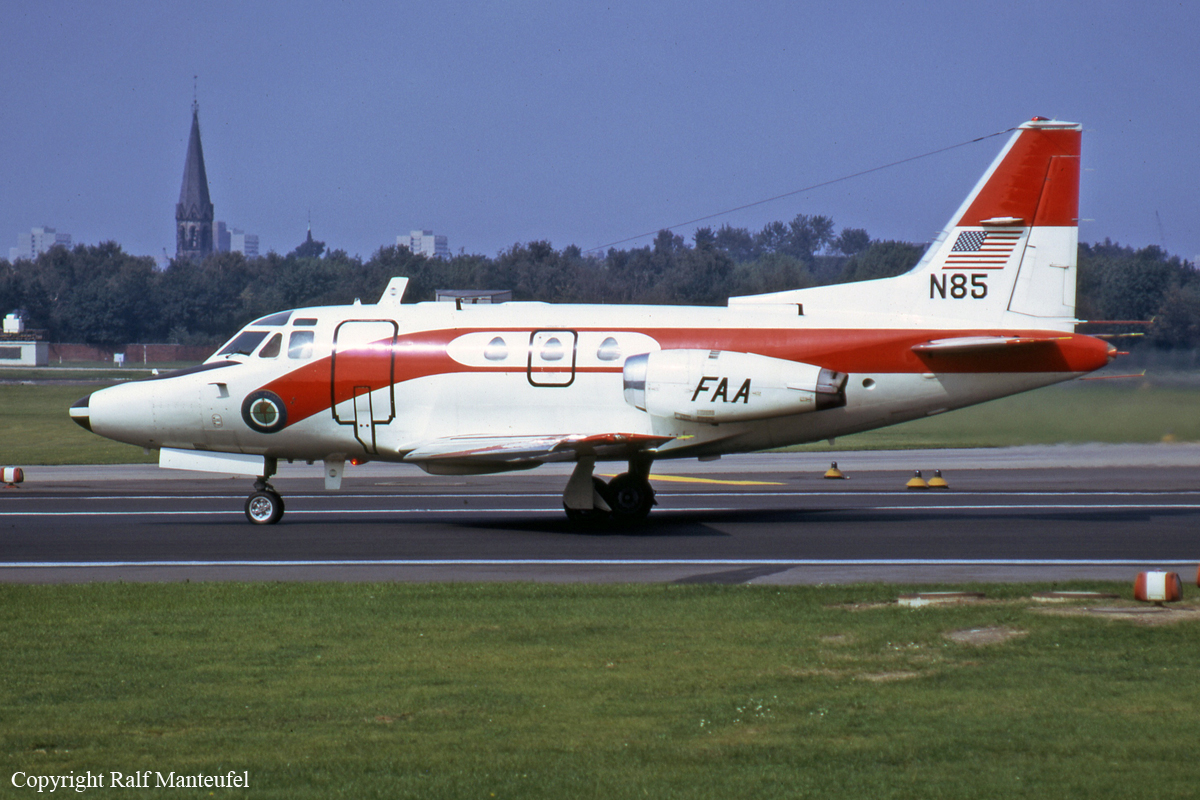
Crash of a Rockwell Sabreliner 40 in Puebla

Date & Time: Mar 24, 1991 at 1208 LT
Type of aircraft:
Registration:
XA-RPS
Flight Phase:
Survivors:
Yes
Schedule:
Puebla - Acapulco
MSN:
282-56
YOM:
1965
Country:
Crew on board:
2
Crew fatalities:
Pax on board:
6
Pax fatalities:
Other fatalities:
Total fatalities:
0
Circumstances:
During the takeoff roll on runway 35, the tyre on the right main gear burst. The crew aborted the takeoff and started an emergency braking procedure. Unable to stop within the remaining distance, the aircraft overran and came to rest. All eight occupants escaped uninjured while the aircraft was damaged beyond repair.
Probable cause:
The exact cause of the failure of the right main tyre remains unknown. However, it was reported that the crew's decision to abort the takeoff procedure was taken too late and he failed to use all available braking systems, which was considered as contributing factors.

Crash of a Rockwell Sabreliner 40R in Detroit

Date & Time: Feb 3, 1990 at 1540 LT
Type of aircraft:
Registration:
N50CD
Flight Type:
Survivors:
Yes
Schedule:
Tampa - Detroit
MSN:
282-42
YOM:
1965
Crew on board:
2
Crew fatalities:
Pax on board:
4
Pax fatalities:
Other fatalities:
Total fatalities:
0
Circumstances:
The aircraft was completing a flight from Tampa to Detroit on behalf of the Detroit City Police. After landing on runway 15 at Coleman A. Young Airport, the airplane encountered difficulties to stop within the remaining distance, overran and came to rest. All six occupants escaped uninjured while the aircraft was damaged beyond repair.

Crash of a Rockwell Sabreliner 40R in Quito: 11 killed

Date & Time: Jun 3, 1988
Type of aircraft:
Operator:
Registration:
FAE068
Flight Type:
Survivors:
No
MSN:
282-68
YOM:
1966
Country:
Crew on board:
2
Crew fatalities:
Pax on board:
9
Pax fatalities:
Other fatalities:
Total fatalities:
11
Circumstances:
On final approach to Quito-Mariscal Sucre Airport by night, the aircraft struck the top of a hill and crashed few km from the airfield. All 11 occupants were killed, among them General Angel Augusto Flores, Chief of the Ecuadorian Air Force, General Raul Cousin, Colonel Galo.

Crash of a Rockwell Sabreliner 40R in Mexico

Date & Time: Apr 21, 1980
Type of aircraft:
Registration:
XA-EEU
Flight Phase:
Survivors:
Yes
MSN:
282-54
YOM:
1966
Country:
Crew on board:
0
Crew fatalities:
Pax on board:
0
Pax fatalities:
Other fatalities:
Total fatalities:
0
Circumstances:
Suffered an accident at León Airport. There were no casualties.

Crash of a Rockwell Sabreliner 40 off New Orleans: 3 killed

Date & Time: Nov 7, 1977 at 1820 LT
Type of aircraft:
Registration:
N77AP
Flight Phase:
Survivors:
Yes
Schedule:
New Orleans - Fort Lauderdale
MSN:
282-37
YOM:
1965
Crew on board:
2
Crew fatalities:
Pax on board:
2
Pax fatalities:
Other fatalities:
Total fatalities:
3
Captain / Total flying hours:
6612
Captain / Total hours on type:
243.00
Circumstances:
Shortly after takeoff from New Orleans-Lakefront Airport runway 35, while climbing by night to a height of 300 feet, the airplane entered a left turn then struck the water surface and crashed into Lake Pontchartrain. A pilot was seriously injured while three other occupants were killed.
Probable cause:
Controlled collision with water during initial climb after the crew failed to maintain a positive rate of climb. The following contributing factors were reported:
- Instruments misread or failed to read,
- Failed to use the checklist.
Final Report:

Crash of a Rockwell Sabreliner 40R off Recife: 1 killed

Date & Time: Jan 14, 1976 at 1835 LT
Type of aircraft:
Operator:
Registration:
N85
Flight Phase:
Flight Type:
Survivors:
Yes
Schedule:
Frankfurt - Georgetown - Recife - Oklahoma City
MSN:
282-97
YOM:
1968
Country:
Crew on board:
3
Crew fatalities:
Pax on board:
0
Pax fatalities:
Other fatalities:
Total fatalities:
1
Captain / Total flying hours:
13920
Captain / Total hours on type:
2440.00
Circumstances:
While descending to Recife-Guararapes Airport, both engines failed simultaneously. The captain reduced his altitude and ditched the airplane few dozen km offshore. Two crew members were rescued while the third drowned. The aircraft sank into the Atlantic Ocean and was lost.
Probable cause:
Double engine failure caused by a fuel exhaustion. The following contributing factors were reported:
- Navigational error on part of the crew,
- Fuel exhaustion,
- Complete engine failure,
- Wrote wrong course on navigation chart.
Final Report:

Crash of a Rockwell Sabreliner 40A near Frobisher Bay: 9 killed

Date & Time: Feb 27, 1974 at 2158 LT
Type of aircraft:
Operator:
Registration:
CF-BRL
Flight Phase:
Survivors:
No
Site:
Schedule:
Stuttgart - Shannon - Keflavik - Frobisher Bay - Toronto
MSN:
282-107
YOM:
1972
Country:
Crew on board:
2
Crew fatalities:
Pax on board:
7
Pax fatalities:
Other fatalities:
Total fatalities:
9
Captain / Total flying hours:
13500
Captain / Total hours on type:
346.00
Copilot / Total flying hours:
8700
Copilot / Total hours on type:
217
Aircraft flight hours:
675
Circumstances:
The aircraft, with two pilots and seven passengers on board was being flown from Stuttgart to Toronto via Shannon, Keflavik and Frobisher. The flight was routine as far as Keflavik. After startup at Keflavik the aircraft remained 18 minutes on the ground before takeoff. Departure was at 2131Z (27 February), and the flight was undertaken at FL390 against a 30 knot wind component, using a GNS-200 on-board navigation system. The aircraft navigation was satisfactory until 2352Z, 285 NM east of Frobisher (approximately 65° N 58° W). At this point the GNS-200 navigation system became unusable for 10 minutes due to a dropout of signals from the very low frequency ground stations on which it depended for operation. The aircraft has been tracked by a military radar network until it neared the Canadian coast. Near the coast the aircraft made a turn to the left of about 20°, but did not subsequently turn back to the right toward Frobisher, as might have been expected. Radar surveillance was not continued beyond that point. The Frobisher main, high power non-direction beacon (FY-206 Khz), went off the air at 0010Z and was restored to service at 0059Z. The standby transmitter failed to operate. At 0013Z, and ATC descent clearance was passed to the aircraft through Frobisher Aeradio; no information was included regarding the status of the radio navigation aids at Frobisher. At 0014Z, the clearance was acknowledged by the flight crew and a descent was commenced. At 0025Z, the flight radioed Frobisher that the radio beacons were not being received; then, that the DME (Distance Measuring Equipment) signals were not being received. The aircraft was at relatively low altitude by this time and lost radio contact with Frobisher. At approximately 0040Z, a small jet aircraft, believed to be CF-BRL, was observed to circle once at low altitude over the radio beacon at Brevoort Island, 120 NM east of Frobisher, and depart in the direction of Frobisher. At 0050Z, at the request of Frobisher Aeradio, an overflying airline jet contacted CF-BRL and learned it was at 4,500 feet (1,372 metres) asl. The pilots were 'lost' and asked whether Frobisher radio beacons were being received. Shortly thereafter, they reported receiving a Frobisher beacon (radio range station, FB 263 KHz, 400 watts) and altering course toward it. They sais they were low on fuel. At 0056Z, the pilot of CF-BRL announced 'both fuel lights are on and we are starting down from 4,500 feet'. The aircraft struck the side of a hill at 0058Z. The wreckage was found 120 km southeast of the destination airport. All nine occupants were killed.
Probable cause:
The following findings were identified:
- During an attempt to locate Frobisher Airport, the aircraft fuel was exhausted by 30 minutes of low altitude maneuvering.
- The descent from cruising altitude was made using navigation information from the on-board GNS system; the crew were unaware that this information was erroneous.
- The main non-directional radio beacon at Frobisher was off the air during a critical phase of the flight; the crew were not informed of this outage prior to commencement of descent.
- The radio beacon transmitter that failed had been fitted with a 40 ampere circuit breaker rather than a 45 ampere circuit breaker specified.
- The standby radio beacon transmitter failed to operate because of a faulty interlock switch system.
- The Frobisher radio range station was operating and suitable for use as a homing beacon; it was not approved for use as a radio range and was not listed on the appropriate Canadian flight navigation charts.
- A Notam issued in August 1973 stated that the Frobisher radio range would be decommissioned 'in approximately two months'; this Notam was still valid at the time of the accident.
- The flight as planned did not comply with the requirements for fuel reserves as expressed in Air Regulation 549.
Final Report:

Crash of a Rockwell Sabreliner 40R in Oklahoma City: 2 killed

Date & Time: Jan 15, 1974 at 0600 LT
Type of aircraft:
Operator:
Registration:
N5565
Survivors:
No
Schedule:
Corpus Christi - Oklahoma City
MSN:
282-119
YOM:
1973
Crew on board:
2
Crew fatalities:
Pax on board:
0
Pax fatalities:
Other fatalities:
Total fatalities:
2
Captain / Total flying hours:
21500
Captain / Total hours on type:
2000.00
Circumstances:
The approach to Oklahoma City was started in limited visibility due to foggy conditions. On final, the crew descended below the MDA when the airplane struck the ground and crashed in flames few miles short of runway threshold. The aircraft was destroyed by impact forces and a post crash fire and both pilots were killed.
Probable cause:
Controlled flight into terrain following an improper IFR operation on final approach. The following factors were reported:
- Instruments misread or failed to read,
- Poor crew coordination,
- Low ceiling and fog,
- Pilot fatigue,
- ILS approach below minimums,
- Descended below MDA,
- Crew had a little rest before flight,
- ATC did not monitor altitude on radar.
Final Report:

Crash of a Rockwell Sabreliner 40 in Midland: 2 killed

Date & Time: Jan 4, 1974 at 1924 LT
Type of aircraft:
Registration:
N34W
Flight Phase:
Flight Type:
Survivors:
No
Schedule:
Midland - Denver
MSN:
282-47
YOM:
1965
Location:
Crew on board:
2
Crew fatalities:
Pax on board:
0
Pax fatalities:
Other fatalities:
Total fatalities:
2
Captain / Total flying hours:
15367
Captain / Total hours on type:
2770.00
Circumstances:
Shortly after takeoff from Midland Airport, while in initial climb by night, the airplane entered a nose-down attitude then crashed in a huge explosion few miles from the airfield. The airplane disintegrated on impact and both pilots were killed.
Probable cause:
Uncontrolled descent during initial climb for undetermined reason. Entered a high speed dive and crashed. Near total destruction limited the scope and decisiveness of investigations.
Final Report:

Crash of a Rockwell Sabreliner 40R in Blaine: 2 killed

Date & Time: Mar 7, 1973 at 0659 LT
Type of aircraft:
Operator:
Registration:
N9503Z
Flight Phase:
Flight Type:
Survivors:
No
Schedule:
Blaine - Hibbing
MSN:
282-10
YOM:
1964
Crew on board:
2
Crew fatalities:
Pax on board:
0
Pax fatalities:
Other fatalities:
Total fatalities:
2
Captain / Total flying hours:
6402
Captain / Total hours on type:
288.00
Circumstances:
Shortly after takeoff from Blaine-Anoka County Airport, while climbing, the airplane went out of control, entered a dive and crashed in a huge explosion in an open field. The aircraft was totally destroyed and both crew members were killed.
Probable cause:
Investigations were unable to determine the exact cause of the accident.
Final Report: