Zone

Crash of a Rockwell Turbo Commander 680V in Keflavik

Date & Time: Aug 5, 1990
Registration:
N444GB
Flight Type:
Survivors:
Yes
Schedule:
Frobisher Bay – Reykjavik
MSN:
680-1565-21
YOM:
1966
Country:
Region:
Crew on board:
1
Crew fatalities:
Pax on board:
1
Pax fatalities:
Other fatalities:
Total fatalities:
0
Captain / Total hours on type:
15.00
Circumstances:
While approaching Iceland on a ferry flight from Frobisher Bay, the crew declared an emergency due to fuel shortage and requested the permission to divert to Keflavik Airport. On final approach to runway 29, both engines failed simultaneously. The aircraft stalled and crashed on a road located 1,500 meters short of runway. Both pilots were injured and the aircraft was destroyed.
Probable cause:
The pilot's experience on this type of aircraft was limited to 15 hours and he failed to calculate the fuel consumption correctly prior to departure from Frobisher Bay. It was determined that he calculated the flight as being 7 hours and 15 minutes while the autonomy of this aircraft is 8 hours and 20 minutes. Investigations revealed that both engines failed after six hours and 15 minutes of flight. Poor flight planning and preparation were considered as contributing factors.

Crash of a De Havilland DHC-6 Twin Otter 300 in Frobisher Bay: 9 killed

Date & Time: Aug 29, 1979 at 2305 LT
Operator:
Registration:
C-GROW
Survivors:
No
Schedule:
Brevoort Island - Frobisher Bay
MSN:
415
YOM:
1974
Country:
Crew on board:
2
Crew fatalities:
Pax on board:
7
Pax fatalities:
Other fatalities:
Total fatalities:
9
Captain / Total flying hours:
3729
Captain / Total hours on type:
476.00
Copilot / Total flying hours:
2600
Copilot / Total hours on type:
323
Aircraft flight hours:
5286
Circumstances:
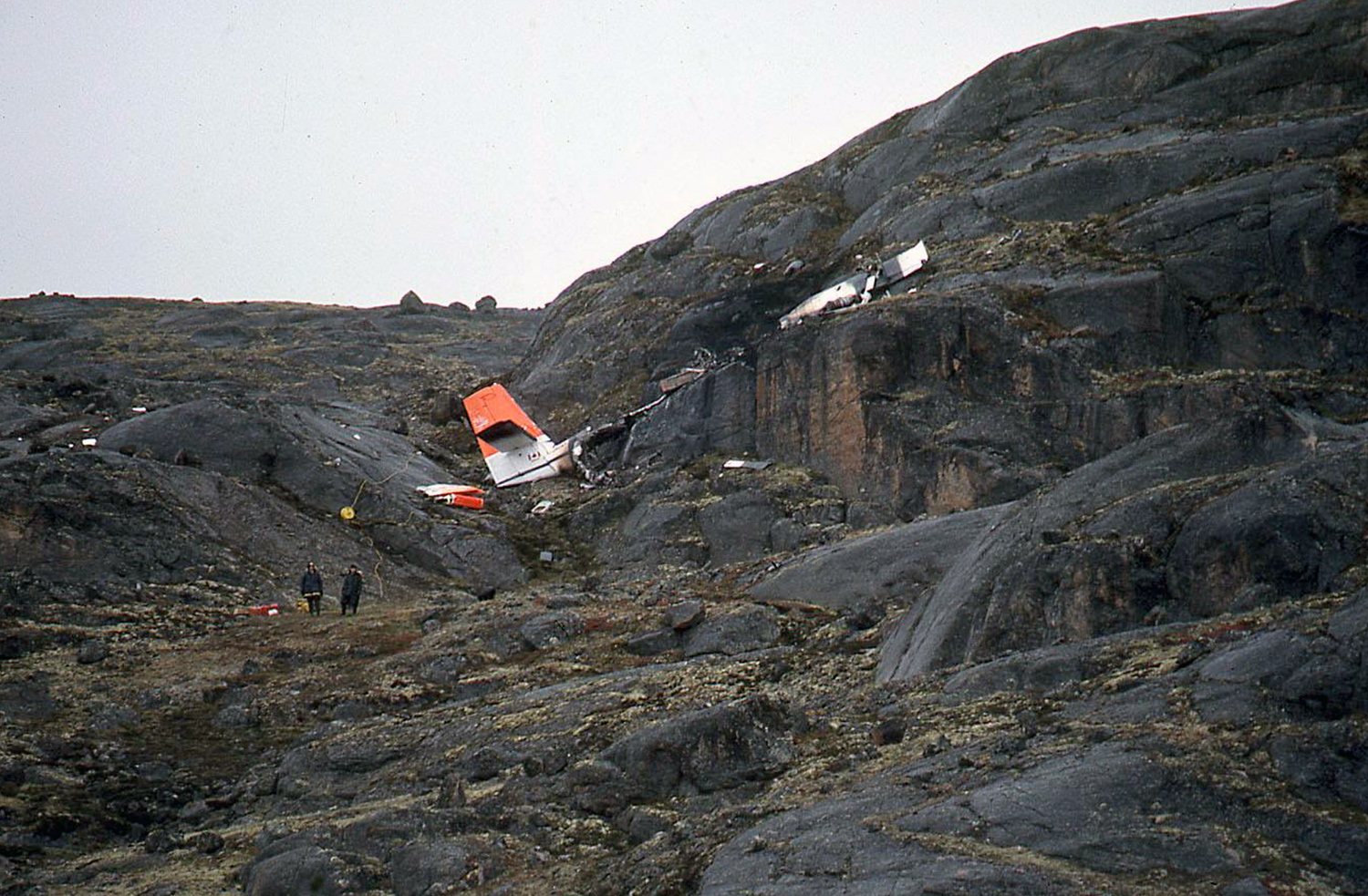
The airplane was being used for a series of flights between Frobisher (YFB) and Brevoort Island, a distance of 119 NM. These flights were conducted under visual flight rules (VFR) with a Flight Notification filed at Frobisher. Two return flights were accomplished without incident and the aircraft was flown back to Brevoort for another round trip. On the final flight the aircraft, with the same two pilots and with seven passengers, left Brevoort at 21:57 hours local time enroute to Frobisher. The pilots contacted Frobisher Flight Service Station (FSS) at 22:31 reporting at 6000 feet altitude estimating Frobisher in 15 minutes. Upon receiving the latest weather indicating conditions below VFR limits, they requested clearance for 'Special VFR'. This clearance was granted. Another weather report was transmitted by the Frobisher FSS giving the 22:44 observation in which the ceiling had lowered to 400 ft with the visibility at 8 miles and the wind from 190 deg M at 22 knots. The pilot stated they would make a front course ILS approach to runway 36 with a landing on 18. At 22:58 they were issued a clearance for an ILS approach. They subsequently reported outbound at procedure turn altitude and at that time confirmed their planned approach for runway 36 with circling for 18. This was the last radio transmission from C-GROW. The Twin Otter was seen flying north along the runway. It then struck high ground about 1,200 feet east of the runway and about 100 feet above runway level. The aircraft was destroyed and all nine occupants were killed.
Probable cause:
The following findings were identified:
- Three other aircraft made successful downwind landings on runway 36; one before and two after the accident flight.
- For undetermined reasons, the crew of C-GROW, following their instrument landing approach, decided not to land on runway 36 with the strong tailwind and elected to circle for runway 18.
- The weather was below circling limits.
- The crew attempted a circling approach at low altitude at night on the non maneuvering side of the runway.
- The aircraft struck the ground while under control during flight in restricted visibility.
Final Report:

Crash of a De Havilland DHC-6 Twin Otter 300 in Frobisher Bay: 1 killed

Date & Time: Aug 23, 1978
Operator:
Registration:
CF-QDG
Survivors:
Yes
MSN:
246
YOM:
1969
Country:
Crew on board:
2
Crew fatalities:
Pax on board:
4
Pax fatalities:
Other fatalities:
Total fatalities:
1
Circumstances:
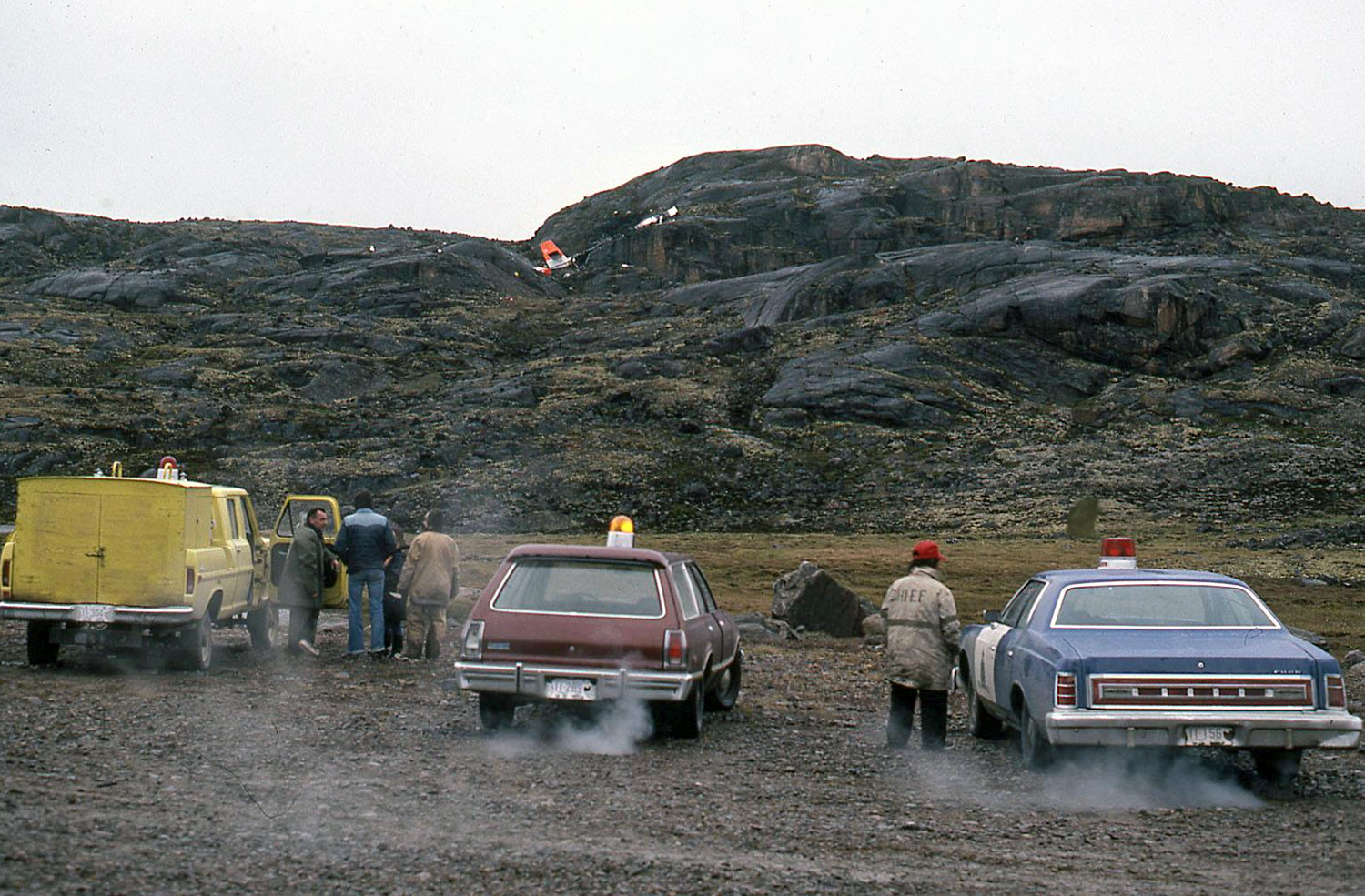
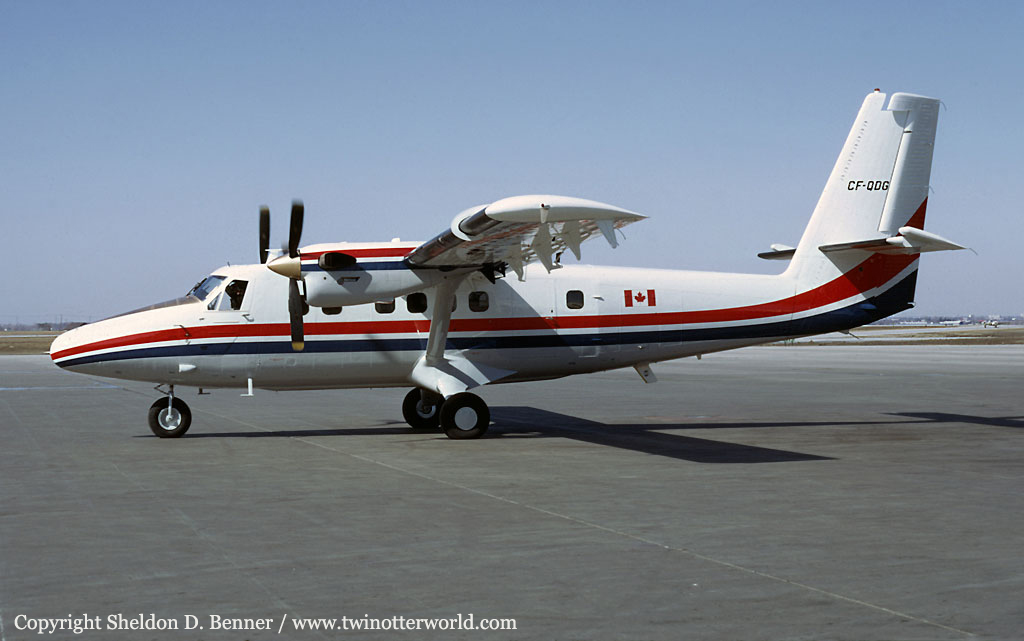
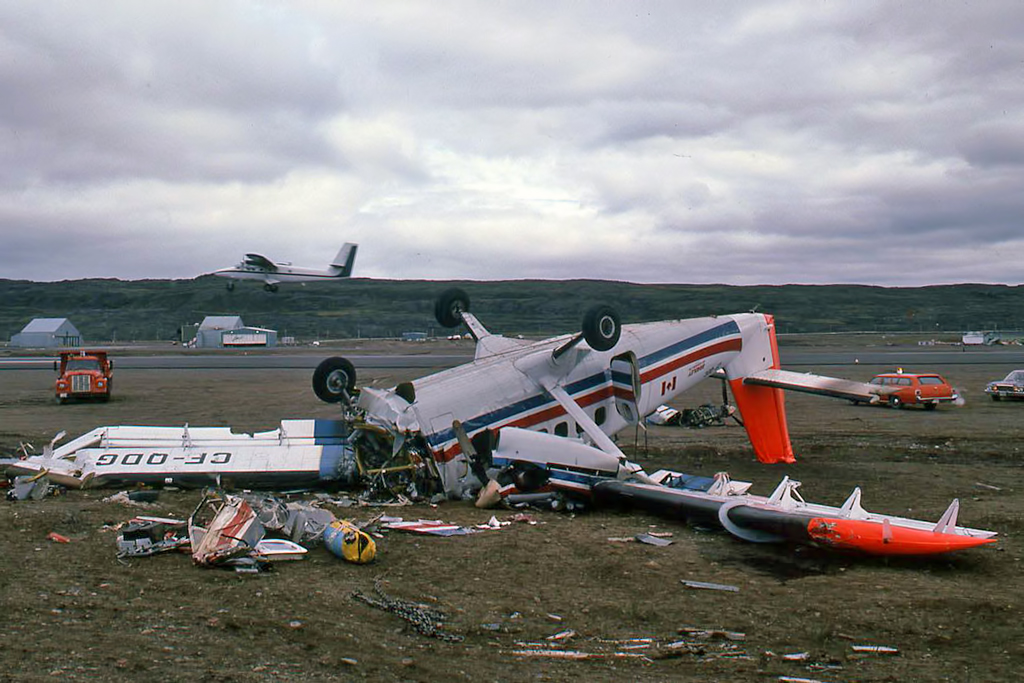
On final approach to Frobisher Bay Airport, while passing 40 feet over the runway threshold, the twin engine airplane rolled to the left and descended out of control, causing the left wing to struck the ILS antenna. The left engine was torn off and the airplane crashed nose first and came to rest upside down on the left side of the runway. Five occupants were injured while one the pilot was killed.

Crash of a Douglas C-47A-10-DL Dakota 3 near Frobisher Bay

Date & Time: Nov 3, 1975 at 2130 LT
Operator:
Registration:
C-FOOY
Flight Phase:
Survivors:
Yes
Schedule:
Pond Inlet – Frobisher Bay
MSN:
12411
YOM:
1944
Country:
Crew on board:
3
Crew fatalities:
Pax on board:
23
Pax fatalities:
Other fatalities:
Total fatalities:
0
Circumstances:
The aircraft was chartered by the Inuit Tapirisat of Canada, a national Eskimo organization, and was bringing delegates to a week-long land claims conference at Pond Inlet back to their home settlements. En route, the crew was informed that a landing in Frobisher Bay was not possible due to the deterioration of the weather conditions. The crew apparently decided to divert to another aircraft but few dozen minutes later, while cruising at an altitude of 9,000 feet, the captain informed ATC that he was low of fuel and should land. He eventually completed a belly landing in an open land located about 80 km north of Frobisher Bay. All 26 occupants were rescued and the airplane, damaged beyond repair, was abandoned on site.
Probable cause:
Emergency landing due fuel shortage.

Crash of a Rockwell Sabreliner 40A near Frobisher Bay: 9 killed

Date & Time: Feb 27, 1974 at 2158 LT
Type of aircraft:
Operator:
Registration:
CF-BRL
Flight Phase:
Survivors:
No
Site:
Schedule:
Stuttgart - Shannon - Keflavik - Frobisher Bay - Toronto
MSN:
282-107
YOM:
1972
Country:
Crew on board:
2
Crew fatalities:
Pax on board:
7
Pax fatalities:
Other fatalities:
Total fatalities:
9
Captain / Total flying hours:
13500
Captain / Total hours on type:
346.00
Copilot / Total flying hours:
8700
Copilot / Total hours on type:
217
Aircraft flight hours:
675
Circumstances:
The aircraft, with two pilots and seven passengers on board was being flown from Stuttgart to Toronto via Shannon, Keflavik and Frobisher. The flight was routine as far as Keflavik. After startup at Keflavik the aircraft remained 18 minutes on the ground before takeoff. Departure was at 2131Z (27 February), and the flight was undertaken at FL390 against a 30 knot wind component, using a GNS-200 on-board navigation system. The aircraft navigation was satisfactory until 2352Z, 285 NM east of Frobisher (approximately 65° N 58° W). At this point the GNS-200 navigation system became unusable for 10 minutes due to a dropout of signals from the very low frequency ground stations on which it depended for operation. The aircraft has been tracked by a military radar network until it neared the Canadian coast. Near the coast the aircraft made a turn to the left of about 20°, but did not subsequently turn back to the right toward Frobisher, as might have been expected. Radar surveillance was not continued beyond that point. The Frobisher main, high power non-direction beacon (FY-206 Khz), went off the air at 0010Z and was restored to service at 0059Z. The standby transmitter failed to operate. At 0013Z, and ATC descent clearance was passed to the aircraft through Frobisher Aeradio; no information was included regarding the status of the radio navigation aids at Frobisher. At 0014Z, the clearance was acknowledged by the flight crew and a descent was commenced. At 0025Z, the flight radioed Frobisher that the radio beacons were not being received; then, that the DME (Distance Measuring Equipment) signals were not being received. The aircraft was at relatively low altitude by this time and lost radio contact with Frobisher. At approximately 0040Z, a small jet aircraft, believed to be CF-BRL, was observed to circle once at low altitude over the radio beacon at Brevoort Island, 120 NM east of Frobisher, and depart in the direction of Frobisher. At 0050Z, at the request of Frobisher Aeradio, an overflying airline jet contacted CF-BRL and learned it was at 4,500 feet (1,372 metres) asl. The pilots were 'lost' and asked whether Frobisher radio beacons were being received. Shortly thereafter, they reported receiving a Frobisher beacon (radio range station, FB 263 KHz, 400 watts) and altering course toward it. They sais they were low on fuel. At 0056Z, the pilot of CF-BRL announced 'both fuel lights are on and we are starting down from 4,500 feet'. The aircraft struck the side of a hill at 0058Z. The wreckage was found 120 km southeast of the destination airport. All nine occupants were killed.
Probable cause:
The following findings were identified:
- During an attempt to locate Frobisher Airport, the aircraft fuel was exhausted by 30 minutes of low altitude maneuvering.
- The descent from cruising altitude was made using navigation information from the on-board GNS system; the crew were unaware that this information was erroneous.
- The main non-directional radio beacon at Frobisher was off the air during a critical phase of the flight; the crew were not informed of this outage prior to commencement of descent.
- The radio beacon transmitter that failed had been fitted with a 40 ampere circuit breaker rather than a 45 ampere circuit breaker specified.
- The standby radio beacon transmitter failed to operate because of a faulty interlock switch system.
- The Frobisher radio range station was operating and suitable for use as a homing beacon; it was not approved for use as a radio range and was not listed on the appropriate Canadian flight navigation charts.
- A Notam issued in August 1973 stated that the Frobisher radio range would be decommissioned 'in approximately two months'; this Notam was still valid at the time of the accident.
- The flight as planned did not comply with the requirements for fuel reserves as expressed in Air Regulation 549.
Final Report:

Crash of a Douglas C-47A-25-DK in Frobisher Bay

Date & Time: Feb 12, 1973
Operator:
Registration:
CF-OOV
Flight Phase:
Flight Type:
Survivors:
Yes
Schedule:
Frobisher Bay – Resolute Bay
MSN:
13300
YOM:
1944
Country:
Crew on board:
2
Crew fatalities:
Pax on board:
1
Pax fatalities:
Other fatalities:
Total fatalities:
0
Circumstances:
Shortly after takeoff from Frobisher Bay Airport, while climbing, one of the engine lost power. The crew elected to return when the airplane stalled and crashed by the airport. All three occupants were slightly injured while the aircraft was damaged beyond repair. The aircraft was returning from a major overhaul in Toronto few days ago.
Probable cause:
Loss of engine power for unknown reason.

Crash of a Beechcraft 65-B80 Queen Air in Frobisher Bay: 3 killed

Date & Time: Dec 10, 1971 at 0055 LT
Type of aircraft:
Registration:
N929V
Flight Type:
Survivors:
No
Schedule:
Fort Chimo - Frobisher Bay
MSN:
LD-325
YOM:
1967
Country:
Crew on board:
3
Crew fatalities:
Pax on board:
0
Pax fatalities:
Other fatalities:
Total fatalities:
3
Captain / Total flying hours:
13000
Circumstances:
While approaching Frobisher Bay Airport by night, the twin engine aircraft crashed in unknown circumstances few km from the airfield. All three occupants were killed.
Final Report:

Crash of a Noorduyn Norseman near Frobisher Bay

Date & Time: Apr 9, 1964
Type of aircraft:
Registration:
CF-HZR
Flight Phase:
MSN:
843
YOM:
1945
Country:
Crew on board:
0
Crew fatalities:
Pax on board:
0
Pax fatalities:
Other fatalities:
Total fatalities:
0
Circumstances:
Crashed in unknown circumstances 110 km northwest of Frobisher Bay. Occupant's fate remains unknown.

Crash of an Avro 685 York C.1 near Fort Chimo: 2 killed

Date & Time: Sep 26, 1956
Type of aircraft:
Operator:
Registration:
CF-HMW
Flight Phase:
Flight Type:
Survivors:
Yes
Schedule:
Frobisher Bay – Fort Chimo
MSN:
MW136
YOM:
1944
Country:
Crew on board:
3
Crew fatalities:
Pax on board:
0
Pax fatalities:
Other fatalities:
Total fatalities:
2
Circumstances:
En route to Kuujjuaq, the crew encountered technical problems and was forced to attempt an emergency landing. The four engine aircraft crashed 44 km north of Kuujjuaq. Two crew members were killed while the third occupant was rescued.

Crash of a Douglas C-47-DL near Fort Chimo: 2 killed

Date & Time: Feb 14, 1956
Operator:
Registration:
CF-BZH
Flight Phase:
Flight Type:
Survivors:
Yes
Site:
Schedule:
Frobisher Bay – Fort Chimo
MSN:
6079
YOM:
1942
Country:
Crew on board:
3
Crew fatalities:
Pax on board:
0
Pax fatalities:
Other fatalities:
Total fatalities:
2
Circumstances:
While approaching Fort Chimo on a cargo flight from Frobisher Bay, the crew encountered poor weather conditions and failed to realize his altitude was too low when the airplane struck a hill located 40 km from Fort Chimo Airport. A crew member was rescued while both other occupants were killed. For undetermined reason, the crew started the descent prematurely.