
Crash of a Douglas C-47B-5-DK in Tinker AFB: 1 killed

Date & Time: Jun 19, 1950
Operator:

Registration:
43-48885
Flight Phase:
Flight Type:
Survivors:
Yes
MSN:
14701/26146
YOM:
1944
Crew on board:
2
Crew fatalities:
Pax on board:
0
Pax fatalities:
Other fatalities:
Total fatalities:
1
Circumstances:
Just after liftoff, while in initial climb, the aircraft stalled and crashed. A pilot was killed and the second occupant was injured.
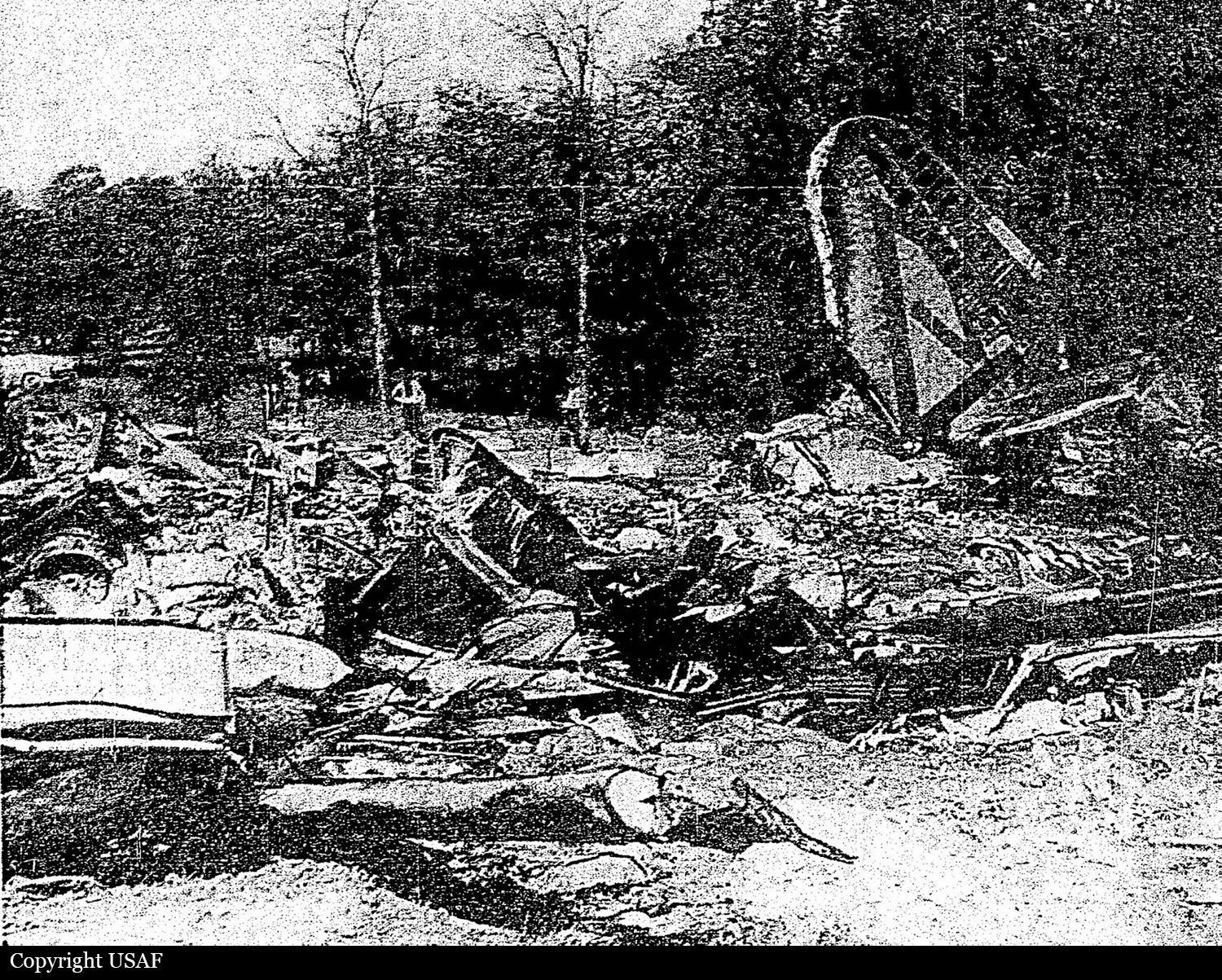

Crash of a Boeing TB-29 Superfortress near Talihina: 13 killed

Date & Time: Sep 26, 1949 at 1915 LT
Type of aircraft:
Operator:
Registration:
44-86333
Flight Phase:
Flight Type:
Survivors:
No
Schedule:
Smoky Hill – Tinker
Crew on board:
13
Crew fatalities:
Pax on board:
0
Pax fatalities:
Other fatalities:
Total fatalities:
13
Circumstances:
En route from Smoky Hill AFB to Tinker AFB, the crew apparently encountered an unexpected situation. While circling over Talihina, the airplane entered a flat spin and crashed in a wooded area located 10 km southwest of town, bursting into flames. All 13 crew members were killed.
Crew:
1st Lt Robert B. Black, pilot,
1st Lt Harold S. Spicer, copilot,
M/Sgt William H. Day, flight engineer,
Cpl Theodore P. Sells, assistant to flight engineer,
1st Lt Philip L. Benefiel, navigator,
S/Sgt Charles G. Slifkey, radio operator,
S/Sgt Thomas M. Crean, radio operator,
1st Lt Jack E. McDannell, bombardier,
Cpt Julian B. Massey Jr., radar observer,
2nd Lt Thomas F. Carlow, radar observer,
S/Sgt Charles A. Jellings, air gunner,
Sgt Harold M. Hanna, air gunner,
S/Sgt Robert O. Troyer, air gunner.

Crash of a Boeing B-29A-70-BN Superfortress at Tinker AFB: 2 killed

Date & Time: Nov 10, 1947
Type of aircraft:
Operator:
Registration:
44-62275
Flight Phase:
Flight Type:
Survivors:
Yes
Schedule:
Tinker – Schilling
MSN:
11752
YOM:
1944
Crew on board:
7
Crew fatalities:
Pax on board:
0
Pax fatalities:
Other fatalities:
Total fatalities:
2
Circumstances:
Shortly after takeoff from Tinker AFB, the bomber went out of control and crashed on an aircraft storage area. The B-29 as well as 12 parked Republic P-47 Thunderbolt were destroyed. Two crew members were killed and five others were injured.
Crew:
1st Lt D. E. Quilin, pilot,
1st Lt William F. Walkemeyer, copilot, †
M/Sgt Wendell G. McFarlin, flight engineer,
T/Sgt John A. Langenberg, radio operator, †
S/Sgt Pasquale A. Manzi, left gunner,
Cpl Robert A. Quinn, right gunner,
Pfc J. F. Anderson, ground crew.

Crash of a Douglas P-70A-1 Havoc at Tinker AFB

Date & Time: Jun 3, 1943
Operator:
Registration:
42-33135
Flight Phase:
Flight Type:
Survivors:
Yes
MSN:
6597
YOM:
1941
Crew on board:
0
Crew fatalities:
Pax on board:
0
Pax fatalities:
Other fatalities:
Total fatalities:
0
Circumstances:
Crashed in unknown circumstances and destroyed. There were no fatalities.

Crash of a Douglas C-47A-DK Skytrain near Tinker AFB: 15 killed

Date & Time: May 8, 1943 at 2142 LT
Operator:
Registration:
42-92024
Flight Phase:
Flight Type:
Survivors:
No
Schedule:
Tinker AFB - Alliance
MSN:
11779
YOM:
1943
Crew on board:
5
Crew fatalities:
Pax on board:
10
Pax fatalities:
Other fatalities:
Total fatalities:
15
Circumstances:
The twin engine airplane departed Tinker AFB at 2132LT on a flight to Alliance, Nebraska, carrying 10 passengers and five crew members. About 10 minutes later, while climbing, it entered an uncontrolled descent to the left and crashed in a plowed field located 3 km north of the airbase, bursting into flames. All 15 occupants were killed, among them three civilians, two employees of Will Rogers Airport and one employee of Tinker AFB.
Crew:
1st Lt Robert Henry Pair Jr., pilot,
2nd Lt Norman Clark Keister, copilot,
2nd Lt Irving Samson Greenburg,
F/O Joseph Norman Phelps,
Sgt Robert E. Bennett,
Cpl Frank C. Sutterby Jr.,
Cpl Douglas M. Grover,
Cpl Stephen R. Mendry,
Cpl Grayson C. Naden,
Pfc Jack D. Rooker,
Pfc Albert C. Tilley,
Pfc C. C. Motley.
Passengers:
G. W. Bradshaw,
R. E. Fitzgerald,
J. C. Coleman.
Probable cause:
Investigations revealed that the airplane struck the ground while in a left turn, the left wing striking the ground first. Approximately 200 yards past the first contact with the ground, the airplane struck with such force that major parts of the airplane, including the engines, were thrown off the airplane and all occupants were thrown out. There was evidence that the airplane was burning after this contact with the ground. The airplane then bounced and finally came to rest approximately 300 yards further on where it continued to burn.
Investigators speculated that the pilot became confused while flying on instruments and allowed the airplane to enter a diving attitude toward the ground. The airplane was seen to emerge from 700-foot overcast in a diving attitude. The pilot was unable to recover in time to prevent the airplane from striking the ground.

Crash of a Douglas A-20 Havoc near Tinker AFB

Date & Time: Feb 6, 1943
Operator:
Registration:
AL437
Flight Phase:
Flight Type:
Survivors:
Yes
Crew on board:
0
Crew fatalities:
Pax on board:
0
Pax fatalities:
Other fatalities:
Total fatalities:
0
Circumstances:
The crew was forced to make an emergency landing near Tinker AFB. There were no fatalities.

Crash of a Boeing B-17F-35-BO Flying Fortress near Bogue: 6 killed

Date & Time: Feb 2, 1943 at 1720 LT
Operator:
Registration:
42-5105
Flight Phase:
Flight Type:
Survivors:
No
Schedule:
Casper - Tinker
MSN:
3644
YOM:
1942
Location:
Crew on board:
6
Crew fatalities:
Pax on board:
0
Pax fatalities:
Other fatalities:
Total fatalities:
6
Circumstances:
En route from Casper to Tinker AFB and while passing over Kansas, the crew encountered marginal weather conditions. The airplane was seen flying out the cloud layer then entered an uncontrolled descent and crashed in a huge explosion in an open field near Bogue. All six occupants were killed.
Crew:
1st Lt Paul M. Capaccio, pilot,
F/O Latteimer Stewart, copilot,
1st Lt Jacob M. Madsen Jr., navigator,
T/Sgt. Thaddeus I. Donlavage, flight engineer,
S/Sgt Frank Culver, radio operator.
M/Sgt H. M. Bloch.
Probable cause:
The airplane was observed about 1720 CWT, traveling northwest. It descended from a low overcast, ascended again into overcast, and briefly thereafter came out in a steep dive. Apparently there was some attempt at recovery, but airplane dived into the ground with sufficient impact to force the engines and nose three to five feet into the frozen earth. Airplane exploded on impact, with intense fire in impact area. Wreckage was scattered south of impact area in direction paralleling line of wings and to one side only, indicating that the airplane had a strong sideways movement at the time of impact. Airplane and bodies of personnel were extensively disintegrated. Controls and instruments were unrecognizable at time of inspection. There had been some thunderstorm activity in vicinity. Just prior to crash, the airplane was traveling in direction opposite to its proper course.
