Crash of a Beechcraft UC-45J Expeditor in San Francisco

Date & Time: May 6, 1970 at 0050 LT
Type of aircraft:
Operator:
Registration:
N86415
Flight Phase:
Flight Type:
Survivors:
Yes
Schedule:
San Francisco – Los Angeles
MSN:
4429
YOM:
1943
Crew on board:
2
Crew fatalities:
Pax on board:
0
Pax fatalities:
Other fatalities:
Total fatalities:
0
Captain / Total flying hours:
6000
Captain / Total hours on type:
500.00
Circumstances:
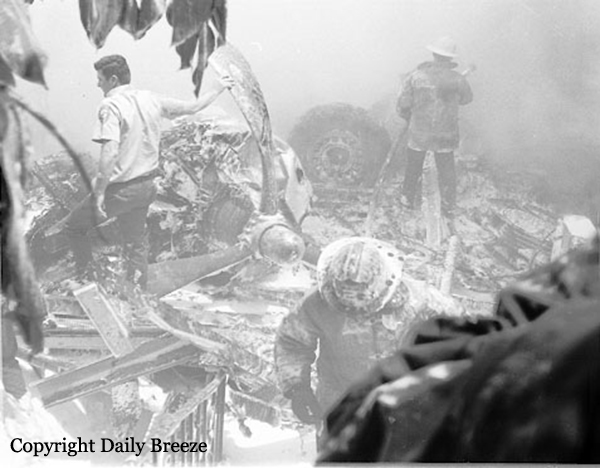
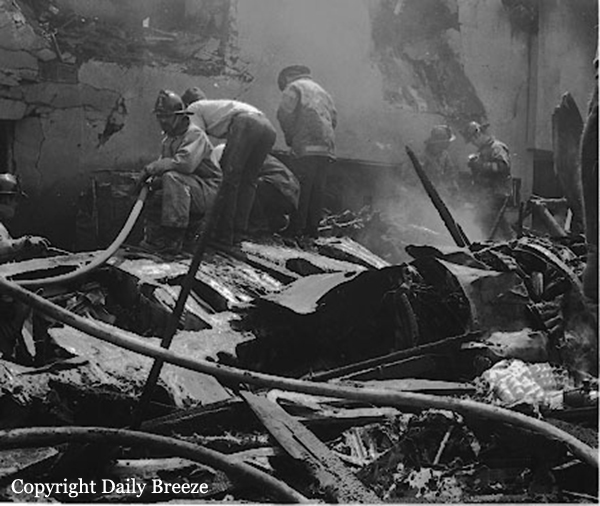
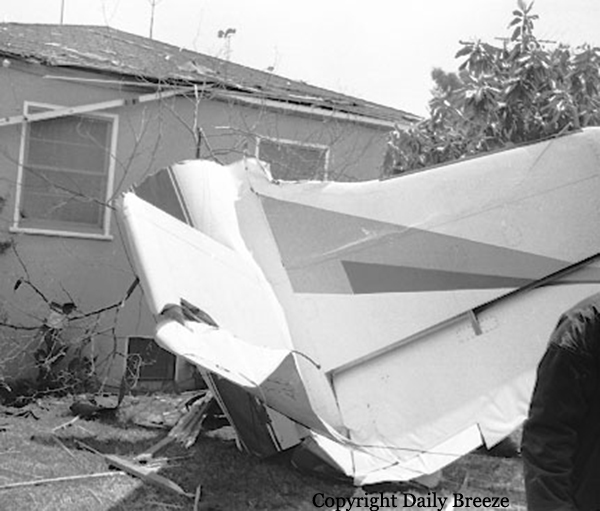
Prior to takeoff, the local controller offered pilot choice of runways 01 or 28. The crew decided to takeoff from runway 01. During the takeoff roll, the airplane was caught by strong winds and control was lost. The airplane veered off runway, lost its undercarriage and came to rest in flames. Both pilots were injured and the aircraft was destroyed by fire.
Probable cause:
The crew selected the wrong runway relative to existing wind. The following factors were considered as contributing:
- Unfavorable wind component,
- Inadequate preflight preparation,
- Improperly loaded aircraft (W&B and CofG),
- Overload failure,
- Wind gusting up to 23 knots,
- Aircraft loaded aft of CofG.
Final Report:

Crash of a Convair T-29D near Hamilton AFB: 13 killed

Date & Time: May 4, 1970 at 0804 LT
Type of aircraft:
Operator:
Registration:
52-5822
Flight Phase:
Flight Type:
Survivors:
Yes
Site:
Schedule:
Hamilton - Spokane
MSN:
52-21
YOM:
1954
Flight number:
Visco 57
Crew on board:
3
Crew fatalities:
Pax on board:
11
Pax fatalities:
Other fatalities:
Total fatalities:
13
Circumstances:
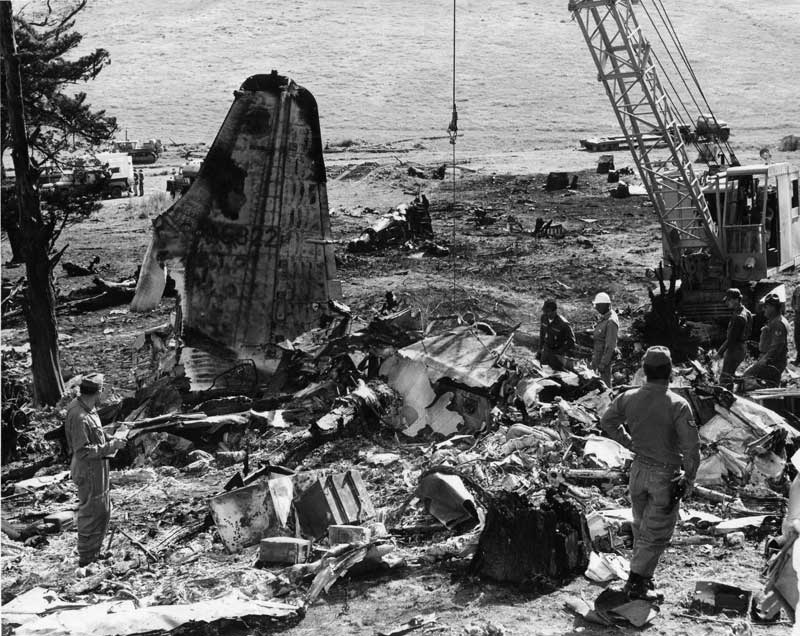
Shortly after takeoff from runway 30 at Hamilton AFB (Novato, CA), the crew was cleared to climb at his discretion, following heading 360 till 2,600 feet then heading 340. Few seconds later, the airplane struck trees and crashed on a mountain slope located eight miles from the airbase. The aircraft was totally destroyed by impact forces and a post crash fire. A passenger was seriously injured while 13 other occupants were killed. The crew from the 26th Division was completing a flight to Spokane, Washington. At the time of the accident, weather conditions were considered as good with three cloud layers at 900, 15,000 and 25,000 feet, a visibility of about 8 miles and a light wind from 340 at 2 knots.
Probable cause:
A second flight was completed in similar conditions few hours later and the investigators were unable to determine the exact cause of the accident.

Crash of a Stinson V-77 Reliant in Perris Valley: 1 killed

Date & Time: Mar 7, 1970 at 1404 LT
Type of aircraft:
Operator:
Registration:
N69440
Flight Phase:
Survivors:
Yes
Schedule:
Perris Valley - Perris Valley
MSN:
77-107
YOM:
1943
Crew on board:
1
Crew fatalities:
Pax on board:
5
Pax fatalities:
Other fatalities:
Total fatalities:
1
Captain / Total flying hours:
800
Captain / Total hours on type:
252.00
Circumstances:
While completing a skydiving flight, the aircraft suffered an airframe failure. Control was lost and it crashed near the Perris Valley Airport. Five occupants were rescued while a passenger was killed.
Probable cause:
Probable cause(s):
- pilot in command - inadequate preflight preparation and/or planning,
- pilot in command - exercised poor judgment,
- pilot in command - failed to follow approved procedures, directives,etc.,
- personnel - maintenance, servicing, inspection: inadequate maintenance and inspection,
- airframe - wings: skin and attachments,
- miscellaneous acts,conditions - improperly loaded aircraft-weight-and/or c.g.
Factor(s):
- miscellaneous acts,conditions - overload failure.
Remarks- metal skin coverage top left wing loose, skin working, separation occurred. Pilot exceeded aircraft operations limits before occurrence.
Final Report:

Crash of a Boeing B-52F-105-BO Stratofortress at Castle AFB

Date & Time: Oct 21, 1969
Type of aircraft:
Operator:
Registration:
57-0041
Flight Type:
Survivors:
Yes
Schedule:
Castle - Castle
MSN:
17435
YOM:
1957
Crew on board:
6
Crew fatalities:
Pax on board:
0
Pax fatalities:
Other fatalities:
Total fatalities:
0
Circumstances:
On touchdown, the aircraft went out of control, veered off runway and came to rest in flames. All six crew members escaped uninjured while the aircraft was destroyed by a post crash fire.

Crash of a Douglas DC-8-63CF in Stockton

Date & Time: Oct 16, 1969 at 1545 LT
Type of aircraft:
Operator:
Registration:
N8634
Flight Type:
Survivors:
Yes
Schedule:
Oakland - Stockton - Oakland
MSN:
46021/424
YOM:
1968
Crew on board:
5
Crew fatalities:
Pax on board:
0
Pax fatalities:
Other fatalities:
Total fatalities:
0
Captain / Total flying hours:
19308
Captain / Total hours on type:
1747.00
Copilot / Total flying hours:
4210
Copilot / Total hours on type:
725
Aircraft flight hours:
3441
Circumstances:
The aircraft overran the departure end of runway 29R at Stockton Metropolitan Airport, California, during the performance of a crew training flight. The aircraft struck a roadway thereby collapsing the left main and nose landing gears. The aircraft came to rest 792 feet beyond the end of the runway. The aircraft was destroyed by fire. The five crewmembers aboard were uninjured. The flight was scheduled for use for recurrent training and annual proficiency checks of first officers in DC-8 equipment. The flight originated at the Oakland International Airport (OAK) and was to terminate at OAK. Training maneuvers were to be conducted in the Stockton area, with landing and takeoff practice to be performed at the Stockton Metropolitan Airport. During a touch-and-go landing on Runway 29R at the Stockton Metropolitan Airport, the captain rejected the takeoff because of the sounding of a takeoff warning hob and the activation of a ground spoiler extend light. The crew was not able to stop the aircraft on the remaining runway.
Probable cause:
A false ground spoiler position indication during the takeoff portion of a touch and go landing that induced the captain to discontinue the takeoff at a point too far down the runway to permit him to stop the aircraft on the runway.
Final Report:

Crash of a Boeing B-52F-70-BW Stratofortress at Castle AFB: 6 killed

Date & Time: Oct 9, 1969 at 2345 LT
Type of aircraft:
Operator:
Registration:
57-0172
Flight Phase:
Flight Type:
Survivors:
No
Schedule:
Castle - Castle
MSN:
464161
YOM:
1957
Crew on board:
6
Crew fatalities:
Pax on board:
0
Pax fatalities:
Other fatalities:
Total fatalities:
6
Circumstances:
The crew was engaged in a local training flight at Castle AFB, completing touch and go manoeuvres. Shortly after takeoff, while in initial climb, the airplane pitch up. The tail stalled and the airplane crashed onto the runway. All six crew members were killed.
Crew:
Cpt Richard F. Beattie, pilot,
Maj Boyd P. Beyer, navigator,
Maj Doyal L. Keller, navigator,
Cpt Wilber D. Wright, student,
1st Lt Frank D. Harriman, student,
2nd Lt Steven D. Lack, student.

Crash of a De Havilland DH.104 Dove 2 off San Francisco: 1 killed

Date & Time: Sep 11, 1969 at 2137 LT
Type of aircraft:
Operator:
Registration:
N13114
Flight Type:
Survivors:
Yes
Schedule:
Eureka - San Francisco
MSN:
04092
YOM:
1947
Crew on board:
2
Crew fatalities:
Pax on board:
0
Pax fatalities:
Other fatalities:
Total fatalities:
1
Captain / Total flying hours:
2187
Captain / Total hours on type:
650.00
Circumstances:
On final approach to San Francisco Airport, while on a night cargo flight, the crew reported pitch problems when control was lost. The airplane crashed into the sea few miles off shore. The copilot was rescued while the body of the captain was found a week later. The airplane sank and was not recovered.
Probable cause:
Uncontrolled descent and collision with water for undetermined reason. The pilot reported loss of pitch control on base leg. The wreckage was not recovered.
Final Report:

Crash of a Piper PA-31-310 Navajo Chieftain in Hollywood: 2 killed

Date & Time: Jul 18, 1969 at 0524 LT
Type of aircraft:
Registration:
N9150Y
Flight Phase:
Flight Type:
Survivors:
Yes
Schedule:
Hollywood - Fresno
MSN:
31-199
YOM:
1968
Crew on board:
2
Crew fatalities:
Pax on board:
1
Pax fatalities:
Other fatalities:
Total fatalities:
2
Captain / Total flying hours:
1825
Captain / Total hours on type:
162.00
Circumstances:
After takeoff from Hollywood-Burbank Airport, while climbing, one of the engine lost power. Control was lost and the airplane crashed near the runway end. While the passenger was seriously injured, both pilots were killed. The aircraft was destroyed.
Probable cause:
The accident was the consequence of the combination of the following factors:
- Inadequate preflight preparation on part of the crew,
- The pilot-in-command failed to abort takeoff,
- Partial loss of power on one engine due to ignition system failure,
- Spark plug carbon deposit,
- The pilot failed to maintain flying speed,
- The passenger was seating between both pilots with no seat or belt,
- The total weight was near gross weight,
- The cargo was not tied down.
Final Report:

Crash of a Douglas R5D-2 at China Lake AFB

Date & Time: Jun 5, 1969
Type of aircraft:
Operator:
Registration:
50852
Flight Type:
Survivors:
Yes
Schedule:
Los Alamitos - China Lake
MSN:
10429
YOM:
1944
Crew on board:
0
Crew fatalities:
Pax on board:
0
Pax fatalities:
Other fatalities:
Total fatalities:
0
Circumstances:
Upon landing at China Lake AFB, the nose gear collapsed. The airplane slid for several yards before coming to rest. There were no casualties.

Crash of a Douglas A-26B-40-DL Invader in Los Angeles: 6 killed

Date & Time: May 10, 1969 at 1117 LT
Type of aircraft:
Operator:
Registration:
N9405Z
Flight Phase:
Flight Type:
Survivors:
No
Site:
Schedule:
Los Angeles - Los Angeles
MSN:
7266
YOM:
1941
Crew on board:
4
Crew fatalities:
Pax on board:
0
Pax fatalities:
Other fatalities:
Total fatalities:
6
Captain / Total flying hours:
11131
Captain / Total hours on type:
2000.00
Circumstances:
Shortly after takeoff from Los Angeles International Airport, while climbing, the left engine failed. The pilot-in-command lost control of the airplane that crashed in flames onto a house located in the district of El Segundo, by the airport. The aircraft and the house were totally destroyed and all four crew members were killed as well as two people in the house.
Probable cause:
Engine failure during initial climb caused by the following factors:
- Master and connecting rods failure,
- Piston rings failure,
- Material failure,
- The pilot failed to maintain flying speed,
- Improper emergency procedures,
- Complete power loss on left engine,
- Front bank left engine failed,
- Single pilot configuration,
- Left prop not feathered.
Final Report: