Crash of a Piper PA-31-310 Navajo Chieftain in Mount Isa

Date & Time: Jul 17, 2008 at 0915 LT
Type of aircraft:
Operator:
Registration:
VH-IHR
Flight Type:
Survivors:
Yes
Schedule:
Century Mine - Mount Isa
MSN:
31-8012077
YOM:
1980
Country:
Region:
Crew on board:
1
Crew fatalities:
Pax on board:
0
Pax fatalities:
Other fatalities:
Total fatalities:
0
Captain / Total flying hours:
469
Captain / Total hours on type:
30.00
Circumstances:
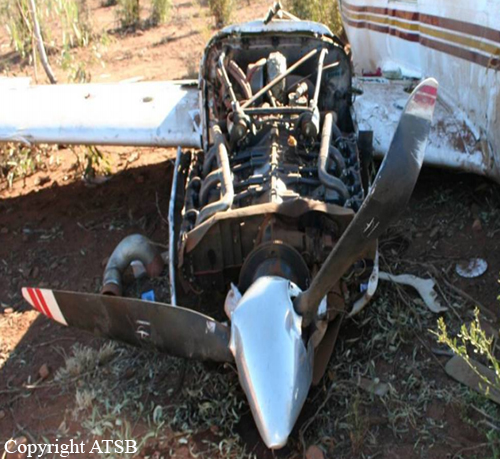
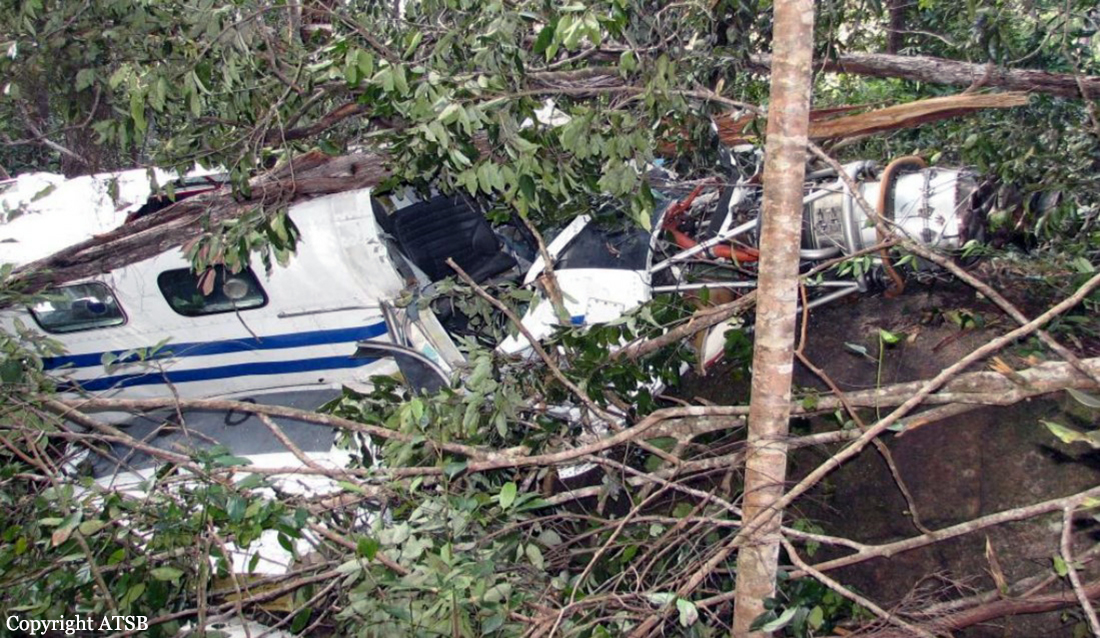
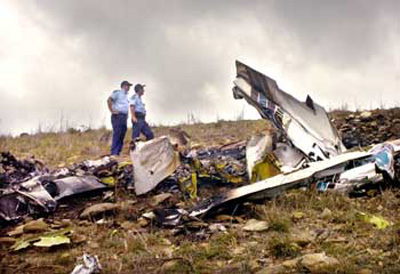
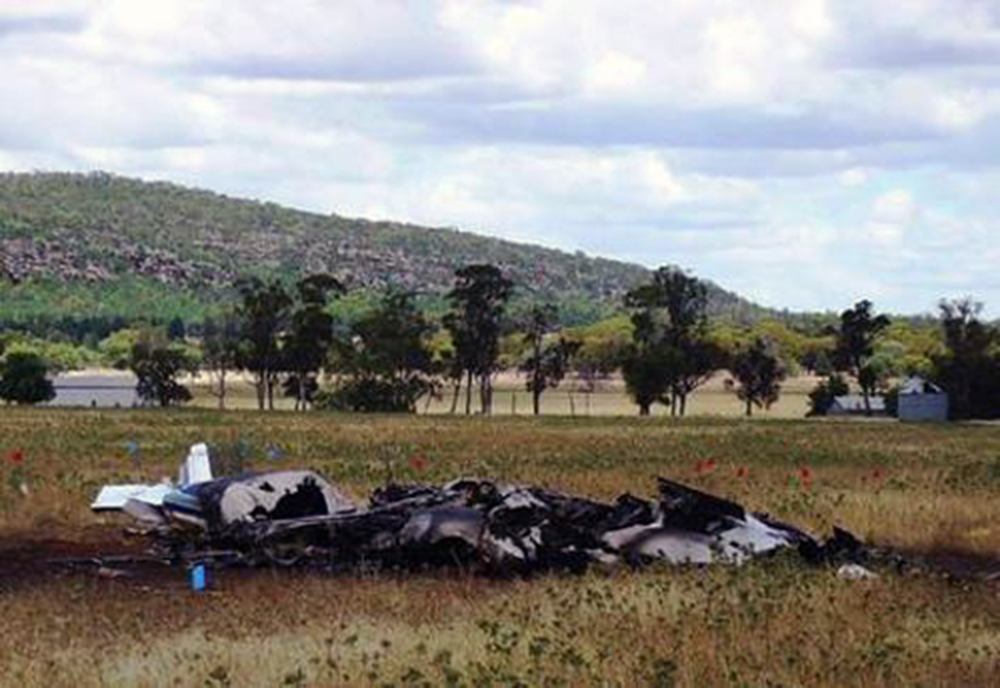
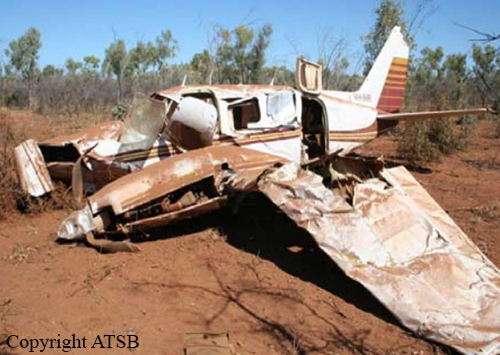
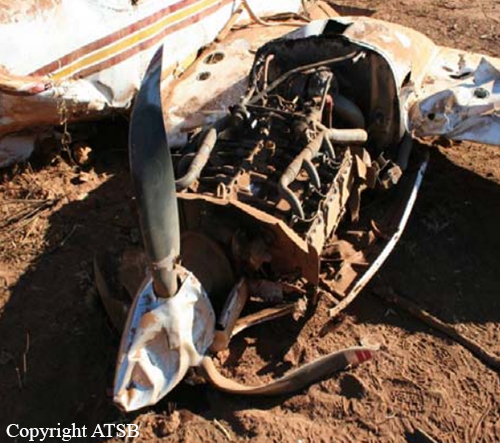
On 17 July 2008, at approximately 0915 Eastern Standard Time1, the pilot of a Piper Navajo PA-31 aircraft, registered VH-IHR, was en route from Century Mine, Qld to Mt Isa, Qld when the left engine lost power. The pilot transmitted an urgency broadcast (PAN) to air traffic control (ATC). A short time later, the right engine also lost power. The pilot then transmitted a distress signal (MAYDAY) to ATC stating his intention to carry out an off-field emergency landing. The aircraft impacted terrain 22 km north of Mt Isa, about 4 km from the Barkly Highway, in relatively flat, sparsely wooded bushland (Figure 1). The pilot, who was the sole occupant, sustained serious injuries.
Probable cause:
From the evidence available, the following findings are made with respect to the fuel starvation event and should not be read as apportioning blame or liability to any particular organisation or individual.
- The pilot did not monitor outboard fuel tank quantity during the flight.
- The pilot incorrectly diagnosed the engine power losses.
- The aircraft was not in the correct configuration for the forced landing.
Final Report:
Crash of a Swearingen SA227AC Metro III off Sydney: 1 killed

Date & Time: Apr 9, 2008 at 2327 LT
Type of aircraft:
Operator:
Registration:
VH-OZA
Flight Phase:
Flight Type:
Survivors:
No
Schedule:
Sydney – Brisbane
MSN:
AC-600
YOM:
1984
Country:
Region:
Crew on board:
1
Crew fatalities:
Pax on board:
0
Pax fatalities:
Other fatalities:
Total fatalities:
1
Captain / Total flying hours:
4873
Captain / Total hours on type:
175.00
Aircraft flight hours:
32339
Aircraft flight cycles:
46710
Circumstances:
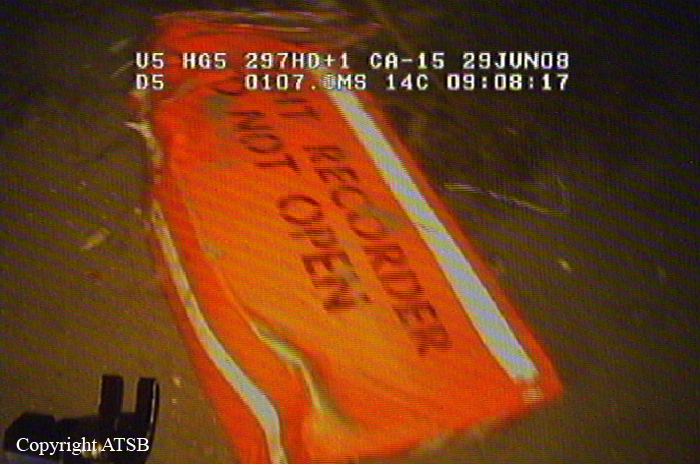
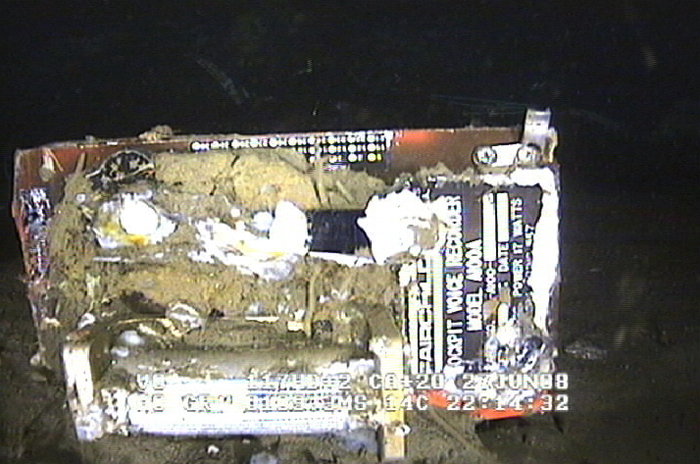
On 9 April 2008, at 2325 Eastern Standard Time, a Fairchild Industries Inc. SA227-AC (Metro III) aircraft, registered VH-OZA, departed Sydney Airport, New South Wales on a freight charter flight to Brisbane, Queensland with one pilot on board. The aircraft was subsequently observed on radar to be turning right, contrary to air traffic control instructions to turn left to an easterly heading. The pilot reported that he had a ‘slight technical fault’ and no other transmissions were heard from the pilot. Recorded radar data showed the aircraft turning right and then left, followed by a descent and climb, a second right turn and a second descent before radar returns were lost when the aircraft was at an altitude of 3,740 ft above mean sea level and descending at over 10,000 ft/min. Air traffic control initiated search actions and search vessels later recovered a small amount of aircraft wreckage floating in the ocean, south of the last recorded radar position. The pilot was presumed to be fatally injured and the aircraft was destroyed. Both of the aircraft’s on-board flight recorders were subsequently recovered from the ocean floor. They contained data from a number of previous flights, but not for the accident flight. There was no evidence of a midair breakup of the aircraft.
Probable cause:
Contributing Safety Factors:
- It was very likely that the aircraft’s alternating current electrical power system was not energised at any time during the flight.
- It was very likely that the aircraft became airborne without a functioning primary attitude reference or autopilot that, combined with the added workload of managing the ‘slight technical fault’, led to pilot spatial disorientation and subsequent loss of control.
Other Safety Factors:
- The pilot’s Metro III endorsement training was not conducted in accordance with the operator’s approved training and checking manual, with the result that the pilot’s competence and ultimately, safety of the operation could not be assured. [Significant safety issue].
- The chief pilot was performing the duties and responsibilities of several key positions in the operator’s organisational structure, increasing the risk of omissions in the operator’s training and checking requirements.
- The conduct of the flight single-pilot increased the risk of errors of omission, such as not turning on or noticing the failure of aircraft items and systems, or complying with directions.
Final Report:
Crash of a PAC Cresco 08-600 near Tully: 1 killed

Date & Time: Aug 16, 2007 at 1513 LT
Type of aircraft:
Registration:
VH-XMN
Flight Phase:
Flight Type:
Survivors:
No
Site:
Schedule:
Ingham - Tully
MSN:
036
YOM:
2002
Country:
Region:
Crew on board:
1
Crew fatalities:
Pax on board:
0
Pax fatalities:
Total fatalities:
1
Captain / Total flying hours:
397
Captain / Total hours on type:
138.00
Circumstances:
The pilot was ferrying the aircraft under the visual flight rules (VFR) from the operator’s base at Tully, Qld to Ingham and return. The flights, conducted in the private category without passengers, were to allow aircraft maintenance to be conducted at Ingham. The flight from Tully to Ingham was conducted in the morning, with no reported difficulties. At 1454 Eastern Standard Time, the pilot departed Ingham on the return flight to Tully. The aircraft did not arrive at Tully. It was not until the next day that the pilot and aircraft were reported missing. Australian Search and Rescue (AusSAR) was notified and a search, based on the last air traffic control radar observed position of an unidentified aircraft from a replay of recorded radar data together with witness reports from the area, was initiated. Searchers located the aircraft wreckage on the morning of 18 August. The aircraft had impacted mountainous terrain in a state forest 24 km south of Tully. The pilot was fatally injured and the aircraft was destroyed.
Probable cause:
Contributing safety factors:
• The aircraft probably entered an area of weather that deteriorated below visual meteorological conditions and for which the pilot was not experienced or qualified.
• The pilot probably became unsure of his position in poor visibility, leading to controlled flight into terrain, fatally injuring the pilot and destroying the aircraft.
Other safety factors:
• The aircraft had not been configured for poor visibility operations, possibly increasing the pilot’s difficulty in navigating.
• The pilot did not submit any form of flight notification such as a SARTIME or Flight Note, as required for a flight in a designated remote area, resulting in a delay to the search and rescue response.
• The operator did not have procedures to provide assurance that a search and rescue would be initiated in a timely way if one of their aircraft did not arrive at the planned destination. [Safety issue]
• As a result of damage to the emergency locator beacon antenna, the beacon did not alert search and rescue organisations to the aircraft accident.
Final Report:
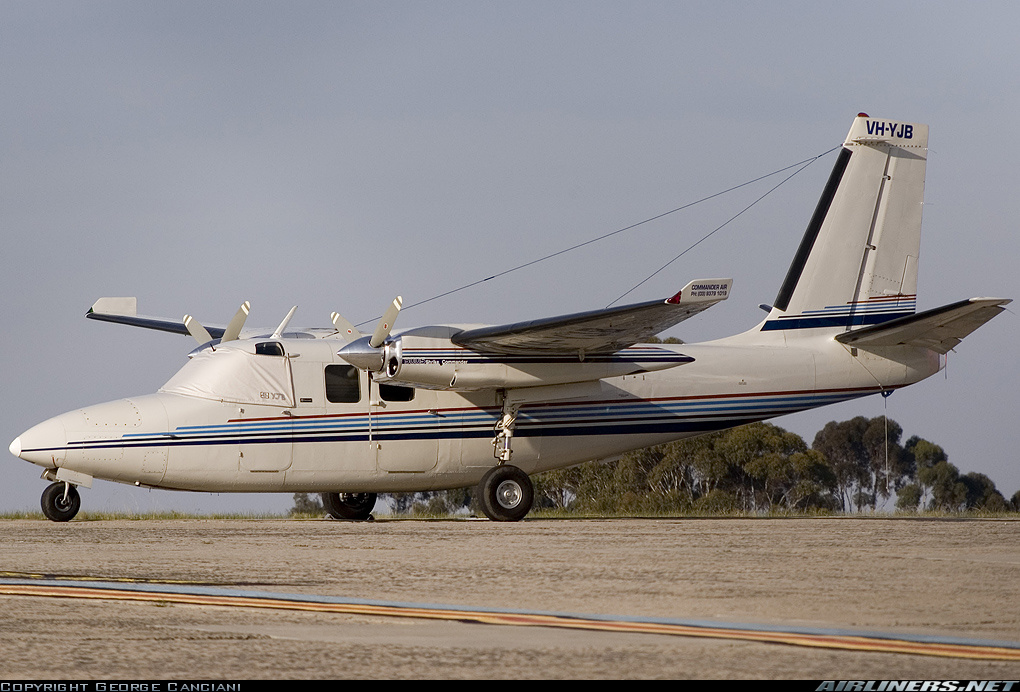
Crash of a Rockwell Shrike Commander 500S in Clonbinane: 2 killed

Date & Time: Jul 31, 2007 at 2000 LT
Operator:
Registration:
VH-YJB
Flight Phase:
Survivors:
No
Site:
Schedule:
Melbourne – Shepparton
MSN:
500-3299
YOM:
1977
Country:
Region:
Crew on board:
1
Crew fatalities:
Pax on board:
1
Pax fatalities:
Other fatalities:
Total fatalities:
2
Captain / Total flying hours:
2342
Captain / Total hours on type:
970.00
Aircraft flight hours:
4558
Circumstances:
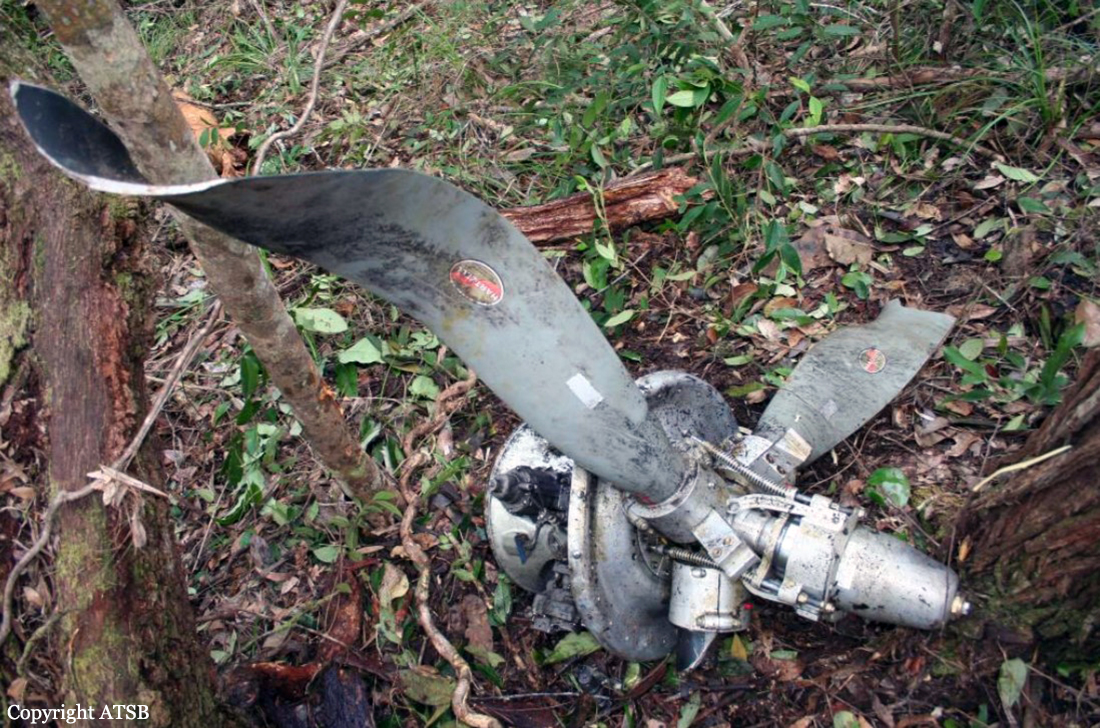
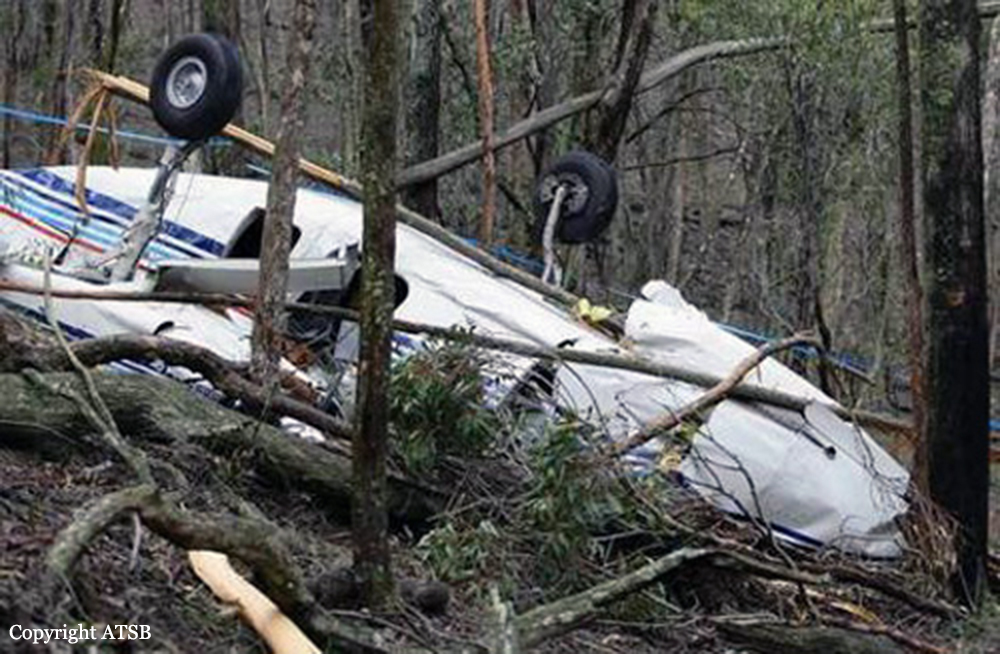
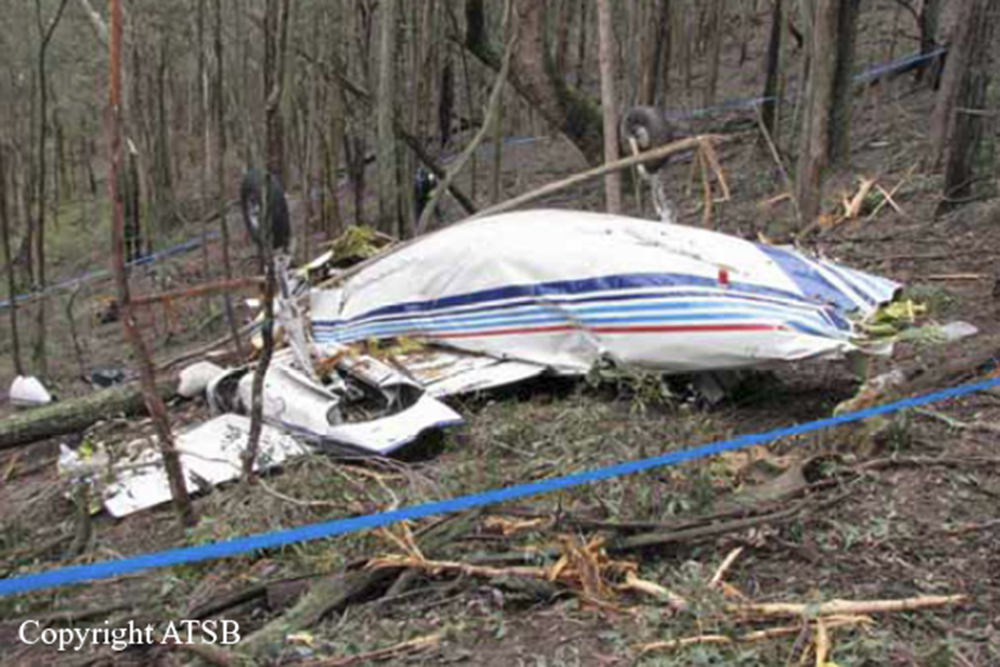
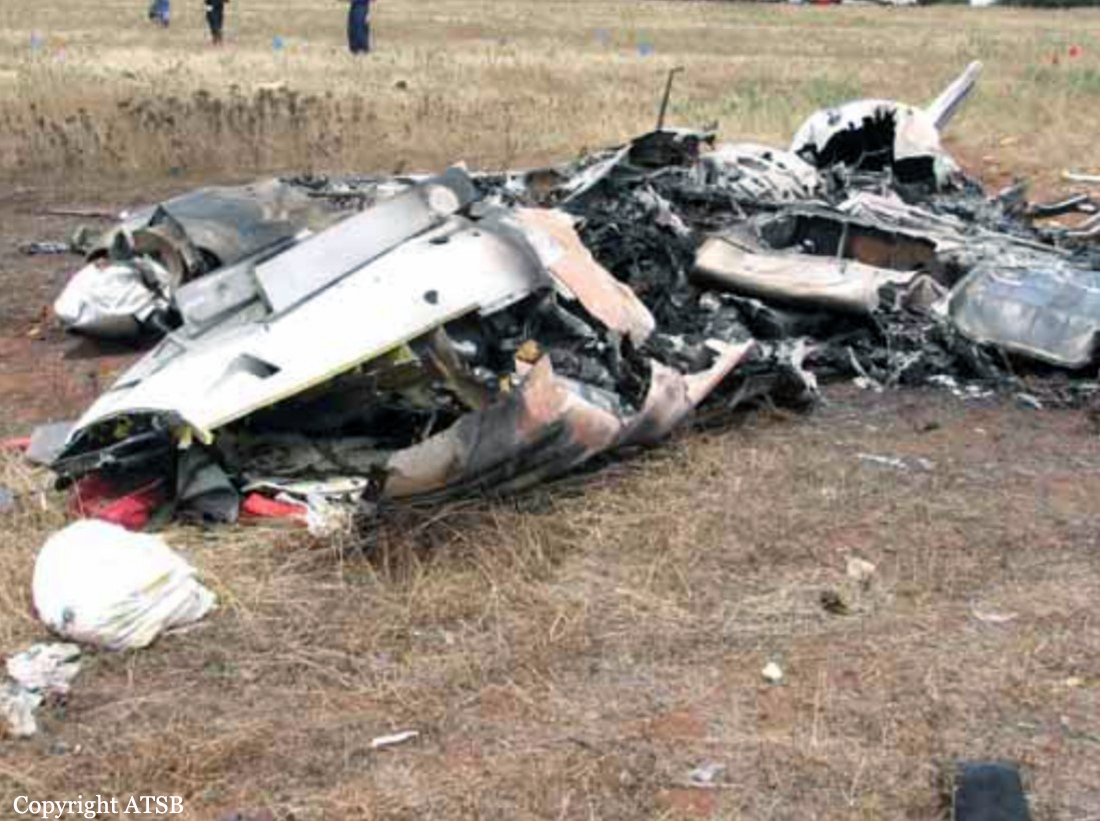
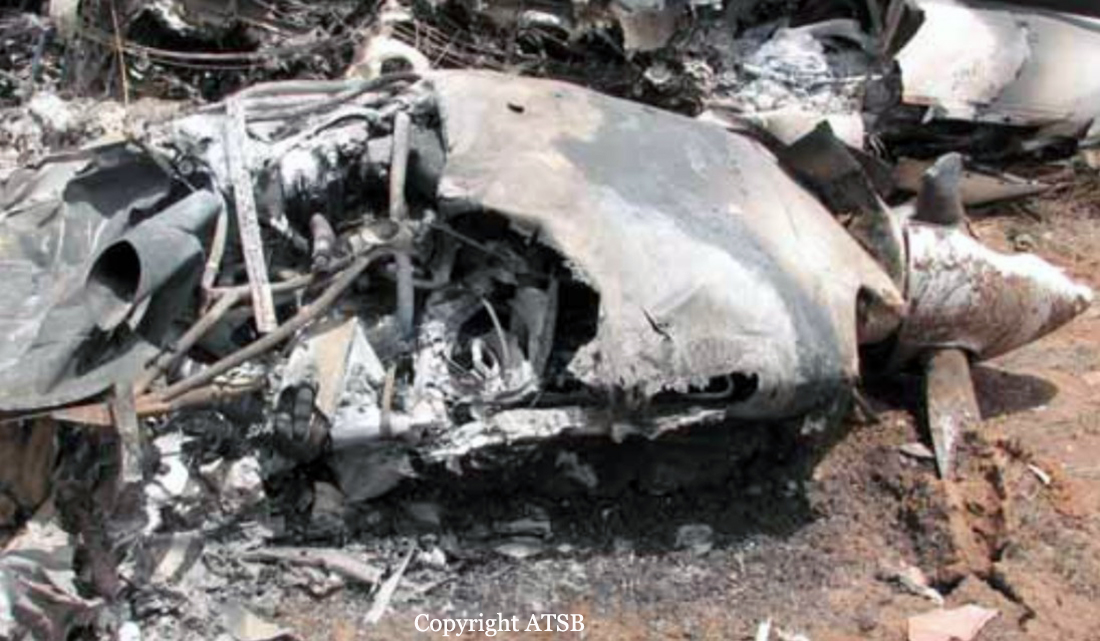
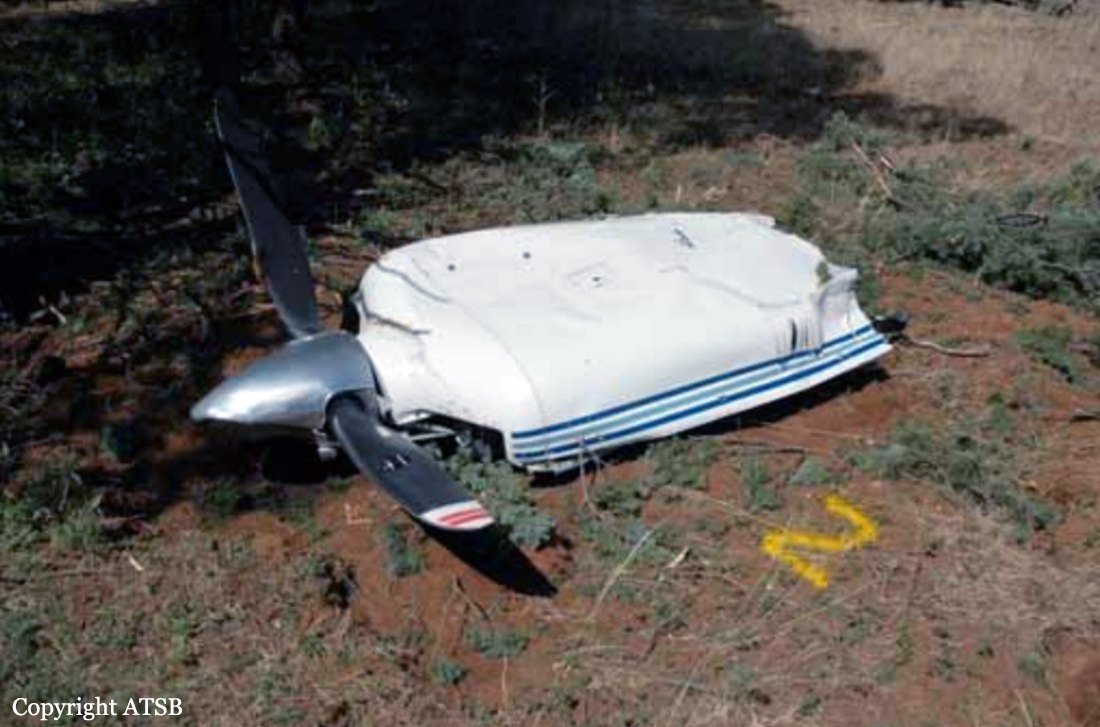
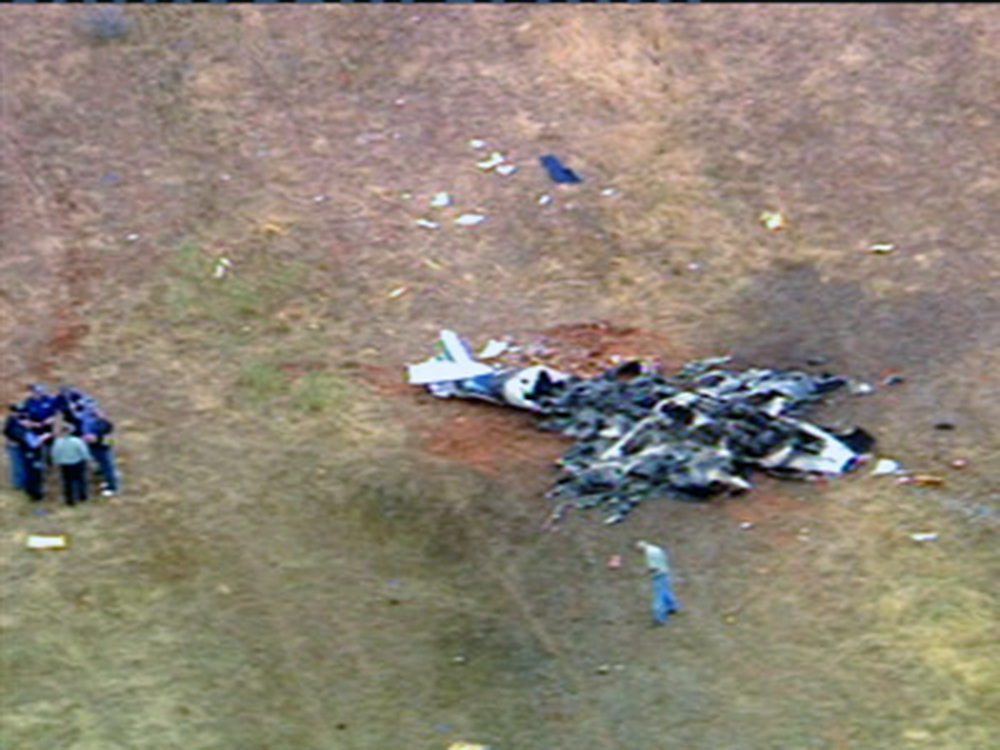
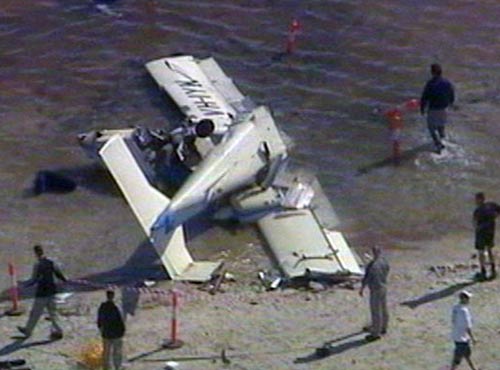
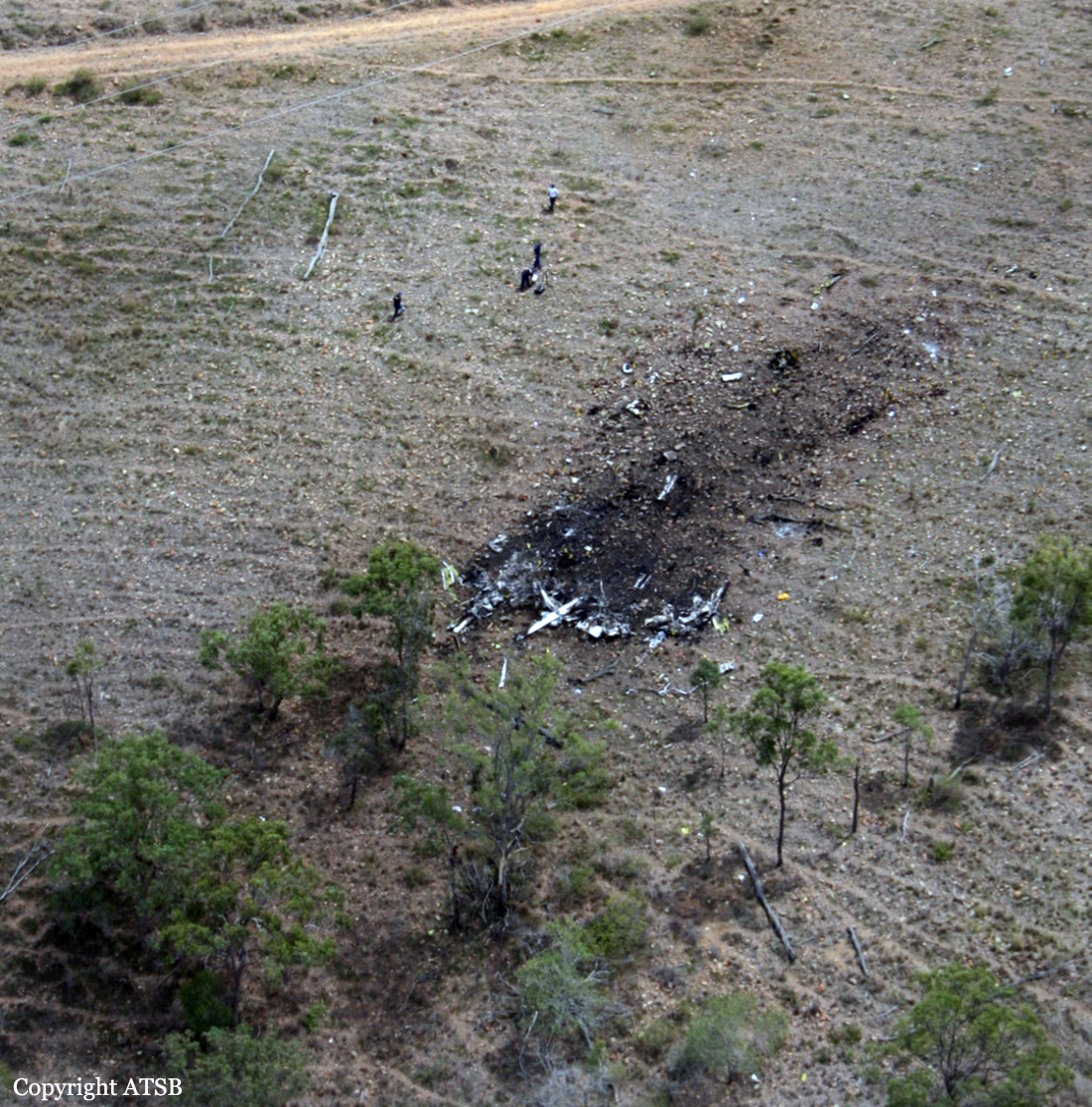
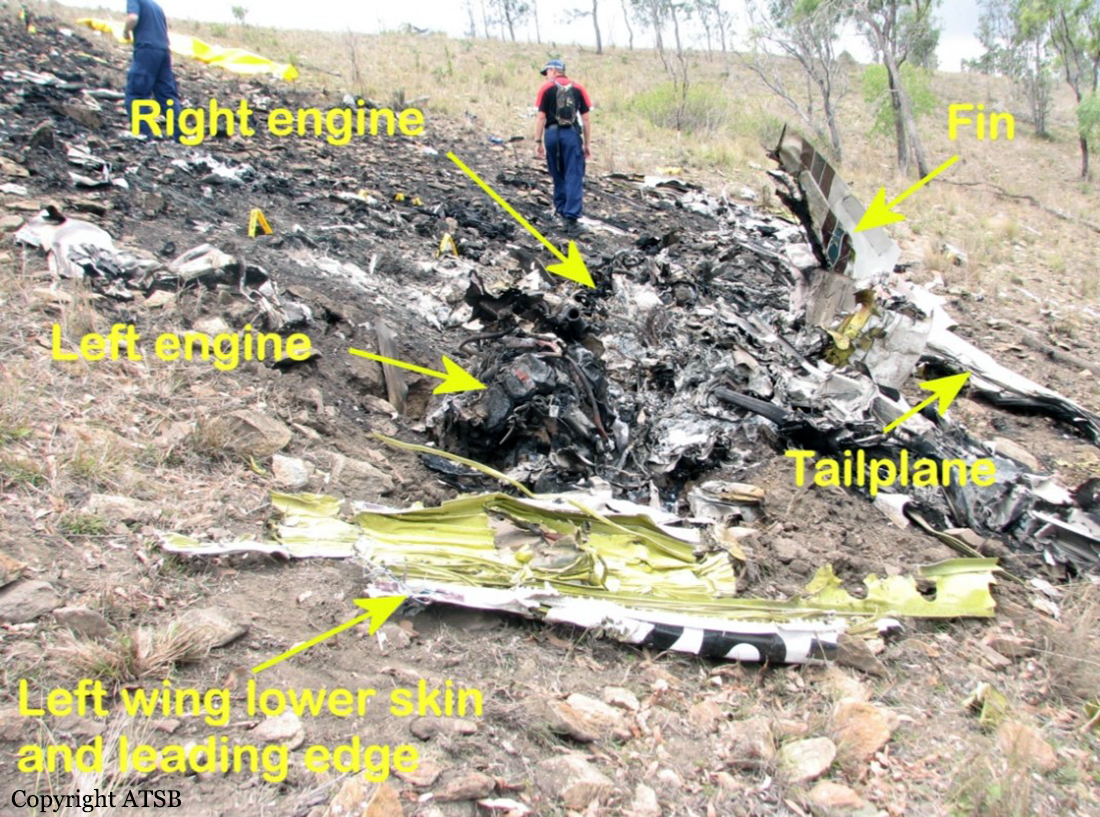
At 1946 Eastern Standard Time on 31 July 2007, a Rockwell International Aero Commander 500S, registered VH-YJB (YJB), departed Essendon Airport, Vic. on a business flight to Shepparton that was conducted at night under the instrument flight rules (IFR). On board were the pilot and one passenger. At 1958, while in the cruise at 7,000 ft above mean sea level (AMSL) in Class C controlled airspace, radar and radio contact with the aircraft was lost simultaneously by air traffic control when it was about 25 NM (46 km) north-north-east of Essendon. The air traffic controller declared a distress phase after a number of unsuccessful attempts to contact the pilot. At 2003, the Operations Director at Melbourne Centre declared the aircraft as probably lost and advised AusSAR. A search was commenced using a helicopter and an aeroplane in addition to ground search parties. No emergency locator transmitter signal was reported. At 2147, aircraft wreckage was located by a searching aircraft in timbered ranges near Clonbinane, approximately 50 km north of Melbourne. At about 2200, a ground search party confirmed that the wreckage was that of YJB and that there were no survivors. The flight was arranged to take the company owner, who was also a licensed aircraft maintenance engineer (LAME), to Shepparton to replace an unserviceable starter motor in another of the operator‟s aircraft. The pilot, who had landed at Essendon at 1915 from a previous flight in another of the operator‟s aircraft, was tasked to fly the owner to Shepparton. The pilot transferred to YJB, which had previously been prepared for flight by another company pilot. At 1938, while taxiing for takeoff, the pilot advised the aerodrome controller of the intention to conduct the IFR flight, adding, „…and request a big favour for a submission of a flight plan, with an urgent departure Essendon [to] Shepparton [and] return‟. The aerodrome controller did not have the facilities for processing flight notifications and sought the assistance of a controller in the Melbourne air traffic control centre. There were no eyewitnesses to the accident. Residents living in the vicinity of the accident site were inside their homes and reported difficulty hearing anything above the noise made by the wind and the foliage being blown about. One of the residents reported hearing a brief, loud engine noise. Another resident thought the noise was that of a noisy vehicle on the road. The noise was described as being constant, „…not spluttering or misfiring‟ and lasted for only a few seconds. Some of those residents near the accident site reported hearing and feeling an impact only moments after the engine noise ceased. The aircraft was seriously damaged by excessive in-flight aerodynamic forces and impact with the terrain. The vegetation in the immediate vicinity of the main aircraft wreckage was slightly damaged as the aircraft descended, nearly vertically, through the trees. The pilot and passenger were fatally injured.
Probable cause:
Structural failure and damage:
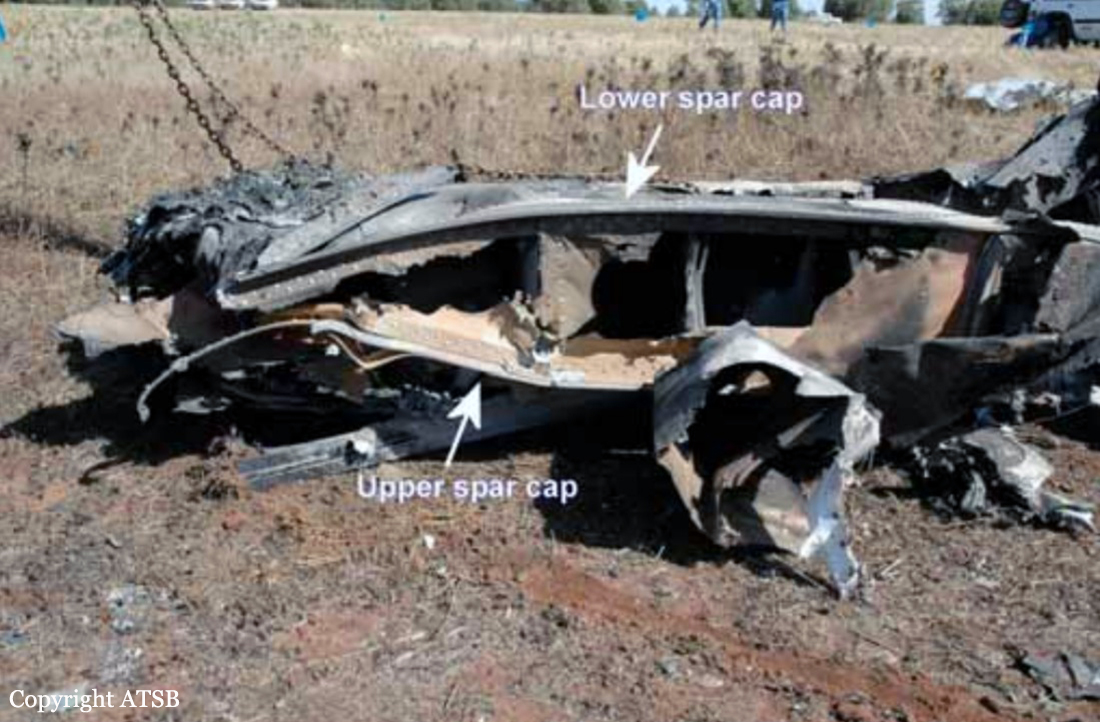
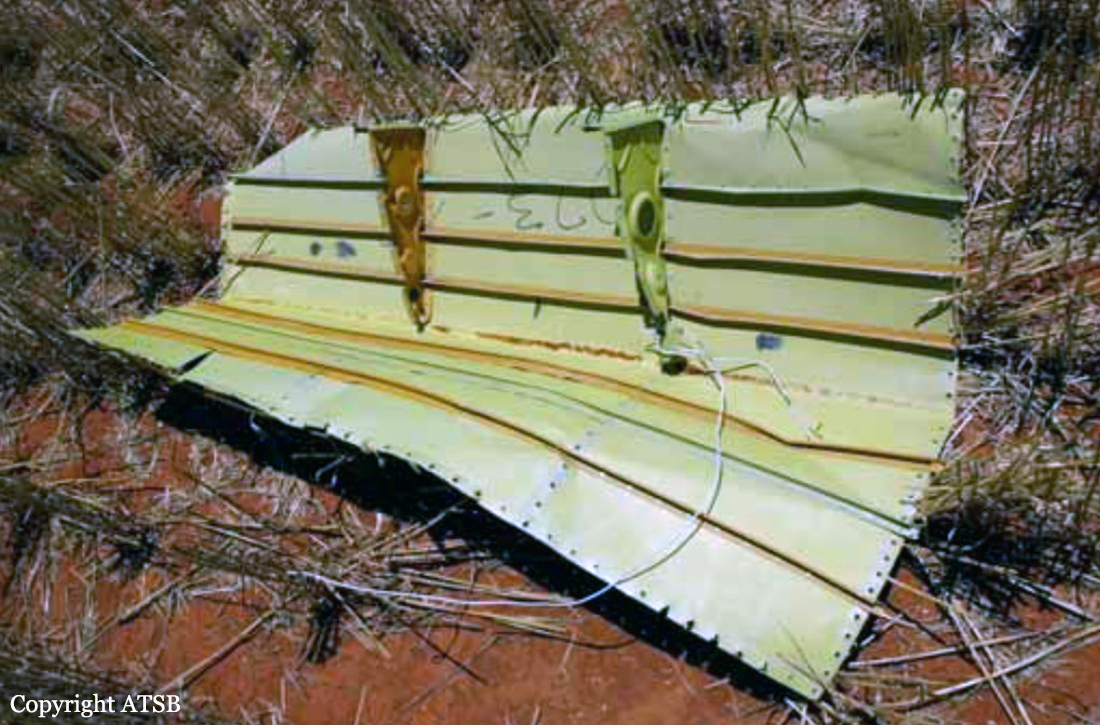
From the detailed examination and study of the aircraft wreckage undertaken by ATSB investigation staff, it was evident that all principal structural failures had occurred under gross overstress conditions i.e. stresses significantly in excess of the physical strength of the respective structures. The examination found no evidence of pre-existing cracking, damage or material degradation that could have appreciably reduced the strength of the failed sections, nor was there any indication that the original manufacture, maintenance or repair processes carried out on the aircraft were in any way contributory to the failures sustained.

Breakup sequence:
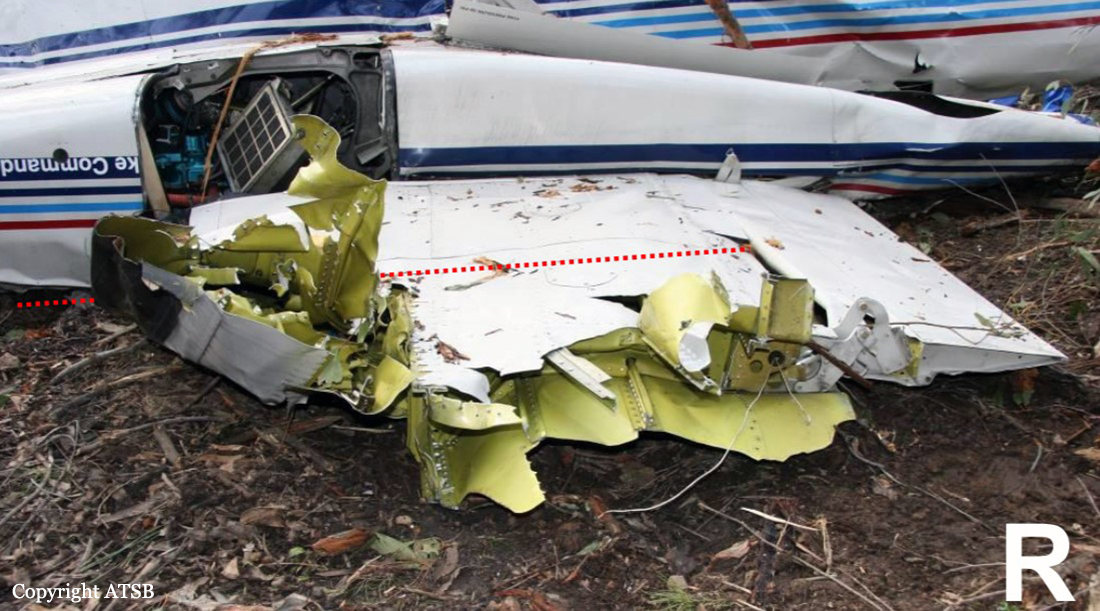
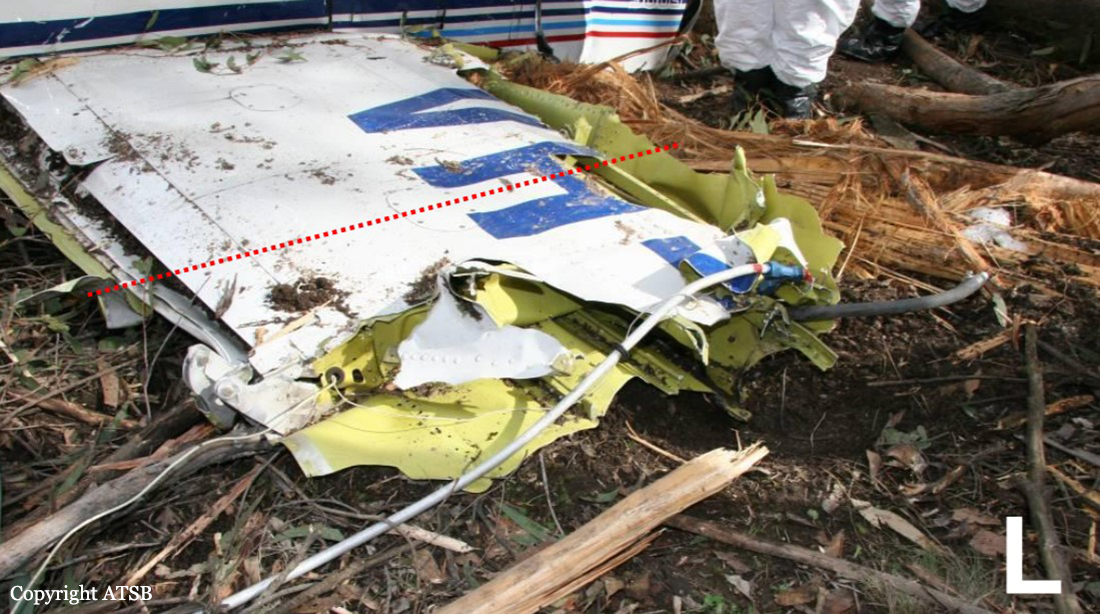
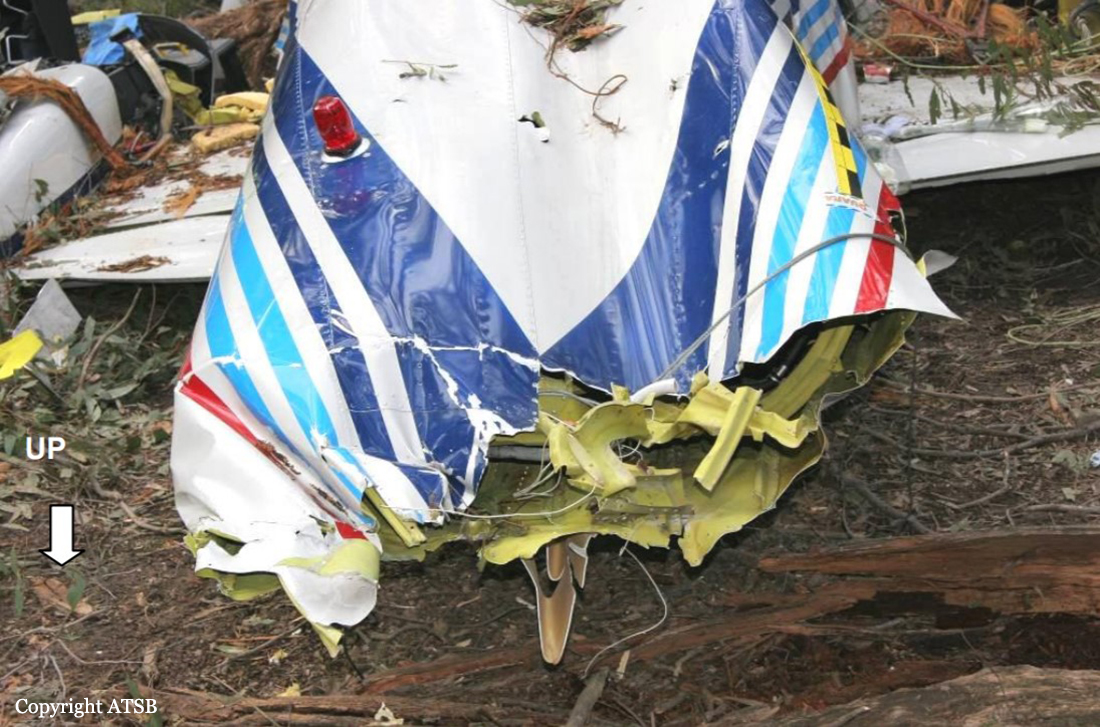
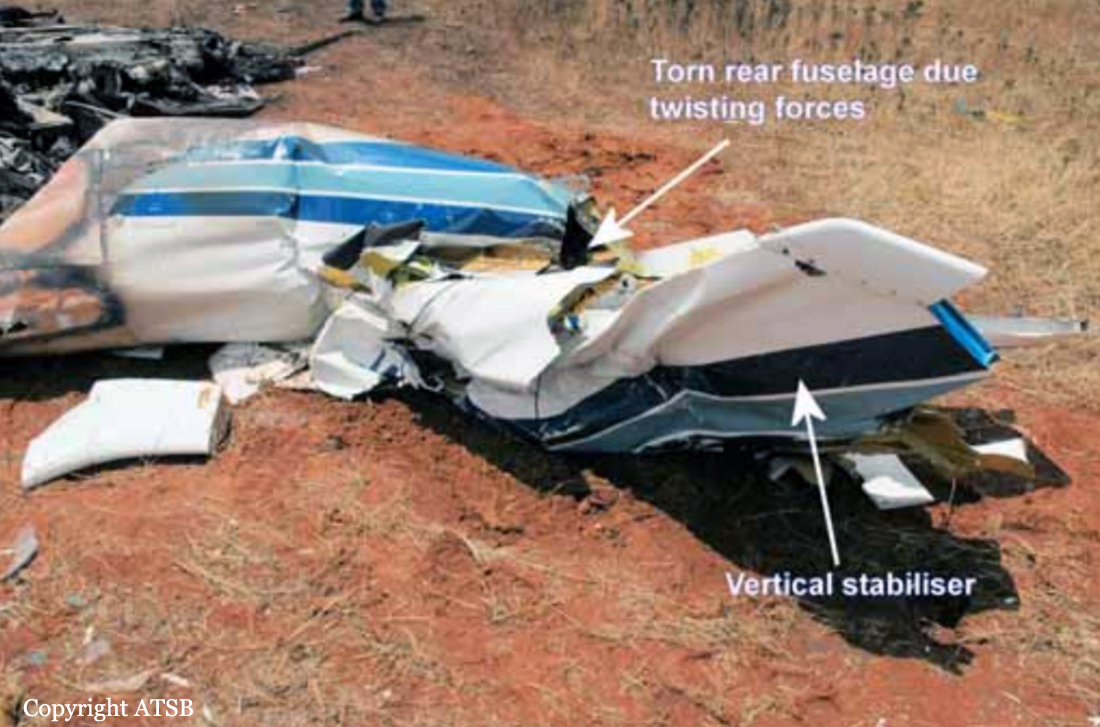
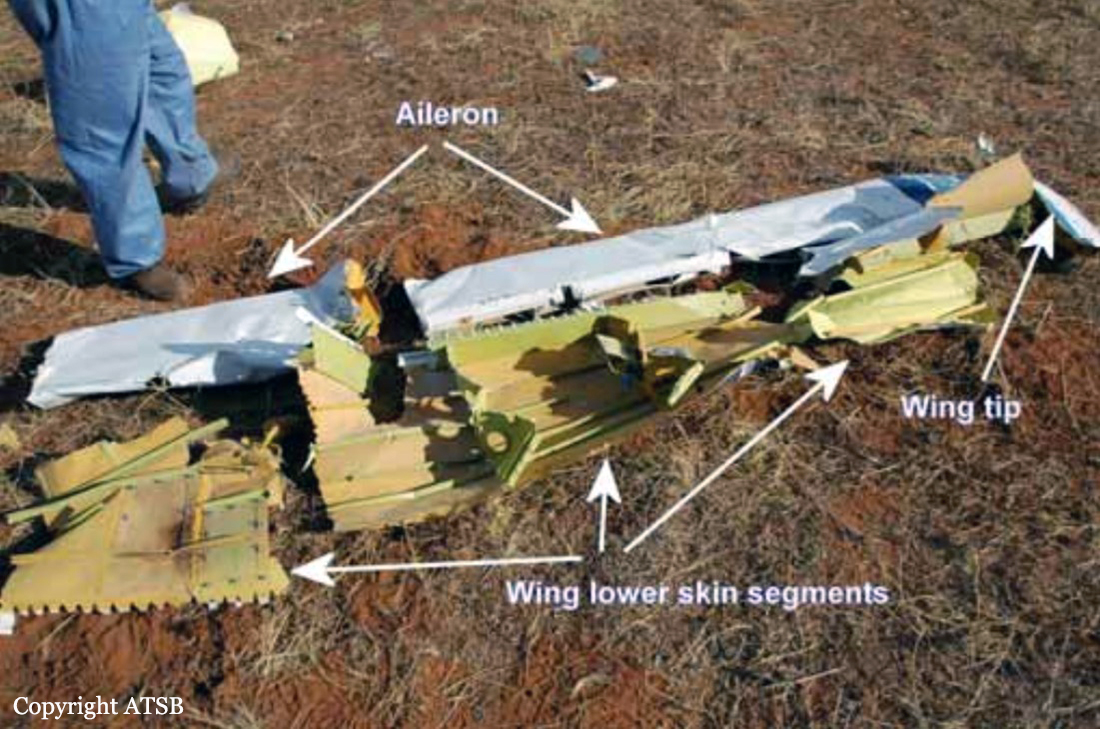
From the localised deformation associated with the spar failures, it was evident that the aircraft had sustained a large negative (downward) loading on the wing structure. That downward load resulted in the localised bending failure of the wing around the station 145 position (145” outboard of the aircraft centreline). The symmetry of both wing failures and the absence of axial twisting within the fuselage section suggested that the load encountered was sudden and well in excess of the ultimate strength of the wing structure. Based upon the witness marks on both wing under-surfaces and the crushing and paint transfer along the leading edges of the horizontal stabilisers, it was concluded that after separating from the inboard structure, both wings had moved aft in an axial twisting and rotating fashion; simultaneously impacting the leading edges of both horizontal tailplanes. Forces imparted into the empennage structure from that impact subsequently produced the rearward separation of the complete empennage from the fuselage. The loss of the left engine nacelle fairing was likely brought about through an impact with a section of wing leading edge as it rotated under and to the rear. The damage sustained by all of the aircraft‟s control surfaces was consistent with failure and separation from their respective primary structure under overstress conditions associated with the breakup of the aircraft. There was no evidence of cyclic or oscillatory movement of the surfaces before separation that might have suggested the contribution of an aerodynamic flutter effects.

Findings
The following statements are a summary of the verified findings made during the progress of the aircraft wreckage structural examination and analysis:
- All principal failures within the aircraft wings, tailplanes and empennage had occurred as a result of exposure to gross overstress conditions.
- The damage sustained by the aircraft wreckage was consistent with the aircraft having sustained multiple in-flight structural failures.
- The damage sustained by the aircraft wreckage was consistent with the structural failure sequence being initiated by the symmetric, downward bending failure of both wing sections, outboard of the engine nacelles.
- Breakup and separation of the empennage was consistent with having been initiated by impact of the separated outboard wings with the leading edges of the horizontal stabilisers.
- There was no evidence of material or manufacturing abnormalities within the aircraft structure that could be implicated in the failures and breakup sustained.
- There was no evidence of service-related degradation mechanisms (such as corrosion, fatigue cracking or environmental cracking) having affected the aircraft structure in the areas of failure.
Final Report:

Crash of a Beechcraft 200 Super King Air in Perth

Date & Time: Apr 9, 2007 at 1703 LT
Operator:
Registration:
VH-SGT
Survivors:
Yes
Schedule:
Perth - Mount Hale
MSN:
BB-73
YOM:
1975
Country:
Region:
Crew on board:
1
Crew fatalities:
Pax on board:
9
Pax fatalities:
Other fatalities:
Total fatalities:
0
Circumstances:
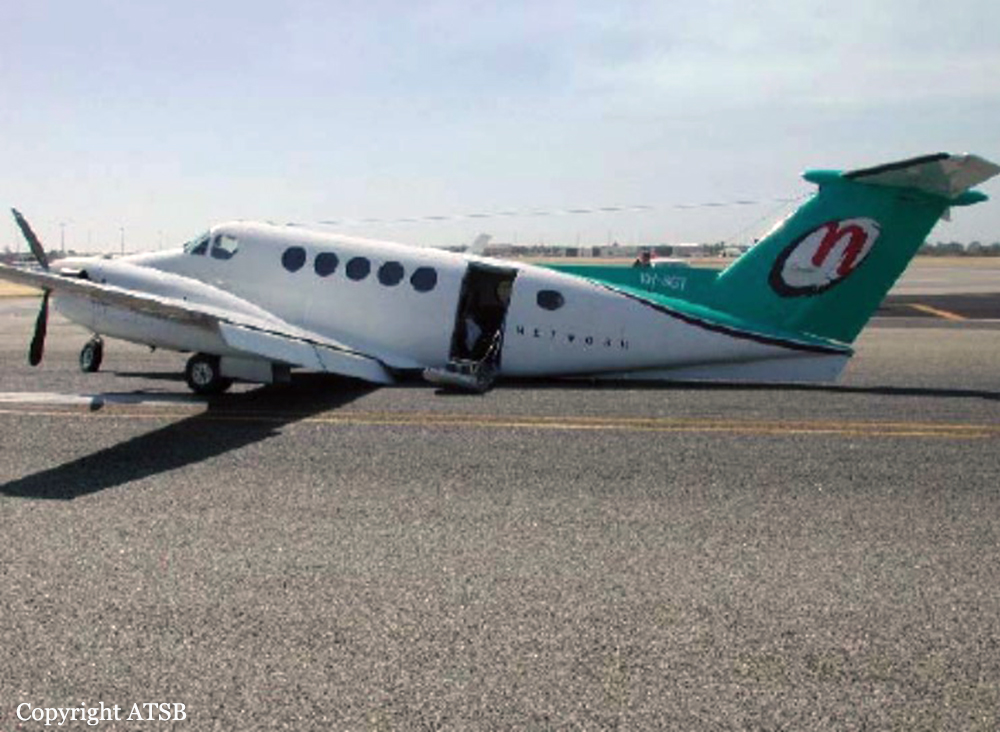
On 9 April 2007, at 1703 Western Standard Time (WST), the main landing gear from a Beech Super King Air 200 aircraft, registered VH-SGT, collapsed on landing at Perth airport. Approximately two hours earlier, the aircraft was chartered to fly from Perth to Mount Hale, WA when shortly after takeoff from Perth the aircraft experienced a malfunction of the landing gear system. The main wheels and nose gear had become jammed and were unable to fully retract when selected up by the pilot. The pilot completed the emergency checklist actions contained in the Aircraft Flight Manual, but was unable to retract or extend the gear using either the automated control or the manual emergency system. The pilot then requested assistance from a passenger to operate the manual emergency extension system. The landing gear remained jammed despite the additional force applied to the lever from the passenger. The pilot contacted air traffic services and requested further assistance from company engineering personnel to visually assess the extension state of the landing gear. Two aerodrome passes were completed throughout the troubleshooting exercise and the pilot remained in radio contact with both groups during this phase. Following the flyovers and after holding over Rottnest Island at 5,000 ft for a period of approximately two hours, the pilot flew the King Air back to Perth airport. With the gear still jammed in the partially retracted position, both the left and right main landing gear assemblies collapsed after the aircraft touched down on Runway 24. The aircraft was substantially damaged as a result of the collapse (Figure 1). The airport Rescue and Fire Fighting (RFF) services and other relevant agencies had been alerted and were waiting in response when the King Air landed. No injuries were sustained by the pilot or any of the nine passengers on board.
Probable cause:
From the evidence available, the investigation revealed that two major system components had failed which could have prevented the Beechcraft Super King Air 200 landing gear from properly retracting after takeoff. The following findings with respect to those failed landing gear system components should not be read as apportioning blame or liability to any particular organisation or individual.
Contributing safety factors:
• The left torque tube support bearing had not been lubricated and had seized due to the accumulation of dirt and grit contaminants that had migrated from the external service environment and into the bearing.
• The geared components within the right main landing gear actuator prematurely failed.
Other safety factors:
• The aircraft manufacturer’s maintenance manual contained insufficient instruction or guidance for operators and maintainers of Super King Air 200 aircraft for the lubrication of the landing gear torque tube support bearings.
Other key findings:
• Both component assemblies were integral to the function and normal operation of the Super King Air 200 mechanical landing gear system. A break down of either component assembly would have prevented any attempt by the pilot to retract or extend the aircraft’s main landing gear. However, while either failure could have produced the landing gear difficulties sustained, the investigation was not able to determine which mechanism was the principal contributor to the event.
• The investigation was unable to conclusively establish why the geared components within the right main landing gear actuator had prematurely failed.
• The lower thrust bearing within the right main landing gear actuator had been correctly installed.
Final Report:

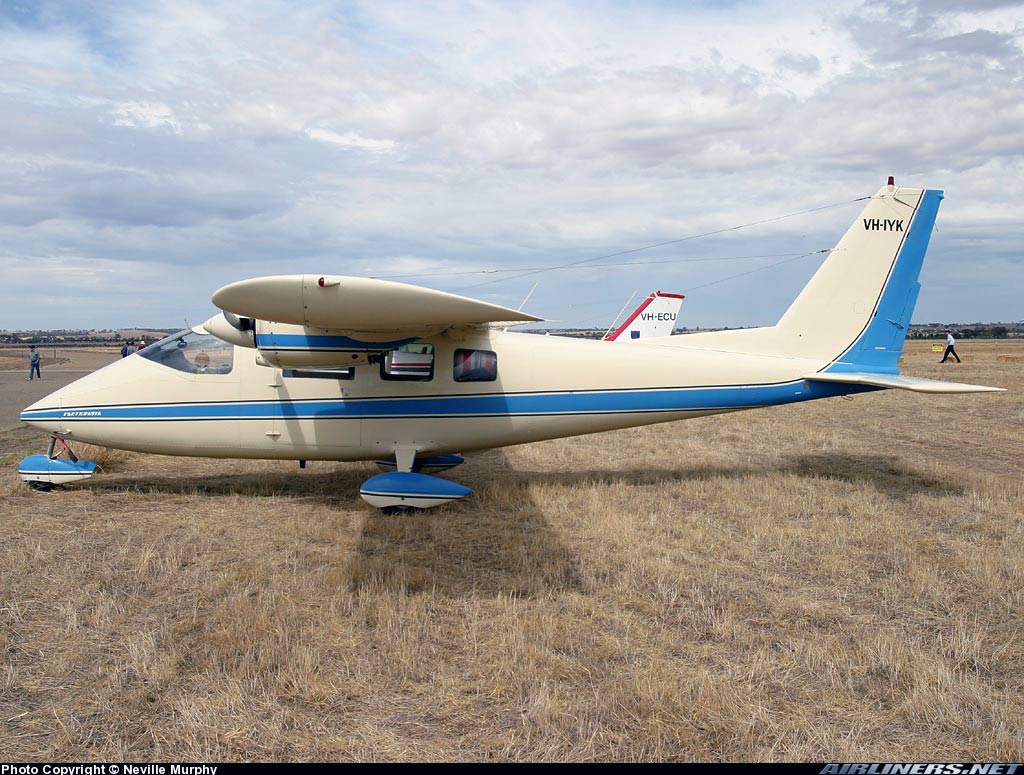
Crash of a Partenavia P.68B Victor off Rottnest Island

Date & Time: Nov 12, 2006 at 1500 LT
Type of aircraft:
Operator:
Registration:
VH-IYK
Flight Phase:
Flight Type:
Survivors:
Yes
Schedule:
Rottnest Island - Perth
MSN:
138
YOM:
1978
Country:
Region:
Crew on board:
1
Crew fatalities:
Pax on board:
5
Pax fatalities:
Other fatalities:
Total fatalities:
0
Circumstances:
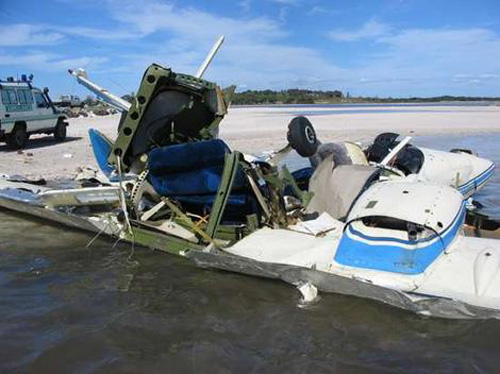
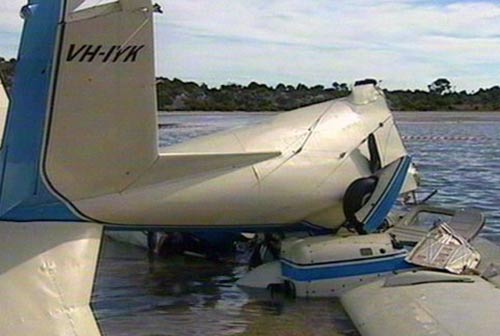
Shortly after takeoff from Rottnest Island Airport, while in initial climb, the twin engine aircraft suffered a bird strike and crashed in a salt lake located near the airport. The aircraft was destroyed upon impact and all six occupants were injured.
Probable cause:
Loss of control during initial climb following a bird strike.

Crash of a Piper PA-31-350 Navajo Chieftain near Raglan: 3 killed

Date & Time: Oct 31, 2006 at 1855 LT
Operator:
Registration:
VH-ZGZ
Flight Phase:
Flight Type:
Survivors:
No
Schedule:
Emerald – Gladstone
MSN:
31-7752006
YOM:
1977
Country:
Region:
Crew on board:
1
Crew fatalities:
Pax on board:
2
Pax fatalities:
Other fatalities:
Total fatalities:
3
Captain / Total flying hours:
3900
Captain / Total hours on type:
70.00
Aircraft flight hours:
3977
Circumstances:
The aircraft was being operated on a private category instrument flight rules (IFR) flight from Emerald to Gladstone, Qld. On board the aircraft were the pilot in command and two passengers. One of the passengers was a qualified pilot, but who was not endorsed on the aircraft type. After departing Emerald at 1807 Eastern Standard Time, the pilot contacted air traffic control and reported climbing to 7,000 ft with an estimated time of arrival at Gladstone of 1915. At 1813:25, air traffic control advised the pilot that ZGZ was radar identified 15 NM east of Emerald. At 1815:12, the pilot requested clearance to climb to 9,000 ft. At 1817:05, air traffic control issued a clearance to the pilot for the aircraft to climb 9,000 ft, and to track direct to Gladstone. At 1820:26, the pilot reported level at 9,000 ft and requested clearance to divert up to 10 NM left and right of track to avoid anticipated weather activity ahead. Air traffic control approved that request. At 1830:56, the pilot requested clearance to divert up to 15 NM left and right of track, and 10 seconds later changed the request to 15 NM left of track. Air traffic control approved that request. At 1835:17, the pilot reported clear of the weather and requested clearance to track direct to Gladstone and to descend to 7,000 ft. Air traffic control approved those requests. At 1848:52, the pilot reported at ‘top of descent’ to Gladstone. Air traffic control cleared the pilot to descend. At 1852:45, the pilot reported changing frequency to the Gladstone common traffic advisory frequency (CTAF). Air traffic control advised the pilot that the aircraft was leaving 5,500 ft and that the radar and control services were terminated. The pilot acknowledged that transmission at 1852:57. Approximately 3 minutes later, at 1855:45, air traffic control noticed that the aircraft’s symbol was no longer evident on the air situation display screen and the controller attempted to contact the pilot of the aircraft by radio. The controller also requested pilots of other aircraft operating in the Gladstone area to attempt to contact the pilot of ZGZ on the Gladstone CTAF frequency. All attempts were unsuccessful. A witness in the Raglan area recalled hearing the sound of aircraft engine(s) overhead. He then heard the engine(s) ‘roar and shut off again’ a few times. A short time later, he saw a flash and a few seconds later heard the sound of an explosion. He realised that the aircraft had crashed and telephoned the Gladstone Police. Subsequently, wreckage of the aircraft was located near Raglan, approximately 39 km west of Gladstone. The three occupants were fatally injured. The aircraft was destroyed by impact forces and post-impact fire.
Probable cause:
From the evidence available, the following findings are made with respect to the loss of control event involving Piper Aircraft Corporation PA-31-350 aircraft registered VH-ZGZ and should not be read as apportioning blame or liability to any particular organisation or individual.
Contributing safety factors:
• The aircraft diverged left from a steady, controlled descent and entered a steep, left spiral descent from which recovery was not achieved.
Other safety factors:
• The dark and very likely cloudy conditions that existed in the area where the aircraft suddenly diverged from its flight path meant that recovery to normal flight could only have been achieved by sole reference to the aircraft’s flight instruments. The difficulty associated with such a task when the aircraft was in a steep descent was likely to have been significant.
Final Report:
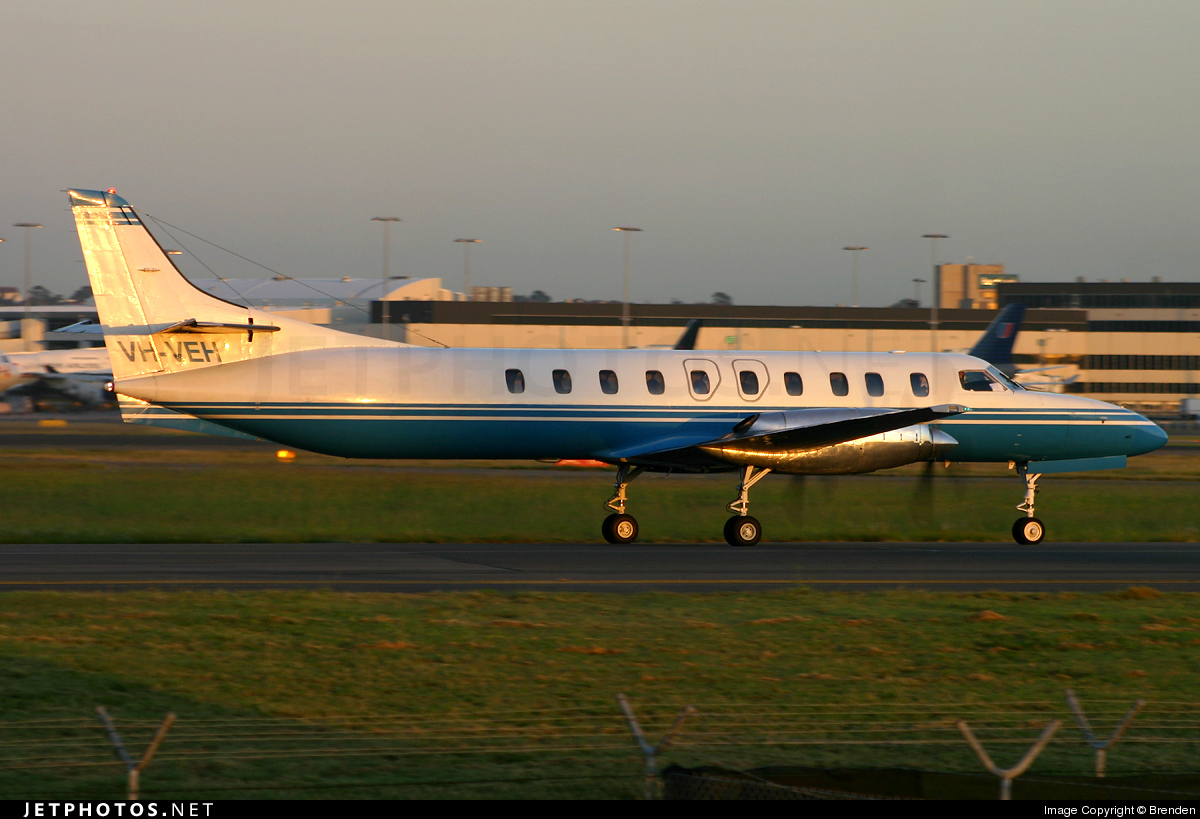
Crash of a Swearingen SA227AC Metro III in Canberra

Date & Time: Jul 1, 2006
Type of aircraft:
Operator:
Registration:
VH-VEH
Survivors:
Yes
MSN:
AC-663B
YOM:
1986
Country:
Region:
Crew on board:
0
Crew fatalities:
Pax on board:
0
Pax fatalities:
Other fatalities:
Total fatalities:
0
Circumstances:
By night, the twin engine aircraft landed hard at Canberra Airport. There were no injuries but the aircraft was damaged beyond repair.
Probable cause:
ATSB did not conduct any investigations on this event.

Crash of a Piper PA-31-350 Navajo Chieftain near Condobolin: 4 killed

Date & Time: Dec 2, 2005 at 1350 LT
Registration:
VH-PYN
Flight Phase:
Flight Type:
Survivors:
No
Schedule:
Brisbane – Swan Hill
MSN:
31-8252075
YOM:
1982
Country:
Region:
Crew on board:
2
Crew fatalities:
Pax on board:
2
Pax fatalities:
Other fatalities:
Total fatalities:
4
Captain / Total flying hours:
4600
Captain / Total hours on type:
1000.00
Aircraft flight hours:
2900
Circumstances:
On 2 December 2005, at 1122 Eastern Daylight-saving Time, a Piper Aircraft Corporation PA-31-350 Chieftain aircraft, registered VH-PYN (PYN), departed Archerfield, Qld, on a private flight to Griffith, NSW. The flight was planned under the instrument flight rules (IFR). On board the aircraft were the pilot, two passengers and an observer-pilot who was on the flight to gain knowledge of the aircraft operation. The aircraft tracked direct to Moree and then Coonamble at 10,000 ft, in accordance with the flight plan. At 1303, the pilot amended the destination to Swan Hill, Vic, tracking via Hillston, NSW. At 1314, the pilot advised air traffic control that the aircraft had passed overhead Coonamble at 1312 maintaining 10,000 ft, and was estimating Hillston at 1418. At 1316, the pilot reported that he was tracking 5 NM (9 km) left of track due to weather. At 1337, the pilot advised that he was diverting up to 20 NM (37 km) left of track due to weather. At 1348, the pilot reported that he was diverting 29 NM (54 km) left of track, again due to weather. No further radio transmission from the pilot was heard. At about 1400, police received a report that an aircraft had crashed on a property approximately 28 km north of Condobolin, NSW. The extensively burned wreckage was subsequently confirmed as PYN. Other wreckage, spread along a trail up to 4 km from the main wreckage, was located the following day. Examination of air traffic control recorded radar data indicated that the aircraft entered radar coverage about 50 km north of Condobolin at 1346:34. The last valid radar data from the secondary surveillance radar located on Mount Bobbara was at 1349:53. During that 3 minute 19 second period, the recorded aircraft track was approximately 56 km left of the Coonamble to Hillston track and showed a change in direction from southerly to south-westerly. The aircraft’s groundspeed was in the range between 200 and 220 kts. The aircraft’s altitude remained steady at 10,000 ft. The last recorded radar position of the aircraft was approaching the limit of predicted radar coverage and was within 10 km of the location of the main aircraft wreckage. Earlier that day, the aircraft had departed Bendigo, Vic, at 0602 and arrived at Archerfield at 1034. The pilot and the observer-pilot were on board. The aircraft was refuelled to full tanks with 314 litres of aviation gasoline at Archerfield. The refuelling agent reported that the main and auxiliary tanks were full at the completion of refuelling. He also reported that the pilots had commented that the forecast for their return flight indicated that weather conditions would be ‘patchy’.
Probable cause:
Contributing factors:
• A line of thunderstorms crossed the aircraft’s intended track.
• The aircraft was operating in the vicinity of thunderstorm cells.
• In circumstances that could not be determined, the aircraft’s load limits were exceeded, causing structural failure of the airframe.
Other safety factors:
• Air traffic control procedures, did not require the SIGMET information to be passed to the aircraft.
• There were shortcomings in the Airservices Australia Hazard Alert procedures and guidelines for assessing SIGMET information.
• Air traffic control procedures for the dissemination of SIGMET information contained in the Aeronautical Information Publication were inconsistent with procedures contained in International Civil Aviation Organization (ICAO) Doc. 4444 and ICAO Doc. 7030.
Other key findings:
• The aircraft was not equipped with weather radar or lightning strike detection systems.
• The pilot did not make any request for additional information regarding the weather to air traffic services.
• The pilot in command was occupying the right cockpit seat and the observer- pilot the left cockpit seat at the time of the breakup, but that arrangement was not considered to have influenced the development of the accident.
Final Report:
Crash of a Piper PA-31-350 Navajo Chieftain in Mount Hotham: 3 killed
Date & Time: Jul 8, 2005 at 1725 LT
Operator:
Registration:
VH-OAO
Survivors:
No
Schedule:
Melbourne - Mount Hotham
MSN:
31-8252021
YOM:
1982
Country:
Region:
Crew on board:
1
Crew fatalities:
Pax on board:
2
Pax fatalities:
Other fatalities:
Total fatalities:
3
Captain / Total flying hours:
4770
Captain / Total hours on type:
1269.00
Aircraft flight hours:
9137
Circumstances:
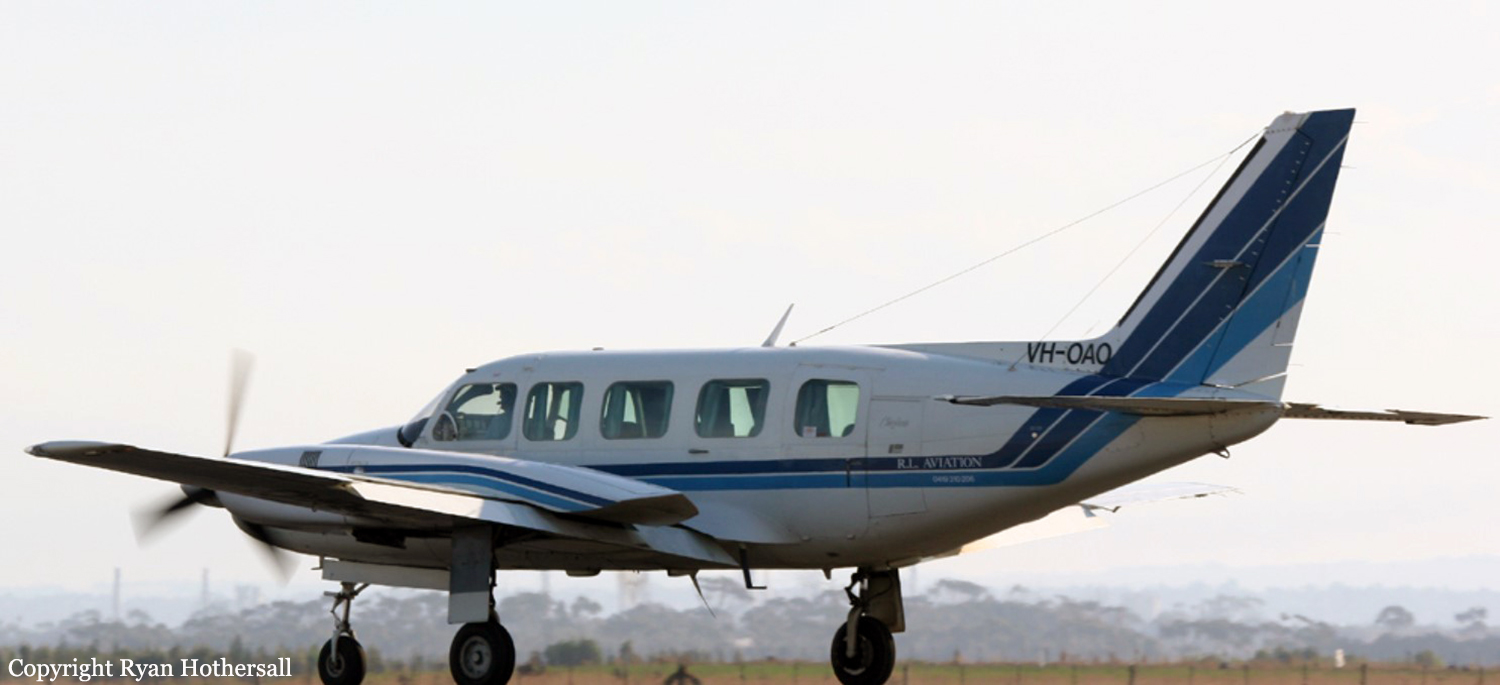
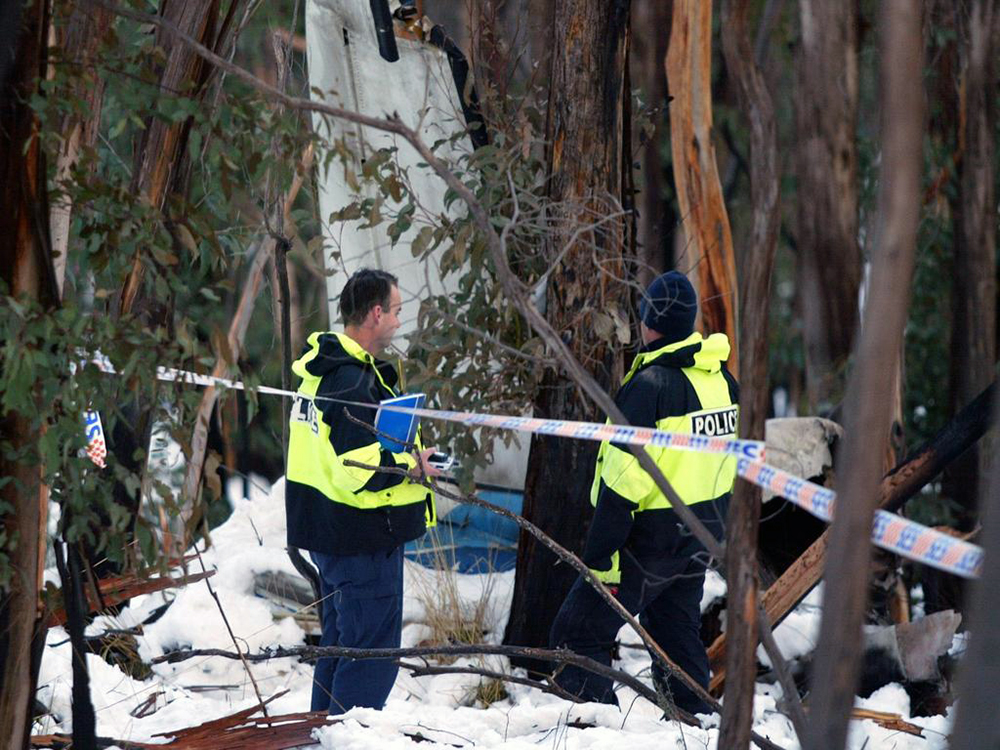
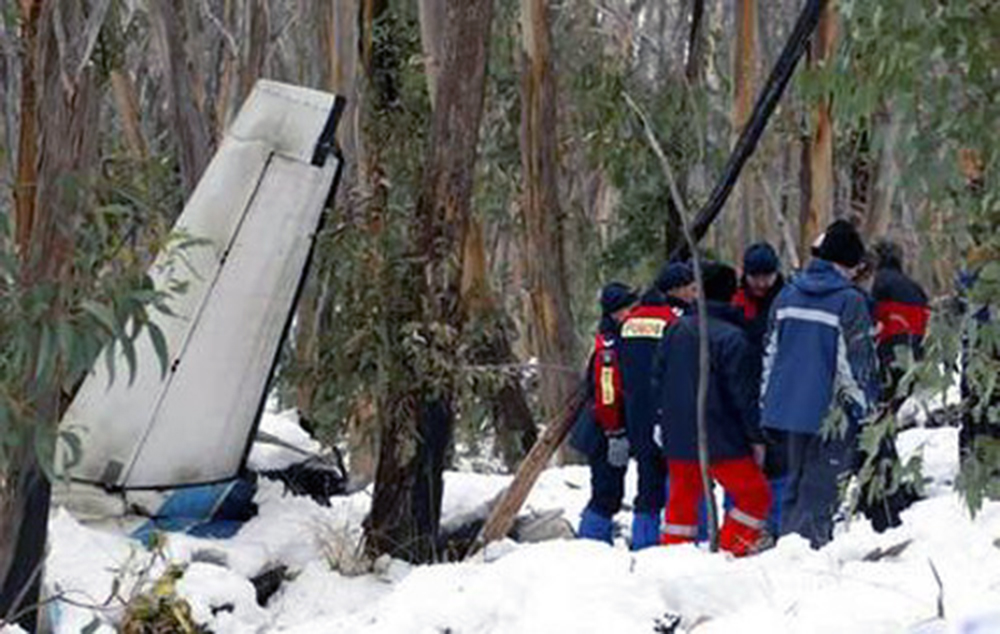
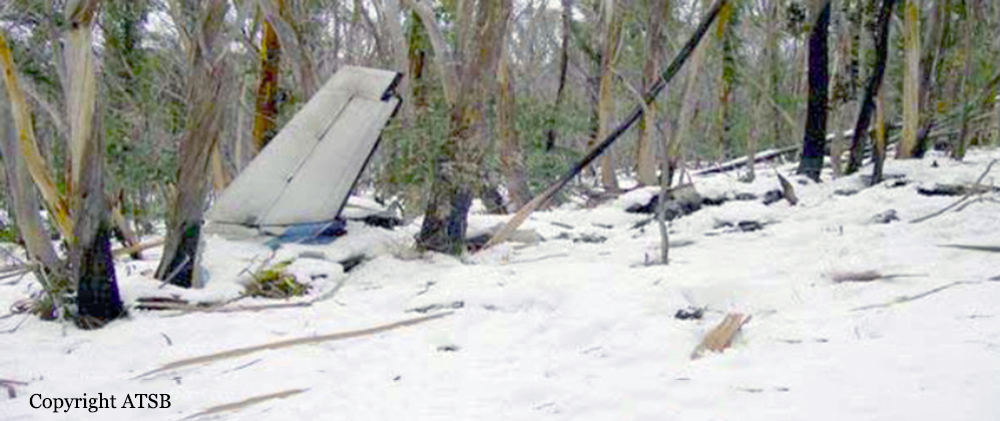
On 8 July 2005, the pilot of a Piper PA-31-350 Navajo Chieftain, registered VH-OAO, submitted a visual flight rules (VFR) flight plan for a charter flight from Essendon Airport to Mount Hotham, Victoria. On board the aircraft were the pilot and two passengers. At the time, the weather conditions in the area of Mount Hotham were extreme. While taxiing at Essendon, the pilot requested and was granted an amended airways clearance to Wangaratta, due to the adverse weather conditions at Mount Hotham. The aircraft departed Essendon at 1629 Eastern Standard Time. At 1647 the pilot changed his destination to Mount Hotham. At 1648, the pilot contacted Flightwatch and requested that the operator telephone the Mount Hotham Airport and advise an anticipated arrival time of approximately 1719. The airport manager, who was also an accredited meteorological observer, told the Flightwatch operator that in the existing weather conditions the aircraft would be unable to land. At 1714, the pilot reported to air traffic control that the aircraft was overhead Mount Hotham and requested a change of flight category from VFR to instrument flight rules (IFR) in order to conduct a Runway 29 Area Navigation, Global Navigation Satellite System (RWY 29 RNAV GNSS) approach via the initial approach fix HOTEA. At 1725 the pilot broadcast on the Mount Hotham Mandatory Broadcast Zone frequency that the aircraft was on final approach for RWY 29 and requested that the runway lights be switched on. No further transmissions were received from the aircraft. The wreckage of the aircraft was located by helicopter at 1030 on 11 July. The aircraft had flown into trees in a level attitude, slightly banked to the right. Initial impact with the ridge was at about 200 ft below the elevation of the Mount Hotham aerodrome. The aircraft had broken into several large sections and an intense fire had consumed most of the cabin. The occupants were fatally injured.
Probable cause:
Findings:
• There were no indications prior to, or during the flight, of problems with any aircraft systems that may have contributed to the circumstances of the occurrence.
• The pilot continued flight into forecast and known icing conditions in an aircraft not approved for flight in icing conditions.
• The global navigation satellite constellation was operating normally.
• The pilot did not comply with the requirements of the published instrument approach procedure.
• The pilot was known, by his Chief Pilot and others, to adopt non-standard approach procedures to establish his aircraft clear of cloud when adverse weather conditions existed at Mount Hotham.
• The pilot may have been experiencing self-imposed and external pressures to attempt a landing at Mount Hotham.
• Terrain features would have been difficult to identify due to a heavy layer of snow, poor visibility, low cloud, continuing heavy snowfall, drizzle, sleet and approaching end of daylight.
• The pilot’s attitude, operational and compliance practices had been of concern to some Airservices’ staff.
• The operator’s operational and compliance history was recorded by CASA as being of concern, and as a result CASA staff continued to monitor the operator. However, formal surveillance of the operator in the preceding two years had not identified any significant operational issues.
Significant factors:
• The weather conditions at the time of the occurrence were extreme.
• The extreme weather conditions were conducive to visual illusions associated with a flat light phenomenon.
• The pilot did not comply with the requirements of flight under either the instrument flight rules (IFR) or the visual flight rules (VFR).
• The pilot did not comply with the requirements of the published instrument approach procedure and flew the aircraft at an altitude that did not ensure terrain clearance.
• The aircraft accident was consistent with controlled flight into terrain.
Final Report: