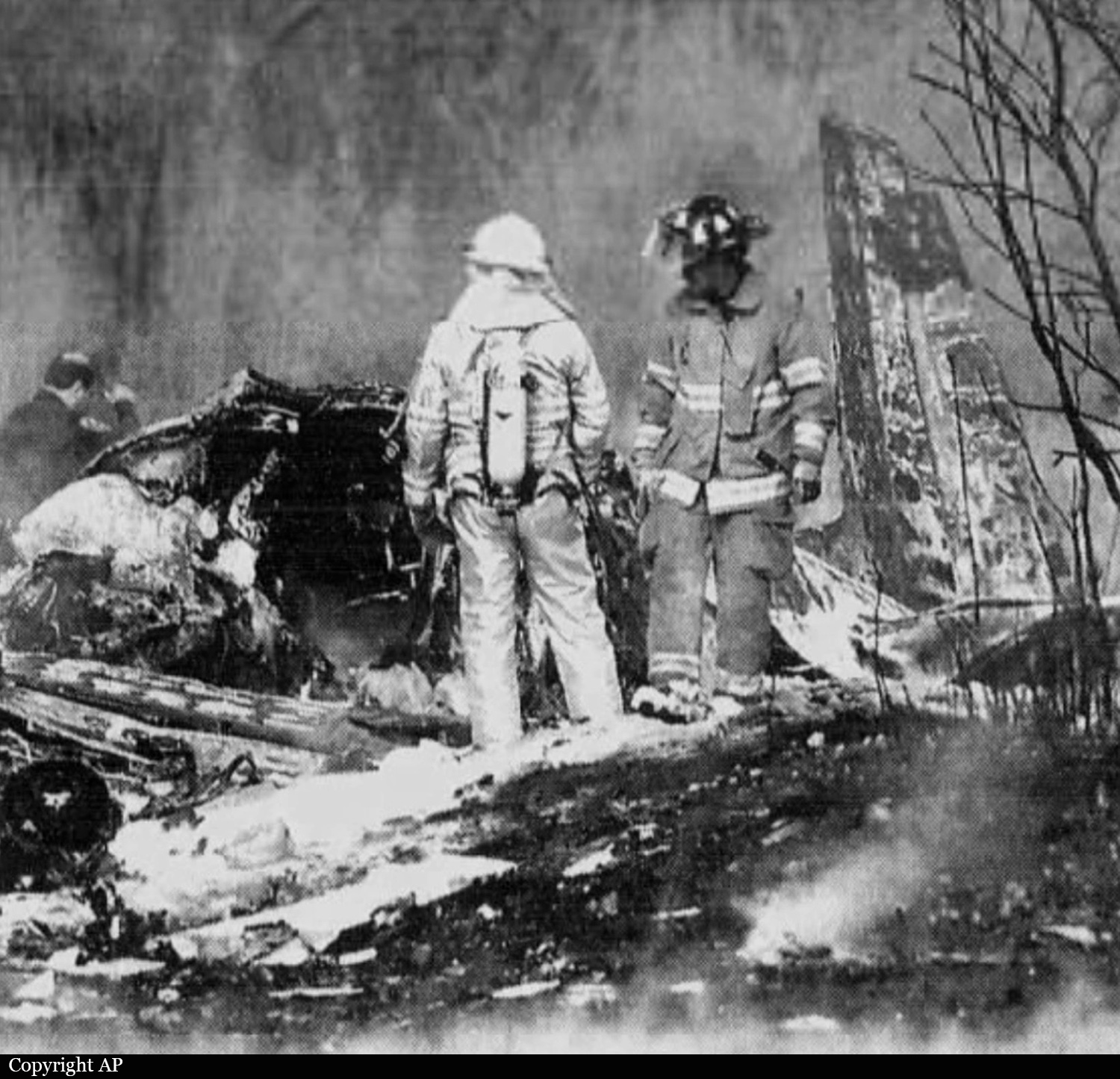
Crash of a Mitsubishi MU-2B-20 Marquise in Cerrillos: 2 killed

Date & Time: Jun 10, 2001 at 1221 LT
Type of aircraft:
Operator:
Registration:
N187AF
Flight Phase:
Flight Type:
Survivors:
No
Schedule:
Peoria – Santa Fe
MSN:
187
YOM:
1970
Crew on board:
1
Crew fatalities:
Pax on board:
1
Pax fatalities:
Other fatalities:
Total fatalities:
2
Captain / Total flying hours:
800
Captain / Total hours on type:
4.00
Aircraft flight hours:
6500
Circumstances:
The pilot was maneuvering the airplane south of the airport preparing to make a VFR approach. Witnesses observed the airplane in a right spin. NTAP data showed the airplane to be well above stall speed before disappearing from radar. Examination of the radar data revealed that in 6 seconds, ground speed dropped 31 knots, from 200 knots to 169 knots, and altitude dropped 440 feet, from 11,760 feet to 11,320 feet (4,400 feet per minute). In the next 6 seconds, ground speed dropped another 31 knots, from 169 knots to 138 knots, and altitude dropped 1,020 feet, from 11,320 feet to 10,300 feet (10,200 feet per minute). According to the manufacturer, if the throttles were to be brought back into Beta (flat pitch) range, it is possible that one propeller could go into Beta an instant before the other propeller. If this were to happen, the airplane would instantly snap roll and enter a spiral. The pilot had received an estimated 4 hours of dual instruction in the airplane.
Probable cause:
The pilot's loss of aircraft control inflight for reasons undetermined. Contributing factors were the pilot's inadequate transition/upgrade training and his total lack of experience in aircraft make/model.
Final Report:


Crash of a Mitsubishi MU-2B-40 Solitaire in The Woodlands: 2 killed

Date & Time: May 1, 2001 at 1241 LT
Type of aircraft:
Registration:
N16CG
Flight Phase:
Flight Type:
Survivors:
No
Schedule:
Conroe – Alamogordo
MSN:
418
YOM:
1980
Crew on board:
1
Crew fatalities:
Pax on board:
1
Pax fatalities:
Other fatalities:
Total fatalities:
2
Captain / Total flying hours:
2839
Captain / Total hours on type:
1108.00
Aircraft flight hours:
2439
Circumstances:
Visual meteorological conditions prevailed for the planned cross-country flight for which the pilot obtained a weather briefing, filed an IFR flight plan, and received an ATC clearance. Approximately 8 minutes after takeoff, radar indicated the airplane was at 11,200 feet msl, heading 241 degrees, with a ground speed of 180 knots. No distress calls or additional communications with the pilot were recorded, and radar contact was lost. The airplane impacted the ground in an uncontrolled descent. The right wing tip tank separated from the airplane and was found 0.18 nautical miles from the main wreckage. The teardown and examination of both engines disclosed that the type and degree of damage was indicative of engine power section rotation and operation at the time of impact. There were no complete systems intact at the accident site due to the impact sequence and post-impact fire which consumed the aircraft. The landing gear and flaps were found in the retracted position. The portion of the right propeller shaft coupling found at the site was fractured through 360 degrees. Metallurgical examination revealed that the propeller shaft coupling failed in fatigue. The presence of the fatigue cracks indicated the coupler fractured in fatigue in service, and the fatigue cracks were not the result of ground impact. The circumferential fracture intersected the ends of several internal spline teeth. The origin of the fatigue crack could not be determined because of severe corrosion damage on the fracture surface. Fatigue propagation was in the aft direction and from the inside to the outside of the coupling. The engine core rotating components would have bee free to rotate when uncoupled from the propeller shaft. The maintenance records indicated that the failed coupling had accumulated approximately 4,000 hours since new, and 1,250 hours since engine overhaul in 1989. Since 1990, as a result of fatigue fractures, the manufacturer introduced several design changes for the propeller shaft coupling via optional Service Bulletins to be accomplished at the next access or hot section inspection (HSI). Impact and thermal damage of the right propeller precluded a determination of the in-flight blade angles. The calculations by the airplane manufacturer indicated that "the [intact] airplane was capable of continued flight" with the right propeller feathered, and that the "airplane can keep attitude, but cannot climb and cannot maintain altitude" with the right propeller in the flat pitch or wind milling positions, respectively. Metallurgical examination of the component brackets and associated bolts from the right tip tank revealed the separation of the tip tank resulted from a single-event overstress fracture of both the forward and aft tank attachment fittings. Calculations showed that a 3.763 radians per second (35.9 RPM) spin rate would cause the failure of the forward wing fuel tank attachment fitting. There had not been a previous in-flight separation of a wing tip fuel tank on this model airplane.
Probable cause:
The pilot's failure to maintain airplane control following a loss of right engine power, which resulted in impact with terrain in an uncontrolled descent. A contributing factor was the loss of right engine power as a result of the fatigue failure of the propeller shaft coupling.
Final Report:

Crash of a Mitsubishi MU-2B-36 Marquise in Caucasia: 1 killed

Date & Time: Apr 15, 2001
Type of aircraft:
Operator:
Registration:
HK-2245P
Flight Type:
Survivors:
No
Schedule:
Bogotá – Caucasia
MSN:
684
YOM:
1976
Country:
Crew on board:
1
Crew fatalities:
Pax on board:
0
Pax fatalities:
Other fatalities:
Total fatalities:
1
Circumstances:
While on final approach to Caucasia Airport, the twin engine aircraft crashed in unknown circumstances 3 km short of runway. The aircraft was destroyed and the pilot, sole on board, was killed.

Crash of a Mitsubishi MU-2B-25 Marquise in Macapá

Date & Time: Feb 10, 2001 at 1230 LT
Type of aircraft:
Operator:
Registration:
PT-LEW
Survivors:
Yes
Schedule:
Belém – Macapá
MSN:
244
YOM:
1972
Location:
Country:
Crew on board:
3
Crew fatalities:
Pax on board:
2
Pax fatalities:
Other fatalities:
Total fatalities:
0
Captain / Total flying hours:
3680
Captain / Total hours on type:
55.00
Copilot / Total flying hours:
4512
Copilot / Total hours on type:
644
Circumstances:
On final approach to Macapá Airport, the left engine exploded and caught fire. The aircraft lost height, descended below the glide and eventually crash landed in a grassy area to the right of the runway and came to rest, bursting into flames. All five occupants escaped uninjured while the aircraft was damaged beyond repair.
Probable cause:
Failure of the second stage of the high pressure compressor disk in the left engine. Investigations were unable to determine the exact cause of the this failure, maybe following fatigue cracks or a construction defect. It was reported that the left engine accumulated 3,000 flying hours since the last compressor overhaul.
Final Report:

Crash of a Mitsubishi MU-2B-26A Marquise in Martha’s Vineyard: 4 killed

Date & Time: Oct 6, 2000 at 2158 LT
Type of aircraft:
Registration:
N60BT
Flight Type:
Survivors:
No
Schedule:
Trenton – Martha’s Vineyard
MSN:
358
YOM:
1977
Crew on board:
1
Crew fatalities:
Pax on board:
3
Pax fatalities:
Other fatalities:
Total fatalities:
4
Captain / Total flying hours:
1946
Captain / Total hours on type:
253.00
Aircraft flight hours:
5400
Circumstances:
The pilot departed on a night cross-country flight without obtaining a weather briefing or flight plan. Arriving in the area of the destination airport, the weather was reported as, 2 statute miles of visibility and mist; overcast cloud layer at 100 feet. The pilot requested an instrument flight rules clearance from the approach controller, and was vectored and cleared for the ILS 24 approach. The clearance included an altitude restriction of 1,500 feet msl, until the airplane was established on the localizer. As the pilot contacted the control tower, the tower controller issued a low altitude alert to the pilot. The pilot replied that he was climbing and the tower controller cleared the pilot to land, which the pilot acknowledged. No further pertinent radio transmissions were received from the airplane. The airplane came to rest in a wooded area about 3/4-mile from the runway threshold, and about 50 feet right of the extended centerline. Review of the approach plate for the ILS 24 approach revealed that the minimum glide slope intercept altitude at the beginning of the final approach segment on the precision approach was 1,500 feet. The glide slope altitude at the final approach fix for the non-precision approach, which was located about 4 miles from the approach end of the runway, was 1,407 feet. The glide slope altitude at the middle marker, which was located about 0.6 miles from the approach end of the runway, was 299 feet. Review of radar data revealed that the airplane was observed at 700 feet, about 4 miles from the airport, and at 300 feet, about 1.5 miles from the airport. The pilot had accumulated about 1,946 hours of total flight experience, with about 252 hours in make and model. The pilot had attended initial and recurrent training for the make and model airplane; however, did not complete the training. The pilot, aged 61, was Charles B. Yates, member of the New Jersey Senate, who was flying to Martha's Vineyard with his wife and two of his three children.
Probable cause:
The pilot's failure to follow instrument flight procedures resulting in a collision with a tree. A factor related to the accident was the low cloud ceiling.
Final Report:

Crash of a Mitsubishi MU-2B-35 Marquise in Den Helder

Date & Time: Jul 20, 2000
Type of aircraft:
Operator:
Registration:
N8484T
Flight Type:
Survivors:
Yes
Schedule:
Den Helder - Den Helder
MSN:
617
YOM:
1973
Country:
Region:
Crew on board:
2
Crew fatalities:
Pax on board:
0
Pax fatalities:
Other fatalities:
Total fatalities:
0
Captain / Total flying hours:
5050
Circumstances:
The aircraft departed Den Helder-De Kooy Airport on a radar tracking flight over the North Sea. Following an uneventful mission, the crew was returning to De Kooy Airport. After touchdown on runway 03, the crew activated the thrust reverser systems when the aircraft lost controllability. The pilot attempted to maintain control and selected the left throttle from 'reverse' again to turn to the right. Eventually, he feathered the right propeller and cut off the fuel supply, causing the right engine to stop. The aircraft veered off runway to the left and came to rest in a ditch. Both pilots escaped uninjured and the aircraft was damaged beyond repair.
Probable cause:
The landing speed, the touchdown point, the runway length and runway condition were considered as good. The problem was the consequence of an expired adjustment screw of the speed controller ('prop governor') on the right engine, so that it did not come into 'reverse pitch' but continued to provide forward thrust, causing an asymmetric aerodynamic braking effect. It was also determined that the Beta light indicator burned and could not light on, preventing the pilot from a possible issue on the reverse thrust system.
Final Report:

Crash of a Mitsubishi MU-2B-60 Marquise in Lewiston: 1 killed

Date & Time: Feb 11, 2000 at 0815 LT
Type of aircraft:
Registration:
N152BK
Flight Type:
Survivors:
No
Schedule:
Boise – Lewiston
MSN:
1537
YOM:
1982
Flight number:
BKJ152
Location:
Crew on board:
1
Crew fatalities:
Pax on board:
0
Pax fatalities:
Other fatalities:
Total fatalities:
1
Captain / Total flying hours:
21000
Captain / Total hours on type:
1500.00
Aircraft flight hours:
5460
Circumstances:
The airplane impacted a ridgeline about 1.5 miles from the runway and approximately 7 to 14 seconds after the pilot reported a dual engine flameout. The airplane's altitude was about 400 feet agl when the pilot reported the flameout. The inspection of the airplane revealed no preexisting anomalies. Icing conditions were forecast and PIREPS indicated that light to moderate rime/mixed icing conditions existed along the route of flight. The Continuous Ignition switches were found in the OFF position. The Approach procedures listed in the Airplane's Flight Manual stated, 'CONTINUOUS IGNITION SHALL BE SELECTED TO ON DURING APPROACH AND LANDING WHILE IN OR SHORTLY FOLLOWING FLIGHT IN ACTUAL OR POTENTIAL ICING CONDITIONS.' The aircraft manufacturer had issued a Service Bulletin in 1995 for the installation of an auto-ignition system to '... reduce the possibility of engine flame-out when icing conditions are encountered and the continuous ignition is not selected.' The operator had not installed the non-mandatory service bulletin. On May 5, 2000, the FAA issued an Airworthiness Directive that required the installation of an auto-ignition system. The toxicology test detected extremely high levels of dihydrocodeine in the pilot's blood. The pilot received a special issuance second-class medical certificate on August 22, 1995, after receiving treatment for a self disclosed history of drug abuse. The drug testing that this pilot underwent as a consequence of his previous self disclosed history of drug abuse would not have detected these substances.
Probable cause:
The pilot failed to follow the flight manual procedures and did not engage the Continuous Ignition system resulting in both engines flaming out when the air induction system was blocked with ice. Additional factors to the accident included the hilly terrain, the icing conditions, and the operator not complying with a Service Bulletin for the installation of an auto-ignition system.
Final Report:

Crash of a Mitsubishi MU-2B-26A Marquise in San Antonio: 2 killed

Date & Time: Jan 22, 2000 at 1433 LT
Type of aircraft:
Operator:
Registration:
N386TM
Flight Phase:
Flight Type:
Survivors:
No
Schedule:
San Antonio - Tucson
MSN:
386
YOM:
1978
Crew on board:
2
Crew fatalities:
Pax on board:
0
Pax fatalities:
Other fatalities:
Total fatalities:
2
Captain / Total flying hours:
2000
Captain / Total hours on type:
21.00
Copilot / Total flying hours:
950
Copilot / Total hours on type:
5
Aircraft flight hours:
3717
Aircraft flight cycles:
3529
Circumstances:
Witnesses reported that during the airplane's takeoff roll they heard a heard a series of repeated sounds, which they described as similar to a "backfire" or "compressor stall." Several witnesses reported seeing the airplane's right propeller "stopped." One witness reported that as the airplane lifted off the ground, he heard "a loud cracking sound followed by an immediate prop wind down into feather." He continued to watch the airplane, as the gear was retracted and the airplane entered a climb and right turn. Subsequently, the airplane pitched up, entered a "Vmc roll-over," followed by a 360-degree turn, and then impacted the ground. Radar data indicated the airplane took off and climbed on runway heading to a maximum altitude of about 200 feet agl. The airplane than entered a right turn and began to lose altitude. A radar study revealed that the airplane's calibrated airspeed was 97 knots when the last radar return was recorded. According to the flight manual, minimum controllable airspeed (Vmc) was 93 knots. Examination of the accident site revealed that the airplane impacted the ground in a near vertical attitude. A post-crash fire erupted, which destroyed all cockpit instruments and switches. Examination of the propellers revealed that neither of the
propellers were in the feathered position at the time of impact. Examination of the left engine revealed signatures consistent with operation at the time of impact. Examination of the right engine revealed that the second stage impeller shroud exhibited static witness marks indicating that the engine was not operating at the time of impact. However, rotational scoring was also observed through the entire circumference of the impeller shroud. The static witness marks were on top of the rotational marks. Examination of the right engine revealed no anomalies that would have precluded normal operation. The left seat pilot had accumulated a total flight time of about 950 hours of which 16.9 hours were in an MU-2 flight simulator and 4.5 hours were in the accident airplane. Although he had started an MU-2 Pilot-Initial training course, he did not complete the course. The right seat pilot had accumulated a total flight time of about 2,000 hours of which 20.0 hours were in an MU-2 flight simulator and 20.6 hours were in the accident airplane. He had successfully completed an MU-2 Pilot-Initial training course one month prior to the accident.
Probable cause:
The pilot's failure to maintain the minimum controllable airspeed following a loss of engine power during the initial takeoff climb. Contributing factors to the accident were both pilot's lack of total experience in the make and model of the accident airplane and the loss of right engine power for an undetermined reason.
Final Report: