Crash of a Mitsubishi MU-2B-35 Marquise in Kralendijk

Date & Time: Nov 2, 2003 at 2331 LT
Type of aircraft:
Operator:
Registration:
N630HA
Flight Type:
Survivors:
Yes
Schedule:
Oranjestad – Kralendijk
MSN:
630
YOM:
1974
Crew on board:
1
Crew fatalities:
Pax on board:
0
Pax fatalities:
Other fatalities:
Total fatalities:
0
Circumstances:
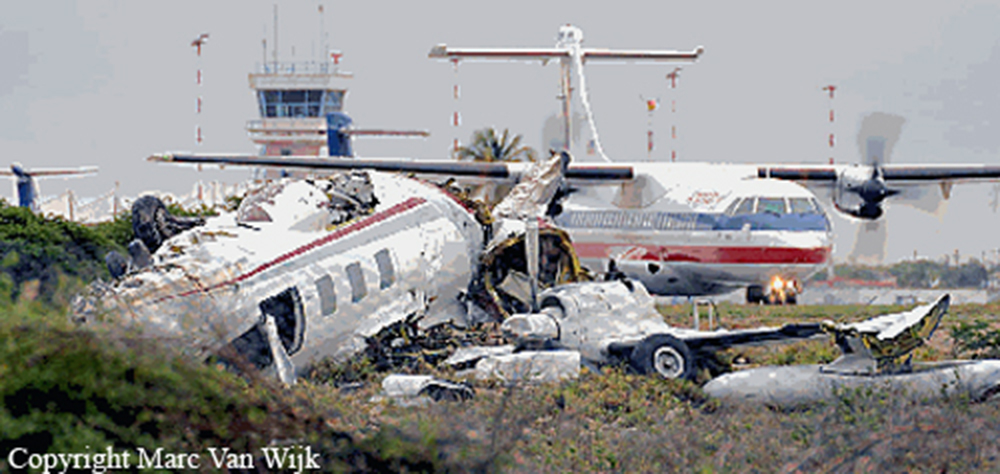
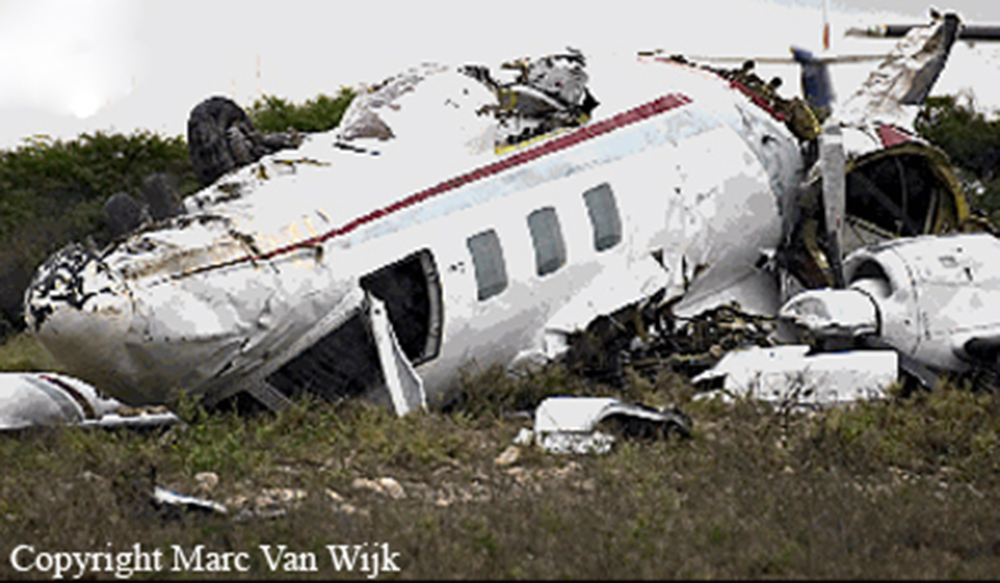
On November 2, 2003, about 2331 Atlantic standard time, a Mitsubishi MU-2B-35, N630HA, registered to Hezemans Air, Inc., collided with terrain short of the runway at Flamingo Airport, Bonaire, Netherlands Antilles, while on a CFR Part 91 positioning flight from Aruba to Bonaire. Visual meteorological conditions prevailed at the time and an instrument flight rules flight plan was filed. The airplane received substantial damage and the airline transport-rated pilot received serious injuries. The flight originated from Aruba, the same day about 2250. The pilot stated that when on a 1- mile final approach for landing both engines lost power. The airplane descended and collided with terrain about 300 meters from the runway. Postaccident examination of the airplane by Civil Aviation Authorities showed the airplane did not contain any usable fuel and there was no evidence of fuel leakage from the airplane prior to the accident or after the accident.

Crash of a Mitsubishi MU-2B-35 Marquise in Belém: 4 killed

Date & Time: Jul 1, 2003 at 1957 LT
Type of aircraft:
Operator:
Registration:
PT-LFX
Survivors:
No
Schedule:
São Luis – Belém
MSN:
650
YOM:
1974
Country:
Crew on board:
2
Crew fatalities:
Pax on board:
2
Pax fatalities:
Other fatalities:
Total fatalities:
4
Captain / Total flying hours:
11236
Captain / Total hours on type:
4886.00
Copilot / Total flying hours:
1015
Copilot / Total hours on type:
359
Circumstances:
The twin engine aircraft was completing a taxi flight from São Luis to Belém, carrying two passengers, two pilots and a load of briefcases with bank documents. On approach to Belém-Val de Cans Airport by night, the crew encountered poor weather conditions with limited visibility, CB's, rain falls and severe turbulences. On final approach, the aircraft went out of control and crashed on the Ilha das Onças Island, about 5,5 km west of runway 06 threshold. The aircraft was destroyed and all four occupants were killed.
Probable cause:
It was determined that both engines were running normally at impact and no technical anomalies were found on the aircraft and its equipments. Both pilots were properly licenced and experienced on this type of aircraft. At the time of the accident, weather conditions were poor with CB's, rains falls, severe turbulences, strong winds and probable windshear that may have been a contributing factor.
Final Report:

Crash of a Mitsubishi MU-2B-35 Marquise in San Juan: 2 killed

Date & Time: Apr 15, 2002 at 1500 LT
Type of aircraft:
Operator:
Registration:
N45BS
Flight Type:
Survivors:
No
Site:
Schedule:
Christiansted - San Juan
MSN:
558
YOM:
1972
Country:
Crew on board:
1
Crew fatalities:
Pax on board:
0
Pax fatalities:
Other fatalities:
Total fatalities:
2
Captain / Total flying hours:
10583
Captain / Total hours on type:
768.00
Aircraft flight hours:
7236
Circumstances:
The flight departed VFR, and when near the destination airport, was advised by air traffic control to hold VFR over the "plaza" and to make left 360 degree orbits. Several witnesses reported light rain was occurring at the time of the accident; there was no lightning or thunder. One witness located where the airplane came to rest reported observing the airplane emerge from the base of the clouds in a 45-degree left wing low and 20 degrees nose low attitude. He momentarily lost sight of the airplane but then noted it rolled to a wings level attitude. He also reported hearing the engine(s) "cutting in an out." Another witness located approximately 1/4 mile north of the accident site observed the airplane flying eastbound beneath the clouds in a right wing and nose low attitude, he also reported hearing the engine(s) sounding like they were "cutting in and out." A pilot-rated witness located an estimated 1,000 feet from where the airplane came to rest estimated that the ceiling was at 300 feet and there was light drizzle. He observed the airplane in a 45-degree angle of bank to the right and in a slight nose low attitude. He stated that the airplane continued in that attitude before he lost sight of the airplane at 250 feet. The airplane impacted trees then a concrete wall while in a nose and right wing low attitude. The airplane then traveled through automobile hoists/lifts which were covered by corrugated metal, and came to rest adjacent to a building of an automobile facility. Impact and a post crash fire destroyed the airplane, along with a building and several vehicles parked at the facility. Examination of the airplane revealed the flaps were symmetrically retracted and landing gears were retracted. No evidence of preimpact failure or malfunction was noted to the flight controls. Examination of the engines revealed no evidence of preimpact failure or malfunction; impact and fire damage precluded testing of several engine accessories from both engines. Examination of the propellers revealed no evidence of preimpact failure or malfunction. Parallel slash marks were noted in several of the corrugated metal panels that covered the hoists/lifts, the slashes were noted 25 and 21 inches between them. According to the airplane manufacturer, the 25 inch distance between the propeller slashes corresponds to an airspeed of 123 knots. Additionally, the power-off stall speed at the airplanes calculated weight with the flaps retracted and 48 degree angle of bank was calculated to be 122 knots. Review of NTSB plotted radar data revealed that the pilot performed one 360-degree orbit to the left with varying angles of left bank and while flying initially at 1,300 feet, climbing to near 1,500 feet, then descending to approximately 800 feet. The airplane continued in the left turn and between 1502:10 and 1502:27, the calibrated airspeed decreased from 160 to 100 knots. At 1502:27, the bank angle was 48 degrees, and the angle of attack was 26 degrees. Between 1502:30 and 1502:35, the true heading changed indicating a bank to the right. The last plotted altitude was 200 feet, which occurred at 1502:35. A NTSB weather study indicated that at the area and altitude the airplane was operating, NWS VIP level 1 to 2 echoes (light to moderate intensity) were noted. Additionally, the terminal aerodrome forecast (TAF) for the destination airport indicated that temporarily between 1400 and 1800 (the flight departed at approximately 1436 and the accident occurred at approximately 1503), visibility 5 miles with moderate rain showers, scattered clouds at 1,500 feet, and a broken ceiling at 3,000 feet.
Probable cause:
The failure of the pilot to maintain airspeed (Vs) while maneuvering following inadvertent encounter with clouds resulting in an inadvertent stall and uncontrolled descent and subsequent in-flight collision with trees, a wall, and a building.
Final Report:

Crash of a Mitsubishi MU-2B-35 Marquise in Hilton Head: 1 killed

Date & Time: Aug 1, 2001 at 0751 LT
Type of aircraft:
Operator:
Registration:
N1VY
Flight Type:
Survivors:
No
Schedule:
Columbia – Savannah – Hilton Head
MSN:
567
YOM:
1972
Flight number:
BKA170
Crew on board:
1
Crew fatalities:
Pax on board:
0
Pax fatalities:
Other fatalities:
Total fatalities:
1
Captain / Total flying hours:
4184
Captain / Total hours on type:
483.00
Aircraft flight hours:
11612
Circumstances:
The airplane was on final approach to land at Hilton Head Airport, when according to witnesses, it suddenly rolled to the right, and descended, initially impacting trees at about the 70-foot level, and then impacting the ground. A fire then ensued upon ground impact, and the debris field spanned about 370 feet along an azimuth of about 082 degrees. Examination of the airplane wreckage revealed that left wing flap actuator and jack nut measurements were consistent with the wing flaps being extended to 40 degrees, and on the right wing the flap jack nut and actuator measurements were consistent with the right flap being extended to about a 20-degrees. In addition, the right flap torque tube assembly between the flap motor and the flap stop assembly had disconnected, and the flap torque tube assembly's female coupler which attaches to the male spline end of the flap motor and flap stop assembly was found with a cotter pin installed through the female coupler of the flap stop assembly. The cotter pin, had not been placed through the spline and the coupler consistent with normal installation as per Mitsubishi's maintenance manual, or as specified in Airworthiness Directive 88-23-01. Instead, the cotter pin had missed the male spline on the flap motor. In addition, the flap coupler on the opposite side of the flap motor was found to also found to not have a cotter pin installed. Company maintenance records showed that on April 3, 2001, about 87 flight hours before the accident, the airplane was inspected per Airworthiness Directive (AD) 88-23-01, which required the disassembly, inspection, and reassembly of the flap torque tube joints. In addition, on July 9, 2001, the airplane was given a phase 1 inspection, and Bankair records showed that a company authorized maintenance person performed the applicable maintenance items, and certified the airplane for return to service.
Probable cause:
Improper maintenance/installation and and inadequate inspection of the airplane's flap torque tube joints during routine maintenance by company maintenance personnel, which resulted in the right flap torque tube assembly coupler becoming detached and the flaps developing asymmetrical lift when extended, which resulted in an uncontrolled roll, a descent, and an impact with a tree during approach to land.
Final Report: