Zone

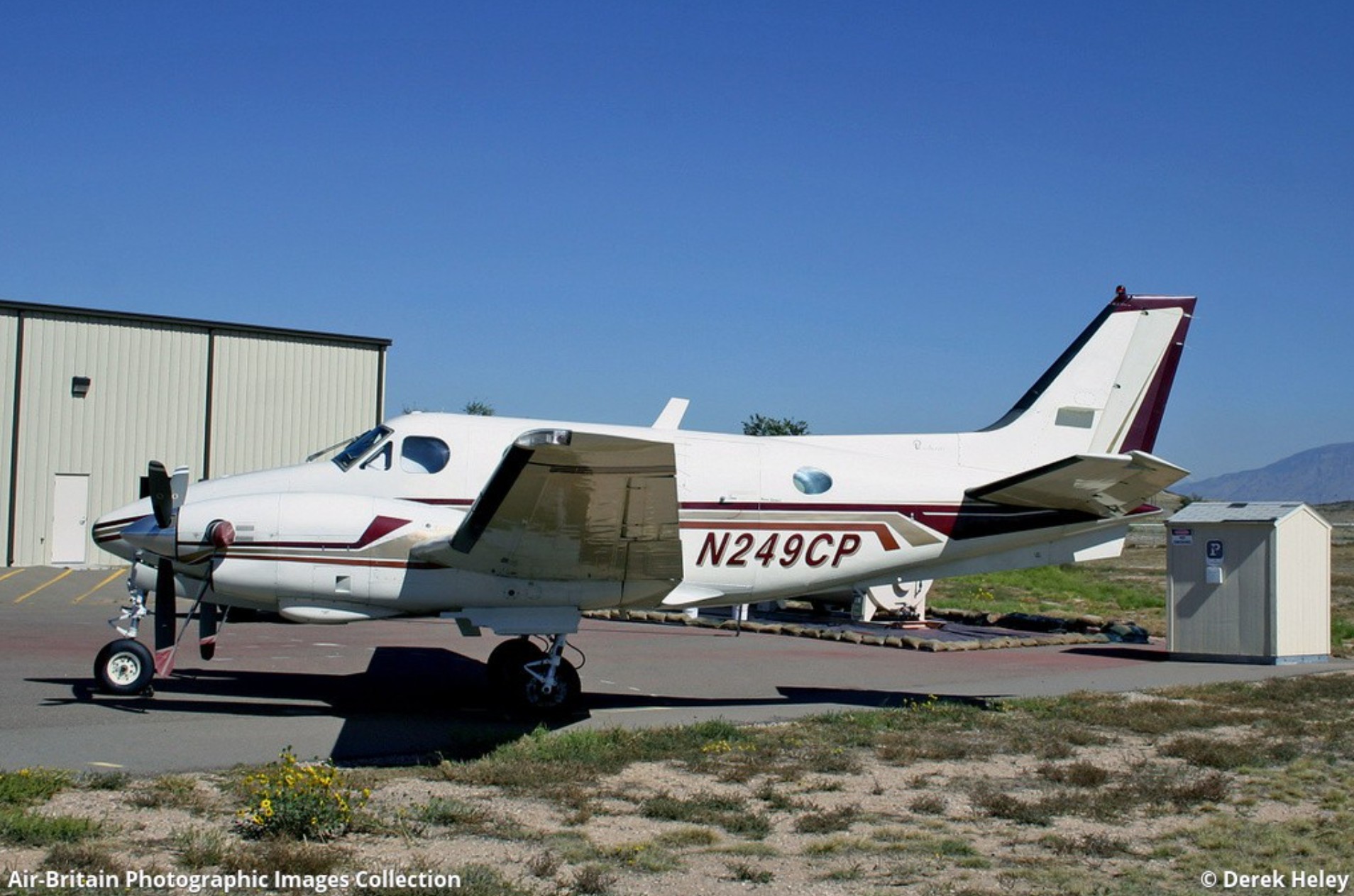
Crash of a Beechcraft C90 King Air near Ruidoso: 4 killed

Date & Time: May 14, 2026 at 0012 LT
Type of aircraft:
Registration:
N249CP
Flight Phase:
Flight Type:
Survivors:
No
Site:
Schedule:
Roswell – Ruidoso
MSN:
LJ-841
YOM:
1979
Crew on board:
2
Crew fatalities:
Pax on board:
2
Pax fatalities:
Other fatalities:
Total fatalities:
4
Circumstances:
The twin engine airplane departed Roswell Air Center on an ambulance flight to Ruidoso, carrying two passengers and two pilots. It crashed in unknown circumstances in the Capitan Mountains, some 30 km northeast of Ruidoso-Sierra Blanca Airport, bursting into flames. The airplane was destroyed and all four occupants were killed.

Crash of a Beechcraft E90 King Air in Ruidoso: 5 killed

Date & Time: Aug 5, 2007 at 2141 LT
Type of aircraft:
Operator:
Registration:
N369CD
Flight Phase:
Flight Type:
Survivors:
No
Schedule:
Ruidoso - Albuquerque
MSN:
LW-162
YOM:
1976
Crew on board:
1
Crew fatalities:
Pax on board:
4
Pax fatalities:
Other fatalities:
Total fatalities:
5
Captain / Total flying hours:
2775
Captain / Total hours on type:
23.00
Aircraft flight hours:
10358
Circumstances:
The emergency medical services (EMS) airplane took off toward the east in dark night visual conditions. The purpose of the Part 135 commercial air ambulance flight was to transport a 15-month-old patient from one hospital to another. Immediately following the takeoff from an airport elevation of 6,814 feet above mean sea level (msl), witnesses observed the airplane initiate a left turn to the north and disappear. Satellite tracking detected the airplane a shortly after departure, when the airplane was flying at an altitude of 6,811 feet msl, an airspeed of 115 knots, and a course of 072 degrees. The airplane impacted terrain at an elevation of 6,860 msl feet shortly thereafter, about 4 miles southeast of the departure airport. The pilot, flight nurse, paramedic, patient, and patient's mother were fatally injured. When the airplane failed to arrive at its destination, authorities initiated a search and the wreckage was located the next morning. Documentation and analysis of the accident site by the NTSB revealed that debris path indicated a heading away from the destination airport. Initial impact with trees occurred at an elevation of 6,860 feet. Fragmented wreckage was strewn for 1,100 feet down a 4.5-degree graded hill on a magnetic heading of 141 degrees. The aircraft's descent angle was computed to be 13 degrees, and the angle of impact was computed to be 8.5 degrees. There was evidence of a post-impact flash fire. Both engine and propeller assemblies were recovered and examined; the assemblies bore signatures consistent with engine power in a mid to high power range. The flaps and landing gear were retracted, indicating that the pilot did not attempt to land the airplane at the time of the accident. Flight control continuity was established, and control cable and push rods breaks exhibited signatures consistent with overload failures. There was no evidence of any pre-impact mechanical malfunction found during examination of the available evidence. The pilot had logged 2,775 total flight hours, of which 23 hours were in the accident airplane. Toxicology testing detected chlorpheniramine (an over-the-counter antihistamine that results in impairment at typical doses) and acetaminophen (an over-the-counter pain reliever and fever reducer often known by the trade name Tylenol and frequently combined with chlorpheniramine). No blood was available for tox testing, so it is not possible to accurately estimate the time of last use, nor determine if the level of impairment that these substances would have incurred during the flight. The airplane was not equipped with either a flight data recorder or a cockpit voice recorder, nor were they required by Federal Aviation Regulation (FAR). The impact damage to the aircraft, presence of dark night conditions, experience level of the pilot, and anomalous flight path are consistent with spatial disorientation.
Probable cause:
Failure to maintain clearance from terrain due to spatial disorientation.
Final Report:

Crash of a Beechcraft F90 King Air in Ruidoso: 2 killed

Date & Time: Dec 2, 1989 at 1435 LT
Type of aircraft:
Operator:
Registration:
N9PU
Flight Type:
Survivors:
No
Schedule:
Carlsbad - Ruidoso
MSN:
LA-57
YOM:
1980
Crew on board:
1
Crew fatalities:
Pax on board:
1
Pax fatalities:
Other fatalities:
Total fatalities:
2
Captain / Total flying hours:
569
Captain / Total hours on type:
92.00
Aircraft flight hours:
921
Circumstances:
Witnesses heard the airplane circling in the vicinity of the NDB. Other witnesses saw the airplane exit the cloud base in a near-vertical dive and impact the ground approximately one mile east and 1/2 mile north of the NDB. Both occupants were killed.
Probable cause:
Loss of control due to pilot disorientation while conducting a non precision instrument approach. Contributing to the accident was the pilot's lack of instrument and multi engine experience, and the existing adverse weather.
Final Report:

Crash of a Consolidated B-24E-15-FO Liberator near Ruidoso: 10 killed

Date & Time: Jun 15, 1943 at 0650 LT
Operator:
Registration:
42-7146
Flight Phase:
Flight Type:
Survivors:
No
Site:
Schedule:
Holloman AFB - Holloman AFB
MSN:
170
YOM:
1943
Crew on board:
10
Crew fatalities:
Pax on board:
0
Pax fatalities:
Other fatalities:
Total fatalities:
10
Circumstances:
The airplane departed Holloman AFB at 0630LT on a navigation, formation and bombing training exercise. Twenty minutes after takeoff, the crew leveled off at 12,000 feet and had to deal with atmospheric turbulence. 42-7146 was the lead in the formation and a propeller of 42-7071 (second) hit the lower part of the tail of 42-7146 after it slid forward. Both airplanes entered an uncontrolled descent and crashed in the Sierra Blanca Range, near Ruidoso, some 84 km northeast of Holloman AFB. All 10 crew members were killed.
Crew:
1st Lt Donald W. Kaspervik, pilot,
2nd Lt Ray E. Ward, copilot,
2nd Lt John V. Andrews, navigator,
2nd Lt Bruce G. Ellis, bombardier,
S/Sgt Eldon F. Ressler, flight engineer,
S/Sgt Arthur P. Wikle, assistant flight engineer,
Sgt Allen Chamovitz, radio operator,
2nd Lt Edward V. Handy Jr., observer,
S/Sgt George L. Scott, air gunner,
S/Sgt Andrew J. Alexander, air gunner.

Crash of a Consolidate B-24E-10-FO Liberator near Ruidoso: 9 killed

Date & Time: Jun 15, 1943 at 0650 LT
Operator:
Registration:
42-7071
Flight Phase:
Flight Type:
Survivors:
Yes
Site:
Schedule:
Holloman AFB - Holloman AFB
MSN:
95
YOM:
1943
Crew on board:
10
Crew fatalities:
Pax on board:
0
Pax fatalities:
Other fatalities:
Total fatalities:
9
Circumstances:
The airplane departed Holloman AFB at 0630LT on a navigation, formation and bombing training exercise. Twenty minutes after takeoff, the crew leveled off at 12,000 feet and had to deal with atmospheric turbulence. The airplane slid to the lead airplane, a second USAAF B-24 registered 42-7146 that was taking part to the same exercise with a crew of 10 on board. A propeller of 42-7071 hit the lower part of the tail of 42-7146. Both airplanes entered an uncontrolled descent and crashed in the Sierra Blanca Range, near Ruidoso, some 84 km northeast of Holloman AFB. A crew from 42-7071 was able to bail out and survived while all 19 other crew members were killed.
Crew:
2nd Lt Donald R. Lembright, pilot, †
2nd Lt Harold E. Simmons, copilot, †
2nd Lt Vernon E. Laschanzky, navigator, †
2nd Lt Michael Iwaszuk, bombardier, †
S/Sgt Julius G. Robison, flight engineer,
Sgt Raymond B. Post, assistant flight engineer, †
S/Sgt Leo F. Sheehan, radio operator, †
Sgt Richard M. Gray, assistant radio operator, †
Sgt Harold Gollin, tail gunner, †
Sgt Joseph J. Huddy, air gunner. †