Crash of a Cessna 550 in Wilmington

Date & Time: Jan 4, 2009 at 0209 LT
Type of aircraft:
Operator:
Registration:
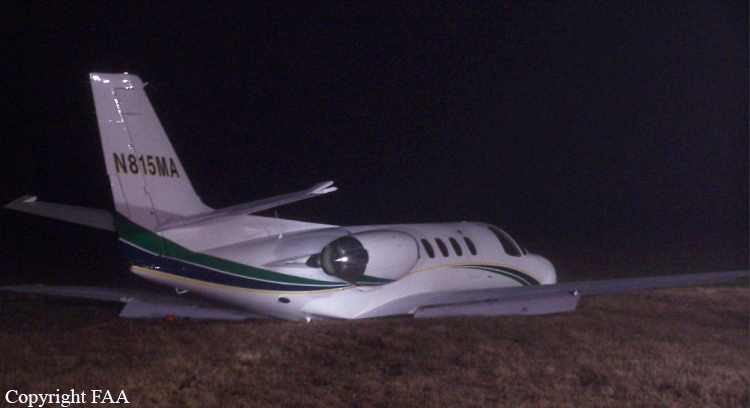
N815MA
Survivors:
Yes
Schedule:
La Isabela - Wilmington
MSN:
550-0406
YOM:
1982
Crew on board:
2
Crew fatalities:
Pax on board:
5
Pax fatalities:
Other fatalities:
Total fatalities:
0
Captain / Total flying hours:
6914
Captain / Total hours on type:
1400.00
Copilot / Total flying hours:
1717
Aircraft flight hours:
11123
Circumstances:
During a night, northbound, international over water flight that paralleled the east coast of the southeast United States, the airplane encountered headwinds. Upon arrival at the intended destination, the weather was below forecasted conditions, resulting in multiple instrument approach attempts. After the first missed approach, the controller advised the crew that there was an airport 36 miles to the north with "much better" weather, but the crew declined, citing a need to clear customs. During the third missed approach, the left engine lost power, and while the airplane was being vectored for a fourth approach, the right engine lost power. Utilizing the global positioning system, the captain pointed the airplane toward the intersection of the airport's two runways. Approximately 50 feet above the ground, he saw runway lights, and landed. The captain attempted to lower the landing gear prior to the landing, but it would not extend due to a lack of hydraulic pressure from the loss of engine power, and the alternate gear extension would not have been completed in time. The gear up landing resulted in damage to the underside of the fuselage and punctures of the pressure vessel. The captain stated that the airplane arrived in the vicinity of the destination with about 1,000 pounds of fuel on board or 55 minutes of fuel remaining. However, air traffic and cockpit voice recordings revealed that the right engine lost power about 14 minutes after arrival, and the left engine, about 20 minutes after arrival. Federal air regulations require, for an instrument flight rules flight plan, that an airplane carry enough fuel to complete the flight to the first airport of landing, fly from that airport to an alternate, and fly after that for 45 minutes at normal cruising speed. The loss of engine power was due to fuel exhaustion, with no preaccident mechanical anomalies noted to the airplane.
Probable cause:
A loss of engine power due to the crew's inadequate in-flight fuel monitoring.
Final Report:

Crash of a Cessna 550 Citation II in Reading

Date & Time: Aug 3, 2008 at 1519 LT
Type of aircraft:
Operator:
Registration:
N827DP
Flight Type:
Survivors:
Yes
Schedule:
Pottstown - Reading
MSN:
550-0660
YOM:
1990
Crew on board:
2
Crew fatalities:
Pax on board:
0
Pax fatalities:
Other fatalities:
Total fatalities:
0
Captain / Total flying hours:
12100
Captain / Total hours on type:
2690.00
Copilot / Total flying hours:
1779
Copilot / Total hours on type:
65
Aircraft flight hours:
5008
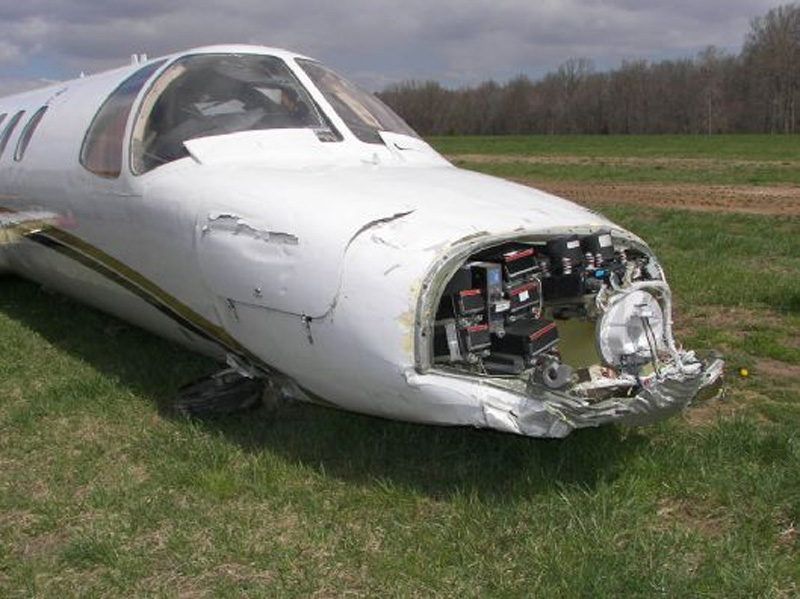
Circumstances:
The air traffic controller, with both ground and local (tower) responsibilities, cleared the accident airplane to land when it was about 8 miles from the runway. Another airplane landed in front of the accident flight, and the controller cleared that pilot to taxi to the hangar. The controller subsequently cleared a tractor with retractable (bat wing) mowers, one on each side, and both in the “up” position, to proceed from the terminal ramp and across the 6,350-foot active runway at an intersection about 2,600 feet from the threshold. The controller then shifted his attention back to the airplane taxiing to its hangar, and did not see the accident airplane land. During the landing rollout, the airplane’s left wing collided with the right side of the tractor when the tractor was “slightly” left of runway centerline. Calculations estimated that the airplane was about 1,000 feet from the collision point when the tractor emerged from the taxiway, and skid marks confirmed that the airplane had been steered to the right to avoid impact. Prior to the crossing attempt, the tractor operator did not scan the runway, and was concentrating on the left side bat wing. Federal Aviation Administration publications do not adequately address the need for ground vehicle operators to visually confirm that active runways/approaches are clear, prior to crossing with air traffic control authorization, thus overlooking an additional means to avoid a collision.
Probable cause:
The air traffic controller’s failure to properly monitor the runway environment. Contributing to the accident was the tractor operator’s failure to scan the active runway prior to crossing, and the Federal Aviation Administration’s inadequate emphasis on vehicle operator visual vigilance when crossing active runways with air traffic control clearance.
Final Report:

Crash of a Cessna 550 Citation II off Milwaukee: 6 killed

Date & Time: Jun 4, 2007 at 1600 LT
Type of aircraft:
Operator:
Registration:
N550BP
Flight Phase:
Flight Type:
Survivors:
No
Schedule:
Milwaukee - Detroit
MSN:
550-0246
YOM:
1981
Crew on board:
2
Crew fatalities:
Pax on board:
4
Pax fatalities:
Other fatalities:
Total fatalities:
6
Captain / Total flying hours:
14000
Aircraft flight hours:
4402
Circumstances:
On June 4, 2007, about 1600 central daylight time, a Cessna Citation 550, N550BP, impacted Lake Michigan shortly after departure from General Mitchell International Airport, Milwaukee, Wisconsin (MKE). The two pilots and four passengers were killed, and the airplane was destroyed. The airplane was being operated by Marlin Air under the provisions of 14 Code of Federal Regulations Part 135 and departed MKE about 1557 with an intended destination of Willow Run Airport, near Ypsilanti, Michigan. At the time of the accident flight, marginal visual meteorological conditions prevailed at the surface, and instrument meteorological conditions prevailed aloft; the flight operated on an instrument flight rules flight plan.
Probable cause:
The pilots’ mismanagement of an abnormal flight control situation through improper actions, including failing to control airspeed and to prioritize control of the airplane, and lack of crew coordination. Contributing to the accident were Marlin Air’s operational safety deficiencies, including the inadequate checkrides administered by Marlin Air’s chief pilot/check airman, and the Federal Aviation Administration’s failure to detect and correct those deficiencies, which placed a pilot who inadequately emphasized safety in the position of company chief pilot and designated check airman and placed an ill-prepared pilot in the first officer’s seat.
Final Report:

Crash of a Cessna 550 Citation II in Dillon: 2 killed

Date & Time: May 3, 2007 at 1037 LT
Type of aircraft:
Operator:
Registration:
N22HP
Flight Type:
Survivors:
No
Schedule:
Rockford - Dillon
MSN:
550-0103
YOM:
1986
Location:
Crew on board:
1
Crew fatalities:
Pax on board:
1
Pax fatalities:
Other fatalities:
Total fatalities:
2
Captain / Total flying hours:
5057
Captain / Total hours on type:
1200.00
Aircraft flight hours:
10526
Circumstances:
Radar data indicated that the airplane descended on a straight track from flight level (FL) 380 in accordance with the pilot's clearance to descend to 13,000 feet and begin the VOR (very high frequency omni-directional radio range) approach to the destination airport. The last transmission from the pilot was an acknowledgment of the cancellation of radar service and an instruction to switch to the airport advisory frequency. At that time, the airplane was at a mode C reported altitude of 14,000 feet. The airplane maintained a steady descent rate for the next minute and leveled off at 13,000 feet. About 2 1/2 minutes later, the airplane began a turn to the right to head outbound for the procedure turn on the approach and descended to 12,900 feet. The approach procedure specified a minimum altitude of 8,200 feet in the procedure turn. The airplane lost 1,600 feet in the next 10 seconds, and this was the last radar contact. A witness working in his office at the airport heard a loud engine noise, and then a “plop” noise. He said that the engine noise was loud, then softer, and then loud again. He heard it for 3 to 5 seconds. Another witness saw an airplane below the cloud bases that was turning to the right with a nose low pitch attitude of about 75 to 80 degrees. It made six to seven turns before it disappeared from sight behind terrain, and the radius of the turn got tighter as the airplane descended. Examination of the airframe, systems, and engines revealed no anomalies that would have precluded normal operation. Anti-ice fluid was on the leading edges of the wing and tail anti-ice panels. An Airmen’s Meteorological Information (AIRMET) in effect for an area that included the accident site noted that the freezing level was from 4,000 to 10,000 feet with the potential for icing from the freezing level to 20,000 feet.
Probable cause:
An in-flight loss of control for undetermined reasons.
Final Report:

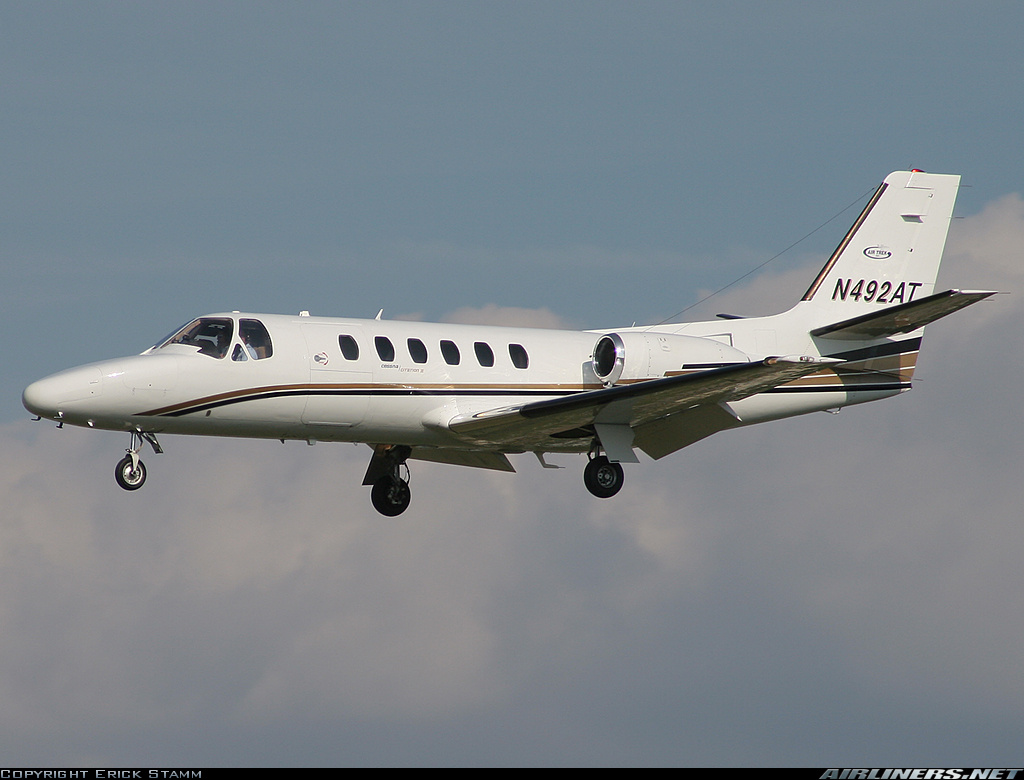
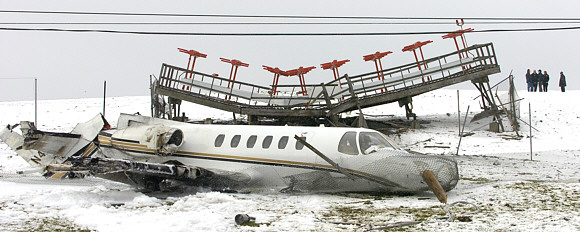
Crash of a Cessna 550 Citation II in Butler

Date & Time: Jan 24, 2007 at 0905 LT
Type of aircraft:
Operator:
Registration:
N492AT
Flight Type:
Survivors:
Yes
Schedule:
Winchester - Butler
MSN:
550-0472
YOM:
1983
Crew on board:
2
Crew fatalities:
Pax on board:
2
Pax fatalities:
Other fatalities:
Total fatalities:
0
Captain / Total flying hours:
22700
Captain / Total hours on type:
1200.00
Copilot / Total flying hours:
1758
Copilot / Total hours on type:
85
Aircraft flight hours:
10735
Circumstances:
The Citation 550 was being repositioned for an air ambulance transportation flight, and was on approach to land on a 4,801-foot-long, grooved, asphalt runway. The airplane was being flown manually by the copilot, who reported that the landing approach speed (Vref) was 106 knots. The pilot-in-command (PIC) estimated that the airplane "broke out" of the clouds about two miles from the runway. Both pilots stated that the airplane continued to descend toward the runway, while on the glide slope and localizer. Neither pilot could recall the airplane's touchdown point on the runway, or the speed at touchdown. Witnesses observed the airplane, "high and fast" as it crossed over the runway threshold. The airplane touched down about halfway down the runway, and continued off the departure end. It then struck a wooden localizer antenna platform, and the airport perimeter fence, before crossing a road, and coming to rest about 400 feet from the end of the runway. Data downloaded from the airplane's Enhanced Ground Proximity Warning System (EGPWS) revealed that the airplane's groundspeed at touchdown was about 140 knots. Review of the cockpit voice recorder suggested that the PIC failed to activate the airplane's speed brake upon touchdown. Braking action was estimated to be "fair" at the time of the accident, with about 1/4 to 1/2 inches of loose, "fluffy" snow on the runway. The PIC reported that he thought the runway might be covered with an inch or two of snow, which did not concern him. The copilot reported encountering light snow during the approach. Both pilots stated that they were not aware of any mechanical failures, or system malfunctions during the accident; nor were any discovered during post accident examinations. According to the airplane flight manual, the conditions applicable to the accident flight prescribed a Vref of 110 knots, with a required landing distance on an uncontaminated runway of approximately 2,740 feet. The prescribed landing distance on a runway contaminated with 1-inch of snow, at a Vref of 110 knots was approximately 5,800 feet. At Vref + 10 knots, the required landing distance increased to about 7,750 feet.
Probable cause:
The copilot's failure to maintain the proper airspeed, and failure to obtain the proper touchdown point, and the pilot-in-command's inadequate supervision, which resulted in an overrun. Contributing to the accident was the PIC's failure to activate the speed brake upon touchdown and the snow contaminated runway.
Final Report: